Feeds:
Posts
Comments

Inquiring readers, Patty Saffran from Brandy Parfums has followed up her lovely post on the Queen’s Diamond Jubilee schedule with a report on the magnificent Household Cavalry Horse Escort. You are treated to a sneak preview of an article that will be published in the July issue of Horse Directory Magazine. Accompanying this post is the layout of her article . You might also be interested in a piece she wrote for us about the horses in Georgette Heyer’s novels. Thank you, Patty, for keeping us in the loop and updating us on these wonderful horses.
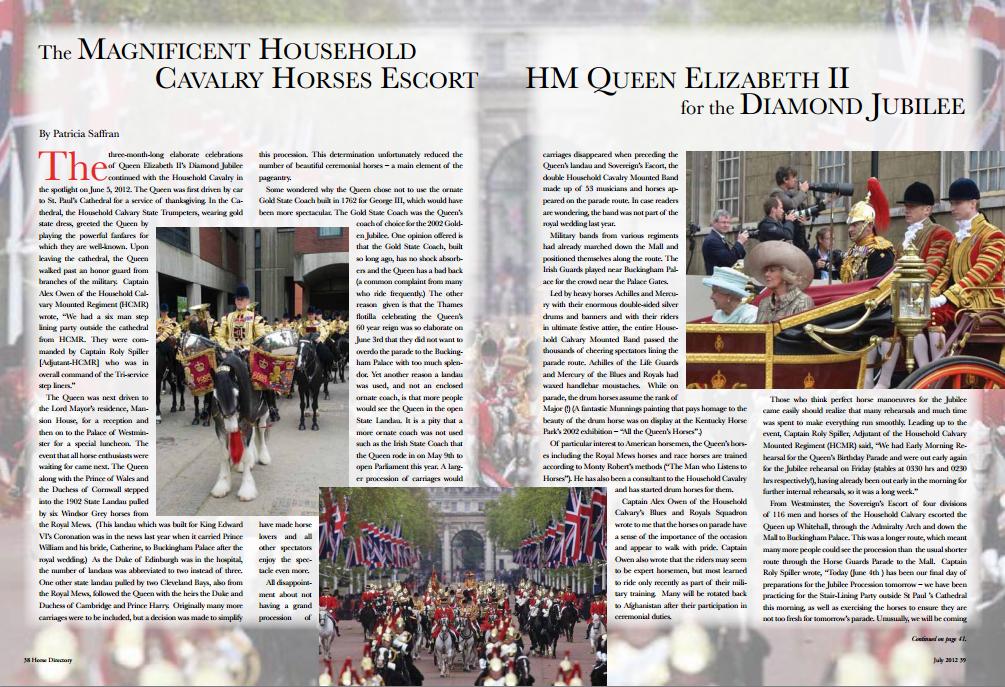
First page of the article. Click on image to view the photos in more detail.

The three-month-long elaborate celebrations of Queen Elizabeth II’s Diamond Jubilee continued with the Household Cavalry in the spotlight on June 5, 2012. The Queen was first driven by car to St. Paul’s Cathedral for a service of thanksgiving. In the Cathedral, the Household Calvary State Trumpeters, wearing gold state dress, greeted the Queen by playing the powerful fanfares for which they are well-known. Upon leaving the cathedral, the Queen walked past an honor guard from branches of the military. Captain Alex Owen of the Household Calvary Mounted Regiment (HCMR) wrote, We had a six man step lining party outside the cathedral from HCMR. They were commanded by Captain Roly Spiller [Adjutant-HCMR] who was in overall command of the Tri-service step liners.
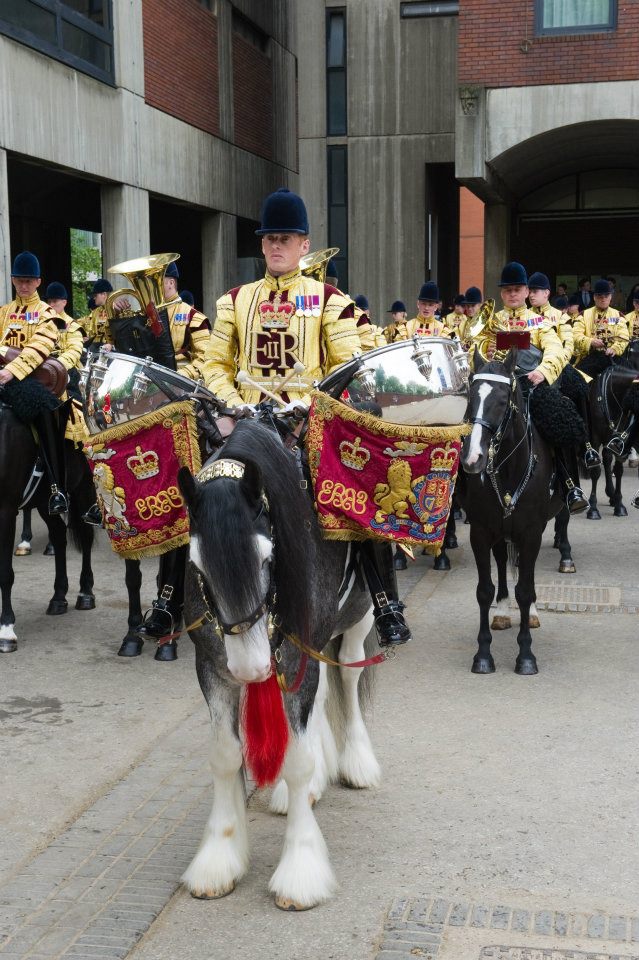
Mercury and his drummer, CoH Kent, ready to plod on down to Westminster.

The Queen was next driven to the Lord Mayor’s residence, Mansion House, for a reception and then on to the Palace of Westminster for a special luncheon. The event that all horse enthusiasts were waiting for came next. The Queen along with the Prince of Wales and the Duchess of Cornwall stepped into the 1902 State Landau pulled by six Windsor Grey horses from the Royal Mews. (This landau which was built for King Edward VII’s Coronation was in the news last year when it carried Prince William and his bride, Catherine, to Buckingham Palace after the royal wedding.) As the Duke of Edinburgh was in the hospital, the number of landaus was abbreviated to two instead of three. One other state landau pulled by two Cleveland Bays, also from the Royal Mews, followed the Queen with the heirs the Duke and Duchess of Cambridge and Prince Harry. Originally many more carriages were to be included, but a decision was made to simplify this procession. This determination unfortunately reduced the number of beautiful ceremonial horses, a main element of the pageantry. Some wondered why the Queen chose not to use the ornate Gold State Coach built in 1762 for George III, which would have been more spectacular. The Gold State Coach was the Queen’s coach of choice for the 2002 Golden Jubilee. One opinion offered is that the Gold State Coach, built so long ago, has no shock absorbers and the Queen has a bad back (a common complaint from many who ride frequently.) The other reason given is that the Thames flotilla celebrating the Queen’s 60 year reign was so elaborate on June 3rd that they did not want to overdo the parade to the Buckingham Palace with too much splendor. Yet another reason a landau was used, and not an enclosed ornate coach, is that more people would see the Queen in the open State Landau. It is a pity that a more ornate coach was not used such as the Irish State Coach that the Queen rode in on May 9th to open Parliament this year. A larger procession of carriages would have made horse lovers and all other spectators enjoy the spectacle even more.

All disappointment about not having a grand procession of carriages disappeared when preceding the Queen’s landau and Sovereign’s Escort, the double Household Cavalry Mounted Band made up of 53 musicians and horses appeared on the parade route. In case readers are wondering, the band was not part of the royal wedding last year.

Military bands from various regiments had already marched down the Mall and positioned themselves along the route. The Irish Guards played near Buckingham Palace for the crowd near the Palace Gates.

Led by heavy horses Achilles and Mercury with their enormous double-sided silver drums and banners and with their riders in ultimate festive attire, the entire Household Calvary Mounted Band passed the thousands of cheering spectators lining the parade route. Achilles of the Life Guards and Mercury of the Blues and Royals had waxed handlebar moustaches. While on parade, the drum horses assume the rank of Major (!) (A fantastic Munnings painting that pays homage to the beauty of the drum horse was on display at the Kentucky Horse Park’s 2002 exhibition “All the Queen’s Horses”.)
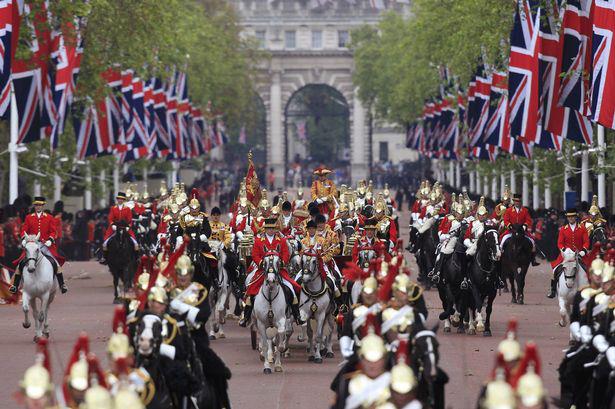
The Queen’s landau and Sovereign’s Escort

Of particular interest to American horsemen, the Queen’s horses including the Royal Mews horses and race horses are trained according to Monty Robert’s methods (The Man who Listens to Horses). He has also been a consultant to the Household Cavalry and has started drum horses for them.

Captain Alex Owen of the Household Calvary’s Blues and Royals Squadron wrote to me that the horses on parade have a sense of the importance of the occasion and appear to walk with pride. Captain Owen also wrote that the riders may seem to be expert horsemen, but most learned to ride only recently as part of their military training. Many will be rotated back to Afghanistan after their participation in ceremonial duties.

Those who think perfect horse manoeuvres for the Jubilee came easily should realize that many rehearsals and much time was spent to make everything run smoothly. Leading up to the event, Captain Roly Spiller, Adjutant of the Household Calvary Mounted Regiment (HCMR) said, “He had Early Morning Rehearsal for the Queen’s Birthday Parade and were out early again for the Jubilee rehearsal on Friday (stables at 0330 hrs and 0230 hrs respectively!), having already been out early in the morning for further internal rehearsals, so it was a long week.”
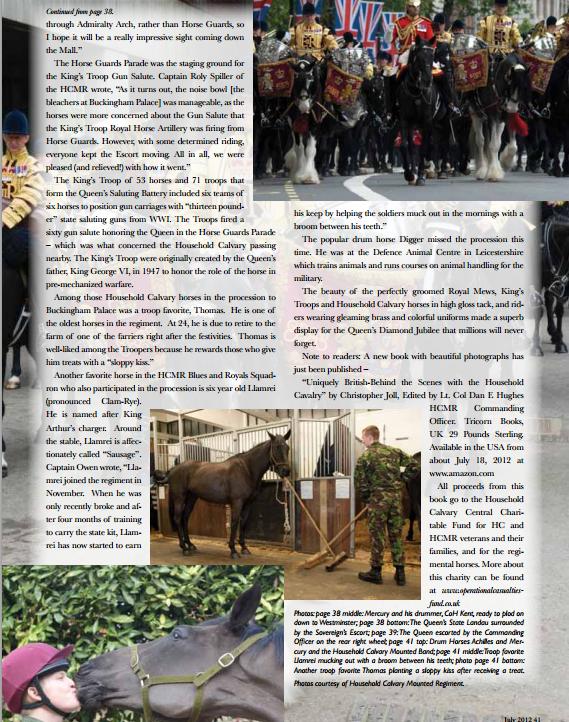
Second page of the article, somewhat cropped.

From Westminster, the Sovereign’s Escort of four divisions of 116 men and horses of the Household Calvary escorted the Queen up Whitehall, through the Admiralty Arch and down the Mall to Buckingham Palace. This was a longer route, which meant many more people could see the procession than the usual shorter route through the Horse Guards Parade to the Mall. Captain Roly Spiller wrote ,”Today (June 4th ) has been our final day of preparations for the Jubilee Procession tomorrow. We have been practicing for the Stair-Lining Party outside St Paul’s Cathedral this morning, as well as exercising the horses to ensure they are not too fresh for tomorrow’s parade. Unusually, we will be coming through Admiralty Arch, rather than Horse Guards, so I hope it will be a really impressive sight coming down the Mall.”
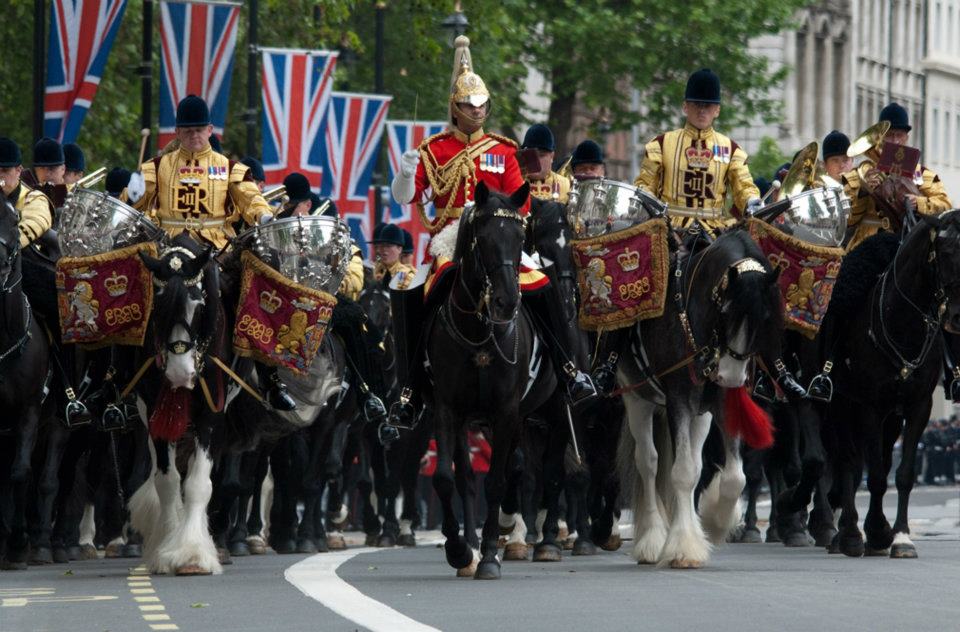
Drum Horses Achilles and Mercury and the Household Calvary Mounted Band

The Horse Guards Parade was the staging ground for the King’s Troop Gun Salute. Captain Roly Spiller of the HCMR wrote, As it turns out, the noise bowl [the bleachers at Buckingham Palace] was manageable, as the horses were more concerned about the Gun Salute that the King’s Troop Royal Horse Artillery was firing from Horse Guards. However, with some determined riding, everyone kept the Escort moving. All in all, we were pleased (and relieved!) with how it went.”

The King’s Troop of 53 horses and 71 troops that form the Queen’s Saluting Battery included six teams of six horses to position gun carriages with thirteen pounder state saluting guns from WWI. The Troops fired a sixty gun salute honoring the Queen in the Horse Guards Parade, which was what concerned the Household Calvary passing nearby. The King’s Troop were originally created by the Queen’s father, King George VI, in 1947 to honor the role of the horse in pre-mechanized warfare.

Among those Household Calvary horses in the procession to Buckingham Palace was a troop favorite, Thomas. He is one of the oldest horses in the regiment. At 24, he is due to retire to the farm of one of the farriers right after the festivities. Thomas is well-liked among the Troopers because he rewards those who give him treats with a sloppy kiss.
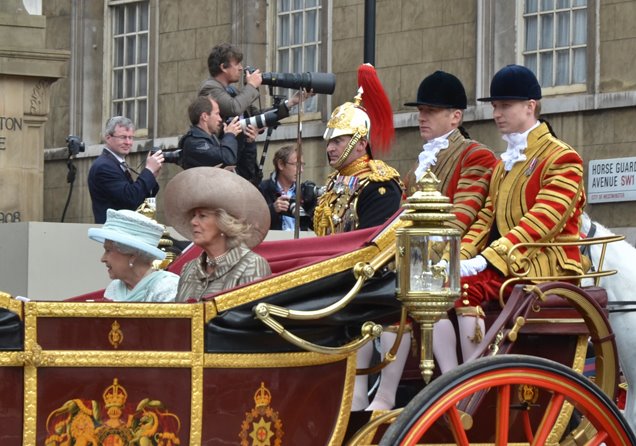
The Queen escorted by the Commanding Officer on the rear right wheel.

Another favorite horse in the HCMR Blues and Royals Squadron who also participated in the procession is six-year-old Llamrei (pronounced Clam-Rye). He is named after King Arthur’s charger. Around the stable, Llamrei is affectionately called Sausage. Captain Owen wrote, “Llamrei joined the regiment in November. When he was only recently broke and after four months of training to carry the state kit, Llamrei has now started to earn his keep by helping the soldiers muck out in the mornings with a broom between his teeth.”

The popular drum horse Digger missed the procession this time. He was at the Defence Animal Centre in Leicestershire which trains animals and runs courses on animal handling for the military.

The beauty of the perfectly groomed Royal Mews, King’s Troops and Household Calvary horses in high gloss tack, and riders wearing gleaming brass and colorful uniforms made a superb display for the Queen’s Diamond Jubilee that millions will never forget.

Note to readers: A new book with beautiful photographs has just been published: “Uniquely British-Behind the Scenes with the Household Cavalry” by Christopher Joll, Edited by Lt. Col Dan E Hughes HCMR Commanding Officer. Tricorn Books, UK 29 Pounds Sterling. Available in the USA from about July 18, 2012 at http://www.amazon.com

All proceeds from this book go to the Household Calvary Central Charitable Fund for HCR and HCMR veterans and their families, and for the regimental horses. More about this charity can be found at http://www.operationalcasualtiesfund.co.uk

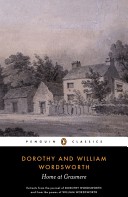
Vintage book cover. The book had been purchased in the shop at Dove Cottage. Image @Grey Pony

Inquiring readers, frequent contributor, Tony Grant,  has done it again and brought the 19th century alive through his discussion of poetry. One can walk the paths along Grasmere in the Lake District with him and William Wordsworth, inhaling the clean crisp air and regarding the sad cautionary tale of Martha Ray, the woman in the scarlet cloak. Visit Tony’s blog at London Calling.

Saturday August 23rd 1798.

“ A very fine morning. Wm was composing all the morning. I shelled peas, gathered beans and worked in the garden till half past twelve. Then walked with William in the wood. The gleams of the sunshine, and the stirring trees, and gleaming boughs, cheerful lake, most delightful. After dinner we walked to Ambleside…”

Thus Dorothy Wordsworth describes the division of labour in the Wordsworth house hold at Dove Cottage, Grasmere in Cumbria. She did the labour and William her brother did the,” Romanticising.” But it shows the division of experience wasn’t as clear cut as might appear at first. Dorothy shows her emotional response to the world she inhabits too, as much as her esteemed brother does in his poetry.

Dorothy

Romanticism was a way of seeing and experiencing the world and which Wordsworth promoted in his poetry. It wasn’t necessarily about being romantic however. It was about an emotional response to the world that balanced a logical factual approach. It promoted the importance of feelings, myth, symbolism and intuition as well as taking into account the facts of a situation.

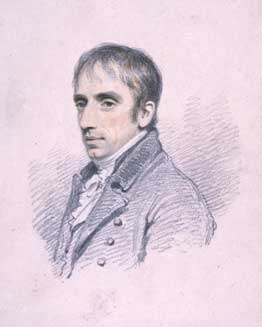
William Wordsworth by Henry Eldridge, 1807

”The Thorn,” written by William Wordsworth in 1789 is very melodramatic and tells the story of a solitary, rejected woman, Martha Ray, who’s baby has died and the mythology that builds around her.

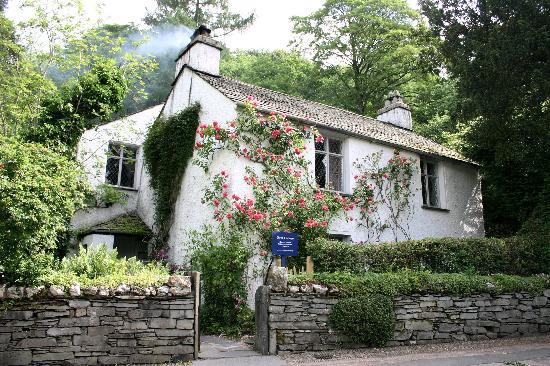
Dove Cottage.

Wordsworth, in the opening stanzas introduces us immediately to the thorn describing it as , “so old and grey,” “stands erect,” “A wretched thing forlorn.” And takes the personification to a higher degree saying it is,” Not higher than a two year’s child.”

He is setting us up to respond to natural things in an emotional way.

Footpath around the lake. Image @A Year In the Lakes

He then balances this emotional approach with factual evidence as he gives us the thorns location ,”high on a mountains highest ridge,” and the minutest detail, telling us that three yards from the thorn is, “a muddy pond,” and close beside the thorn is,

“A beauteous heap, a hill of moss.
Just half a foot in height.”

A mixture of fact and emotion balanced.
Three things are described in close proximity and we wonder how they relate to each other.

Colour is very important. The mound of earth near the thorn has, “vermilion dye,” “lovely tints,” “olive green, “scarlet bright,” “green red and pearly white.” Vivid in our minds eye.

Then, “A woman in a scarlet cloak,” Martha Ray, is introduced into this setting and we are asked,

“Now wherefore, thus, by day and night,
In rain, in tempest, and in snow,
Thus to the dreary mountain top
Does this poor woman go?”

The question all the local villagers ponder too. Observation, and imagination create a myth. Many believe she has killed her baby and buried it next to the thorn but they don’t actually know that. Wordsworth keeps pulling us back to reality, tempering our emotional response, “I cannot tell; I wish I could; for the true reason no one knows.”

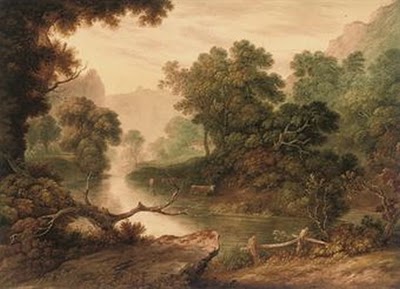
Cattle watering at Grasmere, near Ambleside, Cumbria, by John Glover.

Wordsworth also begins to use the personal pronoun. It is an egotistical device but we are with him. It is us as well as Wordsworth asking the same questions. He has got involved in this apparent tragedy and so have we.

Wordsworth relates to us the story of Martha Ray and what makes her mad.

“Full twenty years are past and gone
Since she (her name is Martha Ray)
Gave with a maidens true good will
Her company to Stephen Hill”

Stephen Hill, we are told, gets Martha pregnant but leaves her and marries somebody else. As result she has the baby but it is never seen by other people.

Then imagination intervenes again,

“For many a time and often were heard
Cries coming from the mountains head
Some plainly living voices were:
And other, I’ve heard many swear,
Were voices of the dead:
I cannot think, whate’er they say,
They had to do with Martha Ray.”

Wordsworth then draws us back to a cool scientific approach,

“But what’s the Thorn? And what the pond?
And what the hill of moss to her?”
And what the creeping breeze that comes
The little pond to stir?”

You can almost imagine Wordsworth and us being explorers into this mystery using investigative questions.
However, finally, myth is triumphant

“…but some will say
She hanged her baby on the tree
Some say she drowned it in the pond
Which is a little step beyond
But all and each one agree
The little babe was buried there
Beneath the hill of moss so fair.”

Fact, imagination, emotion, have combined to create a myth.

What use would this mythologizing be to those people in the hills and mountains of the Lake District? Would it help them make moral decisions? They wanted to bring Martha Ray to public justice based on what they thought and felt. Would it help them to create their own response to Martha’s predicament without having to experience it themselves? Is that the purpose of mythologizing? The purpose of fairy tales and myths have always been important to childhood and early emotional development and moral growth. Wordsworth has created an adult myth. So does the need for myths go beyond childhood and remain important to all?

……………………………………………………………………………………….

In a few weeks, a good friend of mine, Clive, is coming over from Canada for a reunion of old school friends. Some of us are reaching 60 this year and we are getting together for a celebration in Liverpool. Clive and I are going on further north into the Lake District for a couple of days. We will be staying in Ambleside, not far from Grasmere and Wordswoth’s Dove Cottage. We will visit Dove Cottage and I promise we will listen out for the cry of Martha Ray caught in the winds blowing about the peaks surrounding Grasmere and we will too be able to say,

“That I have heard her cry,
“Oh misery! Oh misery!
Oh woe is me! Oh misery!”

More on the topic:

Inquiring readers: Paul Emanuelli has frequently contributed his comments on this blog. Little did I know that he was an author! He has graciously sent in his thoughts about Bath, the city in which he has set his historical crime novel. Paul writes about Bath in his own blog, unpublishedwriterblog. It is well worth a visit!

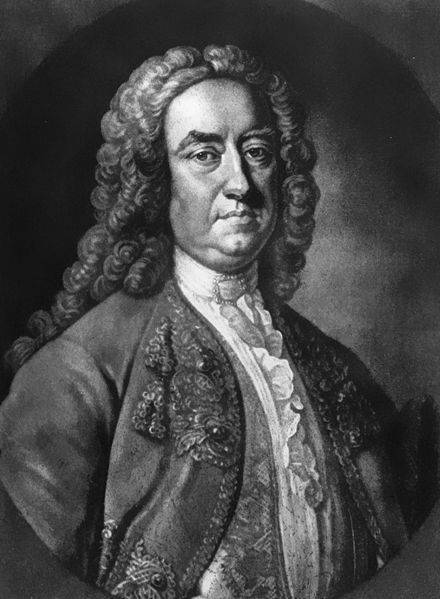
Beau Nash turned the city of Bath into the most fashionable resort in 18th-century England. In his role as Master of Ceremonies he organised the premier social events in the city and chose who should, and should not be invited. He established a select list of people who he defined as the cream of Society, and more importantly he changed the social conventions of the city.

Richard Beau Nash

Nash broke down the old order dominated by the nobility and gentry, and promoted the nouveaux- riches. Whereas in other cities the growing number of wealthy industrialists and tradespeople were still looked down on because of their background, in Bath, Nash welcomed them as elite members of society.

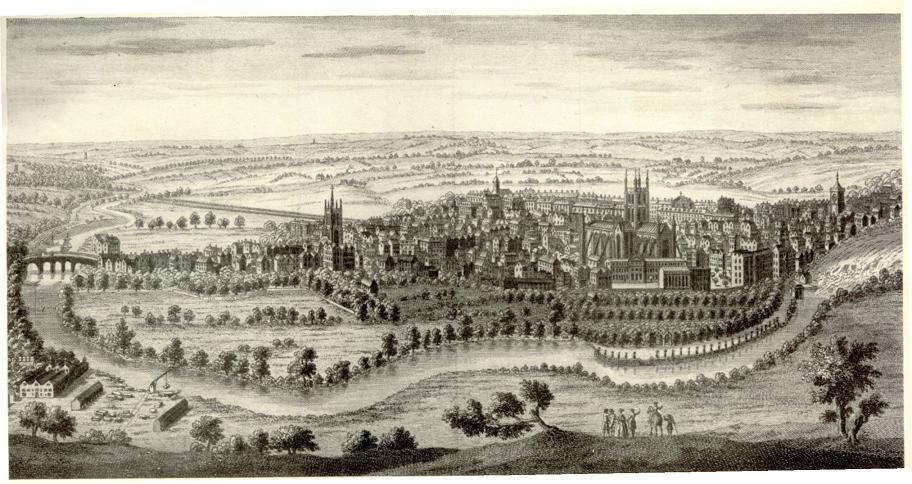
Bath in the 18th century at the time of Beau Nash

For years the city thrived on the wealth of visitors who stayed for the Season. The affluent tourists rented houses and apartments and all the trappings that went with them; crockery and cutlery, silver-ware and ornaments, horses and carriages, servants and attendants. Prominent architects designed fine buildings and the city grew. Milsom Street became one of the most prestigious shopping areas in the country.

Milsom Street and Bond Street with Portraits of Bath Swells.

By 1801, when Jane Austen moved to Bath, the city was the 9th largest in England, with a population of 33,000. Yet the city’s fortunes had already begun to decline. Bath had changed in character and atmosphere. It was becoming less fashionable and the wealthy were visiting less often, and their stays were becoming shorter.

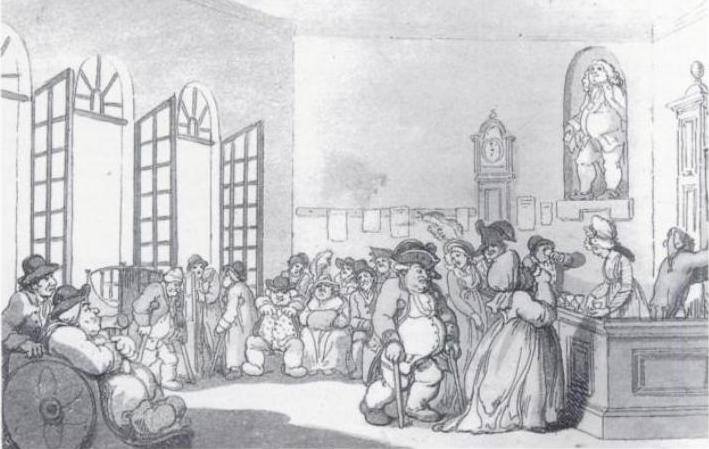
Thomas Rowlandson’s caricature of the Comforts of Bath. The classes noticeably mingled as they awaited drinking the waters in the Pump Room. (Notice the patient in the wheel chair on the left and the sedan chair next to him, which was carried inside the room.) Nash’s statue is in the niche at the top right. You can still see it today.

Built in a bowl of seven hills, Bath’s ever-growing population was increasingly crowded into a relatively small area. It’s little wonder that when Jane Austen moved to the city, she wrote to her sister, Cassandra saying, “The first view of Bath in fine weather does not answer my expectations; … the appearance of the place from the top of Kingsdown was all vapour, shadow, smoke, and confusion.”

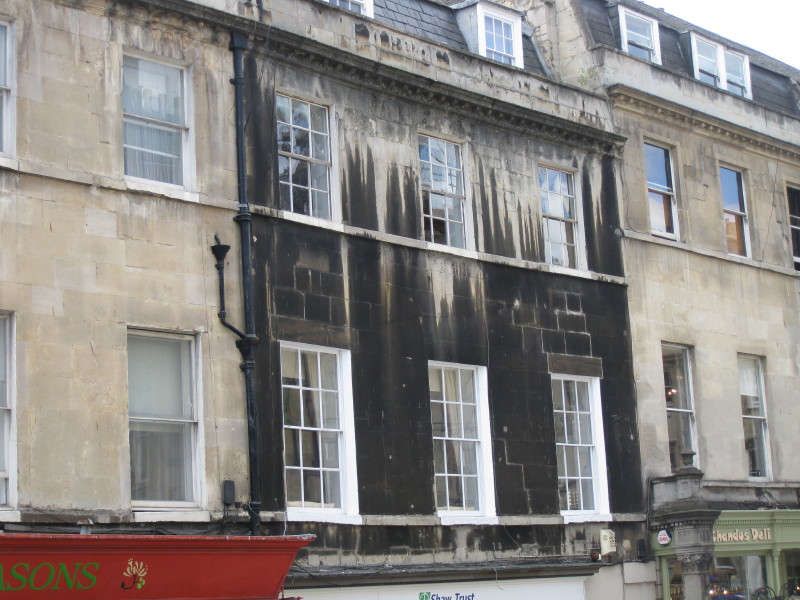
Coal soot darkened the creamy colored stone of the buildings.

Perhaps it is unsurprising that it seemed, “all smoke” when every household depended on coal fires for warmth, that it was “all confusion” when its roads were congested with carts and carriages. And in Georgian cities, once you set foot on the streets there was no escaping the poor drainage and lack of decent sanitation and sewerage systems. As Austen said in a letter to her sister, “We stopped in Paragon (a prestigious address where her wealthy uncle lived) as we came along, but it was too wet and dirty for us to get out.”

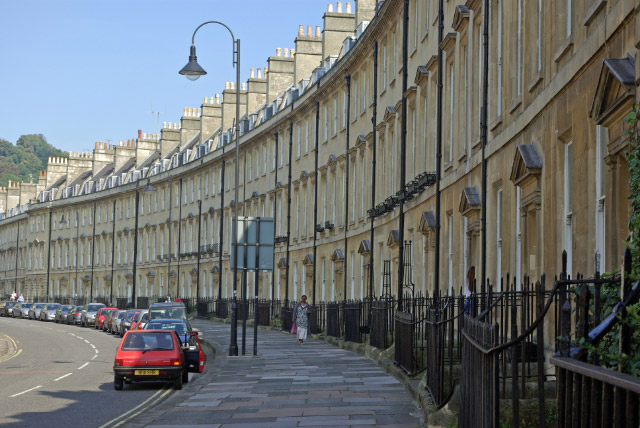
The Paragon, Bath.

By the time Persuasion was published in 1817, the larger part of Bath’s population was working class. Industry was thriving in the city, supplying the many fine shops in Milsom Street and drawing people from the countryside to fill the jobs created. Yet the people who worked in the factories and sweat-shops, the costermongers and shop-assistants, the building labourers and hotel staff were, for the most part, poorly paid.

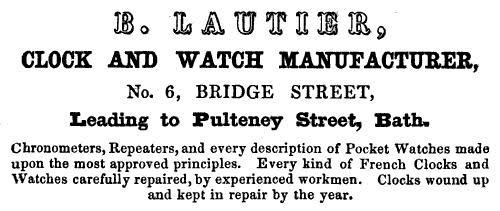
Advertisement for B. Lautier Goldsmith Shop in Bath, 1848

The only housing they could afford was overcrowded and poorly maintained, and the slum areas around Avon Street were increasing in size, as quickly as they were deteriorating in quality and appearance. By 1850, the rookery of hovels and cheap boarding-houses in and around Avon Street were home to almost a quarter of the Bath’s population.

Bath had grown considerably by the 1850’s, the date of this illustration.

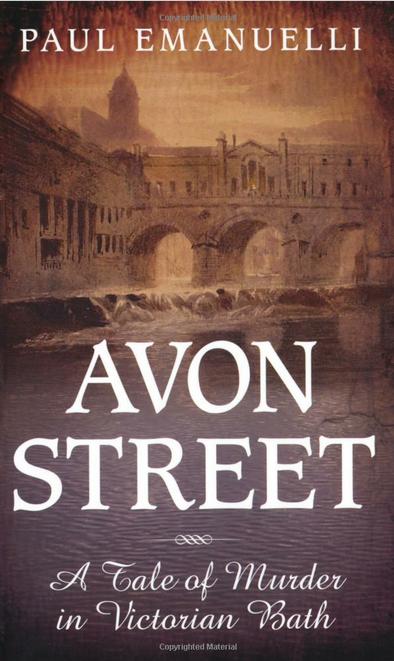
My novel, Avon Street is set in Bath in 1850. But Bath isn’t just a setting. It is a character in its own right. In writing Avon Street, I have tried to take the reader beyond the Georgian facades, and reveal a city, where wealth and elegance were never far from poverty and squalor. Bath was a city, where things were often not as they seemed, where people as Austen said, could “be important at comparatively little cost.” In short it is the ideal setting for a story of confidence tricksters and crime, intrigue and betrayal. A city where enemies can seem all-powerful, and friends are sometimes found where least expected.

Image of Avon Street.

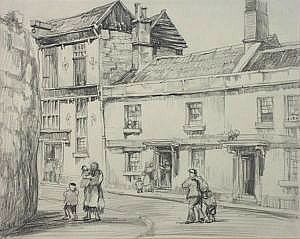
In Persuasion Anne Elliot visits a friend in Westgate Buildings despite Sir Walter’s warning of its unsuitableness – “Everything that revolts other people, low company, paltry rooms, foul air, disgusting associations are inviting to you.” (Click here to see an image of Westgate Buildings in 1900.) It seemed only fitting that the first chapter of my book be set in the same location, on the borders of the Avon Street area.

Pickwick Mews, Avon Street, in 1923. Image @The Victoria Art Gallery

More about Avon Street and Paul Emanuelli: Why Avon Street?

Avon Street: Purchase information

Paperback: 352 pages

Publisher: The History Press Ltd (1 Feb 2012)

Language English

ISBN-10: 0752465546

ISBN-13: 978-0752465548

This historical tidbit comes from a page designed by J.R. Burrows & Company, Historical-Design Merchants about historic carpet cleaning methods. One sees in films carpets being hung outside on a line and beaten with carpet beaters made of cane.

Elinor beats the carpet. Sense and Sensibility 2008

Some carpets were fitted and hard to remove. In such instances, druggets, or hard-wearing canvas cloths, came to the rescue.

The Young Trio, by E.V. Rippingille, 1829. Image @Bristol City Museum & Art Gallery.

One of the most common strategies of keeping carpets clean in the early nineteenth century was to use druggets, heavy woolen goods spread under tables to protect carpet from spills. They are sometimes called crumb cloths. In addition to dining rooms they were used in other areas of heavy wear. E.V. Rippingille painted The Young Trio in 1829 showing a drugget protecting carpet in a parlor where children are at play. – Historic Carpet Cleaning Methods in the Nineteenth and Twentieth Centuries

You can clearly see the drugget underneath the table in this classic print.

The Dinner-Locust; or Advantages of a Keen Scent’, Charles Hunt after E. F. Lambert, c.1823; hand coloured etching and aquatint. Image @The Geffrye Museum of the Home

Read more at these links:

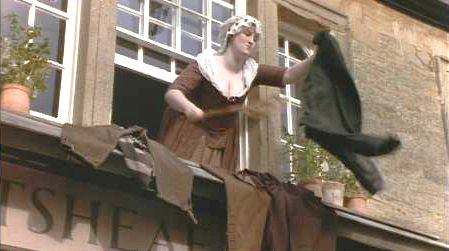
A maid shakes a small carpet or a drugget from a second story window, as well as some trousers. If I recall, one of the actors walked through the door below her as she shook the cloth. Such scenes must have been common then. Sense and Sensibility, 1996.

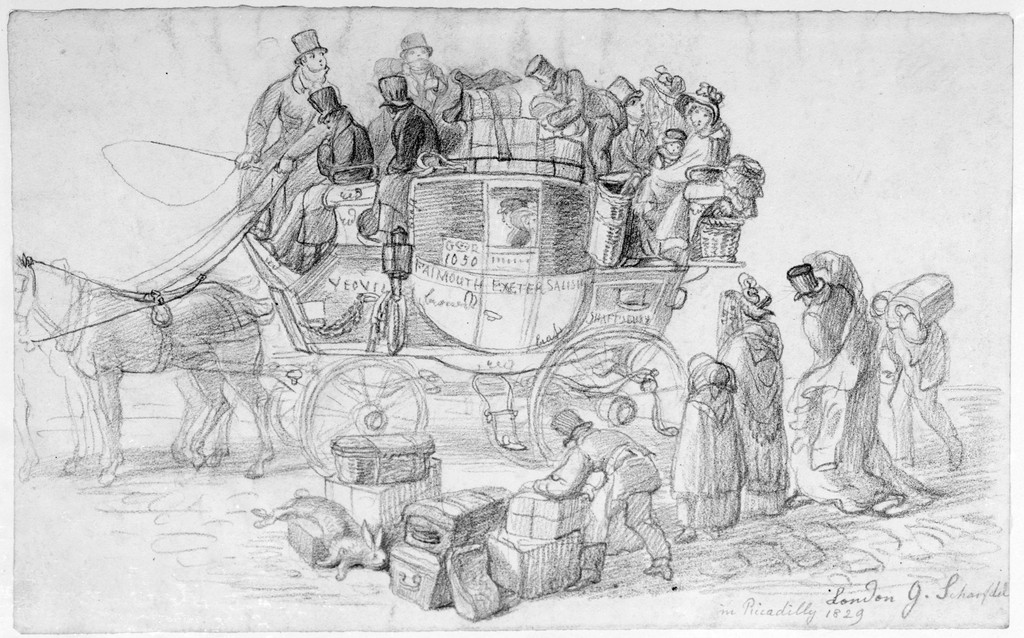
They say a picture is worth a thousand words, and how true it is in this instance. George Scharf the elder, a popular genre painter of the early 19th century, was also a prolific drawer of ordinary scenes in his adopted city of London. One can study his drawing of the Mail Coach Bound for the West County, 1829, endlessly, imagining many tales while thinking back on the history of coach travel. This mail coach is being readied at the Gloucester Coffee House on Piccadilly, where so many mail coaches left at night. The horses are waiting to pull this heavily laden wagon. They will pull it for 15 miles before they will need to be changed. Even with improved roads, the coach will not be going much faster than 7-8 miles per hour. Scharf drew this scene in 1829, a year before the first passenger train would be introduced. By the mid-18th century this scene in Piccadilly would have changed dramatically.

West country mail coach leaving Piccadilly, George Scharf, 1829. Click on image to view a larger version.

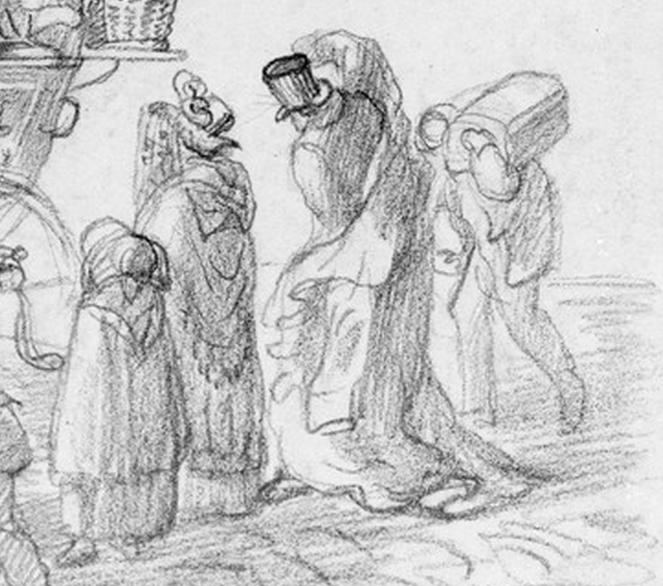
I count 9 people on top the wagon, one passenger sitting next to the coachman, seven on top of the wagon (one is definitely a porter), and two passengers inside.  I imagine there are two more people seated inside that we cannot see, for the interior holds four passengers, and that the gentleman putting on the great coat is waiting for the porters to finish loading the packages before he takes his seat on top of the coach. The woman and child standing next to him must be waiting to see him off, for, if the rest of the mail bags, packages, and luggage are to be loaded, there won’t be room for them as well. If they are waiting to board, then I pity the four horses who will be pulling 13 people along with the mail.

Travel was quite costly back then.

Costs of travel:  [estimates for 1800]

  • Stage Coach:  2-3 pence / mile = 1.25 pounds from London to Bath / half-price if up top / outside [but remember the average income was about £30 / year
  • Hired post-chaise =  estimate about £1 / mile [i.e @1 shilling / horse / mile, to include the postillion] – Jane Austen in Vermont

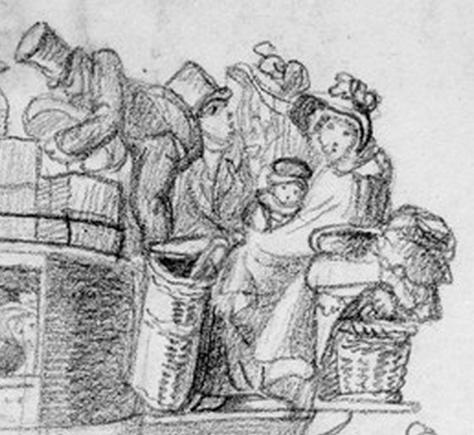
For a family living on  £25 – £30 per year, such costs were prohibitive. The cheapest seats were on top and on the outside. One can see a woman holding her child wedged between straw baskets. Should the coach take a turn too fast or be involved in an accident, she and her babe could be flung off the vehicle or trapped underneath should it overturn. At best, they felt the wind and rain and arrived at their destination disheveled and covered in road dust if the weather was dry, or soaking wet with rain. One shudders at the thought of what it felt like to be an outdoor passenger in the winter.

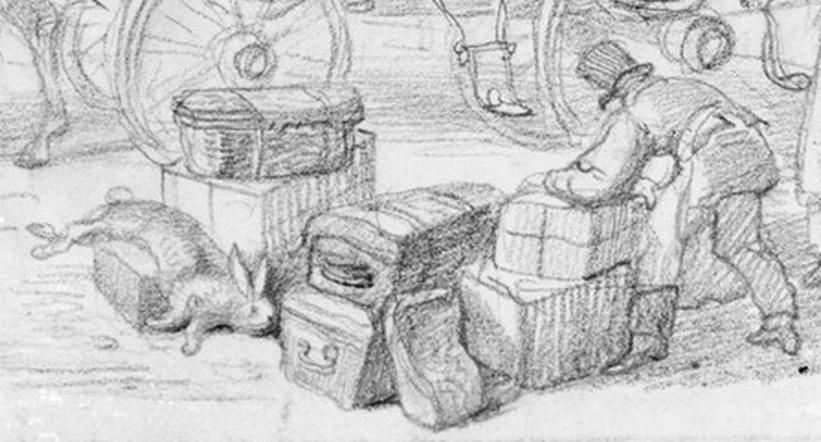
Mail coaches were designed to carry the mail, not to carry passengers comfortably. A close look at Scharf’s image reveals this to be so. There is no wiggle room to speak of. Since travel was expensive and laborious, those who undertook the journey usually arrived in London with lists of things to purchase for friends and family. Jane Austen certainly did, and one can assume that her brother Henry, who lived in London, arrived laden with special requests when he visited his family. The packages being loaded are quite bulky. It is easy to imagine that they contain the ribbons, muslins, china ware, shoes, hats, teas, chocolate, and other assorted items that were special ordered back home. One even sees a recently slaughtered hare among the packages.

One wonders how many more pieces of luggage the mail coach could possibly take on. The packages must be heavy for the porter walking towards the coach is bent over. The male passenger’s great coat and hat are typical of men’s outer wear at the time. As I study the detail below, I am becoming more convinced that the woman and girl are waiting to board. She is wearing a veil, to protect her face from dust, no doubt, and both are covered in layers of outer wear, including a shawl over a cloak. Even so, the ride for exposed passengers would be cold. From the clothes, one can only assume that it is winter.

Mail coaches, while more expensive to ride, were faster than private stage coaches, more stable, and less laden with passengers.

The coach was faster and, in general, less crowded and cleaner. Crowding was a common problem with private stage coaches, which led to them overturning; the limits on numbers of passengers and luggage prevented this occurring on the mail coaches. Travel on the mail coach was nearly always at night; as the roads were less busy the coach could make better speed. – Wikipedia

[William] Hazlitt has thus described, in his own graphic manner, the scene presented on the starting of the old mail-coaches:—”The finest sight in the metropolis,” he writes, “is the setting off of the mailcoaches from Piccadilly. The horses paw the ground and are impatient to be gone, as if conscious of the precious burden they convey. There is a peculiar secrecy and dispatch, significant and full of meaning, in all the proceedings concerning them. Even the outside passengers have an erect and supercilious air, as if proof against the accidents of the journey; in fact, it seems indifferent whether they are to encounter the summer’s heat or the winter’s cold, since they are borne through the air on a winged chariot. The mail-carts drive up and the transfer of packages is made, and at a given signal off they start, bearing the irrevocable scrolls that give wings to thought, and that bind or sever hearts for ever. How we hate the Putney and Brentford stages that draw up when they are gone! Some persons think the sublimest object in nature is a ship launched on the bosom of the ocean; but give me for my private satisfaction the mail-coaches that pour down Piccadilly of an evening, tear up the pavement, and devour the way before them to the Land’s End.” – British History Online

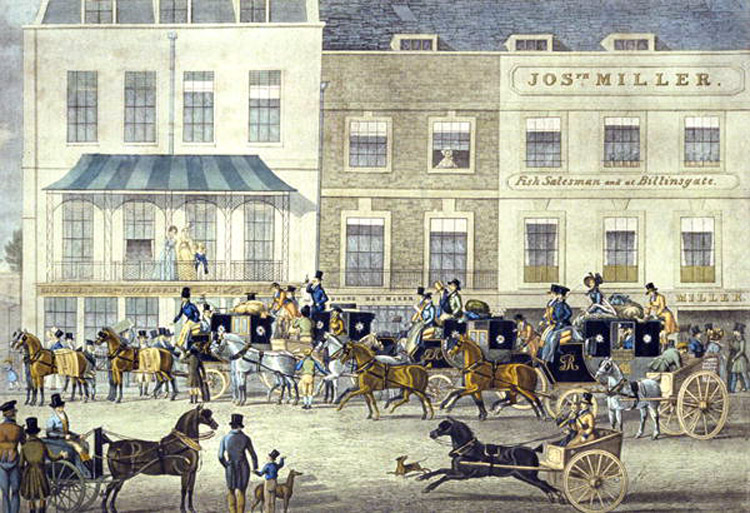
Pollard, Gloucester Coffee House, Piccadilly, 1828

As I said at the beginning, this image is fraught with meaning. I wonder if, when he was sketching this scene,  Scharf knew he was recording the great coaching era at its peak.