Feeds:
Posts
Comments

The Parks of London by Mary Elizabeth Brandon, 1868, on Dandyism.net discusses the dandies parading up and down London’s fashionable parks. After visiting that site, return to read some of my older posts about Hyde Park and the pleasure gardens.

More on the Topic:

Inquiring Reader, This post is the second part of solving the mystery of Cassandra Austen’s age in the 1841 census, which reader Craig Piercey brought to my attention. A number of people became involved in the mystery of Cassandra’s age, which was 68 at the time the census was taken, but was listed as 65. To review the situation, click on this link and read the emails sent to explain the anomaly.

The first letter came from Laurel Ann of Austenprose, who had left a comment on the first post.

Vic,  I have come across many discrepancies on census enumerations. The process is part of the problem. Families were asked to fill out their own sheets and then they gave them to the enumerator who transcribed them onto the sheets of record. The original family sheets do not survive. There is always the possibility of illegible handwriting, transcription error, the family did not understand the directions or people lied about their age! It is not considered a primary source document by the government or family historians. Cassandra’s christening record would serve as a legal record of her birth. Since her father filled this out, we can be pretty certain that it is correct. It is also confirmed in family letters. By her death in 1845 it was required to report deaths to the new Registrar and would have included a doctor’s verification. That is the best explanation I can offer. The government was primarily interested in  numbers. They used the data for general ranges like the number of children under 10 or men of military age etc. The fact that exact ages are listed from 1851 onward is a bonus to family historians now, but not so much for the government then. Census records are not an exact science. I am glad you had so much interest in this puzzle. The discrepancy does appear odd to one who has not done family research.  I hope this is helpful. LA

St. Nicholas Church at Chawton, taken by @sneakymagpie

Laurel Ann was not the first person to point out that the Census taker would use a general number that could be divided by five. Before I received her answer, I had written to Ray Moseley, Fundraising Administrator of Chawton House. He replied promptly:

Dear Vic,

Sarah Parry our education officer at Chawton House has replied as below. I do hope that this helps. If we can of any further help please don’t hesitate to contact me.

Ray

Cassandra and Cassandra Austen grave

Hi Ray

I think that the following might be an explanation.

This is the web page for the 1841 census on the National Archive website: http://search.ancestry.co.uk/iexec/Default.aspx?htx=List&dbid=8978&ti=5538&r=5538&o_xid=24149&o_lid=24149&offerid=0%3a21318%3a0 It makes the point about how ages were recorded on this census and notes if over 15, the ages “were usually rounded down to the nearest 5 years”.

I also had a look at Deirdre le Faye’s A Chronology of Jane Austen and her Family (Cambridge University Press 2006). The entry referring to the 1841 census reads:

“June 6, Sunday
National census this year shows CEA [Cassandra Elizabeth Austen] living at Chawton Cottage, with three maids – Mary Butter, Emily Kemp, Jane Tidman – and one manservant, William Sharp. HTA [Henry Thomas Austen] and Eleanor Jackson are also there on census night.”

Cassandra was born on 9 January 1773 and would have been 68 on the night of the census so it would have been correct, by the format of the 1841 census, to show her age as 65.

Henry would have celebrated his 70th birthday in 1841. He was born on 8 June 1771. The 1841 census was taken on 6 June – just two days before his 70th birthday. So the figures are correct as Henry would have been 69 on the night of the census so again, by the format of how to record ages in the 1841, census it would therefore have been quite correct to show his age as 65. Henry’s surname isn’t shown on the census because the mark below the “Austen” of Cassandra’s name and alongside Henry’s Christian name is the equivalent of ditto marks.

Hope this helps.

Best
Sarah

Chawton Cottage

Sarah’s explanation dovetails in with other speculations, but because she works for Chawton House as an education officer, I will take hers as the last word on the subject.

Tony Grant, London Calling, wrote Louise West at the Jane Austen’s House Museum in Chawton about the same time that I wrote Chawton House, and her reply, while supportive, did not include additional information.

Hi Vic,
I just received this today from Louise West at Chawton Cottage. Remember our exciting foray into working out Cassandra’s age? … Here you are. – Tony

Dear Tony

Many thanks for sharing with me this interesting correspondence.  I really admire all the effort that has gone into trying to solve the mystery and wish I could offer anything more illuminating but I’m afraid I’m as much in the dark as you are.  If you uncover anything definite I would be very interested to hear.

Best wishes

Louise West
Collections and Education Manager
Jane Austen’s House Museum
Chawton
Alton

So, gentle reader. This is the end of our research into this topic. I hope others have found this journey into uncovering a mystery as interesting as I have. Thank you for stopping by, and thanks to all who have answered our emails and helped, especially Laurel Ann, whose initial comments and follow-up email unlocked the mystery first.

PBS Masterpiece Mystery! is featuring Faceless Killers, the first episode of Wallander, Season 2 online. Click here to see the video until November 2, 2010. Click here to read my review for the season.

Kenneth Branagh is Wallander

Kenneth Branagh in Faceless Killers

Kurt Wallander’s life is all about work and it is killing him. Kenneth Branagh is perfect as  the world weary Swedish cop who cares about his cases at the expense of his family and physical and emotional health. The actor is fearless in depicting a tired, overweight and unkempt man who drinks too much, sleeps too little, and suffers from diabetes and depression. Wallander’s wife has left him, his relationships with his daughter and father stink, and he has no friends to speak of.

The first three episodes of Wallander (Series One) were a revelation. Series Two is as good if not better. The series is filmed in the bleak landscape of southern Sweden and in the small port city of Ystad. Initially, there was thought of producing a feature film, but Branagh voted against it, saying.

I thought it might be tough in the current climate to produce a film with somebody like me in it and expect it would last much longer than an opening weekend. Just because our business is incredibly brutal.” – Kenneth Branagh

Wallander is the brain child of Henning Mankell, a successful Swedish author who created the character in reaction to the anti-immigration sentiment expressed in his country.

I had no idea this would be the start of a long journey,” Mankell says. “I was writing the first novel out of anger at what was happening in Sweden. And, since xenophobia is a crime, I needed a police officer. So the story came first, then the character. Then I realised I was creating a tool that could be used to tell stories about the situation in Sweden — and Europe — in the 1990s. The best use of that tool was to say ‘What story shall I tell?’, then put him in it.” – Times Online

Tom Hiddleston and Kenneth Branagh in Wallander

Wallander’s single-minded doggedness in solving his investigations leaves him with little room in life for anything else. The solitary detective is miserable but unable to do anything to change his life, as Kenneth Branagh explained in a recent interview:

So there is little room in his mind for small talk, superficiality. He’s not much interested in sport. He doesn’t have hobbies. He doesn’t have extra room or space for what might be therapeutic reflection. It’s almost always about why people commit acts of violence. And complicated analysis and consideration of what drove him or her to it. Or why the person he has interviewed responded in the way they did. And sometimes in his own life why he is unable to say to his own daughter, “I love you”, or return her call.

‘So all of that physically just makes you feel heavier. I remember reading the script for the first of these new ones – I’d not been near it for a year – and by the end of it I was hunched and bent over. And I felt as though my skin was sagging. I felt as though the gravitational weight of Wallander was starting to have an impact.’  – Telegraph Co.UK

Jeannie Spark as Linda Wallander and Arsher Ali as Jamal, the young doctor she is seeing

The first series, produced by Yellow Bird, Mankell’s film production company, in partnership with Left Bank Pictures, ran on PBS in 2009. Wallander garnered Branagh a Golden Globe nomination and a BAFTA for Best Drama Series for the first season.

PBS will offer the following episodes in Series 2:

Faceless Killers, October 3


An elderly couple is brutally assaulted in their rural farmhouse. The press takes hold of the foreigner angle, inciting swift and deadly retribution against local migrant workers. But there is more to the case — a potential mistress, a lost son and a large sum of money. Wallander’s inquiry takes him deep into his own damaged psyche, forcing him to examine and question his own motives before he can even begin to understand those of a killer.

The Man Who Smiled, October 10,

Gustaf Torstensson quietly chants “Mea culpa, mea culpa,” as he drives to his death. His son Sten Torstensson, a friend of Inspector Kurt Wallander, begs the detective to investigate the suspicious case — Wallander is his last hope. But hope has all but drained from Wallander’s life, as he’s now on indefinite leave from his work and has been all but forgotten after enduring an on-the-job trauma.

The Fifth Woman, October 17

Inspector Kurt Wallander is torn between two disparate cases while dealing with one harsh and heartbreaking reality — the demise of his father. When another victim is found, it is clear that a serial killer is at work in Ystad.

Other features:

As usual, PBS Masterpiece Mystery provides special features that add dimension to the series.

Other posts

Archway opposite Union Passage, Constance Hill

Half a minute conducted them through the pump-yard to the archway, opposite Union Passage; but here they were stopped. Everybody acquainted with Bath may remember the difficulties of crossing Cheap Street at this point; it is indeed a street of so impertinent a nature, so unfortunately connected with the great London and Oxford roads, and the principal inn of the city, that a day never passes in which parties of ladies, however important their business, whether in quest of pastry, millinery, or even (as in the present case) of young men, are not detained on one side or other by carriages, horsemen, or carts. This evil had been felt and lamented, at least three times a day, by Isabella since her residence in Bath; and she was now fated to feel and lament it once more, for at the very moment of coming opposite to Union Passage, and within view of the two gentlemen who were proceeding through the crowds, and threading the gutters of that interesting alley, they were prevented crossing by the approach of a gig, driven along on bad pavement by a most knowing-looking coachman with all the vehemence that could most fitly endanger the lives of himself, his companion, and his horse.- Northanger Abbey

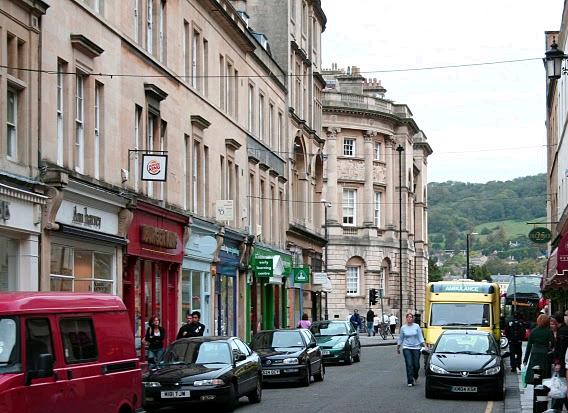
Cheap Street in 2010, Image Tony Grant

“Oh, these odious gigs!” said Isabella, looking up. “How I detest them.” But this detestation, though so just, was of short duration, for she looked again and exclaimed, “Delightful! Mr. Morland and my brother!”

Another angle of the street

The Walking Tour of Bath provides a map that mentions many of the streets described by Jane Austen in the above passage, accompanied by images from medieval times to today.

Cheap Street runs just north and parallel to the Abbey. In this turn-of-the-century post card of Union Passage, which intersects Cheap Street, one can see how drastically different Bath looked back then – many of the Georgian features are hidden under shop signs.

Union Passage in the Early 19th Century, Bath Post Cards

The Walking Tour mentions how Bath’s 18th century forefathers were concerned about preserving the nature of Bath’s gentrified renovations.

Incidentally, a friend who used to live in an 18th c. flat just round the corner in North Parade Buildings had some amusing conditions attached to the terms of his lease. He was prohibited from hanging bedding out of the window, holding public auctions and keeping livestock. One can only presume that the Georgian city fathers, having gentrified Bath at great expense, were concerned to prevent the locals spoiling things by falling back into their old peasant ways.”

Coal soot blackened stone facades. Image Chuck and Claire Davis

The creamy colored limestone stone used in many of Bath’s architectural treasures have been used for building since the days of the Roman occupation.  The above image from European Adventure demonstrates how soot from coal fires blackened the buildings. Jane Austen was probably more familiar with these blackened facades than the creamy stones we are accustomed to viewing nowadays.

…in 1956 a clean air act was imposed. The townspeople were no longer allowed to burn coal and the buildings were painstakingly cleaned. He’s not sure why, but one building was left untouched, giving us the chance to see how they had looked.”

Today, the authentic nature of the buildings are still enforced legally. The Enforcement Policy in Bath Shopfronts Guide today requires:

Colour: No other single aspect of design has so much effect on the character of a shopfront than its colour. A good design can be completely spoilt by poor colour, or a nondescript design uplifted by the right choice of colour. Colour also has an effect on the Street Scene; out of key or aggressive colour will be damaging to everything within the field of vision.

Signs: The design and disposition of signs and the style of the lettering should always be historically credible and correct in design and detail for the design of the shopfront.

Illumination: The character of a shopfront and of the street will be altered by external illumination. This is often not acceptable, particularly where the shopfront is part of a listed building.

Appearance: Changes of a radical nature such as moving door positions are not normally acceptable. These may however be viewed more favourably if they can be shown to produce a permanent benefit such as the provision of a door to the upper floors.”

The cases described in The Bath Heritage Watchdog shows how vigilant the planning commission must be to preserve Bath’s unique heritage, and how historic preservation often clashes with business interests.