Feeds:
Posts
Comments

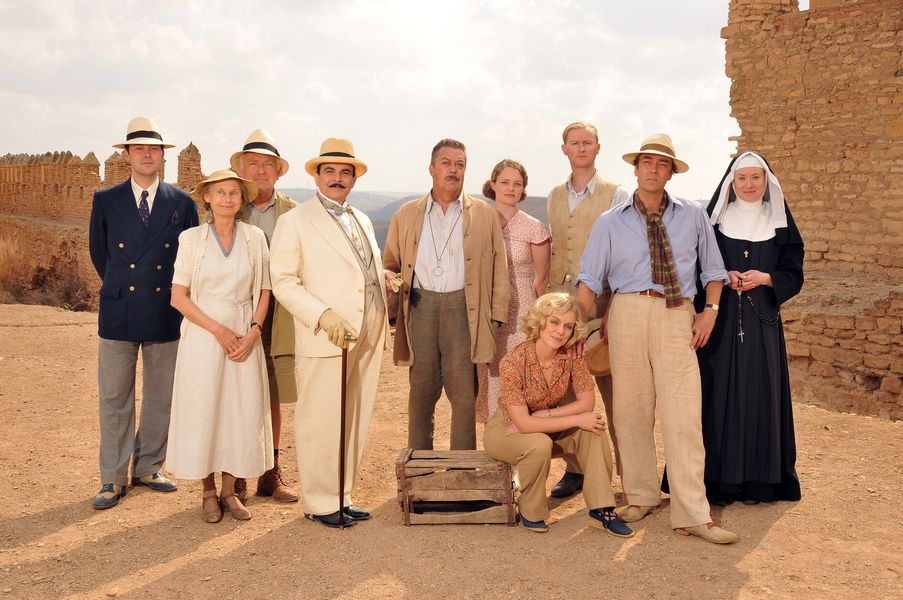
The cast of Appointment With Death

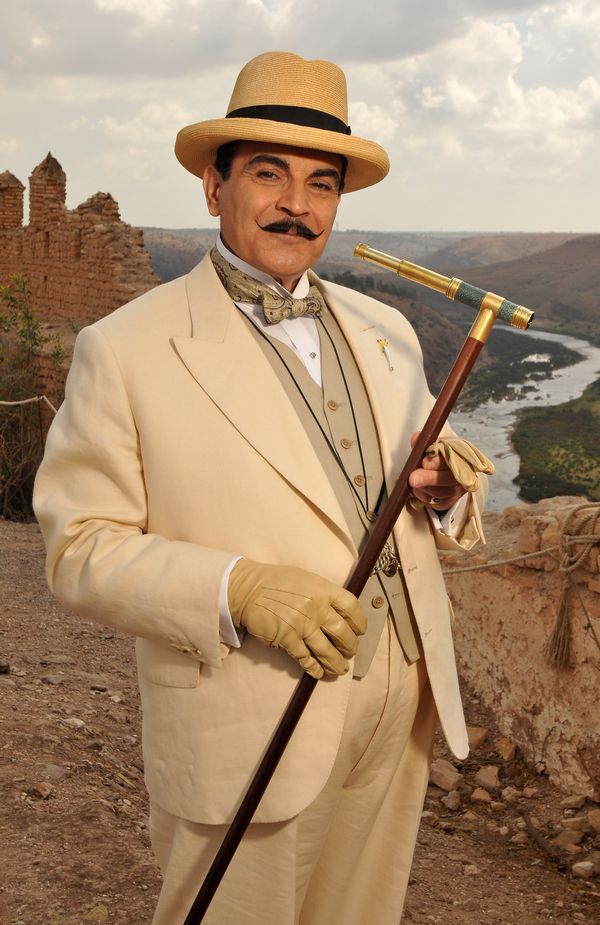
Appointment with Death is the last new Hercule Poirot mystery to be shown on PBS for Season X. David Suchet and a sterling ensemble cast reenacted Agatha Christie’s tale in Syria – or did they?

Lord and Lady Boynton, the victim, and Sarah King, right

Big changes were made to the original storyline, which Christie had originally set in Petra. Lord Boynton, a famous archeologist, now searches for the head of John the Baptist. The cast of characters differed from the novel, and when the murder was finally solved in a dramatic (and unbelievable) way, I could scarcely believe what I was watching.

Two Boynton children and Dr. Gerard
What could possibly be wrong with Dr. Gerard?

Many readers feel that Appointment With Death was one of Christie’s weakest novels, and tinkering with the story has done little to improve the plot. There is an undercurrent of cruelty in this adaptation  (Mrs. Boynton is a worse child abuser than Mrs. Norris in Mansfield Park), which has not been adequately explained. And while Lady Westholme (Elizabeth McGovern) had much to lose, her role in this plot has changed it beyond recognition.

Hercule Poirot and Dame Celia Westholme

Oh, dear. This episode was not a good way to end the season. The only positive thing I can say is that once again the actors are superb. Tim Curry, Elizabeth McGovern, Christina Cole, Tom Riley, and Angela Pleasance make for a sterling cast.

Let's hope the next Poirot season ends with a bigger bang.

Appointment With Death was filmed in the exotic locations of Casablanca and El Jadida in Morocco, and the UK.

Tim Curry….. Lord Boynton
Christina Cole….. Sarah King
Tom Riley….. Raymond Boynton
Cheryl Campbell….. Lady Boynton
Zoe Boyle….. Jinny Boynton
Emma Cunniffe….. Carol Boynton
Angela Pleasence….. Nanny
Paul Freeman….. Colonel Carbury
Beth Goddard….. Sister Agnieszka
Christian McKay….. Jefferson Cope
Mark Gatiss….. Leonard Boynton
John Hannah….. Dr. Gerard
Elisabeth McGovern….. Dame Celia Westholme

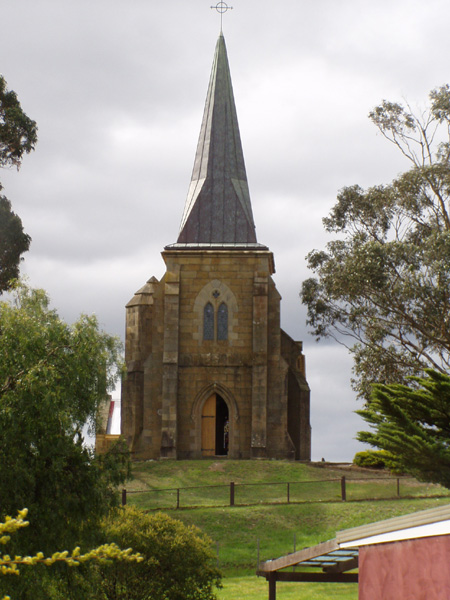
St. Johns Catholic Church, Richmond, Australia

What are the odds that two Richmonds a world apart would boast two historic churches named St. Johns? St John’s in Richmond was built in 1837 and is the oldest Roman Catholic Church in Australia (actually, Tasmania). The structure is situated near the oldest bridge, built between 1823 and 1825 by Australian convicts over the Coal River, and was used by military police and convicts between Hobart and Port Arthur.

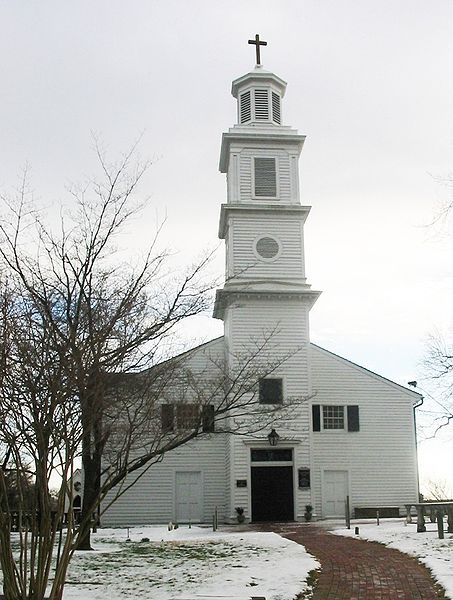
St. John's Episcopal Church, Richmond, Virginia

St. John’s Episcopal Church was built in Richmond in 1741. In 1775, Patrick Henry, George Washington, Thomas Jefferson, Richard Henry Lee, Peyton Randolph and other important Virginia delegates met in the church for the Second Virginia Convention of the House of Burgesses, where Patrick Henry delivered his famous speech: “Give me Liberty or Give me Death.” The delegates were  so impressed by the speech that they decided to organize a Virginia militia, which led the way to Revolutionary War.

Coincidentally, both St. John churches were built on top of hills.

Inquiring readers, One of the perks of overseeing a blog is getting to know the fascinating people one encounters while researching a topic. One such individual is Patrick Baty of Papers and Paints. Mr. Baty has carried out extensive research into the use of pigments in architectural and decorative paintings. Recently I asked him the following questions:

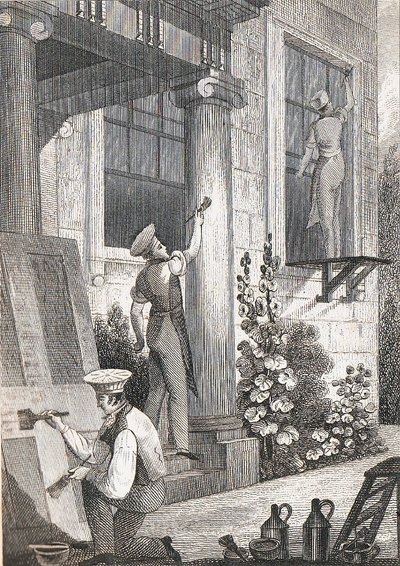
Image of painters from Papers and Paints

“If Sir Walter Elliot from Persuasion decided to paint the door to the carriage house at Kellynch Hall, how would this be accomplished? Would he keep a painter on hand or hire one? Were paints made from scratch from a tried and true formula, or did each painter have a formulaic secret? What were the typical colors used for exterior doors and window casements, and wooden structures?”

Mr. Baty: “It is likely that [Sir Walter] would have hired a painter, unless he was tempted by some of the literature of the time, for example T.H. Vanherman’s “Every Man his own House-painter and Colourman“, 1829. One hundred years earlier there was this revealing passage in a work of 1734:

“Painters Work being very expensive, and this being the only part in Building wherein a Gentleman can be assisting either by himself or Servants, it being almost impossible for any Gentleman to do either Masons, Bricklayers, Carpenters, or Smiths Works; whereas it is well known and daily experienced since the Advertisement of ALEXANDER EMERTON, that several Noblemen and Gentlemen have by themselves and Servants painted whole Houses without the Assistance or Direction of a Painter, which when examined by the best Judges could not be distinguished from the Work of a professed Painter.”

If his house/estate were big enough he might have had a handyman/painter. Otherwise he would have called upon the services of a firm like Messrs Moxon & Carfrae Ltd, painters and decorators, Edinburgh, whose day books survive from the 1770s.

Paints were generally made from ready-mixed paste bought at a colourman’s shop as can be seen in this quote of 1747:

“Methods practised by some Colour-Shops; who have set up Horse-Mills to grind the Colours, and sell them to Noblemen & Gentlemen ready mixed at a low price, & by the help of a few printed Directions, a house may be painted by any common Labourer at one Third of the Expense it would have cost before the Mystery was made public”

Different painters might have had slightly different recipes, but the general mixes would have been very similar.  (The Methods and Materials of the House Painter in England: An Analysis of House Painting Literature 1660 – 1850, thesis by Patrick Baty.)

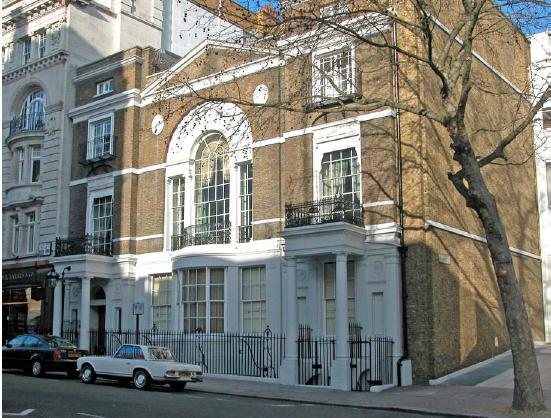
Boodle's St. James's. Papers and Paints performed the colour survey.

The sort of colours being sold by a Bath colourman of the period for exterior use were:

Olive brown paint in casks of 30lb & upwards, per lb 3d

Oil Paints

  • Lead colour 4 1/2d
  • Chocolate colour 4 1/2d
  • Invisible green 4 1/2d
  • Stone colour 5d
  • Black 6d
  • Garden green 8d
  • Rich bottle green 1 0
  • Deep Sardinian green 2 0
  • Light ditto, ditto, 2 0
  • Rainbow green 3 6

Windows, normally, would have been a pale stone colour (off white).

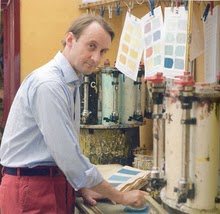
More about Patrick Baty:  Since carrying out a research degree which focussed on The Methods and Materials of the House-painter 1650-1850,Patrick has been running a consultancy that advises on the use of paint and colours in historic buildings.  Buildings have ranged in size and type from Royal palaces; country houses and cathedrals to museums; a wartime RAF station and London housing estates.

Visit Patrick’s sites at the following links: Papers and Paints website; Colourman Blog, the Papers and Paints blog; and Papers and Paints Twitter Account.

More on the topic:

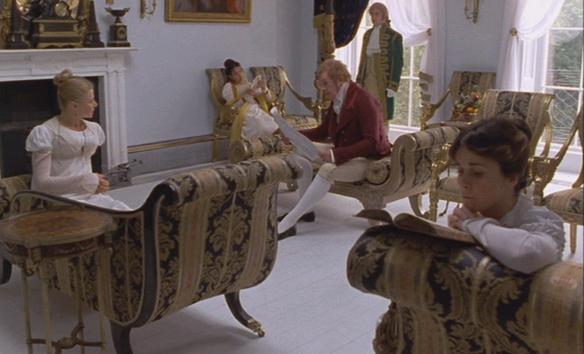
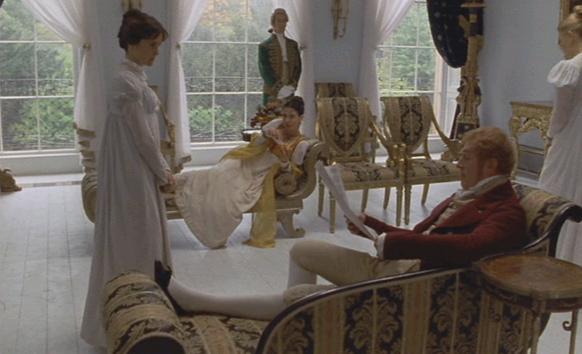
Camden Place, Bath. Sir Walter Elliot and his family reading.

Thomas Hope (1769–1831), the style icon of the Regency interior, would have been happy with these images of Sir Walter Elliot’s interior of Camden Place in Persuasion 1995.  Thomas Hope was known for the “decorative details and ornament based on influences from his nearly ten-year Grand Tour, as well as from motifs from ancient Greece and Egypt.”

Camden Place: A view of the Drawing Room

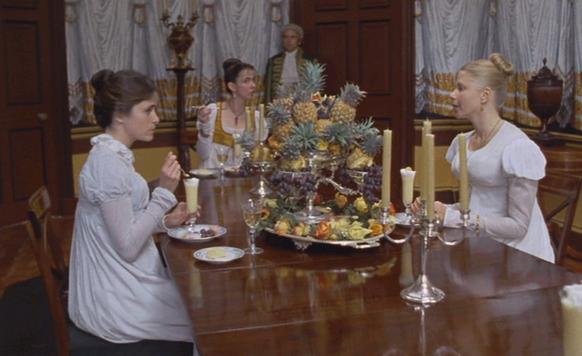
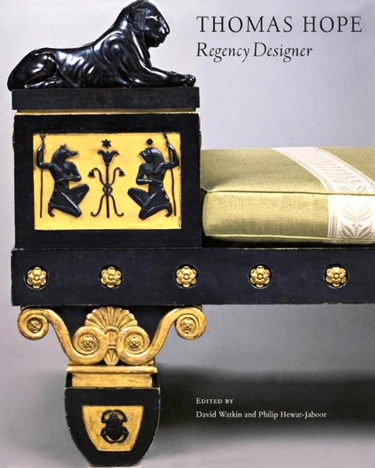
Hope’s startling juxtaposition of styles included Egyptian, Greek, Roman and Indian elements, as well as his own version of the French Empire style. Classical sculpture and vases were displayed alongside modern paintings and sculpture. Most striking of all was the inventive and exotic furniture that Hope designed specifically for the house. – Exhibition, Thomas Hope, V&A Museum

Camden Place: Dining Room (Anne and Elizabeth Elliot and Mrs. Clay)

From these images it is quite obvious that the set designer of this film chose furniture and draperies that for the Regency era would have been regarded as ultra fashionable. Sir Walter might have moved from Kellynch Hall to reduce his expenses, but his tastes remain expensive and he shows no inclination to follow the rules of economy.

More on the Topic

Thomas Hope: Regency Designer

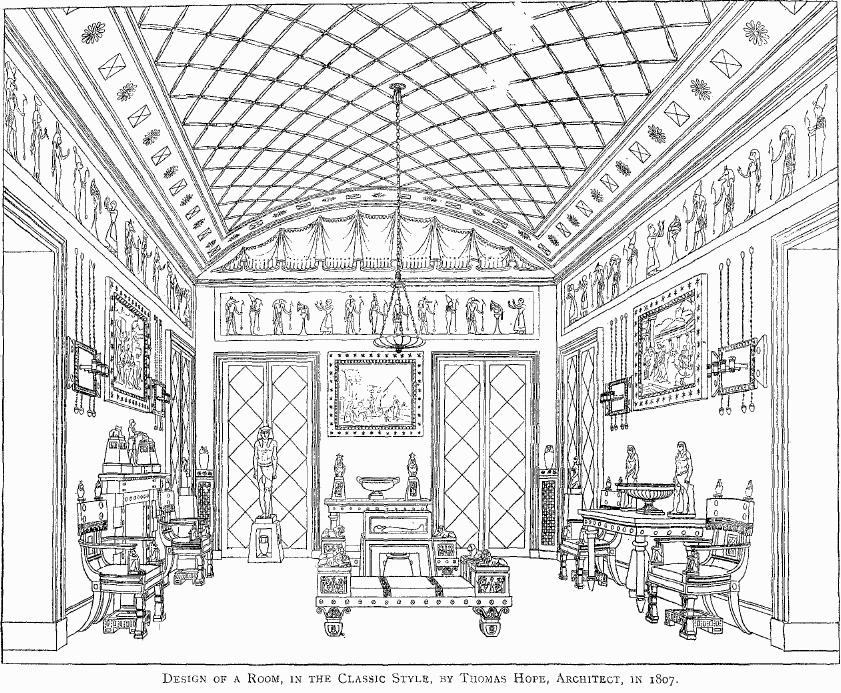
Like designers of his day, Sir Thomas Hope drew his planned room design ahead of time. Witness the following whole room design:
Design of a room, 1807, by Sir Thomas Hope

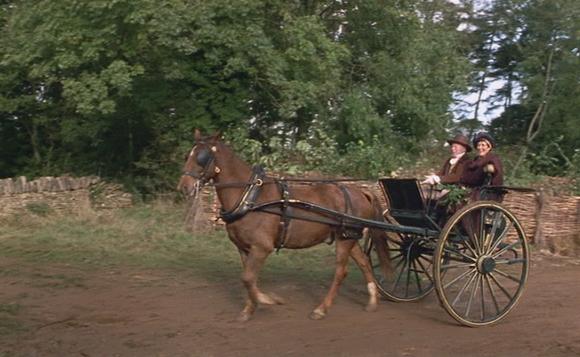
Crofts arrive in the gig, Persuasion 1995

In Persuasion, Jane Austen depicts the Crofts as the happiest couple imaginable. Sophy, who is also Captain Wentworth’s sister, follows her Admiral across the seas, sacrificing her looks in the process. She is only 38 years old, but her complexion is ruddy and has obviously been affected by the sun. Jane Austen writes about the couple in a realistic way, and like all happily married folks, these two exhibit their own idiosyncracies. Admiral Croft, it turns out, is a bad driver. Captain Wentworth says about his brother-in-law to Louisa:

“What glorious weather for the Admiral and my sister! They meant to take a long drive this morning; perhaps we may hail them from some of these hills. They talked of coming into this side of the country. I wonder whereabouts they will upset to-day. Oh! it does happen very often, I assure you–but my sister makes nothing of it–she would as lieve be tossed out as not.”

“Ah! You make the most of it, I know,” cried Louisa, “but if it were really so, I should do just the same in her place. If I loved a man, as she loves the Admiral, I would always be with him, nothing should ever separate us, and I would rather be overturned by him, than driven safely by anybody else.”
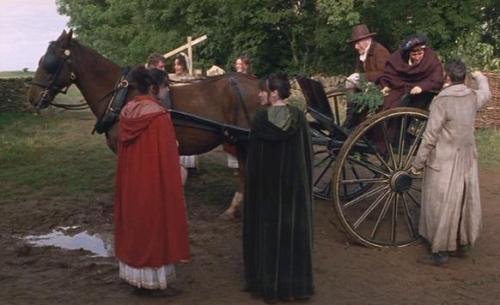
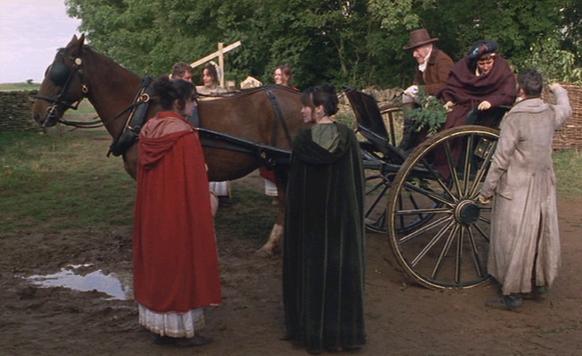
The party stops to talk to the Crofts

During their return walk from Winthrop, the party from Uppercross, which includes Anne Elliot and Captain Wentworth and a number of the Musgroves, encounter Admiral and Mrs. Croft in a gig. They offer a seat to one of the party. Everyone declines, except for Captain Wentworth, who has noticed Anne’s fatigue. He whispers something to his sister, then encourages Anne to join the Crofts in their two-seater for the rest of the way back to Uppercross (about one mile.) Anne is grateful for his thoughtfulness. But as she rides in the carriage, she hears Mrs. Croft warn her husband:

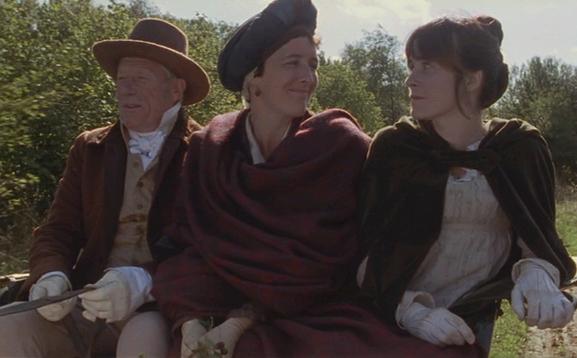
The Crofts and Anne Elliot crowded in a 2-man gig

My dear admiral, that post!–we shall certainly take that post.”

Jane Austen goes on to write:

But by coolly giving the reins a better direction herself, they happily passed the danger; and by once afterwards judiciously putting out her hand, they neither fell into a rut, nor ran foul of a dung-cart; and Anne, with some amusement at their style of driving, which she imagined no bad representation of the general guidance of their affairs, found herself safely deposited by them at the cottage.

The happy admiral is more than willing to allow his wife to steer the carriage alongside him, which many of us who have driven with “back-seat driving” spouses know is a rare attitude indeed!

In this famous scene by Jane Austen, the Crofts moved over to make room for Anne. Mary Musgrove would rather die from fatigue than be seen crowded in a humble gig, but Anne could only feel gratitude. She is beginning to understand that while Captain Wentworth is unable to forgive her for rejecting him, he is still a kind and decent man. He knows her well enough to see that she was tired and made arrangements for her. In these small observable progressions (as with taking the child Walter from her without comment), we see the Captain’s love for Anne come to the surface. It will take a little longer for his anger at her rejection to recede. See also Shopping and Milsom Street, Bath
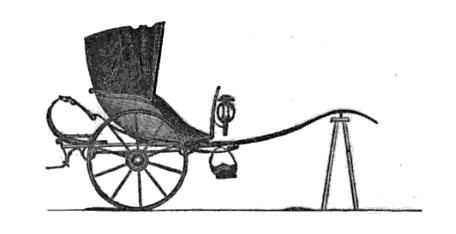
Light weight gig

About Gigs: Gigs were two-wheeled carriages equipped for one horse only. They were designed for two people, one of whom was the driver, and were considered carriages for the middle class, or for the “poorer” classes, who paid less duty on them. Because these carriages were light in weight and springy, they could be easily turned over, especially by a poor driver like Mr. Croft. Gigs were used by doctors, travelers, and people who made short journeys that would not fatigue the horse. Gigs evolved into cabriolets (early versions of cabs) Dennet, Stanhope, and Tilbury. The Stanhope was designed by Fitzroy Stanhope, the second son to the Third Earl Stanhope. This carriage became popular towards the mid-19th century for short trips between Town and the suburbs.
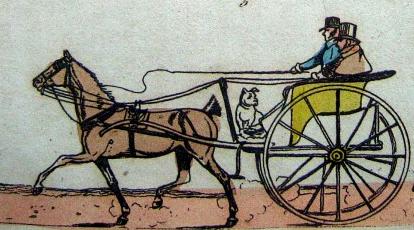
Road to a fight, detail by Henry Alken, 1821

The two men in this high perch phaeton show how precarious a light two-wheeled vehicle can be. One can see the difference between this “sporty” more expensive vehicle and the humble gig (above).