Feeds:
Posts
Comments

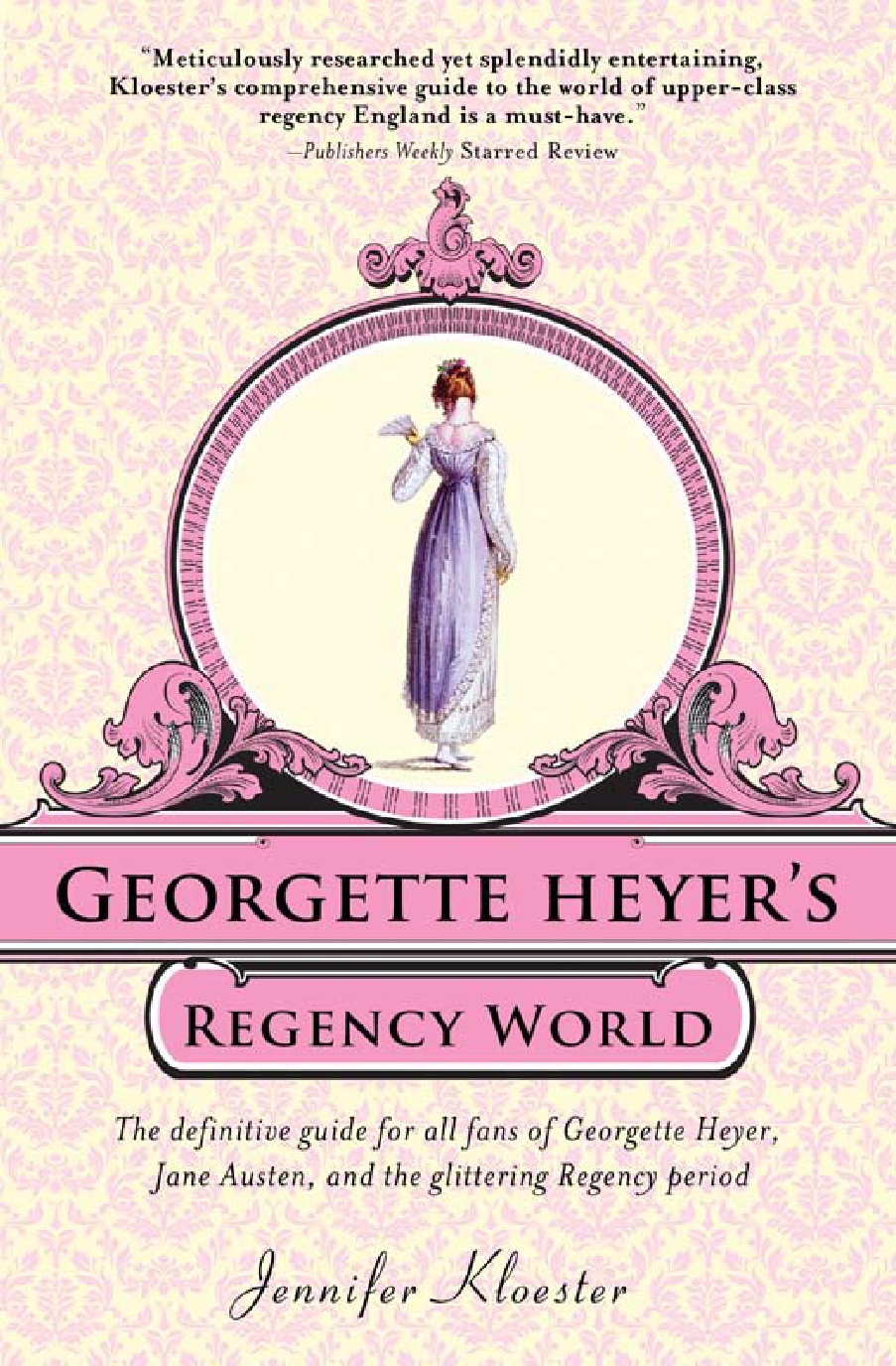
Georgette Heyer’s Regency World by Jennifer Kloester is available August 1.

This extremely interesting compendium of insights and knowledge came my way by One Who Knows how much a fan of Georgette Heyer and Jane Austen I am. Neatly organized into chapters by topic, Kloester provides basic information on the life upper class men and women lived in the Regency Era. Using the historical knowledge she accrued while writing her dissertation on Georgette Heyer, she provides the background on what the Regency was. In Chapter 14, she writes brief, pithy biographical sketches of the Royal family, as well as other real people who appear throughout the Heyer Regency books: Edward Hughes “Golden Ball” Hughes, Sally Jersey, Lady Castlereagh, George Bryan (Beau) Brummell, and noted authors of the day. Her sketches of the Royals are most helpful, for this was an era filled with Royal siblings, offspring and mistresses.

I also enjoyed the chapters on fashion and shopping; the sketches of the various outfits will be most helpful to those readers who do not have a strong foundation in the history of fashion. While men’s fashions began their evolution into the suits of today, women during the Regency enjoyed a rare period of less constriction and heavy underpinnings. Definitions and sketches of pelisses, morning and promenade dresses give good clues to what the characters wear.

Throughout the book, Kloester clarifies definitions by referring to some of Heyer’s Regency novels. So we are reminded that Abigail Wendover first appears to us in Black Sheep dressed in the latest thing in carriage dresses, and that Freddy Standen’s perfectly cut coat and satin knee breeches were identified as just the thing for an appearance at Almack’s. That fine institution of the Marriage Mart is also explained and clarified with references to Cotillion, The Grand Sophy, Friday’s Child, Regency Buck, and Frederica. These references give a nice context to a somewhat dry discussion, and keep the reader engaged in the book.

It is a helpful source of information for the fan of Heyer, for her books are set strongly within the period; Heyer was a meticulous researcher and avid historian. While she defines terms contextually, readers may need a little more information than Heyer provides. Kloester gives it in good doses, enlivened by references to books they may have read, or will be likely to read soon.

It is not, however, the definitive guide for all fans of Austen and Heyer it purports to be. Jane Austen does not set her books in the Beau Monde, or ton, as does Heyer, and her references to clothing, furnishings, and travel are sparse. She is writing in the period, not of the period, and is more interested in the people and their actions than the stuff of their lives. The book does not cite references beyond the mentions in the Heyer books, although Kloester does include an extensive list of resources for someone who wishes to pursue Regency research in Appendix 5. It is not a scholarly work, but an informative one. Her Heyer citations are helpful, if one has read the particular book, and only informative of where to find such an object or how the neck cloth is tied, if not. That being said, the book is filled with tasty little nuggets of information. I enjoyed her brief insights and explanations on the wide-ranging topics.

Reviewed by Lady Anne

Inquiring Readers: Lady Anne is my special friend. I have read Georgette Heyer since I turned 22, and I have read all of her books at least once. But Lady Anne has read Georgette Heyer novels every night for at least 30 years. She knows the plots and dialogs inside and out; and can name every character of all her favorite Georgette Heyer books, including the mysteries and histories. She graciously agreed to review Jennifer Kloester’s book while I tended to a family emergency.

Jane Austen’s World reviews of Georgette Heyer’s novels

For the month of August, join Austenprose‘s celebration of Georgette Heyer!

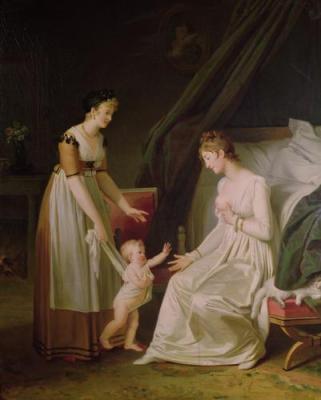
Breastfeeding mother, Marguerite Gerard

French artists Marguerite Gerard (1761-1837) painted this domestic scene of a mother about to breast feed her child.  The subject is unusual in that breasfeeding one’s baby was unfashionable for aristocratic and upper classes,  and the act had become associated with the poor and lower classes.

Generally, wet nurses were paid to feed the babies of the wealthy. Much thought and care went into their selection, and their milk was examined for texture, color, viscosity, and taste. Some thought that aspects of a wet nurse’s personality could be passed through her milk, and therefore her character had to be impeccable. Cassandra Austen, Jane Austen’s mother, sent all her children to the nearby village of Deane to be nursed in their infancy.  Although Cassandra Austen visited her babies daily, they did not return to the family fold until they were around 18 months of age.

The popularity of wet nurses stemmed from the fact that royalty often wanted large families. Wet nurses were hired to feed the newborn so that the royal mother would soon regain fertility and become pregnant again. When royals stopped breastfeeding their children, other women from wealthy families soon followed suit and began to farm their babies out to wet nurses.  This practiced continued until the end of the 19th century, when it largely died out.

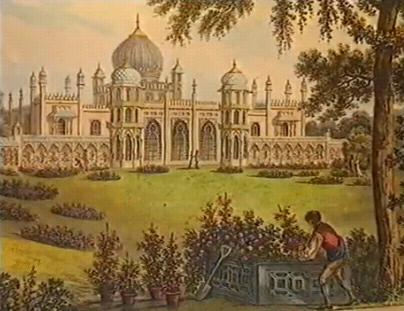
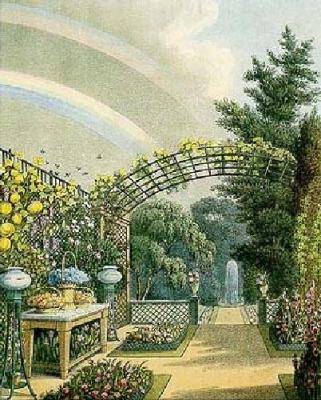
Repton's design for the gardens for the Royal Pavillion, Brighton

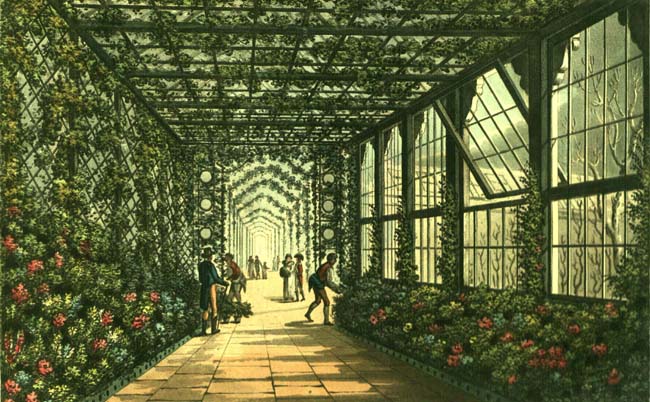
Sir Humphry Repton (1752-1818), who was mentioned in a previous post about the paint color Invisible Green was a famous landscape designer during the end of the 18th century and early 19th century. “In his day, [he]was equal in stature to Capability Brown or Gertrude Jekyll, but is now often-overlooked. However, he was once favoured by the Prince Regent (later George IV), drawing up plans for the Brighton Pavillion, as well as working at Woburn, in Londons Bedford Square, Sherringham in Norfolk and Ensleigh in Devon.”

This 1991 film about Repton’s career, which I found on YouTube and whose title I could not find, features Sir Michael Hordern as the narrator and John Savident as Repton. The special showcases Repton’s magnificent drawings for the redesign of many famous properties; some of his work can still be observed in their natural settings.

About the name: Is it Humphry or Humphrey? I have seen both spellings. The BBC spelled the name as Humprhey, whereas the National Portrait Gallery, Morgan Library, and the majority of sources use Humphry.

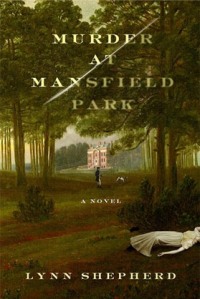
Consider this recipe for a modern Austenesque mystery: Take a familiar and beloved novel, Mansfield Park, with characters whose motives and actions we know intimately, and tear the book up. Throw the pages inside a bag, shake vigorously, and let the characters and plot fall where they may. Add a writer who has cooked up a complex plot for a delicious murder (or two or more, who knows?), and you have Murder at Mansfield Park, a truly hearty and satisfying new mystery novel.

Lynn Shepherd, the chef of this roman à clef, has by dint of her imagination turned  Jane Austen’s classic novel topsy turvy. The characters’ names are familiar, the setting is the same, some of the action as originally described by Jane Austen has been retained, and yet Ms. Shepherd has managed to create something new, refreshing and different.

I must admit to disliking mysteries in general, as many regular readers of my blog know. And I tend not to review Jane Austen sequels. But this novel is different. Oh, I was skeptical at first, slogging through the first chapter, trying to wrap my mind around the changes in the characters. And then I got caught up in the plot and became absorbed to the point where I could not put the book down.

Some red herrings are thrown into the mix, but not so many as to make the reader angry. The plot’s denouement was more than satisfactory and made logical sense. I suppose a true mystery fan might have guessed the killer sooner. Truth be told I held off guessing, for I wanted to be surprised, and so I was.

That Murder at Mansfield Park is Lynn Shepherd’s first novel is most surprising. Her writing style is lovely and effortless as she weaves several plot elements into a seamless whole. Rather than copy Jane Austen, Ms. Shepherd uses Mansfield Park as a take-off point. This novel is intelligently written and assumes that the reader has some command of the English language and enough background knowledge in history, Jane Austen, and other subtle historical and social references to understand the numerous references that crop up.

I give Murder at Mansfield Park six regency fans, my highest rating ever.

Post script: Gentle reader – If you are curious to learn more about Lynn’s novel after reading my review, be forewarned. Many reviewers have spoiled the plot by giving away too much of Lynn’s changes while gushing about them. Honestly, does no one take Review a Novel 101 any more? One irresponsible reviewer of a major online news publication even gave away who was murdered, ignoring the fact that half the fun of this mystery is guessing who the victim will be. So be careful, wary reader, of careless reviewers who do not even bother to place *Spoiler Alert* at the top of their reviews.

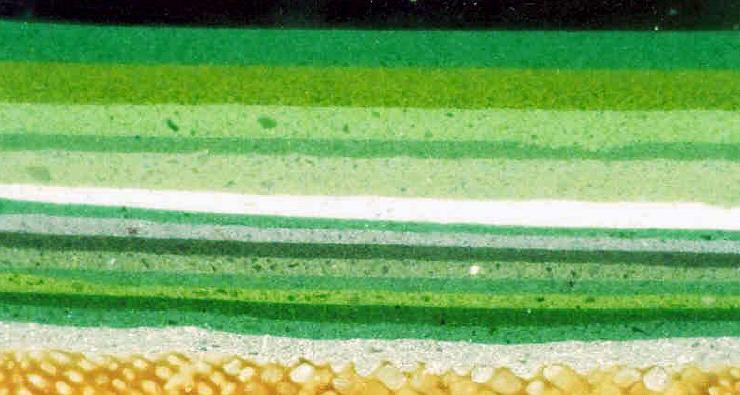
Inquiring reader: This is the second post by historical paint expert Patrick Baty of Papers and Paints, who has carried out extensive research into the use of pigments in architectural and decorative paintings. He has kindly answered a question about the paint color “invisible green,” which was left on his previous post, Painting a House During the Regency Era.

Invisible Green was a favourite of Humphrey Repton, the famous landscape designer of the Georgian/Regency eras. (The image above shows his trellises painted in a dark, rich green.)

William Mason, in his poem “The English Garden” published in 1783, provides us with a very early reference to the Picturesque treatment of fences and to the colour that became know as “Invisible Green”. He describes in verse the preparation of a dark green oil paint based on yellow ochre and black with white lead. Great care was required in mixing the right colour:

‘Tis thine alone to seek what shadowy hues
Tinging thy fence may lose it in the lawn…”

and he concludes by saying:

the paint is spread, the barrier pales retire,
snatched as by magic from the gazer’s view”.

Patrick Baty, Green Schemes, Garden Door, Scottish Estate

In 1808, James Crease, the Bath colourman, described “Invisible Green” as a dark green:

so denominated from its being proper for covering gates and rails in parks, pleasure grounds, etc. by rendering them in a measure invisible at a distance on account of its approximation to the hue of the vegetation”.

In 1829, T.H. Vanherman, the London colourman, described Invisible Green as follows:

“The Invisible Green is one of the most pleasant colours for fences, and all work connected with buildings, gardens, or pleasure grounds, as it displays a richness and solidity, and also harmonizes with every object, and is a back-ground and foil to the foliage of fields, trees, and plants, as also to flowers.”

One of my early projects was at Uppark, where the young Emma Hamilton is alleged to have danced naked on the dining room table.  The wonderful Lucy Inglis has written very well in her blog Georgian London about the concept of prostitution in the eighteenth century in Frances Barton – Alimony and Acting: The Life of Nosegay Fan.

More information on this topic:

Second image by Sir Humprhy Repton of a garden building for the Royal Pavillion at Brighton. The design was not used.