Feeds:
Posts
Comments

 Inquiring Readers,

This post examines the fortunes of the Austen family via the number of servants they employed for the students and family members who lived in Steventon Rectory, and the servants they took with them after Rev Austen’s retirement, and then after his death. The topic is fully described in Linda Robinson Walker’s 2005 Persuasions-Online article, Why Was Jane Austen Sent away to School at Seven: An Empirical Look at a Vexing Question. After reading this short summary of her remarkable essay, I encourage you to click on the link above.

SteventonRectory-Wikipedia

Steventon Rectory, Public Domain, Wikipedia

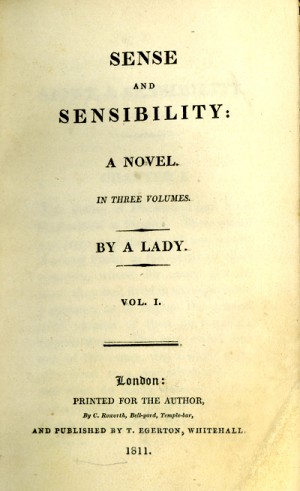
Jane Austen scholars, readers, and fans know about her preoccupation with a single woman’s finances. She wove this topic masterfully into her novels. Women during her era (with very few exceptions) depended legally on their menfolk to see to their financial security. Many widows and spinsters, like Jane and her sister Cassandra, lived as total dependents, even though to our modern eyes some lived in the lap of luxury. Emotionally for Jane, this was not the case. A single woman’s financial security was never ensured. Witness Jane’s life before her father’s death and her quest for financial security afterward when she actively sought to earn some financial security through her writing. This was an uphill battle. Women in Jane’s social position who earned money through “work” were frowned upon, hence, during her lifetime, her novels were credited anonymously to “a lady.” 

ss-title-page-first-edition

First Edition, 1811, public domain image

Despite her financial worries about her future as a spinster, Jane enjoyed a life of relative privilege due to her status as a gentlewoman and the people with whom she associated. The Austen family belonged to a landless class known as the pseudo-gentry. 

Cassandra Austen née Leigh

Jane’s mother, Cassandra Austen, was a distant relative of the Leighs of Stoneleigh Abbey. By the turn of the nineteenth century the Abbey was worth around £19,000. (In 1764, £19,000 was equivalent in purchasing power to about £4,433,593.38 today, an increase of £4,414,593.38 over 259 years. The pound had an average inflation rate of 2.13% per year between 1764 and today, producing a cumulative price increase of 23,234.70%.- CPI Inflation Calculator)

Cassandra Leigh’s distant relative was Sir Thomas Leigh, the Lord Mayor of London under Queen Elizabeth I. “For assisting the Royalists against Cromwell in the English Civil War, Leigh was created a baron in 1643.” – Regina Jeffers

Despite her impeccable lineage, Cassandra benefited very little financially from her family. Her father, Thomas Leigh, was the rector of Harpsden, near Henley-on-Thames in Oxfordshire, and his means were modest compared to his richer relations. Her brother, James Leigh, added Perrott to his name when he inherited the estate of his rich great uncle, Thomas Leigh. This uncle and his heir largely ignored Cassandra and her family (most notably Jane and her sister Cassandra) in their wills. More about Cassandra’s ancestry can be found in this genealogy link

George Austen, Rector

George Austen was a smart, ambitious, self-made, and enterprising man. His mother died in childbirth and his father died a year after marrying a new wife. The widow did not want the responsibility of taking care of George and his sister Philadelphia. When he was nine years old he was separated from her, and taken in by an aunt in Tonbridge. He then earned a Fellowship to study at St. John’s. His impressive education was quite unusual for an orphaned boy with modest means, but he had an important connection – his uncle Francis Austen II, who lived in Sevenoaks, Kent. With his uncle’s support and influence, George received three degrees at Oxford: Bachelor of Arts, Master of Arts, and Bachelor of Divinity. (Discovering the Young Jane Austen in West Kent, England — Sheila Johnson.com.) 

Thomas Leigh died just a few months before the wedding of Cassandra and George … In the strictly snobbish sense, George was marrying above himself, and Thomas may have doubted whether George was good enough for his daughter. – Maggie Lane, p 52

Through his education and his influential connection, George became a cleric of the Church of England and rector of Deane and Steventon in Hampshire. As a rector, his Anglican clerical position was higher-ranking than a vicar’s (think of Mr Elton in Emma, who was desperate to marry a woman of means). And so George earned a respectable position that gave him the opportunity to finance his burgeoning responsibilities. Thankfully, he had a supportive and hard-working wife.


The Austens support of their burgeoning family, and students and servants

The position of rector made George far from a wealthy man. To stay out of debt, he farmed an allotment of land that came with the parishes of Steventon and Deane. He also rented Cheesedown Farm from his Uncle Francis, where he grew food to feed his family, and sold the surplus for profit. George also started a boarding school for boys. With the income from his lands, the tithes, and tuition from male students, the Austens supported their growing family of eight children, as well as the servants required to help with household and farming duties. According to Robinson Walker:

“In 1781 and 1782 the Austen household was bursting with as many as twelve young people – which included the Austen children and pupils. In the four years between 1779 and 1782, as many as sixteen to twenty-two people made their home in the rectory.”

Then, in 1783,  Edward was adopted by the Leighs, and Cassandra and Jane were sent to boarding school. This alleviated the burden of feeding so many mouths. Robinson Walker surmises that these two events opened spaces for 4-8 additional students inside the rectory, attracting much needed income. One can only imagine the emotional effect on Jane at the tender age of nine when she left her beloved home to follow her sister to a boarding school, if even for only a year.

Number of Servants

The increase in students necessitated a change in servant numbers. 

The servants employed at the time Jane was sent away to school in 1783 were enough to fill the attics. With the attics filled by the servants, the rest of the household occupied seven bedrooms. Robinson Walker Provides an idea of the number of people at Christmas in 1786:


“One hint of the number that could squeeze into the rectory, albeit for a brief period, is given by Mrs. Austen when she enumerated the thirteen present for Christmas celebrations in 1786:  herself and Rev. Austen; five of their children; Mr. Austen’s sister, Philadelphia Hancock; Hancock’s daughter, Eliza de Feuillide and her young son with his French maid, and the two motherless Cooper children (Le Faye 54).  In addition, there would have been the Steventon servants.” 

The author provides extensive descriptions from contemporary sources about the number of rooms in the Rectory. These come from the memories and writings of family and visitors, with some variations in their recollections. Catherine Austen Hubback, Jane’s niece, never saw the rectory. She simply quoted her father, Frank, and others who she recalled that “The Parsonage consisted of three rooms in front on the ground floor—the best parlour, the common parlour and the kitchen; behind these were Mr. Austen’s study, the back kitchen, and the stairs.”  She also mentioned “seven bedrooms, and three attics. The rooms were low-pitched, but not otherwise bad, and compared with the usual stile of such buildings, it might be considered a very good house.” 

Anna, another niece, had actually lived in the rectory. She recalled a number of personal details, including her grandfather George’s study which was secluded in the back of the house, far from household activities. The dining room and common sitting room were situated next to the front door. This door opened into a smaller entrance parlour, where Cassandra Austen would greet her visitors.

The kitchen was most likely situated in the southwest wing of the house over a cellar that stored foodstuff. 


“The southwest wing is also dominated by a broad fireplace and tall chimney, suggesting that it was used for cooking, roasting, and baking.  A kitchen on that side of the house would also be near the outbuildings which we know included not only the granary, but a dairy, hen house, stables, and other farm buildings.  The glebe map and Anna’s footpath both indicate that these buildings lay to the west of the house.” – Robinson Walker 

Robinson Walker admits to not knowing the precise number of servants who lived at the parsonage. There were servants who lived in their homes and came when required, such as the washer women, cleaning ladies, George’s bailiff, and male farm laborers. Some servants, due to circumstance, might have had to stay overnight – especially if the lady of the house was ill disposed or during canning and food preparation seasons. Temporary tutors (music, painting, and dancing) might have needed one or two nights’ lodging before moving on. 

The number of servants who stayed at the rectory during certain events is covered extensively in Robinson Walker’s article. Her tables take into account the number of people living in Steventon Rectory from 1775 (Jane’s birth year) to 1779 (when George Austen stopped teaching.)

“In a letter to Cassandra, Jane wrote fondly of Nanny Littlewart dressing her hair. Nanny is Anne Littleworth, who fostered Jane and Cassandra when they were quite young. Jane mentions as many as nine servants in her letters in 1798. The laundry, for example, “was to be handed over from Mrs Bushell to Mrs Steevens; there was a new maid: ‘we have felt the inconvenience of being without a maid so long, that we are determined to like her.” (Worsley, p.95.)

After Rev Austen retired in 1801, the number of servants the family employed when they moved to Bath was reduced dramatically. The number of servants they took with them reflected the size of their new townhouse and reduced financial situation. 

The Austens kept a fairly constant ratio of one live-in servant per family member. When vacationing in Lyme Regis in 1804, Jane and her parents (Cassandra was at Godmersham) traveled with 4 servants:  Molly, Jenny, a cook, and a manservant named James, of whom she wrote to Cassandra. “My Mother’s shoes were never so well blacked before, & our plate never looked so clean.”

Just four years after his retirement, George Austen died unexpectedly. With the loss of his income, Mrs Austen and her daughters downsized into more affordable townhouses. The women now relied on monies that the Austen sons were able to share with them. After two years, Mrs Austen, Cassandra, Jane, along with good friend Martha Lloyd, moved into a house in Southhampton.

In a letter written in January 1807, Jane mentioned three maidservants:  Molly, Jenny and Phebe. Shortly thereafter she reported that a Mrs Hall assisted in moving them in, and the addition of a gardener. 

At Chawton Cottage, which was Jane’s home from 1809 until her death in 1817, two maidservants roomed with them. The women also kept a cook and a manservant. During the Chawton years, Cassandra and Jane were often separated, with Cassandra frequenting Godmersham and Jane visiting her brother Henry in London. One imagines that the number of servants the women hired were just the right amount for their modest lifestyles. Robinson Walker followed the Austen family’s up and down fortunes through the number of servants they employed in a wide-ranging and fascinating account.

More on the topic:

Jane Austen in Vermont, The Saga of the Steventon Parsonage

Jane Austen’s World, Keeping a Clean House Regency Style

Jane Austen At Home, Lucy Worsley, St. Martin’s Press, NY, 2017


By Brenda S. Cox

“Mr. Murray’s Letter is come; he is a Rogue of course, but a civil one. He offers £450-but wants to have the Copyright of MP. & S&S included. It will end in my publishing for myself I dare say.–He sends more praise however than I expected.”–Jane Austen to Cassandra, Oct. 17, 1815, about her new publisher, John Murray, wanting to buy the copyrights of Emma, Mansfield Park, and Sense and Sensibility. She self-published instead.

Publishing Choices Today

Having recently published my own book, I’m very aware of the choices authors have today. We might publish through a traditional publisher, who pays all the costs of publishing, gives the author a percent of the profits (perhaps 5-18%, usually on the lower end), and possibly an advance against those profits.

Or we might self-publish, paying all the expenses ourselves, and getting most of the profits. A range of variations fall between those options.

“Hybrid” authors do some of both, selling some of their books through traditional publishers and self-publishing others.

The author generally keeps the copyright, while assigning certain rights to the publisher, though in some situations, like work-for-hire, the author may agree to sell the copyright to the publisher.

Publishing Choices in Austen’s England

In Jane Austen’s England, authors also had essentially two options. They could sell their copyright to a publisher for a lump sum. The publisher would then bear all the expenses and take all the profits.

Or, the author would publish the book on commission, which was more similar to self-publishing today. The publisher would publish the book, paying the expenses of publishing and distribution. However, the author had to repay the publisher those costs out of the income from the book, plus a commission of about 10% of sales. If the book did not make enough money to cover the costs, then the author had to pay the publisher the rest of the costs out of his or her own pocket.

Jane Austen was what we might today call a “hybrid” author, taking both options. She sold the copyright of two of her books to publishers. The others she published on commission, essentially self-publishing them.

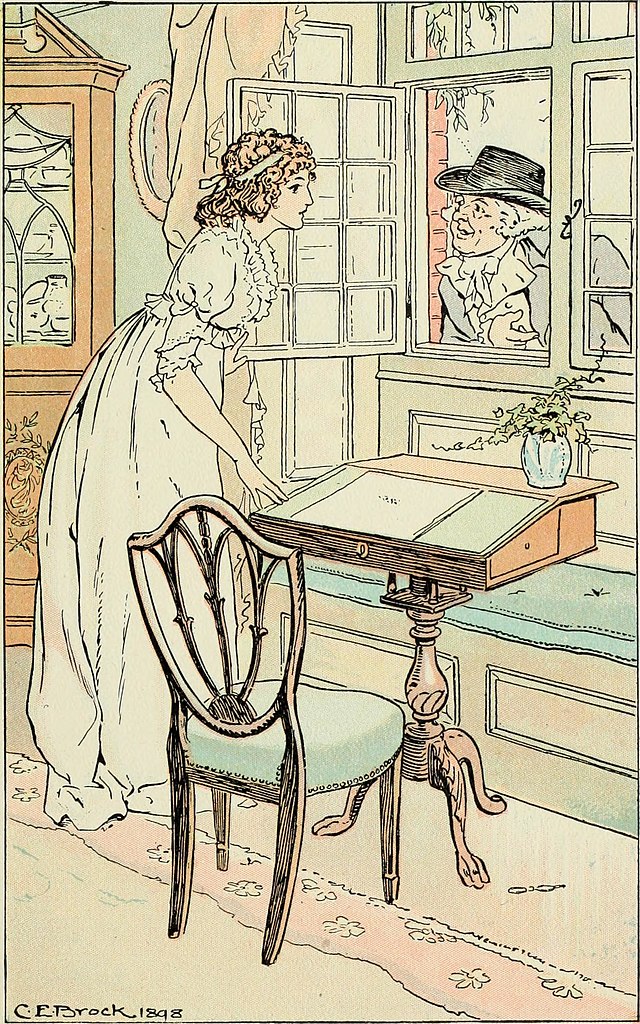
Jane Austen wrote her manuscripts with quill and ink at a desk similar to this, from a C.E. Brock illustration for Sense and Sensibility.

How Jane Austen Chose to Publish Her Books

Hybrid Publishing

The first book Jane Austen sold to a publisher was Susan, which was later published as Northanger Abbey. Like today, agents helped to place books with publishers. Jane’s brother Henry usually acted as her agent. But for this first book, Henry’s lawyer, William Seymour, was the agent who sold the copyright to publisher Benjamin Crosby on Jane’s behalf, in 1803 for £10. Crosby advertised the book once, but never published it. In 1809, Jane attempted to get the manuscript back from Crosby, in a letter in which she signed herself as M.A.D. (Mrs. Ashton Dennis). Crosby threatened to take legal action if she tried to publish the book herself, and he demanded the £10 back. Jane didn’t have that money, which would have been half her annual allowance.

Finally, in the spring of 1816, Henry, acting as her agent himself, bought it back on her behalf for the £10. Austen revised it and changed the name, since a novel called Susan had come out in the years in between. (Modern authors still have to watch for novels with the same name as theirs.) She added a preface apologizing for its being out of date. It was not published until after her death, when Henry got it published on commission.

Publishing on Commission (similar to today’s Self-Publishing)

Austen’s second book to be accepted for publication, and the first that was actually published, was Sense and Sensibility. Her brother Henry, acting as her agent, got the publisher Thomas Egerton to publish it. Out of the profits, Jane had to pay for the production, advertising, and commission. Fortunately it did well. If it had not, she might have had to pay as much as £180, which she certainly could not afford. She had faith in this “baby,” though. In a letter in 1811 (April 25), when she was correcting the proofs of Sense and Sensibility, she wrote to Cassandra, “I am never too busy to think of S&S. I can no more forget it than a mother can forget her sucking child.”

Egerton printed 750 copies in October, 1811, a large print run for a first-time author. Two positive reviews launched it well, and by July, 1813, the copies were sold out and Jane had earned £140 pounds in profits. A second edition was published in October, which continued to give Jane income until 1817.

Sense and Sensibility was published on commission, with the author responsible for costs, in 1811.

Selling the Copyright (more like modern, traditional publishing)

Unfortunately Jane Austen did not make such a good choice for her second published novel, Pride and Prejudice. Perhaps she had been discouraged because her father had previously offered it to a publisher, who chose not to look at it. (Though I must say, her father wrote possibly the worst query letter ever! All it told the publisher was that the novel was about the length of Burney’s Evelina, with no further information. They declined to see it.)

In any case, rather than again risking money she didn’t have, she sold the copyright of Pride and Prejudice to Thomas Egerton. Based on the success of Sense and Sensibility, they paid her £110. Then they paid all the costs of publishing and took all the profits. Egerton published the first edtiion in January of 1813, a second edition that fall, and a third edition in 1817. They made much more money than Jane did on Pride and Prejudice, which of course was quite popular.

Novels were normally published in three volumes. (This made it easier for circulating libraries to lend them out.) This third volume of Pride and Prejudice, published in 1813, begins with Elizabeth and the Gardiners approaching Pemberley.

Back to On Commission (which Austen calls publishing for herself)

For the rest of her books, Jane went back to taking the risk of publishing on commission, where she was responsible for the costs.

Mansfield Park was published on commission in May of 1814. The first edition sold out in six months. She made somewhere between £310 and £340 on it.

Emma was published in December 1815 (dated 1816). Austen turned to a more prominent London publisher, John Murray, to publish Emma. This may have been because Egerton did not want to do a second edition of Mansfield Park, or possibly because Murray was more prestigious. (Egerton was basically a military publisher; Henry apparently had connections there.) Murray offered to buy the copyrights for Emma, Sense and Sensibility, and Mansfield Park, for £450 total. Austen thought this was too low. She wrote to her sister telling her of Murray’s offer, saying he was “a Rogue of course, but a civil one” (Oct. 17, 1815).

So Jane Austen published Emma and a second edition of Mansfield Park on commission, paying the costs herself. She and the publisher decided to print 2,000 initial copies of Emma, Austen’s largest initial print run. Unfortunately, Mansfield Park did not sell well this time, and only about three-quarters of the copies of Emma had sold by February, 1817. At that point, after taking out the costs for publishing both books, Austen received only £38.18.

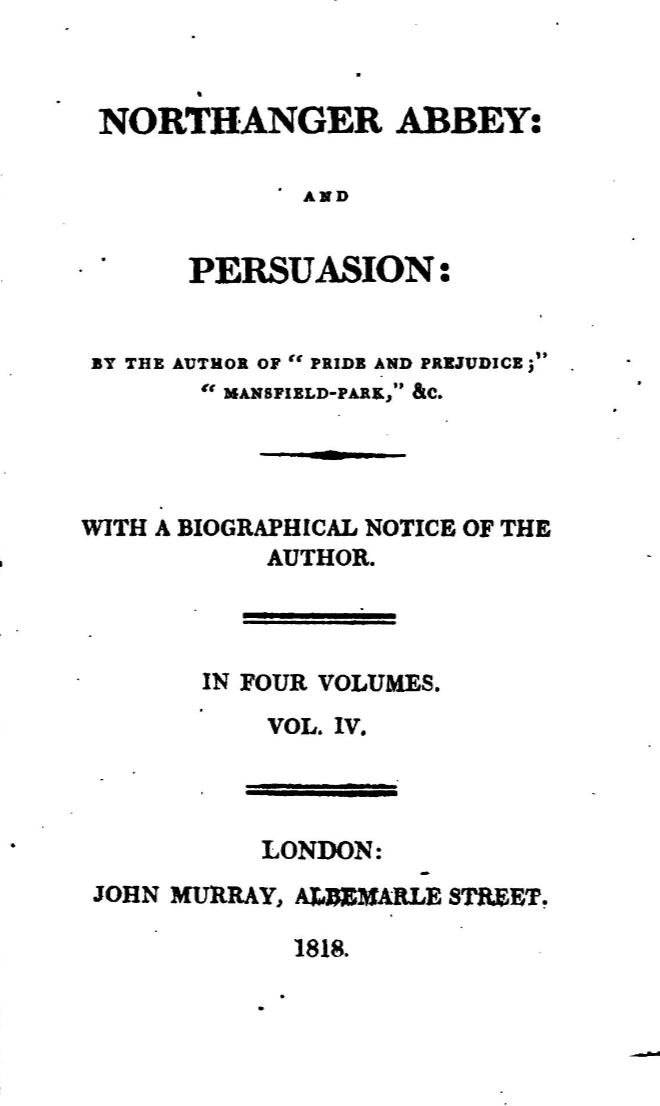
Northanger Abbey and Persuasion: When Jane Austen died in 1817, she left her manuscripts and copyrights to her sister Cassandra. Cassandra and Henry negotiated with John Murray to publish her last two complete novels, Northanger Abbey and Persuasion, in a four-volume edition at the end of 1817 (the books were dated 1818). This included a biographical notice of the author, written by Henry. He publicly revealed for the first time that Jane Austen was the author of all six novels. (The others were identified as “by a Lady” or “by the author  of . . .” the previous books.) Further income from the books went to Cassandra.

As two shorter novels, Northanger Abbey and Persuasion were published together in four volumes, with Henry’s “biographical notice” revealing his sister’s identity as author.

So, Jane Austen essentially self-published her novels, in terms of the expenses. The notable exception was Pride and Prejudice, for which she sold the copyright, taking less risk but substantially reducing her profits. Her first foray into selling a copyright was even more unsuccessful, since the publisher didn’t even publish Northanger Abbey. However, they were no doubt chastised when Henry, after buying back the manuscript, gleefully informed them that it was by the author of Sense and Sensibility and Pride and Prejudice!

Risks and benefits were as hard to gauge back then as they are now.

A professor writing for the British Bank has estimated that Jane Austen’s lifetime income from her books was around £631 before tax, or £575 after tax. That’s just a little more than the average yearly salary for a country clergyman. It’s hard to make clear comparisons to today, but one estimate claims it is equivalent to over £45,000 in today’s money, or about $56,000.

Not too bad for an obscure clergyman’s daughter from the countryside. She would have been glad to know that continued profits from her books helped support her beloved sister.

Jane Austen’s Published Books

Title

Written/Revised

Published

Publisher

How?

Income during Austen’s lifetime

Sense and Sensibility (originally Elinor and Marianne)

1795 as letters, 1797 as narrative/1809-10

Oct. 1811; 1813

Egerton

commission

£140 + income from second edition

Pride and Prejudice (originally First Impressions)

1796-7/1811-12

Jan., 1813; fall, 1813; 1817

Egerton

Sold copyright

£110

Mansfield Park

1811-13

May, 1814; 1816

Egerton; Murray

commission

£310 – £340 on first edition

Emma

1814-15

Dec. 1815 (title page says 1816)

Murray

commission

£38.18, after paying for losses on second edition of MP

Northanger Abbey (originally Susan)

1798-9 /1803/1816

Dec. 1817, title page dated 1818

Murray

Sold copyright to Crosby, 1803, £10; bought back in 1816

Posthumous publication, benefited Cassandra

Persuasion

1815-16

Dec. 1817, title page dated 1818

Murray

On commission with Northanger Abbey

As above

Do you want to know how the books were made and circulated? This series by historian Kathryn Kane, beginning with “The Making of Regency Books,” answers that question. It was a huge job to produce a book, with most of the work done by hand. And books were very expensive. Most people could only afford to get them from circulating libraries, if at all. So the discussions of the libraries of Netherfield and Pemberley emphasize the wealth of the Bingleys and Darcys. Novels were published in three volumes, at an average of seven shillings per volume. The equivalent price today for one three-volume novel would be $90!  For about the same price, readers could join a circulating library and read as many novels as they wished, a volume at a time.

Kane finishes with a deep dive into Sense and Sensibility’s writing and publication. 

Most importantly, in the long run, Austen’s books were published. The manuscripts were not left to moulder somewhere due to lack of money or publishers. Because Jane got them published, they were republished, again and again through the centuries, and give us much joy today!

Sources

Jane Austen’s Works 

Jane Austen’s Income 

Jane Austen Statistics 

Brenda S. Cox is the author of Fashionable Goodness: Christianity in Jane Austen’s England

As we continue to analyze Jane Austen’s novels and identify the best romantic tropes used in each one, we’re well on our way to proving that Austen not only used romantic themes ingeniously but also played an important role in developing several key plot devices that are regularly used in modern filmmaking today.

Last month, I wrote about Rom Coms and Emma. This month, I’m delving into Mansfield Park and finding the romantic themes found in the novel that are commonly found in romantic movies today.

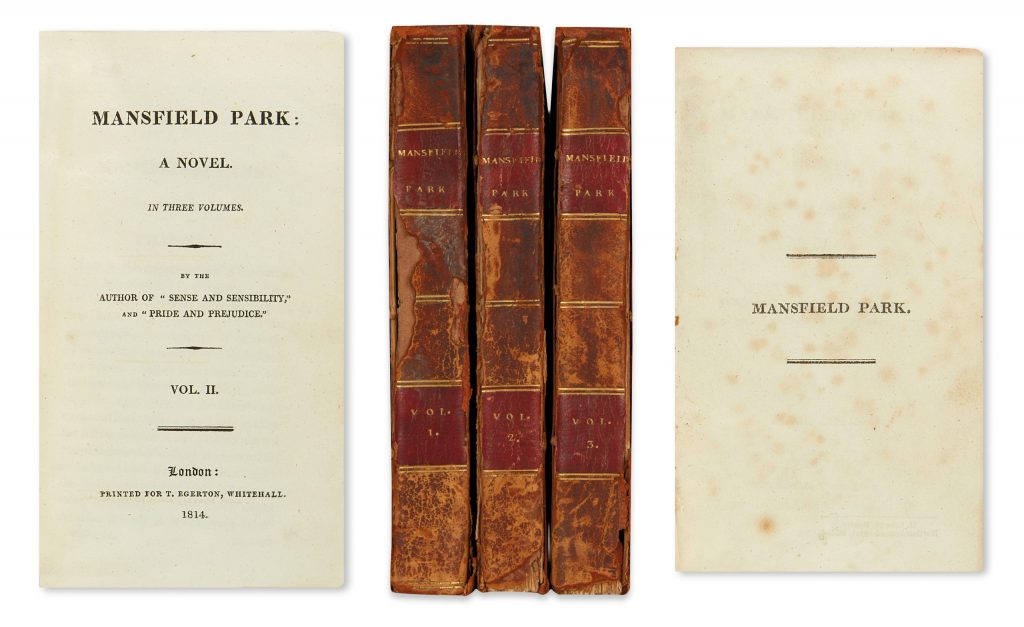
Mansfield Park, 1st Edition, 1814, Swann Auction Galleries

Romantic Themes in Mansfield Park

In Mansfield Park, there are several themes that ring true as romantic tropes we’re familiar with today:

The Ugly Duckling-Turned-Swan (aka the “Make-over”)

Following this train of thought, we see Fanny Price blossom and come into her own in MP. Her transformation isn’t necessarily outward. She doesn’t exactly go to the mall and get a makeover, but she does come out of her shell and begin to stand on her own two feet.

The “makeover” in this novel is actually a bit inverted because while Fanny later gains some of her own agency and confidence, the real change that occurs is that the people around her finally see her for who she really is and start to value her!

The Diamond-in-the-Rough

Adjacent to the “ugly duckling” theme, many rom coms play with the idea that the main character is wonderful just as she is, but she is overlooked, shy, or overshadowed by other characters. There’s usually an “a-ha” moment where one or more characters finally see the main character in a new way.

In MP, Edmund and his family members finally wake up and see Fanny for her true worth. Miss Crawford is the shiny object that distracts Edmund from much of the novel from seeing Fanny’s quieter brilliance.

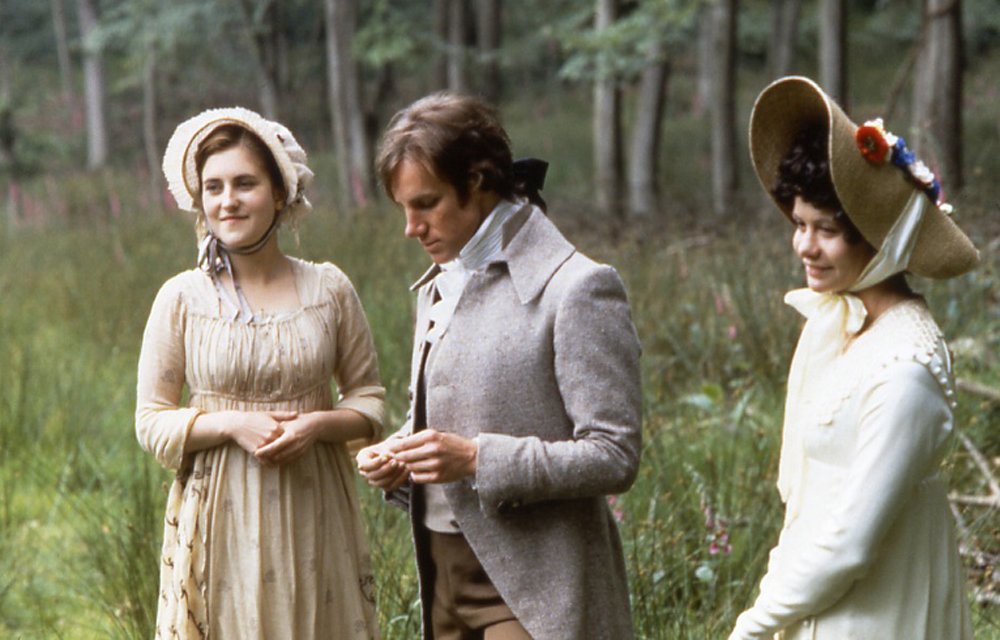
Mansfield Park (1983)

Red Herring (aka, the Shiny Object)

Similar to the chemistry and relationship between Emma and Mr. Knightley (and the Frank Churchill distraction), there’s a red herring (or several) in Mansfield Park as well.

In The Take’s “The Rom Com Explained,” we find this explanation of the red herring theme: “Rom-com leads often start out with a red herring love interest who seems very appealing but turns out to be all wrong. Meanwhile, as the protagonist spends time with someone they aren’t actively trying to impress, they can be their unfiltered self and get to know the other person in a real way. This long-developing chemistry leads to a moment of epiphany, where the character suddenly realizes the feelings that have been crystal-clear to the viewer all along.”

In Mansfield Park, the arrival of Henry and Mary Crawford (siblings) is the pebble thrown into the pond at Mansfield. This disrupts the regular rhythm of life for Fanny and Edmund and the rest of the Bertram family and sets the plot spinning.

Henry throws a wrench into several plot lines, while Mary comes between Fanny and Edmund. Edmund, dazzled by Mary’s beauty, is blinded by Mary and only sees her through rose-colored glasses. Fanny waits in the wings, heart aching, as he falls for Mary.

Mary, similar to Wickham, Willoughby, and others, is the “shiny object” that keeps Edmund distracted and causes havoc for Fanny. Fanny cannot prove what she thinks is wrong with either of the Crawfords. She has no other recourse but to wait patiently until Mary and Henry both show their true colors.

Mansfield Park (2007)

Best Friends-to-Lovers

Of all the themes in rom coms used today, Best Friends-to-Lovers is one of the most popular and it fits Mansfield Park beautifully. While Emma and Mr. Knightley have a bit of this vibe, much of their chemistry comes from their sparring matches (like Elizabeth and Darcy). But with Fanny and Edmund, they are incredibly close friends who share many of the same interests, qualities, and values. Edmund is the first person to take an interest in Fanny when she comes to live at Mansfield.

If you think of MP as a new school, Fanny is the new kid and the popular kids won’t talk to her or play with her. Edmund is different. Edmund helps Fanny when she is sad and lonely. At first, she looks up to him, but as they grow up, mutual respect and affection grows. Later, at least for Fanny, love begins to bud.

The Love Triangle

As in most Austen novels, there’s a love triangle, which is probably the most popular trope in most romantic comedies today.

In Mansfield Park, there are multiple love triangles, but we don’t see all of them at first. The one we focus on most is the Fanny-Edmund-Mary triangle. While Fanny hides lovelorn feelings for Edmund, Edmund doesn’t see Fanny as more than a friend/cousin he grew up with. Miss Crawford comes to town at exactly the wrong moment and steals the show.

Until Edmund sees Miss Crawford for her true self, he is blinded by her alluring personality and beauty and cannot see Fanny standing right in front of him.

Love Triangles similar to Mansfield Park

When I started looking for modern movies with similar themes (Best Friends-Turned-Lovers, Ugly Duckling-Turned Swan, Unrequited Love), I posted questions on my Instagram account (@KindredSpiritBooks) and on the Jane Austen Fan Club on Facebook. I received dozens and dozens of answers to this intriguing question!

If you’ve ever wanted to know what themes come up most often in movies, take a look at this list; it’s the longest list I’ve had yet in this series. There’s no denying that movie-goers respond well to love triangles—especially when the triangle involves two close friends finally realizing their love for one another!

The Holiday, 10 Things I Hate About You, 13 Going On 30, A Cinderella Story, A Walk to Remember, Always Be My Maybe, America’s Sweethearts, Can’t Buy Me Love, FRIENDS (Chandler and Monica), Crossing Delancey , Drive Me Crazy, Easy A, Ever After, Get Over It, Grease, He’s Just Not That into You, Love and Basketball, Love, Rosie , Made of Honour, Maid in Manhattan, Miss Congeniality, Moonstruck, Never Been Kissed, Pretty in Pink, Pygmalion (My Fair Lady), Sabrina, She’s all That, She’s the Man, Sixteen Candles, Some Kind of Wonderful, Something Borrowed, Superman, The Duff, The Office (Jim and Pam), The Perfect Man, The Princess Diaries, The Summer I Turned Pretty, The Truth About Cats & Dogs, Trojan War, Whatever It Takes, While You Were Sleeping, Wild Hearts Can’t Be Broken, Win a Date with Todd Hamilton, Yesterday, Your Place or Mine.

Always Be My Maybe
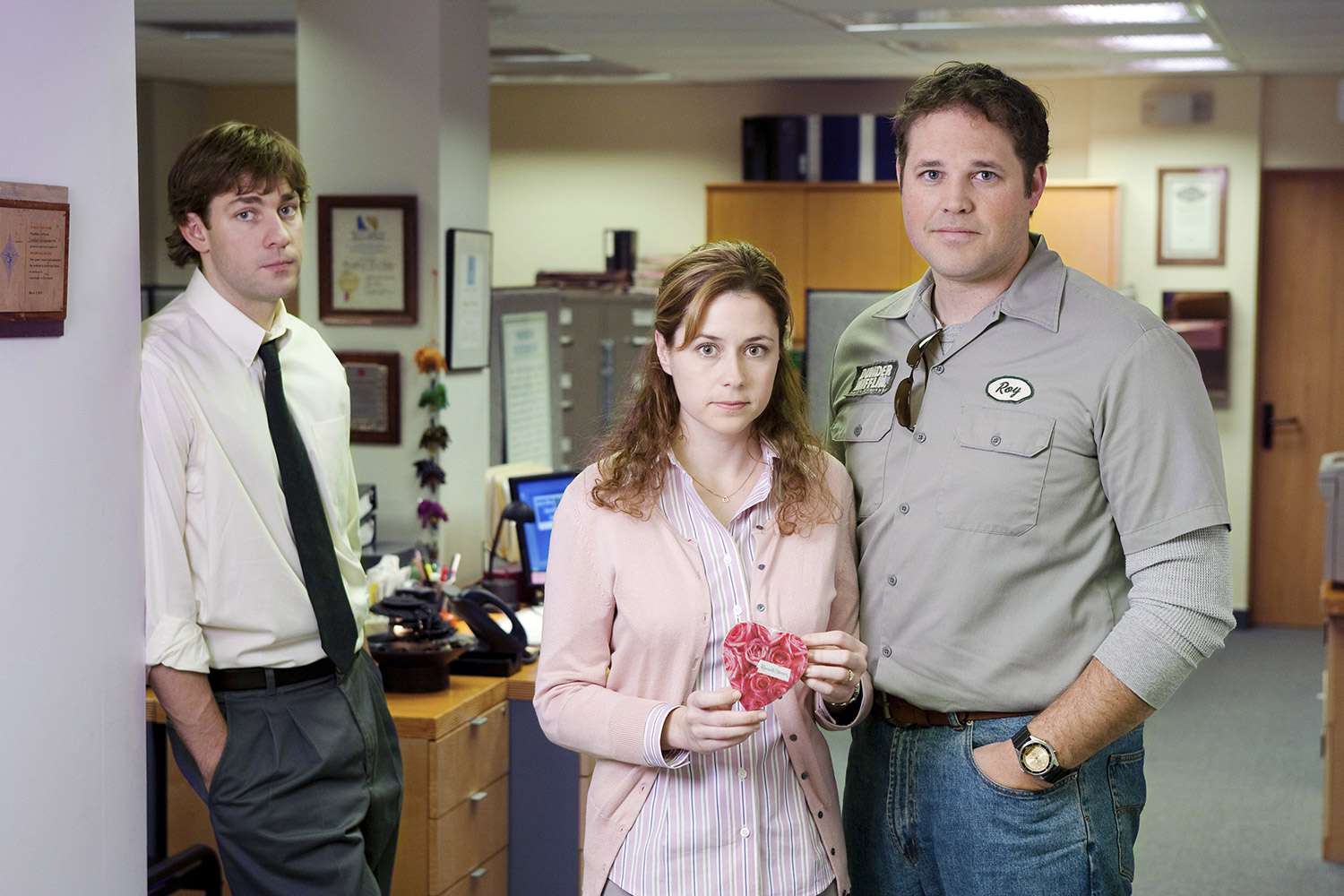
Jim, Pam, and Roy from The Office

When asked what themes they saw in Mansfield Park that are common in romantic films today, several fans quipped, “The Cousins-to-Lovers” theme? Which made me laugh out loud. Yes, cousins did marry cousins during Austen’s time, but it’s still a funny remark.

I’m sure you can add others to this list! In each of these movies, there is some element of MP present.

Fanny Price

When I took these polls, the one thing everyone agreed on was this: We like Fanny Price because she doesn’t change her morals, her convictions, or her personality just to gain acceptance or love. She does blossom, but she doesn’t change. She is the same through-and-through, which makes her a very admirable heroine. Edmund finally wakes up and begins to see her in a new light, but she doesn’t become more like Mary Crawford; she remains steady, true Fanny.

Fanny has a lot to lose in terms of a future when she refuses to give in to Henry Crawford’s proposal and her uncle’s pressure. Without an inheritance of her own, her only options are to continue living with her aunt and uncle Bertram as long as they will have her or find work as a governess. And yet, though she’s timid and easily intimidated, she does not yield.

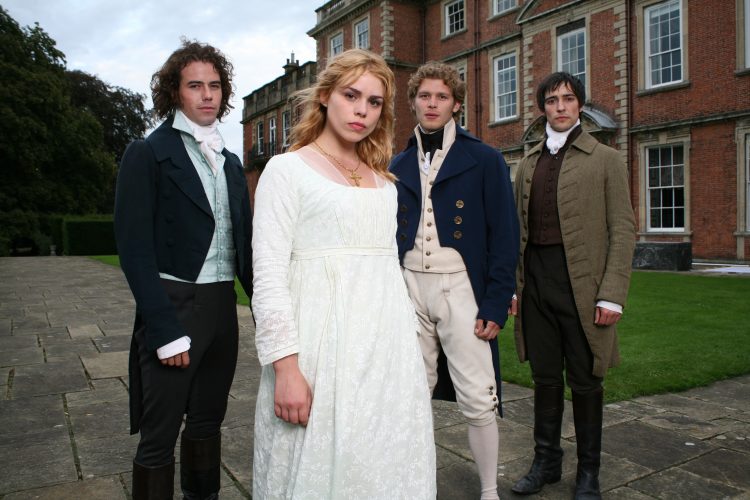
Mansfield Park (2007)

Have you seen any of the film versions of Mansfield Park? If so, which one do you think remains most faithful to the original text? (I’ve yet to find one that I enjoyed as much as the novel, but I’m open to suggestions!)

Are there any other books or movies in this genre that allow the heroine to stay true to herself as she wait patiently for her dreams to come true?


RACHEL DODGE teaches college English classes, gives talks at libraries, teas, and book clubs, and writes for Jane Austen’s World blog. She is the bestselling author of The Little Women DevotionalThe Anne of Green Gables Devotional and Praying with Jane: 31 Days Through the Prayers of Jane Austen. Now Available: The Secret Garden Devotional! You can visit Rachel online at www.RachelDodge.com.

Inquiring readers,

When Sanditon Season 1 first aired, I reviewed every episode in such detail that I now realize I can no longer reclaim the hours I lost watching and rewatching the program, researching the actors and locations, and writing down my thoughts, albeit tongue in cheek. 

By Season 2, I had learned my lesson. I bundled the episodes together for fewer reviews  (tongue still firmly planted in cheek).

My tongue and cheek begged me not to use them for Season 3. Alas and alack, I could not make such a promise. Spoiler alert (and trigger warning for those who are still developing an appreciation for comedy, irony and sarcasm): I am giving my full-blown and personal opinion based on how many times Jane Austen rolled in her grave when her spirit realized how her unfinished novel was given the 21st century commercial, rom-com, Regency treatment. As I watched the 6 episodes back to back, with power naps inbetween, my essential question was: “Where’s Jane in all of this?” 

The season opens with Sir Eddy Denham suffering a Regency-style water rehabilitation (torture) treatment to unlearn his shifty and criminal ways. Jack Fox, who plays Lady Denham’s nephew, looks thin and wan, as if he’s been forced to fast every other day. Lady Denham (Anne Reid) sits on her silk sofa like a corseted spider who has woven a web so tight that Sir Eddy cannot escape his destiny – that of a loser. While his self-abasement is fueled by avarice and greed, this viewer wonders why his tired old storyline has been hauled out for the 3rd time. 

Charlotte Heywood arrives in style to Sanditon in the same carriage that spirited her bereaved self away at the end of Season 2. She’s still engaged to the young farmer her father thought would become a suitable husband. Cai Brigden plays Ralph Starling, a handsome enough fiancé, who’s besotted with his betrothed. Ah, but has she forgotten Mr Colbourne? Or Sydney Parker for that matter? At this point I decided to use my Before-During-After critical thinking teacher strategies to examine Season 3’s plot. 

Screen Shot 2023-05-15 at 3.47.41 PM

Before

Season 1: Charlotte fell passionately in love with the incomparable Sydney Parker. Alas, the actor, Theo James, saw richer beach resorts on his horizon, and left poor Char forlorn, for she would never see such a beautifully sculpted naked man rising from the sea again. (Neither will we, for that matter.) In that season, Sanditon was just a mishmash of old cottages, new buildings, and muddy roads. Its story line more or less followed Austen’s script for 15-20 minutes. Then the deviation from her plot had me laughing so hard, that the wine I was drinking snorted out of my nose. I must say that Rose Williams as Charlotte is lovely and likable, and a realistically feisty miss. But I wondered after the end of Season 1 – what now?

During 

Season 2: Of course the script writers had to kill Sydney off (Still, I asked: What if Theo changed his mind and wanted to come back? And what has become of young Stringer?) Oh, well. Charlotte’s journey without Sydney leads her to cold stiff Alexander Colbourne (Ben Lloyd-Hughes). He’s rich, I’ll give him that, but no amount of bronzer will make his body shine in glittering sunset-lit waters like Sydney’s. Sigh. 

In her grief, Char seeks work as a governess. She lands at the doorstep of Alexander Colbourne, a widower with a child, Leonora, and his charge, Augusta. From the moment they meet, Char and Alex dislike-hate each other. He’s too opinionated and stubborn. She’s too opinionated and stubborn. When she’s finally had enough of his strict ways, she stomps out of his mansion, nearly slamming the door in his self-important face. He follows her on his splendid steed and basically says, “Hey, come back. See ya tomorrow.” As for the girls, one is unruly, the other repellent, but Char’s no quitter. In no time, Alex begins to desire her, and her knowledge of horses seals the deal. Did everyone see this coming? Of course. I must confess being so bored by their predictable storyline that I fell asleep. I did have one question, for my nap prevented me from following the plot closely: “Why, gentle readers, did she leave him to go home to her family at the end of S2 and get engaged to a mere farmer?”

Season 3: (We’re still in the During phase of this 3-part tale.) At the beginning of season 3 Char is still engaged to her daddy’s choice of a fine working husband. While I’m sure Ralph is a nice guy, he’s out of his comfort zone and her league, and all but disappears. He shows his discomfort and  jealousy of the fine friends she’s made. Char’s only returned to Sanditon to celebrate Georgiana Lambe’s (Crystal Clarke) birthday. It is an auspicious occasion, for Georgiana will come into her substantial inheritance. Impoverished fortune hunters are waiting to crawl out of their expensive, unaffordable Sanditon boarding rooms to woo her.

Screen Shot 2023-05-15 at 3.48.49 PM

But let’s leave the ho-humness of these stale plots and examine the sidebar romances, which added some spice and much excitement this season.

Sidebar Romance #1

The torturer in charge of Sir Eddy’s rehab is Dr Fuchs, who was practically invisible in Season 2. Rev Hankins, the second person employed by Lady D to change Sir Eddy into a nicer person, is working on our villain’s soul. The reverend’s long suffering sister, Beatrice, abides by his edicts, for as a spinster with no home of her own she must suffer his insufferability. She has no choice unless she wants to make baubles like Mrs Smith of Persuasion fame. When Rev Hankins and Beatrice leave church, Dr Fuchs (rhymes with mucks) chances upon the pair. He makes goo goo eyes at her and she simpers in return. Rev Hankins will have none of that! Well, you know how that will go. This romance weaves many comedic moments throughout the season. More importantly, their awkward flirting kept me semi-awake.

Sidebar Romance #2 (A Triple Romance with a Twist)

Ah, who would have guessed that Arthur Parker (Turlough Convery) and Edward Lord Harry Montrose (Edward Davis) would provide the truest sidebar romance in this overlong adaptation of Austen’s unfinished novel? To ward off pesky fortune hunters, Georgiana Lambe agrees to a pretend engagement to the Duke, whose family is penniless (unbeknownst to her.) She knows, though, that the Duke is attracted to his own sex. And that’s alright with her. (This means mitts off her nubile body.) Harry wants Arthur. Arthur wants Harry, but cannot hurt Georgiana. Georgiana just wants to keep up the pretense until she’s in full control of her fortune. Edward’s momma is ecstatic at the thought of her son’s union with an heiress and the replenishment of the family fortune. Lord Harry’s spinster sister, Lydia’s, situation reminds me of Beatrice’s, but Lydia has more status and has kept a secret meant to keep us on the edge of our seats. The red herring in her plot is with Alex Colbourne, but we savvy viewers know better. Both have better chemistry with their horses than each other.

Sidebar Romance #3 Lady Denham (Anne Reid) and Rowleigh Pryce (James Bolam)

I won’t spend much time on this “romance.” Two aged, irascible and unlikable characters duke it out with each other. He left her at the altar when she was still nubile; she leaves him at the altar when he can still father a child and she can’t bear one. Lady Denham is based on Lady Catherine de Bourgh, Mrs Norris, and Mrs Ferrars (mother of that odious Fanny Dashwood) – all rolled into one. The “romance” ends with an agreement that they will still see each other regularly, but as little as possible. 

Sidebar Romance #4 Augusta Markham (Eloise Webb) and Sir Eddy (Jack Fox)

Would anyone like to shout Lydia and Wickham and Georgiana Darcy and Wickham in Pride and Prejudice when following the trajectory of this unlikable couple? Yes, Sir Eddy at first only pretends to redeem himself to Lady D, but then he meets the attractive and intriguing Augusta Markham. He learns/knows of her fortune, woos her, twirls her susceptible cookies, AND absconds with her. Augusta is older than the very young Georgiana Darcy, and she can’t wait for Sir Eddy to hop in the sack with her. But seeing her eagerness, he suffers a sudden crisis of conscience. (Those water torture baths are finally working!) And so he rejects her. Ouch. Augusta languishes. He languishes but manages to keep a heroic stiff upper lip. Oh, dear, I think, as I awaken from my power nap, what will next happen to this hapless couple?

Romance #5  The Prince Regent Changes His Mind, and So Does his Mistress

Mature love in the form of Sophie Winkleman as Lady Susan and Liam Garrigan as Samuel Colbourne has been given an unroyal treatment. Lady Susan, taken out of mothballs from Season 1, has really no role other than to walk arm in arm with Char, look elegant and beautiful, and meet Samuel, Alexander’s brother. I must admit I was nodding off during his introduction, so I still have no idea why/how his presence was introduced into the plot. I believe, and please correct me if I am wrong (yes, this happens often) that he’s a lawyer or accountant of sorts. Lady Susan and Samuel banter in friendly exchanges at first and then experience such irresistible hots for each other that they kiss on a public beach! What if someone, like a fisherman or bather, saw them? Qu’elle horreur! After Samuel decides he’s finally found the woman of his dreams, the Prince Regent requests his former mistress’s return to London. Lady Susan, supposedly a sensible woman, plans to hie it back to her fat princely hedonist and leave the love of her life. Whaaaa?!! Samuel is bereft. She’s sad. As devotees of rom-com plots, let’s all together guess the ending! Hint: We are all correct.

Non Romantic Plot Developments:

Tom and Mary: Tom Parker (Kris Marshall) and Rowleigh Pryce unite in a common vision to build a luxury hotel in Sanditon, bulldozing anything standing in their way. 

Achieving their goal means demolishing fishermen cottages that sit on a stretch of beach with a splendid view. Meanwhile, Tom’s wife Mary (Kate Ashfield) has been tending to the poor, including a fisherman’s widow who has little income for herself or her children. Much like Emma Woodhouse, Mary visits the widow frequently with baskets of food and clothes, often accompanied by Char. Mary is horrified by Tom’s plans and they engage in a major row. Tom is adamant, as is Mary.

Then (shades of Marianne Dashwood lying on her deathbed), Mary falls mysteriously ill and, you guessed it, lies on her deathbed. A grieving Tom can only recall his last harsh words towards his beloved. After much hand wringing, Dr Fuchs tells the assembled family members and friends to prepare for the worst. Then, miracle of miracles – as if Mary’s mother hastened to her bedside à la Mrs Dashwood – Mary awakens. Tom turns into a precursor of Ebenezer Scrooge after the three visits from the spirits. Chastened, he follows Mary’s advice. In short order, Tom ditches his plans for the hotel, as well as Rowleigh Pryce, and promises Mary he’ll improve the fishermen’s cottages (and his sex life, no doubt) and the cottagers’ lives.Trifecta! Mary is now hale, hearty, and happy to have her dutiful Tom under her sensible thumb again.

The last is a story line I’ve entitled: “She Loves Me, I trust Her. She Loves Me Not, I’ll Ditch Her, She Still Loves Me.” This plot involves Georgiana’s momma, her sudden appearance, and the shell necklace that proves her motherhood.

We are so lucky in this century, for DNA tests proves irrefutably to whom we are related. But during the Regency one had to rely on one’s instincts. Georgiana, one smart cookie when it comes to defending herself from fortune hunters, practically melts into the arms of a woman who appears out of the Caribbean Blue to claim the closest kinship any orphaned child could want – a mother. The proof? A shell necklace that brings Georgina to tears and conjures memories of Antigua so ancient they might not be true. (I’ve made a number of shell necklaces that look remarkably like Momma’s proof.) After a few conversations and memory prompts, Georgiana cries “Momma!” and throws herself into her arms. Lord Harry’s avaricious Momma, hellbent on making sure her son marries rich Georgiana and wanting to keep her entire fortune, finagles to bribe Georgiana’s mother with enough money to make her disappear. Ah, but love is blind and conquers all. Georgiana’s momma ditches the money and tells her daughter she is more priceless than all the gold on earth. Oh, happy reunion. 

(If I’ve not mentioned that creep artist, Charles Lockhart, it was on purpose.)

After:

Major Sugar Overload

Diabetics should be warned to take their metformin or insulin before watching the treacly epilogue. The cynic in me guffawed my way through those last 10 minutes. Every major plot and most subplots were tied up neatly with pastel colored ribbons and rose colored glasses. I’m sure Jane A. rolled over in her grave once again. While we had indications that some couples in her novels reached marital nirvana (Lizzy and Darcy and Anne and her Captain, for example), most of her stories ended at the wedding. Jane hinted at some unhappy consequences. Well, hint is a weak word when we think about the character arcs she introduced in her novels. I could write an entire post about them, starting with Wickham and Lydia and Charlotte Lucas’s compromise marriage to Mr Collins to oversee her own household. (Me? I’d rather roll naked in hot tar than tolerate that man.) 

At the end:

  • Char marries Alex, becomes a school teacher, and has a baby.
  • Georgiana, through the machinations of her mama, marries her true love, Otis Molineux.
  • Lady Susan and her Samuel sit in bliss at Char’s wedding.
  • Lady Denham keeps her title and fortune, and relishes bossing Mr Pryce around every other month or so.
  • Augusta becomes a governess. Hahahahahah.

On and on. 

  • Unhappy is Char’s ex fiance, Ralph. And I still have one question – whatever happened to young Stringer?

More about Sanditon on this blog: Jane Austen’s World reviews, Seasons 1-2: https://janeaustensworld.com/category/sanditon/

by Brenda S. Cox

A few years ago, on a trip to England, I discovered a wonderful summer Jane Austen event: Regency Week in Alton. Yes, the Jane Austen Festival in Bath in September is great. But for many people, it’s easier to travel in the summer.

And, Austen arguably had closer ties to Alton and Chawton than she did to Bath or Winchester. She spent her last years in the village of Chawton, writing or rewriting all of her novels for publication. Alton is the nearest large town, where her family shopped and visited.

This year’s Regency Week is June 17-25, 2023. I’m excited that I’ll get to speak at this one for the first time! My talk will be “Why Mr. Collins? The Church and Clergy in Jane Austen’s England.” And I will get to do it at Alton’s lovely, historic church, St. Lawrence’s. (When we visited there, the churchwarden showed us bullet holes from the English Civil War in the 1600s.)

The church will also host a Sunday evening choral evensong service, with a Regency theme, and an organ recital. The Friends (Quaker) Meeting House will host a teatime discussion of Sense and Sensibility, which I’m also looking forward to.  

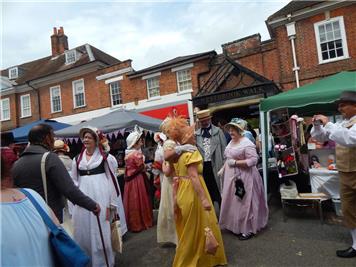
The week kicks off with Regency Day, when you can wander around the town in Regency costume, if you wish. You can visit booths, watch military reenactments, musical entertainment, and dancing, and take a carriage ride. When I went before, I met a number of Austenesque writers, and enjoyed connecting with them. 

On a previous Regency Day, fencing was a highlight of the street events. (promo photo)

Of course a dance workshop, a ball (sold out for this year), and a country dance will be highlights of the week. Guided walks of Alton, Chawton, and the vicinity are offered, focusing on Austen’s connections with the area. Jane Hurst, an expert on the history of the area, leads those. I have met her and she was very helpful to me in my own research for my book.

At the Jane Austen House, tours of the house focusing on Sense and Sensibility and on Pride and Prejudice sound fascinating.  Nearby Chawton House offers a Curators tour of the Quills and Characters exhibit, about Austen-era letter-writing and “women’s experiences of travel, science, reading, and scandal.” A talk about botanical women and tours of the Chawton House Gardens will also be packed with interesting insights. I’m also looking forward to a tour of Gilbert White‘s house in Selborne and his gardens.

Alton Regency Day (promo photo)

Picnics, parades, cocktails, tours, Regency pastimes, craft workshops, talks, and much more fill out this year’s program. Check out the full schedule at their website.

At the 2015 Regency Week, I got to meet some wonderful Austen Variations authors (from left): Abigail Reynolds, Maria Grace, L. L. Diamond, Jane Odiwe, Cassandra Grafton, and Monica Fairview. Since then I have enjoyed many of their books. Booths this year will no doubt focus on other interesting items. Photo ©Brenda S. Cox, 2015

Why a Regency Week in Alton?

I asked the organizers to tell me more about Regency Week and its background. Marie Kelle said:

Jane Austen Regency Week is a 9-day festival held in Alton and Chawton in Hampshire (UK) each year to celebrate both our local internationally-acclaimed writer, and a very interesting period of history, encouraging people to explore their cultural heritage.  It started as just a weekend of events and grew into the 9 day festival we now have.

We have a varied programme covering walks, dancing, tours, talks and much more. The ball is already sold out, but the very enjoyable and less formal Country Dance event still has tickets available.  The week begins with Alton Regency Day which includes a craft and gifts market, Regency and Napoleonic War era re-enactors, Mill Cottage Farm Experience and entertainment from The Kings Pond Shantymen and Alton Morris Dancers.

If you have never been to Regency Week before some highlights for this year are of course Regency Day where, if you wish, you can stroll around dressed in your Regency era outfits, and a Horse and Carriage ride is a must!  Other highlights are Garden Cocktails at Chawton House,  and lunch at the Allen Gallery followed by a tour of the ceramics exhibits. You can also view the Hampshire Libraries Jane Austen Collection at Alton Library. Pride & Prejudice and Sense & Sensibility themed tours at Jane Austen’s House, and House Tour and Cream Teas at Wyards Farmhouse are more of the week’s highlights.  

We have some sewing workshops on offer this year: you can make your own flower pot broach at Gilbert White’s House in Selborne and you can make a Regency Era Reticule. Another workshop will show you how to finish and embellish your own bonnet (this workshop includes a ‘posh tea’).  All this along with three guided historical walks, circular countryside walks of the beautiful scenery around Chawton, and much more!

***

I’d love to see you there! Or, if you can’t come this summer, I hope you’ll put it on your wish list for a future summer. :-)

Schedule, Tickets, and Accommodations

The schedule can be found at www.janeaustenregencyweek.co.uk

Tickets for the 2023 Jane Austen Regency Week are now on sale, both on Eventbrite and also from our office by calling Marie on 01420 85057. Contact marie@altoncommunitycentre.org.uk

Regency Week 2023 eventbrite tickets can be found by clicking this link (please note there is a booking fee per ticket at eventbrite, but if you buy direct from Alton Community Centre there is a £3.00 booking fee per transaction no matter how many tickets are booked.

For options for local accommodation see Places to stay. There are also some local rooms/homes etc on AirBnB.

Jane Austen Regency Week is run by a group of volunteers and participating organizations under the auspices of the charity, Alton Community Association CIO. It is funded through ticket sales, sponsorship and advertising.  Jane Austen Regency Week is a fundraising activity for Alton Community Association CIO (reg charity 1173885).

St. Lawrence’s Church in Alton, by the way, was the model for the cover art of my book, Fashionable Goodness: Christianity in Jane Austen’s England