Feeds:
Posts
Comments

Our very own Brenda S. Cox has just published her new book Fashionable Goodness: Christianity in Jane Austen’s England. It’s already receiving a wonderful reception, and I know it will continue. For those of us who are always expanding our understanding of Jane Austen’s life, and particularly her personal life and faith, this new book is an essential resource.

When I was writing my book Praying with Jane: 31 Days Through the Prayers of Jane Austen, I read every article and book I could find on the topic of religion and faith as it related to Austen and her family. I scoured every available resource on Austen’s personal faith, her family’s daily and weekly religious habits, and the Anglican church at large. I discovered many wonderful details about her religious life, but as I worked, I always felt as though I was putting together a giant puzzle. And when it came to understanding more fully the implications of her religious beliefs and background in her novels, I felt as though the puzzle was missing many important pieces.

In Fashionable Goodness: Christianity in Jane Austen’s England, Brenda has finally put the puzzle pieces in their rightful places and collected all of the information one might want to know about Jane Austen’s religious life in one handy place. This book covers a broad range of topics that any Jane Austen lover can benefit from knowing, especially for those of us who enjoy looking into the varied layers and greater context of her writing.
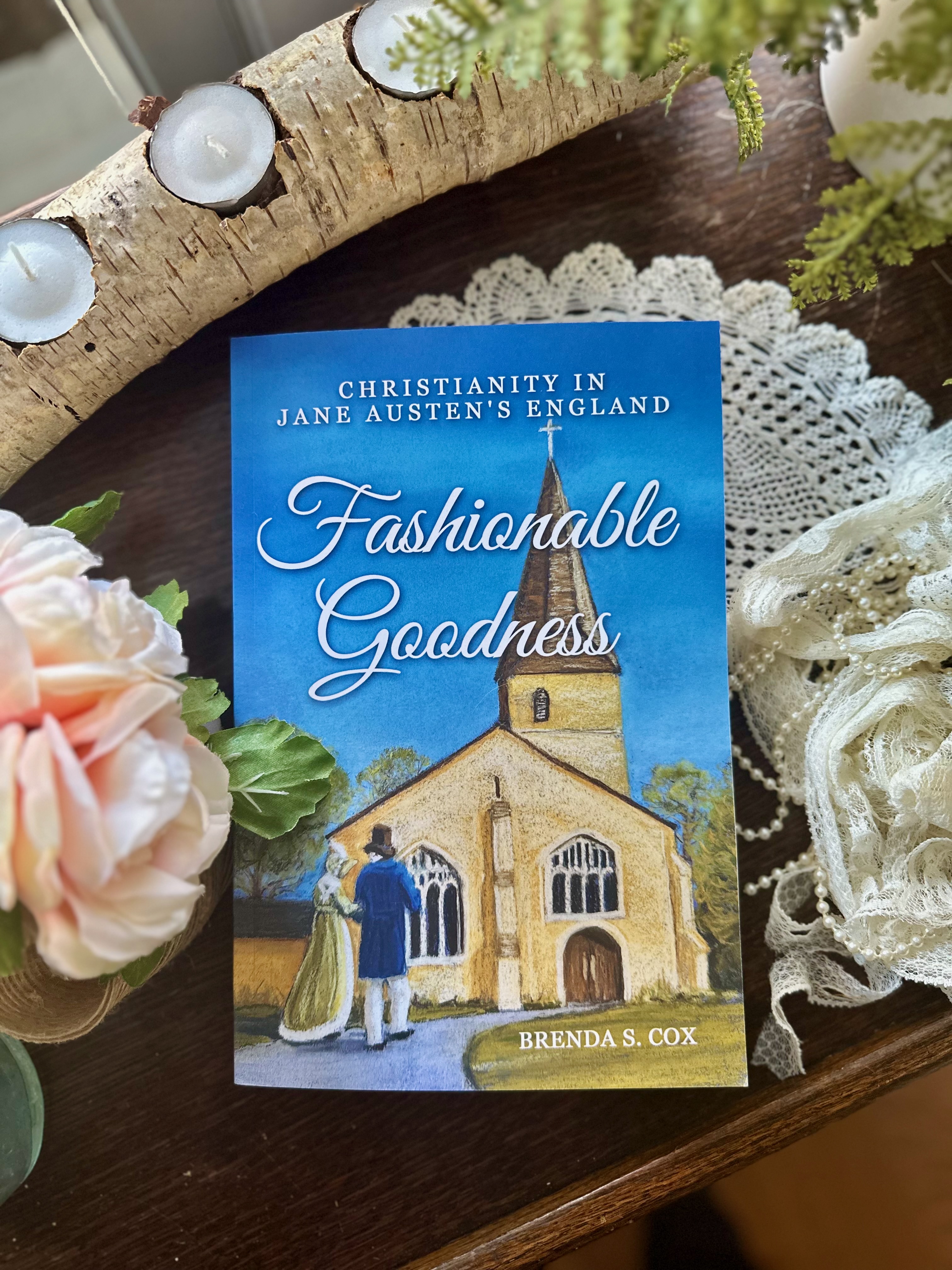
Of particular interest is the clever manner in which Brenda has organized the information in this book. Each chapter is easy to find, plus she has included many helpful resources at the end of the book, including handy tables with income information, terminology, ranks within the church, and denominations; several appendices; detailed chapter notes; a hefty bibliography; a glossary of terms; and a topical index. You can read this book cover-to-cover or you can pick and choose the topics that interest you most.

I highly recommend this book for any Austen fan or scholar. Without this book, you can only know part of what makes Jane Austen’s characters and plots so intriguing. Thank you Brenda for creating this invaluable resource!

(See below for giveaway details.)

St. Nicholas Church, Steventon
Photo: Rachel Dodge

About the Book:

“Brenda Cox’s Fashionable Goodness is an indispensable guide to all things religious in Jane Austen’s world. . . . a proper understanding of 18th century Christianity is necessary for a full appreciation of Austen’s works. Cox provides this understanding. . . . This work will appeal to novice readers of Austen as well as scholars and specialists.”

Roger E. Moore, Vanderbilt University, Jane Austen and the Reformation

The Church of England was at the heart of Jane Austen’s world of elegance and upheaval. Fashionable Goodness: Christianity in Jane Austen’s England explores the church’s role in her life and novels, the challenges that church faced, and how it changed the world. In one volume, this book brings together resources from many sources to show the church at a pivotal time in history, when English Christians were freeing enslaved people, empowering the poor and oppressed, and challenging society’s moral values and immoral behavior.

Readers will meet Anglicans, Dissenters, Evangelicals, women leaders, poets, social reformers, hymn writers, country parsons, authors, and more. Lovers of Jane Austen or of church history and the long eighteenth century will enjoy discovering all this and much more:

  • Why could Mr. Collins, a rector, afford to marry a poor woman, while Mr. Elton, a vicar, and Charles Hayter, a curate, could not?
  • Why did Mansfield Park‘s early readers (unlike most today) love Fanny Price?
  • What part did people of color, like Miss Lambe of Sanditon, play in English society?
  • Why did Elizabeth Bennet compliment her kind sister Jane on her “candour”?
  • What shirked religious duties caused Anne Elliot to question the integrity of her cousin William Elliot?
  • Which Austen characters exhibited “true honor,” “false honor,” or “no honor”?
  • How did William Wilberforce, Hannah More, and William Cowper (beloved poet of Marianne Dashwood and Jane Austen) bring “goodness” into fashion?
  • How did the French Revolution challenge England’s complacency and draw the upper classes back to church?
  • How did Christians campaigning to abolish the slave trade pioneer modern methods of working for social causes?
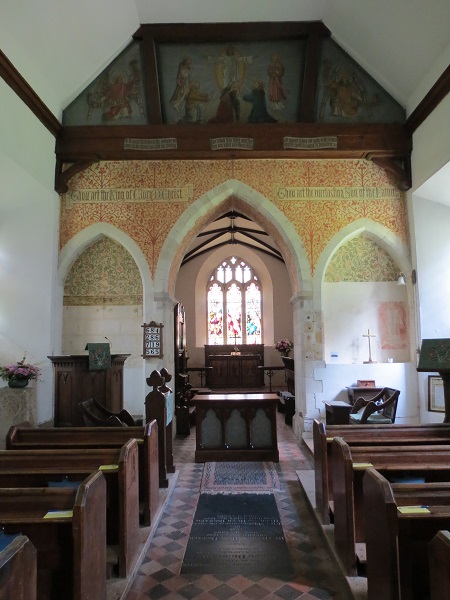
Interior of St. Nicholas Church, Steventon
Photo: Rachel Dodge

About the Author, Brenda S. Cox:

Brenda S. Cox has loved Jane Austen since she came across a copy of Emma as a young adult; she went out and bought a whole set of the novels as soon as she finished it! She has spent years researching the church in Austen’s England, visiting English churches and reading hundreds of books and articles, including many written by Austen’s contemporaries. She speaks at Jane Austen Society of North America meetings (including three AGMs) and writes for Persuasions On-Line (JASNA journal) and the websites Jane Austen’s World and her own Faith, Science, Joy, and Jane Austen.

Buy the Book:

You can purchase Fashionable Goodness: Christianity in Jane Austen’s England here:

Amazon and Jane Austen Books
International: Amazon


Book Giveaway:

To enter for a chance to win a copy of Brenda’s book Fashionable Goodness: Christianity in Jane Austen’s England, please leave a comment below with an answer to this question:

What is one question you’ve always had about Jane Austen’s faith or the role religion plays in her novels?

Giveaway Details: This giveaway is for ONE (1) print copy and ONE (1) ebook (Kindle) edition for readers of this blog. The winners will be drawn by random number generator on November 18, 2022.

Note: This giveaway is limited to addresses in the U.S., U.K., Australia, Canada, Germany, Spain, France, or Italy for a print copy of the book. The author can only send a giveaway ebook (Kindle) to a U.S. address. (However, both the ebook and paperback are available for sale to customers from any of these countries, and some others that have Amazon.)


Blog Tour Schedule


RACHEL DODGE teaches college English classes, gives talks at libraries, teas, and book clubs, and writes for Jane Austen’s World blog. She is the bestselling author of The Little Women DevotionalThe Anne of Green Gables Devotional and Praying with Jane: 31 Days Through the Prayers of Jane Austen. Coming soon: The Secret Garden Devotional! You can visit Rachel online at www.RachelDodge.com.
by Brenda S. Cox

“I am never too busy to think of S&S. I can no more forget it, than a mother can forget her sucking child; & I am much obliged to you for your enquiries.”—Jane Austen, letter to Cassandra Austen, April 25, 1811, quoted in AGM brochure.

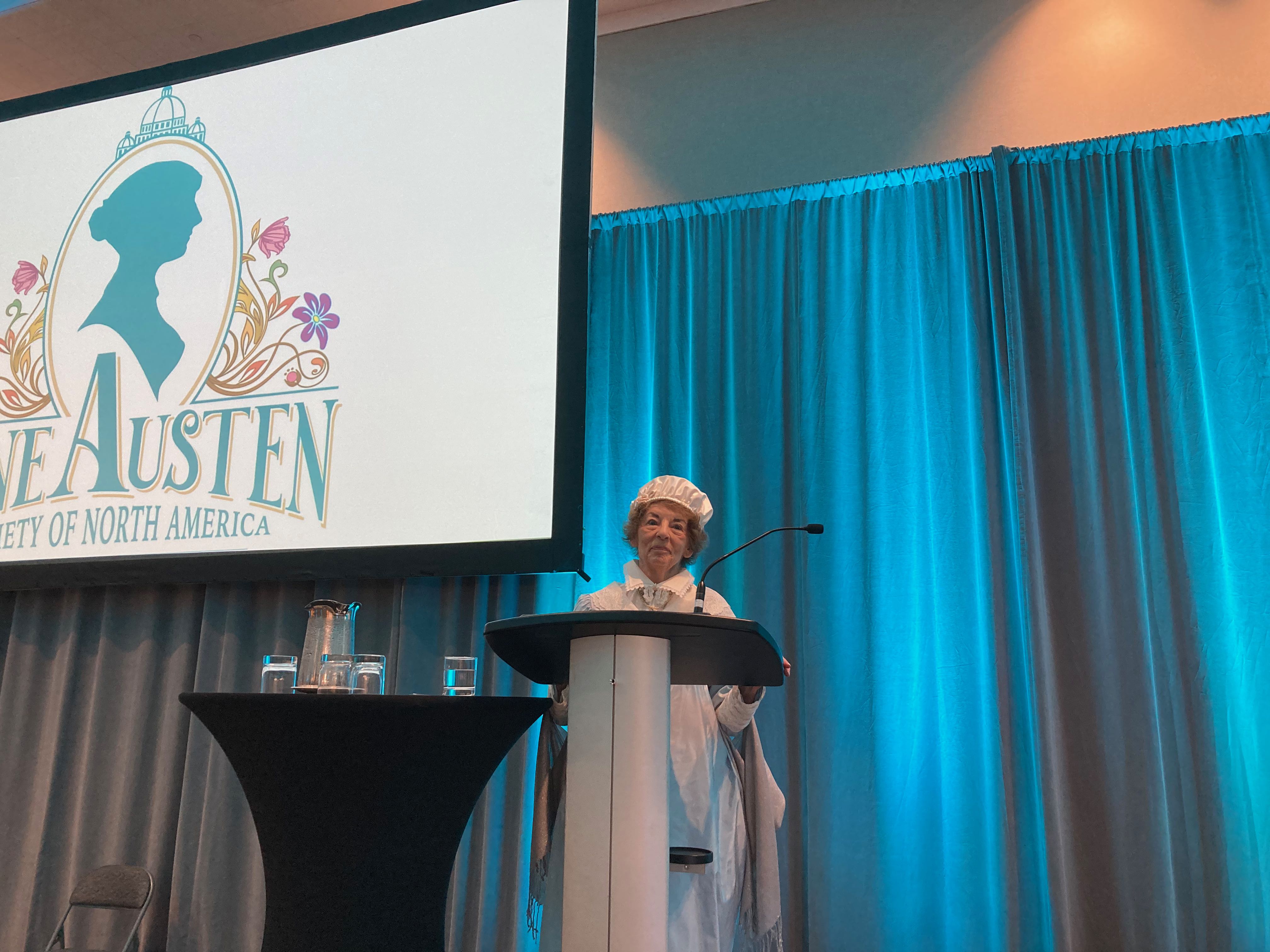
On this day, Oct. 30, 211 years ago (1811), Jane Austen’s first novel was published, Sense and Sensibility! A few weeks ago, the Jane Austen Society of North America (JASNA) met to discuss and celebrate “Sense and Sensibility in the City of Gardens.” The garden city of Victoria, British Columbia, Canada, hosted this 2022 AGM.

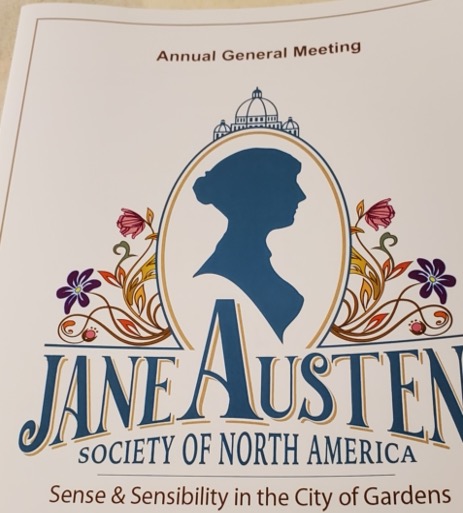
Lovely logo for the 2022 JASNA AGM, Sense and Sensibility in the City of Gardens (Victoria, Canada)

Getting to Victoria was challenging for those of us on the east coast, but it was rewarding. The city is on an enchanting island on the west coast of Canada. Those who came early or stayed late were able to visit famous Butchart Gardens, a nearby castle, or other local sights. Personally, I chose to go whale watching, which was a delight. We watched a pod of orcas and saw a humpback whale waving his front flippers back and forth at us!

During the conference itself I got to choose between many great options. The schedule overflowed with fascinating talks, fun workshops, and great events. Of course an Emporium offered great books from Jane Austen Books as well as other goodies from Jane Austen’s Regency World and regional JASNA chapters. And I found many wonderful “kindred spirits” to talk with between events.

Plenaries: Cowper, Sin, and Duels

Each speaker showed us Sense and Sensibility through a unique lens. The first plenary speaker,  Dr. Emma Clery, spoke on “‘Our Garden is Putting in Order’: The Place of William Cowper in Jane Austen’s Thought-World.” Having studied Cowper extensively for my own book, I was intrigued by Clery’s ideas on Cowper’s influences in Sense and Sensibility. She said the Dashwoods were expelled from the “garden” of Norland, as Jane Austen was expelled from her “garden” at Steventon. This “paradise” is regained at Delaford, which is described in terms of garden walls and fruit trees. People in Austen’s works are like plants, needing the right conditions to grow. I want to explore the many references to trees, timber, and woods that Clery said are found in S&S.

The most controversial talk of the weekend was Robert Morrison’s “‘Deeper in a Life of Sin’: The Regency Romance of Sense and Sensibility.Dr. Morrison, author of The Regency Years, showed the bad sides of all the men in S&S, claiming that none were real heroes. He also suggested that the first Eliza’s baby might have been Brandon’s, and that Marianne might have been losing Willoughby’s baby when she was so ill at Cleveland. He got a lot of pushback on these ideas; we can find potential evidence both for and against his suggestions. But his talk did start some great discussions through the rest of the weekend!

Finally, during Sunday brunch, we heard all about “The Many Duels of Sense and Sensibility” from Susannah Fullerton, author of Jane Austen & Crime. Fullerton told us that dueling at this time was not legal, but was rarely prosecuted. In this “Age of Politeness,” looking too closely at a man or brushing against him could result in a duel. She went on to describe the duels in S&S which were fought with words. She sees duels between John and Fanny Dashwood (Fanny wins), Fanny and Elinor’s mother (Fanny wins), Elinor and Lucy (goes back and forth), and more. From this perspective, as a novel of cutting and thrusting, Fullerton challenged us to look at the references to needles, pins, scissors, and knives in S&S, as well as “cut” and “sharp.”

Activities and Options

Outside of the plenaries, we had many great activities to choose from: workshops (including, as always, lots of dancing), special interest sessions, an improvised play, and great breakout sessions. Breakouts focused on a wide range of topics, including the arts, Austen in Spanish, specific characters in S&S, military service in the East India Company, information literacy, landscapes, a “playlet” dramatizing Lucy Steele’s tactics, and much more. Articles based on many of these are likely to appear in the next editions of Persuasions and Persuasions On-Line, so be on the lookout!

Breakout Sessions on Religious Themes

Besides religious echoes in the three main talks, three of the breakout sessions focused on one of my interests, the religious aspects of the novel. Laura Dabundo, author of Jane Austen: A Companion, shared about “Jane Austen’s Ode to Duty: Morality and Conscience in Sense and Sensibility.” Comparing S&S to Wordsworth’s “Ode to Duty,” Dabundo showed that “duty is manifest in one’s principled obligations to family, friends, church, and nation, personally and in community.” 

Roger E. Moore, author of Jane Austen and the Reformation, asked whether S&S might be “Jane Austen’s Most Religious Novel.” He examined the idea of religious enthusiasm, overly emotional reactions to religion, feared in Austen’s day. Many of Marianne’s thoughts, feelings, and actions fit with this religious enthusiasm. So it is possible Austen was showing the pitfalls of that contemporary concern.

I (Brenda S. Cox) also had the privilege of sharing my thoughts about “Faith Words in Sense and Sensibility: A Story of Selfishness and Self-Denial.”  I explored themes of vices and virtues in the novel. Austen, rather than preaching like many of her contemporaries, chose instead to use examples to encourage moral behavior. Elinor’s selfless behavior throughout, and Marianne’s repentance late in the novel, give strong examples to follow. Austen used “faith words” that had strong religious connotations in her time to reinforce her messages.

A Few of My AGM Highlights, in Pictures

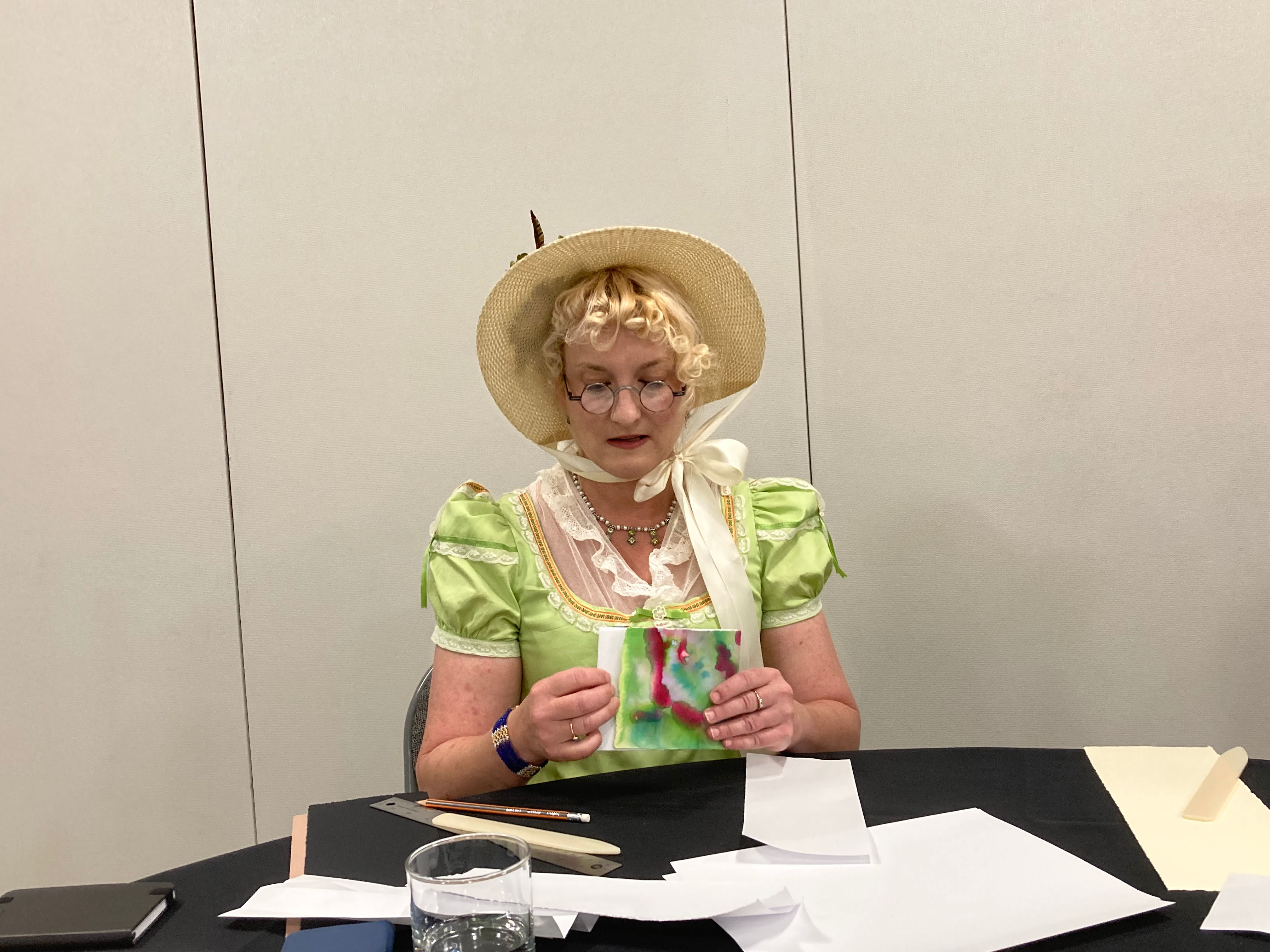
Bookbinding workshop: Richelle Funk taught us some basic bookbinding skills, and we made lovely little notebooks; I used mine to take notes during the conference. Here, Baronda Bradley, in one of her gorgeous outfits, prepares her booklet for binding.
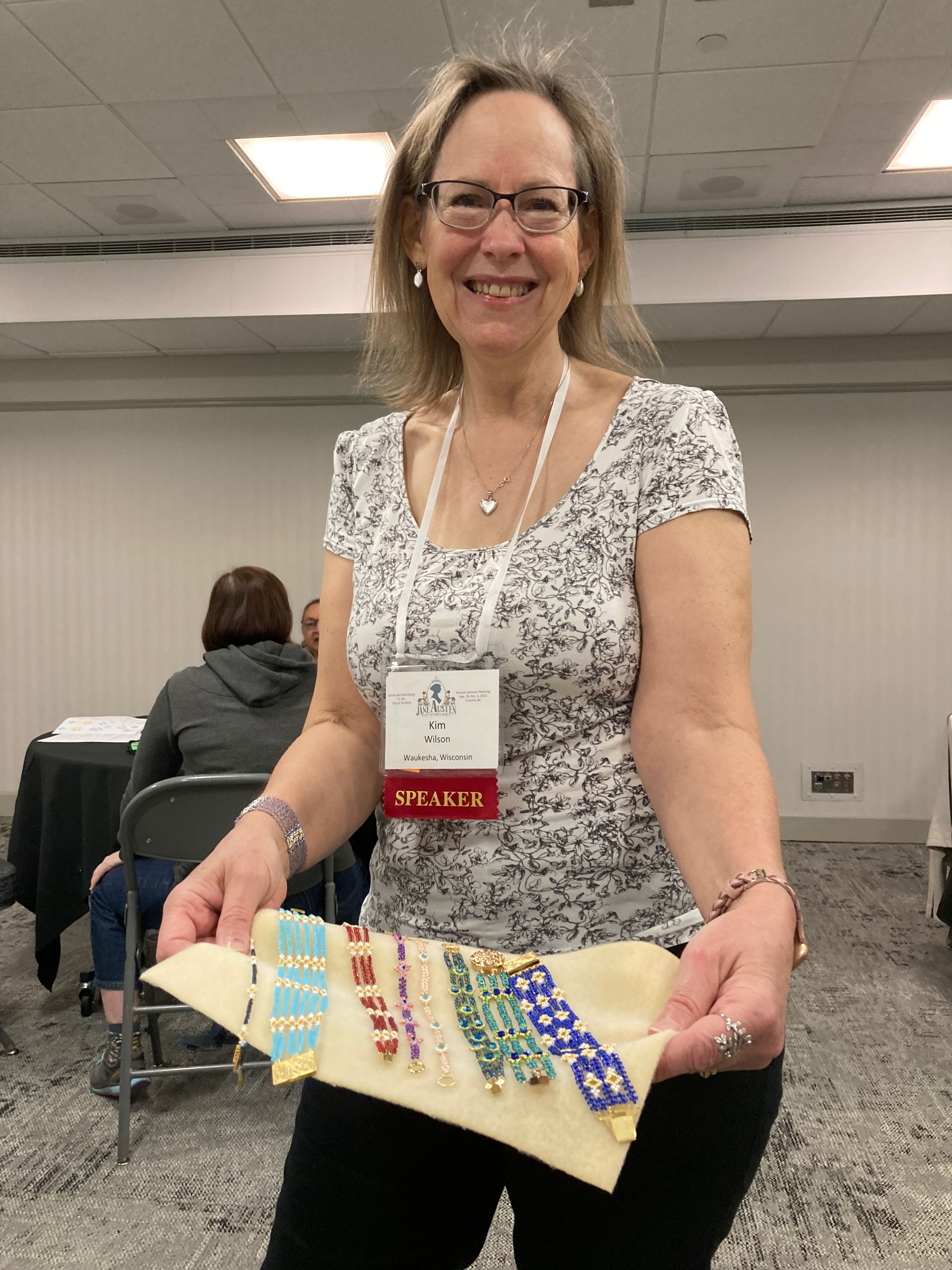
Beading with Jane Austen Workshop: Kim Wilson displays a replica of Jane Austen’s bracelet, along with other variations that can be made with her instructions and supplies, soon to be available online; sign up for her newsletter list to be notified. With her instructions and materials, I was able to start a lovely single-strand bracelet, and finish it as soon as I got home.

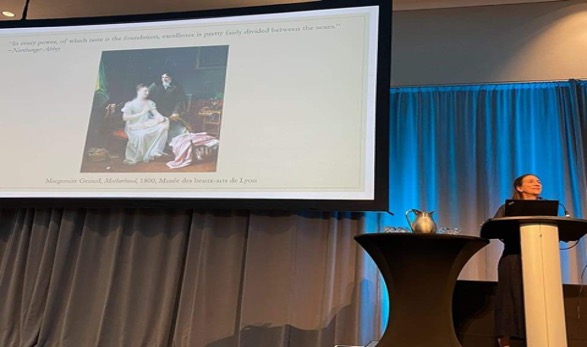
In a special interest session, Kristen Miller Zohn told us about “Gender and Decorative Arts in Austen’s Novels.” She explored how decorative arts, interiors, and clothing presented in Austen’s novels, particularly Northanger Abbey, speak to the unique roles of women and men in Austen’s era.
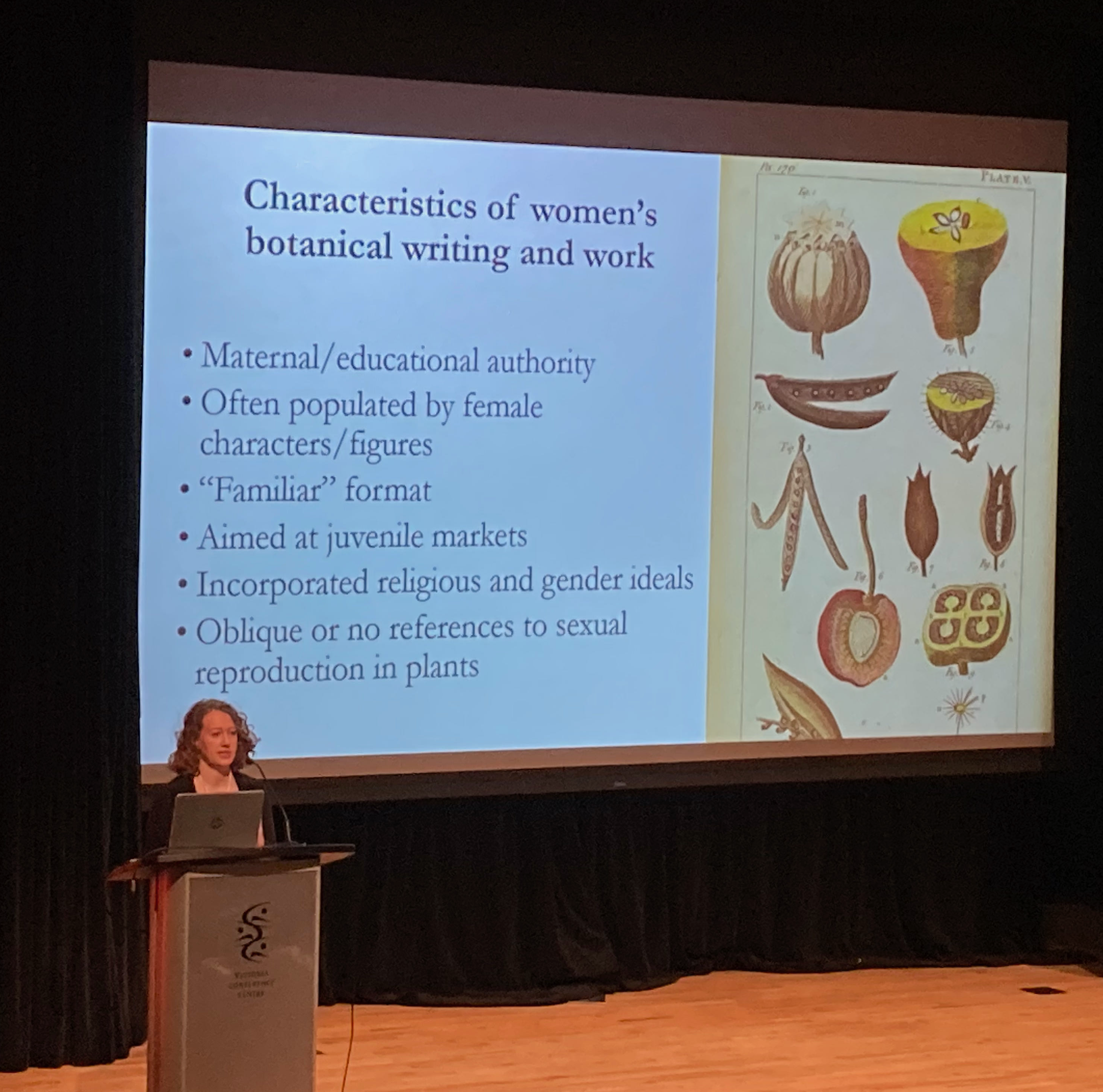
Cecily Van Cleave, a historical fiction writer, led another special interest session on “Beyond the Garden Wall: Priscilla Wakefield, Women in Botany, and the Intersection of Art and Science during the Austen Era.” We learned that women wrote science guides in this time, intended to help young ladies replace frivolous pursuits with more serious, intellectual hobbies.
Donna Fletcher Crow, dressed in a replica of Austen’s costume in the Byrne portrait, showed us maps and scenes of “Jane Austen in London with the Dashwoods.” She also explained the significance of Austen’s choices for locations. Listeners, though, seemed to be most fascinated by her mention of pencils as cutting-edge technology of the time, with graphite as a precious English product.
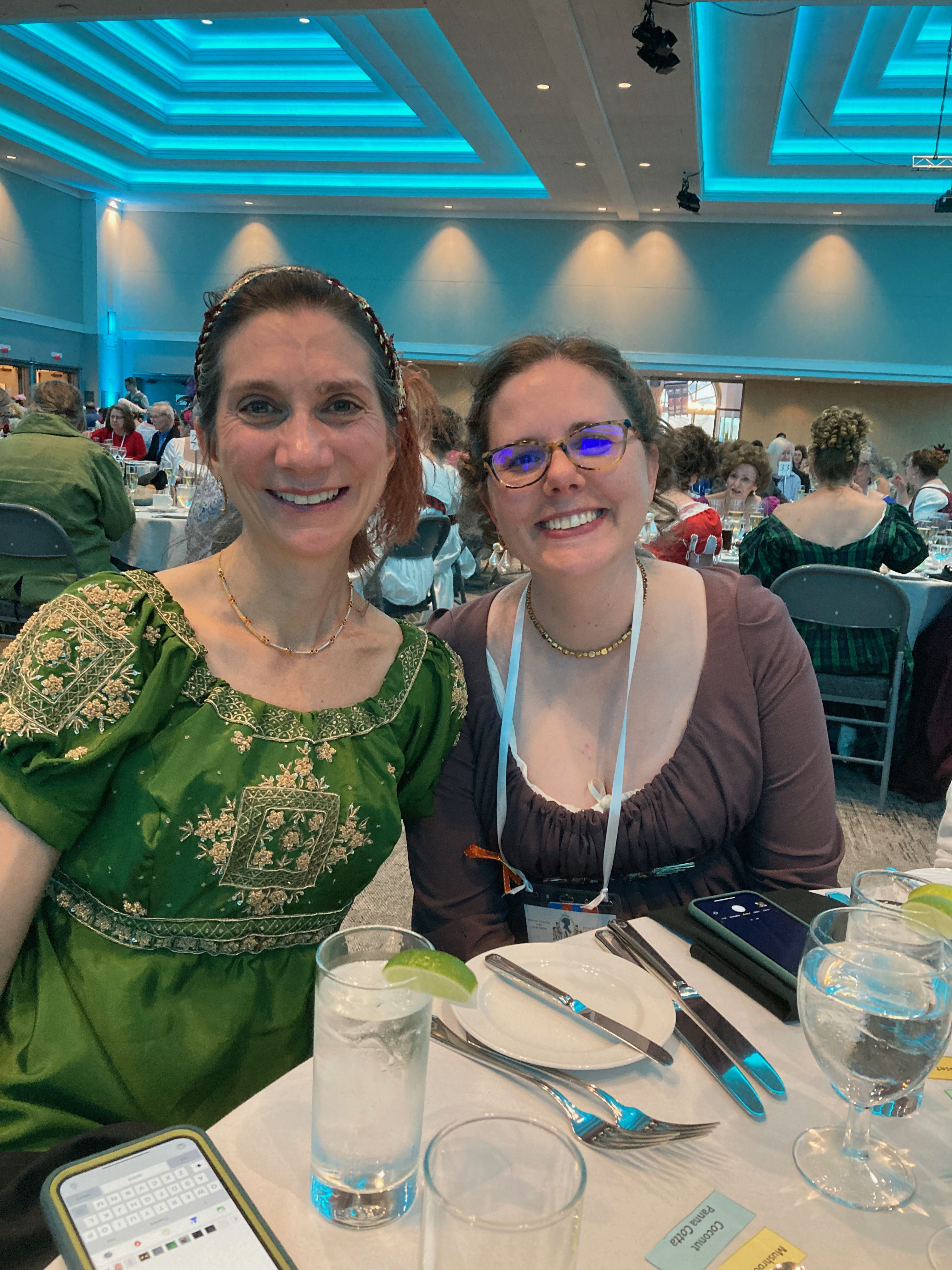
The Banquet and Promenade were a lovely time for many to dress up and show off their outfits. Kristen Miller Zohn and Jennifer Swenson, coordinators of the 2021 Chicago AGM, at the banquet.

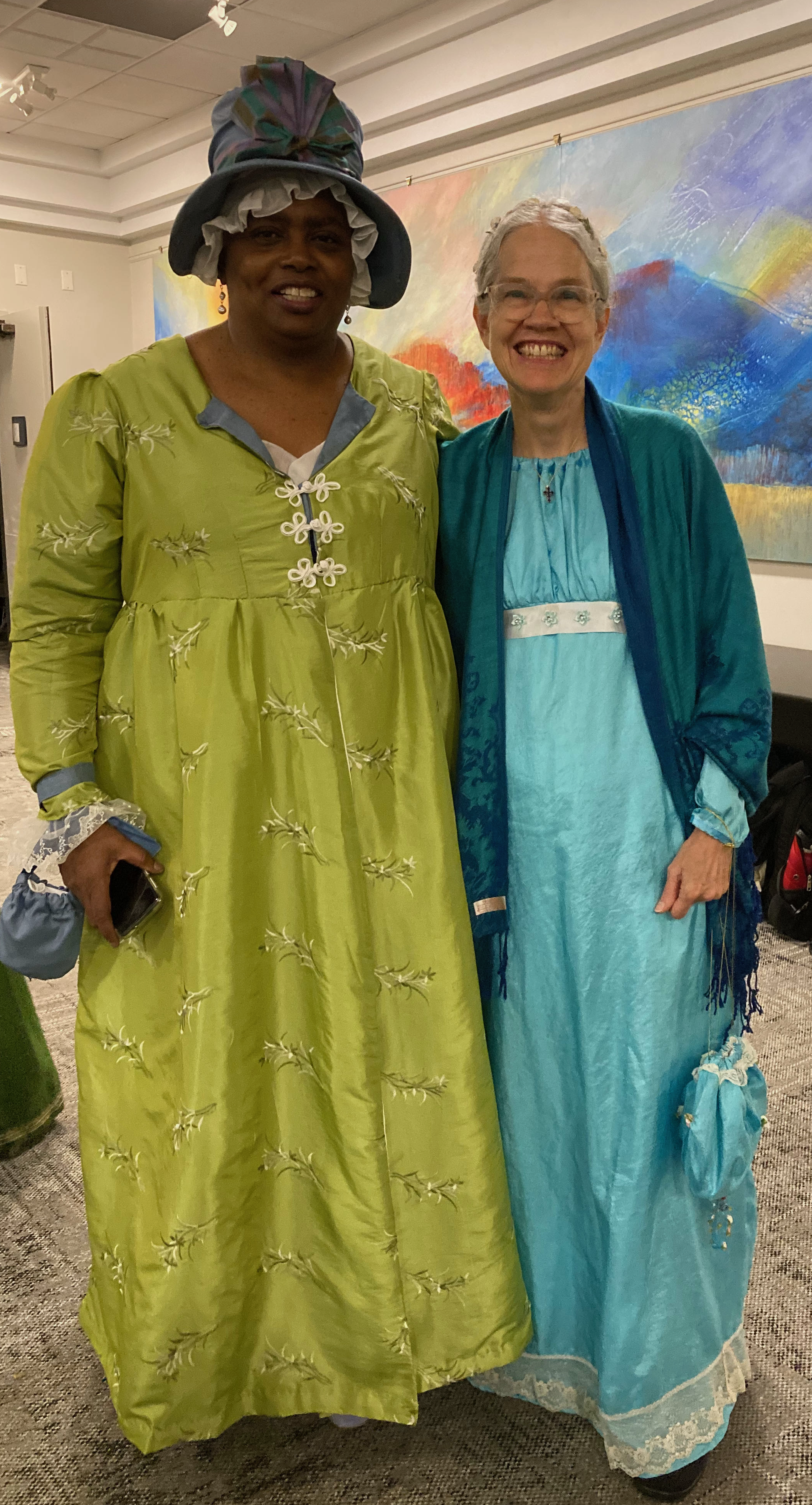
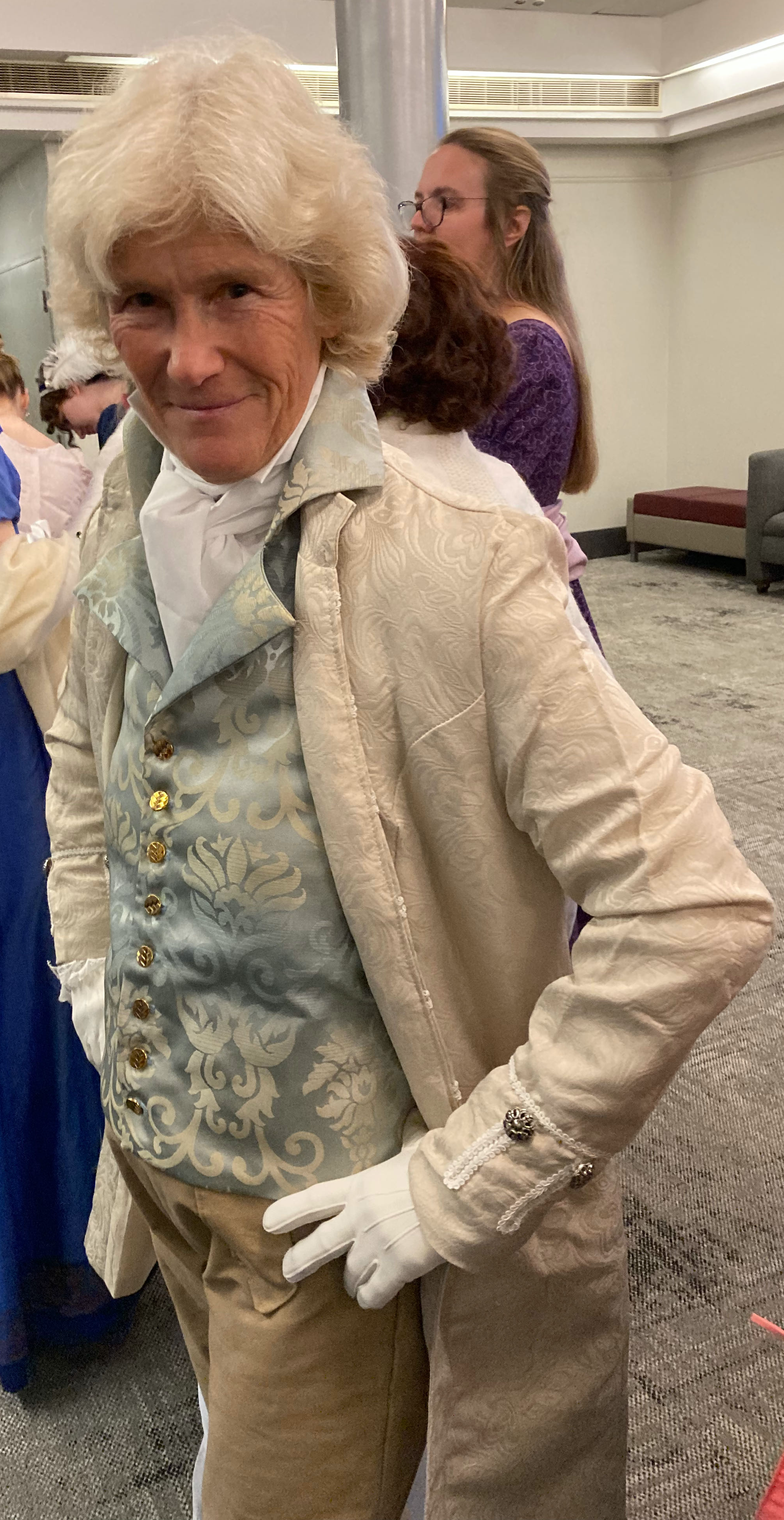
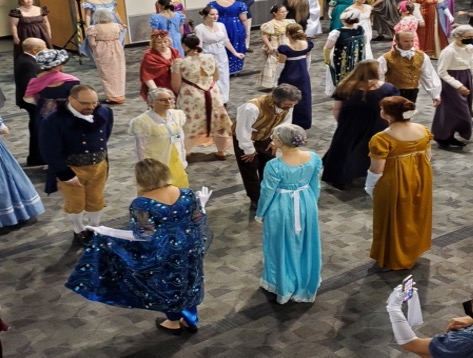
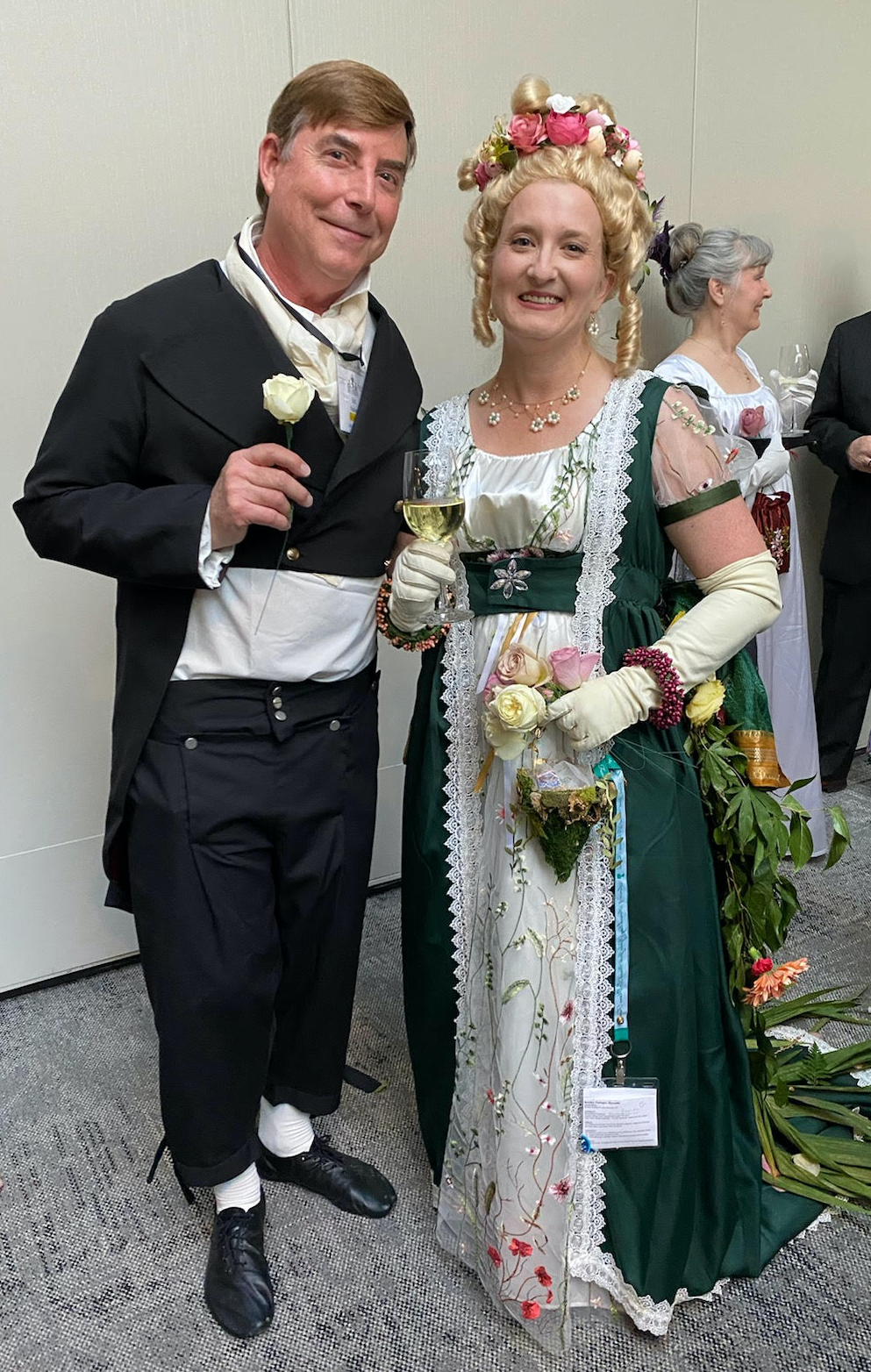
For many of us, the Ball is always a joy and delight. Most people dressed in lovely costumes, like those in the above photos of Renata Dennis (head of the diversity committee) and myself, Jeanne Talbot, and Baronda Bradley (whose bustle held a bouquet of fresh flowers) with her husband Eric Fladager. We all danced the night away.

Next year, I hope you will join us at the 2023 AGM in Denver for “Pride & Prejudice: A Rocky Romance.”

All photos © Brenda S. Cox, 2022.

Brenda S. Cox, author of the new book, Fashionable Goodness: Christianity in Jane Austen’s England, writes for Jane Austen’s World and for Faith, Science, Joy, and Jane Austen. You can also visit her on Facebook.

Fashionable GoodnessGentle Readers:

One of our blog’s writers, Brenda Cox, is introducing her book Fashionable Goodness: Christianity in Jane Austen’s England this week to the Jane Austen community. I am not only excited about its publication, but honored to be the first person on this tour to interview her. 

Prior Praise: 

“Finally! Fashionable Goodness is the Jane Austen reference book that’s been missing from the bookshelves of every Austen fan and scholar.”

— Rachel Dodge, bestselling author of Praying with Jane

You will look at Mr. Collins, the Crawfords, the Dashwoods, the Tilneys, the Wickhams, and Willoughbys–and especially Fanny Price!–with new and surprising insights. Bravo to Brenda Cox for giving us this very accessible, illuminating take on the ‘fashionable goodness’ of Austen’s era!”

— Deborah Barnum, Jane Austen in Vermont

Vic: What prompted you to write Fashionable Goodness? Was your decision a quick one, or was your journey long and thoughtful?

Brenda: It was a long journey. I first intended, about ten years ago, to write a novel based on Sense and Sensibility. But I always want to get things “right,” so I began to research. I wanted to include the church and faith in the story, since those things are important to me and I knew they were important to Austen. I discovered some fascinating churches, with their own stories, on a visit to Bath. I got hold of all the relevant books and sources I could. As I learned more and more about the church in Austen’s England, my notes multiplied. 

Finally, I realized that I needed a book about this topic, and it might benefit other readers as well. Therefore, I decided to put together a book that would bring together a wide range of information in one place. I wanted it to be accurate, affordable, and accessible for any reader. The book grew, I cut it back, grew, and I cut it back, multiple times. The text is easy for anyone to read, plus I have included resource lists and notes for scholars.

Eventually I shared it with friends, writers, and my wonderful editor, who all told me I needed to publish it. It’s been a  journey of several years even from then. I am such a perfectionist that it’s hard for me to let go of the book and release it into the world, but I’m excited to see it become “real” at last!

Vic: How did researching and writing Fashionable Goodness give you insights about Jane Austen as a person and a writer?

I can see now how deeply Austen’s faith affected her life and novels. I can also now understand her references to the church and clergy. That gives even more depth to the stories and characters.

Vic: How did your research change your personal feelings towards Jane?

Brenda: I feel closer to her now, since I’ve spent so much time in her letters and books. I looked at many small details to gain a clearer picture of her values. I can understand and appreciate her views, even when they are not quite the same as mine.

Vic: Do you have any advice for authors who are thinking about self-publishing? What tools do they need? What support system would help them along?

Brenda: For myself, I spoke to a number of agents and publishers during my journey, and their input was helpful. Some really liked the book and wanted to read it when it came out. However, it didn’t fit into their “categories,” since it’s about literature, history, and religion, and the intersection of all three. Also the book is fairly long, but my editor and beta readers kept wanting me to add more rather than take things out! So finally I went with self-publishing, which gives me the freedom to publish something “outside of the box” and charge what I think is a reasonable price.

But, I made sure to do it right. I have been writing for publications for many years. I know the craft well, from books, courses, and workshops about writing. I attended writers’ conferences to learn and to network. I hired a professional editor: a Janeite I providentially met at an AGM, who has edited for major publishers. I got extensive feedback from other writers and from beta readers. I got very involved in JASNA and gave JASNA talks, which honed my information and showed me what Janeites wanted to know. And, in the book, I show extensive documentation (with many pages of endnotes and a long bibliography) for those who might wonder about a self-published work.

The mechanics of self-publishing are much easier than in the past; Amazon keeps honing the process. A friend recommended Vellum as a formatting program, which I found excellent and reasonably priced. Once you have a good, professionally written and edited book, getting it online is not difficult, if you are at all technically inclined. (If you are not, you can hire people to do that part.) 

I am thankful that self-publishing has allowed me to get this book out into the world without the long lead time and higher prices of more traditional publishers. But I do encourage anyone considering self-publishing to get good help and make sure your work is done well.

Thank you, Brenda, for your thoughtful answers. You are the fourth writer I know who is self-published. While the journey is not easy, all feel such satisfaction in finding their hard work in print. I wish you all the luck in the world with this book!–Vic

Brenda CoxAbout the author, Brenda S. Cox:

Brenda S. Cox has loved Jane Austen since she came across a copy of Emma as a young adult; she went out and bought a whole set of the novels as soon as she finished it! She has spent years researching the church in Austen’s England, visiting English churches and reading hundreds of books and articles, including many written by Austen’s contemporaries. She speaks at Jane Austen Society of North America meetings (incuding three AGMs) and writes for Persuasions On-Line (JASNA journal) and the websites Jane Austen’s World and her own Faith, Science, Joy, and Jane Austen.

Where to Buy:

Fashionable Goodness: Christianity in Jane Austen’s England is now available from Amazon and Jane Austen Books. International link: Amazon

Blog Tour Schedule

Austen in the News

R.I.P. Marsha Hunt: Mary Bennet Actress in 1940’s Cinematic Treatment of Pride and Prejudice

749px-Marsha_Hunt_in_Pride_and_Prejudice_trailer

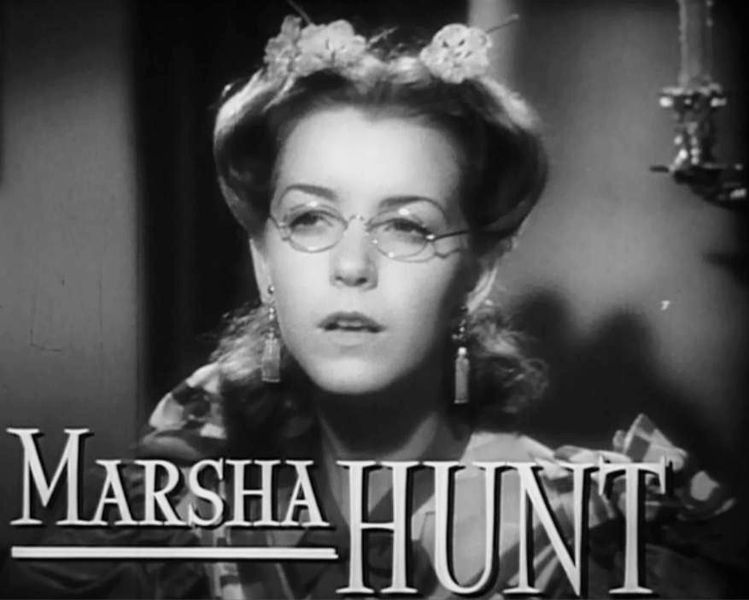
Marsha Hunt as Mary Bennet

Marsha Hunt, Pride and Prejudice’s Mary Bennet in the classic 1940 film, died a few weeks ago at 104 years of age. Those of us of a certain age recall this first full feature film of Pride and Prejudice well (view a description on IMBD). This flawed (yes, FLAWED classic in my opinion – the comments in this post, including mine, are quite heated. Many readers and classic film aficionados have disagreed with my opinions) introduced the Bennets and Mr Darcy in full black and white glory in a Mr Dickens wonderland. Still, Marsha’s Miss Mary left an indelible memory in my mind – the middle child, striving to compete awkwardly but in her own way with her more noticed and beautiful sisters – struck much empathy in my heart. 

The female costumes in this film were awful, for they were NOT vintage 1813, when P&P was published, but were repurposed from another studio film that dated in the Victorian era. Greer Garson’s advanced age (36) in playing Elizabeth had me snort wine out of my nose. Laurence Olivier as Mr Darcy (and the same age as his character) looked as if he fought a burr in his pants throughout the entire production. (He was unhappy with Greer, wanted Vivien Leigh to play the part, but the studios nixed this because of their scandalous love affair, which would be no more than rubbish today.)  

In addition, the film’s ending was changed in a manner that defied Jane’s intentions: Lady Catherine de Bourgh was the Deux et Machina who reunited Darcy and Elizabeth in marriage. When I saw that scene, I could no longer hold in my popcorn. (This JASNA article from 1986 holds a different view from mine. It was written years before subsequent adaptations when 1800’s Regency empire fashions were accepted as romantic and accurate by contemporary audiences.)

marsha hunt glamorous

Marsha Hunt

This P&P adaptation IMO was not a Jane Austen adaptation – it was a fantasy Hollywood re-creation. I don’t care how much Aldous Huxley was/is admired – he messed with my Jane.  Marsha Hunt is still my most memorable Mary (She acted in over 60 films in her career). Whose Mary is your favorite in subsequent P&P film adaptations? Informed minds want to know!

IMBD Obituary of Marsha Hunt.

Now Available: Jane Austen: Connecting the Dots (Her Letters Explained), Edited by Harvey T. Dearden

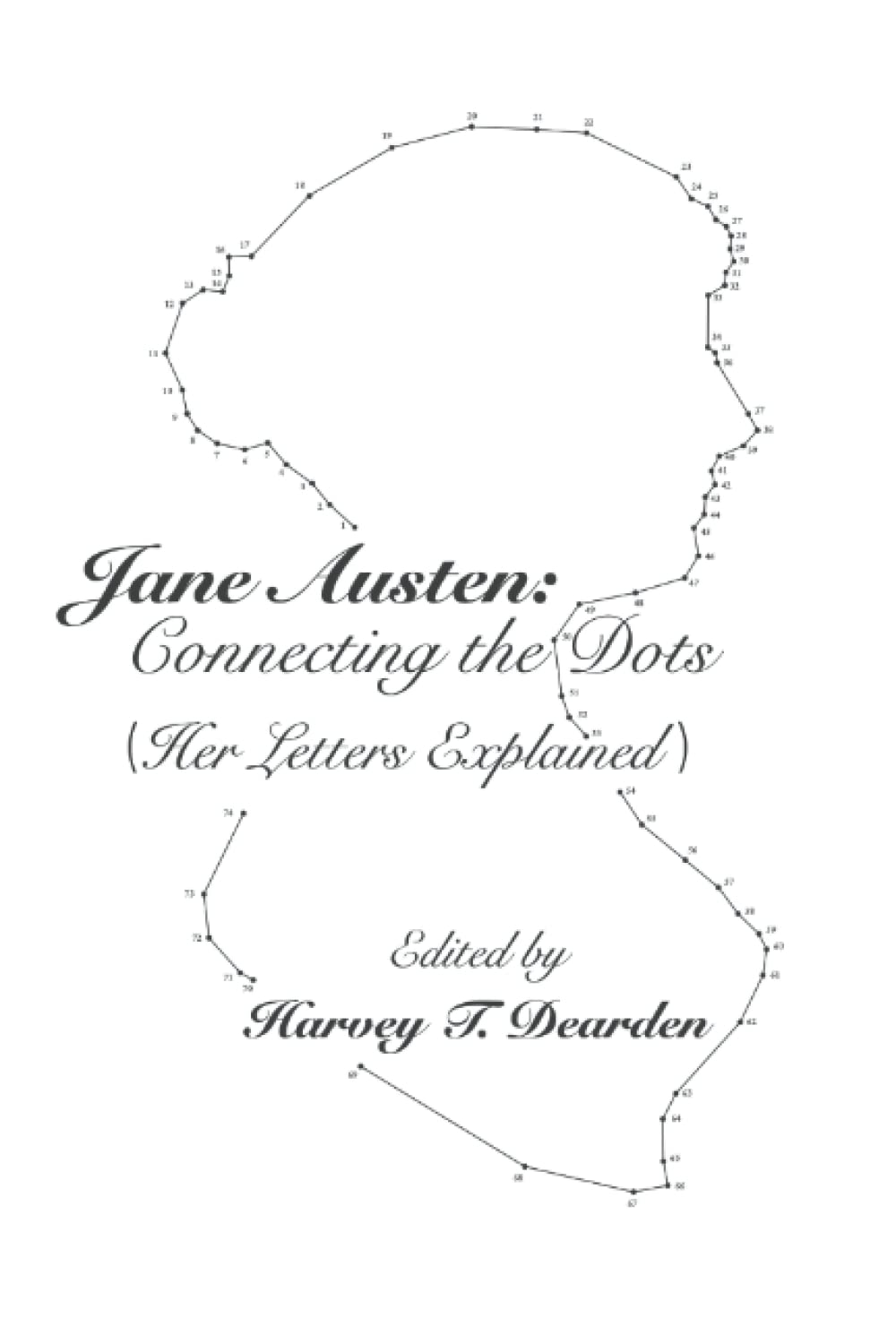
Jane Austen Connecting the Dots - Her letters explainedHow could any book compete with Deirdre Le Fay’s 4th edition of the Jane Austen’s Letters, I wondered? None in my opinion, for her last edition provides all the information I needed when reading Austen’s letters. YET. Harvey T. Dearden assembled a resource of her letters for people new to Austen who wanted an annotated edition that was easy to use and follow.

Let’s be honest. Le Faye’s excellent book is hard to use. While her content includes the letters, abbreviations and citations, notes, general notes, select bibliography, biographical index, topographical index, subject index, and general index – the size and arrangement of the book is awkward. I experienced a lot of back and forthing, and needed to tag the pages when reviewing the history and details of the letters. Le Faye’s research is definitive and the best in the business, but the hard book is difficult to use because its size is small (8 ¾” x 5 ½”  x 2 ½ “) and incredibly thick (667 pages). One cannot keep the book open without breaking its spine and placing heavy weights on it to read it while taking notes.

Mr Dearden’s new edition introduces the letters to a newer reading audience. His annotations are simpler, his book’s contents are more straightforward, and the size of his paperback allows the book to lay flatter, while the font size s larger.  In short order, Jane Austen: Connecting the Dots (Her Letters Explained) target an audience of Austen fans who are curious to know more about Austen’s personal life, thoughts, and family and friend connections in a relaxed manner.

Mr Dearden’s book is designed for Austen fans. Ms LeFaye’s book is the definitive scholarly edition of Austen’s letters. Her book is rich with scholarly information; Mr Dearden’s book is easy to handle and use.

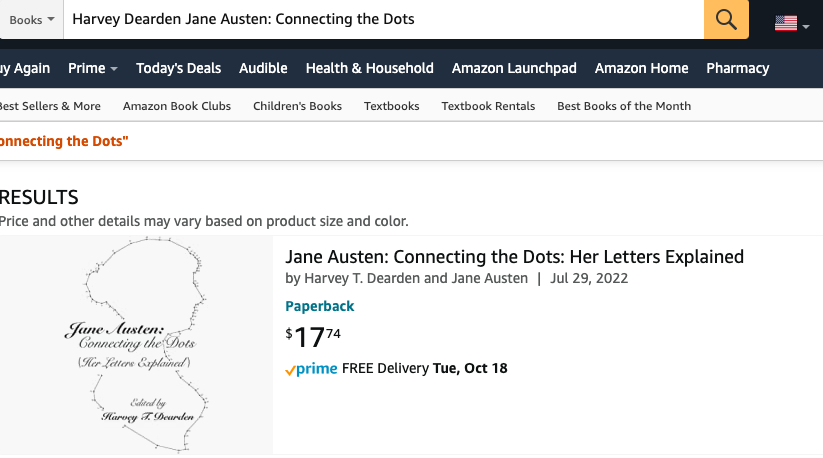
Find Jane Austen: Connecting the Dots book by Harvey T. Dearden at Amazon UK.

For US citizens, enter the title of the book and author in Amazon US. This works best if you already subscribe to Amazon Prime.

Screen Shot 2022-10-16 at 4.48.31 PM

As promised, I’m back with a reminder and announcement about Regency Marketplace’s brand-new seasonal Jane Austen Box! I’m delighted to share that the theme of this new box is “Christmas In Highbury”! If you missed my review of the lovely Autumn in Chawton Box I received, you can read about it and see photos HERE.

Christmas in Highbury

This Christmas, be transported to the little hamlet of Highbury in County Surrey. Here we find Emma and her friends and family preparing for a delightful country holiday, and you’re invited! Regency Christmastide for the aristocracy was often celebrated at the families’ country estates, and in Emma, we see her sister Isabella and Knightley’s brother John bring all their children to Hartfield for the occasion, enlivening the quiet household with their fun and noise. Mr. Woodhouse would have them stay forever!

The Perfect Gift

The “Christmas In Highbury” Jane Austen Box will be filled to the brim with a cozy and elegant medley of Emma and Regency-inspired Christmas gifts! A perfect gift box to send or receive this holiday season, it also makes a wonderful hostess gift. December 16th is Jane Austen’s birthday, too, so celebrate in style!

At Christmas every body invites their friends about them, and people think little of even the worst weather.

Jane Austen’s Emma

Place Your Order

The “Christmas In Highbury” Jane Austen Box will be available to reserve from Saturday, October 15th-Tuesday, November 15th, 2022. All boxes will ship out the first week of December! These boxes sell out quickly, so do not delay. Place an order for yourself or as a gift for a friend or relative today.

If you are longing to receive a box for Christmas, send this link to a friend or loved one as a big HINT: https://regencymarketplace.com/collections/jane-austen-box.

If you want to take it up a notch, you can subscribe to the Quarterly Jane Austen Box and receive a box every 3 months, or purchase as a One-Time Gift option (non-recurring). Free Shipping in the USA! International Flat Rate Shipping available.

Coupon Code

Many thanks to Regency Marketplace for providing me with a discount code that I can share with all my friends and readers this Christmas ordering season. If you would like to receive a discount, you can use my special COUPON CODE for 10% off the Winter Box! *While Supplies Last.*

Previous Winter-Themed Jane Austen Box

RACHEL DODGE teaches college English classes, gives talks at libraries, teas, and book clubs, and writes for Jane Austen’s World blog. She is the bestselling author of The Little Women DevotionalThe Anne of Green Gables Devotional and Praying with Jane: 31 Days Through the Prayers of Jane Austen. Coming soon: The Secret Garden Devotional! You can visit Rachel online at www.RachelDodge.com.