Feeds:
Posts
Comments
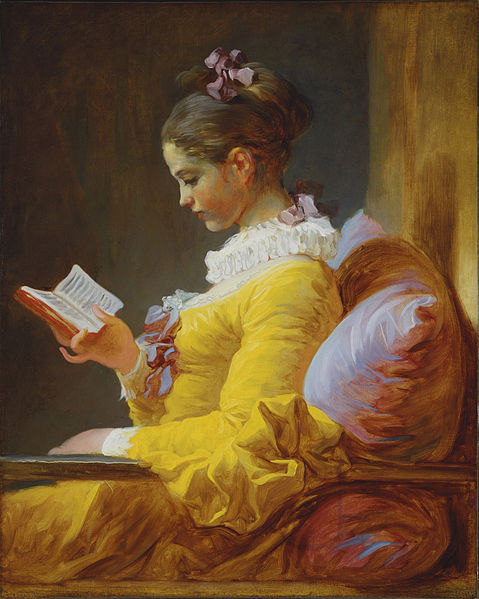
A Young Girl Reading, or The Reader (French: La Liseuse), is an 18th-century oil painting by Jean-Honoré Fragonard. Image @Wikipedia

A Young Girl Reading, or The Reader (French: La Liseuse), is an 18th-century oil painting by Jean-Honoré Fragonard. Image @Wikipedia

Happy New Year, gentle readers. I hope to write more for my blog in 2014. Thank you for your loyal readership. I cannot tell you how much I enjoy your comments and thoughts.

In winter weather, what can be a better way to pass the time than to curl up under a blanket with a good book? I’d like to recommend two books for you to purchase with the gift  money you (hopefully) received this holiday season. Both books are necessary additions in the libraries of confirmed Janeites and Jane Austen lovers, or so it is my belief. (Note: Contest closed. Congratulations Janice Jacobson!)

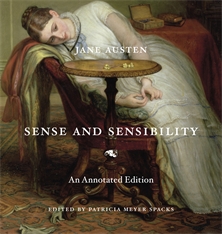
Sense and Sensibility: An Annoted Edition edited by Patricia Meyer Spacks.

The first is the 4th installment of  an incomparable anthology series of Jane Austen’s novels. Sense and Sensibility: An Annoted Edition is published by The Belknap Press of Harvard University Press and edited by noted scholar Patricia Meyer Spacks. This lush book could easy be confused for a coffee table book – the cover is so beautiful and the color images inside are of the highest quality, but the annotations are anything but superficial. Dr. Spacks’ research adds dimension to Jane Austen’s words and to an era that is long gone, and whose customs have become foreign to our modern understanding. Her observations include a comparison of characters within the novel – “Miss Steele is as acquisitive in a small way as the John Dashwoods are in a grander fashion”. She also draws a similarity between two novels, nothing that Willoughby is similar to Henry Crawford in that both men have fallen in love with the women they targeted for a light flirtation and amusement.

In her introduction, Dr. Spacks elaborates on the 18th century definition of sensibility, which was understood to be derived from the nervous system. Hence, fragile nerves, irritability, hysteria, tremors, fainting spells, and sickness at heart were closely associated with the term (as with Marianne Dashwood’s and Mrs. Bennet’s histrionics). Spacks’s introduction also delineates how Austen conceived of the book and how Elinor and Marianne cannot easily be pigeon-holed into the two separate categories. As they grow in understanding, both women possess elements of the other’s characteristic. As most of us know, Jane Austen wrote the first draft (known as Elinor and Marianne) by the time she was 20 years old. The book, written first in epistolary form, did not assume the third person narrative until 1811. Perhaps this is the reason why a number of passages in the book seem to lack detail or were uneven.
Sense_Sensibility_Spacks

Publicity materials for this annotated edition explain that:

In her notes, Spacks elucidates language and allusions that have become obscure (What are Nabobs? When is rent day?), draws comparisons to Austen’s other work and to that of her precursors, and gives an idea of how other critics have seen the novel. In her introduction and annotations, she explores Austen’s sympathy with both Elinor and Marianne, the degree to which the sisters share “sense” and “sensibility,” and how they must learn from each other. Both manage to achieve security and a degree of happiness by the novel’s end. Austen’s romance, however, reveals darker overtones, and Spacks does not leave unexamined the issue of the social and psychological restrictions of women in Austen’s era.

One get the strong sense that Spacks prefers Willoughby as a hero over Edward, whose character is rather tepid and static. Colonel Brandon’s mature patience doesn’t fare much better in some of the annotations, which also include extensive descriptions of manners, mores, and historical facts. Mundane customs are described, such as the games of whist and cassino.

Home, hearth, and space play important roles in this novel.The country side affects Edward more than Willoughby, who regards the land merely as a place in which to hunt. Edward will eventually live off the land, and happily so. Ennui, or inertia, is also evident in the novel’s characters. Spacks quotes the scholar, Isobel Armstrong, who observed that “a long, patient but sapping wait is the fate of many in this novel; Edward, Elinor, Colonel Brandon, even the unsympathetic Steeles.” Perhaps this is the reason why so few of us think of Edward as a strong hero. His character lacks decisive action. When he does make a decision, as with his unfortunate choice of fiancee, he seems stuck and unable to make a move when encountering a road block. The conniving Lucy spends considerable time waiting for Edward and hoping that Mrs. Ferrars will come around to accepting her. Most of her machinations (that of seducing Robert Ferrars) occur off the novel’s pages and we hear about her success in marrying Robert only through word of mouth.

My one complaint about this edition is that the annotations seem spare compared to Pride and Prejudice, the first annotated book edited by Dr. Spacks. To be fair, Sense and Sensibility is not as highly ranked on most reader’s lists as Persuasion, Pride and Prejudice, or Emma. It is the earliest of Jane Austen’s published novels, which may explain why the number of annotations seem to be fewer in this book. Nevertheless, I highly recommend this edition, which costs $35, a bargain considering the the number of colored illustrations and information contained therein.

Northanger Abbey is the next novel to be annotated. It will come out in spring of 2014. I cannot wait for it to be published. 
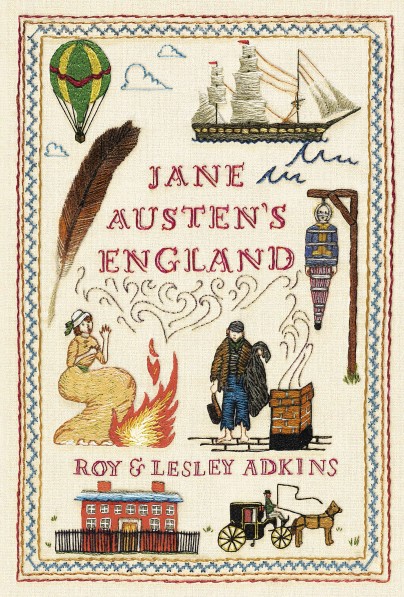
Jane Austen's England by Roy and Lesley Adkins

Jane Austen’s England by Roy and Lesley Adkins

Jane Austen’s England by Roy and Lesley Adkins

The next book on my recommended buy list is Jane Austen’s England by Roy and Lesley Adkins. Actually, I should amend my ranking, for both books are equal in my estimation. The publisher sent an uncorrected proof of  Jane Austen’s England when I was in the throes of taking care of my parents this past summer and fall, and so I read the book piecemeal, hoping to find the time to give it the review it deserved. My copy is earmarked and underlined. I have read many passages twice. Roy and Lesley Adkins have accomplished a remarkable job of research and writing that informs as well as entertains. I realize that many of you have read a number of histories associated with Jane Austen’s age and some of you will find the information repetitive. In addition, you can easily find many of the sources used for this book on the Internet or for purchase.

This book is divided into topics that follow the lives of Jane Austen and her characters. While the historic territory that the Adkins go over is not unique, their presentation is organized in such a way that all we need to do is to turn to Breeding or Toddler to Teenager to Wealth and Work and Medicine Men to find out more about the daily habits of the Austens, Jane’s characters, or the socio-economic conditions of those who lived during the Regency era. The Adkins do not subject us to mere romantic assumptions, but relate the harsh reality of life for the majority of people living during that age. The chapter on Filth minces few nice words. This was an era when outhouses abutted to sculleries, cholera was spread through contaminated water, and cesspits drained into watercourses. Men and women were known to urinate and defecate in streets. While our dear Jane did not write about these indelicacies, she must have witnessed such actions and known of many more contemporary customs that would turn our heads today. In her novels, she ignored the harsh realities of war and famine, common occurrences in her day, and assumed that her readers would seamlessly fill in the details of daily life while she concentrated on her character studies.

Topics in Jane Austen’s England  include kidnapped children, superstitions and folk wisdom, the use of Almanacs (useful for planning evening parties during a full moon), boundary stones, funeral customs, tax burdens of the rich and poor, Frost Fairs, animal fighting, animal abuse, hunting, cricket, horse races, regattas, amateur theatricals, London theatres with their noisy audiences, the cost of music tickets (two weeks wages for a servant), ballad sellers, public houses, taking snuff, state lotteries, the cessation of the Grand Tour during the Napoleonic Wars, the danger and challenges of travel and transportation, boot scrapers, toll roads, toll booths, turnpikes, surveying,  mapping England, medicine, apothecaries, the royal navy, and more. Whew!

Even though I finished the book late last month, I struggle to remember all the fascinating details that this 300+ page book contains.

For a New Year’s gift, I am holding a book giveaway of a hard back copy of Jane Austen’s England until midnight, January 7, 2014. All you need to do is leave a comment about an interesting fact you know about Regency life or Jane Austen’s era. Participants are confined to the U.S. and Canada. (So sorry!) Winners will be chosen by a random number generator. You may enter as often as you like, provided that you share another interesting bit of information about Jane Austen’s England each time you make a comment.

Happy New Year, all. Thank you for stopping by my blog.

Apoplexy in the 18th century

My blog has been silent again. Just as my schedule was letting up a bit, my father fell ill. In Jane Austen’s time, extended families lived in one village and often under the same roof. Healthy family members or friends took care of the sick, elderly, and very young. In this age, when sons and daughters and siblings live far apart, taking care of a loved one is not as convenient. I took time off from work, more to help my 88 year-old mother than my father, who was in the hospital, and to take some stress off my brother, who was starting a challenging and demanding new assignment. We thought Dad had suffered a stroke. In the 18th century, his condition would have been described as apoplexy, or “paralysis caused by stroke. Sudden deprivation of all the internal and external sensation and of all motion unless of the heart and thorax.” ( Glossary of Old Medical Terms Used in the 18th and 19th Centuries)

As he came out of a restaurant bathroom, my dad forgot to walk. I happened to be there, worried that he was taking so long. He began to slur his words and hallucinated that his father, who has been dead for 40 years, was joining us for dinner. We rushed him to the emergency room, where he wound up in good hands, receiving excellent diagnostic care. After four days of tests, he was transferred to a rehab hospital for the elderly to receive 10 days of speech therapy, physical therapy, and occupational therapy.

Stroke (apoplexy) satirical art work. 1822 copy of a Charles Aubry original. Click here to go to Fine Art America to read the details.

Stroke (apoplexy) satirical art work. 1822 copy of a Charles Aubry original. Click here to go to Fine Art America to read the details.

Back in the old days, those who suffered apoplexy or stroke were not so lucky. Many died within hours of the event, if not a few weeks later. Blood letting was one cure that was thought to be effective, although in most cases the practice was harmful and weakened the patient.

Some of those who survived successive attacks, especially the young, were mistaken for being mad. Romance author, Laura Kinsale, has written a remarkable book entitled Flowers From the Storm, in which a hedonistic and haughty duke is placed by his family into a mental institution after a major stroke. His sudden inability to communicate and lack of physical control is described in detail by this talented author in a story that, 15 years after I first read it, still stands out in my mind. I imagine the fate that this fictional Duke suffered was shared by many actual people of that era.

In our case, Dad benefited from modern medicine. An MRI showed previous minor strokes, but a CAT scan proved that this was not the reason for his illness. Dad’s illness was a “neurological event” that has been attributed to the progression of his Parkinson’s disease, once known as shaking palsy; the effects of a new medication, which made him hallucinate; the poisonous interaction among the 16 some medications he was taking per day; the slow advancement of his dementia; lack of exercise; and simply old age.

Two hundred years ago, I would have lived close enough to my parents to help on a daily basis. These days, Dad will be depending on home visits from medical personnel and the loving attentions of his wife.

My, how times have changed.

More on the topic:

Spectacles in 1835

Recently three 19th century portraits appeared in Pinterest of individuals wearing eyeglasses. They struck me as being remarkably unique, in that so few people at the time are shown wearing these accessories. The first shows a Southern belle in Louisiana. She wears the light-framed oval shaped spectacles so popular during that era.

Jean-Joseph Vaudechamp portrait of Mrs. Antoien Julien Meffre-Rouzan, c. 1839, New Orleans

Jean-Joseph Vaudechamp portrait of Mrs. Antoien Julien Meffre-Rouzan, c. 1839, New Orleans

During the 1830’s and afterwards, a new
inexpensive metal gained popularity for the manufacture of
spectacle frames and many other items. In New York City in
1829, German chemist Louis Feuchtwanger introduced the alloy
“German silver”, composed of varying amounts of copper,
zinc and nickel. Spectacle frames of this material became widely
available after 1835. The cost and durability of German silver
spectacle frames made them very popular…History on Your Face

blondel 1835

Portrait of a Man 1835, Oil on canvas by Merry Joseph Blondel

This gentleman could be a lawyer or accountant, even Mary Bennet’s husband. What say you?

Portrait of a Lady, 1835

Portrait of a Lady, 1835

The woman in this last image could be Mary Bennet from Pride and Prejudice all grown up.

Love these paintings. Here is my Pinterest board for 18th and 19th Century Art. Enjoy: http://www.pinterest.com/janeaustenworld/18th-19th-century-art/

This article from Historic Eyewear discusses19th century American spectacles in detail.

Ring in a boxInquiring readers, dear friend Tony Grant (London Calling) has written an article to help jump start my re-entry into blogging. I love this post, for I am a huge Kelly Clarkson fan, and I was happily astounded to learn that she was a Janeite. Who knew that the simple girl from Texas with the huge voice would make it so big in the music industry that one day she would outbid a host of collectors for Jane Austen’s cabochon blue stone ring? Since her winning bid, the ring has lived in limbo, as Tony’s tale will recount, but now it is safely in British hands again, thanks to a committed group of people.

Kelly’s other association with Jane Austen is peripheral. She sang a song for the hit movie, Love Actually, in which a number of actors who starred in Jane Austen films appeared: Colin Firth, Emma Thompson, Keira Knightley, Hugh Grant, and Alan Rickman. I have placed the YouTube video at the bottom of this post. Meanwhile, I hope you enjoy Tony’s tale.

It is possible that you might have heard about a certain ring that hit the headlines worldwide recently.

American singer Kelly Clarkson, a 31 year old singer from Fort Worth Texas, bought a small gold ring with a smooth turquoise stone set in it at Sotheby’s Auction for around £150, 000. The news hit the headlines because this ring had been the property of Jane Austen. British government officials, the Jane Austen Society and readers of Jane Austen across the known world were aghast.

Kelly Clarkson

A number of issues came to the fore. First, a ring, which is of British national importance, because of its provenance, was about to be taken out of Britain; secondly it was going to a pop star, who although she professed her love of Jane Austen, was really just buying it, because she could. A holding order was placed on the ring by the British Government preventing it leaving the country. A few months were given for a British buyer to raise the funds to purchase it back from Miss Clarkson.

Chawton Cottage houses the Jane Austen House Museum.

Chawton Cottage houses the Jane Austen House Museum.

Chawton Cottage , the home of Jane Austen for the last eight years of her life, came forward to raise the necessary money. An anonymous benefactor provided most of the funds required within a short space of time and petitions and activity,  amongst American, Australian and British Janeites secured the rest. Susannah Fullerton took the lead in Australia and Maggie Sullivan sent out a rallying call in America and Chawton House made clear their aim over here. Janeites from around the world contributed money on the site set up by Chawton Cottage and Kelly Clarkson graciously sold it to Chawton Cottage. The ring will now have associations to Jane Austen, as well as to Miss Clarkson. The whole of the Jane Austen community will feel that they have a part of it because of their contributions. It will truly become a ring owned and loved by all. It has now gained another dramatic layer of history and meaning.

The ring will be on display at Chawton Cottage alongside other pieces of Jewellery, the topaz crosses brought back from a voyage by the Austen’s younger brother, Charles and also a beaded bracelet, also owned by Jane, for all visitors to see.

The Arts Council’s reviewing committee secretary states,

The expert adviser had provided a written submission stating that the gold ring (width 17.5 mm; height 8 mm) set with a turquoise was probably made in the eighteenth century, possibly about 1760-80. In excellent condition, the ring sat in a later nineteenth-century case bearing the name of T. West, Goldsmith of Ludgate Street, London and was accompanied by papers documenting the history of the ring within the family of Jane Austen.”

The gold circle of the ring is 9 carat gold which is rather low in pure gold content and so denotes the ring as being an ordinary piece. The highest carat possible is 23 carat, which is almost 100% gold. It has been assessed because of its design and construction as being made between 1760 and 1780. The ends of the hoop of the ring curve round underneath the bezel. Taken with the thin hoop and simple oval bezel this suggest its date. Jane was born in 1775 so it is evident that the ring was not made for her originally. The provenance of the ring is based solely on letters and documents within the Austen family and only go back to Jane‘s ownership. After her death it went to Cassandra and then passed down through the family. Could it possibly have got to Jane in the same way? A relative dying and passing it on to Jane as a keepsake. It is something that Jane obviously wanted to keep. It’s simplicity and effectiveness would have appealed to her. On her finger it would have had a lustre under candlelight. It would have been something that other people would have noticed at any gathering such as a ball or family event such as Christmas.

Janes ring

Gold itself was not an easy commodity to come by between 1760 and 1780. The American war of Independence which waged between 1775 and 1783 made Gold a rare commodity. It was a vital constituent of the wealth of the nation. Britain had to pay for the War. Much gold came to Britain from Brazil in the 18th century, but because of the European war against France and the War against the colonies in North America getting gold here from South America was not an easy business. Transport ships could be captured or sunk. It pushed the price of gold up. Even 9 carat gold must have been expensive and hard to come by at the time. There were some gold mines in Britain  , at Dollgethlau in Wales, in the low border hills of Scotland and in Cornwall at the Treore mine near Wadebridge, the Carlson veins at Hopes Nose Mine and within the copper veins of Bampfylde, North Molton. The Romans first discovered gold in Wales so there is a long history of gold mining in Britain. It would be good to imagine that the gold in Jane’s ring came from one of the mines in Cornwall. She loved the West Country and had family holidays in Lyme, Sidmouth and Colyton.

There is a turquoise gem set in the ring. Turquoise is meant to be a bringer of good luck. It has been found in the tombs and on the artifacts of many Egyptian Pharaohs and important people. It can change colour under certain circumstances. Turquoise is found all over the world. It is associated with copper mining and indeed Cornwall, where copper has been mined it is also associated with turquoise. Because of the geopolitical state of the world in the 1770’s onward, Cornwall, like the gold in Jane’s ring, is the most likely source of the turquoise. It has also been suggested that the turquoise stone in Jane’s ring might be a special variant called Ondontolite. Ondontolite is also called bone or fossil turquoise. It is a gem formed by the infiltration of surrounding minerals into fossil bones. This would fit with the turquoise stone in Jane’s ring because, Dorset and the West Country have rich fossil deposits.

Jane’s ring is therefore connected to wars, national financial need, geology, the mining industry and mining communities and the lives of their inhabitants, which were being developed exponentially with the coming of the Industrial Revolution, social status, personal attractiveness, social occasions and mystical meaning. A designer designed it and a craftsman made it and a shopkeeper sold it. It is one symbol of economic and social endeavour within an historical context.

In the novels rings and jewellery have their importance and meaning. In Pride and Prejudice, Lydia describes how her carriage overtakes the curricle of William Goulding and she lowers the window and lets her ring be seen. Isabella Thorpe in Northanger Abbey looks forward to the day that friends and neighbours will envy her her, “exhibition of hoop rings on her fingers.” These two examples are of characters who show vanity and self-importance but in Mansfield Park, Fanny Price, who receives the present of a small cross from her brother William, is at pains to find just the right simple chain to wear it with and show off her brothers generosity. William cannot afford the chain to go with the cross and Edmund eventually comes to Fanny’s rescue with just the right sort of simple chain for her to wear. The jewellery in the novels  seem to portray elements of character. They show Jane Austen’s understanding of the use of jewellery. This adds to the importance of the turquoise ring that Chawton Cottage have managed to now acquire.

In the Arts Council assessment of the ring, in the part where they describe the provenance of the ring, they describe documentary evidence for it belonging to Jane and various members of her family through the generations.  The report sets out the ownership of the ring after Jane’s death. The other point to be made is the report in the news that the ring is, ” a never seen before ring owned by the novelist Jane Austen.”

The family for generations have kept the ring  to themselves. Jane is one of the most pored over, read about and speculated upon authors in history. The family appeared to want to keep something of her just to themselves, their own private bit of her.

Letter to the next recipient of the ring.

Letter to the next recipient of the ring.

One member of the family in each generation was given guardianship over the ring. So what was special about the keepers of the ring? After Jane’s death Cassandra owned it. She passed it on to her sister in law Eleanor Austen, the second wife of Henry Austen, “as soon as she knew I was engaged to your uncle.” Henry had been Jane’s favourite brother and it was he, whilst a banker living in London, who had arranged for her novels to be published. Eleanor passed it on to Caroline Mary Craven Austen, the daughter of Jane’s brother James. Caroline Austen passed it on to her niece Mary Austen Leigh who passed it on in turn to her niece Mary Dorothy Austen Leigh. Mary Dorothy Austen Leigh then passed it on to her sister Winifred Jenkyns in 1962. Apart from the obvious observation that the ring passed along the female line what else can we deduce? The ring was adapted for the use of somebody with a smaller finger than the original owner. A bar of gold, called a stretcher, has been fitted at a later date, probably by the company T West Goldsmiths of Ludgate Hill which is named on the inside of the box holding the ring. It seems that the ring was worn and not just kept as a memento. This might suggest things about the owner in each generation. A memorial ring, which this is, especially after Jane’s death and passed on through the family, commemorates Jane through generations. The wearer and owner could almost be seen as a surrogate Jane to the family in each generation. It is unlike a memento, such as a piece of furniture or a vase, which is set at a distance from people to be viewed. This ring has a different connection. It was worn on occasions. One wonders what occasions the Austen ancestor in each generation would wear it? When you wear an item belonging to somebody you take on aspects of that person. It’s not just the touching of the object which makes a connection with that person and the past but it is also the using it as they would have used it. They almost, in a way, become that person. A little like an actor wearing a costume,however in a case like this, wearing Jane’s ring would have been much more personal and evocative than merely playing a part.

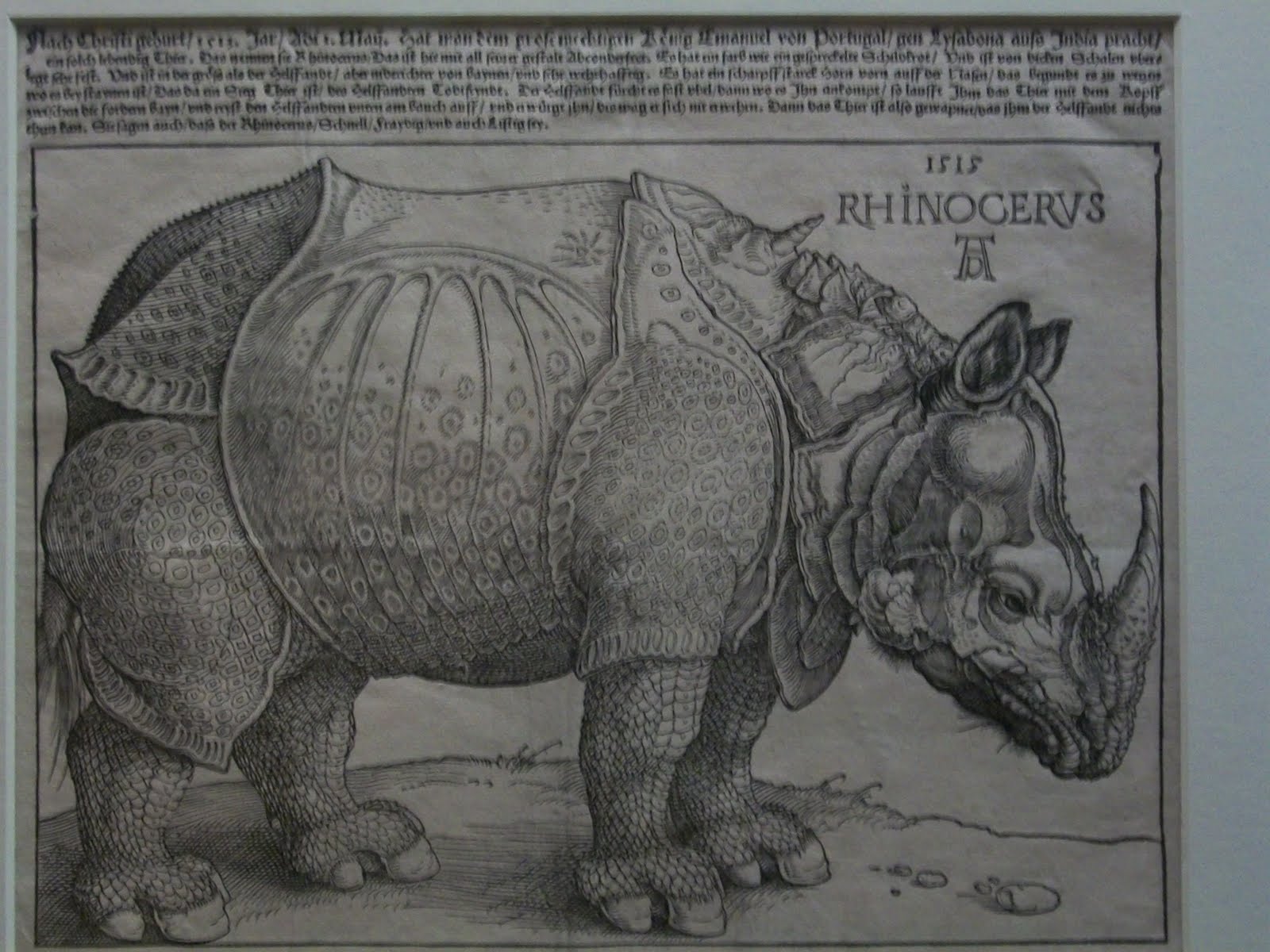
Durer's image of a rhino

Durer’s image of a rhino

Neil MacGregor, the director of The British Museum, wrote and published “A History of The World in 1000 Objects,” in 2010 and broadcast his readings of the book on BBC radio 4. In his description of the first of his 100 objects, the Mummy of Hornedjitef (circa 240BC), an object taken out of chronological order in MacGregors 100 objects, he uses it as an illustration of how knowledge develops. The interpretation of the mummy has changed as more research has been possible. The Mummy is a vivid example of the work of the academic. Neil MacGregor states that the work of an Archaeologist or Historian is to gather the evidence and make the best of the evidence they can. This changes over time as more evidence emerges but the archaeologist can only do his best with what he has. MacGregor gives Durers portrait of a rhinoceros, drawn in 1515, as an example. Durer had never seen a rhinoceros. He drew his portrait from first hand witness accounts. He did his best with what evidence he had. The drawing is completely wrong. I have used the evidence I have got for Jane’s ring and gathered other evidence to answer questions as they occurred, from various sources but I, like Durer, don’t really know.
Clarkson, had almost the last word. This was her reaction to Chawton Cottage buying the ring from her,

“The ring is a beautiful national treasure and I am happy to know that so many Jane Austen fans will get to see it at Jane Austen’s House Museum.”

Chawton actually had the last word. They hoped for a long and fruitful relationship with Kelly and hoped she would visit the ring at the cottage.

Kelly Clarkson wears a facsimile of Jane Austen's ring at a concert.

Kelly Clarkson wears a facsimile of Jane Austen’s ring at a concert. Image @Mirror News

Everybody appears to be friends!!!

Here’s Kelly’s song in Love Actually, The Trouble With Love Is, with scenes from the film

Mirror News: Kelly Clarkson Jane Austen ring row

Gentle Readers,

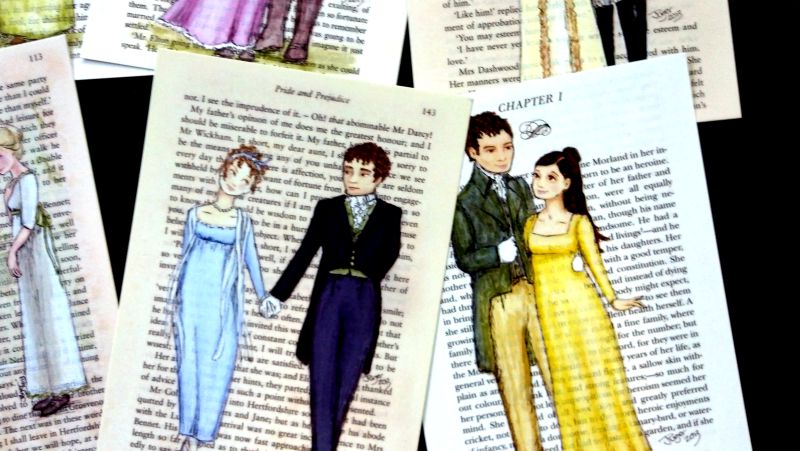
What better way to resume my blog than with Jessica Purser’s lovely Jane Austen post cards and bookmarks? I apologize for my unexcused silence. Life simply caught up with me, and due to a schedule that overwhelmed me because of work and family obligations, I had to cut back on my blog, and Facebook and Twitter comments. I did keep up with my Pinterest boards, for I found that cataloging images was as relaxing as playing solitaire. Whenever I found 10 spare minutes here and there (while waiting, watching the news or a television show, or during a solitary meal), I would pin. I want to thank those who persisted in contacting me (and who I needlessly worried) and who coached me to return to my blogging duties a little earlier than I had planned. Jessica Purser sent these lovely cards and notes for me to review in July. They certainly deserved my immediate attention and not such a long wait.

JPurser_PrideandPrejudice.jpg

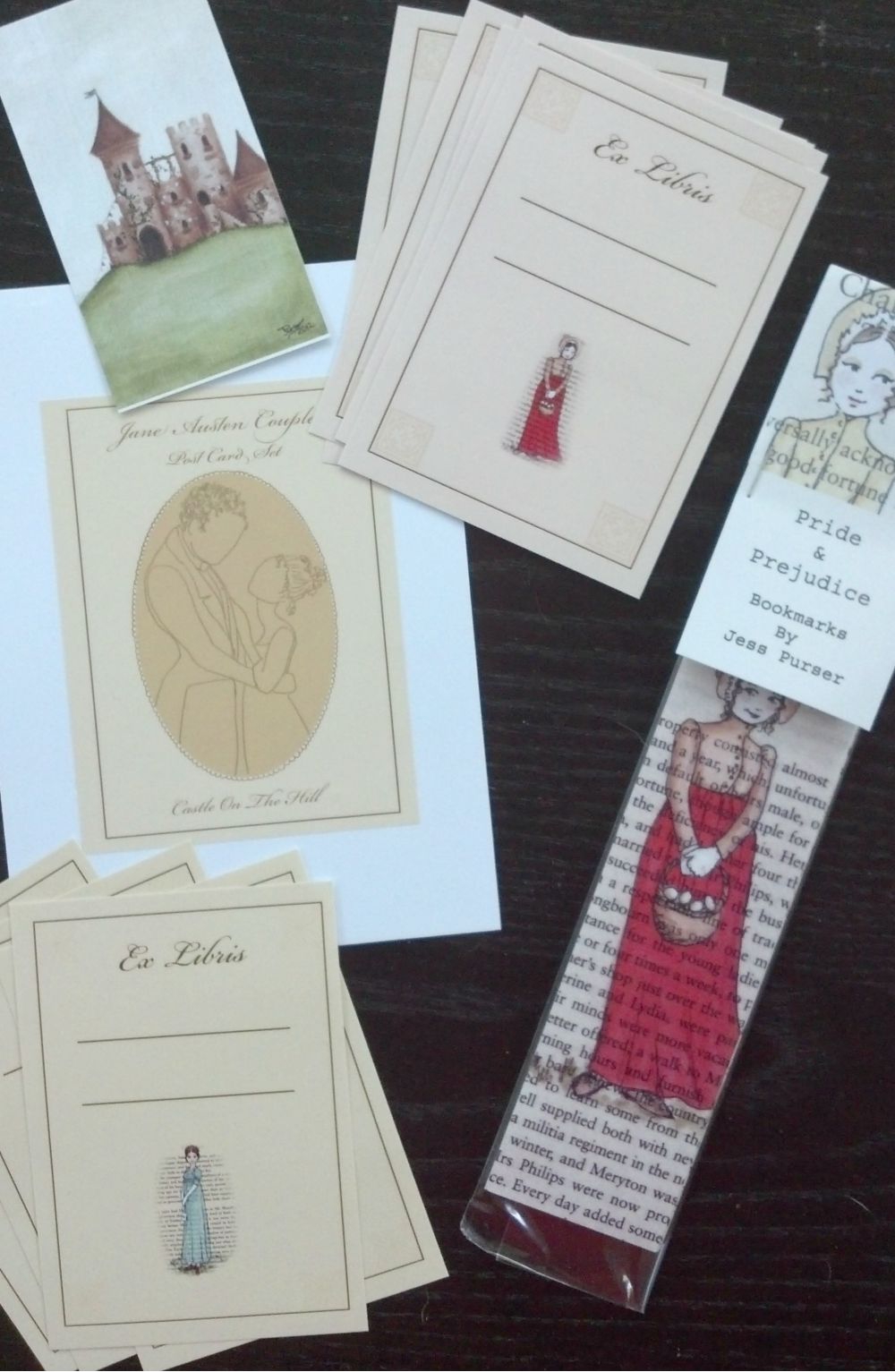
I placed a number of the images on my table. Sorry about the quality of the images. I have interspersed them with images from Jessica Purser’s Etsy site.

I am sure that many of you have already viewed samples of Jess’s images on Facebook, Twitter, Tumblr, and Twitter, but I couldn’t help sharing these cute interpretations of Jane Austen’s characters anyway.

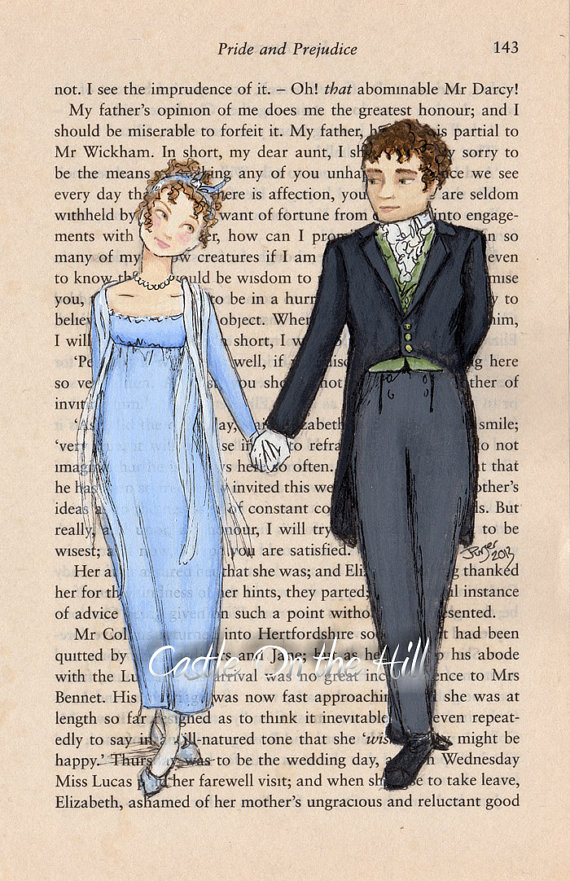
Elizabeth and Mr. Darcy

Elizabeth and Mr. Darcy

Ms. Purser sent me quite a few samples, which I photographed (rather clumsily, I must admit). I am also featuring a number of images from her Etsy site.

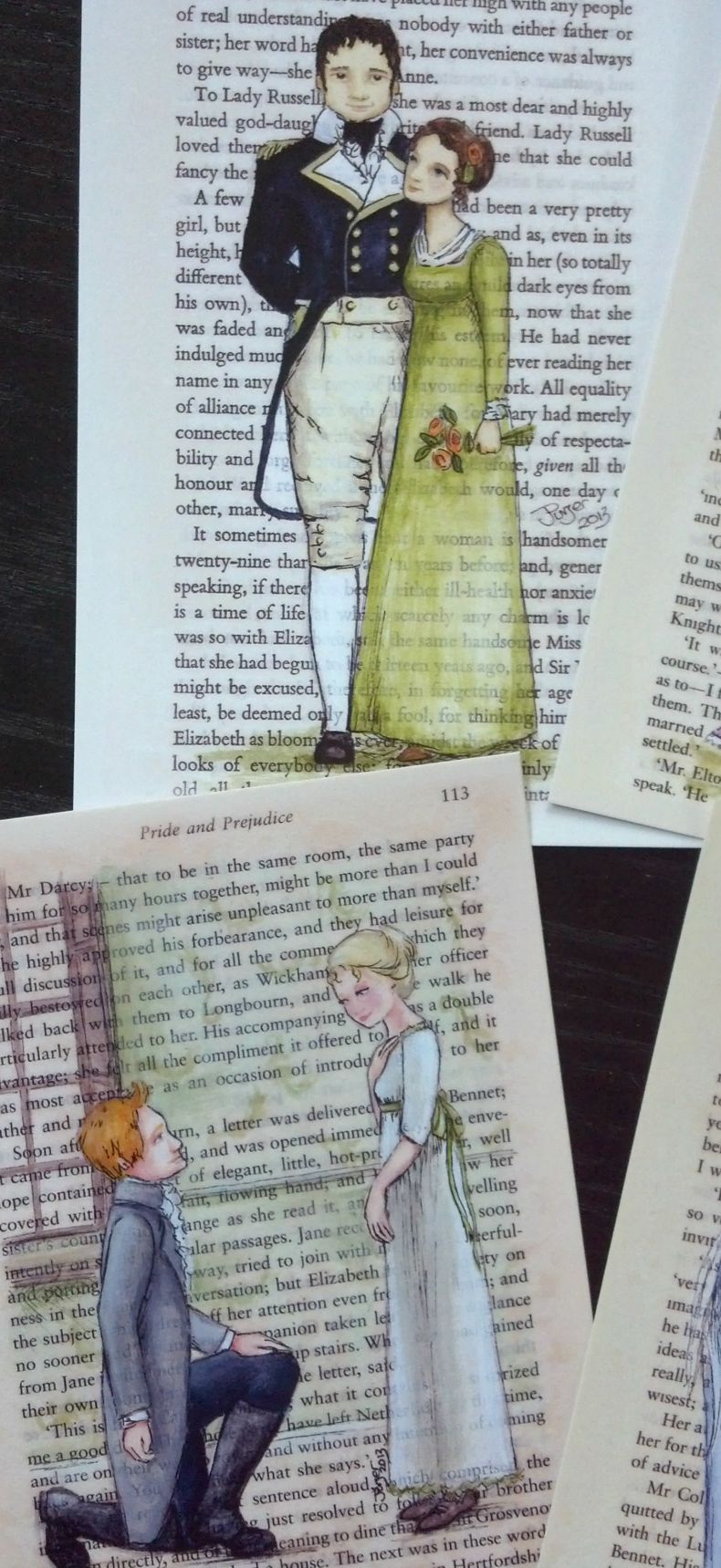
persuasion_pride_purser.jpg

Anne and Captain Wentworth in Persuasion, and Bingley proposing to Jane in Pride and Prejudice

I can’t think of a better way to restart my blog than to share Jess’s wonderful creations with you. They are painted on pages of Jane Austen’s novels, which provide context.

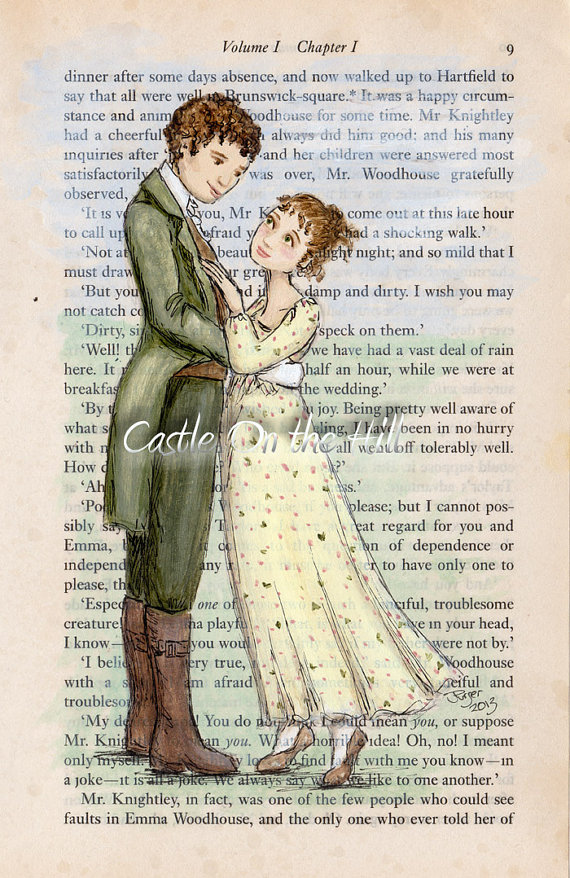
Emma and Mr. Knightley

Emma and Mr. Knightley

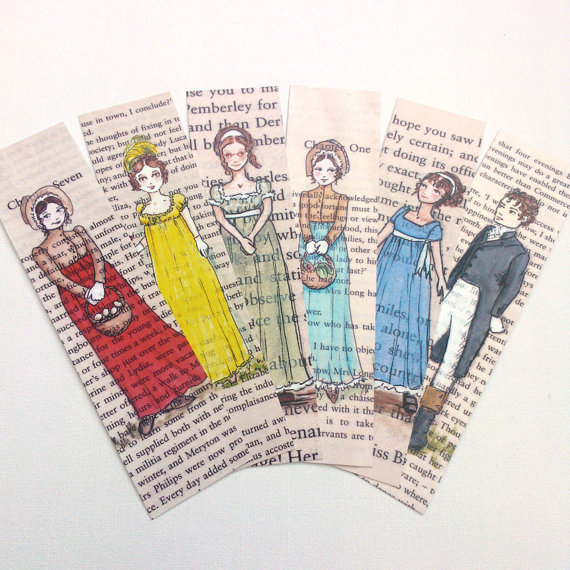
The postcards are printed on hardy card stock and the larger images are suitable for framing. I have been using the bookplates and bookmarks, and sharing them with friends.

Bookmarks and book plates. How lovely.

Bookmarks and book plates. How lovely.

Thank you, Jessica, for this lovely art work.

Jess's book marks

Jess’s book marks

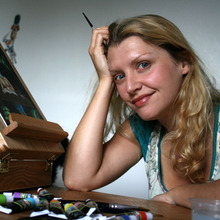
Jessica PurserRead more about Jessica in this Interview with Jessica Purser on Rockalily Cuts

Order her art work at: Castle on the Hill, Jessica’s Etsy Shop