Feeds:
Posts
Comments

Posts Tagged ‘Regency Dance’

By Brenda S. Cox

“My idea of good company, Mr. Elliot, is the company of clever, well-informed people, who have a great deal of conversation; that is what I call good company.”—Anne Elliot, Persuasion

This year I enjoyed plenty of “good company” at the yearly Jane Austen Festival in Bath. Every September, Janeites gather from around the world to enjoy a wide range of events.

This year’s Jane Austen Festival was held Sept. 13-22.

Program cover for the Jane Austen Festival, 2024, in Bath.

After a few pre-Festival events,  the 2024 Jane Austen Festival officially kicked off with a Grand Regency Costumed Promenade on Saturday morning. Organizers were expecting 1100 people in full Regency dress. We walked through Bath, from the Holbourne Museum at Sydney Gardens (near one of the Austen’s homes in Bath) all the way up to the Assembly Rooms (the “Upper Rooms” in Austen’s time).

Soldiers and musicians led the parade. The promenaders, including men and women, boys and girls, swept up the wide streets. The weather was cool and sunny, unlike the first time I attended the Festival, when it was rainy and I ended up with a muddy petticoat, like Elizabeth Bennet!

More than a thousand people in Regency dress promenade the streets of Bath at the Jane Austen Festival.

The promenade ended at the Festival Fayre in the Assembly Rooms. All kinds of Regency goods were on offer, from the wonderful Jane Austen’s Regency World Magazine to gloves, bonnets, socks, dresses, jewelry, and much more.

I was fortunate enough to have a ticket to the Netherfield Ball that evening. A dance workshop prepared us in the afternoon. It was quite a treat to get to dance in the Assembly Rooms! (Outside of Festival dates, the Rooms are now closed most of the time, since the Fashion Museum moved out, but tours are offered occasionally.)

If you’ve never tried Regency dancing, the basics are not too difficult. The dance workshop gave good preparation, and the caller walked us through each dance before we danced it. You switch partners often, and ladies often dance with ladies, since gentlemen are always scarce. We all occasionally make mistakes, laugh about them, and keep dancing. This is true of all the Austen dances I’ve been to, in England and America.

This year’s Festival included three balls: one for experienced dancers on the first Friday, the Netherfield Ball I attended on the first Saturday, and a Northanger Abbey Gothic Soiree on the second Saturday, plus many dance workshops and demonstrations. Lots of dancing!

A mini-promenade rounded out the festival on the final Sunday, for those who missed the main promenade.

Ladies and gentlemen lined up for a country dance at the Netherfield Ball in the Bath Assembly Rooms. Jane Austen Festival, 2024.

Many wonderful events were offered. I could only attend a small fraction of them. Here are the types of events. I’ll tell you about a few of the ones I got to participate in, then list others to give you a taste.

Tours

Though I know Bath fairly well, I signed up for an interesting tour called “Romantic chic lit or radical writer.” The guide took us around to Austen-related sites in Bath, speculating about Austen’s more radical leanings and challenges in her life.

Other tours offered, for those who wanted to see more of Bath and its surroundings: theatrical walking tour with dramatic entertainment; minibus tour to Hampshire to see places Jane Austen lived; variety of walking tours of Bath; canal cruise; minibus tour to “Meryton” and “Longbourn”; Jane Austen’s Bath homes; ghost walk; “Beastly Bath,” focusing on disagreeable aspects of the city in Austen’s time; walking tour to nearby Weston; twilight tour of the delightful No. 1 Royal Crescent, set up as an eighteenth century home; Gothic novel tour; and tour of Parade House in Trowbridge.

Workshops

I enjoyed “Singing with Jane Austen.” We learned and sang together songs from Austen’s time. Some were silly children’s songs, others songs from Austen’s music teacher.

Other workshops offered, for those who like hands-on activities: dancing, croquet, silhouette embroidery, building Northanger Abbey (drawing gothic buildings), fencing, bonnet and turban making, fabric dyeing, parasol making, Regency games, reticule making, Regency hand sewing, and making a spencer.

Musical Events

At a lovely concert in the Assembly Rooms, we got to hear music from Austen’s own collection, played on the harp and pianoforte. What a treat that was, especially hearing a harp like the one Mary Crawford enchanted Edmund with.

One of my favorite events was a demonstration of popular dances throughout Austen’s lifetime. The Jane Austen Dancers, in “Dancing in the Footsteps of Jane Austen,” danced them all for us, from the minuet to the waltz. They even showed us the “reel” that Mr. Darcy challenged Elizabeth to enjoy.

Gillian Dooley also spoke on Jane Austen and Music, playing and singing some of the songs. I missed that one, but I look forward to hearing her at the JASNA AGM.

Concert at the Assembly Rooms with Lisa Timbs – Square Piano, Annemarie Rhys Jones – Harp, and Verity Joy – Soprano.
Jane Austen Dancers, demonstrating dances of Jane Austen’s time chronologically, at St. Swithin’s Church.

Church

The “Regency Church Service” at Bath Abbey on the first Sunday included Regency church music, and many of us dressed in Regency clothes to attend. Evensong that afternoon was another chance to enjoy a lovely worship service sung by a choir of young people and adults. 

Talks

I had the privilege of talking about the church in “Why Mr. Collins: The Church and Clergy in Austen’s England.” The wonderful venue was St. Swithin’s Church: the church where Austen’s parents were married, where William Wilberforce got married, and where Austen’s father is buried, as well as Fanny Burney. It’s also mentioned in Northanger Abbey as Walcot Church, since it is the parish church of Walcot.

Later in the week, I enjoyed hearing Lizzie Dunford of the Jane Austen House talk about Jane Austen and classic fairytales.

John Mullan also gave two fascinating talks, one on dancing in the novels, and one on dialogue in the novels. He shed light on many relevant quotes from the novels.

I learned more about Regency health and taking the waters at the new Bath Medical Museum. This museum is tiny and has limited opening hours, but includes helpful information and exhibits.

Other talks, for those who like me who love to learn all they can about Jane Austen’s world, covered: fashion; Jane Austen and London; the Assembly Rooms: “Romance, Rows, and Riots”; social rules about love, courtship, and marriage; movie locations; “Race for an Heir,” the royal family in Austen’s time; Austen’s life; and the theatre.

Demonstrations

I loved “Stargazing at the Herschel Museum of Astronomy with the Bath Astronomers.” We got to explore this delightful museum, early home of William and Caroline Herschel. William Herschel discovered the planet Uranus from his backyard at this building. His sister Caroline, the first professional woman astronomer, discovered a number of comets. Once it got dark, we trooped outside where we saw the space station pass overhead, watched stars, and learned about heavenly bodies from astronomers. We were all sorry to leave when the next group arrived.

In another demonstration, “a whole campful of soldiers” was set up to demonstrate drills and marching. Talks on soldiers’ wives and on dueling gave more insight into soldiers’ lives.

The militia lining up for the Promenade at the Jane Austen Festival in Bath. His Majesty’s 33rd Regiment of Foot graced us with their presence.

Accessories

I appreciate people who collect Regency items and are willing to show them to us, explain them, and even let us handle them. Two of my favorite talks were on “Rummaging through the Reticule,” showing examples of the many items a Regency lady might carry in her reticule, and “Stand and Deliver! Desirable Dress Accessories in the Georgian Age,” showing items a Regency gentleman might carry, and which a highwayman might steal. I wasn’t able to attend “The Etiquette of Dining,” but it included demonstrations with period “silver, porcelain, and domestic items.”

Mark Wallis displays men’s accessories that a highwayman might have taken. Jane Austen Festival, Bath, 2024.

Discussions

It was great fun throughout the Festival to meet with other people passionate about Jane Austen and discuss her works and life together. At “Sew Chatty,” we brought our current sewing projects so we could sew together and chat, as women in Austen’s day did. “Book clubs” also met to discuss Pride and Prejudice and Mansfield Park. Our group had a lively discussion of Mansfield Park, touching on the characters of Fanny Price, Mary Crawford, Mrs. Price, and others. We wondered whether or not Fanny has a flaw to overcome and grows as a character during the novel. (What do you think?)

Ladies sewing and chatting together at “Sew Chatty” in the Coppa Club at the Bath Townhouse.

Food was shared, of course, at Regency breakfasts, a Sunday afternoon picnic,  and high teas at “Highbury” (in the Jane Austen Centre Regency Tea Room). Other participants went on their own to enjoy tea or a meal at the Pump Room.

Other events included a Regency hair salon, a murder mystery with the audience as detectives, and several shows, including “Lady Susan.” Visitors also of course enjoyed the Roman Baths, the Royal Crescent, and other sights around Bath.

Overall I think a great time was had by all. Kudos to Georgia Delve, the Festival Director (and one of the Jane Austen Dancers), and her wonderful team who organized it all and kept everyone in the right places!

The Jane Austen Festival is a delightful opportunity to connect with other Janeites, learn, and have fun. Next year’s Festival will be Sept. 12-21. Since 2025 is the 250th anniversary of Jane Austen’s birth, special celebrations will be held and a large crowd is expected, so book your accommodations early. (I use booking.com; no doubt there are other good options.) If you’re planning to go, I recommend that you become a Festival Friend, for £35, to get first priority on booking popular events like balls; those tickets sell out quickly.

Regency dress is required for certain events—balls and promenades—but optional for others. For most events, some people dressed up, others didn’t. I was impressed that many people wore their Regency clothes around Bath all week long. I wasn’t quite that dedicated, myself. I did get great ideas for new outfits, though.

If you attended the Festival this year or in previous years, please tell us what your favorite events were.

All photos, except the program cover, © Brenda S. Cox, 2024.

Read Full Post »

A Dance with Jane Austen: How a Novelist and her Characters went to the Ball, Susannah Fullterton

“Ah”, I said, when I saw Susannah Fullerton’s book in my mail box. “Here’s just the book I need.” Some of the biggest gaps in my Austen reference library concern dance and music. Whenever I wanted to find out more about the social customs of balls and dancing, how ladies and gentleman conducted themselves, the food served at supper balls, the etiquette of a gentleman’s introduction to a lady before he could dance with her, precisely when the waltz became acceptable not only among the racy upper crust but with villagers in the hinterlands as well, and the difference between private balls and public balls, I had to consult a variety of books. This was time-consuming, and a bit frustrating, for there were variations in details that each source offered.

And now Susannah Fullerton has come to my rescue! Readers who have visited the Jane Austen Society of Australia (an excellent site) know that Ms. Fullerton is its president, and that she has written a previous book, Jane Austen and Crime. A Dance With Jane Austen is a compact illustrated book crammed with information, but written in a relaxed and accessible style. Topics include: Learning to dance, Dressing for the dance, Getting to and from a ball, Assembly balls, Private balls, Etiquette of the ballroom, Men in the ballroom, Dancing and music, ‘They sat down to supper’, Conversation and courtship, The shade of a departed ball, and Dance in Jane Austen films.

Ms. Fullerton culls information from Austen’s letters, novels, and historic texts, such as The Complete System of English Country Dancing, by Mr. Wilson, a dancing master of some renown and decided opinions. She also describes how Beau Nash, the influential master of ceremonies and taste maker in Bath, laid down a set of rules for Society to follow. Nash single-handedly changed a small, sleepy city into THE playground for the smart set with his dictums and innovations, which lasted well beyond his death.

The Five Positions of Dancing, Wilson, 1811

Jane Austen was no stranger to Bath’s public assemblies, or to dancing in private settings. She loved to dance and rarely said no when a man approached her for a set. Jane danced as often as she could, wryly observing to her sister when she was in her thirties and when partners became scarcer: “You will not expect to hear that I was asked to dance, but I was.”

Getting to a ball might be problematic for those who had no means to keep horses or carriages. It made little sense to walk miles in fancy garb over dirt roads to a social event, and so arrangements needed to be made for those who were going to a dance to piggy-back with individuals who were willing to take them. This meant arriving and leaving a dance on someone else’s schedule. Catherine Morland did not walk to the Assembly Rooms, but took a sedan chair, for private carriages were seldom used within Bath proper. Her journey from “Great Pulteney Street to the Upper Rooms would have cost her between one shilling and six pence and two shillings (one way) – an expensive luxury at the time.”

A Modern Belle Going to the Rooms at Bath, Gillray caricature

The dancing ritual was one of courtship, and Jane Austen took full advantage of a ball to set the stage for character development. In each novel she takes a different approach. Lizzie and Darcy tense relationship began at the Meryton Assembly Ball, a situation that was not helped at the private ball at the Lucas’s house nor at the Netherfield Ball, where Lizzie’s family behaved abominably. The dances in Mansfield Park serve to show how selfish the characters are, and to point out Fanny’s isolation from the neighbors. Dancing masters taught children to dance properly, and they received further practice at children’s balls, but Fanny had few opportunities for practice, and she felt tense when she was prominently displayed at her birthday ball. Jane Austen masterfully used the dances in Emma to show how Emma never quite loses sight of Mr. Knightley even as she dances with Frank Churchill, and one gets a good sense of the frustration Catherine Morland feels at not being able to dance at her very first ball in Bath, for there was no one to introduce her and Mrs. Allen properly, or the utter irritation she feels when John Thorpe ruins her well-laid plans to dance with Mr. Tilney at a later assembly ball. Austen also uses balls to demonstrate how outrageous Marianne Dashwood’s behavior is towards Willoughby, breaking many rules of etiquette and decorum.

A Broad Hint of Not Meaning to Dance, James Gillray, published by Hannah Humphreys

Ms. Fullerton sets aside a few pages to discuss dances in films. These elaborately staged scenes are highly popular with film buffs. The costumes are beautiful, as is the music, and the settings are often quite lavish. But be aware that most of the dances and music are often inaccurate and chosen for cinematic effect. (As an aside, I was glad to note that Susannah’s take on Pride and Prejudice 1940 was similar to mine.)

Susannah Fullerton

Insights such as these make this book a sheer pleasure to read. A Dance with Jane Austen will be a valuable addition on the book shelves of any Regency author, Janeite, and history buff. As Susannah Fullterton says about her book:

Dances in the Regency era were almost the only opportunity young men and women had to be on their own without a chaperone right next to them, and dancing provided the exciting chance of physical touch. ..Dances were long – one often spent 30 minutes with the same partner – so there was plenty of opportunity for flirtation, amorous glances, and pressing of hands. After the dance was over, there was all the pleasure of gossip about everything that had happened.”

A Dance with Jane Austen will be available in October. Readers who are lucky enough to go to the Jane Austen Society Annual General Meeting in New York in a few weeks will have the opportunity to meet Ms. Fullerton! I give this book 5 out of 5 Regency tea cups.

Preorder the book at this Amazon.com link or at Frances Lincoln Publishers
Hardcover: 144 pages
Publisher: Frances Lincoln (October 16, 2012)
Language: English
ISBN-10: 0711232458
ISBN-13: 978-0711232457

Please note: The blue links are mine; other links are supplied by WordPress. I do not make money from my blog. I do, however, receive books from publishers to review.

Read Full Post »

When Lady Caroline Lamb met Byron in 1812, the waltz was starting to gain traction with the more progressive elements of Society. This couples dance was considered rather racy in an age when stately group English country dances were the primary offerings at Almack’s.

Thomas Rowlandson’s image of the waltz in 1806

The vivacious and racy Lady Caroline Lamb met Lord Byron in 1812. She recalled that time in a letter she wrote 12 years later:

Devonshire House at that time was closed from my uncles death for one year – at Melbourne House where I lived the Waltzes and Quadrilles were being daily practised – Lady Jersey, Lady Cowper, the Duke of Devonshire, Miss Milbank, and a number of foreigners coming here to learn…

You may imagine what forty or fifty people dancing from 12 in the morning until near dinner time all young gay & noisy were.
In the evenings we either had opposition suppers or went out to Balls and routs – Such was the life I then led when Moore and Rogers introduced Lord Byron to me… Caroline Lamb, 1824, in a letter to Captain Thomas Medwin

It is interesting to note that Caroline mentions Lady Jersey and Lady Cowper, two of the patronesses of Almack’s, where the waltz was banned. Eventually, however, the ultra exclusive Almack’s would cave in, and by 1814 the waltz was finally sanctioned. Young ladies would still need approval before a gentleman could clasp his arm around her waist, but the doors had been opened beyond the confines of the upper classes.

La Walze, Le Bon Genre, 1810. This caricature has a feeling of decadence.

By 1815, when Jane Austen’s Emma was published, the waltz has become so respectable that it would be danced in Highbury at the home of the Coles.

Mrs Weston, capital in her country-dances, was seated, and beginning an irresistible waltz; and Frank Churchill, coming up with most becoming gallantry to Emma, had secured her hand, and led her up to the top.” – Emma

The waltz looks gentrified in this 1816 illustration.

More on the topic:

Read Full Post »

Allemande

Definition of an Allemande -Music:
An allemande (also spelled allemanda, almain, or alman) (from French “German”) is one of the most popular instrumental dance forms in Baroque music, and a standard element of a suite, generally the first or second movement.

Definition of an Allemande – Dance:

A 17th and 18th century court dance developed in France from a German folk dance: a dance step with arms interlaced.

The name ‘country dance’ has nothing to do with country as opposed to town, but comes from the French ‘contre-danse’, describing the way in which the dancers start by standing up facing each other in two long rows, men on one side and girls on the other. The leading couple would then move off down the row, the other couples falling in behind them; there was no fancy footwork involved, but the dancers would weave their way in a variety of patterns across the floor, linking arms or hands with their partners s the figure required – the ‘allemande’figure involved a ‘a great deal of going hand in hand, and passing the hands over heach other’s heads in an elegant manner’. – Jane Austen, The World of Her Novels, Deirdre Le Faye, p. 104.

More on the topic:

Read Full Post »

Inquiring Readers: This is the second of four posts to Pride and Prejudice Without Zombies, Austenprose’s main event for June/July – or an in-depth reading of Pride and Prejudice. My first post discussed Dressing for the Netherfield Ball. This post discusses the dances and etiquette of balls in Jane Austen’s era. Warning: the film adaptations get many dance details wrong.

Dancers, Rowlandson, 1790's

So, he enquired who she was, and got introduced, and asked her for the two next. Then, the two third he danced with Miss King, and the two fourth with Maria Lucas, and the two fifth with Jane again, and the two sixth with Lizzy, and the Boulanger …” Mrs Bennet about Mr. Bingley at The Netherfield Ball.

The English ballroom and assembly room was the courting field upon which gentlemen and ladies on the marriage mart could finally touch one another and spend some time conversing during their long sets or ogle each other without seeming to be too forward or brash. Dancing was such an important social event during the Georgian and Regency eras that girls and boys practiced complicated dance steps with dancing masters and learned to memorize the rules of ballroom etiquette.

The Five Positions of Dancing, Wilson, 1811

Balls were regarded as social experiences, and gentlemen were tasked to dance with as many ladies as they could. This is one reason why Mr. Darcy’s behavior was considered rude at the Meryton Ball- there were several ladies, as Elizabeth pointed out to him and Colonel Fitzwilliam at Rosings, who had to sit out the dance.

“He danced only four dances, though gentlemen were scarce; and, to my certain knowledge, more than one young lady was sitting down in want of a partner.”

Mr. Bingley, on the other hand, danced every dance and thus behaved as a gentleman should.

Ladies had to wait passively for a partner to approach them and when they were, they were then obliged to accept the invitation. One reason why Elizabeth was so vexed when Mr. Collins, who had solicited her for the first two dances at the Netherfield Ball, was that she’d intended to reserve them for Mr. Wickham. Had she refused Mr. Collins, she would have been considered not only rude, but she would have forced to sit out the dances for the rest of the evening.

A Broad Hint of Not Meaning to Dance, Gillray, 1804

The only acceptable excuse in refusing a dance was when a lady had already promised the next set to another, or if she had grown tired and was sitting out the dance. Elizabeth could offer neither excuses at the start of the ball, and thus was forced to partner with Mr. Collins.

At a ball, a lady’s dress and deportment were designed to exhibit her best qualities:

As dancing is the accomplishment most calculated to display a fine form, elegant taste, and graceful carriage to advantage, so towards it our regards must be particularly turned: and we shall find that when Beauty in all her power is to be set forth, she cannot choose a more effective exhibition – The Mirror of Graces, 1811

Real Life in London

It was also extremely important for a gentleman to dance well, for such a talent reflected upon his character and abilities. Lizzie’s dances with Mr. Collins were causes of mortification and distress.

Mr. Collins slightly out of step

“Mr. Collins, awkward and solemn, apologising instead of attending, and often moving wrong without being aware of it, gave her all the shame and misery which a disagreeable partner for a couple of dances can give. The moment of her release from him was exstacy.”

A gentleman could not ask a lady to dance if they had not been introduced. This point was well made in Northanger Abbey, when Catherine Morland had to sit out the dances in the Upper Rooms in Bath, for Mrs. Allen and she did not know a single soul. Mrs Allen kept sighing throughout the evening, “I wish you could dance, my dear, — I wish you could get a partner.” Mr. Tilney was introduced by Mr. King, the Master of Ceremonies in the Lower Rooms, to Catherine, who could then dance with him. At Rosings, when Mr. Darcy explained to Lizzie that he danced only four dances at the Meryton Assembly ball because he knew only the ladies in his own party, she scoffed and retorted: “True; and nobody can ever be introduced in a ball room.”

Because a ball was considered a social experience, a couple could (at the most) dance only two sets (each set consisted of two dances), which generally lasted from 20-30 minutes per dance. Thus, a couple in love had an opportunity of spending as much as an hour together for each set.

A gentleman, whether single or married, was expected to approach the ladies who wished to dance. Given the etiquette of the day, Mr. Elton’s refusal to dance with poor Harriet at the Crown Ball in Emma was rude in the extreme, but Mr. Knightley performed his gentlemanly duty by asking that young lady to dance (and winning her heart in the process).

A lively dance at Almack's

Regency dances were extremely lively. The dancers were young, generally from 18-30 years of age, and they did NOT slide or glide sedately, as some recent film adaptations seem to suggest. They performed agile dance steps and exerted themselves in vigorous movements which included hopping, jumping, skipping, and clapping hands.

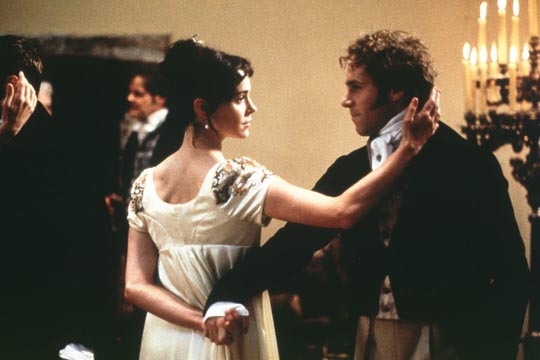
Depending on the dance formation and steps, a gentleman was allowed to touch a lady and hold her hand (and vice versa, as shown in the example of Mansfield Park 1999 above and in the image below).

Allemande

The couple had many opportunities to converse or catch their breaths when they waited for others to finish working their way down a dance progression.  The ability to carry out a conversation was considered very important, as Lizzie pointedly reminded Mr. Darcy:

“Elizabeth … took her place in the set, amazed at the dignity to which she was arrived in being allowed to stand opposite to Mr. Darcy, and reading in her neighbours’ looks their equal amazement in beholding it. They stood for some time without speaking a word; and she began to imagine that their silence was to last through the two dances, and at first was resolved not to break it; till suddenly fancying that it would be the greater punishment to her partner to oblige him to talk, she made some slight observation on the dance. He replied, and was again silent. After a pause of some minutes, she addressed him a second time with:

“It is your turn to say something now, Mr. Darcy.—I talked about the dance, and you ought to make some kind of remark on the size of the room, or the number of couples.”

He smiled, and assured her that whatever she wished him to say should be said.

“Very well.—That reply will do for the present.—Perhaps by and by I may observe that private balls are much pleasanter than public ones.—But now we may be silent.”

“Do you talk by rule then, while you are dancing?”

“Sometimes. One must speak a little, you know. It would look odd to be entirely silent for half an hour together, and yet for the advantage of some, conversation ought to be so arranged as that they may have the trouble of saying as little as as possible.”

The dances that would have been danced at the Nethefield Ball were:

The English Country Dance

The characteristic of an English country dance is that of gay simplicity. The steps should be few and easy, and the corresponding motion of the arms and body unaffected, modest , and graceful. – The Mirror of Graces, 1811

Country dances consisted of long lines of dances in which the couples performed figures as they progressed down the line.

When a dancer was too tired to do steps, she would have been considered no longer dancing at all, as with Fanny in Chapter 28 of Mansfield Park:

“Sir Thomas, having seen her walk rather than dance down the shortening set, breathless, and with her hand at her side, gave his orders for her sitting down entirely.”

Rather than everyone starting at once, dances would have called and led off by a single couple at the top; as that couple progressed down the set other couples would begin to dance, then lead off in turn as they reached the top, until all the dancers were moving. Jane Austen occasionally got to lead a dance, as she mentioned in a letter of November 20, 1800, to her sister Cassandra:

“My partners were the two St. Johns, Hooper, Holder, and very prodigious Mr. Mathew, with whom I called the last, and whom I liked the best of my little stock.”

This could lead to very long dances indeed (half an hour to an hour) if there were many couples in a set” – What Did Jane Austen Dance?

The Cotillion


The cotillion was based on the 18th-century French contradanse and was popular through the first two decades of the 19th century. It was performed in a square formation by eight dancers, who performed the figure of the dance alternately with ten changes.

The rapid changes of the cotillion are admirably calculated for the display of elegant gayety, and I hope that their animated evolvements will long continue a favourite accomplishment and amusement with our youthful fair. – The Mirror of Graces

The minuet.

The Devonshire Minuet

This dance had grown almost out of fashion by the time A Lady of Distinction wrote The Mirror of Graces, and it is conjectured that Jane Austen must have danced it in her lifetime.

Boulanger

Boulangers, or circular dances, were performed at the end of the evening, when the couples were tired. Jane Austen danced the boulanger, which she mentioned in a letter to Cassandra in 1796: “We dined at Goodnestone, and in the evening danced two country-dances and the Boulangeries.”

Quadrille

Note: the Quadrille and the waltz would not have been danced at the Netherfield Ball. Jane did mention the quadrille in a letter to Fanny Knight, which was dated 1816. And the waltz would not have been regarded an acceptable dance in 1813. It is doubted that Jane ever waltzed. The reel might have been danced at the Meryton Assembly, or at a private dance given by Colonel Foster and his wife, for instance, but it would probably not have been featured at the Netherfield Ball at the same time as a country dance.

Second Note: The movies have it all wrong. According to the author of this post on Capering and Kickery, “Real Regency Dancers Are Au Courant

Along with the peculiar notion that dance figures from the 17th century are useful for the early 19th century comes the even more peculiar notion that entire dances of that era are appropriate. Regency-era dancers were not interested in doing the dances of their great-great-great-great-great-great-great grandparents, any more than today’s teenagers are. Dances like “Hole in the Wall” and “Mr. Beveridge’s Maggot” were written in the late 17th century. Their music is completely inappropriate for the Regency era. Their style is inappropriate. Their steps are inappropriate. There is no sense in which these dances belong in the Regency era. Loving obsessions with these dances make me want to cry at the sheer ignorance being promulgated by the people who keep putting these dances in movies.”

More on the Topic

Read Full Post »

Older Posts »