Feeds:
Posts
Comments

Posts Tagged ‘Regency Fashion’

Jane Austen fans are familiar with the high-waisted muslin dresses popular during her adulthood. How many are aware that machine-made net or gauze became a “hot” item from 1810 and on?

Evening dress with gauze overlay

“Net dresses were very fashionable and their popularity was spurred by new inventions. The development of machine-made net in the late 18th and early 19th centuries meant that gauzy lace effects were increasingly affordable either as trimmings or garments. The bobbin-net machine was patented by the Englishman John Heathcoat in 1808 and produced a superior net identical to the twist-net grounds of hand-made bobbin lace. It was so successful that women in the highest ranks of society, including the Emperor Napoleon’s first wife, Josephine, wore machine-net dresses. Initially, however, all machine nets were plain and had to be embroidered by hand.” – Victoria and Albert
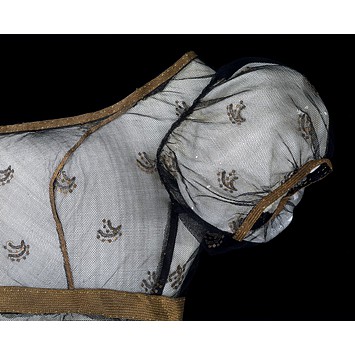
Detail of an evening dress with net lace. Image @Victoria & Albert Collection

Machine-made bobbin net was first made in France in 1818. Until this date, lace as it was made was known as old lace. After that date, lace is categorized as being modern.
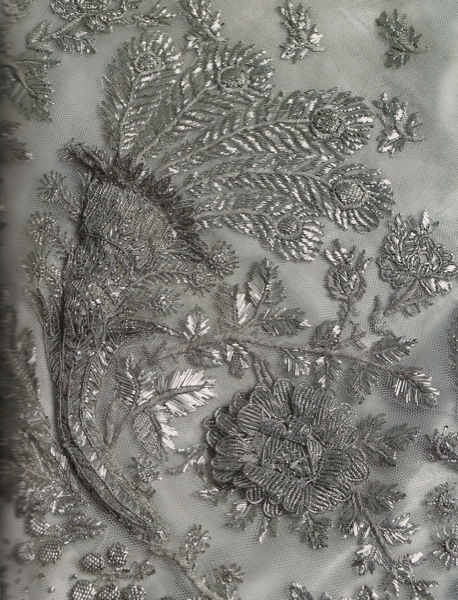
Silver embroidery on net on Empress Josephine's court gown. Image @Madame Guillotine

Machine made lace made an appearance around 1760. The nets and tulles became immediately popular. Their arrival spurred the production of other silk lace cloths, which led to a general rise in popularity of the silk lace trade – until a machine was invented that could produce silk net lace as well.

Evening dress with net overlay, 1817-1818, V&A Museum

In the 18th century the hand-made net was very expensive and was made of the finest thread from Antwerp: in 1790 this cost £70 per pound, sometimes more. At that time the mode of payment was decidedly primitive: the lace ground was spread out on the counter and the cottage worker covered it with shillings from the till of the shopman. As many coins as she could place on her work she took away with her as wages for her labour. It is no wonder that a Honiton lace veil before the invention of machine-made net often cost a hundred guineas. Heathcoat’s invention of a machine for making net dealt a crushing blow to the pillow-made net workers. The result is easily guessed. After suffering great depression for twenty years the art of hand-made net became nearly extinct, and when an order for a marriage veil of hand-made net was given, it was with the greatest difficulty that workers could be found to make it. The net alone for such a veil would cost £30. – A history of hand-made lace: Dealing with the origin of lace, the growth of the great lace centres, the mode of manufactures, the methods of distinguishing and the care of various kinds of lace, Emily Jackson, p. 170

Hem of 1817_1818 Evening Dress with net overlay, V&A Museum

The most popular European centers for lace making were located in France, the region known as Belgium today, Ireland, England,and Italy.

During the French Revolution the French textile industry had suffered and unlike in England, use of textile machinery had been non-existent.  Emperor Napoleon stopped the import of English textiles and he revived the Valenciennes lace industry so that fine fabrics like tulle and batiste could be made there. – Regency Fashion History

Black net over gold gown, 1818. Image @Defunct Fashion

Between 1806-1810, net gowns embroidered with chenille embroidery became popular. Profits rose for the manufacturers as the price for the cloth plummeted.

In 1809 Heathcoat took a patent for his bobbin net machine. But the profits realised by the manufacturers of lace were very great, and the use of the machines rapidly extended; while the price of the article was reduced from five pounds the square yard to about five pence in the course of twenty-five years. – John Heathcoat and the Bobbin Net Machine, Samuel Smiles (1859)

By 1813, the bobbinet machine had been perfected. After 1815, gauze was used over satin evening dresses, with the fabric gathered at the back. By 1816, crepe, net and tulle were worn over evening wear made of satin, silks, velvets, kerseymere, satin, lame, and both plain and shot sarcenet.

La Belle Assemblee Court and Fashionable Magazine contains this description of a lady’s dress in Her Majesty’s Drawing Room in January 1818:

Hon. Lady Codrington.—Net draperies, magnificently embroidered in gold  lama, in bouquets and sprigs, over a petticoat of white satin, with blond lace at the bottom, headed with a rouleau of gold lama; train of crimson velvet, trimmed with gold lama and blond lace. Head-dress gold lama toque, with ostrich plume, and diamonds.

1818 Evening Dress, June. La Belle Assemblée. ENGLISH. No. 1.—Evening Dress. Round dress of embossed gauze over white satin, with coriage of peach-coloured satin, elegantly ornamented with rouleau medallions and palm leaves of white satin. Mary Queen of Scots hat, ornamented with pearls, and surmounted by a full plume of white feathers. Negligé necklace of fine pearls, and gold chain beneath, with an eyeglass suspended. White satin shoes, aud white kid gloves.

Not every lady of that era was obsessed over bobbin net lace or tulle. Many began to publicly and proudly favor the old hand made lace.

…both in England and on the Continent and at Almack’s, the Assembly Rooms at Bath and Tunbridge Well, the chaperons would gossip of their lappets of Alencon or Brussels. Numerous were the anecdotes as to how this treasure or that had turned up having escaped the doom the rag-bag, which alas! was the fate of so much old lace during the muslin and net period. – Emily Jackson, A History of Hand-made Lace, 1900, p 48.

Machine made lace dealt a great blow to the industry of hand-made fabrics. In Tiverton in 1822, where once 2,400 lace makers worked, only 300 lace makers were still employed.

Evening dress with net overlay, 1818. Image @Old Rags

The Duchess of Gloucester was one of the few whose affections never swerved from her love of the old rich points towards blondes and muslins, and her collection was one of the finest in Europe. Lady Blessington, too, loved costly lace, and, at her death, left several huge chests full of it. Gradually lace began to be worn again, but it was as it were ignorantly put on, worn simply because it was again the fashion to wear lace, and lace must therefore be worn; the knowledge of its history, worth, and beauty was lacking…  – Emily Jackson, A History of Hand-made Lace, 1900, p 48.
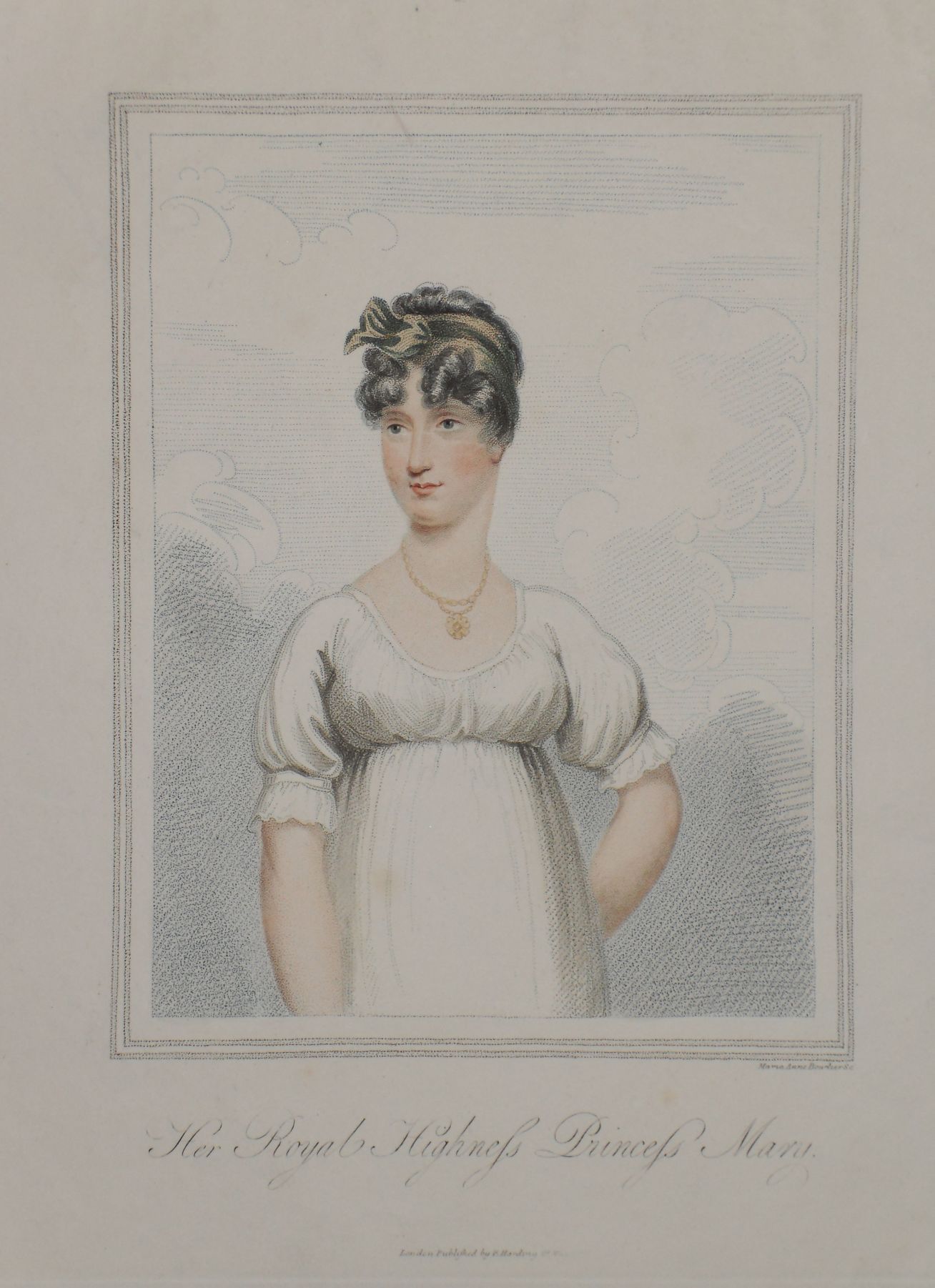
Princess Mary, Duchess of Gloucester (Daughter of King George III) Image @Justin F. Skrebowski

Sprigs beautified the machine-made net. It is said that Queen Charlotte introduced applique on net to support the machine net industry. Honiton appliques consisted of white linen thread sprigs mounted on the net, but black  silk sprigs were applied as well. The black silk cost twice as much as the linen threads and soon went out of fashion.

The trade of lace making remained for several generations in some families, thus in 1871 an old lace maker was discovered at Honiton, whose turn or wheel for winding cotton had the date 1678 rudely carved on its foot –Old lace, a handbook for collectors: an account of the difference styles of lace, their history, characteristics & manufacture, Margaret Jourdain, 1908, p94-95
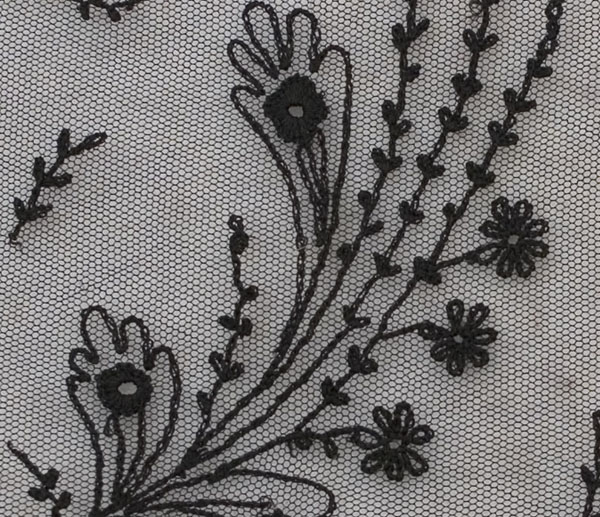
Detail of early 19th c. tamboured net shawl. Image @Vintage Textiles

Sources:

Read Full Post »

My regular Jane Austen readers have been patient as I succumbed to Downton Abbey fever and began to cover events 100 years after Jane Austen’s death. Customs changed during that intervening century. Take the matter of dress. While proper Regency ladies changed their outfits from morning gowns to walking gowns when they went out, and changed into dinner dress when dining, by Victorian and Edwardian times the custom of a lady changing her clothes throughout the day had turned into a fine art.  One could get by with no less than 4-5 changes per day. A woman who packed to visit a country estate was sure not to be seen in the same outfit twice. This meant that for a 4-day visit she would need at the very minimum to have her maid pack 16 changes of outfits. One can only imagine the work of a lady’s maid to keep all the clothes and unmentionables in perfect (and clean) condition. Such attention to detail required quite a bit of organization.

Morning dress, 1815. Ackermann plate. While she looked proper in her at home attire, this morning dress looks stodgy compared to the Edwardian teagown.

Corsets were worn all through the 19th century and into the early part of the 20th century. Women were constricted into these garments for most of their waking day, but there were times when they were free from these tight-laced garments.  During the early 19th century, upper class women at home would wear comfortable (but beautiful) morning gowns. Dressing gowns were also worn. Such gowns were meant to be seen by the family and close relatives only. The moment a woman expected to be seen, she would change into more proper dress.

Cora, the Countess of Grantham, lived during a time when teagowns were all the rage. These beautiful ornate gowns had the advantage of being simply cut and worn without a corset. It was possible that for just a few hours she could relax comfortably before dinner.

They were generally loose-fitting and elaborately trimmed, and gave full vent to the dressmaker’s or couturier’s skill and taste for theatricality. Tea-gowns were influenced by historical styles from eighteenth century Watteau-pleats, to renaissance hanging sleeves and empire waistlines and quite often, all of them at the same time. Never has so much love and art been invested in such an arguably unnecessary garment. All kinds of informal garments including tea jackets, peignoirs, dressing gowns, combing sacques, morning robes and dressing jackets also had their place in the leisured Edwardian lady’s wardrobe, all of them beautifully decorated and almost all of them now obsolete. 1900-1919: The Last Age of Elegance 

American dancer and actress Irene Castle wearing a teagown, 1913

It had long been the custom for a lady to entertain both male and female visitors in her boudoir. (Read my article on this topic.) During the Regency era, dressing gowns were quite plain and simple compared to teagowns.

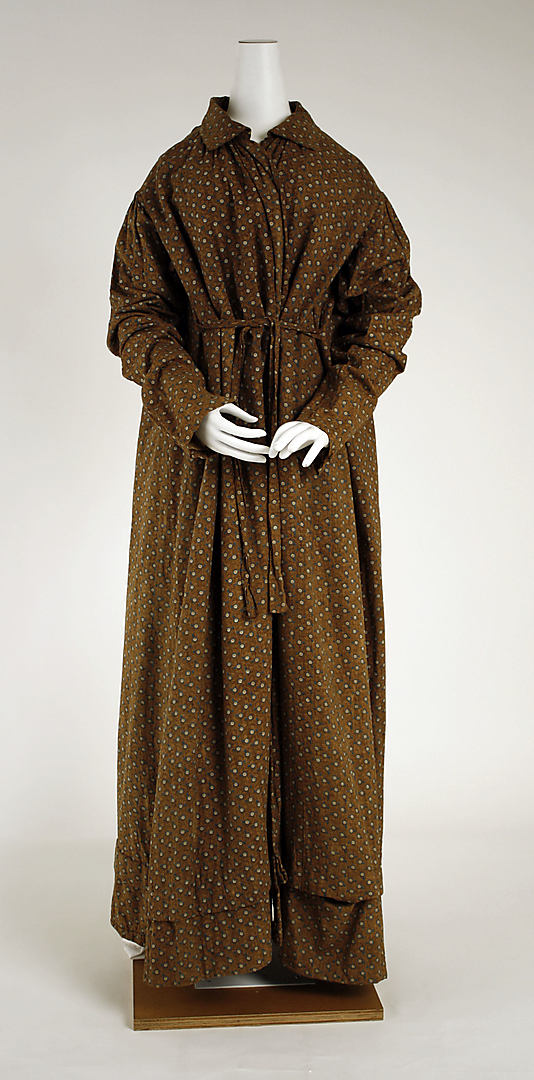
1810-23 dresssing gown. Image @Met Museum

At times the teagown gave rise to temptation, for a woman could entertain in private and not need the services of her maid:

Worn between five and seven oclock,  gave rise to the French phrase ‘cinq à sept‘. This referred to the hours when lovers were received, the only time of day when a maid wouldn’t need to be there to help you undress and therefore discover your secret. – “Style”, The World of Downton Abbey, Jessica Fellowes

Early 19th century dressing gown. Image @Met Museum

Attired in her tea-gown, a soft flowing robe of filmy chiffon or fine silk, trimmed with an abundance of lace and often free of corsetry, the hostess must have been a tempting prospect for many men. Such loose gowns afforded women great comfort, ease of access and a tremendous sense of femininity. Little wonder then that whilst hemlines rose and fell the tea-gown, which had appeared in England as early as 1875 lingered on until the 1920s. – Edwardian tea gowns, fashion era

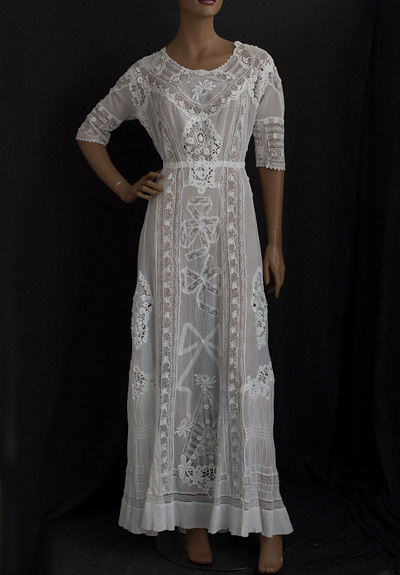
This Lingerie-style dress embellished with Irish crochet, c.1905 (below) can be seen in more detail on Vintage Texiles. Made of sheer cotton decorated with lace and ruffles, this sheer dress required a slip.

Edwardian teagown, 1905. Image @Vintage Textile

More on the topic:

Read more on the topic: Tea Gowns, Edwardian Promenade

Image of an early 19th century dressing gown at the Met Museum

Read Full Post »

The riding habit, was first introduced in the 17th century. They were tailored by men in the manner of men’s dress: a fitted jacket worn over a long skirt, often worn with a masculine hat. Samuel Pepys, ever helpful with observations of his time, wrote in 1666 of seeing the Queen’s ladies of honor “dressed in their riding garbs, with coats and doublets and deep skirts, just for all the world like men, and buttoned their doublets up to the breast, with periwigs and with hats; so that, only for a long petticoat dragging under the men’s coats, nobody could take them for women in any point whatever — which was an odd sight, and a sight which did not please me.” – Candice Hern

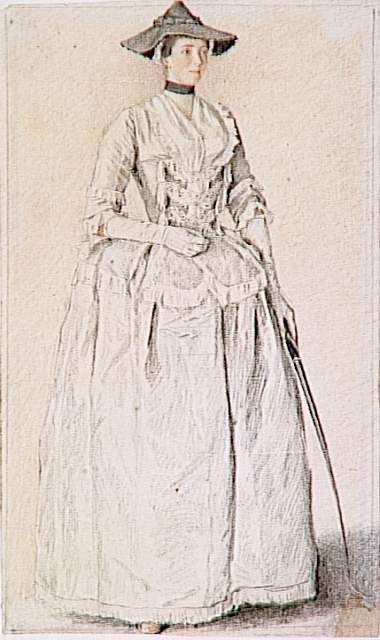
In the 18th and through most of the 19th centuries, women’s riding habits were generally made by tailors and constructed like men’s wear. They were usually buttoned left over right, like a man’s coat. Other women’s fashions were made by dress makers and mantua makers. Masculine touches onwomen’s riding habits included mariner’s cuffs and fabrics and trims as seen on naval uniforms.  These riding habits were functional, but in the late 1700s they became fashionable dress as well, and were worn for informal day wear for traveling, visiting, or walking.

Madame Gaspard de Péleran by Jean-Etienne Liotard, 1738

The materials worn for riding from the mid-seventeenth to the early twentieth centuries were easily distinguished from the silks, muslins, and velvets of fashionable evening dress. Equestrian activities required sturdy and often weatherproof fabrics such as woolen broadcloth, camlet (a silk and wool or hair mixture), melton wool, and gabardine for colder weather and linen or cotton twill for summer or the tropics. In the eighteenth and early nineteenth centuries, habits were frequently adorned with gold, silver, or later woolen braiding, often imitating the frog-ging on Hussar or other military uniforms. – Equestrian costume

Equestrian portrait of Marie-Louise-Elisabeth d'Orléans (The Duchess of Berry in hunting-costume in 1710)

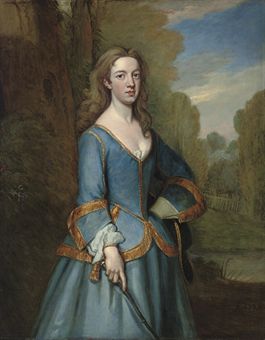
The appearance of a lady on horseback in a fashionable London riding-habit, and tricked out in the newest guise with patches, is amusingly described by Steele. The lady is supposed to be riding through the town of Kettering in Northamptonshire, in the month of July, 1724. ” Yesterday astrange and surprising creature was seen to pass through our town on horseback. It had the face of a young woman, stuck full of patches ; a perriwig which hung down to its waist; a hat cock’d with the smartness of a young officer; a huge bunch of ribbons fastened behind its left shoulder; a shirt laid in large pleights on the breasts and tied close at the neck and wrists, which, with a vest of white satteen, trimmed with black, had much the resemblance of a shroud.

Portrait of Lucy Pelham-Holles, Countess of Lincoln (d. 1736), three-quarter-length, in riding habit, in a landscape

Our whole town was soon alarmed with this strange appearance, and various are still the opinions what it really was. The old people, who were the most couragious generally, went pretty near to it with their spectacles on to view it more distinctly; the younger sort kept it at an awful distance. Some were of opinion that it was a highwayman in disguise, and accordingly were for seizing it; others took it for a nun; but by a certain arch leer it had with its eyes I dare engage it had not a bit of nun’s flesh about it. However, by its pale complexion and shroud-like dress, most of my neighbours at last concluded it to be a ghost, and so took to their heels, and left me (who am no great believer in these things) almost alone with it in the road. I had now an opportunity, during the time it was drinking a glass of Rhenish wine and sugar at the Saracen’s Head Inn, to survey it well, and thereupon concluding it to be an Hermaphrodite, I enquired of the man who seemed to have the keeping of it, if he intended to show it in our town, and at what inn? For you must know, Sir, that I have a mighty curiosity to see one of those creatures all over. But the man with an angry countenance told me: That what I took for an Hermaphrodite was only a young lady, and that the sort of dress she was in was commonly worn for a riding-habit by the ladies of fashion at London. But as neither I nor my neighbours can believe it possible for folks upon no ill design to disguise themselves in such a manner… – A history of English dress from the Saxon period to the present day, Volume 2 (Google eBook)R. Bentley, 1893

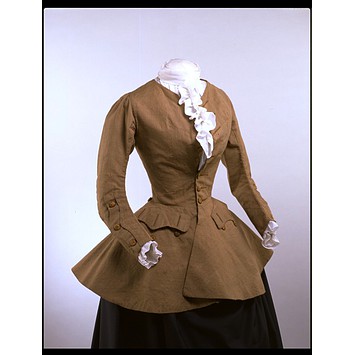
Women's riding Coat, 1750-59. Image V&A museum

Women’s riding outfits, known as ‘riding habits’, of the 18th century adapted elements of men’s dress. This jacket of the 1750s is styled after a man’s coat, although it has been modified with a waist seam to fit over stays and a wide petticoat. A narrow straight collar attached at the back neck and buttoning in front added protection on chilly rides. The fine tailoring and plain aspect of this jacket is typical of 18th century women’s riding habits. – Victoria & Albert Museum.

More Links

Read Full Post »

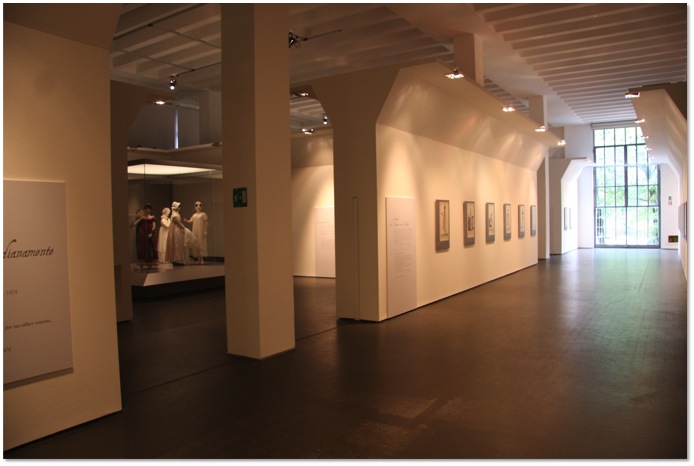
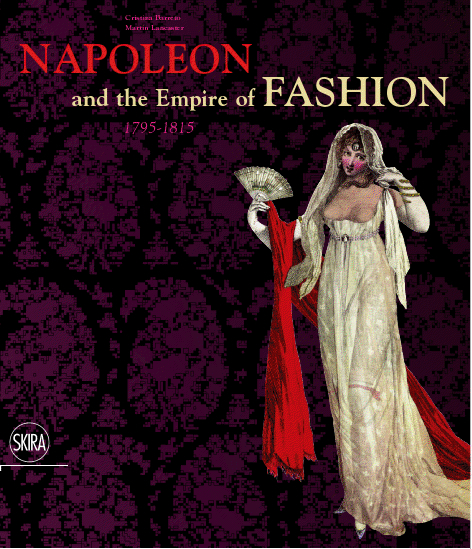
The lush fashion exhibition, Napoleon and the Empire of Fashion, closed in Milan in September. On the website, readers are still allowed to choose where they would like it to travel next!

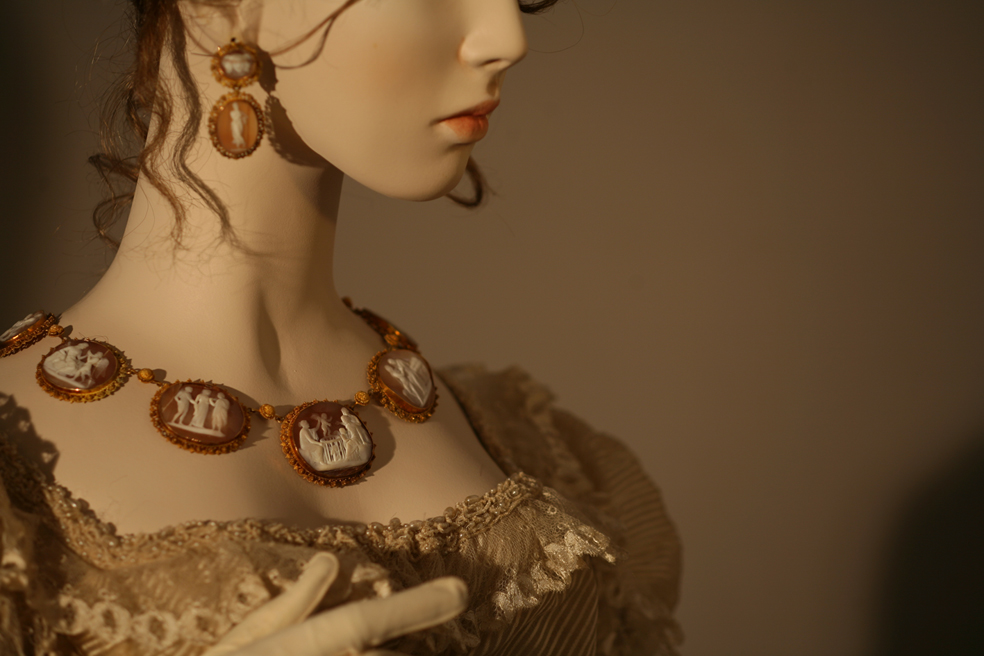
The beautiful cameo necklace and earrings complete this evening ensemble.

The catalogue, written by Cristina Barreto and Martin Lancaster, is sumptuous and filled with color photographs. The clothes are compared to fashion illustrations of the day. One cannot get a better education of French fashion during this period than this book. This video and the link to the slide show below it show what we have missed by not traveling to Milan last spring and summer.

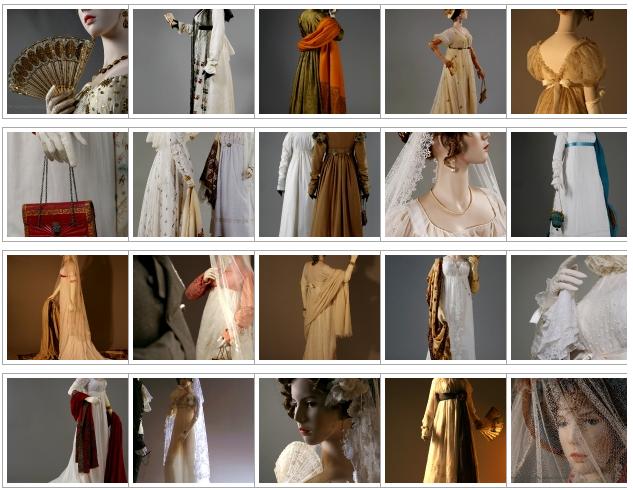
Napoleon’s desire to protect the garment industry in France after the French Revolution resulted in an explosion of designs that propelled the French fashion industry to the forefront, making it hugely influential. By encouraging women to purchase many gowns (so that they would not be seen in the same dress too often), France became synonymous with fashion. See the slide show of images from the exhibition by clicking on this link.

The many French fashions shown from the 1795-1810 years

Vote where you would like the exhibit to travel next. If the exhibit comes to New York, I hope to see the same mannequins. Aren’t they simply superb?

Napoleon and the Empire of Fashion in Milan

Order the catalog at Amazon: It ships within 1-3 months.

Read Full Post »

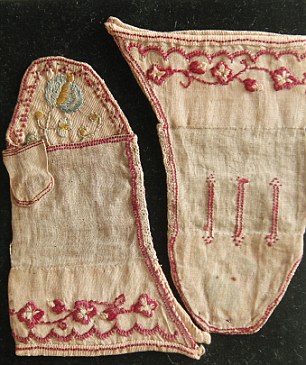
Princess Charlotte's embroidered linen mittens

Among the fashion items in Kensington Palace are a pair of hand-embroidered mittens owned by Princess Charlotte, daughter of George 1V and Caroline of Brunswick  (the Princess Diana of her day) who died tragically young in 1817 while in childbirth. Read more: Mail Online

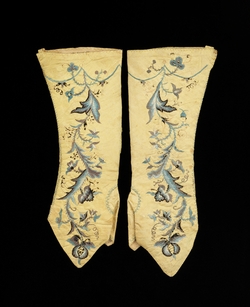
Silk 18th C. mittens. Image @Metropolitan Museum

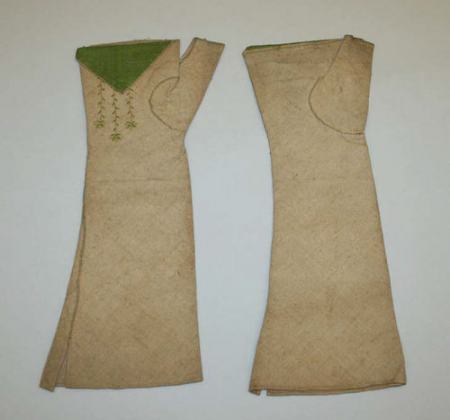
Your average 18th century mitt would have a thumb (or rather half a thumb), but not have any other fingers. It would sometimes extend not just over the hand but over part of the fingers as well. This meant that it would keep you warm (or protected from the sun in the summer) but not hinder your movements at all. You could do things like write, draw or do needlework with mitts on. And combined with a muff, they were quite enough even for venturing outside in the winter.” – Mitts & Fingerless Gloves

18th century mittens. Image @Metropolitan Museum of Art

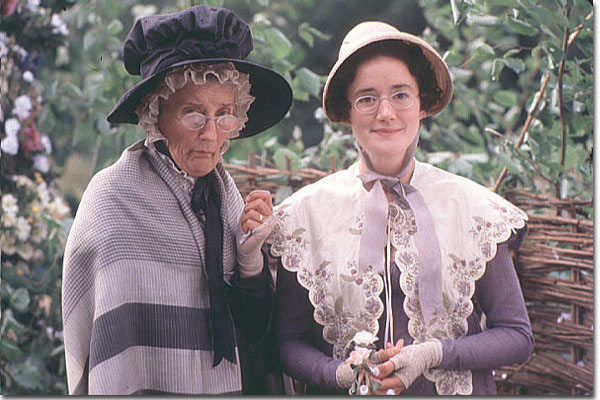
Mrs. Bates and Miss Bates wearing lacy mitt gloves

Read Full Post »

« Newer Posts - Older Posts »