Feeds:
Posts
Comments

Archive for 2011

I sat on an outdoor balcony during lunch yesterday, editing some work and eating a salad, and was struck by the sounds of the city – the traffic whizzing by, the rattling chain of an old bicycle, the siren of a distant firetruck, the buzz of a lawn mower, the chirps and tweets of birds, and … almost no human voices. It was late and I was practically alone, and the heat was keeping pedestrians indoors.

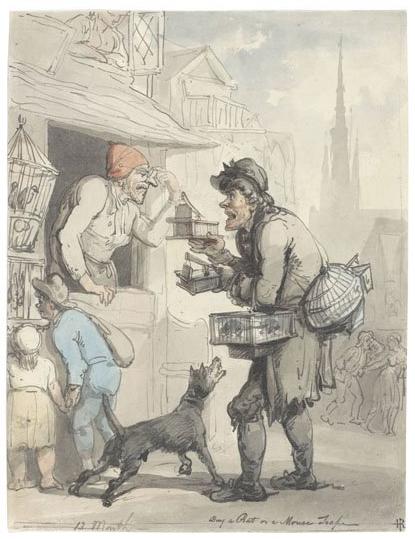
Rowlandson's "Buy a trap, a rat trap, buy my trap"

London in the 18th 19th centuries was famous for its noises. The rattling of carriage wheels, the sounds of animal hooves as they were driven to market, and the cries of the street vendors competing with each other created a daily assault to auditory nerves. On hot days, people propped their windows open to capture the slightest breeze, thereby letting in the noise. In Richmond yesterday all I heard was the hum of air conditioners and fans, for windows were kept firmly shut allowing no city sounds in.

Jane Austen moved from the quiet rural life in Steventon to Bath, and I wonder how much the noise and dirt of city life affected her creativity. Some people cannot abide noise while they are writing. I wonder if this was the case with Jane?

Cries of London, "Buy my rat trap," Rowlandson

Captured in many illustrations by a number of artists over the centuries, the street Cries of London are still famous today, though the voices have died down. This illustration by Rowlandson illustrates the cry for rat traps. (My favorite rat trap is my terrier, Cody.) Color illustrations were expensive, much like color printing is today. Even fashion illustrations in ladies magazines came in two forms, color for those who could afford the cost and black and white for the frugally minded.

Today promises to be another scorcher. I will keep my windows shut again and the city noises out.

Click here to read my post about London Street Noises: The Enraged Musician by William Hogarth

Read Full Post »

Gentle readers, strap on your seat belts. Tony Grant from London Calling sent in his review of “A Jane Austen Education: How six novels taught me about love, friendship and the things that really matter“by William Deresiewicz. Let’s just say this is a review by a bloke about a bloke’s book. There will be no teacup or regency fan ratings this time. 

Just recently a dear friend sent me a copy of A Jane Austen Education by William Deresiewicz. I had read some of the reviews written on a few of the Jane blogs and my impression from those was that it must be a fresh, slightly different approach to engaging with Jane’s works. I sort of put the idea of reading it to one side, I must admit. I thought it would be just another quirky angle on Jane. Anything with Jane’s name attached to it sells, doesn’t it? However, now having a copy here in front of me I decided, at the very least, I should have a look, delve in, and see what I thought.

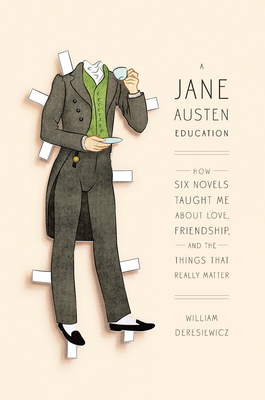
The front cover was at first a mystery and slightly off putting. A paper doll cut out suited gentleman, headless, to be placed over an inanimate cardboard cut out of a Regency, or did it look more early Victorian, gentleman, presumably wearing underwear, seemed an odd choice. One dimensional, stiff, inanimate, stuck in one pose, drinking tea, ah yes, there was the Jane connection. What did all this reveal about what I was about to discover between the sheets?

The contents page revealed a nice straightforward approach. Chapter 1 Emma, Every Day Matters, Chapter 2 Pride and Prejudice, Growing Up and so on through the six published novels, each providing William with a stepping stone along his journey of self discovery and growth. And to round it all off, a nice concluding chapter “The End of the story.” Yes, a well-ordered and neatly constructed narrative was bound to follow.

By the end of the first chapter I had our William sussed. Start with the personal stuff (my life was crap-type thing) – provide an overview of the novel, characters, and plot, and then follow through by laboriously comparing his life events with the characters and events in the book. And finally, relating how it had changed him for the best. I began to feel that I was about to hunker down for a tortuous time. But things were worse than that, William was depressed. Now I’m fine with depression and especially manic depression. All the great comedians profess to be depressives. We have had and have (some of them are dead by the way) Peter Sellers, Spike Milligan and John Clease. All of them are professed manic depressives who used this depth of pain to create some of the greatest humour ever. Winston Churchill suffered from what he termed his ”black dog.” Virginia Woolf and Sylvia Plath, both incredible writers who could bare their souls and take us to places in the human psyche we would never have dreamed of, both took their lives. Life was too unbearable.

However William writes,

Well it just sat there, that realisation, like a lump in my gut – sat there for weeks. I didn’t know what to do with it, how to get rid of it, how to dig myself out the hole I just discovered I was in. But I knew I couldn’t live like that anymore.”

This passage is a build up to telling his girlfriend at the time, that he thought they should part their ways. There was no depth to their relationship apparently. This level of depression is the equivalent of having a bad cold. In the hierarchy of depressive situations, William is not going to reach into our emotional depths and inspire us with what is a very common place situation. I was hoping things would get better, but no, he droned on in this flat slightly miserable way all through the first chapter. And what did he learn from Emma?

“Even I was beginning to realise what a real relationship looked like,” he droned.

Oh I see!!!!!!! Yes, I was really beginning to see.

I was getting the idea. I really do hope William gets his full share of the kudos that Jane’s name, applied to a title, provides. I was beginning to think, what else is there? What other value?

At one stage, I must say, I thought that the analysis part of each chapter had worth, William is an English literature lecturer at a university after all, but then I got bored with that too. He is far, far too contrived. Later in the book, here is William analysing Mansfield Park, my favourite Austen novel,

“What Austen recommended to us, she urged upon her nearest and dearest, too. Love means effort and self control – for the sake of others, and thus, ultimately, for your own.”

Oh God, this is beginning to sound so profound. Life’s hard lessons learned so emphatically, and by a writer so young too.

I squirmed a few times while reading this. Yes, I did persevere. The book was compelling in a ”how can it get worse?” sort of way.

But this is the real sneaky bit. Come on William, tell us the truth. What were you thinking when you wrote this stuff ?

We had jumped each other one night the previous summer, and though we had been together for over a year we had little in common and had never much progressed beyond the sex.”

Honesty, the baring of ones soul, telling it like it is — it’s all in this book. William repeats at discrete, well-paced intervals, lightly (and apparently carelessly), how bad he feels about superficial relationships and jumping into bed for hot steamy one night stands. Any bloke down my pub would laugh at him heartily and call him a …….!!! No I really can’t write what I know my mates would say. William might sue me. This book just ain’t for blokes, let’s put it that way.

It does beg the question who this little boy lost saga is for.

By the end of the book William tells us he has found true, deep, long-lasting love. He has found out at last what it means to be “intimate.” One of the most squirm-creating moments in this whole squirm-creating edifice was earlier in the book when William asks a girlfriend in a cafe what intimacy was and if they were being intimate at that time.

The book ends: (Warning: Spoiler alert.)

That first weekend she came to Brooklyn, the visit that sealed our fate, she brought along a book, just in case there was some downtime. [I’m trying to imagine what the downtime might entail and why and how there could be downtime.] She knew I was a graduate student by that point, but she had no idea what I studied or whom I was writing my dissertation about. It was just the thing she happened to be reading at the time.

The book was Pride and Prejudice.

Reader, I married her.”

So let me get this right. In the end, after all the soul searching, all those profound life lessons it boiled down to Pride and Prejudice?

We’ve been taken through the superficial relationships and I must admit, when I got to the end of the book, I discovered William’s photograph on the back of the fly sheet. It startled me. This bloke had superficial relationships!!!!! There has been the father who disapproved. There has been the depressive moments, mild depression by the way, boring and ordinary, that nothing but a good blow of the nose into a handkerchief wouldn’t have solved. There have been the life lessons learned. I’m sorry, I can’t get it out of my head: This young bloke has learned life’s lessons through Jane Austen already. Where does he go from there? My experience is nothing like that. Life creeps up on you imperceptibly. You adapt and grow slowly, often without noticing and sometimes you regress badly. Life and life’s lessons are nowhere near as easy to learn, as William makes out, by reading a set of novels. You can’t learn it in your head, you have to live life. Sometimes I think it’s impossibly to learn the so-called life lessons. Often we are just stuck, through no fault of our own, because we are who we are.

I am very reluctant to throw a book onto a fire, for echoes of the many evil political regimes that have done that sort of thing come to mind. What I’ll do, out of gratitude to my friend who sent me this copy, is put it on my bookshelf to gather dust. Then I’ll forget about it.

Read Full Post »
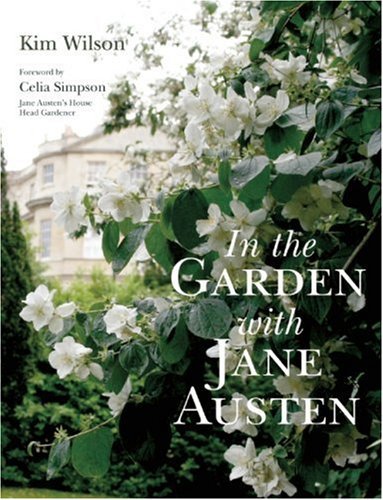
Instead of commemorating Jane Austen’s death at 41 on July 18, 1817, I would like to celebrate her life with a book giveaway of In the Garden With Jane Austen by Kim Wilson. It is a slim hard-back book filled with color photographs. In it Kim discusses the gardens that Jane Austen would have known and visited.

This contest will end on July 18th at midnight, EST. The winner will be chosen by random number generator.

To leave a comment, please let me know which flower you would leave behind at her grave. Update because of a confusion: A comment enters you into the contest. CONTEST CLOSED: Congratulations Eileen Landau! Your comment about a tussie-mussie was chosen by Random.org

Read Full Post »

It’s a truth universally acknowledged that after a bride and groom consummate the marriage the pitter patter of little feet will surely follow (and follow and follow and follow). Such was the case during Jane Austen’s day. Her mother bore eight children and luckily survived her ordeals. The wives of Jane’s brothers Edward and Frank did not, both dying in childbirth with their eleventh child. That these two women were able to survive so many pregnancies was a miracle in itself, given that the chance of a woman dying in childbirth at the time was 20%.

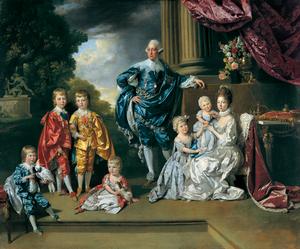
Queen Charlotte, King George IIIs consort, gave birth to 15 children in 21 years. The King and Queen are depicted with their 6 eldest.

Deborah Kaplan writes in Jane Austen Among Women:

“On the birth of his fourteenth child in 1817, Thomas Papillon received this advice within a letter of congratulations from his wife’s uncle, Sir Richard Hardinge: It is now recommended to you to deprive Yourself of the Power of Further Propagation. You have both done Well and Sufficiently.”

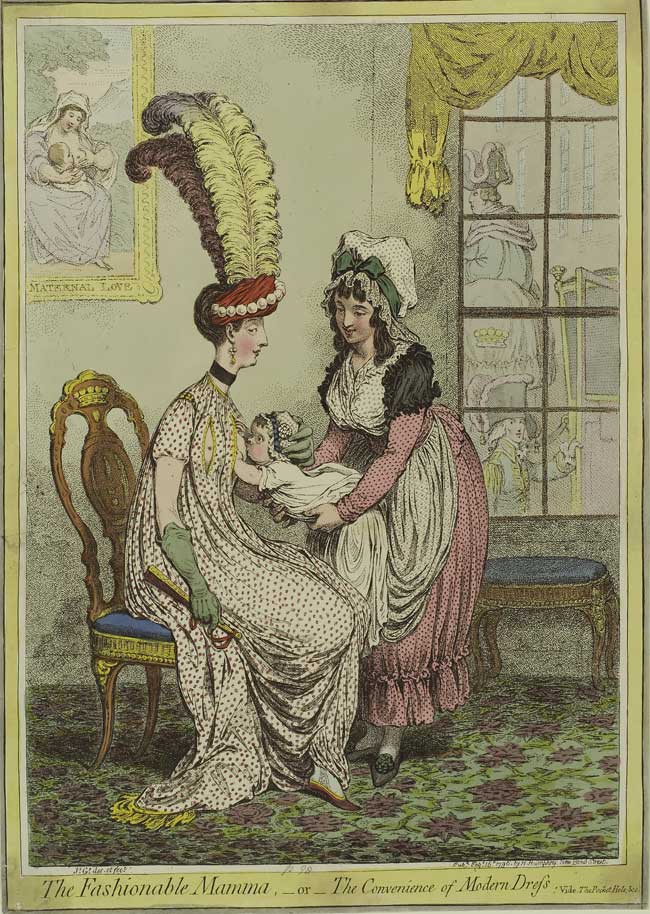
The fashionable mamma, or the convenience of modern dress, James Gillray

Abstinence was one method of birth control, as Sir Richard recommended. Breast feeding was another. If a mother breasfed her child for 3-4 years, the pregnancies would be naturally spaced inbetween periods of amenorrhea (the absence of menstruation). While breastfeeding regained some popularity during the Georgian and Regency eras, women did not feed their babies long enough to supress menstruation for very long and often handed them over to a wet nurse. Cassandra Austen farmed her children to a nurse in a nearby village after six to eight months, guaranteeing that her lactation would soon cease and that she would soon be fertile again. The common belief that having intercourse during lactation would in some way harm the mother and child did offer some added protection from pregnancy, but large families were still common.

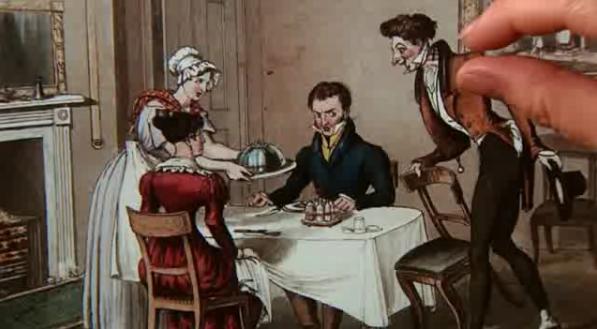
Amanda Vickery shows a bachelor cadging food from an irritated married friend. The poor young man probably lived in a modest rented room.

Social customs also served to keep pregnancies down. Amanda Vickery mentioned in At Home with the Georgians that a bachelor needed to acquire a house and reliable income before he could seriously contemplate marriage. Such acquisitions took years to amass and would hold up the young man’s inevitable role as parent. Once the young man could afford to marry, however, his long period of delayed consummation with a chaste woman ended and he would waste no time in siring a legitimate child.

A woman’s chaste reputation owed much to the urgent necessity of her not getting pregnant before marriage. Conceiving a child out of wedlock turned a woman into a pariah. In medieval times a chastity belt guaranteed that no bride would enter her marriage bed sullied. Unfortunately, these contraptions came in only one size and were therefore extremely uncomfortable for the larger sized woman.(Johannah Cornblatt, Newsweek). Update: Information about chastity belts in medieval times is being debunked these days as a myth. See links in the comment section below.

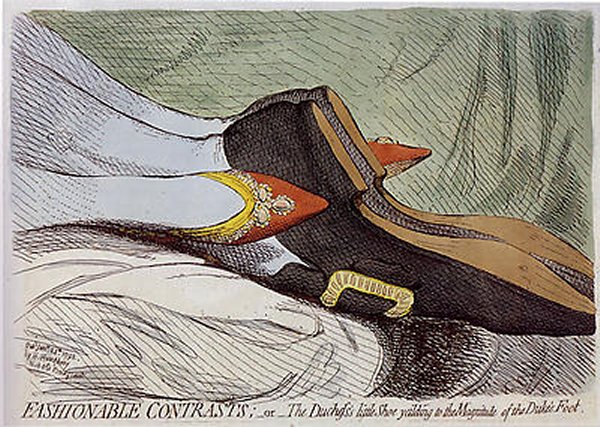
James Gillray's priceless caricature.

Married couples anxious to reduce their number of offspring (or who had reached their limit of 10, 11, or 15) tried coitus interruptus and the rhythm method. Since the female fertility cycle was not fully understood until the early twentieth century, the latter form of birth control resembled a game of Russian Roulette more than family planning. Several religious institutions, the Catholic Church in particular, frowned upon a married couple attempting any form of birth control at all, but there was evidence that birth control was effectively practiced. “Some couples managed to delay the first conception within marriage and few babies were born in the months of July and August, when the heaviest harvest labor took place.”-History of Birth Control.

Condoms, which were made of linen soaked in a chemical solution or the lining of animal intestines, had been in use for centuries, but this method of birth control was linked to vice and was mostly practiced in houses of ill repute.

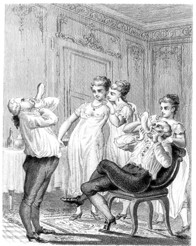
Casanova blowing up a condom with prostitutes looking on.

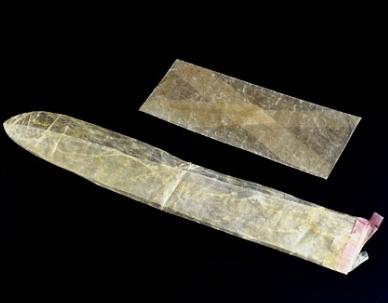
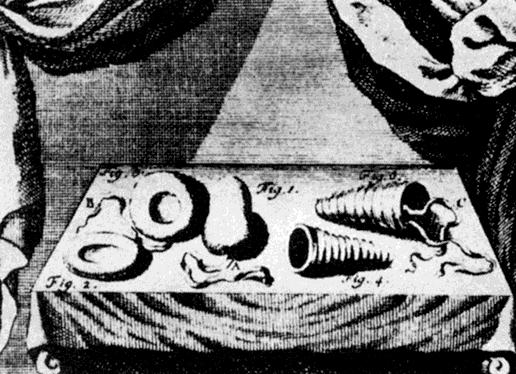
Giacomo Girolamo Casanova (1725-1798) was among the first to use condoms to prevent pregnancy. The famous womanizer called the condom an “English riding coat.” His memoirs also detail his attempt to use the empty rind of half a lemon as a primitive cervical cap. The engraving shows the Italian seducer blowing up a condom. The photo shows an early 19th-century contraceptive sheath made of animal gut and packaged in a paper envelope. – Newsweek

Condom made of animal gut with paper envelope. Image @Newsweek

One can imagine that such clumsy barriers to impregnation failed on too many occasions to count, although they did manage to prevent venereal disease.

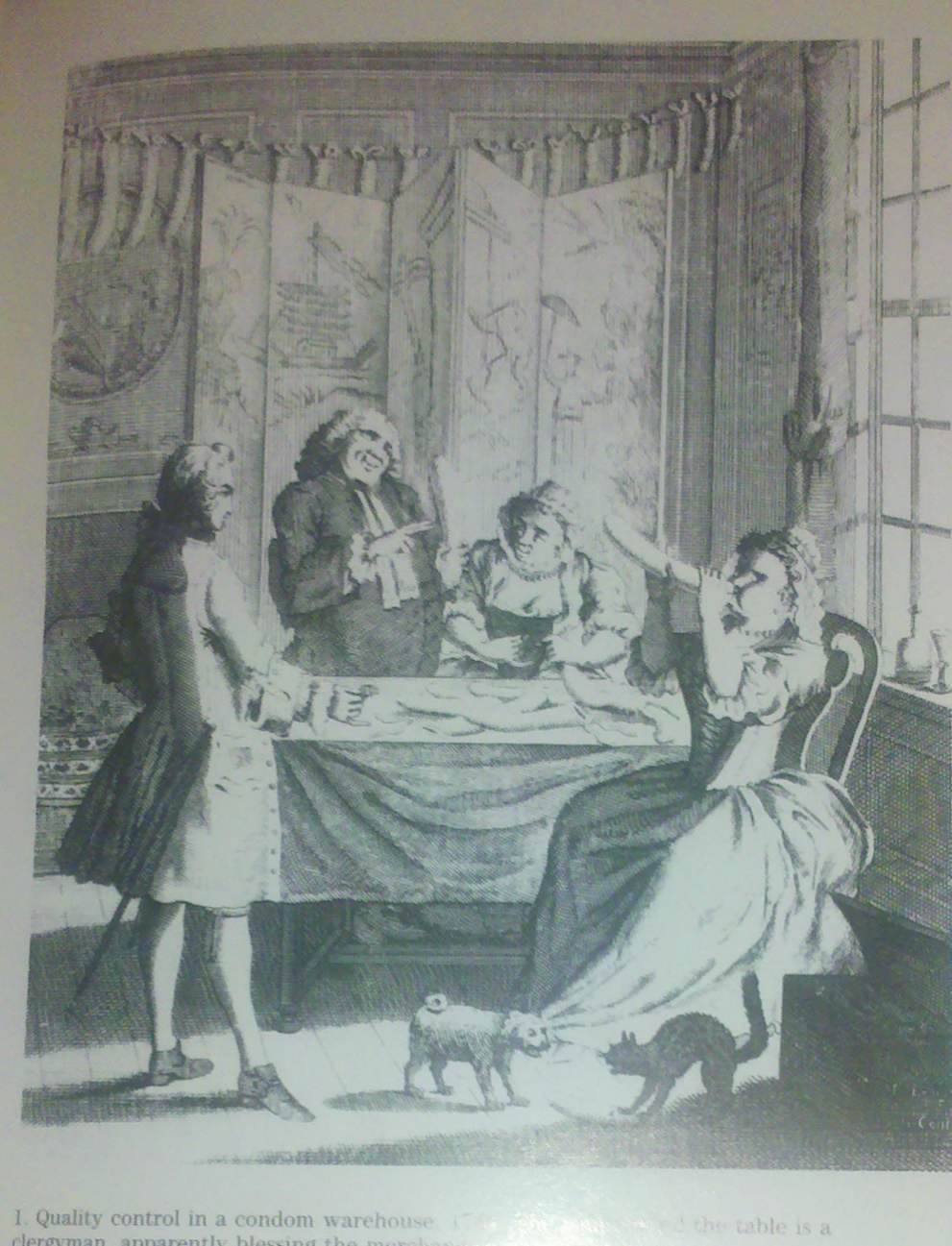
Georgian caricatures made much sport of condoms. This one is entitled: "Quality control in a condom warehouse."

There were other means of pregnancy prevention. Aristotle recommended anointing the womb with olive oil. His other spermicides included cedar oil, lead ointment, or frankincense oil.

Pessaries, 1755. Image @The Global Library of Women's Medicine

“The pessary [mechanical tool or device used to block the cervix] was the most effective contraceptive device used in ancient times and numerous recipes for pessaries from ancient times are known. Ingredients for pessaries included: a base of crocodile dung (dung was frequently a base), a mixture of honey and natural sodium carbonate forming a kind of gum. All were of a consistency which would melt at body temperature and form an impenetrable covering of the cervix. The use of oil was also suggested by Aristotle and advocated as late as 1931 by birth control advocate Marie Stopes.” – History of Birth Control

Other societies had used methods of blocking sperm including plugs of cloth or grass in Africa, balls of bamboo tissue paper in Japan, wool by Islamic and Greek women, andlinen rags by Slavic women. Ancient Jews used a sea sponge wrapped in silk and attached to a string. – History of Birth Control.

Many young girls who had been seduced, engaged in pre-marital sex, or been raped would attempt not to get pregnant by any means. The unfortunate women who did were ostracised, much like Colonel Brandon’s young charge, Liza, who had been enticed by Willoughby in Sense and Sensibility to give up her virginity. These women were frantic to end their pregnancies rather than lose their standing in society or their livelihood, for no pregnant unmarried woman could work as a maid, shopgirl, or seamstress. They would try anything to end their pregnancies, including ingesting turpentine, castor oil, tansy tea, quinine water into which a rusty nail was soaked, horseradish, ginger, epsom salts, ammonia, mustard, gin with iron filings, rosemary, lavender, and opium. Severe exercise, heavy lifting, climbing trees, jumping, and shaking were also attempted, in most instances to no avail. – History of Birth Control

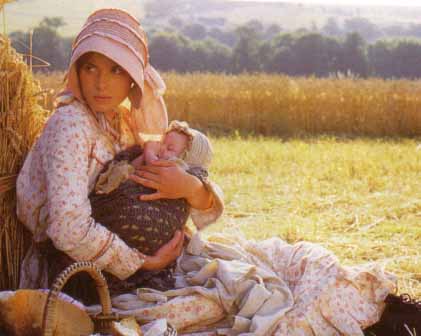
Tess of the D'Urberfield and her baby, Sorrow. Thomas Hardy wrote about the consequences of seduction. (Nastassia Kinski as Tess, 1980)

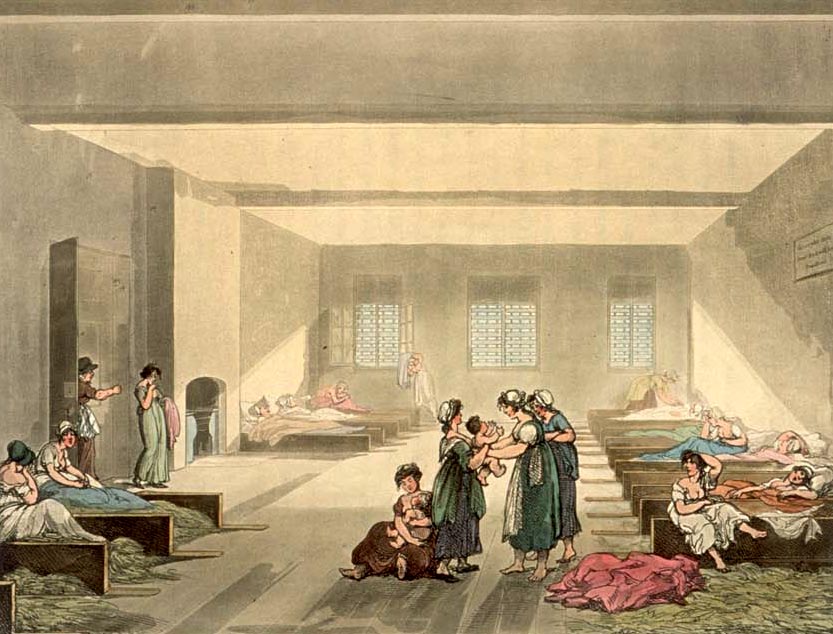
Infanticide has been practiced since the dawn of time, most famously with the Greeks, who left deformed babies to die outdoors. In Regency times, desperate women would leave their babies in the streets to die. Many left their infants at workhouses, a form of infanticide as the quote below attests, and a large number, too poor to support themselves and unable to work off their debts, wiled away their time in prison.

“When the poor stayed with their children in workhouses, the outcome was little better. Between 1728 and 1757, there were 468,081 christenings and 273,930 infant deaths in those younger than the age of 2 in London workhouses. Foundling hospitals and workhouses were institutionalized infanticide machines.” – Global Library of Women’s Medicine

Women at Bridewell Prison, 1808. Rowlandson and Pugin for Ackermann's Repository of Arts

Once children were born and the family was large, it was not unusual to farm out a few children, some to work in their childhood, as Charles Dickens did, and other to live with relatives, as was the case with Fanny Price, who lived with her aunt’s family in Mansfield Park and Edward Austen Knight, who was adopted by a rich, childless couple.

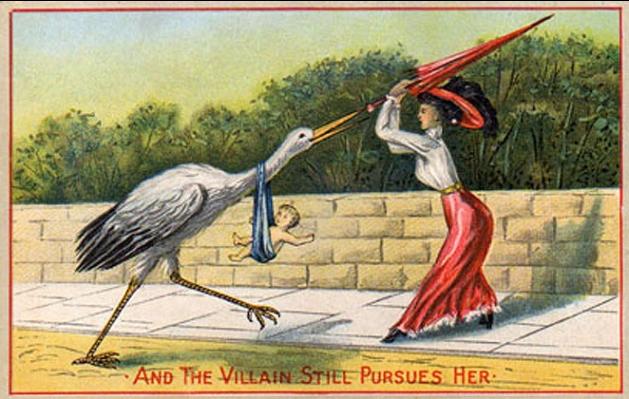
Early 20th century attitude towards an unwanted child. Image @Newsweek

It has been said that families had many children during the 18th and 19th centuries because of the high rate of infant mortality and the need for many helping hands on the farm. But as society became industrialized, large families became a hindrance. With many mouths to feed and limited resources (except in the case of the rich), it is no wonder that couples since time immemorial have searched for ways to limit the number of their offspring.  Update: As Nancy Mayer rightly pointed out in her comment, most women during the Georgian and Regency eras thought it their duty to bear their husbands children and oversee the family household. The matter of family planning might well have been influenced by women of a certain class who could not allow pregnancies to interfere with the rhythm of the work cycle, single women who were desperate to seek ways to end their pregnancies before their condition became obvious, and in houses of ill repute, where condoms would offer some protection against disease. Mistresses and prostitutes would find pregnancies to be more of a hindrance than help in their work. I have often wondered, for example, how Emma Hamilton managed to have so few children and yet enjoy the charms of so many men.

1920's Lysol Advertisement. Image @The Museum of Menstruation and Women's Health

More on the topic:

Read Full Post »

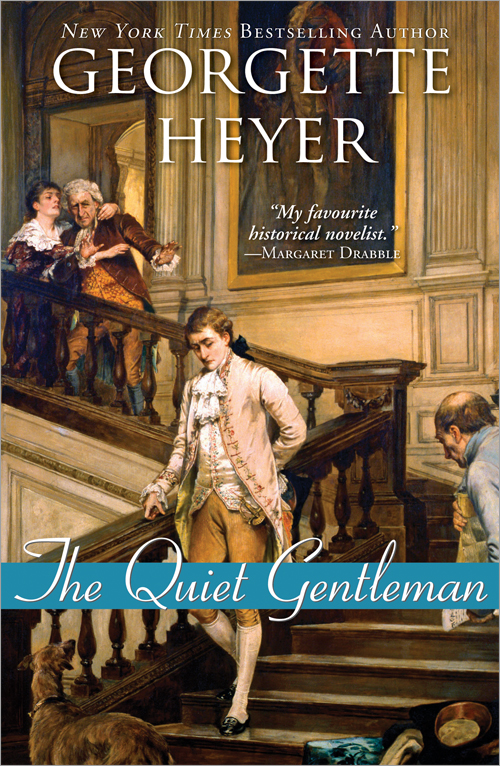
The Quiet Gentleman by Georgette Heyer starts out anything but quietly. Gervase Frant, 7th Earl of St. Erth, had the bad judgment to survive the Battle of Waterloo by escaping a violent death. His half-brother, Martin, and step mama had half counted/half hoped on his not attaining the Earldom, for St. Erth had served in many a battle. Much to their annoyance, he emerged from military service to claim an inheritance that his younger brother had started to assume would be his. And so the fun begins. The novel celebrates its 60th year and its release by Sourcebooks marks the novelists’ 109th birthday on August 16th.

In Gervase we have a blondly handsome dandy with a mild-mannered facade. His physical appearance hides the fact that he does what he pleases in a most sensible and determined way, unsurprising given his military background. When the family first meets him, Gervase stood revealed in “all the fashionable elegane of dove-coloured pantaloons, and a silver-buttoned coat of blue superfine.”

A quizzing-glass hung on a black riband round his neck, and he raised this to one eye, seeming to observe, for the first time, the knee-breeches worn by his brother and his cousin, and the glory of his stepmother’s low-cut gown of purple satin.”

This description served to tell the reader that Gervase was still wearing his traveling clothes and was in no way prepared to dine as the others were. His appearance also dupes his stepmama and half-brother into thinking he can be manipulated and bamboozled.

The heroine, Drusilla Morville, is not the obvious sort, for she is neither encroaching nor flashy. She’s more like an Elinor Dashwood than a Marianne, possessing an unassuming self-assurance and an adherence to tasteful, restrained fashion that would make Katherine, the new Duchess of Cambridge proud.

Heyer gives us what Austen does not – detail upon detail of fashion and interiors, well researched facts, I might add, for Heyer’s descriptions are accurate. Her long passage regarding the building of Stanyon Castle is important, for it lays the groundwork for the mystery that is to come. One can depend on every historical tidbit and social custom to be spot on, for Heyer is, if anything, meticulous. And while her still waters do not run as deep as Jane Austen’s, they run satisfyingly long and provide the reader with the feeling of having dipped into Regency England.

In this scene, young Martin approaches the love of his life, Miss Marianne Bolderwood, in one of the succession-houses, where she is pursuing her hobby of the moment, potting spring bulbs:

He heard the sound of he voice uplifted in a gay ballad. It came from the potting-shed, and he strode up to it, and looked in, to find that she was alone there, engaged in transferring several white hyacinghs from their separate earthenware pots to a large Worcestershire bowl. She made a charming picture, with her pale golden curls uncovered, and confined only by a blue riband, a shawl pinned round her shoulders, and a small trowel in one hand.”

Hyacinths were quite popular during the Georgian era, and while this detail is not at first strikingly obvious, Heyer knew enough to mention them (as did Jane Austen in Northanger Abbey). In fact, hyacinth vases were first used in the Georgian period to force the bulbs into early bloom.

Heyer’s dialogue is matchless, and, dare I say it, Austen’s equal in wit and pointed observation. Drusilla Morville’s parents are rebellious Bluebloods and eccentric to the nth degree, but when push comes to shove, liberal-minded Mama Morville, who is also an authoress, knows exactly what she wants for her daughter – a good marriage – and she does not hesitate in telling her husband off when he starts to protest at her attraction to St. Erth:

“If the Earl – I say, if! – were to offer for dear Drusilla, and you were to refuse your permission, I should be strongly inclinded to clap you into Bedlam! I marvel, my love, that a man of your intellect should so foolishy confuse theory with practice!”

And there you have it – the evidence of Heyer’s abilities to keep the reader on her toes and insert humor into almost every scene. Throughout the book we have been assured that neither of the Morvilles can be persuaded to deviate from their eccentric convictions, but when confronted with reality, heaven forbid that they should confuse their priorities!

We are also introduced to the protocol of dueling in the most convoluted and humorous way. Even as she makes fun of the convention, Heyer manages to teach the reader about its rules . This conversation is between Martin and Mr Barny Warboys, who is afterwards driven to search his father’s library for the Code of Honour . Martin is asking his good friend to second his opponent :

“Dash it, Martin, it ain’t the part of a friend of yours to second your opponent! Told you I’d act for you, didn’t I? Stupid thing to do, but not the man to go back on my word.”

“Barny, if he applies to you, will you act for him?”

Mr. Waryboys scratched his chin. “Might have to,” he conceded. “But if I act for him, who’s to act for you? Tell me that!”

“Good God, anyone! Rockcliffe — Alston!”

“Ay, that will be a capital go!” said Mr Warboys scathingly … “Lord, Martin, dashed if I don’t think you must be queer in your attic!”

Jane Austen’s novels are classics, which goes without saying, and Georgette Heyer’s are not, but they are nevertheless amusing and worth reading. Austen experimented with character and sub-layered her plots, whereas Heyer’s novels are (excuse me for saying this) formulaic. While Austen introduced outrageous and unforgettable secondary characters, Heyer stacked them up to the ceiling with demanding Mamas, dull-as-post bachelors, wide-eyed and breath-takingly beautiful lasses, loyal friends, strong-willed heroes, and sensible heroines. Even after having read all of her 50+ books at least twice, I have trouble recalling which of Heyer’s secondary characters belong in which book.

Heyer also tends to have her secondary characters take over much of the plot. In The Quiet Gentleman, I would have rather read more about Drusilla (who was barely there) than the beautiful but empty-headed Miss Bolderwood. St. Erth’s younger half-brother, Martin Frant, is too cardboard cut-out and immature for my liking, but his mama reminded me most forceably of Lady Catherine deBourgh, and that was fun.

In this plot romance also takes a back seat to mystery. Who wants to off the Earl and why?

Overall, I would say that The Quiet Gentleman is one of Heyer’s more mature novels. The hero and heroine are sensible, the plot is set in the country, where life plods along slowly and the characters attend only a few parties and balls, and the mystery unfolds at a rather leisurely pace.

Rating: Four out of Five Teacups

It has been at least twenty years since I last read The Quiet Gentleman. I am glad I had the opportunity to read it once again, and give this book four out of five Regency tea cups.

Georgette Heyer Reviews on this blog:

Here’s a bit of heresy for Georgette Heyer fans: Ten reasons why I can’t read Georgette Heyer

Read Full Post »

« Newer Posts - Older Posts »