Feeds:
Posts
Comments

Archive for 2011

Fashionable mourning dresses, Ladies Museum, 1805

According to Jane Austen chronicler and scholar, David Nokes, when Martha Lloyd’s mother died on April 16, 1805, Jane Austen showed few signs of grief or emotion over that woman’s earthly departure. Instead, Jane wrote a jaunty verse to an uncivil (and imaginary) dressmaker. I surmise that these verses were meant more to cheer Martha up than to bring Martha’s mood down by reminding her of her loss. Mrs Austen, who was known for her droll verses, wrote a mythical reply by the dressmaker. At this time the Austen women were still reeling from Rev. Austen’s death in January and their own change in financial circumstances, having moved to more modest lodgings and becoming accustomed to a drastically reduced style of life. They would soon invite Martha to live with them in Bath. (Martha would remain with the Austen women through their move to Southampton in 1809.) After Jane’s death in 1817, Martha joined Cassandra in Chawton to help look after Mrs. Austen.

The poem that Jane wrote gives us a glimpse into how mourning clothes were made to order quickly. In this for-instance, the dressmaker, Miss Green, was slow to respond.

Lines sent to an uncivil Dress maker

Miss Lloyd has now sent to Miss Green,
As, on opening the box, may be seen,
Some yards of a Black Ploughman’s Gauze,
To be made up directly, because
Miss Lloyd must in mourning appear –
For the death of a Relative dear –
Miss Lloyd must expect to receive
This license to mourn & to grieve,
Complete, er’e the end of the week –
It is better to write than to speak – Jane Austen

Mrs. Austen’s reply as Miss Green

I’ve often made clothes
For those who write prose,
But ’tis the first time
I’ve had orders in rhyme – .
Depend on’t, fair Maid,
You shall be obeyed;
Your garment of black
Shall sit close to your back,
And in every part
I’ll exert all my art;
It shall be the neatest,
And eke the completest
That ever was seen –
Or my name is not Green! – Mrs. Cassandra Austen

Read Full Post »

Gentle Readers, Laurel Anne from Austenprose and I were chatting the other day about this, that, and the other, for we are both a bit Jane Austen nutty (if you haven’t noticed.) As you continue reading, you will need to know only one thing:  we are just a wee bit longer in the tooth than Jane’s young heroines:

LA: Vic and I were chatting on the phone today. Over the course of our three plus year Austen-inspired friendship we have mostly emailed, so this was a treat. She has the most infectious laugh which made me laugh too. Of course we were talking about our favorite author and she remarked that Austen excelled at humor and the amazing secondary characters she developed. Somehow it just popped out and I boldly asked her what Jane Austen character she most identified with. Without hesitation she replied, Lady Russell from Persuasion. “Lady Russell?” I replied in surprise! “Well, yes.”

Jane Rus.., er, Mrs. Russell

She then revealed that she is often wrong about the advice she gives people. At work she gathers the young-uns around her and freely offers opinions, whether they are solicited or not. When she gives wrong counsel – which she admits is more often than not – she torpedos herself in a most spectacular fashion. “The error of my ways does not go unnoticed by this unforgiving crowd. Unlike Lady Russell, I will own up to a misteak, er, mistake or two, and apologize for having interfered, but I hold the line at groveling.”

Another reason why she identifies with this character is her independence. Lady Russell is a widow with a healthy income and she has no intention of remarrying and being subjugated by a man. “I am a divorced woman who has discovered the joys of living singly on my own terms and by my own schedule. Ah, what total, selfish bliss!”

Vic further admitted that at a party, or when she lets her hair loose, she starts to resemble Mrs. Jennings. You know the type: a bit vulgar, out for a good time, giggling at precisely the wrong moments, and making those with a more composed nature feel uncomfortable with crass jokes and loud language. “Like Mrs. Jennings, I have a good heart. But I can be out there and in your face too. I might seem unseemly to a quieter person like Elinor, and be totally disliked by the likes of a Marianne, but my friends and family get me, and that’s what counts.”

Oh Vic! You are such a card. Lady Russell and Mrs. Jennings? She then turned the tables on me. “Now, who do you identify with in Jane’s novels? Are you like me, a bossy and interfering carouser? Or are your a bit more sedate and ladylike?”

Harriet Smith (Tony Collette) patiently poses for Emma

Vic: “Sedate. A total Harriet Smith,” LA replied. Many years ago a dear Janeite friend tagged her as a Harriet to her Emma. “It seemed appropriate since I was often asking for advice and was very mailable to change.” In her view, Harriet was a bit of a ditz and gullible which she has been accused of too. The thing she liked about being a Harriet is that Austen gave her such a great ending. She is resilient, and after being tossed about in love no less than three times in a year, Harriet gets the man she wanted in the first place and proves Emma, with her self-important airs, was totally clueless about the human heart. “I like having the last laugh, and being right.” ;-)

Sir John Middleton (Robert Hardy) and Mrs. Jennings (Elizabeth Spriggs)

Lately LA thinks she has evolved into Sir John Middleton from Sense and Sensibility. He was the Dashwood’s cousin and landlord of Barton Cottage. He is very gracious and likes to pop in and make sure his tenants are comfortable and entertained. He is a bit of a bore and talks too much about things that are not of interest to his young companions, but he likes dogs, has a good heart and loves to laugh. “As an enthusiastic bookseller, I like to inform customers of their choices and make suggestions. I am also a bit of an organizer and enjoy planning events on my blog, and orchestrating the 23 authors in my anthology. It is like herding cats, but I like being the boss of my own world!”

One man’s ways may be as good as another’s, but we all like our own best. Persuasion, Ch 13

Now our question. Which Jane Austen character do you, estimable viewer, most identify with, or which character are you afraid of becoming? Feel free to leave your comments!

Read Full Post »

Fans of Jane Austen’s fiction are familiar with the rising middle class, successful and enterprising tradesmen, upward mobility through marriage, the fragility of life (especially for fishermen, sailors and child-bearing women), and the difficulties of road travel. All these topics are touched upon in a short biography of Mr. Edward Innes, a successful baker and property man.

In this image, Mr. Innes is dressed as a gentleman, and is followed by a companion, Mr. James Cooper. As his position rose in life, his sensibilities must have become quite delicate, for as he passes a woman carrying a basket, Mr. Innes shields his face and nose from the offending stench that must have emanated from her basket.

Mr. Edward Innes and his second, James Cooper

Mr. Innes, if this account is to be believed, was a nonpareil, covering the distance to London in his carriage at the unheard of speed of 50 miles per day.

The progenitors of Mr Innes were farmers in the neighbourhood of Glencorse, but his father was a baker, and had his shop at one time at the head of the Fleshmarket Close. Latterly, the shop having been let without his knowledge to a higher bidder, he removed to his son’s property situated betwixt Marling and Niddfy’s Wynds. In his younger years, the old man was usually styled the handsome baker from his exquisite symmetry, and he was not less fortunate in his choice of a pretty woman for his wife. Isabella, or Bell Gordon, had been married to the captain of a vessel, who was drowned at sea only a few weeks after. The young widow then only in her eighteenth year, happening to be on a visit at the house of her brother in law, Mr Syme ,ship builder, Leith; the handsome baker was introduced to her acquaintance, and the result was a speedy union. Besides a daughter by her first husband, Mrs Innes had eight children, of whom the subject of our notice was the second eldest.

Mr Edward Innes, after serving his apprenticeship with his father, commenced as a baker on his own account in the High Street. In addition to his good fortune in business, he acquired considerable property by his wife, a Miss Wright of Edinburgh, by whom he had several children. Mr Innes kept a horse and gig, an equipage rather unusual for a tradesman in his day; and what was considered remarkable at that time, he drove to London on one occasion, accompanied by his wife, in eight days, a distance averaging fifty miles a day. The circumstance was much talked o,f and taking into account the then state of the roads, the performance was really one of no ordinary magnitude. – A series of original portraits and caricature etchings, Volume 2, Part 2 (Google eBook), John Kay, 1838, p 284.

Note: Considering the poor road conditions of the day, carriage horses averaged from 2-4 miles per hour; at breakneck speed, they could achieve a remarkable 6 miles per hour, but horses that pulled a carriage could keep up this pace for only a short distance. Thus Mr. Innes and his wife spent long hours on the road (10-12 per day) and had their horses frequently changed at stops along the way.

Other posts on this topic:

Read Full Post »

For those who were so unfortunate as to miss Upstairs Downstairs, PBS has made the series available online one day after the initial airing. Click here to watch Episode One.

Ten points to ponder as you contemplate the first episode of Upstairs Downstairs:

1. Rose is back. She is the bridge between the old series and the new. (Jean Marsh was one of the original creators of the show.) Time has not been kind to Rose. Although only six years have passed since the Bellamys left 165 Eaton Place, the poor maid turned housekeeper seems to have aged three decades.

Rose now runs her own business

2. Co-creator Eileen Atkins was committed to another project when filming of the original series began, but she was available for this series. Her turn as Lady Maude Holland, the dowager mama does not quite rival Maggie Smith’s Violet in Downton Abbey, but unlike Maggie, Eileen was given a most interesting, very capable, quite mysterious and handsome secretary – Mr. Amanjit Singh.

Maude dictates her memoirs to her secretary

3.  Few series feature a monkey or a fledgling in a nest. This one has both.

Mr. Amanjit Sing (Art Malik) and Johnny (Nico Mirallegro) place the egg in a linen closet

4. Agnes and Hallam are passionately in love. I wonder if her bitchiness when talking to the servants turns him on, or is it her thriftiness?

Passion in Eaton Place (Keeley Hawes and Ed Stoppard)

5. Like Downton Abbey, there seems to be a foreshadowing of a relationship between the chauffeur and his young mistress, in this instance, Agnes’s sister, Lady Persie, a rebellious though uneducated minx.

Harry (Neil Jackson) and Lady Persie (Claire Foy)

6. What self-respecting viewer can resist a series that features both the family jewels and a home renovation?

The Holland Jewels

7.  We are given one more reason to despise Wallis Simpson.

Instead of the King, Wallis brings Her Ribbentrop (Edward Baker-Duly) to the party

8. A mystery is afoot. Will Johnny the footman, whose passion for the nubile (but very underage Ivy) has put him in the clinker, be able to highfoot it back to Eaton Place?

Ivy (Ellie Kendrick) turns out to be a tease.

9. Will we ever warm up to Pritchard and Mrs. Thackeray? Or will our fond memories of Mr. Hudson and Mrs. Bridges stand in the way? And where was Georgina (Lesley Ann Downe)?


10. Shall Episodes 2 & 3 firmly answer the question: Which series is better, Downton or UpDown? Inquiring minds want to know. Vote here.

Ivy meets Lady Holland

Read Full Post »

18th century robe a la Francaise. Image @Rijksmuseum

During the 18th century and much of the Regency era, trains were popular on evening and court dresses, and at times on walking gowns. The length of the train shortened as the 18th century progressed, but even shorter trains swept over lawns and grounds and sidewalks. This fashion turned out to be quite expensive, for after several short walks, the fabric would be quite soiled or would need replacement. Oliver Goldsmith wrote in Citizen of the world (1760):

Nothing can be better calculated to increase the price of silk than the present manner of dressing. A lady’s train is not bought but at some expense, and after it has swept  the public walks for a very few evenings, is fit to be worn no longer, more silk must be bought in order to repair the breach, and some ladies of peculiar economy are thus found to patch up their tails eight or ten times in a season.”

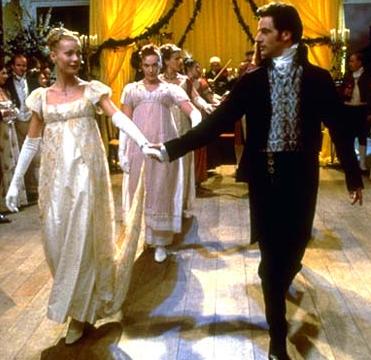
One imagines that the delicate muslin trains of the Regency era were as easily wrecked by wear and tear, and that only the rich could afford such an extravagant consumption. There were ways to save one’s train. In 1996’s Emma, Gwynneth Paltrow is seen holding up her train during the dance.

Emma's train is attached to her wrist.

In Northanger Abbey, Jane Austen described how Isabella Thorpe and Catherine Morland pinned up each others trains.

They called each other by their Christian name, were always arm in arm when they walked, pinned up each other’s train for the dance, and were not to be divided in the set; and if a rainy morning deprived them of other enjoyments, they were still resolute in meeting in defiance of wet and dirt, and shut themselves up, to read novels together.”

1800 sprigged muslin gown. Image @Christies

One can only conclude that trains (or tails, as Goldsmith called them) were an extravagance that the ordinary working woman did not indulge in wearing, for until mass production made cloth more affordable, the added lengths of cloth, plus the constant need for laundering and patching, would make this fashionable feature prohibitively high for most women.

Note: That Isabella and Catherine met  “in defiance of wet and dirt” meant something, for shoes and fabrics were so delicate at the time, that ladies tended to stay indoors on rainy days.


Read Full Post »
« Newer Posts - Older Posts »