Feeds:
Posts
Comments

Archive for 2011

Wood floors of Brunswick House

In researching floors and floor coverings of Georgian houses, I came across these interesting tidbits of information.

During the middle ages, the floors of simple peasant households consisted of dirt. Hay and straw were strewn on top of the surface, and often cow dung and household wastes were tossed on top of the rushes. This mixture was trampled upon by the inhabitants. (During the middle ages, animals often shared the house with their human owners.) The result was a surface that became as hard as cement over time. Around the 1100s, saltpeter (potassium nitrate) was used for gunpowder, and the floors of former peasant homes provided a good source for this mineral. Mint was used as a deodorizer to cover the smell of the floors, for walking around the room and tramping onthe herb helped to spread its scent.  (A Not So Boring History of Flooring)

The interior of this Irish cottage shows the rough dirt floor. This image was taken in the late 19th century

Concrete floors were also widespread. They were made by plastering a concrete preparation over reeds that were fastened to joists. When this substance dried the concrete assumed the character of a slab of unbroken stone which was strong enough to bear a heavy load without the aid of supporting joists. This hardy substance was both fireproof and long lasting.

Pigs shown entering the Irish cottage. Late 19th century

Concrete floors eventually began to be replaced with wood floors during the Middle Ages.

We are not able to find any distinct records of wood having been employed for the boarding of the floors of dwelling-houses until towards the latter part of the middle ages, when an upper story began to be attached to middle-class houses in consequence of the increased value of land. The most abundant specimens of these early wooden floors are to be met with in London, probably for the reason that land being of higher values there than elsewhere, upperstoried houses wore more common. The name of 1′ lofts” was given to these upper storied rooms on their first introduction, from whence we have the compound word sentence of “up-a-loft,” and the word “cock-loft” has, probably, the same derivation, for wo find it now to be occasionally employed in some of the villages in the Midland counties to signify an up-stairs bedroom.- Building News and Engineering Journal, Vol 41, 1881

Wood floor planks were rough at first, and hand planed and hand finished with stone or metal. Old growth trees allowed for the maximum wood plank width (about 1-2 feet), which minimized the work required to cover a floor surface. In the 18th century, floorborads were irregular in shape and ranged in size and length. The goal was to use the smallest number of boards to cover a surface. More formal rooms used narower floorboards, indicating the wealth of the family who could afford to pay for the extra hours that craftsman took for the smaller sized boards.
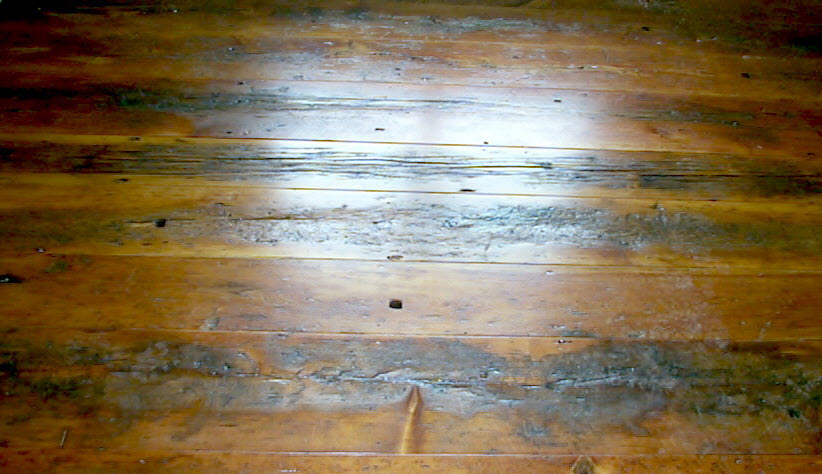
Antique hemlock flooring with nail holes and saw marks.

Narrower floor boards general adoption gained rapid foothold during the Industrial Revolution after the repeal of duties place on foreign timber and the introductionof steam-powered planing machinery. In the early 1800s, production for such boards increased. The irony is that today wider floorboards have become a status symbol, for they have become more valuable as old growth trees have become scarce.

Wood floors had a variety of finishes. They were left unpainted and scrubbed with a mixture of sand and herbs. They were lymewashed, or oil painted in solid colors and stenciled. The floors were not sanded or washed or varnished during this early period. At a  later time varnishes and stains were applied to help make the wood last longer.

This charming watercolour by Diana Sperling shows the bare wood floor. It was the custom during this period to roll up the carpet and shove furniture aside for impromptu casual dancing.

In the mid 1800s decorated floor tile floors became popular in Europe. They had been used in Turkey, the Middle East, and in Dutch houses during the 1600s, and can be readily seen in Dutch interior paintings.

Floors were covered with a variety of rugs: rag rugs made of old bits of cloth; oil cloths; marble cloths; floor cloths, which were often painted to resemble carpets; and Persian rugs for the wealthy, which were prized for their color, design, and durability. Floor cloths were used in fine homes in France in the 14th century and made their appearance in England in the 17th century. Designs were often painted on them, as this U.S. example from Lakeport Plantation shows:
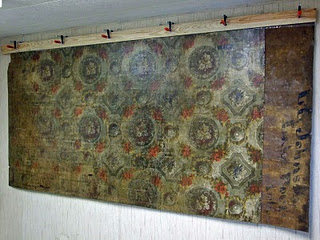
Floor cloth sample from Lakeport Plantation
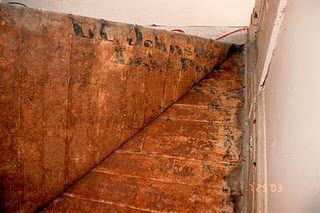
One can see from this example how sturdy the cloth was after treatment.

Another fascinating fact is that rubber floors were used as far back as the 13th century and remained popular until the 1600s. In 1863, Frederick Walton, an English rubber manufacturer, patented linoleum, which is still made in the same way today.

Interesting fact: From ‘besom’ to broom

To sweep floors during the Middle Ages, the British used a ‘besom’ – a handful of twigs with the leaves attached. Besoms were often made of twigs from the ‘broom scrub,’ and so the sweeping implements came to be called ‘brooms’ around AD 1000.

More on the topic:
Read Full Post »

Amongst herbs to be eaten I find gourds, cucumbers, coleworts, melons disallowed, but especially cabbage. It causeth trouble-some dreams and sends up black vapours to the brain . . .” – Richard Burton, 16th century

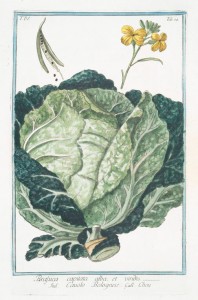
Cabbage was first introduced in Great Britain by the Romans. In ancient times the Greeks revered it for its medicinal qualities, and it was well known in the Mediterranean region, where it spread out to other parts of Europe. The vegetable was cultivated as food for man and cattle and consumed mainly by the poor,  for this hardy plant could be grown in the vegetable garden in temperate climates for long periods and harvested into early winter. White cabbage, used for boiling, braising, and stewing, was distinguished from the red cabbage, which was mostly used for pickling. From the 14th century and on, European peasants consumed cabbage in the form of soups and stews, which nourished them through the long winter months. It wasn’t until the 18th century that cabbages began to make their appearance on more aristocratic tables.

Cabbage’s long lasting quality made it a valuable and nutritious vegetable staple for long sea voyages. One imagines that Jane Austen’s sailor brothers ate a great deal of cabbage while sailing.

In his journal for July 1772, Cook gives the following account of the provisions placed aboard the Resolution and Adventure…Biscuit, flour, salt beef, salt pork, beer, wine, spirit [distilled alcohol], pease [dried peas], wheat, oatmeal, butter, cheese [hard], sugar, oyle olive [olive oil], vinegar, suet, raisins, salt, malt, sour krout [sauerkrout], salted cabbage, portable broth [dessicated soup], saloup, mustard, mermalade [marmelade] of carrots, water…” – Sailors & Sauerkraut: Excerpts from the Journals of Captain Cook’s Expeditions All Pertaining to Food With Recipes to Match, Barbara Burkhardt, Barrie Andugs McLean & Doris Kochanek [Grey’s Publishing:Sidney BC] 1978 (p. 23)- The Food Timeline

High in vitamin c and anti-inflammatory properties, this cruciferous vegetable was not only nutritious and helped to fight scurvy, but an apocryphal story states that during Captain Cook’s first voyage, members of his crew were saved from gangrene by doctors who applied poultices of cabbage to their patients’ wounds.

At the time, cabbage was called a ‘cabbage cole’ or ‘colewort. ‘By the mid eighteenth century, an array of different cabbages was grown, and as one anonymous writer put it:

‘There various Kinds of this Plant are endless to describe_’ The common White Cabbage, Sugarloaf, Pontefract, Battersea, Red Cabbage, and the green and White Savoy Cabbage’ [Anon (1744)].

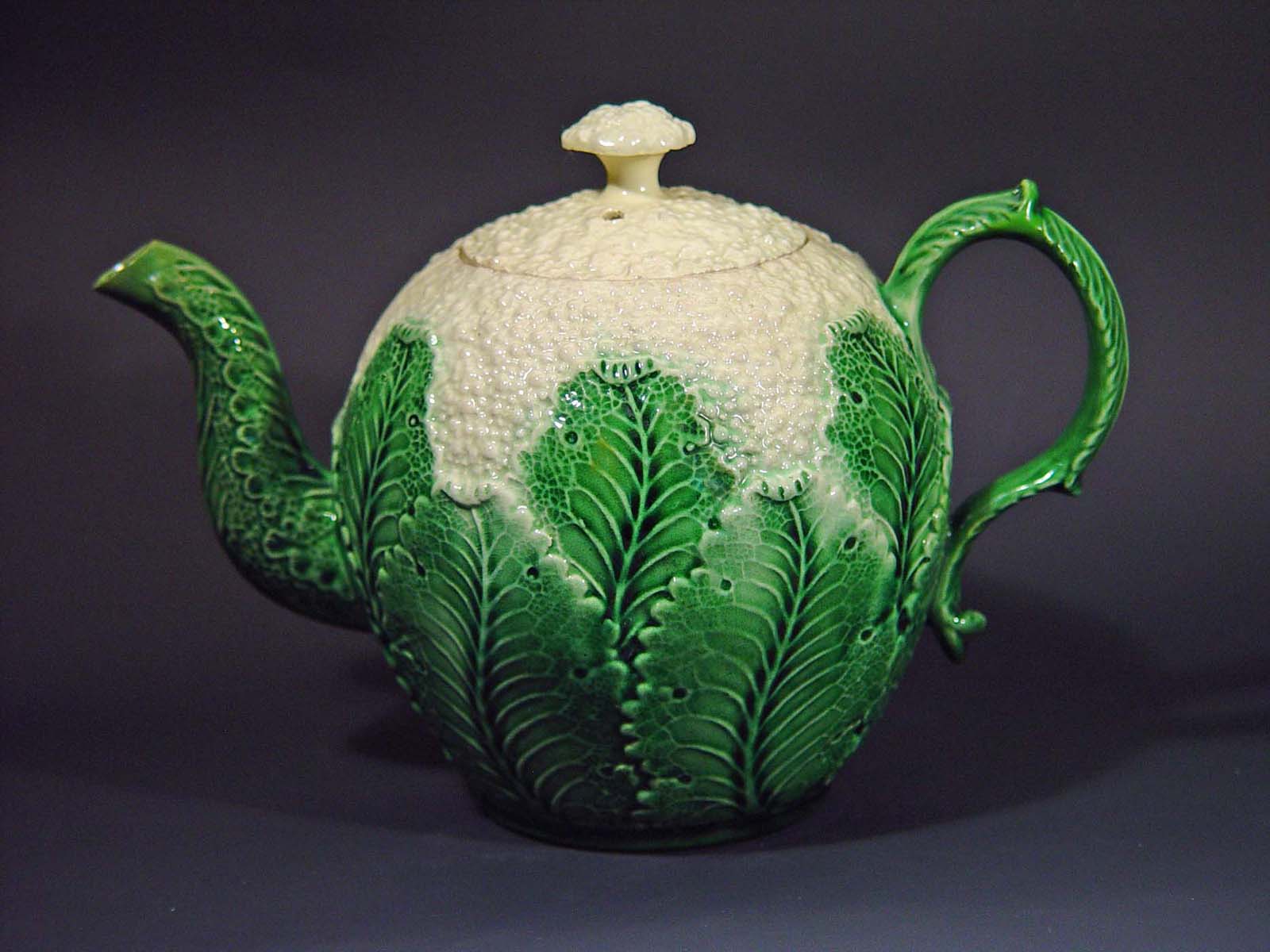
1770 creamware teapot. Image @Earle D. Vandekar of Knightsbridge

Cabbages were grown in family gardens in raised beds, near the door for easy picking, and protected from damaging winds by a fence or hedge and mulch. Recipes for cooking cabbage were included in early cookery books, however, one defies the modern cook to be able to follow Hannah Glasse’s charming recipe for beans ragoo’-d with a cabbage (at least I would have a difficult time.)

TAKE a nice little cabbage, about as big as a pint bacon ; when the outside leaves, top, and stalks are cut off, half boil it, out a hole in the middle pretty big, take what you cut out and chop it very fine, with a sew of the beans boiled, a carrot boiled and mashed, and a turnip boiled,  mash all together, put them, into’a sauce-pan, season them with, pepper, salt, and nutmeg, a good piece of butter, stew them a few minutes over the fire, stirring the pan often. In the mean time put the cabbage into a sauce-pan but take great care it does not fall to pieces; put to it four spoonsfuls of water, two of wine, and one of catchup ; have a spoonful of mushroom-pickle, a piece of butter rolled in a little flour, a very little pepper, cover it close, and let it stew softly till it is tender; then take it up carefully and lay it in the middle of the dish, pour your mashed roots in the middle to fill it up high, and your ragoo round it. You may add the liquor the cabbage was stewed in, and send it to table hot. This will do for a top, bottom, middle, or side-dish. When beans are not to be had, you may cut carrots and turnips into little slices, and fry them; the carrots in little round slices, the turnips in pieces about two inches long, and as thick as one’s finger, and toss them up in the ragoo.

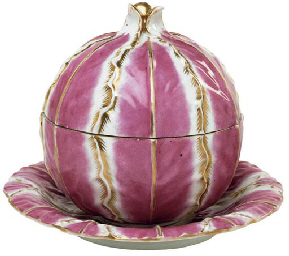
Cabbage tureen, mid-19th century Jacob Petit Porcelain. Image @Christie's

By 1773 the cultivation of cabbage in England was sufficiently commercialized to make it a criminal offence to steal or damage growing crops of cabbage, whose price had dropped by half since the 1730s. Chefs and cooks used cabbage to make ragout and pudding, or stuff it with meat. In the 16th and 17th centuries warm milk was added to make cabbage cream that was left to mature before being presented at dinner tables.

Red cabbage was prepared and sold as a pickle. Newspapers advertised the sale of cabbage seed, where it was defined as flat sided, green savoy, hellow (probably a misprint for yellow) red, Russia, sugar loaf, turnip, yellow savoy and Yorkshire. (Simone Clarke – British History Online.)

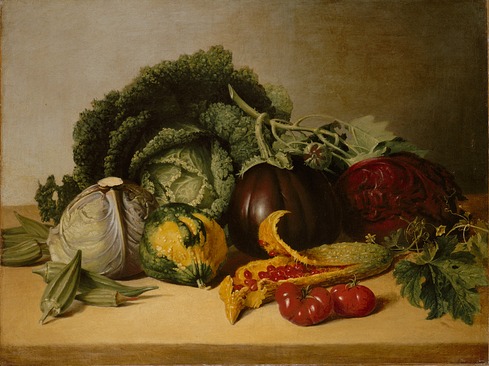
Still life with cabbage, James Peale

“The time has come…to talk of many things: Of shoes–and ships–and sealing wax–of cabbages–and kings–And why the sea is boiling hot–And whether pigs have wings.” – Lewis Carroll

Mrs. Beeton’s STEWED RED CABBAGE (19th century)

INGREDIENTS – 1 red cabbage, a small slice of ham, 1/2 oz. of fresh butter, 1 pint of weak stock or broth, 1 gill of vinegar, salt and pepper to taste, 1 tablespoonful of pounded sugar.

Mode.—Cut the cabbage into very thin slices, put it into a stewpan, with the ham cut in dice, the butter, 1/2 pint of stock, and the vinegar; cover the pan closely, and let it stew for 1 hour. When it is very tender, add the remainder of the stock, a seasoning of salt and pepper, and the pounded sugar; mix all well together, stir over the fire until nearly all the liquor is dried away, and serve. Fried sausages are usually sent to table with this dish: they should be laid round and on the cabbage, as a garnish.

Time.—Rather more than 1 hour. Average cost, 4d. each.

Sufficient for 4 persons.

Seasonable from September to January.

Hannah Glasse’s 18th century Recipe for Pickled Red Cabbage declares this dish to be useful only for garnish:

To pickle red-cabhage.

SLICE the cabbage thin, put to it vinegar and salt, and an ounce of all-spice cold cover it close, and keep it fer use. It is a pickle of little use but for garnishing of dishes, sallads, and pickles, though some people are fond of it.

Years ago, my then husband and I spent an outrageous sum of money eating Bubble and Squeak at a chichi Mayfair restaurant in London. Imagine my surprise when I discovered that this costly (to us) side dish consisted of the humble potato and cabbage, a dish invented by Maria Rundell in 1806.

Maria Rundell’s recipe for Bubble and Squeak.

Boil, chop, and fry, with a little butter, pepper, and salt, some cabbage, and lay on it slices of rare done beef, lightly fried.

In both the following receipts, the roots must be taken off the tongue before salted. – A new system of domestic cookery: formed upon principles of economy, and adapted to the use of private families, Maria Eliza Ketelby Rundell, 1808

Read Full Post »

Gentle Readers, A few months ago frequent contributor Tony Grant wrote a lovely post about Richmond Park. Recently, a man walking his dog lost control of his animal, who was not on his lead. The result could have been catastrophic. Tony writes that the authorities are taking this incident seriously and may prosecute.

I walk my dog Cody along the river almost daily. We live in the city, and sometimes the paths are crowded with cyclists, joggers, children and babies pushed in carriages, yet it amazes me that so many people choose to walk their dogs without a leash. Many of them, often quite large, run up to Cody, who is restrained. An unequal situation, to say the least.

Read Full Post »

I was at the private view of the “Diorama”; it is in part a transparency; the spectator is in a dark chamber, and it is very pleasing, and has great illusion. It is without the pale of art, because its object is deception. The art pleases by reminding, not deceiving. The place was filled with foreigners, and I seemed to be in a cage of magpies. – John Constable.

Ruins of Hollyrood Chapel, one of Daguerre's paintings for an 1824 Paris diorama

Imagine a world without films or television, computers or cell phones. Where transportation was slow and costly, and only the rich could afford to travel out of the country. Then imagine a new cutting edge technology in which lifesized illusions of ancient or distant lands were recreated on large transluscent screens and scenes of beauty or disaster were enhanced with lights that simulated scenes containing fire, the changing seasons, and sunrises and sunsets. Dioramas were a 19th century version of virtual reality – spectacles that both entertained and filled the viewer with wonder. Illusionary, seemingly 3D, and augmented by concealed lights in back of the stage, these entertainments were shown in buildings designed to display them.

Photo shows people watching Daguerre's diorama. Undated illustration. Image by © Bettmann/CORBIS

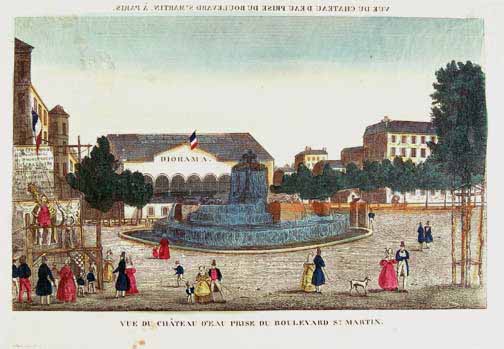
In 1822, a mere 5 years after Jane Austen’s death, Louis Jacques Mandé Daguerre, introduced the first Diorama theater in Paris.

Diorama in Paris. Image @Jack and Beverley's Optical Toys

“Daguerre made large paintings of scenes and displayed they in elaborate layered stage settings along with real objects. The theater was equipped with windows and louvers that could be opened and closed to front light and back light the images. This caused transparent areas of the scene to change and new images to appear. Most often these were day to night transformations.” – Jack and Beverley’s Optical Toys

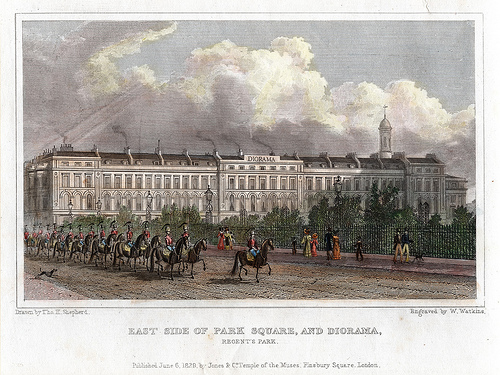
Diorama, Regent's Park

One year after Daguerre’s introduction of this wondrous new entertainment, the first diorama opened up in London in Regent’s Park. (The building still stands, but the interior has been vastly transformed.) The subject matter included landscape scenes of the grand tour, religious stories, recreations of paintings and grand architecture, and historical themes well-known to the public. The images could be made more or less bright according to the mood or atmosphere required by the theme. Props were also added for realism:

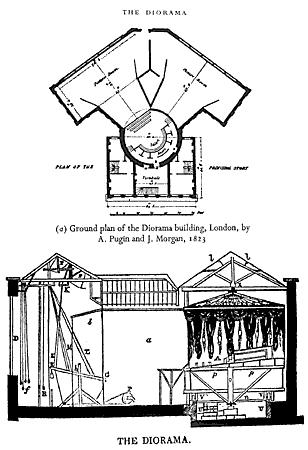
Diorama theatre

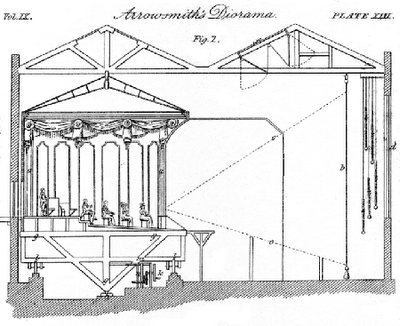
The visitors, after passing through a gloomy anteroom, were ushered into a circular chamber, apparently quite dark. One or two small shrouded lamps placed on the floor served dimly to light the way to a few descending steps and the voice of an invisible guide gave directions to walk forward. The eye soon became sufficiently accustomed to the darkness to distinguish the objects around and to perceive that there were several persons seated on benches opposite an open space resembling a large window. Through the window was seen the interior of Canterbury Cathedral undergoing partial repair with the figures of two or three workmen resting from their labours. The pillars, the arches, the stone floor and steps, stained with damp, and the planks of wood strewn on the ground, all seemed to stand out in bold relief, so solidly as not to admit a doubt of their substantiality, whilst the floor extended to the distant pillars, temptingly inviting the tread of exploring footsteps. Few could be persuaded that what they saw was a mere painting on a flat surface. The impression was strengthened by perceiving the light and shadows change, as if clouds were passing over the sun, the rays of which occasionally shone through the painted windows, casting coloured shadows on the floor. Then shortly the lightness would disappear and the former gloom again obscure the objects that had been momentarily illumined. The illusion was rendered more perfect by the sensitive condition of the eye in the darkness of the surrounding chamber.” “- The History of the Discovery of Cinematography http://www.precinemahistory.net/1800.htm

Diorama

Dioramas were created for spectacle and entertainment, and one can readily imagine Georgette Heyer’s characters attending these events during the London Season.

The popularity of the dioramas generated a debate over whether their pictures were art. The press discussed them as ‘exhibitions of art.’ But if the dioramas were art, it was a mundane art, and it rarely elevated the viewer’s taste. Indeed, if contemporary reactions are to be believed, the highest artistic achievement the diorama could attain was providing an entertaining substitute for reality. These pleasant but uncomplicated images required little or no preparation for serious thought… – Robert W. Brown.

Diorama diagram. Image @Wikipedia

This first-hand account gives the modern reader a sense of how these 30 – 50 minute light shows seemed to the viewer:

Woodcut of a diorama, day and night scenes.

A bell now rings, we find ourselves in motion; the whole theatre in which we sit, moves round till its wall closes the aperture or stage, and we are in perfect darkness; the bell rings again, a curtain rises, and we are looking on the time-worn towers, transepts, and buttresses of Notre Dame, its rose window on the left, and the water around its base reflecting back the last beams of the setting sun. Gradually these reflections disappear, the warm tints fade from the sky, and arc succeeded by the cool grey hue of twilight, and that again by night—deepening by insensible m degrees till the quay and the surrounding buildings and the water are no longer distinguishable, and Notre Dame itself scarcely reveals to us its outlines against the sky. Before we have long gazed on this scene the moon brgins to emerge slowly—very slowly, from the opposite quarter of the heavens, its first faint rays tempering apparently rather than dispersing the gloom; presently a slight radiance touches the top of one of the pinnacles of the cathedral—and glances as it were athwart the dark breast of the stream; now growing more powerful, the projections of Notre Dame throw their light and fantastic shadows over the left side of the building, until at last, bursting forth in serene unclouded majesty, the whole scene is lit up, except where the vast Cathedral interrupts its beams, on the quay here to the left, and where through the darkness the lamps are now seen, each illumining its allotted space.” – London Volumes 5-6, Edited by Charles Knight, 1843, pp. 284 – 288

Diorama, Edinburgh

By the early half of the 19th century there were five diaromas open in London. They were also popular in other British cities, as well as Breslau, Berlin, Cologne, Stockholm, and the United states. It is interesting to note that the end of the diorama’s popularity coincided with the rise of photography.

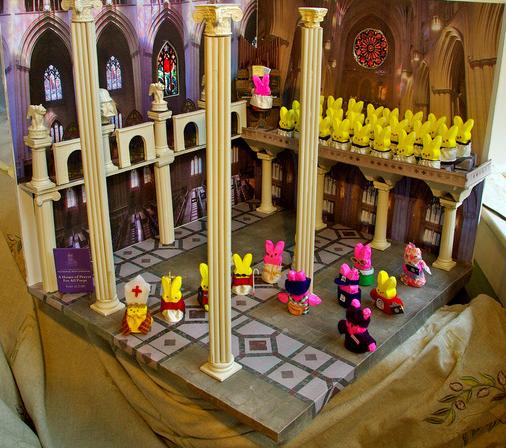
The Annual Peeps Diorama competition grows bigger every year: Easter at the National Peeps-thedral

Dioramas have shrunk in size, and today’s viewers know them only as scenes in boxes or bottles, as museum displays, or for competitions, such as the science fair or annual peeps contest.

Read Full Post »

Gentle reader, I’ll be away with my family and am on a short hiatus. Here’s wishing my American readers a wonderful holiday!

Pilgrims at Plymouth Rock, 1620


Read Full Post »

« Newer Posts - Older Posts »