Feeds:
Posts
Comments

Archive for 2011

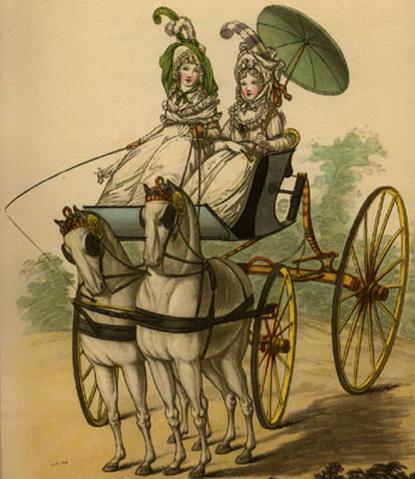
High Perch Phaeton

Gentle readers, Patty of Brandy Parfums is an avid fan of history, horses, Jane Austen, and Georgette Heyer. She is also a devoted reader of this blog.  Just recently she wrote ‘Georgette Heyer for Horse Lovers’ for the October issue of Horse Directory Magazine. Patty has graciously allowed me to reproduce her article for Jane Austen’s World.

Walnut Hill Driving Competition, the largest driving competition in North America held each August in Pittsford NY, has no speed classes for high-perch phaetons. They tip over too easily to be safe. Yet in the colorful, elegant world of English author Georgette Heyer’s romance novels, many with references to horses, intrepid heros and heroines drive these carriages around corners at high speeds without tipping over.

Georgette Heyer published her first novel in 1921, when she was nineteen, and went on to write over fifty novels. She was especially known for her witty Regency romance novels, and was widely copied and imitated. If you have never heard of her, it is because after a badly made movie based on one of her novels, The Reluctant Widow, came out in 1951, Heyer put in her will that she did not want any other of her books turned into movies.

In Heyer’s Bath Tangle, Major Hector Kirkby questions Lady Serena Carlow about her choice of a high-perch phaeton with its “bottom five feet from the ground” and pair of horses. Major Kirkby says –

‘Serena,-my dearest! I beg you won’t! I know you are an excellent whip, but could you not have a more dangerous carriage!’

‘No! If I were not an excellent whip!…….The difficulty of driving them is what lends a spice!’
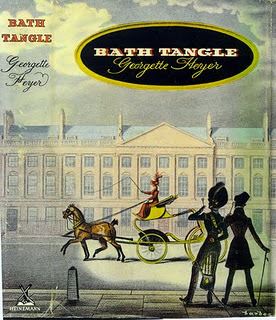
Cover of Bath Tangle by Heyer's favorite cover artist, Arthur Barbosa

The Heyer heros and heroines, who are skilled equestrians known as bruising riders, ride horses they treasure, like Maid Marion that Lady Serena rides in Bath Tangle.

By Jove, Lady Serena, you’re a devil to go!’ Mr. Goring exclaimed, in involuntary admiration. She laughed, leaning forward to pat the mare’s steaming neck. ‘I like a slapping pace, don’t you?’

‘I should have called it a splitting pace!’ he retorted…..’My heart was in my mouth when you rode straight for that drop fence!’
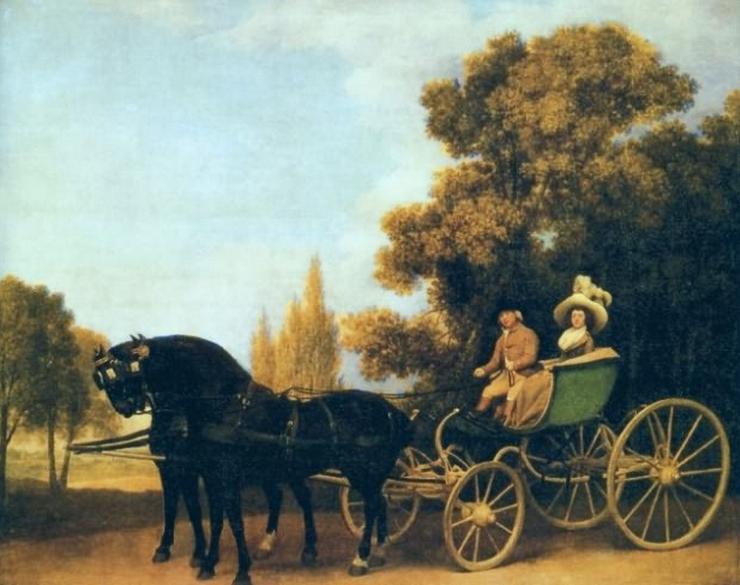
The more stable crane necked phaeton with smaller wheels

Because Heyer’s novels take place when horses were used for transportation, carriages and coaches breakdown in many of her books. In The Corinthian, there is little horse activity in the beginning except a coach breaking down, but the hero, Sir Richard Wyndham, a bored bachelor and renowned whip, is sure to get into action at some point in the story. Sir Richard (Ricky) asks his friend, the Honourable Cedric (Ceddie).

Ceddie, were you driving your own horses yesterday?’

‘Dear old boy, of course I was, but what has that to say to anything?’

‘I want ’em,’ said Sir Richard………I must have a fast pair immediately.’

My favorite Heyer novel so far for horseyness is The Quiet Gentleman, a Regency romance and mystery of sorts, with Gervase Frant, the Earl of St Erth, a subdued dandy returning home from military duties at Waterloo. Mr. Warboys says –

‘……..that’s a devilish good-looking hunter you have there, St Erth! Great rump and hocks! Splendid shoulders! Not an inch above fifteen-three, I’ll swear! The very thing for this country!’

‘Oh, he is the loveliest creature!’ Marianne said, patting Cloud’s neck. He makes no objection to carrying me in this absurd fashion: I am sure he must be the best-mannered horse in the world!’
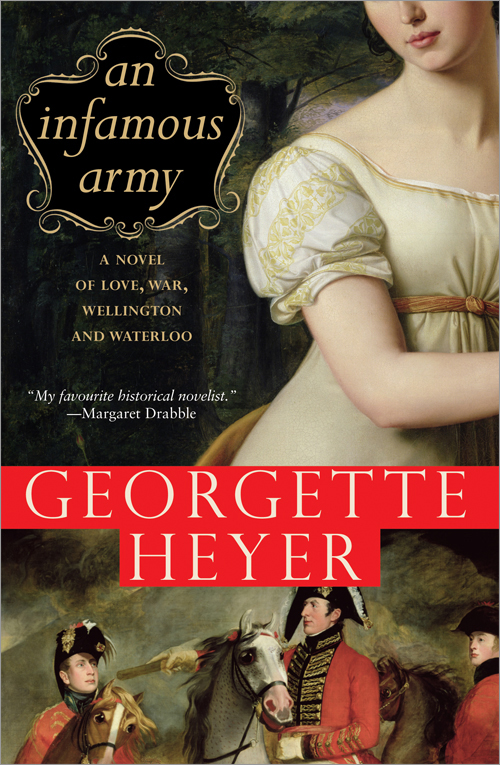
Cover of Infamous Army with horse. Image@Sourcebooks

Georgette Heyer wrote her romance novels over a period of many years and they were always best sellers even during WWII in England, when their lively, entertaining content helped people forget their misery. Heyer also wrote mysteries, and more serious historical fiction like the superb An Infamous Army, which takes place in Brussels in 1815 during the time of Waterloo. Infantry and calvary movements are so accurately described that this book is required reading at Sandhurst.

Other horsey and just plain amusing novels recommended include The Masqueraders, False Colors, Arabella, Sylvester or the Wicked Uncle and The Grand Sophy, a work unfortunately marred by the appearance of a cliché moneylender.  Sourcebooks has reissued many of Heyer’s fifty novels and they are proving quite popular – a wonderful diversion for our uncertain times.

More on the topic:

This is the first video of the film, The Reluctant Widow. Only 9 of the 10 videos are featured. Have no fear, this 1951 film is so badly made that you will probably not make it that far. Click on this link to access it.

Read Full Post »

Four YouTube videos feature the recipes of Mrs. Beeton and her story in a BBC2 show, The Marvellous Mrs. Beeton, hosted by Sophie Dahl. Check the first of four videos here, then find the other videos in YouTube’s sidebar.

Edwardian Promenade lists these videos in its YouTube account. (A visit to the site is well worth your time.) Thank you, Karen Reedy-Wilcox, for pointing out these videos.

Sophie Dahl, hostess and narrator of this show.

Read Full Post »

Dressing in a 1790s round gown is a short 23 second clip.

This video of getting into an 1805 gown has been around longer, but is worth revisiting. Koshkacat has a fabulous site. In this video one can see why a maid’s (or a relative’s) help is required.

At the bottom of this web page by Wm Booth Draper, you will see the sort of straight pins that were used to close gowns.

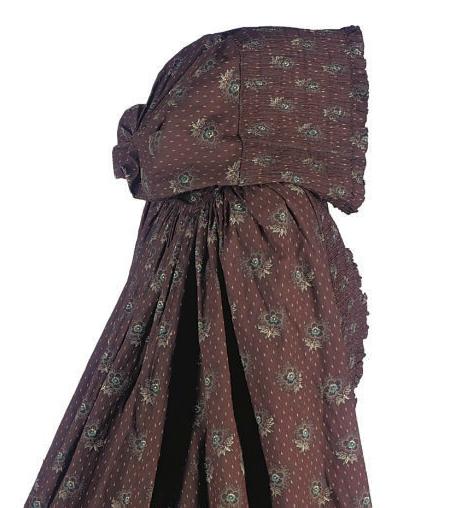
This chocolate brown chintz cloak from 1790 has a cream and turquoise floral print. The hood and edges are deeply pleated, and the entire garment is lined in cream flannel with a scarlet floral print and a tan print cotton. Images@Christie’s.

Read Full Post »

Gentle readers: Today I present to you this chapter about The Dress Maker in its entirety from a book in the public domain, Book of English Trades, and library of the useful arts, published in 1818.

THE LADIES’ DRESS-MAKER.

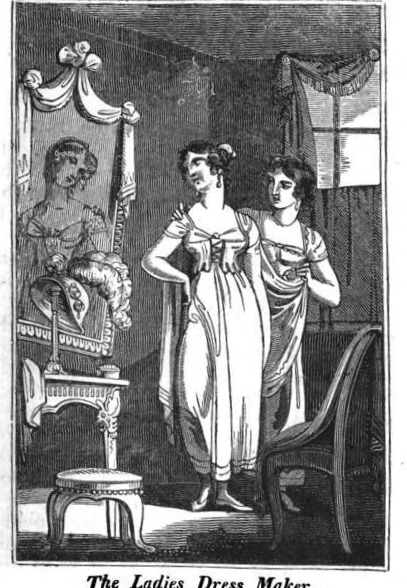
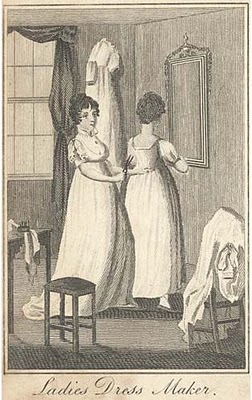
Image from the book: "The plate represents the Dress-Maker taking the pattern off from* a lady, by means of a piece of paper or cloth: the pattern, if taken in cloth, becomes afterwards the lining of the dress."

Under this head we shall include not only the business of a Mantua Maker, but also of a Milliner: for, although in London these two parts of in fact the same trade, are frequently separate, they are not always so, and in the country they are very commonly united.

The history of dress would be as voluminous as the history of mankind: dress is a thing subject to almost daily fluctuation, so that a history of the ladies’ dresses in England, for merely half a dozen years, would furnish matter for a bulky volume; we shall therefore not attempt it, but merely observe that the best, and, perhaps, the only excuse for such continual change in the empire of dress, is the opportunity which that change offers of employment to those persons who would otherwise have no immediate claim upon the rich and opulent; and thus, what would be retained in their coffers, is now scattered in a variety of ways amongst the community in the purchase of luxurious dress, and in the alterations which fashion is continually introducing.

In the Milliner, taste and fancy are required; with a quickness in discerning, imitating, and improving upon various fashions,which are perpetually changing among the higher circles.

  • Silks and Satins, of various sorts, are much used in this business; which were formerly imported into this country, but now are manufactured ia great perfection in Spitalfields and its neighbourhood.
  • Gauze is a very thin, slight, transparent kind of stuff, woven sometimes of silk, and sometimes only of thread.
  • Crape is a very light, transparent stuff; in some respects like gauze: but it is made of raw silk, gummed and twisted on the mill, and woven without crossing. It is used for mourning, and is now a very fashionable article in court-dresses.
  • Spangles are small, thin, round leaves of metal, pierced in the middle, which are sewed on as ornaments to dress.
  • Artificial Flowers are made, sometimes, of very fine coloured paper, sometimes of the inside linings upon which the silk worm spins its silk, but principally of cambric, which is a kind of linen made of flax, and was first manufactured at Cambray in France, whence its name.
  • Ribbands used by the Milliners are woven: of these there are different sorts, distinguished by different names; as, the China, the sarcenet, and the satin.
  • Muffs and fur tippets are sold by the Milliner; but the manufacture of them from the skin, is a distinct business.
  • Velvet is also used by Milliners, and is now much in fashion: it is a sort of stuff, or silk; the nap of which is formed of part of the threads of the warp, which the workman puts on a channeled ruler, and then cuts, by drawing a sharp steel tool along the channel of the ruler, to the end of the warp.
  • Muslin is a fine sort of cloth, wholly made of cotton, so named from the circumstance of having a downy nap on its surface, resembling moss, which in French is called mousse.

Dress Maker

The Ladies’ Dress-Maker’s customers are not always easily pleased; they frequently expect more from their dress than it is capable of giving. “Dress,” says Mr. Addison, ” is grown of universal use in the conduct of life. Civilities and respect are only paid to appearance. It is a varnish that gives a lustre to every action, that introduces us into all polite assemblies, and the only certain method of making most of the youth of our nation conspicuous: hence, Milton asserts of the fair sex,

-Of outward form
Elaborate, of in ward, less exact.’

“A lady of genius will give a genteel air to her whole dress, by a well fancied suit of knots, as a judicious writer gives a spirit to a whole sentence, by a single expression.”

The Dress-Maker must be an expert anatomist; and must, if judiciously chosen, have a name of French termination; she must know how to hide all defects in the proportions of the body, and must be able to mould the shape by the stays, that, while she corrects the body, she may not interfere with the pleasures of the palate.

The business of a Ladies’ Dress-Maker and Milliner, when conducted upon a large scale and in a fashionable situation, is very profitable ; but the mere work-women do not get any thing at all adequate to their labour. They are frequently obliged to sit up very late, and the recompense for extra work is, in general, a poor remuneration for the time spent.

More on the topic on this blog:

Read Full Post »

French paintings of ladies dressing and at their toilettes provide us with an insight of  how dressing rooms were once constructed and used. While we think of dressing as a private affair, William Hogarth demonstrates in his painting, Marriage à-la-mode: The Countess’s Morning Levee, how a woman of means with a large elaborate dressing room would entertain visitors while she was completing her toilette.

Image @Wikipedia

In reality, the toilette became a ritual in 18th century France for the very rich, one that had both intimate and public elements. A maid would groom and sponge bathe her lady in private, but then her mistress would devote hours to having her hair dressed, eating her breakfast from a tray, writing letters, entertaining friends, and picking the clothes she would wear for the day. The wealthier the woman, the more elaborate her morning ritual. As Hogarth showed, the custom of entertaining guests in one’s dressing room was also popular in England. In the image below, a shameless young lady is entertaining her spiritual adviser in her boudoir. His expression is priceless.

The Four Times of Day: Morning, Nicholas Lancret, 1739. Image@National Gallery, London

Wikipedia provides a history of the word “toilet”. The word did not have the same meaning back then as it does today.:

It originally referred to the toile, French for “cloth”, draped over a lady or gentleman’s shoulders while their hair was being dressed, and then (in both French and English) by extension to the various elements, and also the whole complex of operations of hairdressing and body care that centered at a dressing table, also covered by a cloth, on which stood a mirror and various brushes and containers for powder and make-up: this ensemble was also a toilette, as also was the period spent at the table, during which close friends or tradesmen were often received. The English poet Alexander Pope in The Rape of the Lock (1717) described the intricacies of a lady’s preparation:

“And now, unveil’d, the toilet stands display’d
Each silver vase in mystic order laid.”

These various senses are first recorded by the OED (Oxford English Dictionary) in rapid sequence in the later 17th century: the set of “articles required or used in dressing” 1662, the “action or process of dressing” 1681, the cloth on the table 1682, the cloth round the shoulders 1684, the table itself 1695, and the “reception of visitors by a lady during the concluding stages of her toilet” 1703 (also known as a “toilet-call”), but in the sense of a special room the earliest use is 1819, and this does not seem to include a lavatory.

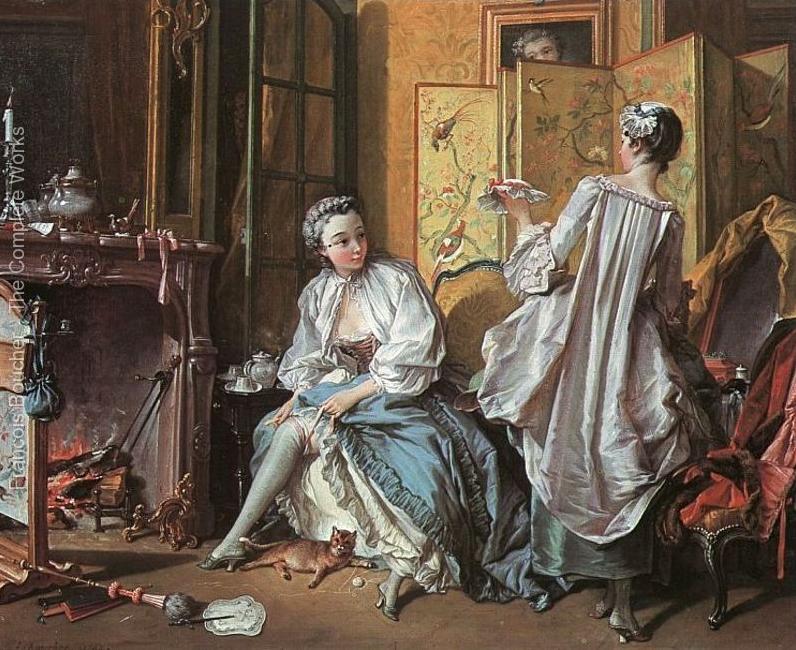
La Toilette, Boucher, 1742. Image@francoisboucher.org

Woman’s Fashions of the 18th Century fully describes the above painting by Boucher, in which the seated woman, probably a courtesan, is tying a garter over her stocking while wearing a short jacket to protect her outfit from particles of applied makeup and the powder on her wig. No visitors invade this intimate scene, which clearly shows a tray with refreshments and a decorative dressing screen behind the chair.

James Gillray portrays the progress of the toilet. Note the wash basin and water urn on the floor.

Women did use their dressing rooms at more intimate and private moments, when one presumed they would be alone. The washing of one’s face, feet and hands was a daily ritual, while bathing one’s entire body was not.  Such ablutions were done privately.  People would wash in basins. A portable hip bath would be placed in the dressing room if they decided to bathe completely.

Boilly, La Toilette Intime ou la Rose Effeuille. Image @Wikimedia Commons

While outhouses were common, the wealthy tended to use elaborate potty chairs (see image below). The French used bidets inside their dressing rooms, as shown in Boilly’s painting above. Invented by the French, their earliest recorded use was in 1710. If one wonders how women in elaborate costumes managed to go to the bathroom, this image by Boucher provides a glimpse. The handling of the bowl and upright posture was possible, for women during that era wore no underdrawers.

18th century Sheraton potty chair

Dressing rooms remained popular for a long time. In Can You Forgive Her?, Lady Glencora invites Alice Vavasor to have tea in her dressing-room, saying “You must be famished, I know. Then you can come down, or if you want to avoid two dressings you can sit over the fire up-stairs till dinner-time.” Alice follows Lady Glencora into the dressing-room, “and there found herself surrounded by an infinitude of feminine luxuries. The prettiest of tables were there;–the easiest of chairs;–the most costly of cabinets;–the quaintest of old china ornaments. It was bright with the gayest colours,–made pleasant to the eye with the binding of many books, having nymphs painted on the ceiling and little Cupids on the doors.” Lady Glencora goes on to explain, “I call it my dressing-room because in that way I can keep people out of it, but I have my brushes and soap in a little closet there, and my clothes,–my clothes are everywhere I suppose, only there are none of them here.”

Dressing room with chamber pot chair, 1765. Image@Morris Jumel House, Manhattan.

Anthony Trollope made an interesting point. During the 1860’s, when his novel was written, wealthy women changed their wardrobes more often for different functions during the day than Regency women. She invites Alice to linger in her dressing room, presumably to rest, read, and drink tea, rather than change into yet another set of clothes to join the company downstairs. Lady Glencora also indicates that the dressing room could also be a refuge away from visitors and prying eyes.

Jane Austen's bedroom. The closet with wash basin and potty sits to the left of the fireplace.

A wealthy couple might have two bedrooms (his and hers) with an adjoining sitting room. Each person would have their own dressing room. Simpler households did not have the luxury of such space. In Chawton Cottage, Jane Austen and her sister, Cassandra, shared one bedroom. Their potty and wash basin where stored in a closet.

Today’s walk in closets with adjoining bathroom most closely approximate the dressing room of yore, although people today do not tend to entertain their visitors in their closets.

Other posts on the topic:

Read Full Post »

« Newer Posts - Older Posts »