Feeds:
Posts
Comments

Archive for October, 2011

They say an image is worth a thousand words. This one, drawn in 1855, made me pause. It’s from Forrester’s Pictorial Miscellany for the Family Circle by Matthew Forrester.

French shepherd sitting on raised stool and stilts. Book illustration, pen drawing. Image @Wikimedia Commons

Here’s the accompanying text (p. 65-67):

The Shepherds of Les Bas Landes.

In the south-western part of France, bounded on the west by the Atlantic Ocean, and on the south by the Pyrenees, a chain of high mountains separating France from Spain, there is a large barren tract of land, that, from the number of its heaths, has conferred the title of Les Landes on the department to which it belongs. Being generally a level plain, intermixed with shrubs and swamps, it is naturally described as being the most desolate and dreary portion of France. A few spots, like the oases of the African deserts, are to be found at long intervals of space, and here only can rye be grown, the rest being a dreary waste, dotted with heath, firs, or cork trees.

The climate is very unhealthy, the heat in summer being scorching, and in winter the marshes are enveloped in dense fogs. From the « level nature of the land, and from the fact that a considerable portion of it is under water, the shepherds have recourse to stilts, and the dexterity which is manifested in their management has often elicited wonder and admiration from the passing traveller, who rarely meets with many traces of civilization. You will see a picture of one of these shepherds on the preceding page. There he sits from morning till night, knitting away, and watching his flock.

The shepherds in these parts are very careful of their flocks, whose docility is remarkable. Not less so is the good understanding between the sheep and the dogs. The celerity with which the shepherds draw their flocks around them is not more astonishing than the process by which they effect it is simple and beautiful. If they are at no great distance from him, he gives a peculiar whistle, and they leave off feeding, and obey the call; if they are afar off and scattered, he utters a shrill cry, and instantly the flocks are seen leaping over the swamps, and scampering towards him. When they have mustered around him, the shepherd sets off on his return to the cabin, or resting place he has secured, and the flock follow behind, like so many well-trained hounds.

Their fine looking dogs, a couple of which are generally attached to each flock, have nobler duties to perform than that of chasing the animals together, and biting the legs of stragglers. To their protection is confided the flock from the predatory expeditions of wolves and bears, against whose approach they are continually on the watch, and to whom they at once offer battle. So well aware are the sheep of the fatherly care of these dogs, and that they themselves have nothing to fear from them, that they crowd around them as if they really sought their protection, and dogs and sheep may be seen resting together in perfect harmony. Thus habituated to scenes of such gentleness and magnanimity, the shepherds themselves are brave, generous, and humane, and though, as may be imagined, for the most part plunged in the deepest ignorance, are highly sensitive among themselves to the slightest dereliction from the strict paths of true morality.

Given this bucolic description, would the shepherd’s heart be torn asunder once his sheep were ripped from his protection and driven to market?

Read Full Post »

Gentle Readers, Laurel Ann Nattress from Austenprose has edited a splendid new book, Jane Austen Made Me Do It, which will be released tomorrow. In honor of that event, she has begun a Grant Blog tour. Please visit my other blog, Jane Austen Today, and leave your comment if you would like to win a copy. The following authors contributed their stories:

Pamela Aidan • Elizabeth Aston • Brenna Aubrey • Stephanie Barron • Carrie Bebris • Jo Beverley • Diana Birchall • Frank Delaney & Diane Meier • Monica Fairview • Amanda Grange • Syrie James • Janet Mullany • Jane Odiwe • Beth Pattillo • Alexandra Potter • Myretta Robens • Jane Rubino & Caitlen Rubino Bradway • Maya Slater • Margaret Sullivan • Adriana Trigiani • Laurie Viera Rigler • Lauren Willig

Such fun! Click here to leave your comment. Contest is open to residents of Canada and the United States. The drawing, by random number generator, will be held on October 15th.

Read Full Post »

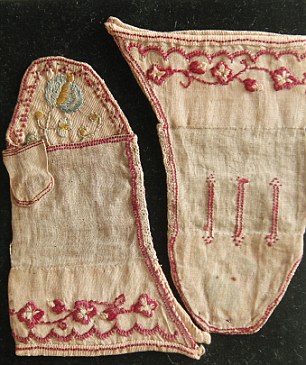
Princess Charlotte's embroidered linen mittens

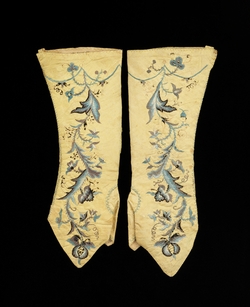
Among the fashion items in Kensington Palace are a pair of hand-embroidered mittens owned by Princess Charlotte, daughter of George 1V and Caroline of Brunswick  (the Princess Diana of her day) who died tragically young in 1817 while in childbirth. Read more: Mail Online

Silk 18th C. mittens. Image @Metropolitan Museum

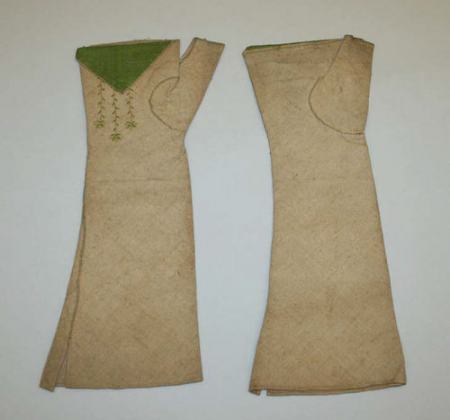
Your average 18th century mitt would have a thumb (or rather half a thumb), but not have any other fingers. It would sometimes extend not just over the hand but over part of the fingers as well. This meant that it would keep you warm (or protected from the sun in the summer) but not hinder your movements at all. You could do things like write, draw or do needlework with mitts on. And combined with a muff, they were quite enough even for venturing outside in the winter.” – Mitts & Fingerless Gloves

18th century mittens. Image @Metropolitan Museum of Art

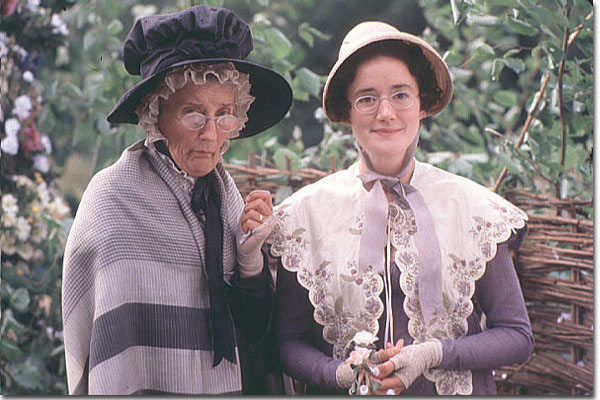
Mrs. Bates and Miss Bates wearing lacy mitt gloves

Read Full Post »

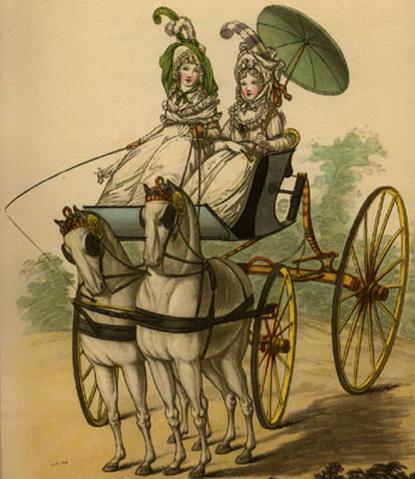
High Perch Phaeton

Gentle readers, Patty of Brandy Parfums is an avid fan of history, horses, Jane Austen, and Georgette Heyer. She is also a devoted reader of this blog.  Just recently she wrote ‘Georgette Heyer for Horse Lovers’ for the October issue of Horse Directory Magazine. Patty has graciously allowed me to reproduce her article for Jane Austen’s World.

Walnut Hill Driving Competition, the largest driving competition in North America held each August in Pittsford NY, has no speed classes for high-perch phaetons. They tip over too easily to be safe. Yet in the colorful, elegant world of English author Georgette Heyer’s romance novels, many with references to horses, intrepid heros and heroines drive these carriages around corners at high speeds without tipping over.

Georgette Heyer published her first novel in 1921, when she was nineteen, and went on to write over fifty novels. She was especially known for her witty Regency romance novels, and was widely copied and imitated. If you have never heard of her, it is because after a badly made movie based on one of her novels, The Reluctant Widow, came out in 1951, Heyer put in her will that she did not want any other of her books turned into movies.

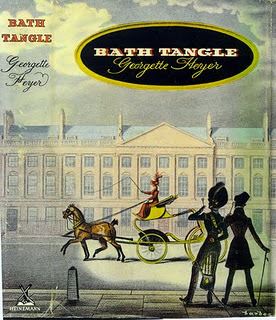
In Heyer’s Bath Tangle, Major Hector Kirkby questions Lady Serena Carlow about her choice of a high-perch phaeton with its “bottom five feet from the ground” and pair of horses. Major Kirkby says –

‘Serena,-my dearest! I beg you won’t! I know you are an excellent whip, but could you not have a more dangerous carriage!’

‘No! If I were not an excellent whip!…….The difficulty of driving them is what lends a spice!’

Cover of Bath Tangle by Heyer's favorite cover artist, Arthur Barbosa

The Heyer heros and heroines, who are skilled equestrians known as bruising riders, ride horses they treasure, like Maid Marion that Lady Serena rides in Bath Tangle.

By Jove, Lady Serena, you’re a devil to go!’ Mr. Goring exclaimed, in involuntary admiration. She laughed, leaning forward to pat the mare’s steaming neck. ‘I like a slapping pace, don’t you?’

‘I should have called it a splitting pace!’ he retorted…..’My heart was in my mouth when you rode straight for that drop fence!’

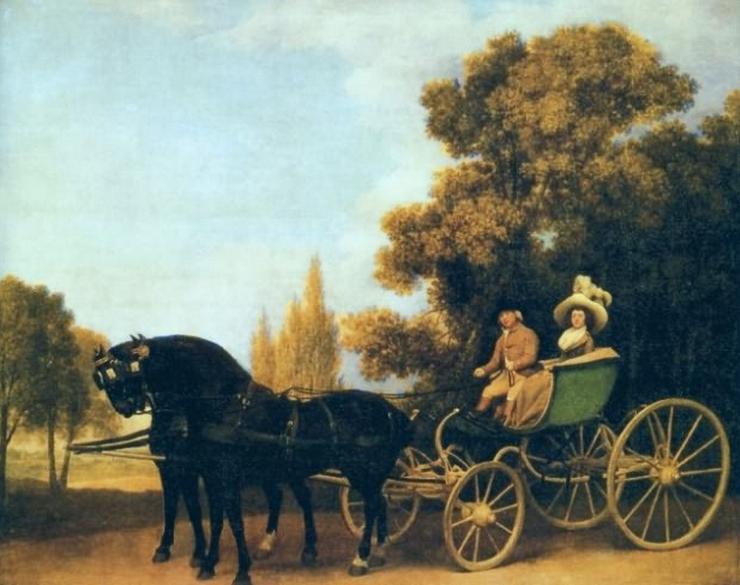
The more stable crane necked phaeton with smaller wheels

Because Heyer’s novels take place when horses were used for transportation, carriages and coaches breakdown in many of her books. In The Corinthian, there is little horse activity in the beginning except a coach breaking down, but the hero, Sir Richard Wyndham, a bored bachelor and renowned whip, is sure to get into action at some point in the story. Sir Richard (Ricky) asks his friend, the Honourable Cedric (Ceddie).

Ceddie, were you driving your own horses yesterday?’

‘Dear old boy, of course I was, but what has that to say to anything?’

‘I want ’em,’ said Sir Richard………I must have a fast pair immediately.’

My favorite Heyer novel so far for horseyness is The Quiet Gentleman, a Regency romance and mystery of sorts, with Gervase Frant, the Earl of St Erth, a subdued dandy returning home from military duties at Waterloo. Mr. Warboys says –

‘……..that’s a devilish good-looking hunter you have there, St Erth! Great rump and hocks! Splendid shoulders! Not an inch above fifteen-three, I’ll swear! The very thing for this country!’

‘Oh, he is the loveliest creature!’ Marianne said, patting Cloud’s neck. He makes no objection to carrying me in this absurd fashion: I am sure he must be the best-mannered horse in the world!’

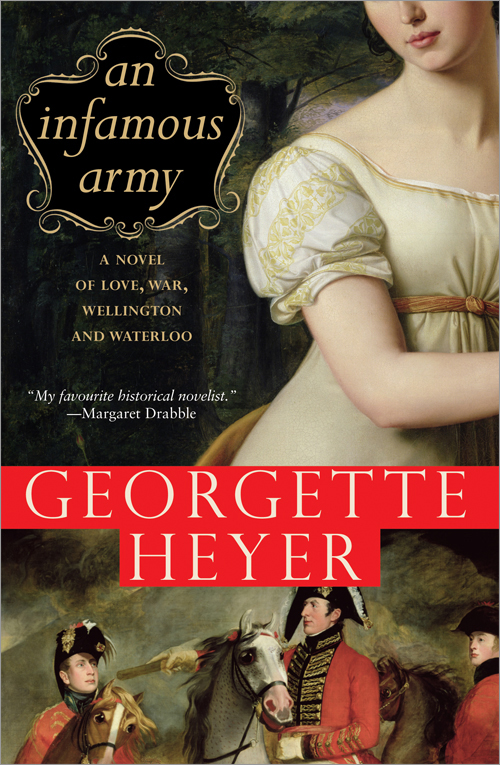
Cover of Infamous Army with horse. Image@Sourcebooks

Georgette Heyer wrote her romance novels over a period of many years and they were always best sellers even during WWII in England, when their lively, entertaining content helped people forget their misery. Heyer also wrote mysteries, and more serious historical fiction like the superb An Infamous Army, which takes place in Brussels in 1815 during the time of Waterloo. Infantry and calvary movements are so accurately described that this book is required reading at Sandhurst.

Other horsey and just plain amusing novels recommended include The Masqueraders, False Colors, Arabella, Sylvester or the Wicked Uncle and The Grand Sophy, a work unfortunately marred by the appearance of a cliché moneylender.  Sourcebooks has reissued many of Heyer’s fifty novels and they are proving quite popular – a wonderful diversion for our uncertain times.

More on the topic:

This is the first video of the film, The Reluctant Widow. Only 9 of the 10 videos are featured. Have no fear, this 1951 film is so badly made that you will probably not make it that far. Click on this link to access it.

Read Full Post »

Four YouTube videos feature the recipes of Mrs. Beeton and her story in a BBC2 show, The Marvellous Mrs. Beeton, hosted by Sophie Dahl. Check the first of four videos here, then find the other videos in YouTube’s sidebar.

Edwardian Promenade lists these videos in its YouTube account. (A visit to the site is well worth your time.) Thank you, Karen Reedy-Wilcox, for pointing out these videos.

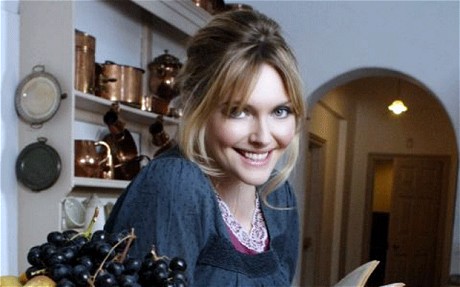
Sophie Dahl, hostess and narrator of this show.

Read Full Post »

« Newer Posts - Older Posts »