Amongst herbs to be eaten I find gourds, cucumbers, coleworts, melons disallowed, but especially cabbage. It causeth trouble-some dreams and sends up black vapours to the brain . . .” – Richard Burton, 16th century
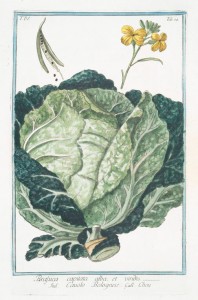
Cabbage was first introduced in Great Britain by the Romans. In ancient times the Greeks revered it for its medicinal qualities, and it was well known in the Mediterranean region, where it spread out to other parts of Europe. The vegetable was cultivated as food for man and cattle and consumed mainly by the poor, for this hardy plant could be grown in the vegetable garden in temperate climates for long periods and harvested into early winter. White cabbage, used for boiling, braising, and stewing, was distinguished from the red cabbage, which was mostly used for pickling. From the 14th century and on, European peasants consumed cabbage in the form of soups and stews, which nourished them through the long winter months. It wasn’t until the 18th century that cabbages began to make their appearance on more aristocratic tables.
Cabbage’s long lasting quality made it a valuable and nutritious vegetable staple for long sea voyages. One imagines that Jane Austen’s sailor brothers ate a great deal of cabbage while sailing.
In his journal for July 1772, Cook gives the following account of the provisions placed aboard the Resolution and Adventure…Biscuit, flour, salt beef, salt pork, beer, wine, spirit [distilled alcohol], pease [dried peas], wheat, oatmeal, butter, cheese [hard], sugar, oyle olive [olive oil], vinegar, suet, raisins, salt, malt, sour krout [sauerkrout], salted cabbage, portable broth [dessicated soup], saloup, mustard, mermalade [marmelade] of carrots, water…” – Sailors & Sauerkraut: Excerpts from the Journals of Captain Cook’s Expeditions All Pertaining to Food With Recipes to Match, Barbara Burkhardt, Barrie Andugs McLean & Doris Kochanek [Grey’s Publishing:Sidney BC] 1978 (p. 23)- The Food Timeline
High in vitamin c and anti-inflammatory properties, this cruciferous vegetable was not only nutritious and helped to fight scurvy, but an apocryphal story states that during Captain Cook’s first voyage, members of his crew were saved from gangrene by doctors who applied poultices of cabbage to their patients’ wounds.
At the time, cabbage was called a ‘cabbage cole’ or ‘colewort. ‘By the mid eighteenth century, an array of different cabbages was grown, and as one anonymous writer put it:
‘There various Kinds of this Plant are endless to describe_’ The common White Cabbage, Sugarloaf, Pontefract, Battersea, Red Cabbage, and the green and White Savoy Cabbage’ [Anon (1744)].
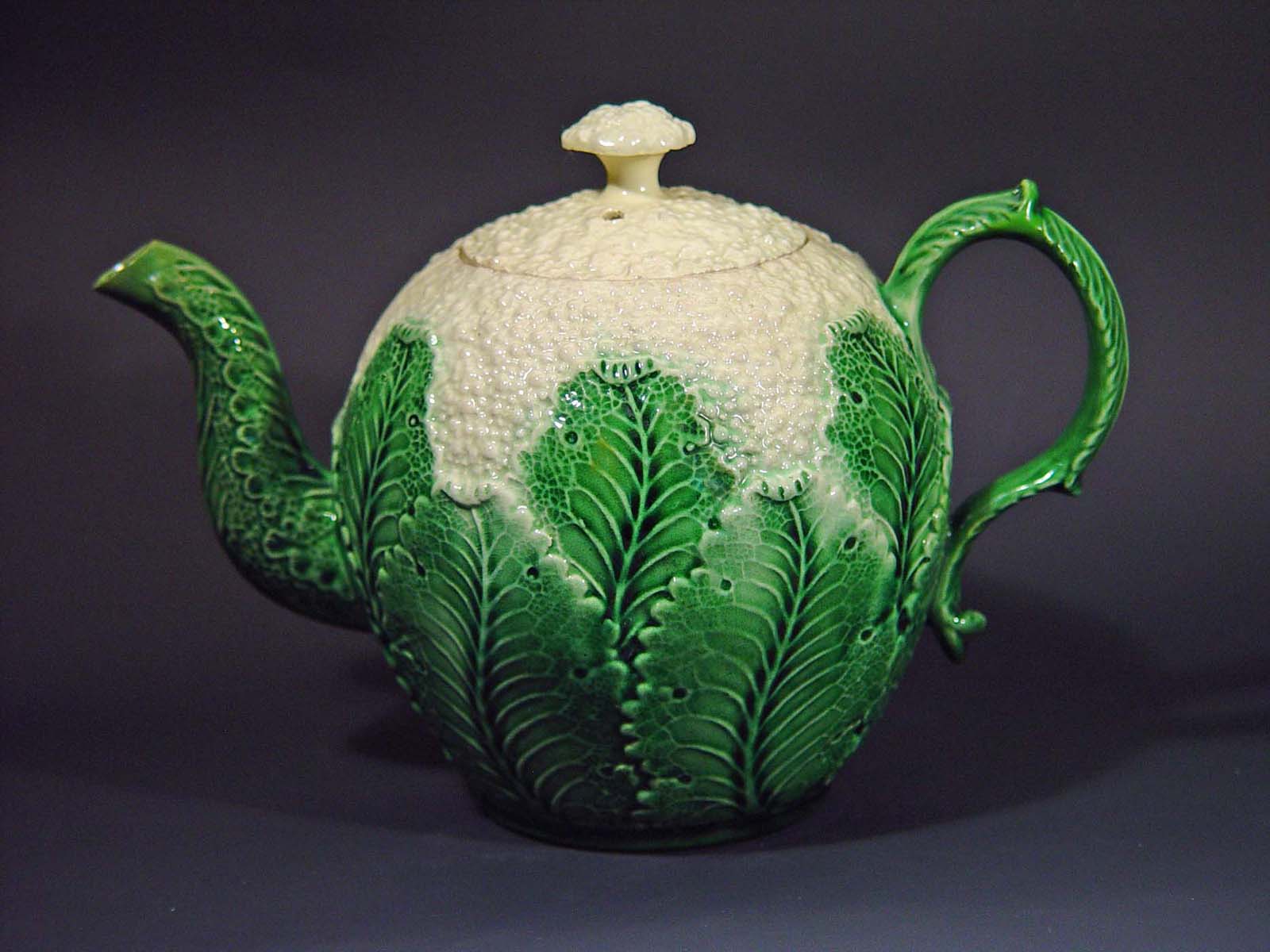
1770 creamware teapot. Image @Earle D. Vandekar of Knightsbridge
Cabbages were grown in family gardens in raised beds, near the door for easy picking, and protected from damaging winds by a fence or hedge and mulch. Recipes for cooking cabbage were included in early cookery books, however, one defies the modern cook to be able to follow Hannah Glasse’s charming recipe for beans ragoo’-d with a cabbage (at least I would have a difficult time.)
TAKE a nice little cabbage, about as big as a pint bacon ; when the outside leaves, top, and stalks are cut off, half boil it, out a hole in the middle pretty big, take what you cut out and chop it very fine, with a sew of the beans boiled, a carrot boiled and mashed, and a turnip boiled, mash all together, put them, into’a sauce-pan, season them with, pepper, salt, and nutmeg, a good piece of butter, stew them a few minutes over the fire, stirring the pan often. In the mean time put the cabbage into a sauce-pan but take great care it does not fall to pieces; put to it four spoonsfuls of water, two of wine, and one of catchup ; have a spoonful of mushroom-pickle, a piece of butter rolled in a little flour, a very little pepper, cover it close, and let it stew softly till it is tender; then take it up carefully and lay it in the middle of the dish, pour your mashed roots in the middle to fill it up high, and your ragoo round it. You may add the liquor the cabbage was stewed in, and send it to table hot. This will do for a top, bottom, middle, or side-dish. When beans are not to be had, you may cut carrots and turnips into little slices, and fry them; the carrots in little round slices, the turnips in pieces about two inches long, and as thick as one’s finger, and toss them up in the ragoo.
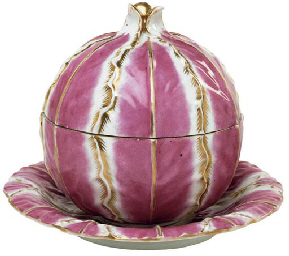
Cabbage tureen, mid-19th century Jacob Petit Porcelain. Image @Christie's
By 1773 the cultivation of cabbage in England was sufficiently commercialized to make it a criminal offence to steal or damage growing crops of cabbage, whose price had dropped by half since the 1730s. Chefs and cooks used cabbage to make ragout and pudding, or stuff it with meat. In the 16th and 17th centuries warm milk was added to make cabbage cream that was left to mature before being presented at dinner tables.
Red cabbage was prepared and sold as a pickle. Newspapers advertised the sale of cabbage seed, where it was defined as flat sided, green savoy, hellow (probably a misprint for yellow) red, Russia, sugar loaf, turnip, yellow savoy and Yorkshire. (Simone Clarke – British History Online.)
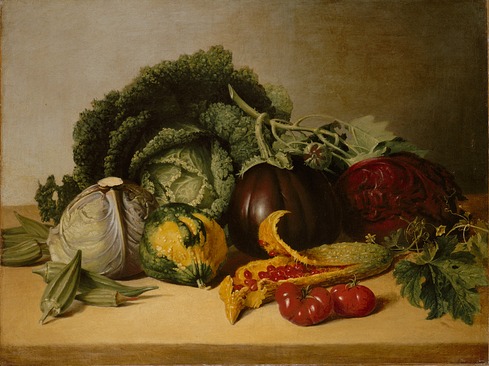
Still life with cabbage, James Peale
“The time has come…to talk of many things: Of shoes–and ships–and sealing wax–of cabbages–and kings–And why the sea is boiling hot–And whether pigs have wings.” – Lewis Carroll
Mrs. Beeton’s STEWED RED CABBAGE (19th century)
INGREDIENTS – 1 red cabbage, a small slice of ham, 1/2 oz. of fresh butter, 1 pint of weak stock or broth, 1 gill of vinegar, salt and pepper to taste, 1 tablespoonful of pounded sugar.
Mode.—Cut the cabbage into very thin slices, put it into a stewpan, with the ham cut in dice, the butter, 1/2 pint of stock, and the vinegar; cover the pan closely, and let it stew for 1 hour. When it is very tender, add the remainder of the stock, a seasoning of salt and pepper, and the pounded sugar; mix all well together, stir over the fire until nearly all the liquor is dried away, and serve. Fried sausages are usually sent to table with this dish: they should be laid round and on the cabbage, as a garnish.
Time.—Rather more than 1 hour. Average cost, 4d. each.
Sufficient for 4 persons.
Seasonable from September to January.
Hannah Glasse’s 18th century Recipe for Pickled Red Cabbage declares this dish to be useful only for garnish:
To pickle red-cabhage.
SLICE the cabbage thin, put to it vinegar and salt, and an ounce of all-spice cold ; cover it close, and keep it fer use. It is a pickle of little use but for garnishing of dishes, sallads, and pickles, though some people are fond of it.
Years ago, my then husband and I spent an outrageous sum of money eating Bubble and Squeak at a chichi Mayfair restaurant in London. Imagine my surprise when I discovered that this costly (to us) side dish consisted of the humble potato and cabbage, a dish invented by Maria Rundell in 1806.
Maria Rundell’s recipe for Bubble and Squeak.
Boil, chop, and fry, with a little butter, pepper, and salt, some cabbage, and lay on it slices of rare done beef, lightly fried.
In both the following receipts, the roots must be taken off the tongue before salted. – A new system of domestic cookery: formed upon principles of economy, and adapted to the use of private families, Maria Eliza Ketelby Rundell, 1808
- Modern Bubble and Squeak Recipe







 Jane Austen's World
Delightful reading! We haven’t had bubble and squeak for ages! Thanks for the inspiration, along with your study on the uses of cabbages (with or without kings).
Rose
Wow. I never imagined what could be done with a simply cabbage! I love the authentic cooking instructions, and, yes, I would be hard put to follow those directions. Thanks for the great information!
Interesting reading. Thanks Vic!
Very timely, as cabbage salad has been in our fridge on regular rotation these winter months. Far from stewing it, though, I keep the crunch by just slicing, then tossing with raisins, chopped almonds, caraway, and salad dressing. Thanks for the fun look at cabbages past!
As someone who is of 100% Irish descent, I have eaten my share of cabbage. We had it at least once a week with potatoes and a ham bone thrown in for flavor. I preferred it to the turnips. :)
I enjoyed this article, so many things you can do with cabbage. We also had boiled dinner frequently while growing up and that was one of my favorites!