Feeds:
Posts
Comments

Archive for January, 2012

(Hint: for quicker download, click on title of this article.) As viewers of Downton Abbey, we think we have gotten to know Highclere Castle and its setting well.  Sir Barry remodelled Highclere Castle for the third earl of Carnarvon from 1839 to 1842. The architect had just finished building the Houses of Parliament. The house once looked quite different and was Georgian in feature, as this image shows.

highclere-castle-in-the-18th-century

Extensive renovations were made during the late 18th and early 19th centuries. In the mid-19th century, Henry, the 3rd earl of Carnarvon, transformed the house into a grand mansion with 60- 80 bedrooms (the sum varies according to the source) and over 120,000 square feet. The staircase, also designed by Thomas Allom, sits in the tower designed by Charles Barry.

Highclere Castle after renovation

Highclere Castle after renovation. Sir Charles Barry’s renovation was in the “High Elizabethan” style. The building was faced in Bath stone.

The Architectural Design

Architectural design for the tower of Downton Abbey by Sir Charles Barry, 1842. Image@Christie’s

The BBC said about Barry’s Houses of Parliament:

A good example of the period’s confused love affair with the past, it was summed up earlier this century as classic in inspiration, Gothic in detailing, and carried out with scrupulous adherence to the architectural detail of the Tudor period. – BBC, A British History of Architecture

This description can easily be applied to Highclere Castle with its whimsical look back to Tudor times.

The term “Jacobethan” refers to the Victorian revival of English architecture of the late 16th century and early 17th century, when Tudor architecture was being challenged by newly arrived Renaissance influences. During the 19th century there was a huge Renaissance revival movement, of which Sir Charles Barry was a great exponent – Barry described the style of Highclere as “Anglo-Italian”.[3] – Wikipedia

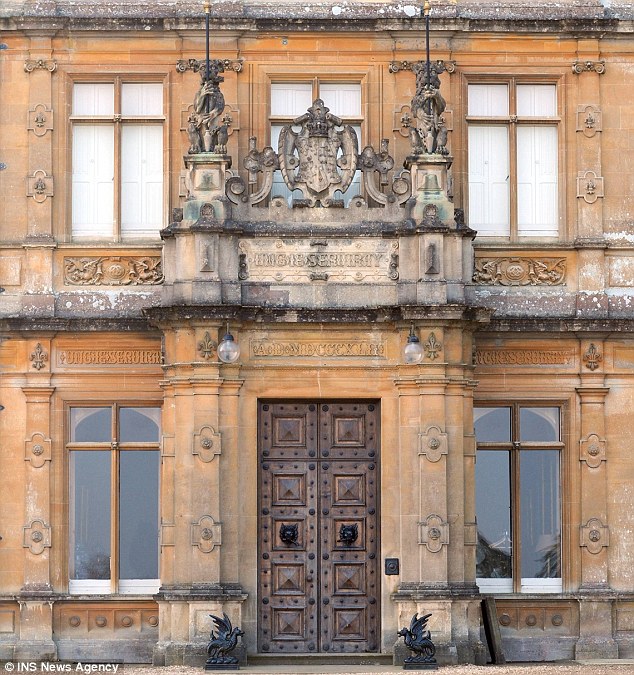
The Facade and Front Door

The front door

Many visitors come to this blog looking for a floor plan of Highclere Castle. This one depicted below sits on the Highclere Castle website and is a bit hard to read. Not all the rooms are currently in use, and a number, such as the music room, are available to be rented as conference rooms.

The House Plan

In the television series, the servant quarters and kitchens were not filmed at the Castle, but were constructed at Ealing studios in West London.

From The Victorian Country House by Mark Girouard.

Entrance Hall and Saloon

stairs and hall

Stairs and hall

Red stairs birds eye view

Red stairs birds eye view

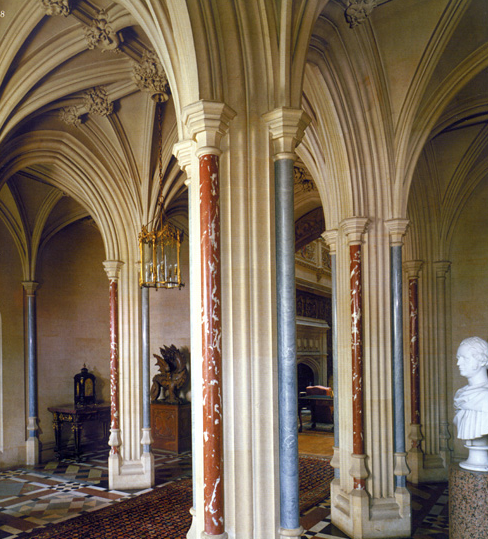
Pillars

Pillars

Passage above saloon leading to the bedrooms

Interior of Highclere Castle

Saloon from gallery above. The room was designed by Thomas Allom and completed in the 1860s.

Saloon seating space Picture by Paul Hilton ©

Saloon seating space Picture by Paul Hilton ©

Salloon

Saloon

Detail of saloon ceiling

Detail of saloon ceiling

The Music Room

Music room

Music room

Music room

These days the music room is available as a conference room.*

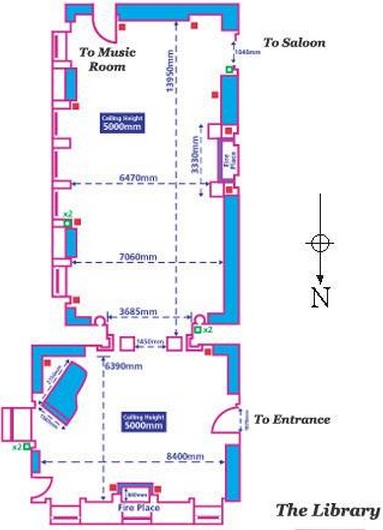
The Library

Double library

Double library with coffered celings holds over 5,000 books.

Comfortable seating within the library

Comfortable seating within the library

The library is unusual in that it consists of a two part room. The opening between the two areas is featured by columns. This room is also available to rent as a conference room.*

The Drawing Room

The drawing room image @Boston Globe. The drawing room was designed by Almina, the 5th Countess of Carnarvon,  in the "rococo revival" style .

The drawing room image @Boston Globe. The drawing room was designed by Almina, the 5th Countess of Carnarvon, in the “rococo revival” style .

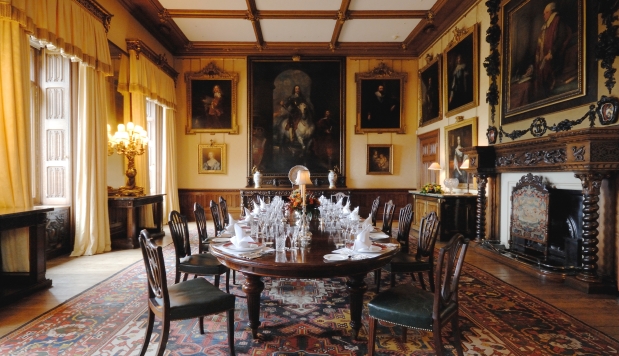
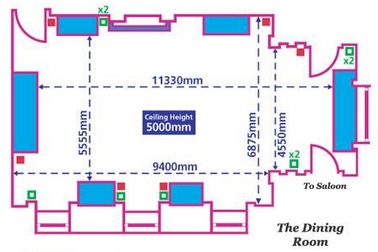
The Dining Room

Much drama is centered in the dining room. The actors often took days to film a scene, and it was quite a feat to keep the food looking fresh and to maintain continuity in both the drinking glasses and on the plates. Read Downton Abbey: Dining in Splendor for more information.

The dining room

The dining room

diningroom-highclere

Image @Conferences UK

Bedrooms

Modern bedroom

Renovated bedroom

One of the bedrooms in need of renovation. Image @Daily Mail

One of the bedrooms in need of renovation. Image @Daily Mail

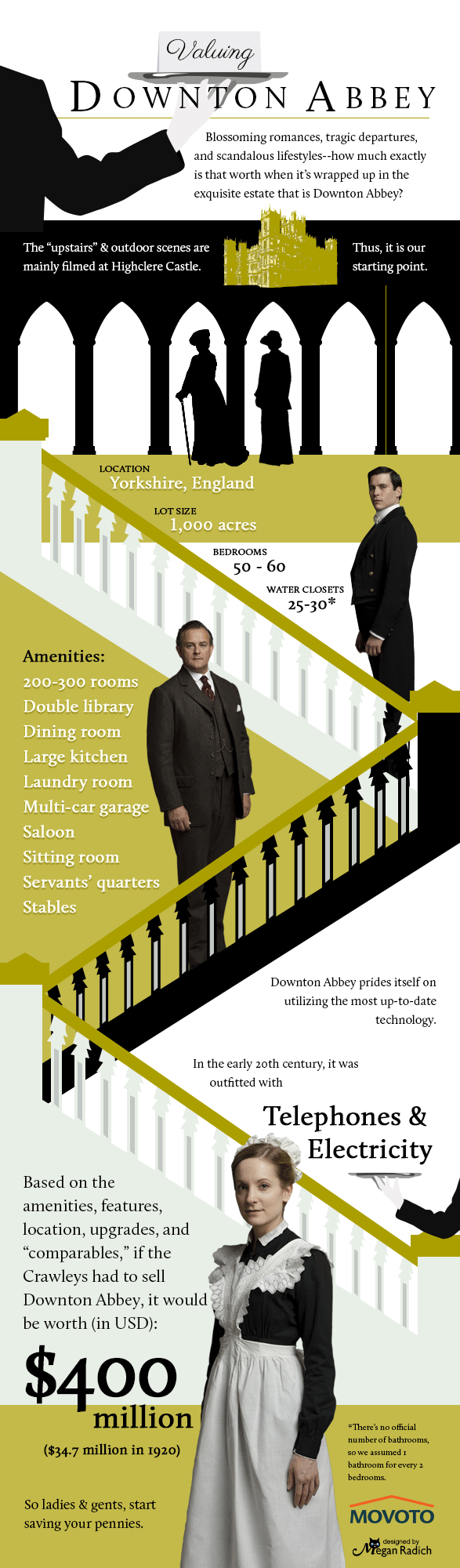
This image on Huffington Post shows more details about Downton Abbey/Highclere Castle and values the mansion:

valuingdowntonabbey

More on the topic:

Read Full Post »

We’ve heard the term, “Behind the green baize doors”, but what exactly does it mean? You hear this reference most often in regard to servants and in old books.

Baize was a sturdy green cloth attached to a swing door.  The insulating fabric prevented noises from disturbing the individuals on either side:

The ‘Green Baize Door’ was the dividing line between the two domains, and trespassing beyond meant going into foreign territory. The ‘Green Baize Door’ was a feature of almost every substantial house. It was generally an ordinary framed door onto which was tacked a green baize cloth, usually with brass tacks. It was the universal signal of the dividing line between the two halves of the house.The Bull children would not be tolerated by the servants in the domestic part of the house unless they were working under supervision. This was like walking into somebody else’s house. The servants would normally use a different route to get to the various parts of the house, and would aim to be seen as little as possible. This was not because they were considered beneath notice: on the contrary, it was so that they could do their work uninterrupted by the requirement to exchange civilities. Houses evolved so that domestic staff could go about their task without interruption, not to ensure the privacy of the residents. They had none. –Borley Rectory and the Green-Baize DoorDomestic life at Borley Rectory, by Andrew Clarke copyright 2002

Image @Chest of Books

The brass-headed tacks holding the cloth down could sometimes be arranged in a decorative design. The cloth not only deadened sound but also absorbed kitchen odors. Green baize doors became popular during the mid-Eighteenth century, so Jane Austen must have been aware of the practice, which was more and more used as the 19th century progressed. During Victorian times the practice of sound proofing doors with baize was quite common. The cloth could also be used to insulate nursery room doors, bedroom doors, and doors leading to studies or any place where sound needed to be muffled.

It was a time when housemaids were taught to turn their face to the wall if they should pass their employer on the stairs. For whose protection? one wonders. The era of Squire Allworthy and Sir Roger de Coverley had long passed, when relations between master and man were more informal. – The green baize door: social identity in Wodehouse; Part two – Allan Ramsay 

Early 19th century mahogany desk with baize lining**

Baize (or bayes), also known as a bocking flannel,  was a coarse wool or cotton material, which had a felt-like texture:

“In Europe, baize was used mainly for case, cabinet and closet linings, as well as furniture coverings. Clothing baize was used for monk and nun habits as well as soldier’s uniforms. In the North American Native market, the term baize frequently alludes to inexpensive coarse broadcloth. – Wool Trade Cloth 

Baize dates back to the 16th century, 1525 to be precise. A mid-17th century English ditty about the history of ale and beer brewing, mentions “bays”:

Hops, heresies, bays, and beer;
Came into England all in one year.

“Heresies refers to the Protestant Reformation, while bays is the Elizabethan spelling for baize. – Good English Ale 

Baize scrap from the Titanic. Image @Online Titanic Museum*

Baize was used in a number of ways, including as a protective cover for gaming tables, for the nap of the cloth increased friction, preventing cards from sliding and slowing billiard or snooker balls.  The cloth is available in a variety of naps. Roman Catholic churches used red or green baize for altar cloth protectors, and the cloth was used in museum cases and desks as well.

St. Jerome in his study

As previously mentioned, baize was also used for clothing.

“I would recommend to you the Green Baize Gown, and if that will not answer, You recollect the Bear Skin.” Letter from Abigail Adams to John Adams, 3 December 1788

The site for Knox Family Clothing mentioned mid-18th century receipts for baize and bayes,  as well as rattinet, armozeen, dowles, buff battinet, flannel, linen, silk, and velvet.

In Practical Cooking and Dinner Giving, published in 1876, Mary Foote Henderson recommends:

“Put a thick baize under the table-cloth. This is quite indispensable. It prevents noise, and the finest and handsomest table – linen looks comparatively thin and sleazy on a bare table.”  

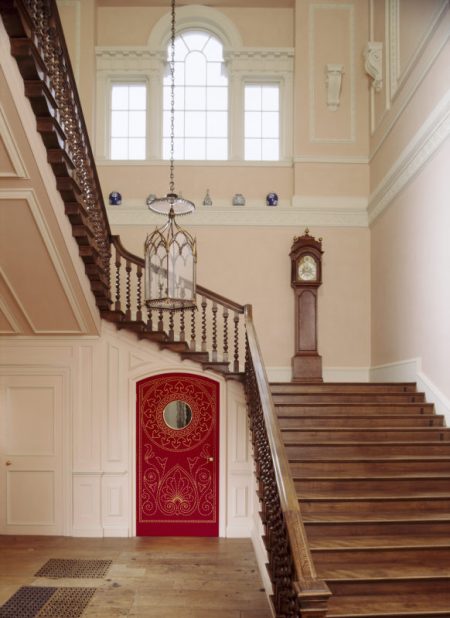
The Staircase Hall at Uppark. The red baize door leads to the servants' quarters. ©NTPL/Geoffrey Frosh

Red baize was also used as insulating material, as the decorative door at Uppark (image above) indicated. (National Treasure Hunt, National Trust Collections) In this advertisement for an 1808 Georgian house for sale, a red baize door to the inner lobby is featured. The red baize servant door providing access to the inner lobby and the kitchen, rear reception and breakfast room. 1808 house

More on the topic:

Read Full Post »

It’s rare that I purchase a Jane Austen sequel. Generally, publishers will send books for review or I’ll pick up a copy at the library. When Death Comes to Pemberley was announced I did not hesitate to purchase a copy for my Kindle. P.D. James, the book’s author, is a highly regarded mystery writer with a solid record for selling mystery books to discerning mystery fans. (The book placed third on the NY Times best seller list this weekend.)

A good friend of mine, whose judgment I value, owns every single P.D. James novel and was overall satisfied with this novel. I had never read a P.D. James novel before, and she was curious to know what I thought of this book. Another Janeite friend had read it and remarked that it was very well done and followed the forensic detective work of its time. They waited to discuss the book with me until after I had finished reading it and could give my opinion. Last weekend the three of us came to the same conclusion, which was that the mystery was weak and a bit lame, and that the actual murderer was so preposterous as to be unbelievable. My question to them was: “Why would a famous author like P.D. James waste her time writing a Jane Austen sequel, especially if the mystery was less than sterling?” Both defended her decision to write this book, while I was not particularly swayed. Both were ecstatic that she had written one more book, for they fear that their author, being 90+ years old, might not have too many novels left to write. To that I said she shouldn’t have bothered.

My suspicion is that had P.D. James been an unknown author peddling her manuscript for the first time to publishers and agents, Death Comes to Pemberley would have been tossed on the slush pile and she would have received a slew of the rejection letters,  one of which might have looked like this:

Dear Ms. P.D. James,

Thank you for your submission of Death Comes to Pemberley, which we read with interest, for your writing style is quite extraordinary. I’m sorry to say that  our interest in your manuscript was killed by its long talky scenes and sparseness of  mystery plot. I don’t need to hear about the crime from potential witnesses, then learn the same information during the inquiry and then again during the trial.

You will need to solve a major  problem with the plot by writing the denouement towards the end of the story, rather than 2/3 of the way through.  After I discovered who the murderer was, I frankly did not care to sift through another five chapters so that you could tie up loose plot threads. Let me make a few suggestions for improvement before you send the manuscript on to others:

1. Check your facts. In the first chapter on the first page you referred to Mr. Collins as Mr. Bennet’s nephew. He is Mr. Bennet’s cousin.  I almost stopped reading the book right then, for the mistake and others made me wary of the quality of your research or understanding of Pride and Prejudice and its characters.

2. Show don’t tell. Yes, I understand that this is a Jane Austen sequel and that you are working with familiar characters, but you slowed your plot to a crawl with your reams of exposition at the start of the novel and, strangely, at the end. Also, your men were too talky. While I appreciate the fact that they might have spoken more formally two hundred years ago, men don’t as a general rule talk in long unbroken sentences, especially to each other.

3. Write an original novel with your own characters. Whenever you deviated from Mr. Darcy and Elizabeth and other Pride and Prejudice characters, your novel jumped to life.

Sincerely, Vic @Jane Austen’s World

Death Comes to Pemberley is yet another instance of a famous author joining the Jane Austen bandwagon. Some of you might remember Colleen McCullough jumping into the fray with her detestable The Independence of Mary Bennet, which must have garnered riches for the publisher before readers caught on. (Read my review here.) These two best-selling authors, while they rightly have earned their literary reputations, fell down in my opinion when they so cynically wrote novels that, to put it kindly, barely scraped bottom when compared to Jane Austen’s own brilliant work. Besides, what business had they to write a Jane Austen sequel? Do they really think it is all that easy?

The career of a Jane Austen sequel writer is not an easy one. Most write their books out of love for Jane Austen and her characters. Those that I have come to know through correspondence are earnest about their desire to continue Jane’s stories. They work hard for very little recompense. Unless a publisher anticipates a blockbuster novel (such as Pride and Prejudice and Zombies, a concept novel if ever there was one), most provide book advances that barely cover the cost for postage or time spent researching a topic. Once upon a time book publishers, editors, and agents invested in long-term relationships with new authors, building their reputations up slowly and giving them time to develop their talents.

Image @New Yorker

This is no longer the case. A writer has only two or three years to make money back for the publisher.*(See Laurel Ann’s comments below.)  That is a lot of pressure, considering that royalties on the published price of trade books ranging from 10%-12.5% and on paperbacks from 7.5% to 10%. Many first time authors fail to realize any profit on their books. The average first novel sells around 2,000 – 4,000 books, but the break even for publishers is around 5,000 books. Four out of five first novels fail to make money for the publisher. Authors might only earn the total amount of their advance, minus the cost of extra copies of books they have purchased for giveaways and bookmarks, and the loss of spare time as they visit book stores, libraries, reading clubs, and groups and attend conferences all over creation in order to publicize their books will never be made up. These days authors are expected to oversee their own blog, and a Facebook and twitter account as well. Many spend hours writing down answers to interview questions or being interviewed online.

As readers you will notice a big push for books several times a year, when many new titles are competing with each other. Before the holiday season this year, P.D. James received an automatic “in” from most of the major book critics; she received extremely kind reviews in my estimation. It’s almost as if even the most discerning critics didn’t bother to read her entire book. The ordinary sequel writer gets no such first-class treatment. Their eyes are glued on Amazon’s rankings, hoping they will break free from the midlist and sell enough volumes to give them a second contract for another book.

One author I talked to said she made almost no income from writing; another said she was unlikely to collect royalties this year. Another author, who lives in my city, was dropped by her publisher despite glowing reviews, only to be picked up by another publisher. For these authors, their writing careers must seem like an unpredictable roller coaster ride.

While I am not a great fan of Jane Austen sequels and prequels, I do salute these writers, who follow their passion. Many have written a truly enjoyable story that I can wholeheartedly promote. I can’t exactly say the same of Death Comes to Pemberley. Sorry Ms. James, but I give this book only 2 out of 5 regency tea cups.

For more information about the life of a writer, read The New Literary Lottery. This NY Magazine article by Alex Williams is a bit dated, but fascinating.


Read Full Post »

This Sunday, PBS will air on most stations an hour presentation of  Secrets of the Manor House, a documentary narrated by Samuel West, that explains how society was transformed in the years leading up to World War One. Expert historians, such as Lawrence James and Dr. Elisabeth Kehoe, discuss what life was like in these houses, explain the hierarchy of the British establishment, and provide historical and social context for viewers. For American viewers of Downton Abbey, this special couldn’t have come at a better time.

The British manor house represented a world of privilege, grace, dignity and power.

For their services for the King in war, soldiers were awarded lands and titles. The aristocracy rose from a warrior class.

This world was inhabited by an elite class of people who were descended from a line of professional fighting men, whose titles and land were bestowed on them by a grateful king.

Manderston House, Berwickshire.

For over a thousand years, aristocrats viewed themselves as a race apart, their power and wealth predicated on titles, landed wealth, and political standing.

Huge tracts of lands with fields, villages, laborers' cottages, and forests surrounded country estates.

Vast landed estates were their domain, where a strict hierarchy of class was followed above stairs as well as below it. In 1912, 1 ½ million servants tended to the needs of their masters. As many as 100 would be employed as butler, housekeeper, house maids, kitchen maids, footmen, valets, cooks, grooms, chauffeurs, forestry men, and agricultural workers. Tradition kept everyone in line, and deference and obedience to your betters were expected (and given).

22 staff were required to run Manderston House, which employed 100 servants, many of whom worked in the gardens, fields, and forests.

As a new century began, the divide between rich and poor was tremendous. While the rich threw more extravagant parties and lived lavish lives, the poor were doomed to live lives of servitude and hard work.

Lord Palmer pulls on a false bookcase to open a passage to the next room.

Manderston House in Berwickshire represents the excesses of its time. The great house consists of 109 rooms, and employed 98 servants just before the outbreak of World War One. Twenty two servants worked inside the house to tend to Lord Palmer and his family. Every room inside the house interconnected.

The curtains in the ballroom of Manderston House look as fresh as the year they were made in 1904.

The curtains and drapes, woven with gold and silver thread, were made in Paris in 1904 and cost the equivalent of 1.5 million dollars. Manderston House itself was renovated at the turn of the century for 20 million dollars in today’s money. This was during an era when scullery maids earned the equivalent of $50 per year.

Once can clearly see the differences in bell sizes in this photo.

The servant hall boasted 56 bells, each of a different size that produced a unique ring tone. Servants were expected to memorize the sound for the areas that were under their responsibility.

Scullery maids were placed at the bottom of the servant hierarchy. They rose before dawn to start the kitchen fires and put water on to boil. Their job was to scrub the pots, pans and dishes, and floors, and even wait on other servants.

Life was not a bed of roses for the working class and the gulf between the rich and poor could not have been wider than during the turn of the 21st century.

Thoroughbred horses lived better than the working classes.

While the servants slept in the attic or basement, thoroughbred horses were housed in expensively designed stable blocks. As many as 16 grooms worked in the stables, for no expense was spared in tending to their needs.

The stables at Manderston House required 16 grooms to feed, care for, and exercise the horses.

As men and women worked long hours, as much as 17-18 hours per day, the rich during the Edwardian era lived extravagant, indulgent lives of relaxation and pleasure, attending endless rounds of balls, shooting parties, race meetings, and dinner parties.

Up to the moment that war was declared, the upper classes lived as if their privileged lives would never change.

The Edwardian era marked the last great gasp of manor house living with its opportunities of providing endless pleasure. For the working class and poor, the inequities within the system became more and more apparent. The landed rich possessed over one half of the land. Their power was rooted in owning land, for people who lived on the land paid rent. The landed gentry also received income from investments,  rich mineral deposits on their land, timber, vegetables grown in their fields, and animals shipped to market.

The lord of the manor and his steward can be seen walking among the farm laborers, many of whom were women.

The need to keep country estates intact and perpetuate a family’s power was so important that the eldest son inherited everything – the estate, title, all the houses, jewels, furnishings, and art. The laws of primogeniture ensured that country estates would not be whittled away over succeeding generations. In order to consolidate power, everything (or as much as possible) was preserved. Entailment, a law that went back to the 13th century, ensured that portions of an estate could not be sold off.

The Lord Mayor of London was seated at the center of the table next to the Countesses of Stamford and Lichfield.

The system was rigged to favor the rich. Only men who owned land could vote, and hereditary peers were automatically given a seat in the House of Lords. By inviting powerful guests to their country estates, they could lobby for their special interests across a dinner table, at a shoot, or at a men’s club.

Thoroughbred horses were valued for their breeding and valor, traits that aristocrats identified with.

The Industrial Revolution brought about changes in agricultural practices and inventions that presaged the decline of aristocratic wealth. Agricultural revenues, the basis on which landed wealth in the UK was founded, were in decline. Due to better transportation and refrigeration, grain transported from Australia and the U.S. became cheaper to purchase. Individuals were able to build wealth in other ways – as bankers and financiers. While the landed gentry could still tap resources from their lands and expand into the colonies, the empire too began to crumble with the rise of nationalism and nation states.

The servant hierarchy echoed the distinctions of class upstairs. The chef worked at the end of the table on the left, while the lowest ranking kitchen maids chopped vegetables at the far right. The kitchen staff worked 17 hours a day and rarely left the kitchen.

Contrasted with the opulent life above stairs was an endless life of drudgery below stairs. On a large estate that entertained visitors, over 100 meals were prepared daily. Servants rose at dawn and had to stay up until the last guest went to bed. Kitchen maids, who made the equivalent of 28 dollars per year, rarely strayed outside the kitchen.

Steep back stairs that servants used. Out of sight/out of mind.

One bath required 45 gallons of water, which had to be hauled by hand up steep, narrow stairs. At times, a dozen guests might take baths on the same day. House maids worked quietly and unseen all over the manor house. The were expected to move from room to room using their own staircases and corridors. Underground tunnels allowed servants to move unseen crossing courtyards.

Manderston House's current butler shows the servant's hall

Maids and footmen lived in their own quarters in the attic or basement. Men were separated from the women and were expected to use different stairs. Discipline was strict. Servants could be dismissed without notice for the most minor infraction.

Footmen tended to be young, tall, and good looking.

Footmen, whose livery cost more than their yearly salary, were status symbols. Chosen for their height and looks, they were the only servants allowed to assist the butler at dinner table. These men were the only servants allowed upstairs.

Green baize doors separated the servants quarters from the master's domain.

Green baize doors were special doors that marked the end of the servants quarters and hid the smells of cooking and noises of the servants from the family.

The Jerome sisters were (l to r) Jennie, Clara, and Leonie.

As revenues from agriculture dwindled, the upper classes searched for a new infusion of capital.This they found in the American heiress, whose fathers had built up their wealth from trade and transportation. Free from the laws of primogeniture, these wealthy capitalists distributed their wealth among their children, sharing it equally among sons and daughters. The ‘Buccaneers,’ as early American heiresses were called, infused the British estates with wealth. ‘Cash for titles’ brought 60 million dollars into the British upper class system via 100 transatlantic marriages.

Working class family

Transatlantic passages worked both ways, even as American heiresses crossed over to the U.K.,  millions of British workers emigrated to America looking for a better life. The sinking of the Titanic, just two years before the outbreak of World War One, underscored the pervasive issue of class.

Most likely this lifeboat from the Titanic was filled with upper class women and children. Only 1 in 3 people survived.

The different social strata were housed according to rank, and it was hard to ignore that a large percentage of first class women and children survived, while the majority of third and second class passengers died.

Labor strikes became common all over the world, including the U.K.

Society changed as the working class became more assertive and went on strikes. The Suffragette movement gained momentum. Prime Minister David Lloyd George was a proponent of reform, even as the aristocracy tried to carry on as before.

Lloyd George campaigned for progressive causes.

Inventions revolutionized the work place. Electricity, telephones, the type writer, and other labor-saving devices threatened jobs in service. A big house could be run with fewer staff, and by the 1920s a manor house that required 100 servants needed only 30-40.

Change is ever present. The last typewriter factory shut its doors in April, 2011.

Women who would otherwise have gone into service were lured into secretarial jobs, which had been revolutionized by the telephone and typewriter.

Many of the aristocratic young men in this photo would not return from war.

The manor house set enjoyed one last season in the summer of 1914, just before war began. Many of the young men who attended those parties would not return from France. Few expected that this war would last for six months, much less four years. Officers lost their lives by a greater percentage than ordinary soldiers, and the casualty lists were filled with the names of aristocratic men and the upper class.

Over 35 million soldiers and civilians died in World War 1

Common soldiers who had died by the millions had been unable to vote. Such inequities did not go unnoticed. Social discontent, noticeable before the war, resulted in reform – the many changes ushered in modern Britain.

As the 20th century progressed, owners found it increasingly hard to maintain their manor houses. According to Lost Heritage, over 1,800 have been lost.

Watch Secrets of the Manor HouseJanuary 22 on PBS. All images from Secrets of the Manor House.

Please note: All advertisements on this blog are placed here by wordpress. I earn no income from my blog.

Read Full Post »

Dear Readers, this article, written by Tony Grant, continues on his blog, London Calling. Tony recalls events that actually happened to his great grant uncle, William McGinn.

Arras British Cemetery

Graves at the Arras British cemetery. There are about three thousand graves here.

Tony Grant touches his great uncle's name

It took Marilyn, Alice, Emily, Abigail and myself well over an hour to find Williams name on the Lutyens monument. There are 35,000 names of the missing carved on this monument.Here I am reaching up to touch his name.

Lutyens monument

The entrance to Lutyens monument to the British dead who were killed in the fields around Arras.
A map, showing Aveluy Woods , south of Arras where my great uncle William McGinn was killed.

Aveluy Wood

This picture of soldiers working on the road that passed through Aveluy Woods was taken about a month before my uncle was killed.
A map showing the German advance during the last great Battle of the Somme. The last great battle of this terrible war on the Western Front.
My greatuncle William McGinn, taken in France.

Wimbledon camp where William trained

The military camp on Wimbledon Common where many rifle regiments trained before going to France. My uncles regiment, The Civil Service Rifles trained here.

William McGinn disembarked in Rouen, 1918

The last postcard my great uncle wrote from France. This is the port of Rouen a great embarkation point for Brtiish troops on their way to the Western Front.

This is what he wrote to my great Grandmother.
All the families of soldiers who died on the Western Front received a message from the King.

William McGinn at nineteen

William McGinn, before embarking for France. He was 19 years old. He survived in France for three weeks.

WORLD WAR I, AN OVERVIEW OF THE POLITICAL, THE HOME FRONT AND THE MILITARY.

World War I is coming to our screens through the medium of Downton Abbey. The series has reached the Summer of 1914, a time of shifting tectonic plates in the power of nations and Empires, very much like the time we live in now, brought on by the great financial crisis we are all living through. This present series is a reminder to us all.

My own family have been very much part of the terrible traumas of the past two world wars. Close members of my family have died in action in both wars. In 1914, at the start of the First World War, my maternal great grandmother and grandfather, Susie and William McGinn moved from County Limerick, in the South of Ireland, to Newcastle upon Tyne in the north of England. The move was to enable my great grandfather to get work in the shipyard, Swan Hunters, on the Tyne. They lived in a three story house,a pigeon loft installed in the roof, at 12 Airey Terrace Walker, close to the River Tyne and Swan Hunter’s yard.

Their son, also called William, was a very bright lad and passed his civil service exams to get him a prized job with the civil service. At the age of 18 he returned to Ireland to work in the post office in Dublin as a clerk. It was the moment the IRA was preparing for the Easter Uprising against British rule in Ireland. Although my great uncle was a true Irishman, born in Ireland, but because he had emigrated to England and his parents were living in England, he and his family were regarded as traitors and he was threatened with the message, “Your next McGinn,” meaning the IRA would kill him. He wrote home and my Great-grandmother sent him the money to return to Newcastle.

To read the rest of the story, click on this link to London Calling.

Gentle Readers, please note that I make no money from my blog. The advertisement you see has been generated by WordPress, not by me.

Read Full Post »

Older Posts »