Feeds:
Posts
Comments

Archive for March, 2026

By Brenda S. Cox

“We dined at Goodnestone, and in the evening danced two country dances and the Boulangeries. I opened the ball with Edward Bridges . . . We supped there, and walked home at night under the shade of two umbrellas.”—Jsane Austen, Sept. 5, 1796.

More than thirty times in her letters, Jane Austen mentions Goodnestone (pronounced “GOOD-nuh-stun” or “gunston.”) The original name was Godwynestone, after the Anglo-Saxon family who lived in the area from before the Norman Conquest until the reign of King Henry VIII. The founder of the family, Earl Godwyn (or Godwin), was the father of King Harold II, killed in the Norman Conquest.

The estates of the area passed through a few other families. They were eventually acquired by Brook Bridges, Esq. in the early 1700s. He built Goodnestone Park. His son became a baronet, like Sir Thomas Bertram and Sir Walter Elliot in Austen’s novels. He passed that title down to his descendants, a Brook Bridges in each generation.

Jane Austen visited Goodnestone several times, and often refers to the comings and goings of her friends and relations there. What was her connection to this place?

Goodnestone Park and Farm and Rowlings

Last month on this site we “visited” Godmersham, home of the Knight family who adopted Jane Austen’s brother Edward. Edward Austen married Elizabeth Bridges, daughter of Sir Brook William Bridges, owner of the nearby estate of Goodnestone. When Edward and Elizabeth were first married, they lived at Rowling, about a mile from Goodnestone. Their first four children were born there. Jane Austen visited them there, socializing with Elizabeth’s family at Goodnestone Park. (See “A Walk in Kent” for photos of Rowling.)
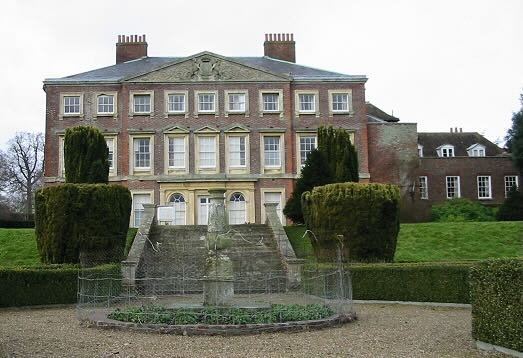
Goodnestone Park, where Austen danced with Edward Bridges.
Photo by Nick Smith / Goodnestone House, 2007, CC BY-SA 2.0
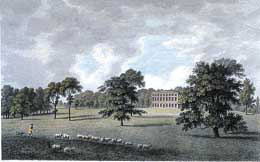
Goodnestone Park in the 1770s
Public domain via wikimedia

“The Mrs. Finches were afraid you would find Goodnestone very dull; I wished when I heard them say so that they could have heard Mr. E. Bridges’ solicitude on the subject, and have known all the amusements that were planned to prevent it.”—Aug. 24, 1805, from Jane Austen at Godmersham Park to Cassandra Austen at Goodnestone Farm, Wingham

Edward and his wife inherited Godmersham and moved there at the end of 1797. Jane and Cassandra continued to visit other Bridges family members at Goodnestone Farm. Her nephew described Goodnestone Farm as “a comfortable house very near the great house, which has generally been inhabited as a dower house or by some younger member of the Bridges family, to whom it belongs.”

Jane’s friend Harriot (or Harriot-Mary), one of her sister-in-law Elizabeth’s younger sisters, insisted Jane stay longer on a visit in 1805. In the following year, Harriot married Rev. George Moore. He was the son of an archbishop and held four church livings. One of Elizabeth’s younger brothers, Rev. Brook-Edward, was perpetual curate of Goodnestone from 1802-9, as well as holding five other church livings at various times. His older brother, Rev. Brook-Henry, held two church livings. (They did like hyphenated names.) The Bridges family apparently had “considerable patronage in the church,” like the Darcys of Pemberley, or at least they had close connections with families who had patronage (the right to assign church livings).
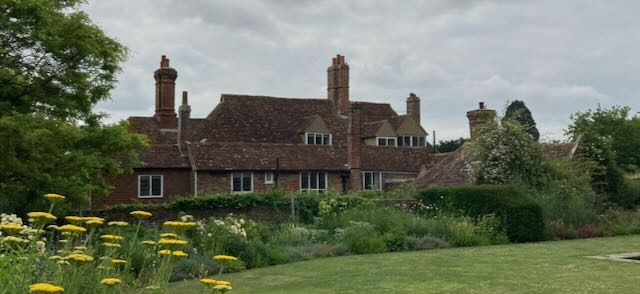
The dower house at Goodnestone, where Jane Austen stayed on later visits to the Bridges family.

Holy Cross Goodnestone church

On  her visits, Austen must have attended the local church, Holy Cross Goodnestone. This is now considered an “Austen Family Church,” like others we have visited in this series. Jane’s brother Edward married his wife Elizabeth in this church in 1791.
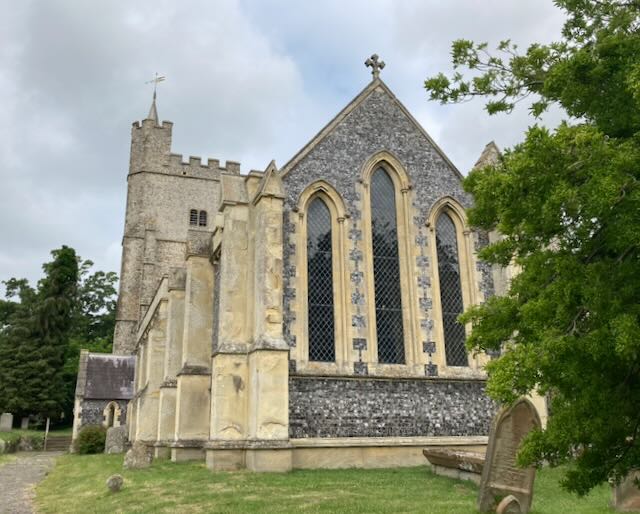
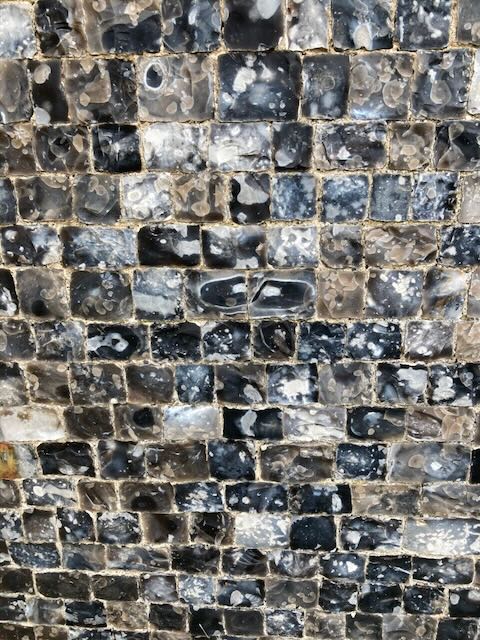
Holy Cross Goodnestone church
Faced flints (chipped or “knapped” to make them flat) cover the south wall of the Goodnestone church, giving it a unique appearance.
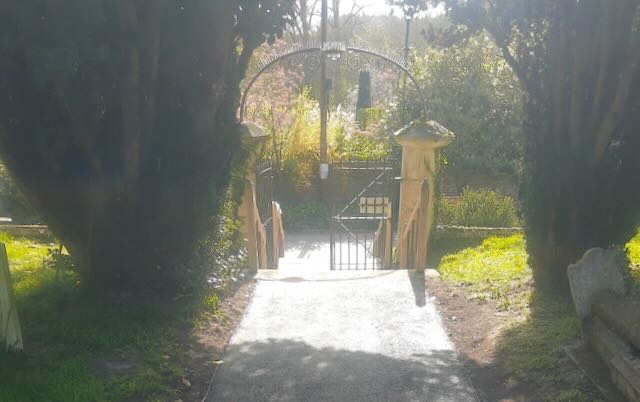
Path between yew trees at Goodnestone church. See Yew trees in churchyards. The path was recently renovated for easier access to the church. JASNA’s churches fund helped finance the renovation. Photo ©Sue Kittle, 2026
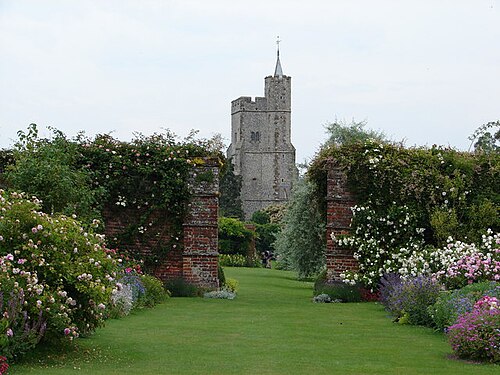
View of the Goodnestone church tower from one of the many beautiful gardens. Once used as a beaon tower and fortress, it is still a bell tower, with four bells, one of which was made in 1628. The church now has six “Ringers” who ring the bells on special occasions. A single bell is rung for church services. Photo by Adam Hincks, CC BY-SA 2.0
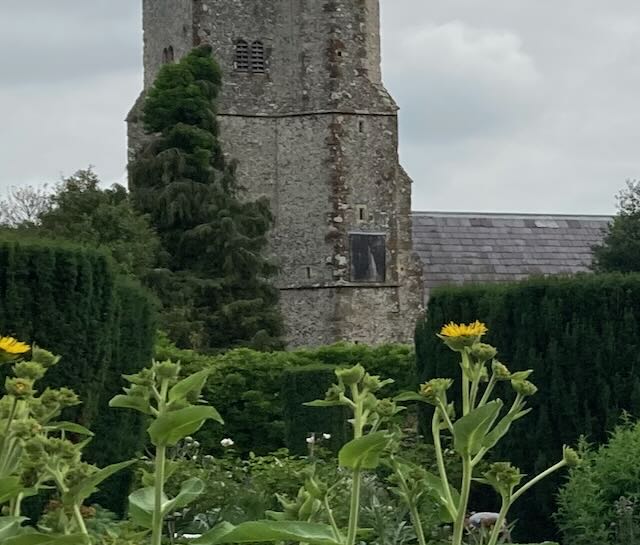
On one face of the Goodnestone church tower, a sundial, shown here, was inscribed “Every hour shortens life,” though the markings are very worn now. On another face is a Victorian clock, which has to be manually wound every eight days.
Detail of photo by Adam Hincks, CC BY-SA 2.0

Holy Cross Goodnestone church interior

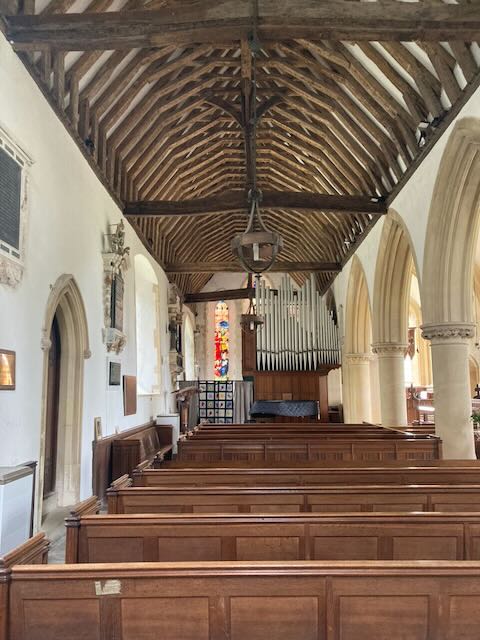
The interior of the church was remodeled in the Gothic Revival style in 1841, so it looks different now than it did in Austen’s time.
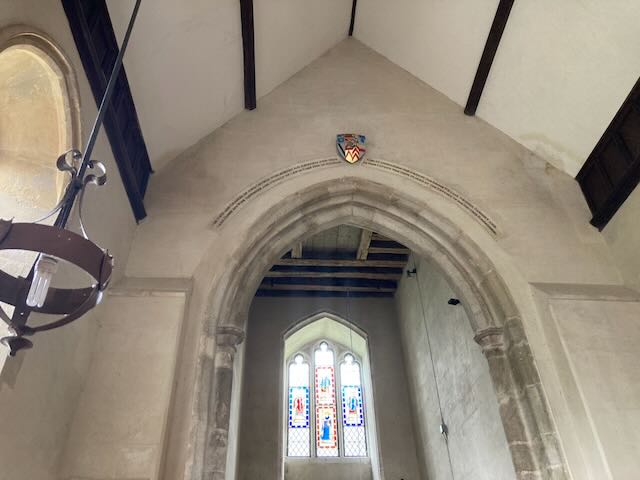
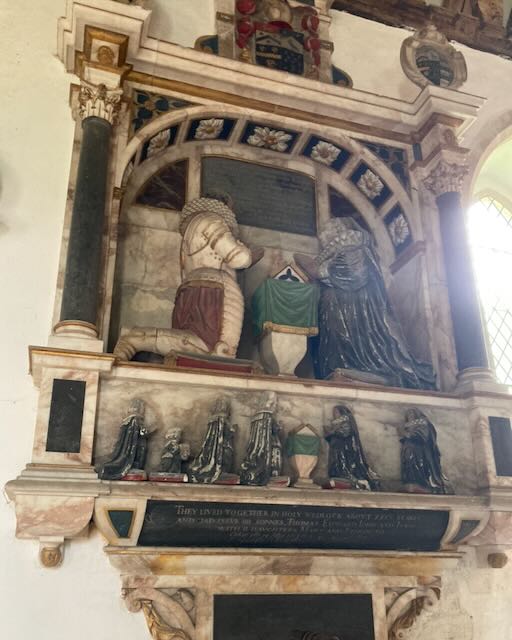
An inscription over this arch commemorates Sir Brook William Bridges (Edward Austen’s father-in-law) who rebuilt the nave and chancel of the church in 1841.
Monuments on the church walls, and flagstones on the floor, still commemorate influential families. This is a monument to Sir Edward Engeham, who purchased the estate from the de Godwynstones, and his family. He died in 1636, age 65, a year after his wife’s death at age 52.
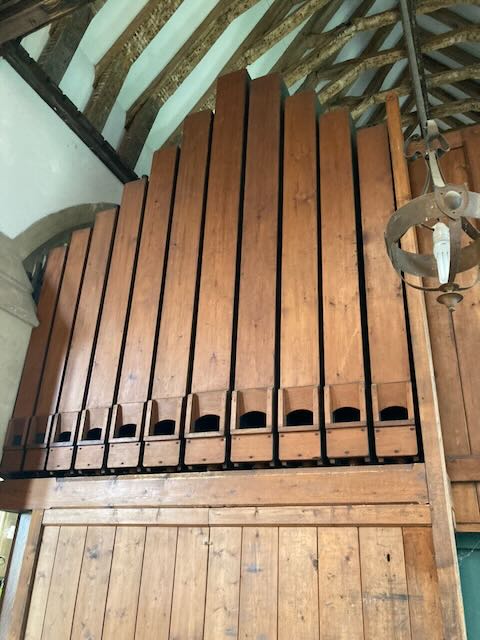
In Austen’s time, the nicer pews would have been rented or owned by wealthy families. These Goodnestone church pews are Victorian, and the organ dates from 1904, restored and augmented in 2014.
The Goodnestone organ also has wooden pipes, for the pedals.
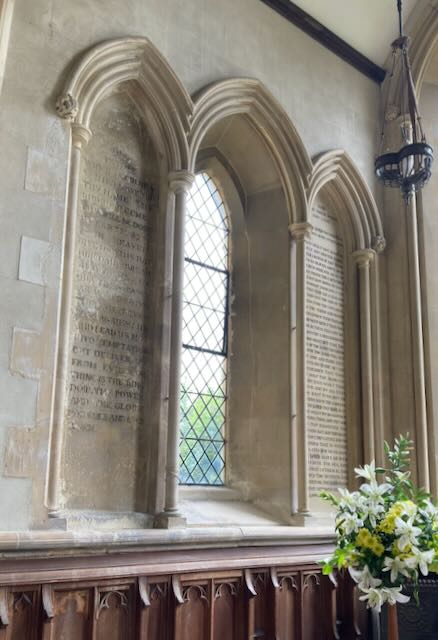
Jane Austen may well have read these engravings on the wall, similar to those in many English country churches. The left side displays the Lord’s Prayer, the right side lists the Ten Commandments.

“We have walked to Rowling on each of the two last days after dinner, and very great was my pleasure in going over the house and grounds. We have also found time to visit all the principal walks of this place, except the walk round the top of the park, which we shall accomplish probably to-day.”—Jane Austen at Goodnestone Farm writing to Cassandra at Godmersham, August 30, 1805. 

Church and Community

A congregation of about twenty people gather for Sunday services at the church (fewer when their excellent choir is not singing). But they may have 100 to 120 participants at services for holidays and weddings.

Like many country churches, the Goodnestone church is also used for various community services. Concerts are held there regularly, and the choir is excellent. They have sung Evensong in cathedrals as well. Schoolchildren come to the church once a week from the Church of England primary school in the village. The church even serves as a post office, open two mornings a week.

News article about the post office being opened in the Goodnestone church.

Goodnestone is part of the Canonry Benefice, which includes seven churches in East Kent. The vicar and other clergy for the benefice serve all the churches, at services alternating between the churches. For example, during the upcoming Holy Week, from Palm Sunday to Easter Sunday, fifteen church services will be held at the various churches (at least one per day). Three of them will be at Holy Cross, Goodnestone.

The church is well worth seeing if you visit the area. It is generally open during daylight hours. You can contact the church if you have questions. Jane Austen enjoyed the gardens and walks in the area, and you can also walk through the lovely gardens and the “Serpentine Walk.” See Visitor Information. Goodnestone Park is now used as a wedding venue.

Brenda S. Cox is the author of Fashionable Goodness: Christianity in Jane Austen’s England. She also blogs at Faith, Science, Joy, and Jane Austen.

All photos in this post, unless otherwise marked, ©Brenda S. Cox, 2023

For Further Exploration

Holy Cross, Goodnestone

Goodnestone, Godmersham, and Canterbury

Rowling and Rowling House

Edward Austen Knight

Detailed History of Goodnestone and Church, written in 1902

More photos of Holy Cross, Goodnestone

Old Photographs of Goodnestone

History of Goodnestone Park with paintings

Goodnestone Park Grade II* listing (Grade II* means a “particularly important building of more than special interest.” Listed buildings require special permissions before any significant changes can be made.)

Church of the Holy Cross Grade I listing with photos (Grade I means “of exceptional interest.”)

Other Austen Family Churches

Steventon

Chawton

Deane

Hamstall Ridware and Austen’s First Cousin, Edward Cooper

Adlestrop and the Leigh Family

Stoneleigh Abbey Chapel and Mansfield Park

Great Bookham and Austen’s Godfather, Rev. Samuel Cooke

Ashe and the Lefroy Family

St. Paul’s Covent Garden (with links to other churches mentioned in Austen’s writings)
St. Swithin’s Walcot (Bath)

Godmersham

Read Full Post »

This is the time of year when I start to dream of traveling to England or other beautiful places over the summer. I know just how Elizabeth Bennet felt when looking forward to her trip with her Uncle and Aunt Gardiner.

What a delightful thought! Anticipation is half the joy of any exciting pursuit. Her words could not be more true:

Her tour to the Lakes was now the object of her happiest thoughts: it was her best consolation for all the uncomfortable hours which the discontentedness of her mother and Kitty made inevitable; and could she have included Jane in the scheme, every part of it would have been perfect.

“But it is fortunate,” thought she, “that I have something to wish for. Were the whole arrangement complete, my disappointment would be certain. But here, by carrying with me one ceaseless source of regret in my sister’s absence, I may reasonably hope to have all my expectations of pleasure realized. A scheme of which every part promises delight can never be successful; and general disappointment is only warded off by the defence of some little peculiar vexation.”

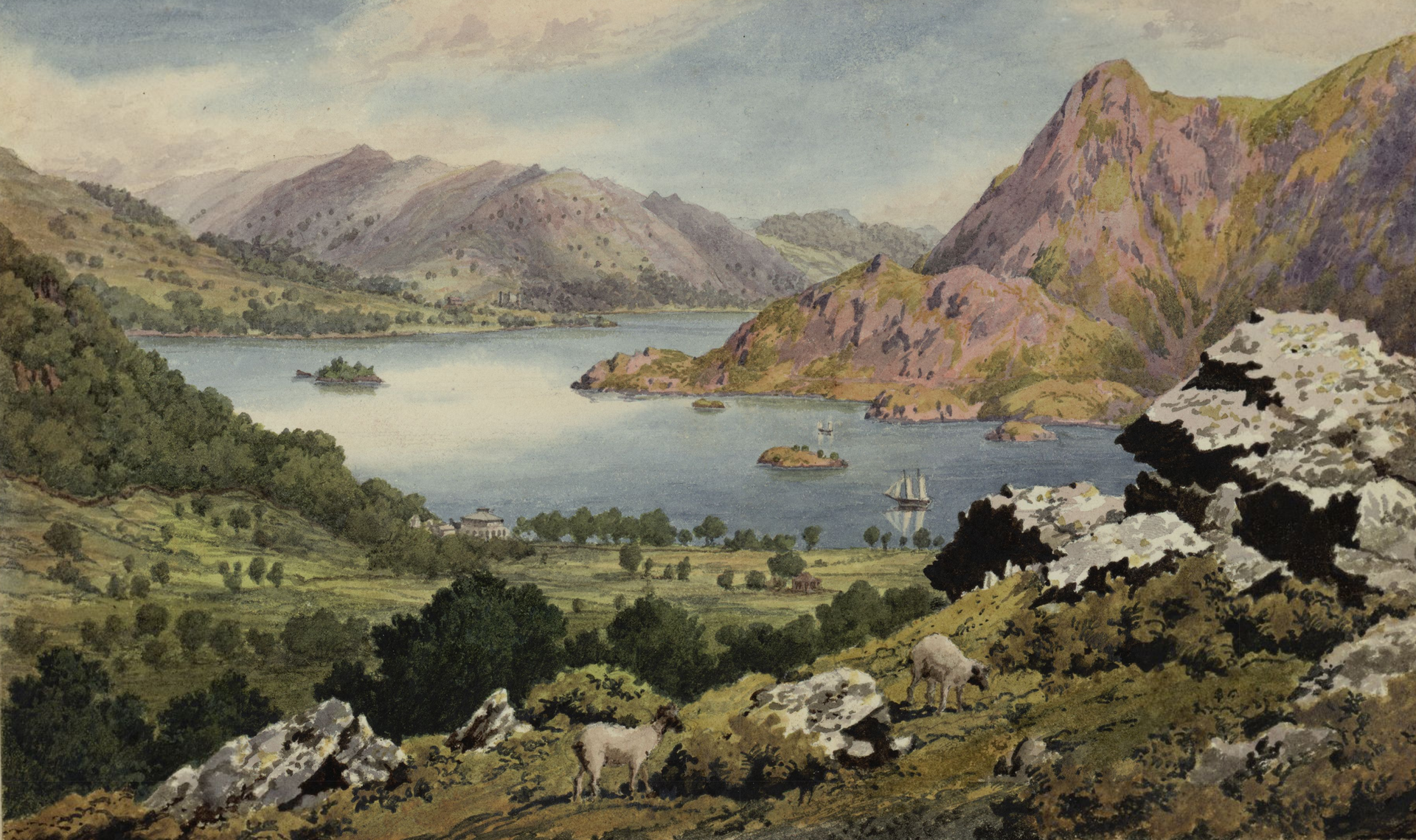
A view of the Lake District: Parker, John. Ullswater from Above Patterdale. 1825. Wikimedia Commons.

Travel Plans

Like many of us who have had our plans amended, Elizabeth has high expectations of all they might see on their trip, but eventually she finds contentment in the final plans to visit Derbyshire and the Peak District but not venture to the Lakes:

…they were obliged to give up the Lakes, and substitute a more contracted tour; and, according to the present plan, were to go no farther northward than Derbyshire. In that county there was enough to be seen to occupy the chief of their three weeks; and to Mrs. Gardiner it had a peculiarly strong attraction. The town where she had formerly passed some years of her life, and where they were now to spend a few days, was probably as great an object of her curiosity as all the celebrated beauties of Matlock, Chatsworth, Dovedale, or the Peak.

Most of us can relate to Elizabeth’s feelings on the topic:

Elizabeth was excessively disappointed: she had set her heart on seeing the Lakes; and still thought there might have been time enough. But it was her business to be satisfied—and certainly her temper to be happy; and all was soon right again.

Wright of Derby, Joseph. Dovedale by Moonlight. c.1784–1785, oil on canvas. Wikimedia Commons.

Travel Route

Her trip was revised, but there was still much for her to see. I’ve always been intrigued by this paragraph that tells us about the route they took on their way to Derbyshire, for there would have been many interesting sights along the way:

It is not the object of this work to give a description of Derbyshire, nor of any of the remarkable places through which their route thither lay—Oxford, Blenheim, Warwick, Kenilworth, Birmingham, etc., are sufficiently known. A small part of Derbyshire is all the present concern.

If Elizabeth and the Gardiners stopped along the way, what might these locations have looked like at the time? Most scholars agree that this trip would have taken several days, which means they would have had to change horses several times and stop for food and rest and lodging. It’s fun to imagine what all they saw and where they stopped, though we know they would have wanted as much time as possible in Derbyshire.

For anyone curious about how far and how fast people could travel in Jane Austen’s England, I highly recommend Wade H. Mann’s article, “Distance and Time in Regency England” on Quills & Quartos. It breaks down the realities of journeying by carriage, horseback, and foot, giving a clear sense of the distances and travel times that shaped the world Austen’s characters inhabited.

Pollard, James. London to Brighton Stage Coach. c. 1822, coloured aquatint, engraved by Matthew Dubourg (attributed), Wikimedia Commons.

Oxford

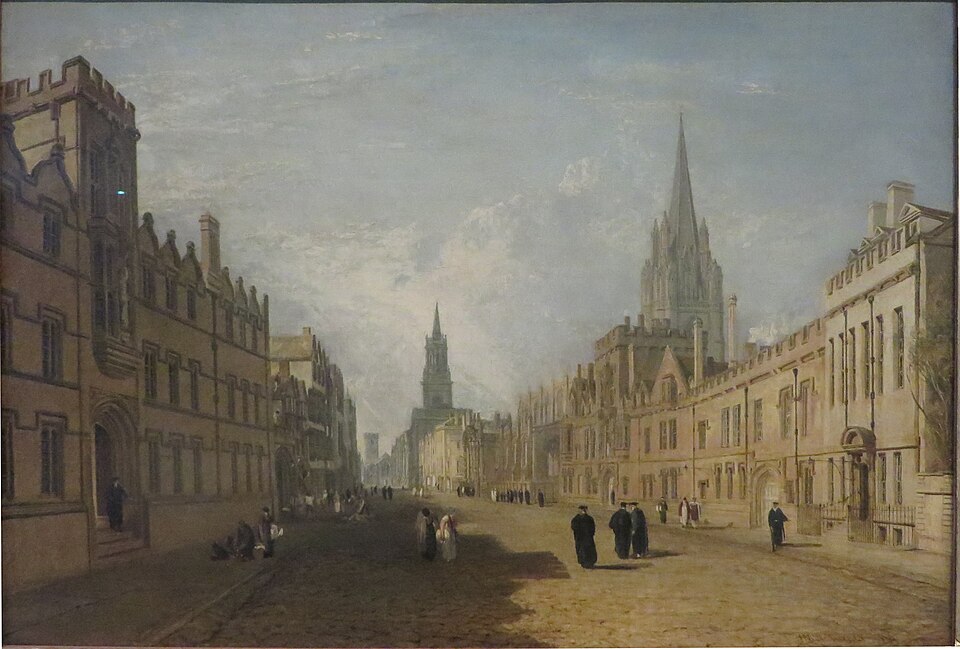
Austen’s contemporary readers would have recognized Oxford as a center of learning and culture. High Street and Cornmarket Street bustled with shops, inns, and markets. The architecture would have also been of interest. There are many gardens and parks to explore and walk, museums and libraries, and several religious sites. There would have been much for Elizabeth and the Gardiners to experience along the way.

High Street, Oxford, J. M. W. Turner, Wikipedia, 1810.

Blenheim

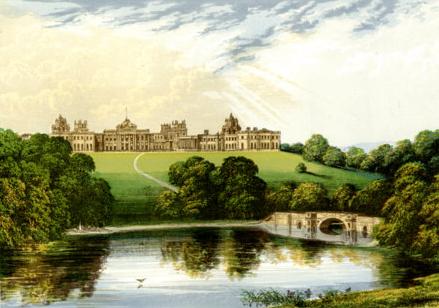
Blenheim Palace, the seat of the Dukes of Marlborough (which would later become the birthplace of Winston Churchill), was also on the route. As we see later when Elizabeth and the Gardiners visit Pemberley, by the late 18th and early 19th centuries, many famous estates in England had become informal tourist attractions. Wealthy travelers, and even respectable middle-class visitors, often toured grand houses while traveling through the countryside.

Morris, F. O. Blenheim Palace. 1880. Wikimedia Commons.

Warwick

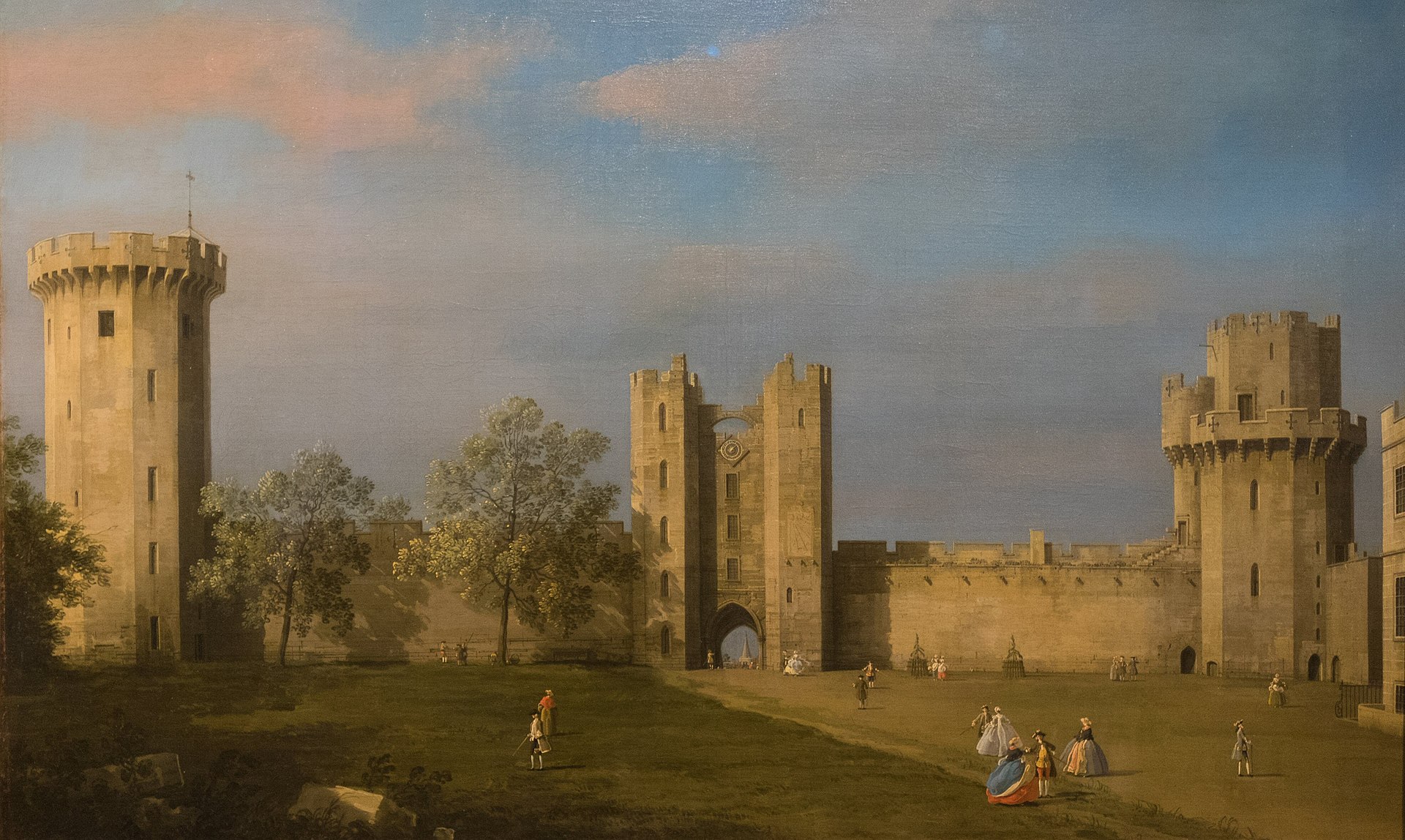
Today, Warwick is a lovely little village, and the castle is one of my favorite sites to visit. During Austen’s time, Warwick Castle would have boasted recent new landscaping by Lancelot “Capability” Brown (1716–1783). Warwick Castle’s grounds were redesigned in the 18th century, and Brown’s landscapes created sweeping lawns, gentle vistas, and picturesque trees. Visitors like Elizabeth Bennet might have enjoyed exploring the grounds.


Canaletto. Warwick Castle, the East Front from the Courtyard. Birmingham Museum and Art Gallery, Wikimedia Commons.

Kenilworth

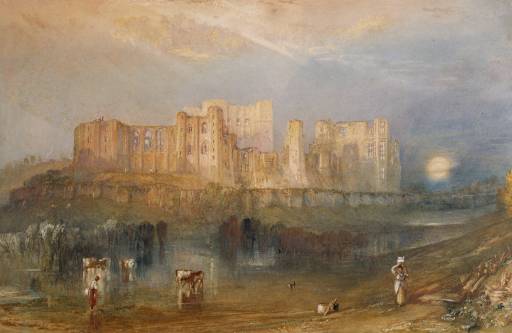
Kenilworth Castle, already a famous historic ruin during the Regency Era, offered visitors sweeping views, crumbling walls, and picturesque gardens. Tourists like Elizabeth Bennet might have strolled the grounds and enjoyed the romantic, dramatic scenery that made it a highlight of Warwickshire travel.

Turner, Joseph Mallord William. Kenilworth Castle. c. 1830, watercolour, bodycolour, and graphite on paper. Fine Arts Museums of San Francisco. Wikimedia Commons.

Finally, in Austen’s day, Birmingham was a bustling market and industrial town rather than a landscaped estate. Travelers might stop for lodging, shopping, or supplies, experiencing the commerce of an emerging urban center instead of picturesque grounds or aristocratic architecture.

Derbyshire

Once they arrive in Derbyshire, we know whom Elizabeth and the Gardiners visit and what they see. Unlike Elizabeth Bennet, most of us will never enjoy living at such a glorious estate as Pemberley. But we can visit many of the real, historic sites. And if we’re very lucky, perhaps we might be invited to visit a historic estate or home one day, such as my visit to Sherbourne Park.

Most of all, Elizabeth’s travels remind us that the journey is often just as important and interesting as the destination. Unless, of course, Mr. Darcy is waiting at one of those destinations.

Tune in for more about Elizabeth’s travels in the coming months!


Rachel Dodge teaches writing classes, speaks at libraries, teas, and conferences, and writes for Jane Austen’s World blog. She is the bestselling, award-winning author of The Anne of Green Gables DevotionalThe Little Women DevotionalThe Secret Garden Devotional, and Praying with Jane: 31 Days Through the Prayers of Jane Austen. She has narrated numerous book titles, including the Praying with Jane Audiobook with actress Amanda Root. A true kindred spirit at heart, Rachel loves books, bonnets, and ballgowns. Visit her online at www.RachelDodge.com.

Read Full Post »