Feeds:
Posts
Comments

Archive for the ‘18th Century England’ Category

Imagine that your beloved husband or son suddenly disappeared after meeting friends at a neighborhood bar, and that you would not know for months what had happened to them. You fear that he has been taken by a pressgang.
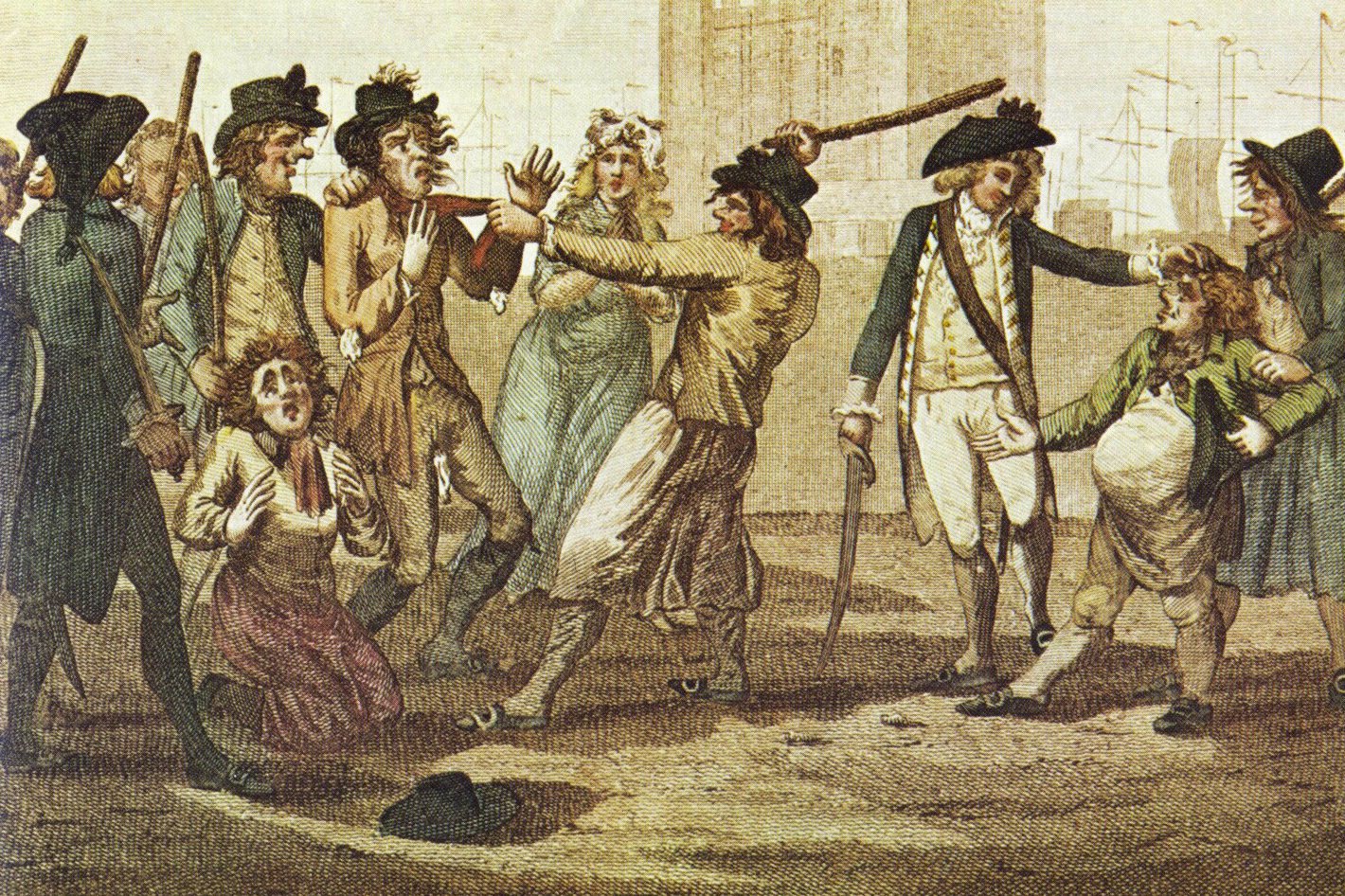
Press gang taking unwilling men

Such was the case in Jane Austen’s time, when Great Britain fought long wars over land and sea. Since medieval times it had been the royal prerogative to impress free men into a seamen’s service. The custom was roundly condemned, except in cases of “necessity of the sudden coming in of strange enemies into the kingdom.”* During times of war, “the tempation of impressment” was “too strong to be resisted by Parliament.”* And so pressgangs would roam towns and the countryside to take men against their will to serve in His Majesty’s navy.

“The class on whom it fell, however, found little sympathy from society. They were rogues and vagabonds, who were held to be better employed in defence of their country, than in plunder and mendicancy. During the American war, impressment was permitted in the case of all idle and disorderly persons, not following any lawful trade or having some substance sufficient for their maintenance. Such men were seized upon, without compunction, and hurried to the war. It was a dangerous license, repugnant to the free spirit of our laws; and, in later times, the state has trusted to bounties and the recruiting sergeant, and not to impressment, — for strengthening its land forces.” – The constitutional history of England since the accession of George Third, 1760-1860, Volume 2 (Google eBook), Thomas Erskine May, 1866 p 261-262

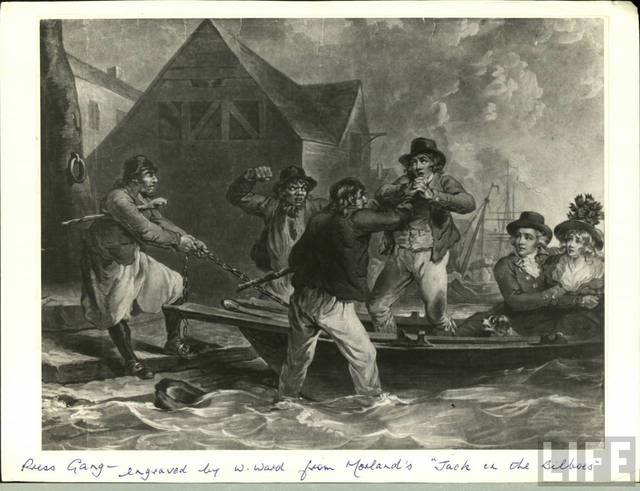
Press Gang. Image @LIFE magazine

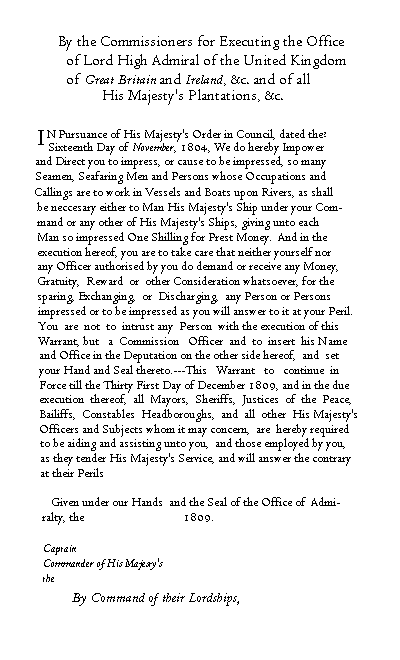
During the Napoleonic wars, the need for sailors was great, and larger numbers of free men (including Americans) were forced into service. They were taken in any way, usually at night, through violence, entrapment, and fraud. Before anyone could discover their absence, they were taken on board and locked up until the ship sailed from port. The captured men were often wounded and would die from lack of treatment.

Press warrant. Image @Nelson's Navy**

“Impressment was restricted by law to seamen, who, being most needed for the fleet, chiefly suffered from the violence of the press-gangs. They were taken on the coast, or seized on board merchantships, like criminals: ships at sea were rifled of their crews, and left without sufficient hands to take them safely into port. Nay, we even find soldiers employed to assist the pressgangs: villages invested by a regular force: sentries standing with fixed bayonets; and churches surrounded, during divine service, to seize seamen for the fleet.

The lawless press-gangs were no respecters of persons. In vain did apprentices and landsmen claim exemption. They were skulking sailors in disguise, or would make good seamen at the first scent of salt-water; and were carried off to the sea ports. Press-gangs were the terror of citizens and apprentices in London, of laborers in villages, and of artisans in the remotest inland towns. Their approach was dreaded like the invasion of a foreign enemy. To escape their swoop, men forsook their trades and families and fled, — or armed themselves for resistance. Their deeds have been recounted in history, in fiction, and in song. Outrages were of course deplored; but the navy was the pride of England, and every one agreed that it must be recruited. In vain were other means suggested for manning the fleet, — higher wages, limited service, and increased pensions. Such schemes were doubtful expedients: the navy could not be hazarded: press-gangs must still go forth and execute their rough commission, or England would be lost. And so impressment prospered. – The constitutional history of England since the accession of George Third, 1760-1860, Volume 2 (Google eBook), Thomas Erskine May, 1866 p 261-262
May’s words in 1866 seem a bit overwrought, but one can only imagine how awful impressment must have been for the families who did not know what happened to their men, and for the men who were bound into service against their will.
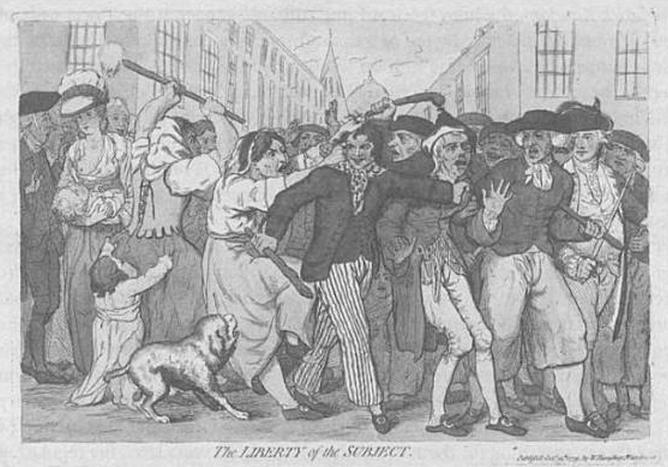
Towns people, including women, opposing the press gang, 1779

Although authorities would do all they could to prevent impressment, the Georgian police force was still primitive compared to what it would become in the Victorian era. Still, local townsmen would fight off the press gangs to save a hapless man from impressment.
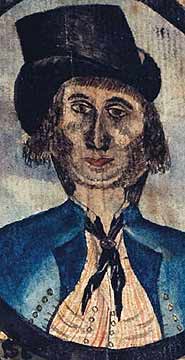
George Hodge, sailor in Nelson's navy

Even sailors who had served their term of duty were in danger of being pressed into service again. It was not unusual for a sailor to join, be captured, find freedom, run from the press gangs, be impressed, and then join the navy of their own free will again.  George Hodge left a remarkable diary of his years as a sailor.

He was captured again in 1797, but was returned home and then spent months on the run from press gangs…But in 1798 he was caught and joined HMS Lancaster, which had 64 guns.   For the next nine years he served mainly along the west African coast. But he also went to Ceylon and the East Indies.

In 1808 he joined HMS Marlborough, 74 guns, and spent the years until 1812 mostly on blockade duty around Europe. – Daily Mail
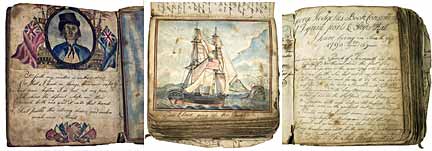
George Hodge's remarkable diary

In 1795, William Pitt introduced a Quota Act, which stated how many men each county had to provide for service. Convicted men were given the option to serve out their harsh sentences in prison, or serve in the navy. While this Act did not end the practice of impressment, it served to reduce it. Impressment virtually ended with the Napoleonic Wars in 1814. By the mid-19th century the custom had disappeared.

Press Gang – words to the song

As I walked out on London Street
A press gang there I chanced to meet
They asked me if I’d join the fleet
On board of a man-o-war, boys

Come brother shipmates tell to me
What kind of treatment they give you
That I may know before I go
On board of a man-o-war, boys

When I got there to my surprise
All they had told me was shocking lies
There was a row and a bloody old row
On board of a man-o-war, boys

The first thing they done they took me in hand
They lashed me with a ‘tar of a strand’
They flogged me till I could not stand
On board of a man-o-war, boys

Now I was married and me wife’s name was Grace
‘Twas she that led me to shocking disgrace
It’s oft I’d curse her ugly face
On board of a man-o-war, boys

When next I get may foot on shore
To see them London girls once more
I’ll never go to sea no more
On board of a man-o-war, boys

More on the topic:

Read Full Post »

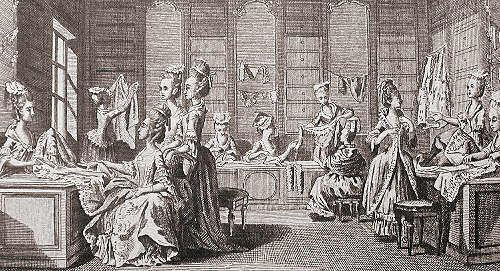
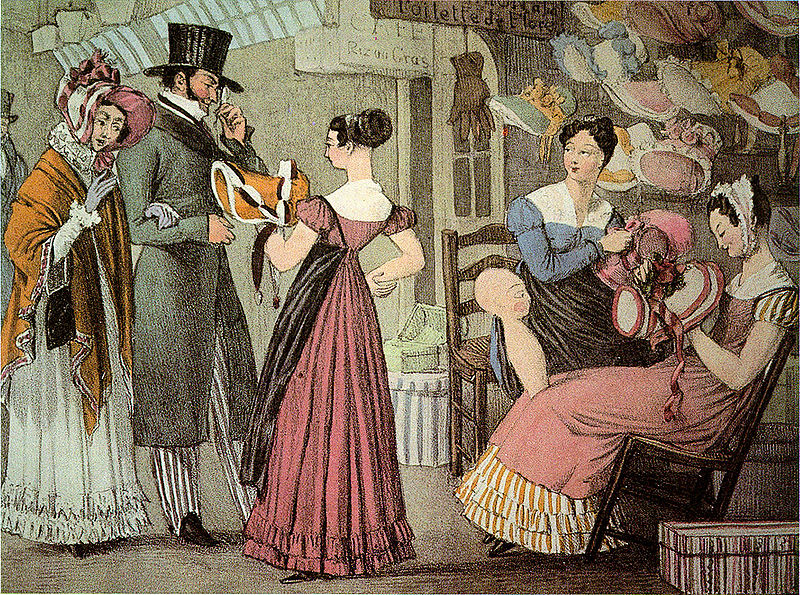
Early milliner shops were like our department stores, selling all manner of fashionable items. The image of a milliner shop in Paris shows the costumes we have come to associate with the era of Marie Antoinette. After the French Revolution, fashions changes drastically, for the French citizenry did not want to be reminded of the recent bloodshed or the ancient Regime. The rage in fashion was an imitation of the classical dress worn by the Greeks and Romans.

Dressmaker shop, 1775

The end of the 18th century witnessed a signal change in the style of women’s dress. The gown no longer consisted of two dresses, an under and an outer one. The formal styles which had prevailed throughout the century and brought into use stiff materials such as solid damasks, velvets, satins, and silks, were replaced by the fashion of the short-waisted clinging gown made of muslin and soft silk. This “Empire” mode characterized the dress of the first quarter of the 19th century. – The Encyclopedia Americana, Frederick Converse Beach, George Edwin Rines, 1902,  “costume”

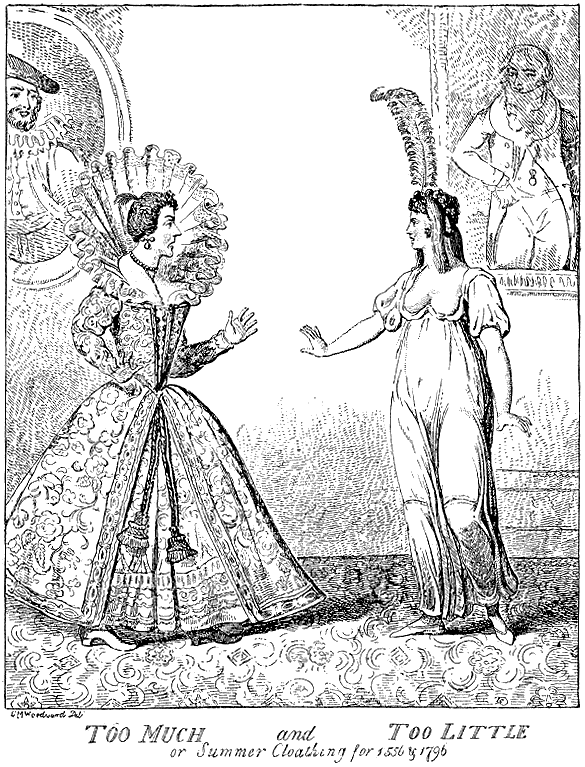
Too Much and Too Little, or Summer Cloathing for 1556 & 1796

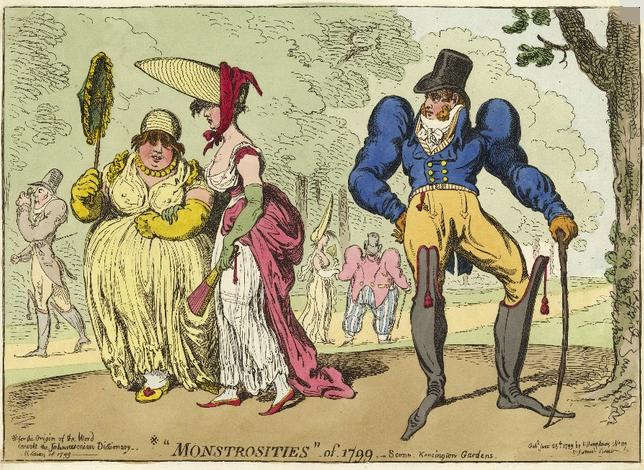
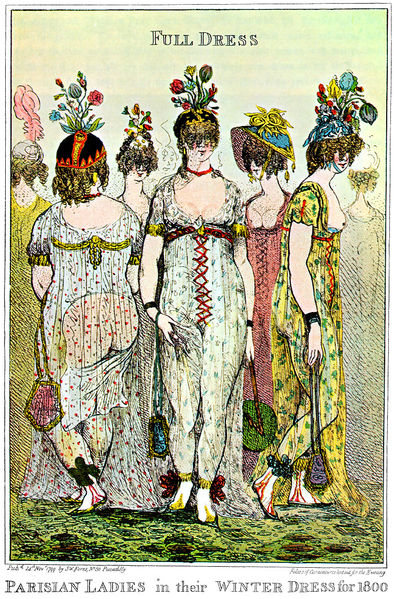
Parisians dressed in the new fashions were known as the “incroyables” (men) and the “merveilleuses,” (women.) These fashions were not at first admired and generally regarded as hideous. Caricaturists had a heyday making fun of these freaks of Fashion. British fashionistas shortly followed suit, as the cartoon by Gillray attests.

Monstrosities of 1799, Kensington Gardens, Gillray

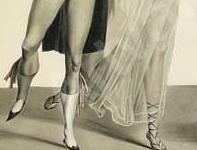
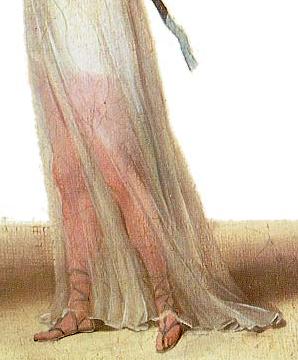
Macaronis turned into dandies, and gently bred ladies wore clothes so thin and diaphanous, that the shape of their legs showed clearly through the skirts. The muslin disease (catching a serious cold or pneumonia) lasted for as long as fashionable young women wore thin muslin dresses with bare necks and arms in damp and drafty buildings.

Merveilleuse et Incroyable. The close up of the dress reveals how sheer the fabrics were.

In some instances, nothing was left to the imagination. In the satirical image below by Isaac Cruikshank, the ladies are shown wearing next to nothing. Satire took many forms in the late 18th century. The Lady’s Monthly Museum featured a dialogue between a lady visiting Paris and a man milliner. His answer is hilarious.

Caricature by Isaac Cruikshank

Dialogue Between a Lady and A Man Milliner at Paris

“Citizen, I am just come to town: –pray, have the goodness to inform me how I must appear, to be in the fashion.”
“Madame, ’tis done in a moment; in two minutes I shall equip you in the first style. –Have the goodness to take off that bonnet.”
“Well.”
“Off that petticoat.”
“There it is.”
“Away with these pockets.”
“There they go.”
“Throw off that handkerchief.”
“’Tis done.”
“Away with that corset and sleeves.”
“Will that do?”
“Yes, Madame, you are now in the fashion. ‘Tis an easy matter, you see.–To be dressed in the fashion, you have only to undress.” – The Lady’s Monthly Museum, February 01, 1801, pg. 126.

Definition of a man milliner: A man who makes or deals in millinery, that occupation having been at one time predominantly performed by women; hence, contemptuously, a man who is busied with trifling occupations or embellishments.

Louis-Léopold Boilly painted a gown so sheer that without a petticoat, her short chemise is easily visible under the delicate muslin.

The days of the Revolution (1789 – 1799) brought in simple fashions. Corsets were discarded, the waist became short and the skirt clinging, and cheap materials were used. During the Directoire, the women adapted the classic style, borrowing from both Greek and Roman fashions. These costumes were scanty, and frequently were split up the sides. The dresses were often transparent and worn without chemises. The gentlemen of this fantastic period were styled “Incroyables,” “Unimaginables”; the ladies, “Merveilleuses” and “Impossibles.”  The men wore an exaggerated copy of what had been previously called the English fashion.- Costume design and illustration,  Ethel Traphagen, 1918,  p 120.

Millinery shop in Paris, 1822

A milliner could carry possibly a thousand different goods, becoming the forerunner of the modern department store. At this point, the term “milliner” was tied to the Latin word “mille,” meaning thousand.

The 18th Century milliner might have offered a thousand goods but all shared the quality of being fashionable accessories. Wares could include shoes, jewelry, table service, clocks, hosiery, fabrics, shirts, aprons, cloaks, caps, hats, muffs and mitts. – The Millinery Shop, Colonial Williamsburg

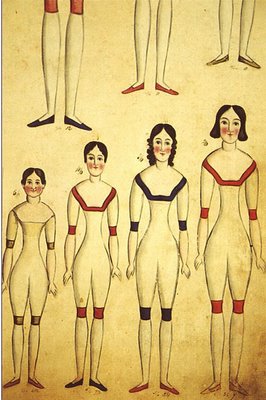
Milliner doll catalog, 1820s. These dolls were dressed in the fashion of the day. Look at the above image for a sample size of a doll. Image @Christine LeFever: Dolls and Fancywork

More on the topic:

Read Full Post »

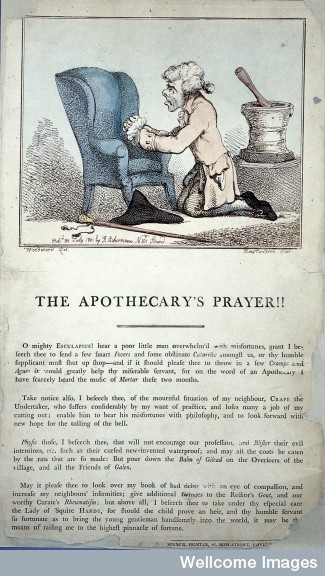
Caricatures from the late 18th- early 19th century always pique my interest. In this instance, Rowlandson’s apothecary (1801) is praying deeply. But what for? Skills to heal more efficiently and better, or for a slew of customers whose illnesses will help fill his coffers with lucre?

Knowing Rowlandson’s outrageous penchant for irony, I am willing to bet it is the latter. So I entered a few phrases into my trusty Google search bar and found this cached explanation of the prayer:

A prayer with a mischievous aim: This example is a sarcastic Apothecary’s Prayer, which was accompanied by a Thomas Rowlandson caricature. 12

“Oh mighty Esculapius! Hear a poor little man overwhelm’d with misfortunes, grant I beseech thee to send a few smart Fevers and some obstinate Catarrhs amongst us or thy humble supplicant must shut up shop…”

“and if it would please thee to throw in a few Cramps and Agues, it would greatly help thy miserable servant, for on the word of an apothecary, I have scarcely heard the music of Mortar these two month…”

“Physic those, I beseech thee, that will not encourage our profession, and blister their evil intentions, viz, such as their cursed new-invented waterproof…”

This was a weatherproof material which was expected to keep the wearer dry and hence free from colds and coughs and other diseases. – Wright, David. Some Prayers and Oaths from the History of Medicine, cached page.

The entire prayer:

O mighty Esculapius! hear a poor little man overwhelm’d with misfortunes, grant I beseech thee to send a few smart Fevers and some obstinate Catarrhs amongst us, or thy humble supplicant must shut up shop–and if it should please thee to throw in a few Cramps and Agues it would greatly help thy miserable servant, for on the word of an Apothecary I have scarcely heard the music of Mortar these two months.

Take notice also, I beseech thee, of the mournful situation of my neighbour, Crape the Undertaker, who suffers considerably by my want of practice, and loses many a job of my cutting out; enable him to bear his misfortunes with philosophy, and to look forward with new hope for the tolling of the bell.

Physic those, I beseech thee, that will not encourage our protection, and Blister their evil intentions, viz. such as their cursed new-invented waterproof; and may all the coats be eaten by the rats that are so made: But pour down the Balm of Gilead on the Overseers of the village, and all the Friends of Galen.

May it please thee to look over my book of bad debts with an eye of compassion, and increase my neighbours’ infirmities; give additional twinges to the Rector’s Gout, and our worthy Curate’s Rheumatism; but above all, I beseech thee to take under thy special the Lady of Squire Handy, for should the child prove an heir, and thy humble servant so fortunate as to bring the young gentleman handsomely into the world, it may be the means of raising me to the highest pinnacle of fortune.

I looked up the word Galen. He was the physician who succeeded Hippocrates and who described cancer as an excessive black bile.  Until the 17th century it was believe that the bile coursed throughout the entire body. Even if a tumor was removed, the black bile remained to create more tumors. Not a nice prayer, n’est-ce pas?

More on the topic:

Image Credit: Wellcome Library, London
An apothecary praying for a host of illnesses to descend on his customers so that he can make more money. Coloured etching by T. Rowlandson, 1801, after G.M. Woodward.
Coloured etching and text 1801 By: George Moutard Woodward after: Thomas Rowlandson
Published: R. Ackermann,[London] (101 Strand) :  30 July 1801
Printed: [E.] Spragg)(London :
Size: border 18.7 x 23 cm.
Collection: Iconographic Collections
Library reference no.: ICV No 11040
Full Bibliographic Record Link to Wellcome Library Catalogue

Copyrighted work available under Creative Commons by-nc 2.0 UK: England & Wales, see http://images.wellcome.ac.uk/indexplus/page/Prices.html
Previous Ref: D5459/2/146

Read Full Post »

Gentle readers,

Summer means long, lazy afternoons lounging in the yard or by the pool side, grilling meats like hamburgers, sausages, and hot dogs. The hamburger has had a long tradition.

In 1802, the Oxford English Dictionary defined Hamburg steak as salt beef. It had little resemblance to the hamburger we know today. It was a hard slab of salted minced beef, often slightly smoked, mixed with onions and breadcrumbs. The emphasis was more on durability than taste. “ – Hamburger History 

Sailors from Hamburg, Germany, crossed the Baltic Sea regularly and returned with a taste for the minced raw beef dishes served up in Russian ports. The German haus-frau’s interpretation of these Baltic dishes was to fry or broil the patties. And voila! The Hamburg steak was born. By the late 1700’s the British knew them as Hamburg sausages.

Enter Hannah Glasse and her famous Art of Cookery book, which featured a recipe for Hamburgh sausage.

Hannah Glasse's recipe for Common Sausages

“By the mid-18th century, German immigrants also begin arriving in England. One recipe, titled “Hamburgh Sausage,” appeared in Hannah Glasse’s 1758 English cookbook called The Art of Cookery Made Plain and Easy. It consisted of chopped beef, suet, and spices. The author recommended that this sausage be served with toasted bread. Hannah Glasse’s cookbook was also very popular in Colonial America, although it was not published in the United States until 1805. This American edition also contained the “Hamburgh Sausage” recipe with slight revisions.” – History and Legends of Hamburger 

By 1834, the menu of Delmonico’s in New York City advertised a Hamburger steak. And the rest, as they say, is history. Today the humble hamburger is popular the world over due to the marketing genius (or avarice?) of McDonald’s and other fast food chains.

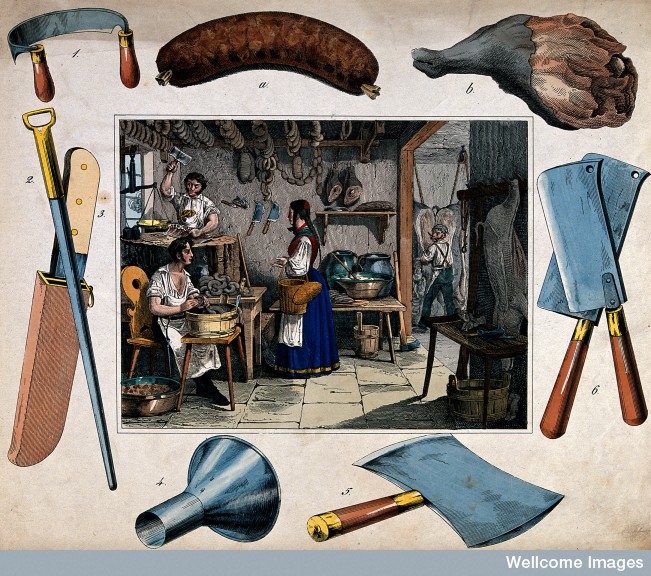
18th c. Sausage shop. Image © Wellcome Trust

Image description: Two men are working with knives and cleavers as another makes sausages, a woman has come to buy and is holding some money in her hand. Coloured etching. A pork-butcher’s shop: two butchers are working with knives and cleavers as another makes sausages, a woman has come to buy and is holding some money in her hand. Coloured etching, 18-. 19th c.” – Wellcome Trust

More on the topic:

Read Full Post »

Last week I featured the book, The History of Little Goody Two-Shoes, a moralizing children’s book that Jane Austen kept all through her lifetime. As she was growing up, she was probably familiar with the Cinderella fairytale. Hundreds of versions of the folk tale from a variety of European sources exist, but the myth goes as far back as ancient Greece and China.  The story of the cinder maid and the glass slipper was popularized in 1697 by Charles Perrault in Histoires, ou Contes du Temps Passè.  

Written for the aristocratic Salons of C17th French society, Perrault’s ‘Cendrillon’ is stripped of all violent, bawdy or socially moralizing material and is instead focused primarily on entertaining. – The Origins of the Cinderella Story

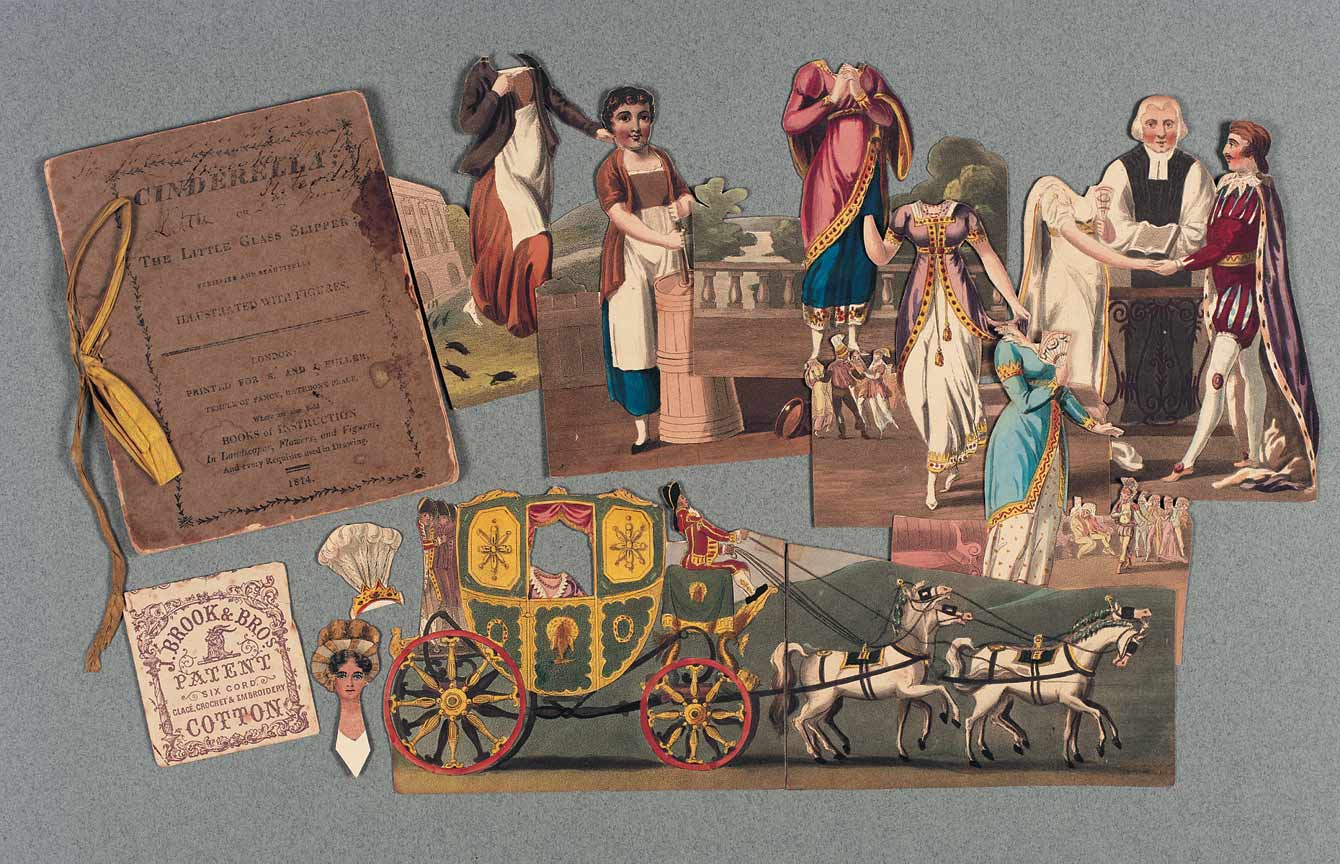
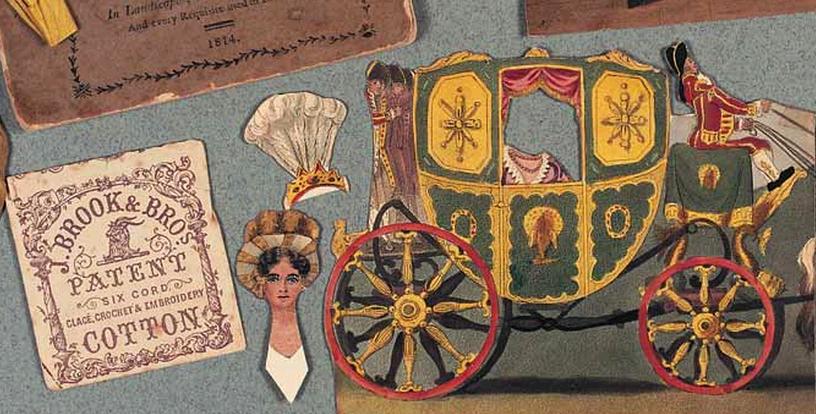
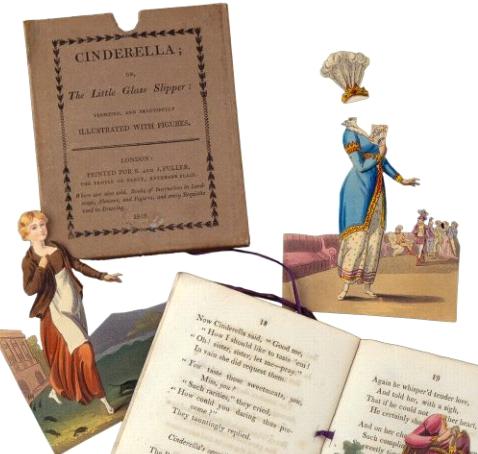
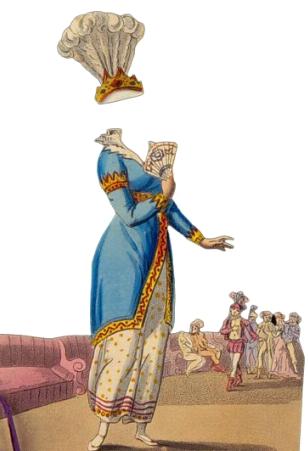
The images in this post show the paper dolls based on Perrault’s tale that were popular during Jane Austen’s time.

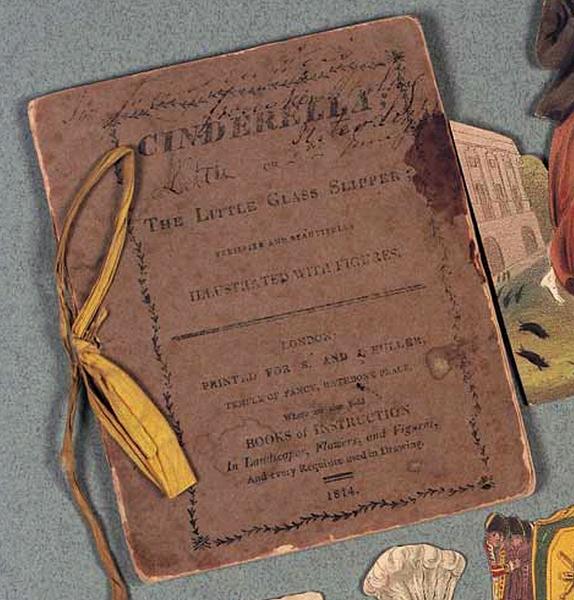
1814, Cinderella or the Glass Slipper. Image @Theriault's.

The images shown above and below are for sale at Theriault’s: The Doll Masters

Lot: 17. An 1814 English Paper Doll and Book “Cinderella” by S&J Fuller
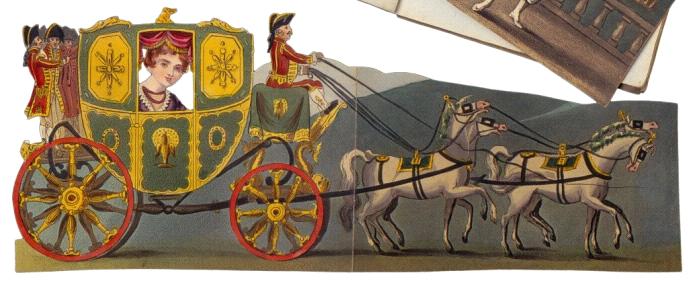
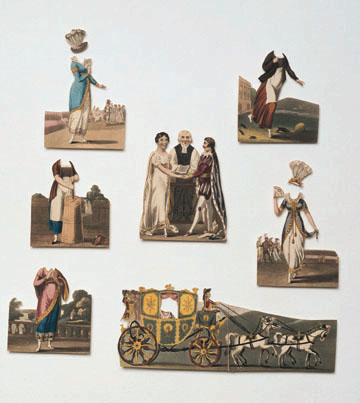
A paper bound miniature book,5″ x 4″,recounts in “beautifully versified” form the favored fairy tale,and was designed to be read while playing with the paper dolls,vignettes and accessories that illustrate the tale,comprising six costume scenes including the wedding,and Cinderella’s coach and horses (in two sections). An inscription inside the front cover reads “To my dear little niece Constance Foley”. S&J Fuller,Temple of Fancy,Rathbone Place,London,1814. Structure and lovely delicate colors of paper dolls and scenes well preserved,coachman’s head missing,one hand missing,stain on book cover. England,1814.

Image @Theriault's.

Around 1810, the London firm of  S. & J. Fuller published books with paper dolls. The 1814 book (or Book of Instruction, as printed on the cover) relates the Cinderella story in verse and is illustrated with cut out figures.

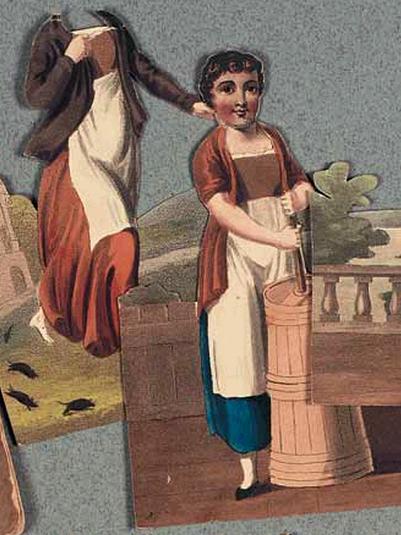
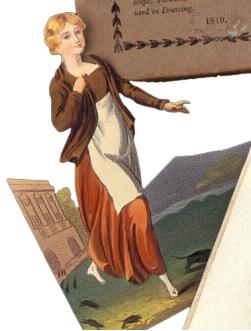
It is interesting to note that Cinderella’s head is removable and can be placed on various paper cut bodies. You see her in the image below walking through a town scape and churning butter. Children could arrange the characters in the paper sets, or drama sheets, and reenact the story.

While these scenic play books became increasingly popular, I imagine that they must have been very expensive and affordable only by the well-to-do.

Image @Theriault's.

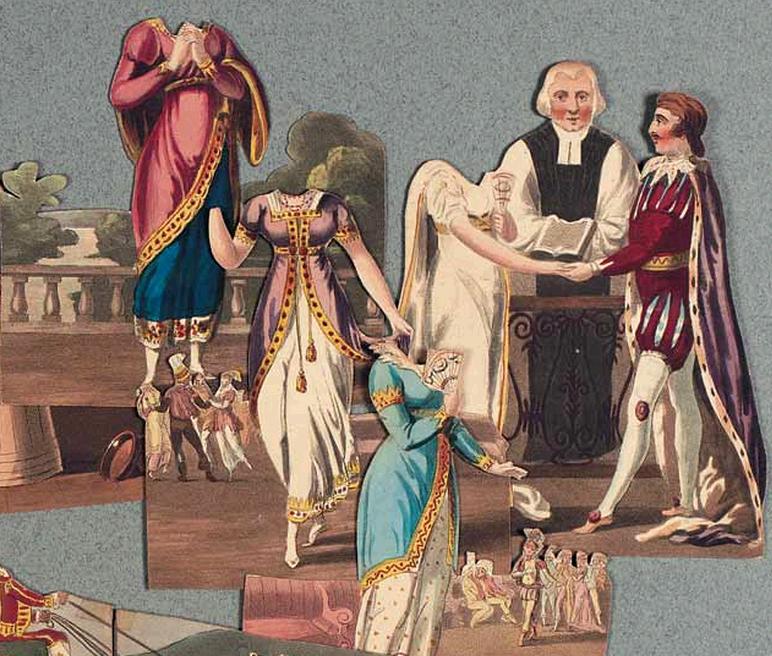
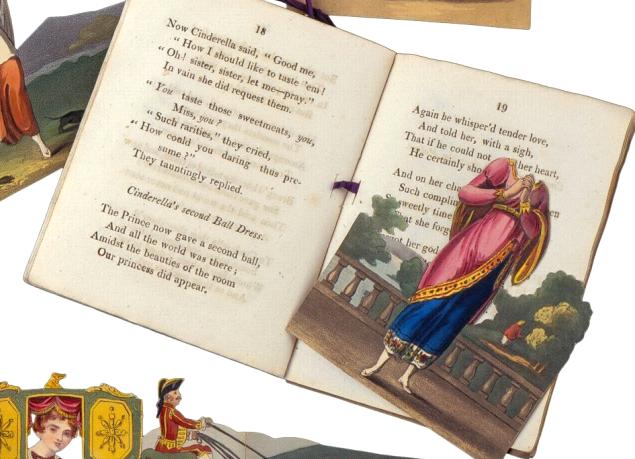
The image below contains fancy gowns and the marriage ceremony in which Cinderella marries her prince. Cinderella’s high-waisted costumes have a decided Renaissance influence, and the prince could have doubled for Romeo.

Image @Theriault's.

Cinderella’s head becomes much more refined once she hooks up with the prince, as you can see below. She is given a fashionable hat and a jeweled tiara with feathers. The head can also be placed on the figure in the carriage, when the Cinderella story has come full circle.

Image @Theriault's.

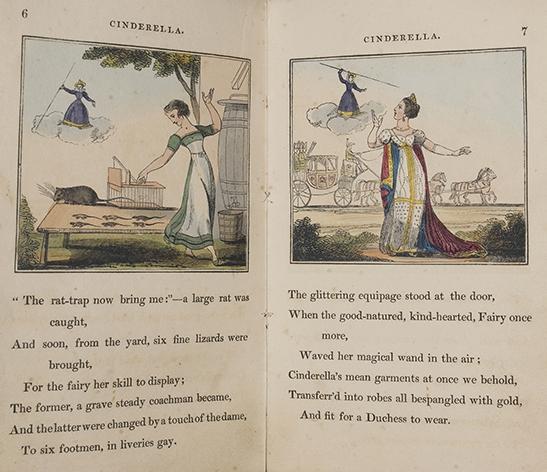
The beautiful versified edition of Cinderella below was donated in 1991 by Ms. Julia P. Wightman to the  The Morgan Library in New York.  Printed in 1819, the paper cut dolls seem more refined than in the 1817 version, especially Cinderella’s head, which has blond hair. Click on the open book images to read portions of the verse.

Image @Morgan Library.

Image @Morgan Library.

Image @Morgan Library.

Image @Morgan Library.

Image @Morgan Library.

The image below is from Picturing Childhood: The evolution of the illustrated children’s book.  Therieaults the Doll Master, Cinderella Paper Dolls, 1814, Published by S. and J. Fuller, London, 5 3/4 in. (14.6 cm) (approx.) Note that Cinderella’s elegant head is placed in the wedding scene. In this instance her hair is dark again..

Image @Picturing Childhood

Below is a more traditional children’s book version of Cinderella. It was published in 1827 and illustrated with hand–colored woodcuts. By the mid-19th century, lithography and printing were being used routinely in book illustrations, but such drawings were still rare when this book came out.

Cinderella, John Harris, London. 1827

In 1812, the Brothers Grimm wrote the Cinderella story that seems more familiar to readers today. By the end of the 19th century, over 300 versions of the Cinderella story existed in Europe. In those years:

The Fairy–Godmother seems more frightening than her later benevolent renderings, such as in Disney’s film version of the story. – Past Times: Cinderella :18th and 19th century Cinderella books.

More on the Topic:

Read Full Post »

« Newer Posts - Older Posts »