This Jane Austen blog brings Jane Austen, her novels, and the Regency Period alive through food, dress, social customs, and other 19th C. historical details related to this topic.
Last month, June 19-22, I had the joy of attending JASP, the Jane Austen Summer Program. I had only attended once before, during covid when it was online. That was fantastic, so I was delighted to finally get to go in person.
This year’s theme was Sensibility and Domesticity. The focus was on Sense and Sensibility (S&S), domestic arts, and trans-Atlantic connections between the young USA and Austen’s England.
Laura Klein and Megan Poff play and sing pieces from Jane Austen’s own playlist that relate to Sense and Sensibility, such as “Begone Dull Care” which they connected with Willoughby. JASP 2025
Plenary Sessions
Plenary talks explored household books of the time; effects of the war on home life; “The Constitutional Safeguard of a Flannel Waistcoat”; and the Jane Austen Playlist, with a performance of songs connected to S&S.
In “Reading the Americas with Jane Austen,” Susan Allen Ford (author of What Jane Austen’s Characters Read And Why) explained what Austen would have learned about the Americas in books Austen is known to have read. For example, novelist Charlotte Turner Smith used her study of botany and travel writing to describe American scenery, as a teaching technique. In the introduction to her collection of tales, The Letters of a Solitary Wanderer, Smith argues that “young persons, who have no taste for any thing but narrative, may sometimes, by the local description of a Novel, learn what they would never have looked for in books of Geography or Natural History.” However, she presents Native Americans as savage and violent.
Anne Grant’s Memoirs of an American Lady, which Austen also read, gives a different perspective. It shows Native Americans as noble friends. Grant grew up in close contact with Mohawks, even learning to speak their language. Austen was able to get multiple perspectives on North America.
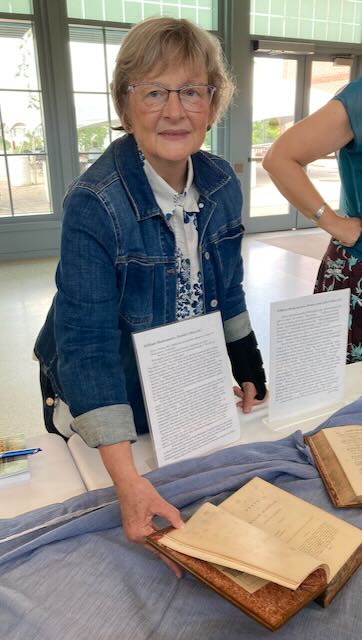
Susan Allen Ford, who spoke on Austen’s readings about America, shows rare books. JASP 2025
Jennie Batchelor, author of Jane Austen Embroidery, offered two fun embroidery workshops and a final plenary on “Transatlantic Domestic Arts in the Era of Jane Austen.” Jennie told us about resources used by women in England and America at the time, such as The Young Ladies School of Arts. That book gives instructions and receipts (recipes) for many kinds of ladies’ activities, from breeding canaries to gilding. It includes the technical, scientific knowledge needed for many of these skills. Fashionable boarding schools also taught such arts.
As one example, Sense and Sensibility mentions filigree work, which Lady Middleton expected Lucy to do at night by candlelight. Elinor kindly volunteered to assist Lucy. Filigree is quilling: cutting and rolling up small pieces of paper and fastening them onto a surface. This was quite fiddly, eye-straining work that Lucy was constrained to do in order to please her hostess.
Jennie Batchelor led two embroidery workshops, following patterns she adapted from magazines of Austen’s time. Some participants are tracing patterns onto their fabric at the windows, as Austen might have done. JASP 2025
Context Corners and Discussion Groups
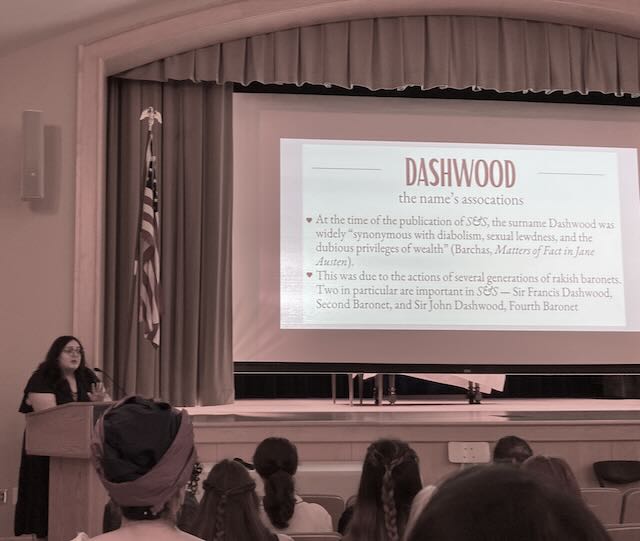
I was particularly looking forward to one special feature of JASP: context corners and discussion groups. Graduate students led four 15-minute sessions (“context corners”) discussing various aspects of Sense and Sensibility. Topics connected S&S with sensibility and sisters; inheritance law; the East Indies; and “Scandal and the Fallen Woman.” For that final topic, we considered when the “fallen woman” was considered morally corrupt and when she began to be considered as a victim of immoral men or capitalism. We also learned definitions of a “rake” and saw comparisons with real people, noting similarities between William, Lord Craven, and the fictional John Willoughby.
In a Context Corner on “Scandal and the Fallen Woman,” Nellie Downie told us about a real Dashwood family who were involved in various scandals. They were quite different from Austen’s Dashwoods. JASP 2025
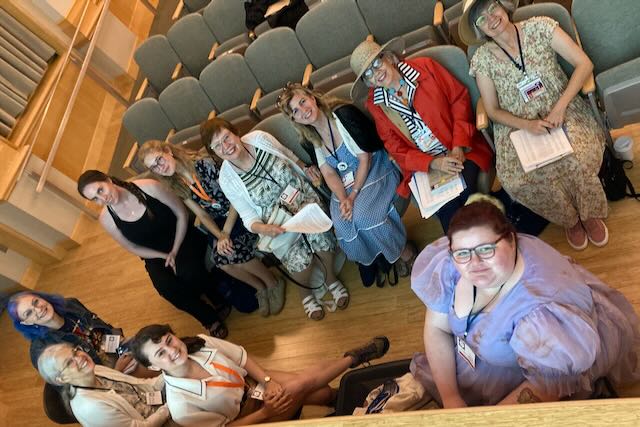
After each context corner talk, we split up into small groups named after places in S&S. Mine was Norland Park. Using lists of excellent discussion questions and quotes, we had far-ranging discussions which were great fun. We had 45-60 minutes per discussion, so we could really get into it and trade ideas, building off of each other’s insights.
Education was a major emphasis of the conference, and teachers had their own forums in addition to the regular events.
In the Norland Park group, as in all the other groups, we had lively discussions on many aspects of Sense and Sensibility. JASP 2025
And More Delights
The rest of the time was filled with fun events, including:
An opening banquet
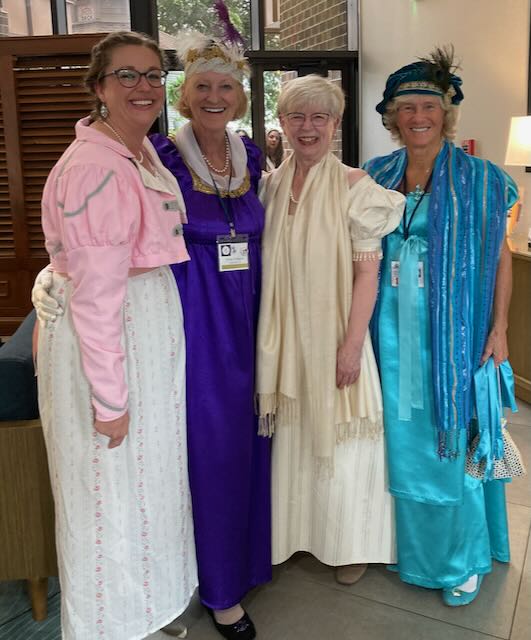
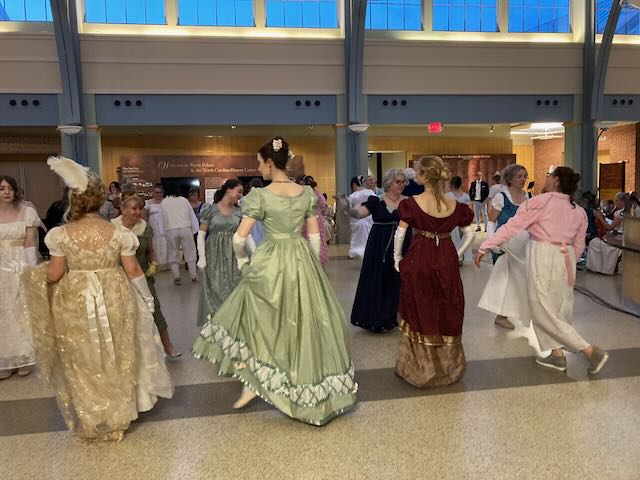
Multiple fun dance practices with “Mr. Steplively” and a Saturday night Regency Ball, with Regency Games for those who preferred not to dance. (A nice touch was the availability of reasonably priced costumes for those who wanted to rent Regency gowns.)
Ready to promenade from the hotel to the ball. Breckyn Wood, Erna Arnesen, Betty Parker Ellis, Jeanne Talbot, JASP 2025.
Dancing at the Regency Ball, JASP 2025
A theatrical evening, where we got to watch an original play connected S&S with Hamlet, and a screening of Sense and Sensibility: The Musical, a delightful take on the novel.
An adaptations panel which included music and costumes used in film versions of S&S, and more.
Optional tours
An emporium selling Jane Austen Books along with other fun items, and a silent auction.
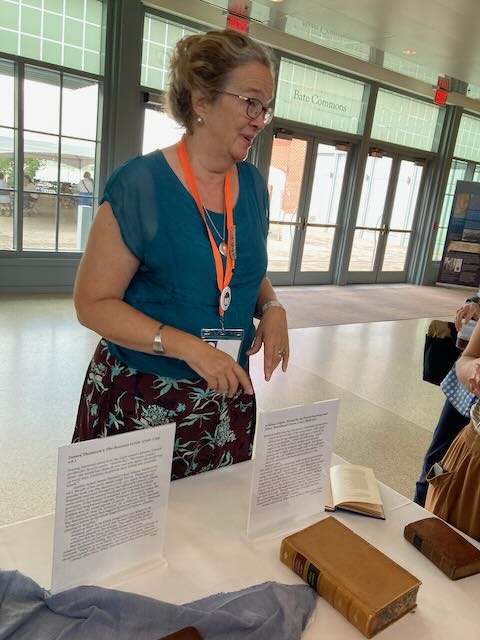
A display of early editions of S&S and contemporary books by William Cowper, Sir Walter Scott, James Thomson, William Gilpin, and more.
Inger Brodey, president of the Jane Austen Collaborative (of which JASP is a part), shows her early copies of books by Thomson and Gilpin.
Location, Location
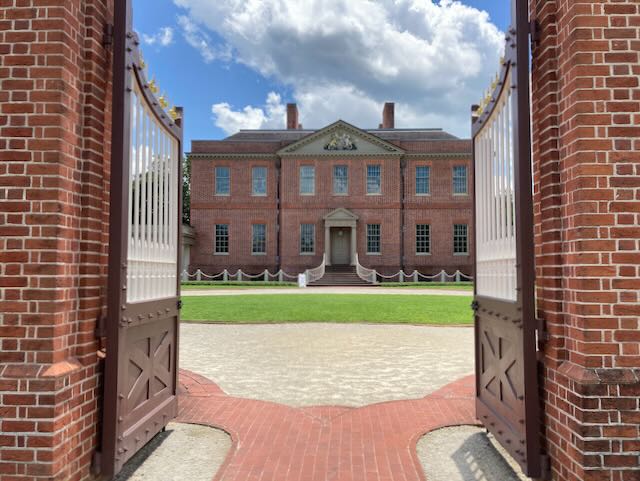
Past JASPs have been held at UNC-Chapel Hill. This year about 150 participants met in New Bern, a historic town near the coast in North Carolina. Waterside views were lovely, and we got to tour the beautiful Tryon Palace and its extensive grounds. Our sessions were held at the North Carolina History Museum nearby.
Next summer, JASP is moving to Seton Hill University in Greensburg, Pennsylvania. The topic will be Pride, Prejudice, and the Pursuit of Happiness. I’m hooked on this great program, and I hope to see some of you there!
Tryon Palace, first permanent capitol of North Carolina, also Governor Tryon’s home, completed in 1770. Reconstructed and reopened in 1959. Well worth a visit! JASP 2025
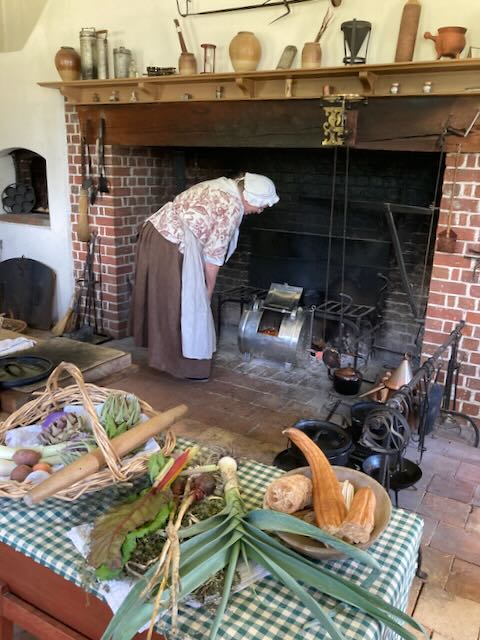
Touring the Tryon Palace was like touring an aristocratic home of Austen’s day, with period-appropriate furnishings, all the way down to the kitchen, where a real chicken was roasting in the fireplace. JASP 2025
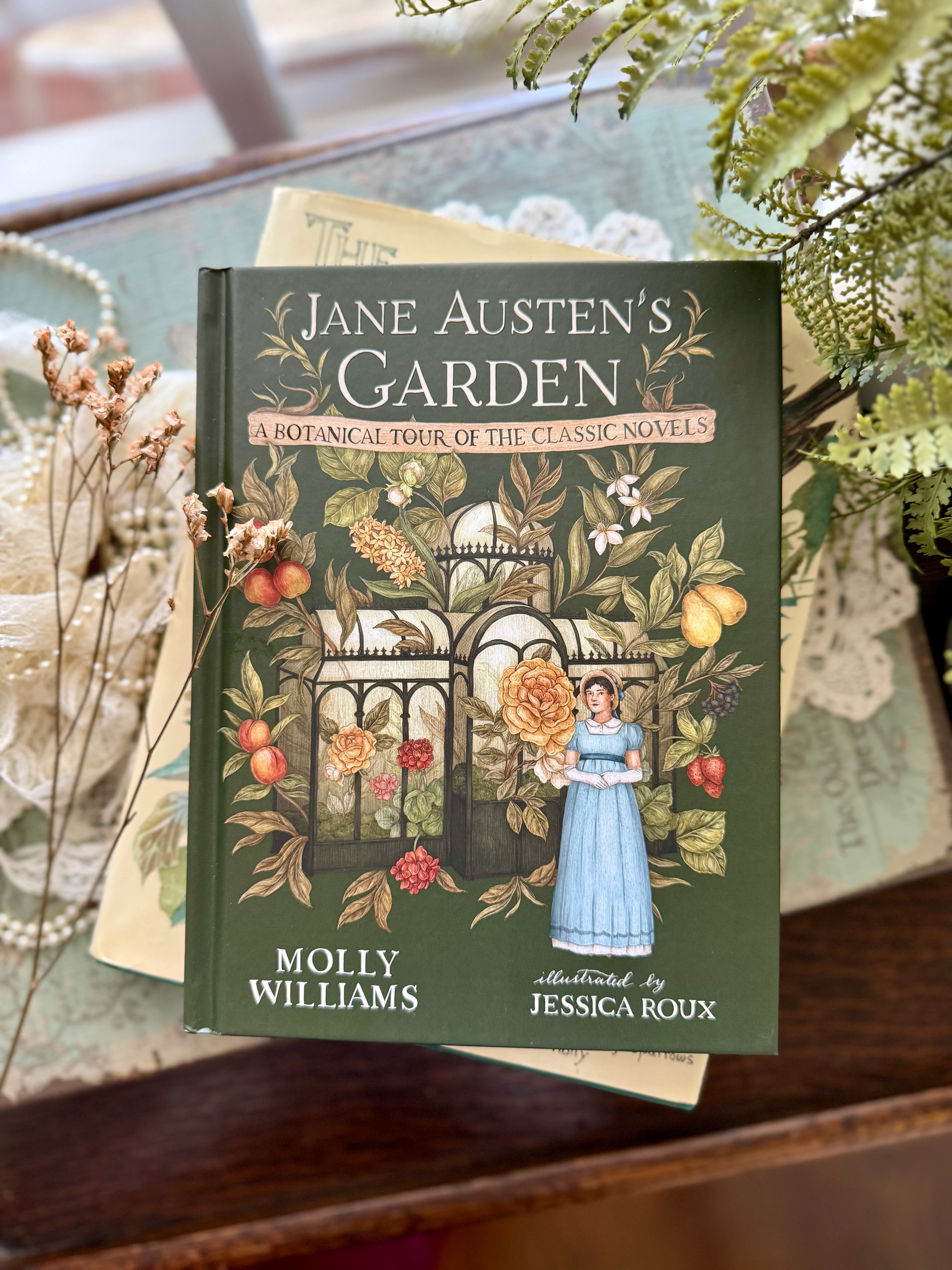
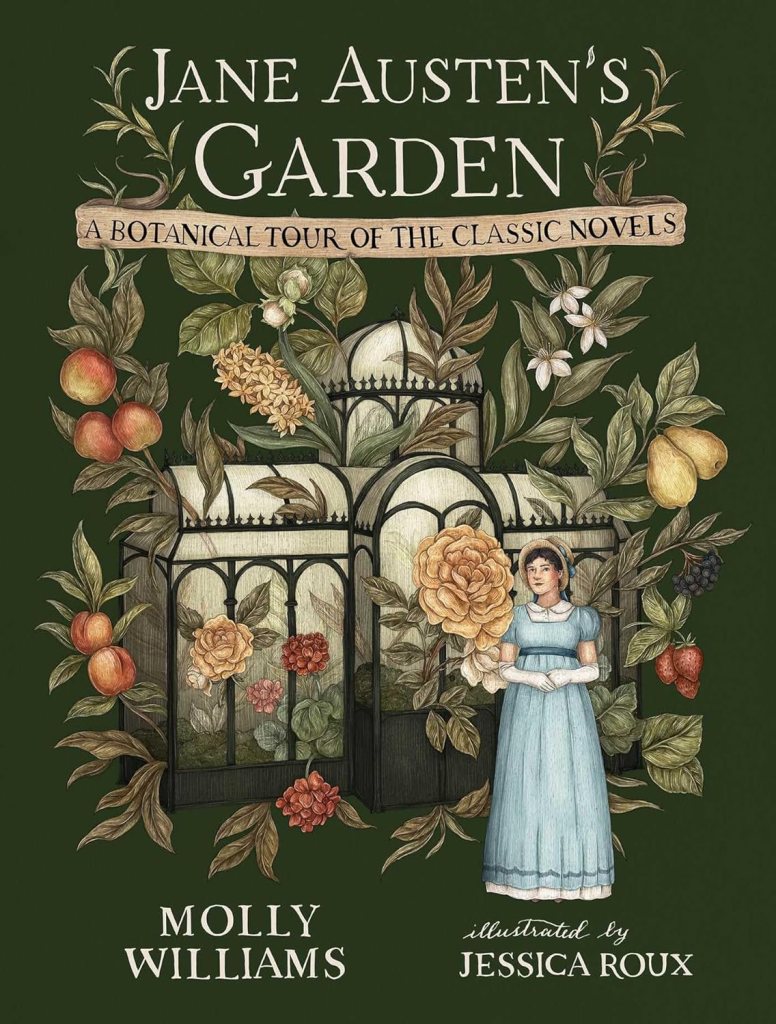
Fellow Janeites, I have a new book review for you in honor of Jane’s 250th year: Jane Austen’s Garden: A Botanical Tour of the Classic Novels written by Molly Williams and illustrated by Jessica Roux. This new book pairs two of my favorite things: Jane Austen and gardening! I looked forward to its release for months and it now sits prominently on my shelves!
I knew this book would be beautiful, and I confess that I preordered it based on how pretty it looked. I have another gorgeous book by Jessica Roux called Floriography: An Illustrated Guide to the Victorian Language of Flowers. I’ve always been drawn to the language of flowers and their meanings.
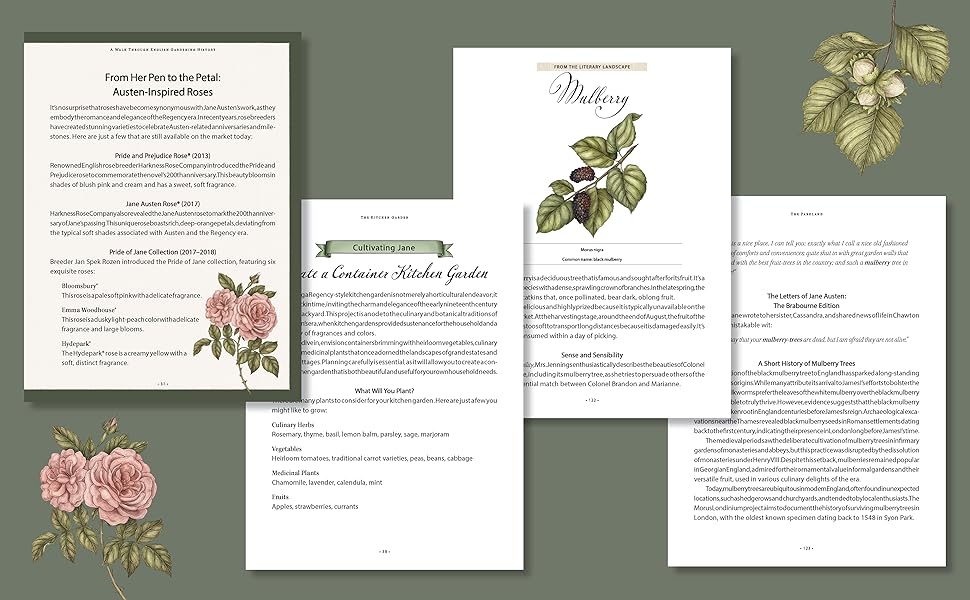
When I ordered it, I assumed Jane Austen’s Garden would mostly include drawings and tidbits of information. However, when it arrived, I discovered that it is filled with detailed information about the flowers, plants, trees, fruits, and vegetables mentioned in Austen’s novels and in her own garden and kitchen garden! There are even instructions about how to grow your own fruits and vegetables at home.
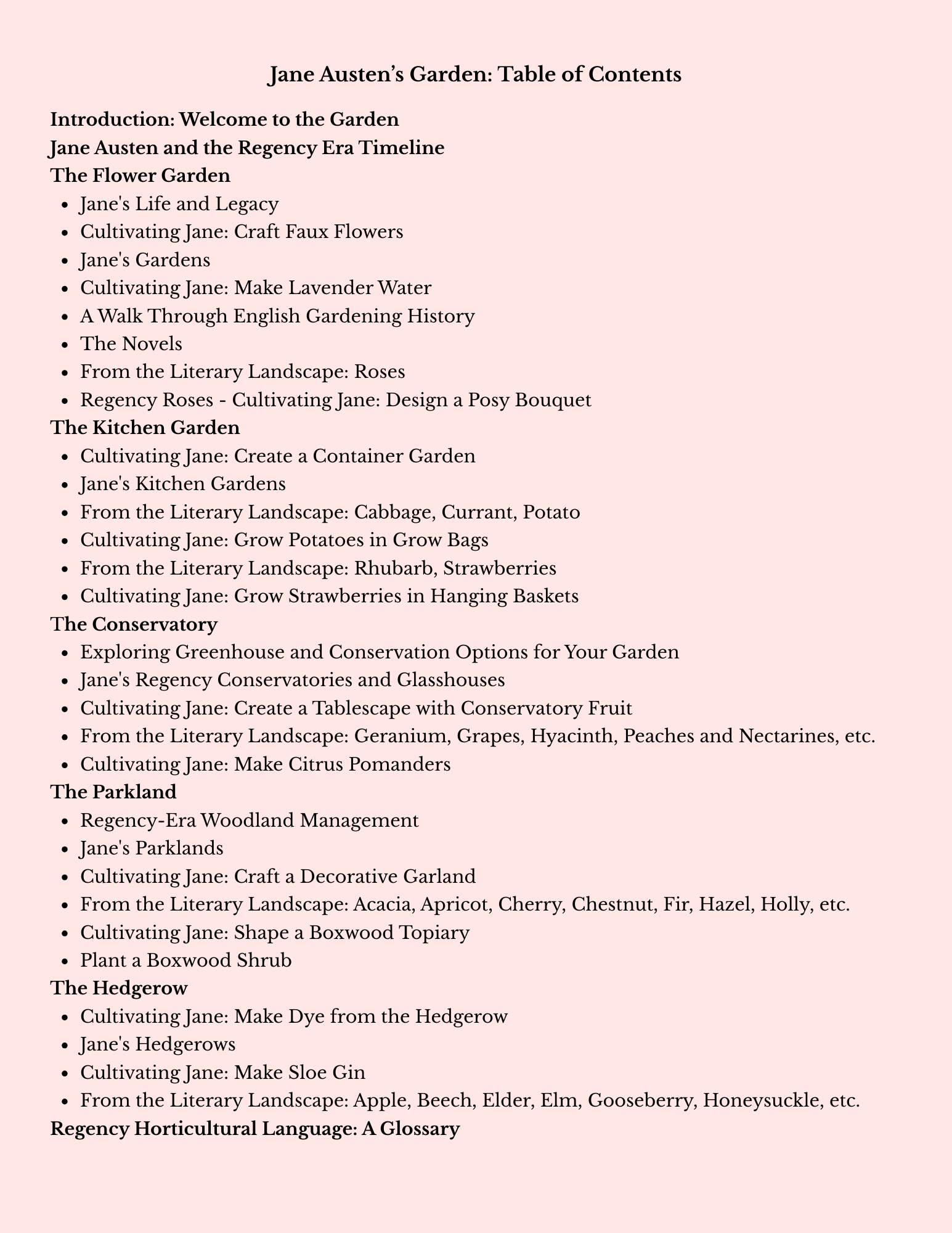
And don’t let the Table of Contents fool you. This book has a LOT to offer. The editor(s) merely listed the craft projects in the book in the Table of Contents, which does a great disservice to Williams’ painstaking research and intriguing information. Williams provides ample material for Jane Austen fans and has done a wonderful job of researching every detail of this book.
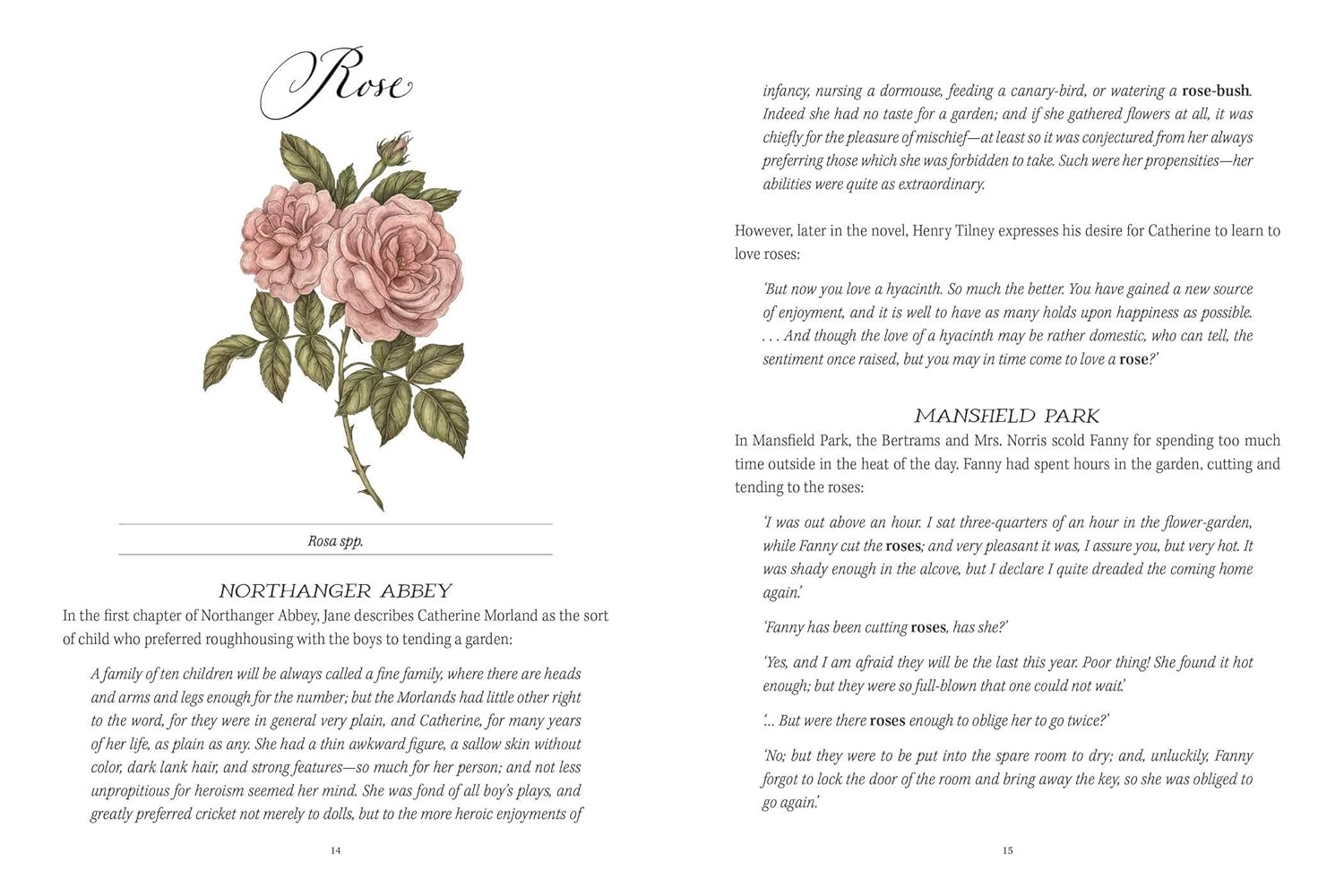
In each chapter, there is a section entitled “From the Literary Landscape.” This is the best part!! This is where Jane Austen fans can really dig into Williams’ research. She outlines the instances when various trees, fruits, or flowers are mentioned in the novels (or how the Austens used them in their everyday lives). Then, Williams goes into detail about what they signified and/or their history. As many of you know from my articles over the years, I love to look for specific items in the novels and research them.
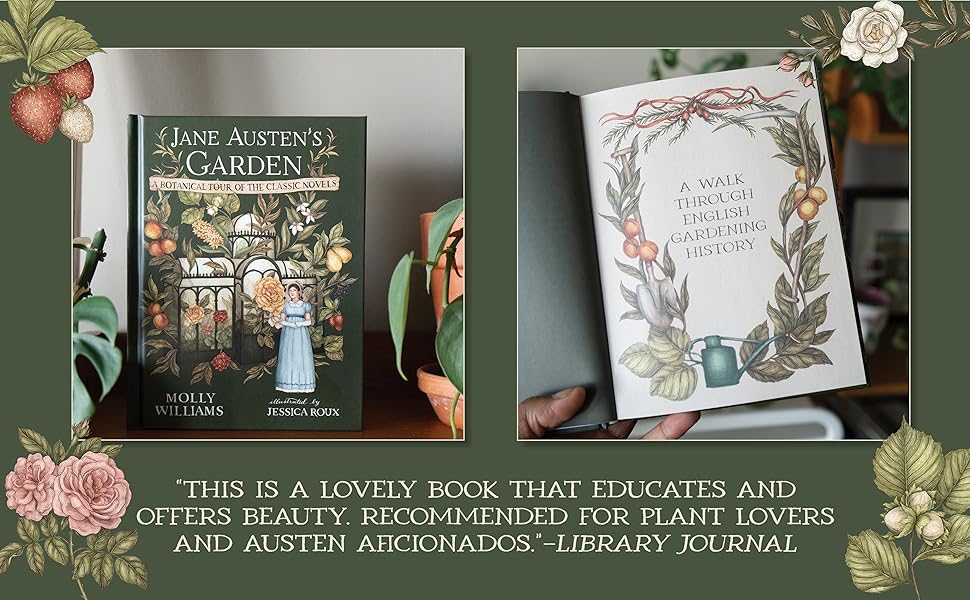
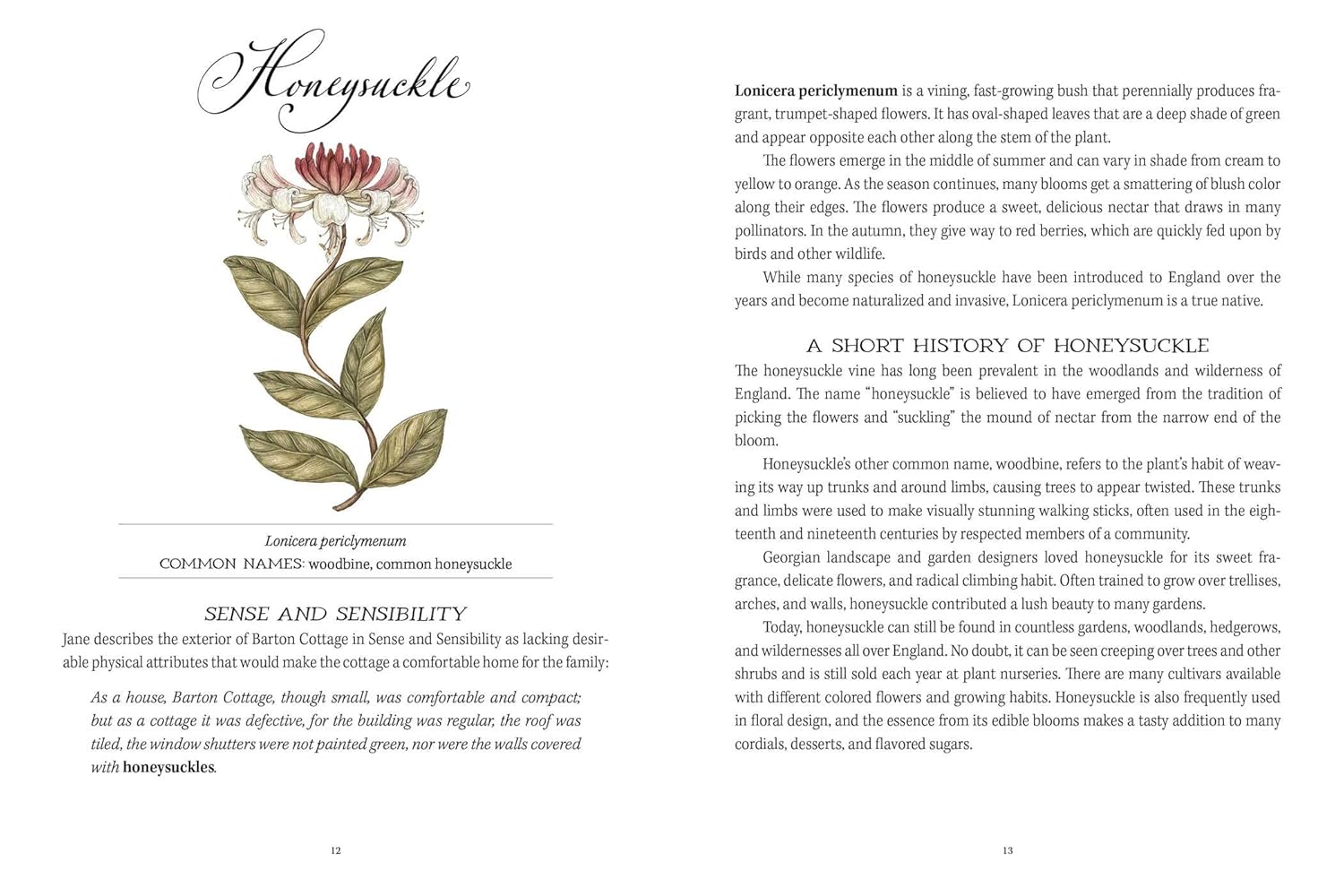
Finally, the illustrations in this book are to die for. Truly, Roux is a most extraordinary artist. You can see more of her art HERE. I truly could look at it all day long!!!! I have a dream of writing a book with botanical illustrations one day, and I can’t imagine having someone like Roux do the artwork. She brings Williams’ research to life and captures the Regency imagination beautifully.
Book Description
An elegantly illustrated celebration of Jane Austen’s life and literature as told through the flowers, plants, and landscapes that inspired her.
Through explorations of the botanical inspirations and symbolism in Austen’s work and personal life, as well as historical information about the gardens and landscapes of the Regency Era, Jane Austen’s Garden will transport readers back in time to the lush English landscape of the early 1800s. Woven throughout are DIY projects to help you create a home garden worthy of a surprise visit from Lady Catherine de Bourgh or maybe just give your dining table a bit of historical flair. Accessible, entertaining, and enhanced by the enchanted illustrations of celebrated artist Jessica Roux, Jane Austen’s Garden is a fun twist on a familiar subject that will delight plant lovers and Janeites alike.
Book Contents
The Table of Contents is misleading as it only outlines the various DIY projects you can try at home. The book itself has a LOT more meat to it, so don’t let the overview dissuade you from purchasing it. In an effort to provide a fuller picture of all that Williams included, I created a full outline of the book:
Below are two examples of how Williams includes information about different flowers and plants in the novels, along with more illustrations from Roux:
About the Author and Illustrator
Molly Williams is the author of Killer Plants: Growing and Caring for Flytraps, Pitcher Plants and Other Deadly Flora, and Taming the Potted Beast: The Strange and Sensational History of the Not-So-Humble Houseplant, and she writes regularly for Apartment Therapy‘s gardening and horticulture section. She grew up on a flower farm and is now a professor of writing in New England. You can visit her online HERE.
Jessica Roux is a Nashville-based freelance illustrator and plant and animal enthusiast. She loves exploring in her own backyard and being surrounded by an abundance of nature. Using subdued colors and rhythmic shapes, she renders flora and fauna with intricate detail reminiscent of old-world beauty. She is the author and illustrator behind Floriography: An Illustrated Guide to the Victorian Language of Flowers, Ornithography: An Illustrated Guide to Bird Lore & Symbolism, and the Woodland Wardens Oracle Deck & Guidebook. You can visit her online HERE.
250 Years of Bookish Bounty
Books like these truly make the 250th celebration of Jane Austen’s life, writing, and legacy a true gift and a joy. I’m so thankful to the authors, illustrators, editors, and publishers who make books like this possible. The bounty of books releasing this year is a wonder to behold. I hope you’ll check this one out and add it to your bookshelves!
“There must have been many precious hours of silence during which the pen was busy at the little mahogany writing-desk, (This mahogany desk, which has done good service to the public, is now in the possession of my sister, Miss Austen) while Fanny Price, or Emma Woodhouse, or Anne Elliott was growing into beauty and interest.”–A Memoir of Jane Austen by James Edward Austen-Leigh, her nephew
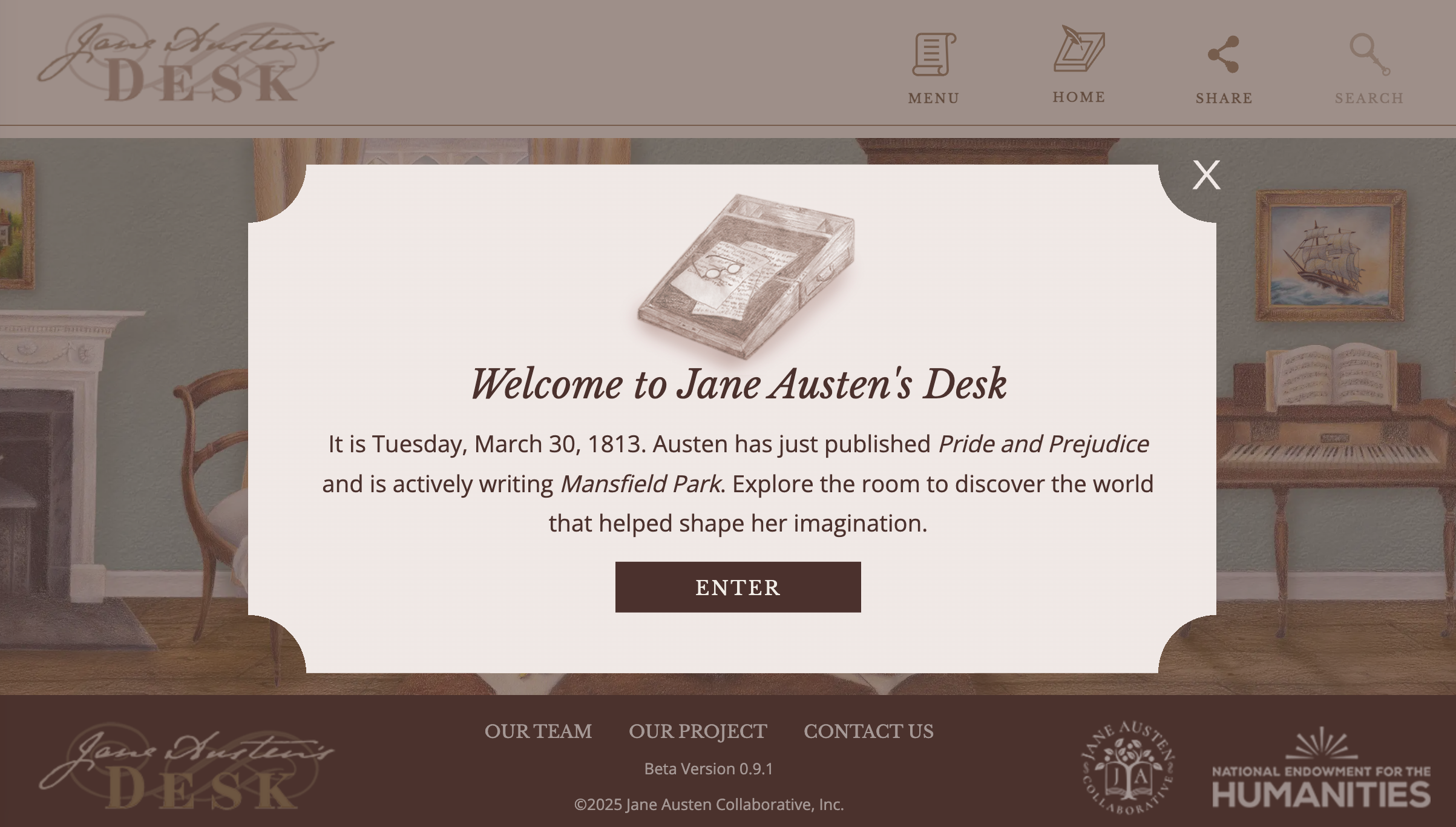
Welcome page to the website “Jane Austen’s Desk”
Wouldn’t you love to explore Jane Austen’s desk and room? Inger Brodey, Sarah Walton, and their amazing team at the Jane Austen Collaborative are recreating Jane’s desk and room for us to visit virtually.
While the website is still a beta version, I found lots of great information there. The plan is for it to become a “portal” linking to many Austen resources.
The site opens with a view of a room loosely based on the drawing room of Jane Austen’s House in Chawton
Jane Austen’s Desk
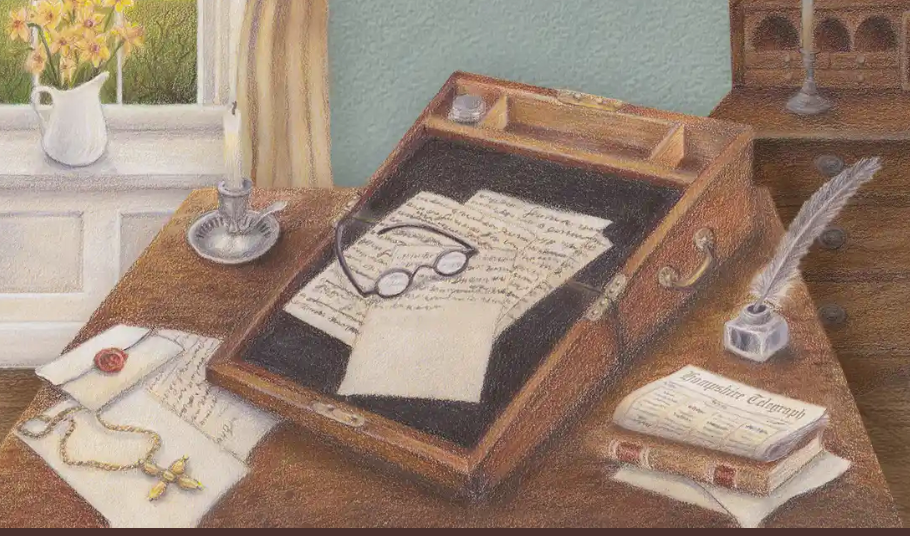
When you visit the room, you might want to start at the desk itself—Jane’s travel desk sits on a table. You’ll see manuscripts of several of the novels, which you can open and enjoy in early editions. Commentary tells more about the novel and the edition, with direct links to interesting sections like “Darcy’s list of desirable female accomplishments” and “Fanny asking about the slave trade.”
Nearby are newspapers, one of the most fun links. Several contemporary papers are included. You can hone in on a number of interesting articles, ranging from her brother Edward’s selling part of Stoneleigh Abbey, to reports of her brother Frank’s naval exploits, to the story of a swindler who pretended to be a rich person’s housekeeper!
Jane Austen’s travel desk (the real one is owned by the British Library). The manuscripts on the desk, the newspapers next to it, and the cross, take you to various resources.
The Bookshelf
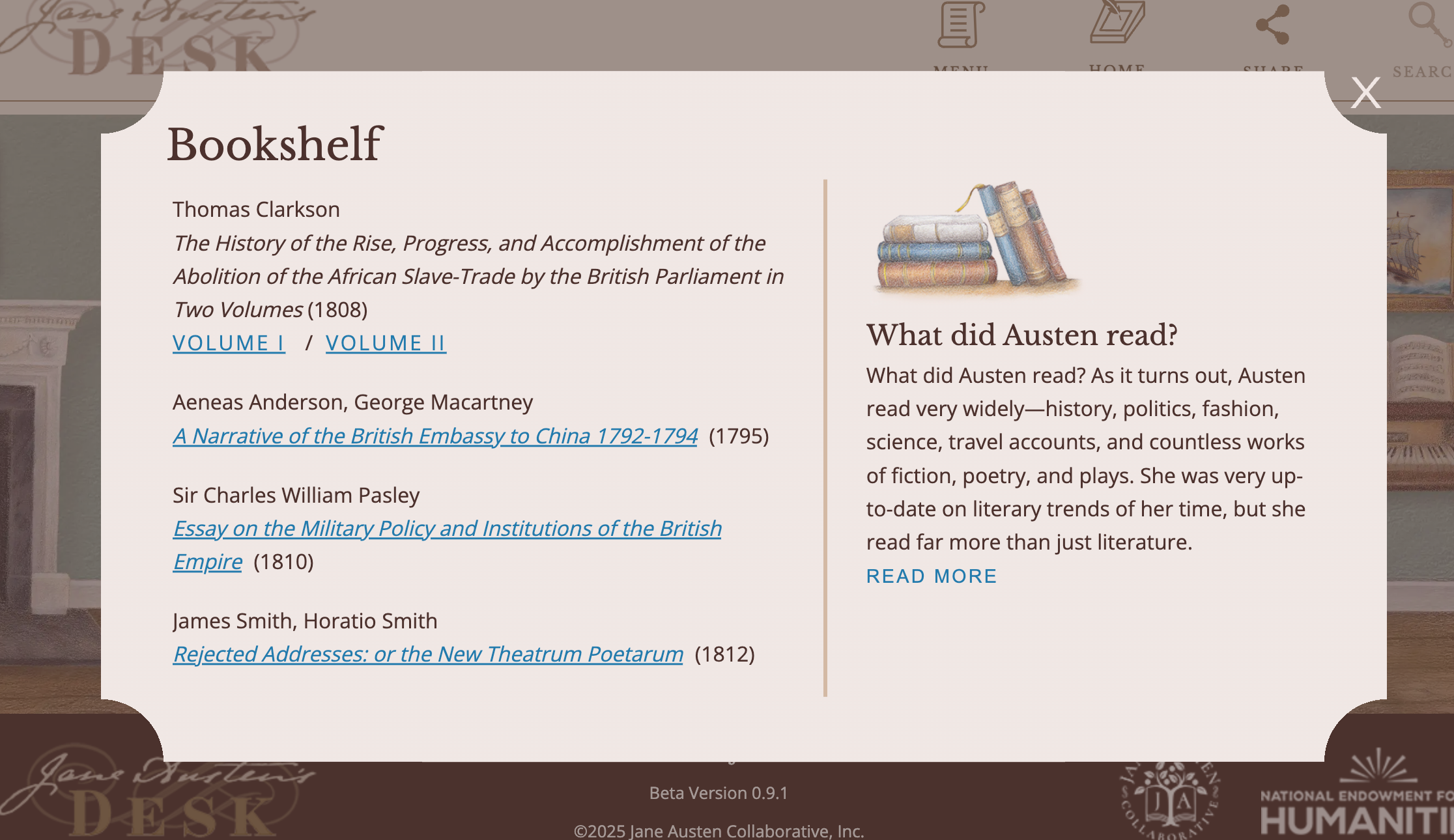
Click on the bookshelves in Rev. Austen’s bureau-bookcase , and you’ll see some books mentioned in Austen’s writings. I expect this will be expanded later. But for now, you can read from several authors Austen said she was “in love with”—Thomas Clarkson (on abolition), Sir Charles Pasley (on the military), and James and Horatio Smith (verse parodies). We also have a book that Fanny Price was reading, George Macartney on the British Embassy to China.
For each, you will find an easy-to-read early version of the book; clear commentary; pictures; and links to relevant passages in the novels and letters. Two also link to related articles. A great start if you want to explore these books connected to Austen!
Catalogs on the ledge of the bookcase open up to records of the Alton Book Society that Austen enjoyed. You’ll find lists of members, rules, and lists of the books that the members, including Austen, traded around. This gives us another peek into Austen’s life and reading.
The Bookshelf takes you to some books Austen read.
Travels
A pianoforte stands next to the bookcase. It will eventually be connected to Austen’s music.
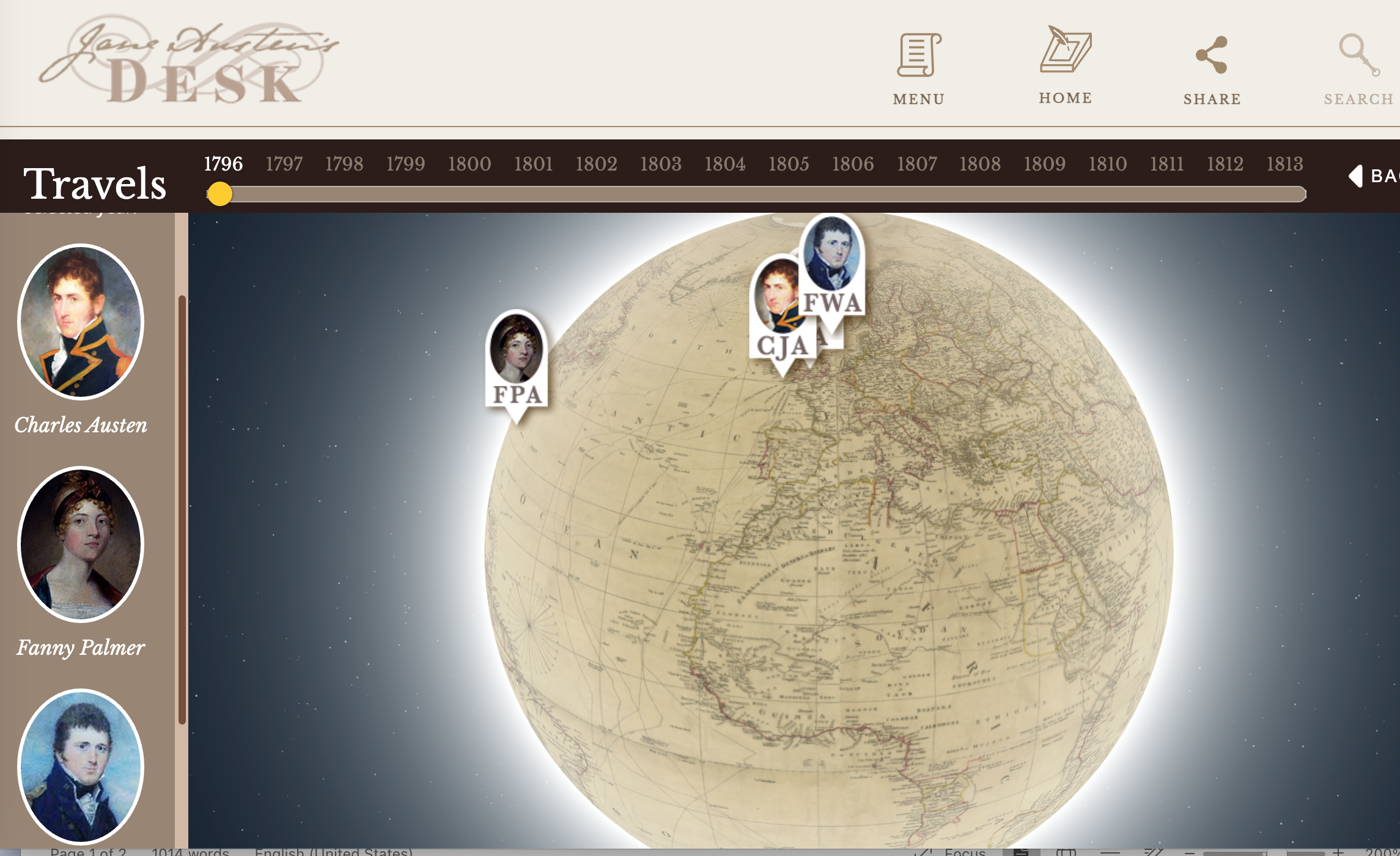
Above the pianoforte, click on the portrait of a ship on the sea. You go to a globe, where you can follow the travels of Austen’s family.
Jane Austen’s Desk, travel section. You can trace the positions of Frank and Charles Austen, Charles’s wife Fanny Palmer, and Jane Austen herself, year by year. You can also read stories about Frank and Charles’s experiences at sea.
Silhouettes on the wall connect you to Jane Austen’s family tree. If you click on the orange “i”, you get more information about each person. The plus buttons reveal more generations.
Many of these features include audio commentary as well as written commentary. For example, Lizzie Dunford of Jane Austen’s House tells us about the topaz crosses Charles brought back for his sisters.
There are great possibilities for future additions.
JAW: Inger, what gave you the idea for doing this website?
Inger: I was interested in Austen’s own creative process, and also in countering the myth that she was not well informed in the science and politics of her day. I found a kindred spirit in Sarah Walton, who was a grad student when we started. In the 1990s, both Sarah and I had been enchanted by JK Rowling’s website with clickable, magical elements on her desk to interact with.
JAW: How is the website being funded?
Inger: We have received two rounds of funding from the National Endowment for the Humanities, and have applied for more. We intend to create a GoFundMe or Kickstarter campaign to seek private funding to support specific new developments, such as the learning games we have in mind.
JAW: What are some parts you are excited about adding in the future?
Inger: The current setting is Spring 1813, while [Jane Austen] is writing Mansfield Park. Eventually we hope to add additional settings: for example, Summer or Winter 1814, when she was composing Emma; or Autumn, 1815, when Persuasion was in process.
JAW: What are some parts that you and your team are finding challenging?
Inger: Well, it all takes much more time to create than one would imagine. We have a great team of programmers and designers, including the wonderful Harriet Wu who has drawn the site by hand. We constantly try to find the sweet spot where we can appeal to both scholars and the general public, and to all ages. Just as with our Jane Austen Summer Program, we also focus on providing tools for educators who wish to bring Jane Austen into the classroom.
JAW: What other ideas do you have for expansion in the future?
Inger: As you can see on the site, there are many objects with potential to “animate” in the future. We are collaborating with Laura Klein to add music to the piano, Jennie Batchelor for sewing, and have plans for links to weather and agricultural information (via the scene out the window), tea culture (via the kettle), letter writing (via a folded letter), and many more.
We applied for a grant to develop a state-of-the-art platform for navigating, reading, notating, and analyzing Austen’s novels, including the potential for crowd-sourced editions.
As long as we can continue to find funding, I think this will be a lifelong project—there is so much potential to grow!
JAW: Thanks, Inger, we look forward to that!
The Desk, the Summer Program, and Online Talks
Gentle readers, I recommend you explore Jane Austen’s Desk. The website has not yet been configured for mobile phones, so you’ll need to access it on your computer or tablet.
When you’ve finished exploring, go back to the main page and take a survey, to possibly win a prize. The survey takes some thought and time, but you will get to give input for what you’d like to see in the future at this very helpful site.
The same Jane Austen Collaborative who created Jane Austen’s Desk also runs the Jane Austen Summer Program. This year it will be held June 19-22, 2025, in North Carolina. The theme is “Sensibility and Domesticity,” exploring “topics including medicine, birth, and domestic arts in Regency England and colonial North Carolina.” They will “focus on Austen’s first published novel, Sense and Sensibility—considering the birth of her career as a published writer as well as taking a transatlantic look at the world into which she was born.” I’m signed up, and would love to see some of you there!
Of course, even if you can’t get to North Carolina, you can always enjoy Jane Austen & Co.’s great offerings online. They are currently exploring Music in the Regency; I enjoyed a recent talk on Women & Musical Education in the Regency Era, by Kathryn Libin. Get on their mailing list for announcements of upcoming events.
They generously provide free access to recordings of their previous talks, on topics including “Austen and the Brontes,” “The Many Flavors of Jane Austen,” “Everyday Science in the Regency,” “Reading with Jane Austen,” “Asia and the Regency,” “Race and the Regency,” and “Staying Home with Jane Austen.” Something for everyone, it seems to me.
“The Prices were just setting off for church the next day when Mr. Crawford appeared again. He came, not to stop, but to join them; he was asked to go with them to the Garrison chapel, which was exactly what he had intended, and they all walked thither together.”—Mansfield Park, chapter 42
The Garrison Chapel in Portsmouth, where the Price family and Henry Crawford worshiped.
Real Churches in Austen’s Novels
The Garrison Chapel (now called the Garrison Church) is one of a handful of specific, real churches Jane Austen mentions in her novels.
In Northanger Abbey, John Thorpe passes “Walcot Church,” St. Swithin’s on the edge of Bath. We hear about the “church-yard” in Bath, adjacent to Bath Abbey, though the Abbey is not named. Catherine Morland looks for the “well-known spire” of Salisbury Cathedral on her way home. (See “Churches, Chapels, Abbeys, and Cathedrals in Northanger Abbey”.)
In Pride and Prejudice, Wickham and Lydia get married at St. Clement’s in London, possibly St. Clement Danes in London’s city of Westminster, or St. Clement Eastcheap, near London Bridge. By the way, it’s not clear which of those is the St. Clement’s of the old nursery rhyme about London church bells, which begins “Oranges and lemons, say the bells of St. Clement’s.”
In Mansfield Park, Mary Crawford mentions St. George’s, Hanover Square (in Mayfair, London) as a place for weddings. Dr. Grant seeks a promotion to Westminster Abbey or St. Paul’s Cathedral (he gains a prebendal stall at Westminster). And the Prices attend church at the “Garrison Chapel” in Portsmouth.
All these churches can still be visited, though the Garrison Church is partly in ruins. (Have I missed any churches named in Austen’s novels? Let me know in the comments if you have noticed others!)
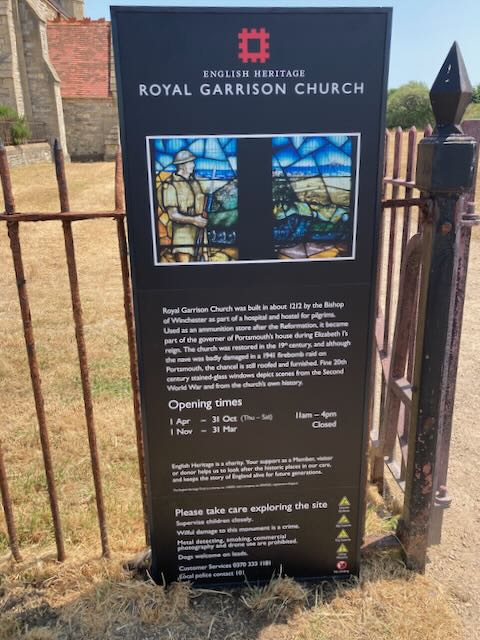
The Royal Garrison Church, now run by English Heritage, can be visited on certain days, April through October. Admission is free.
The Garrison Chapel in Portsmouth
What was the Garrison Chapel? It was called a chapel, not a church, at that time, since “church” meant the Church of England main church of a parish. There were several types of chapels. This one was an institutional chapel, connected to a certain place or group of people. It was the chapel for military troops serving in Portsmouth. Since Fanny Price’s father was a “lieutenant of marines,” this was the logical place for her family to worship.
Mansfield Park tells us, “In chapel they were obliged to divide, but Mr. Crawford took care not to be divided from the female branch.” Roger E. Moore, in Jane Austen and the Reformation, explains, “officers and sailors sit separately from civilians” (124). Presumably Fanny’s father joined his friends, his “brother loungers,” in one section, while his family, with Henry Crawford, sat in a different section.
Nave of the Garrison Church, originally a hospital, meaning a place of hospitality for the needy. Beds lined the sides. The roof was destroyed by bombing in World War II.
Origins
The Garrison Church building dates all the way back to 1212 A. D., over 800 years ago. The Bishop of Winchester founded it as a “hospital” called the “Domus Dei,” or “House of God.” It was not a place for medical care, but a place of hospitality. The poor, the ill, and people on pilgrimage could come there and find rest. Beds lined what later became the nave of the church.
Mass was said regularly in a chapel at the east end of the building. Residents would either attend services or listen from their beds if they could not stand. A priest was in charge, aided by twelve poor men or women. They helped look after visitors in exchange for bread, ale, and a place to stay.
According to Moore, the main hall was “surrounded by a complex of auxiliary buildings, including a master’s house and hall, kitchen, bakehouse, stable, and lodgings for the brothers and sisters who staffed it” (124-5). Income from nearby houses and land supported the work, just as medieval monasteries were supported by nearby properties.
Moore says that the mention of this place in Mansfield Park is significant. The “Domus Dei” (which later became the Garrison Chapel) gladly welcomed anyone who appeared there asking for entrance, regardless of social status. It is contrasted with Mansfield Park, where Mrs. Norris does not “gladly” welcome poor Fanny to the parsonage where she and her husband live. Even the Bertrams give Fanny only a small attic room, without even a fire for warmth. Moore also points out that when Fanny sees Henry in Portsmouth, she is impressed that he has been acting as a “friend to the poor and oppressed,” just as the brothers and sisters at the Domus Dei had done for many.
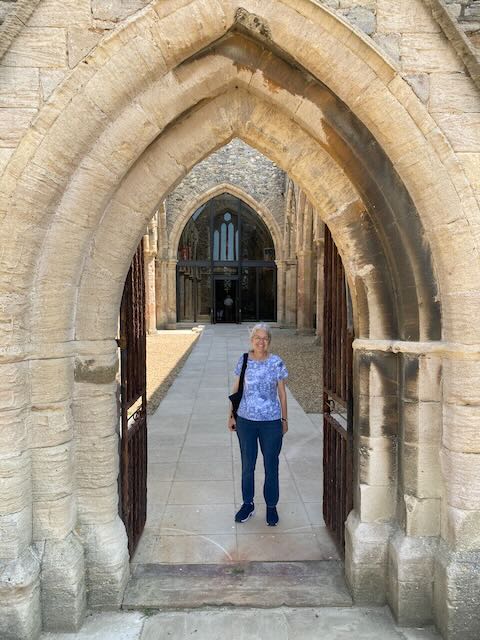
The author (Brenda Cox) at the entrance to the Garrison Church today. All visitors are welcome (at specified times), as in medieval times.
The hospital closed in 1540 when King Henry VIII suppressed the monasteries and other religious houses, including most such hospitals. Valuables were stripped from it, and the buildings were used to store munitions. Queen Elizabeth I expanded the fortifications at Portsmouth, made the large dormitory into a chapel for the garrison, and the rest of the buildings became the home of the garrison’s governor.
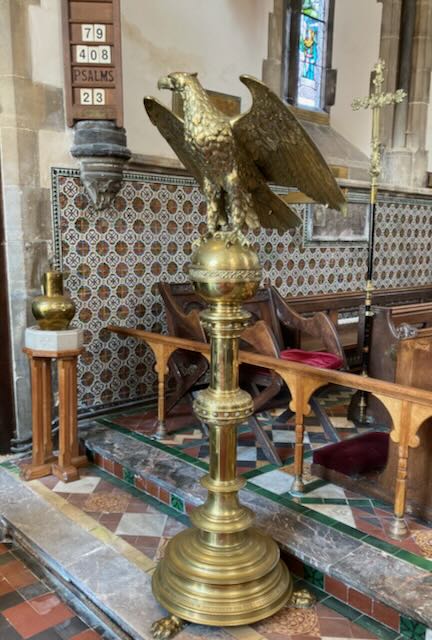
Eagle lectern in the Garrison Church, from 1801, commemorates Queen Victoria. Eagles were often used for church lecterns, which held Bibles or the Book of Common Prayer. Eagles were believed to be able to look at the sun, just as Christians look directly into God’s Word. It is also the bird believed to fly closest to heaven, symbolizing carrying God’s Word around the world. (Source: a guidebook in the church)
In 1826, the Governor’s house next to the chapel was demolished. Forty years later, restoration work began on the church (now called a church rather than a chapel), balancing “the original medieval appearance with Victorian needs and preferences,” according to a sign at the site. A new altar, pulpit, and stalls were added.
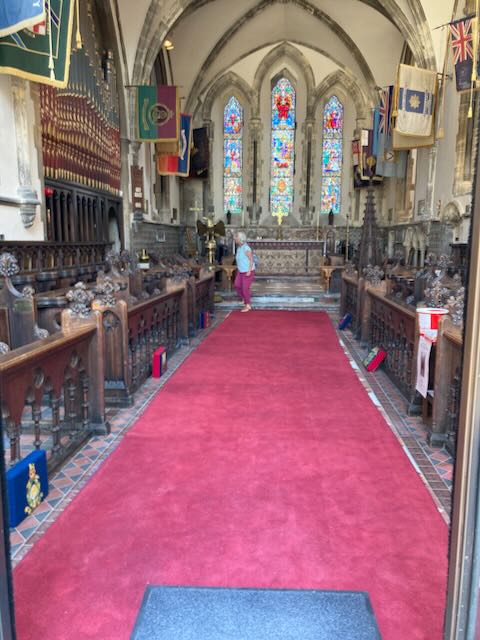
Garrison Church chancel today; furnishings are Victorian and later.
Garrison Church Today
The church was bombed in 1941, destroying much of the roof of the nave (the large hall that used to be the hospital). However, the smaller worship area, the chancel, survived and continued to be used. See this site for more about the church’s history.
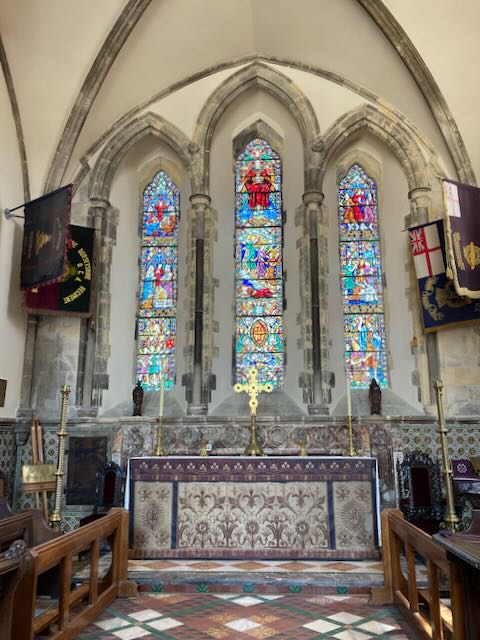
Stained glass windows with Bible themes above the altar of the Garrison Church, added in 1957.
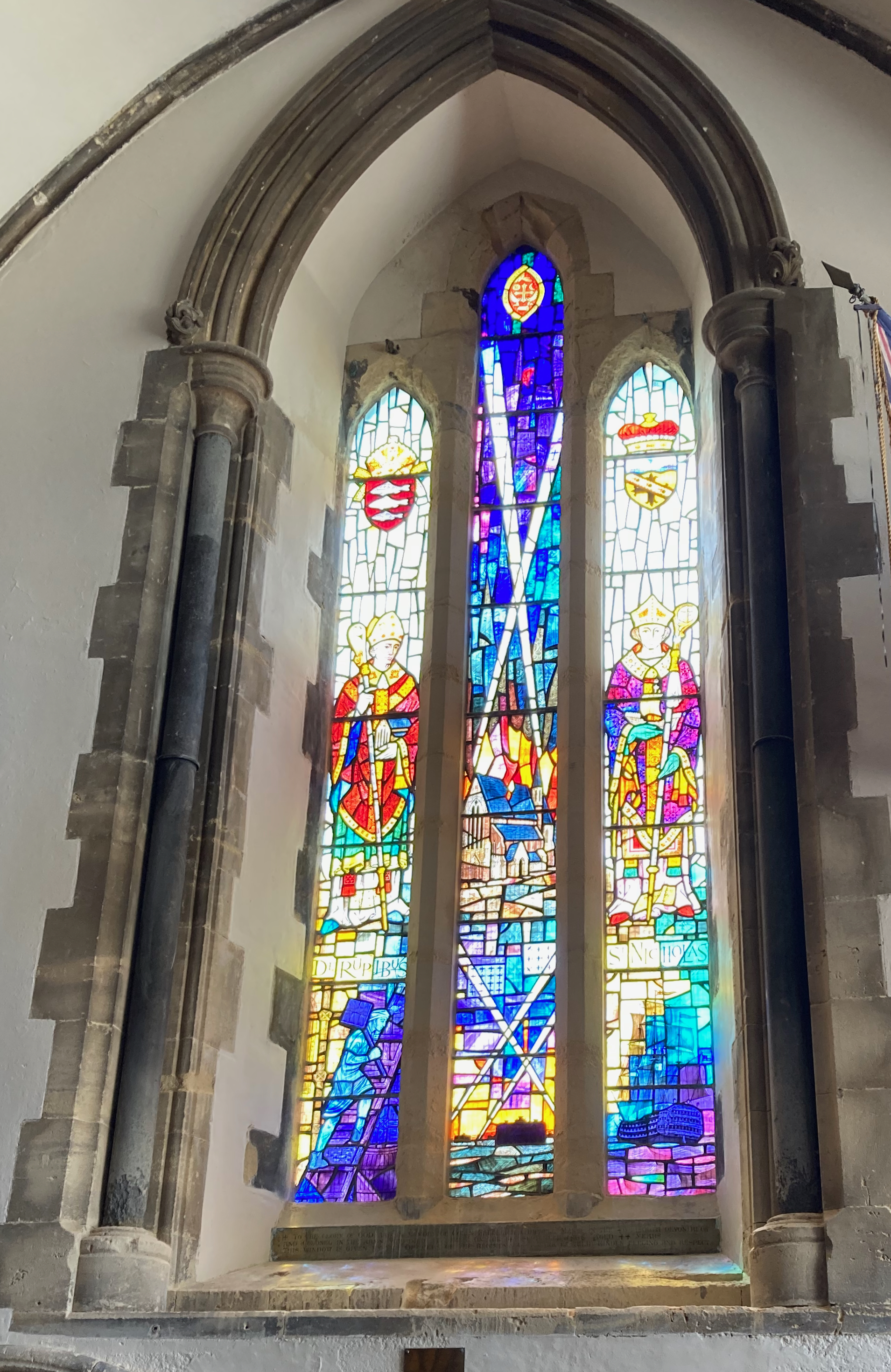
Garrison Church stained glass windows, added in 1967, depicting its history. The founder is on the left. Bombing of the church is depicted in the center. The right panel shows St. Nicholas, patron saint of the church. St. Nicholas is the patron saint of sailors, merchants, and travelers, appropriate for this port city. Vice-Admiral Lord Nelson’s coat of arms and his ship HMS Victory are above and below St. Nicholas.
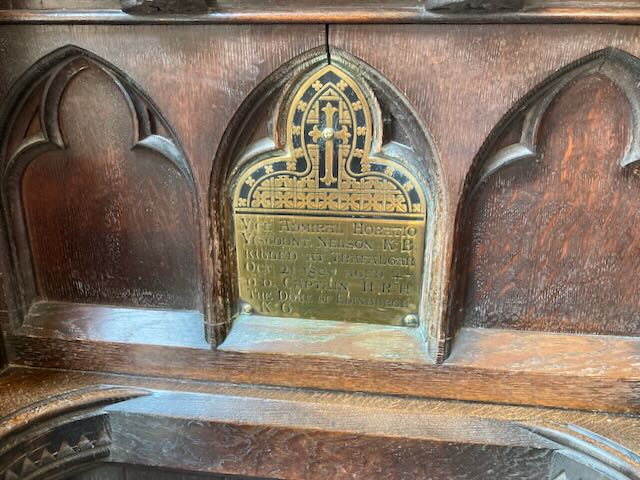
The choir stalls include memorials to soldiers killed in the Crimean War, and this one to Lord Nelson.
Apparently the church is still in use for occasional services for the military. It is open to the public on certain days and times, for free; check the website before going.
In Portsmouth Harbor you can also visit HMS Victory, Lord Nelson’s ship, which is undergoing a thorough restoration. The cruise we took of the harbor was lovely. On the same day, my friends and I also visited Netley Abbey. Nearby Southampton has a few sites related to Austen. However, we were not allowed to enter the Dolphin Hotel, where she danced. You can only see it from the street.
There’s so much history and meaning in Jane Austen’s mildest references. I’m thankful for the many people who have preserved and kept alive the places that were important to Austen and to her characters, including the Garrison Chapel.
Today marks the start of a new month-by-month series, “A Year in Jane Austen’s World,” in which I highlight several important events and details that happened in Jane Austen’s novels, letters, and lifetime during each month of the year.
We’ll kick off Jane Austen January (aka “Jane-uary”) by examining passages and situations in each of her novels that occur in January. While some of the novels have no mention of January, others do—with interesting results! Next, we’ll note where Austen was and what she was doing in January by checking her letters for January dates and details. Finally, we’ll highlight events and anniversaries that occurred in January that directed affected Jane Austen or her family.
All of this can help us better understand Austen’s life and times as we look at specific dates, events, and details in the context of months and seasons.
Snowdrops at Chawton House in January, courtesy of Chawton House.
January in Regency Times
One of the highlights of January for Jane Austen’s family was surely Twelfth Night (also known as Epiphany), which falls on January 5th.
Maria Grace, in her article “Celebrating Twelfth Night–Jane in January and You,” explains its religious importance: “Epiphany or Twelfth Night … was the exciting climax of the Christmastide season… It was a feast day to mark the coming of the Magi bearing gifts to the Christ child, and as such was the traditional day to exchange gifts.”
She also explains the social side of Twelfth Night: “In Jane Austen’s day, the party of the year would generally be held on Twelfth Night.” (Austen Variations)
During the Regency Era, people hosted parties and balls to celebrate Christmas and especially the last day of the Christmas season. The entertainment often involved guests playing assigned parts for the evening, dressing up in costumes, eating “Twelfth Cake,” and eating and drinking.
Rowlandson, “Twelfth Night Characters,” Creative Commons, 1811.
In a letter to Cassandra on December 27, 1808, Austen writes about an upcoming ball between Christmas and “Twelfth-day” at Manydown:
I was happy to hear, chiefly for Anna’s sake, that a ball at Manydown was once more in agitation; it is called a child’s ball, and given by Mrs. Heathcote to Wm. Such was its beginning at least, but it will probably swell into something more. Edward was invited during his stay at Manydown, and it is to take place between this and Twelfth-day. Mrs. Hulbert has taken Anna a pair of white shoes on the occasion.
Austen’s Letters (December 27, 1808)
Later, on January 10, 1809, she writes, “The Manydown ball was a smaller thing than I expected, but it seems to have made Anna very happy. At her age it would not have done for me.”
Manydown Great House, Wikipedia Commons, 1833.
January Travel in Jane Austen’s Novels
In Austen’s novels, January is primarily mentioned in the context of parties and travel. Anne Elliot goes to Bath for January and February, Miss Crawford is invited for “a long visit” to see her friend in London in January, Mrs. Jennings goes to her own house in London in January, and Mr. Bingley, Mr. Darcy, and Bingley’s sisters all go to London (when Bingley leaves Netherfield) and stay for the winter.
In Sense and Sensibility, Lucy Steele and her sister, Anne, go to “town” (London) in January to stay with relatives (and subsequently move from house to house throughout the season as socially advantageous opportunities become available):
I had quite depended upon meeting you there. Anne and me are to go the latter end of January to some relations who have been wanting us to visit them these several years! But I only go for the sake of seeing Edward. He will be there in February, otherwise London would have no charms for me; I have not spirits for it.
Sense and Sensibility
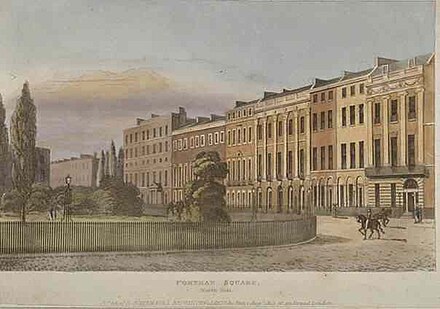
Mrs. Jennings, who “resided every winter in a house in one of the streets near Portman Square,” invites Elinor and Marianne to come with her to London in January when her thoughts begin to turn toward home after Christmas.
Portman Square, London, Wikipedia Commons, 1813.
The London Season
So why do so many of Austen’s characters travel to London in January? Wouldn’t the weather make travel difficult? Wouldn’t they prefer to stay home (and inside) where it’s cozy?
These are fair questions, but after Christmas, a large portion of the genteel class moved “to town” during the winter months for the London Season, which coincided with England’s political schedule, for entertainment and socializing. The Season had previously started in the fall, meaning most people went to London before the bad weather set in, but with the improvement of roads and travel during Austen’s day, the season slowly shifted later.
Here’s an explanation of the London Season from Jane Austen’s House Museum:
The London season coincided with the sitting of Parliament, beginning at some point after Christmas when fashionable families would move into their London houses. The men would attend Parliament, whilst the women shopped, visited, and found husbands for themselves or their daughters. It lasted until early summer, when the ‘beau monde’ would return to their country estates, escaping the city’s stifling heat and pungent smells.
The season was a whirlwind of court balls and concerts, private balls and dances, parties and sporting events. On a typical day, ladies would rise early to go riding in Hyde Park, before returning home to breakfast and spending the day shopping, dealing with correspondence and paying calls.
Most villages had assemblies and balls during the winter, but all of the most important social occasions happened “in town.” In Pride and Prejudice, we’re told that the Bennet sisters have little to do “beyond the walks to Meryton” in January and February, when conditions are “sometimes dirty and sometimes cold” (Ch. 27). It makes sense that many young women longed to go to town in the winter, at the height of the London Season and “marriage market,” when the majority of the parties, balls, and social events were held.
Rowlandson, Drawing Room at St. James’s Palace in London, Wikimedia Commons, 1810.
January in Jane Austen’s Letters
January often brings rain, cold weather, and even snow to the various locations where Austen lived and traveled. Austen kept her spirits up, but January in England, especially in homes without central heating or today’s insulation, could not have been entirely comfortable. Balls and assemblies, visits and travel, kept Austen busy and content during the winter months.
Austen’s entries follow below and give us a glimpse into the miserable weather conditions during one particularly snowy and wet January:
17 January 1809 (Castle Square): “Yes, we have got another fall of snow, and are very dreadful; everything seems to turn to snow this winter.”
24 January 1809 (Castle Square): “This day three weeks you are to be in London, and I wish you better weather; not but that you may have worse, for we have now nothing but ceaseless snow or rain and insufferable dirt to complain of; no tempestuous winds nor severity of cold. Since I wrote last we have had something of each, but it is not genteel to rip up old grievances.”
In the same letter, Austen describes her writing: “I am gratified by her having pleasure in what I write, but I wish the knowledge of my being exposed to her discerning criticism may not hurt my style, by inducing too great a solicitude. I begin already to weigh my words and sentences more than I did, and am looking about for a sentiment, an illustration, or a metaphor in every corner of the room. Could my ideas flow as fast as the rain in the store-closet, it would be charming.”
On the topic of the store-closet, she writes this: “We have been in two or three dreadful states within the last week, from the melting of the snow, etc., and the contest between us and the closet has now ended in our defeat. I have been obliged to move almost everything out of it, and leave it to splash itself as it likes.”
30 January 1809 (Castle Square): “Here is such a wet day as never was seen. I wish the poor little girls had better weather for their journey; they must amuse themselves with watching the raindrops down the windows. Sackree, I suppose, feels quite broken-hearted. I cannot have done with the weather without observing how delightfully mild it is; I am sure Fanny must enjoy it with us. Yesterday was a very blowing day; we got to church, however, which we had not been able to do for two Sundays before.”
And a final update on the flooded closet: “The store-closet, I hope, will never do so again, for much of the evil is proved to have proceeded from the gutter being choked up, and we have had it cleared. We had reason to rejoice in the child’s absence at the time of the thaw, for the nursery was not habitable. We hear of similar disasters from almost everybody.”
If you’ve ever dealt with water damage or burst pipes due to cold weather, you know how awful and destructive it can be. Austen makes light, but one can imagine it caused quite a bit of damage.
Snow at Jane Austen’s House Museum, January 2021.
January in Jane Austen’s Lifetime
And finally, let us turn our attention to some of the most important dates and events that happened (or were celebrated) during the first month of the year in Jane Austen’s lifetime. In December 1800, Reverend Austen decided to retire and remove his family to Bath. Austen’s letters in January 1801 prove an interesting read as she and the Austen family prepare to move later in the year:
3 January 1801 (Steventon): Austen writes that her mother wants to keep two maids and quips about their plans to have “a steady cook and a young giddy housemaid, with a sedate, middle-aged man, who is to undertake the double office of husband to the former and sweetheart to the latter.”
Austen discusses three parts of Bath where they might live: “Westgate Buildings, Charles Street, and some of the short streets leading from Laura Place or Pulteney Street.” She writes extensively about each neighborhood and several others, giving her opinion and hopes about each. She details which pictures, furniture, and beds they are choosing to keep or leave behind and asks Cassandra’s advice. And she shares plans for the family to travel to Bath a few weeks from then.
Austen shares own thoughts on their move to Bath: “I get more and more reconciled to the idea of our removal. We have lived long enough in this neighborhood: the Basingstoke balls are certainly on the decline, there is something interesting in the bustle of going away, and the prospect of spending future summers by the sea or in Wales is very delightful. For a time we shall now possess many of the advantages which I have often thought of with envy in the wives of sailors or soldiers. It must not be generally known, however, that I am not sacrificing a great deal in quitting the country, or I can expect to inspire no tenderness, no interest, in those we leave behind…”
The letter is full of useful information and well-worth a read. You can access it HERE.
14 January 1801 (Steventon): Austen speaks of the many visitors they’ve received in response to the news that Rev. Austen is retiring and the family is moving to Bath. She says, “Hardly a day passes in which we do not have some visitor or other: yesterday came Mrs. Bramstone, who is very sorry that she is to lose us, and afterwards Mr. Holder, who was shut up for an hour with my father and James in a most awful manner.”
4 Sydney Place, Bath.Plaque outside 4 Sydney Place, Bath.
January Dates of Importance
This brings us now to several dates that would have been quite important to Austen personally:
Celebrations/Birthdays:
9 January 1773: Jane Austen’s sister, Cassandra Elizabeth Austen, born.
23 January 1793: Edward Austen’s first child, Fanny, born.
Goodbyes/Sorrows:
January 1796: Tom Lefroy leaves Ashe for London (and never returns) and Tom Fowle (Cassandra’s fiancé) sets sail for the Indies, where he later dies.
21 January 1805: Rev. George Austen (Jane’s father) dies suddenly in Bath.
Writing:
28 January 1813: Pride and Prejudice was published, by Thomas Egerton (Whitehall, London).
21 January 1814: Austen begins writing Emma.
The Joys of Sleuthing
I hope you’ve enjoyed this first installment of our month-by-month exploration of Jane Austen’s world. I was pleasantly surprised to find that there was so much more to research and explore about the month of January than I anticipated. I enjoyed sleuthing around, following my nose, and discovering what I could uncover–just with the word “January.” If you have ideas about what I might pursue for February in Jane Austen’s World, please share your ideas in the comments.
Fashionable Goodness: Christianity in Jane Austen's England is now available! By JAW contributor Brenda S. Cox. See Review. Available from Amazon and Jane Austen Books.
Available through December 31st, 2025. Click on image for details, and share this poster with other teachers and students!
The Obituary of Charlotte Collins by Andrew Capes
Click on image to read the story.
Comments
“My idea of good company…is the company of clever, well-informed people, who have a great deal of conversation.” – Jane Austen, Persuasion
Gentle readers: Please feel free to post your comments and continue the conversation! Due to SPAM, we will no longer accept comments on posts after 30 days of publication. In some instances, links will be removed from comments as well.
Administrators and Contributors
Vic Sanborn, founder of this blog, is supported by a team of talented and knowledgeable writers about Jane Austen and the Regency era. They are:
Tony Grant, who now contributes his photos from London and England
Click on their names to enter their own blogs.
In addition, we thank the many experts and authors who frequently contribute their posts and opinions, and who continue to do so freely or at our request.
Click here to enter the page. Topics include Regency fashion, historic foods, Jane Austen societies, British sites, related topics. Click on image.
May we suggest?
Hello, my name is Vic and I live in Maryland, USA. I have adored Jane Austen almost all of my life. I am a proud lifetime member of the Jane Austen Society of North America. This blog is a personal blog written and edited by me and my team. We do not accept any form of cash advertising, sponsorship, or paid topic insertions. However, we do accept and keep books and CDs to review.
If you would like to share a new site, or point out an error, please email us. (Yes, we are fallible. We'll own up to our mistakes and will make the corrections with a polite smile on our faces.) Write us at
Thank you for visiting this blog. Your comments and suggestions are most welcome.
Project Gutenberg: eBook of Stage-coach and Mail in Days of Yore, Volume 2 (of 2), by Charles G. Harper
STAGE-COACH AND MAIL IN DAYS OF YORE: A PICTURESQUE HISTORY
OF THE COACHING AGE, VOL. II, By CHARLES G. HARPER. 1903. Click on this link.
















 Jane Austen's World