Feeds:
Posts
Comments

Archive for the ‘19th Century England’ Category

One can imagine that during her final illness, Jane Austen was no stranger to leeches. This method of bloodletting was so common in Great Britain (Wales especially) and France that by the 1830’s Hirudo medicinal leeches (common in Europe) were hard to find and had to be imported or home grown .

Leech finders, 1814. George Havell, Costumes of Yorkshire.

Gathering leeches was a traditional female occupation, although there are always exceptions to the rule. Take this passage about leech-fishers in France from the Gazette des Hopitaux:

Man leech fishing in a marsh in Bretagne. 1857. Image @Shutter Stock

If ever you pass through La Brenne, you will see a man, pale and straight-haired with a woollen cap on his head, and his legs and arms naked; he walks along the borders of a marsh, among the spots left dry by the surrounding waters. This man is a leech- fisher. To see him from a distance,—his wo-begone aspect, his hollow eyes, his livid lips, his singular gestures,—you would take him for a maniac. If you observe him every now and then raising his legs and examining them one after another, you might suppose him a fool ; but he is an intelligent leech-fisher. The leeches attach themselves to his legs and feet as he moves among their haunts; he feels their bite, and gathers them as they cluster about the roots of the bulrushes and aquatic weeds, or beneath the stones covered with a green and slimy moss. He may thus collect, ten or twelve dozen in three or four hours. In summer, when the leeches retire into deep water, the fishers move about upon rafts made of twigs and rushes.”  – Excerpt taken from Curiosities of Medical Experience (1838) by John Gideon Millingen, via The Condenser: Hunting Down Good Bits

Despite the many strides that were made in medicine regarding human anatomy and diseases, the knowledge about treatments lagged behind. Lack of anesthetics made surgery an excruciating experience, and there were no antibiotics. Useful plants, such as digitalis, were discovered more by luck than by science. Bloodletting or ‘breathing a vein’ was one way in which a patient could be treated by a physician who had few options. Applying leeches often resulted  in a severe loss of blood, which was more detrimental to the patient’s condition than not. A human with a poor immune response could suffer from wound infections, diarrhea and septicemia, all influenced by the bacterium, Aeromonas veronii, carried in the leeche’s gut.
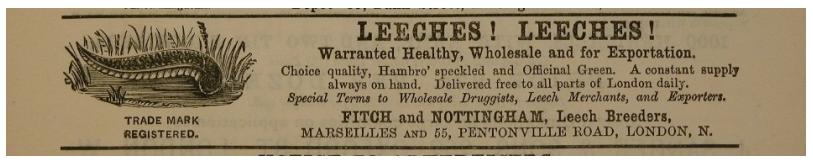
19th century leech advertisement

Regardless of adverse consequences, bloodletting has been practiced for at least 2,500 years. The earliest instruments, or lancets, were sharpened pieces of wood or stone, but it is leeches that I want to write about. (I am more repulsed by their sight than a snake’s, and had a hard time searching for an image that did not make me gag.)  The ancient Greeks believed in the humoral theory, which proposed that when the four humors, blood, phlegm, black and yellow bile in the human body were in balance, good health was guaranteed. An unbalance in these four humors led to ill health. Fast forward to the middle ages, when superstition and religion gave weight to the art of bleeding. If you recall, the earliest surgeons were barbers as well. Their leeches cured anything from headaches to gout!

Bloodletting with leeches is an ancient tradition

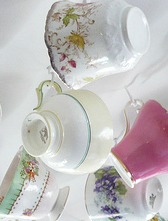
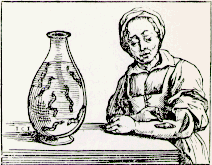
Leeches are commonly affixed by inverting a wine-glass containing as many as may be required, upon the part affected. The great disadvantage of this practice is, that some of them frequently retire to the upper part of the glass and remain at rest, defying all attempts to dislodge them, without incurring the risk of removing those that may have fastened.” – James Rawlins Johnson, A Treatise on the Medicinal Leech
Francois Broussais proposed in  his Histoire des phlegmasies ou inflammations chroniques (1808) that all disease resulted from excess build up of blood. The alleviation of this condition required heavy leeching and starvation. Leeches subsequently became the most prevalent way of treating a patient, especially in France, where tens of million of leeches were used per year, resulting in a drastic leech shortage. The British were equally enamored with this form of therapy. It is conjectured that Princess Charlotte’s death in childbirth in 1817 was exacerbated by her physician, who prescribed a rigorous course of blood letting and starvation diet during her pregnancy, weakening her before her agonizing 50+ hours of labor. (Read my article on this topic.)

In 1833, bloodletting became so popular in Europe, that the commercial trade in leeches became a major industry. France, suffering a deficiency, had to import 41.5 million leeches. The medicinal leech almost became extinct in Europe due to the extremely high demand for them. Leeches were collected in a particularly creepy way. Leech collectors would wade in leech infested waters allowing the leeches to attach themselves to the collector’s legs. In this way as many as 2,500 leeches could be gathered per day. When the numbers became insufficient, the French and Germans started the practice of leech farming. Elderly horses were used as leech feed where they would be sent into the water and would later die of blood loss. – Maggots and Leeches Make a Comeback

Oh, how I pity those elderly horses!
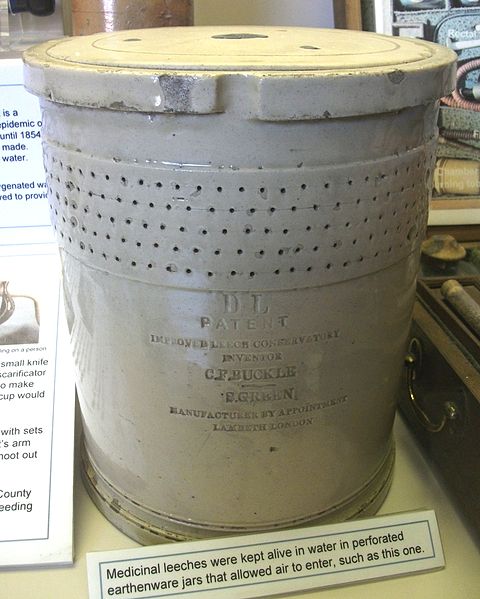
 

Large leech collector jar.

Intestinal tract of the hirudo leech

Leeches are quite extraordinary in that they have 31 brains and can gorge themselves up to five times their body weight before falling off their host. Afterward they require no feeding for another 6 months. There are over 650 known species of leeches, not all of which are bloodsuckers (some eat earthworms, for example). Placing leeches onto a patient (making sure the frontal sucker with teeth was directed to the skin) is relatively pain free, for their bite releases an anaesthetic. During feeding they secrete compounds, such as a vasodilator that dilates blood vessels and anticoagulant that prevents the blood from clotting. The worms are hermaphrodites, functioning as both the male and female sex. Even after being frozen, leeches can be coaxed back to life!  Needless to say, these creatures must provide an endless source of interest to scientists.

Early 19th century rare cobalt blue transportable leech jar. These were mostly made of clear glass. Cloth covered the everted lip to prevent escapees.

People (meaning mostly women) stood in fresh water marshes, lakes, pools, and the edges of river banks, and allowed the leeches to attach to their legs. (I shudder as I type this.) Once the leeches were gathered, they were placed in a basket, ceramic pot with breathing holes, or a reservoir.

One of these traders was known to collect, with the aid of his children, seventeen thousand five hundred leeches in the course of a few months; these he had deposited in a reservoir, where, in one night, they were all frozen en masse.” But congelation does not kill them, and they can easily be thawed into life, by melting the ice that surrounds them. Leeches, it appears, can bear much rougher usage than one might imagine: they are packed up closely in wet bags, carried on pack-saddles, and it is well known that they will attach themselves with more avidity when rubbed in a dry napkin previous to their application. Leech-gatherers are in general short-lived, and become early victims to agues, and other diseases brought on by the damp and noxious air that constantly surrounds them ; the effects of which they seek to counteract by the use of strong liquors.”  Excerpt taken from Curiosities of Medical Experience (1838) by John Gideon Millingen, via The Condenser: Hunting Down Good Bits
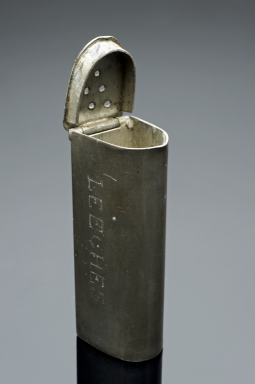
Pewter box for transporting leeches. Image @Science Museum of london

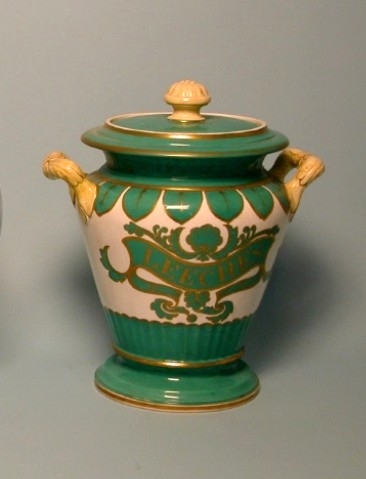
Leeches were carried in a variety of containers made of glass, silver, or pewter. Small bowls were portable, and the larger ones were probably kept in an apothecary’s shop or pharmacy. The everted lips were used to attach a cloth, which prevented the hapless creatures from escaping.
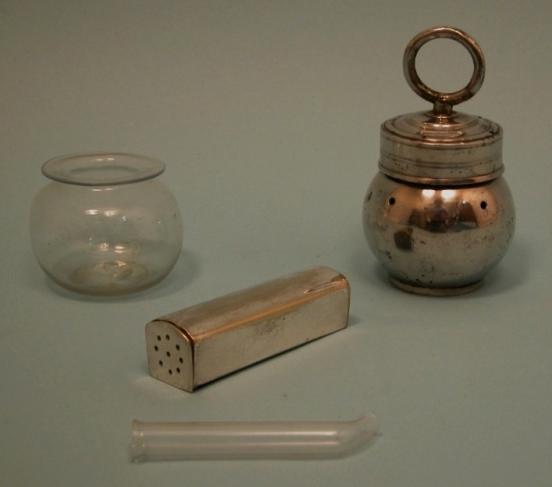
Portable leech carriers made of glass, silver and pewter. Small leech tubes directed the worm to difficult to reach places in the mouth, larynx, ear, conjunctiva, rectum and vagina, begging this question: How did one retrieve the engorged leech?

After the 1830s, the practice of leeching began to decline as medical diagnostic skills improved. Physicians realized that patients who were leeched did not often recover more fully than those who were not, and other, more beneficial treatments,  including pharmaceutical and homeopathic remedies, began to replace leeching
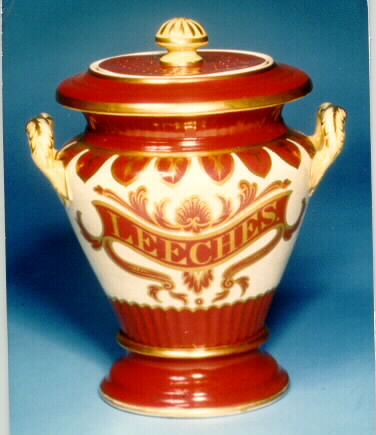
Red and cream Staffordshire leech jar

More on the Topic

Leech bowl

Read Full Post »

My regular Jane Austen readers have been patient as I succumbed to Downton Abbey fever and began to cover events 100 years after Jane Austen’s death. Customs changed during that intervening century. Take the matter of dress. While proper Regency ladies changed their outfits from morning gowns to walking gowns when they went out, and changed into dinner dress when dining, by Victorian and Edwardian times the custom of a lady changing her clothes throughout the day had turned into a fine art.  One could get by with no less than 4-5 changes per day. A woman who packed to visit a country estate was sure not to be seen in the same outfit twice. This meant that for a 4-day visit she would need at the very minimum to have her maid pack 16 changes of outfits. One can only imagine the work of a lady’s maid to keep all the clothes and unmentionables in perfect (and clean) condition. Such attention to detail required quite a bit of organization.

Morning dress, 1815. Ackermann plate. While she looked proper in her at home attire, this morning dress looks stodgy compared to the Edwardian teagown.

Corsets were worn all through the 19th century and into the early part of the 20th century. Women were constricted into these garments for most of their waking day, but there were times when they were free from these tight-laced garments.  During the early 19th century, upper class women at home would wear comfortable (but beautiful) morning gowns. Dressing gowns were also worn. Such gowns were meant to be seen by the family and close relatives only. The moment a woman expected to be seen, she would change into more proper dress.

Cora, the Countess of Grantham, lived during a time when teagowns were all the rage. These beautiful ornate gowns had the advantage of being simply cut and worn without a corset. It was possible that for just a few hours she could relax comfortably before dinner.

They were generally loose-fitting and elaborately trimmed, and gave full vent to the dressmaker’s or couturier’s skill and taste for theatricality. Tea-gowns were influenced by historical styles from eighteenth century Watteau-pleats, to renaissance hanging sleeves and empire waistlines and quite often, all of them at the same time. Never has so much love and art been invested in such an arguably unnecessary garment. All kinds of informal garments including tea jackets, peignoirs, dressing gowns, combing sacques, morning robes and dressing jackets also had their place in the leisured Edwardian lady’s wardrobe, all of them beautifully decorated and almost all of them now obsolete. 1900-1919: The Last Age of Elegance 

American dancer and actress Irene Castle wearing a teagown, 1913

It had long been the custom for a lady to entertain both male and female visitors in her boudoir. (Read my article on this topic.) During the Regency era, dressing gowns were quite plain and simple compared to teagowns.

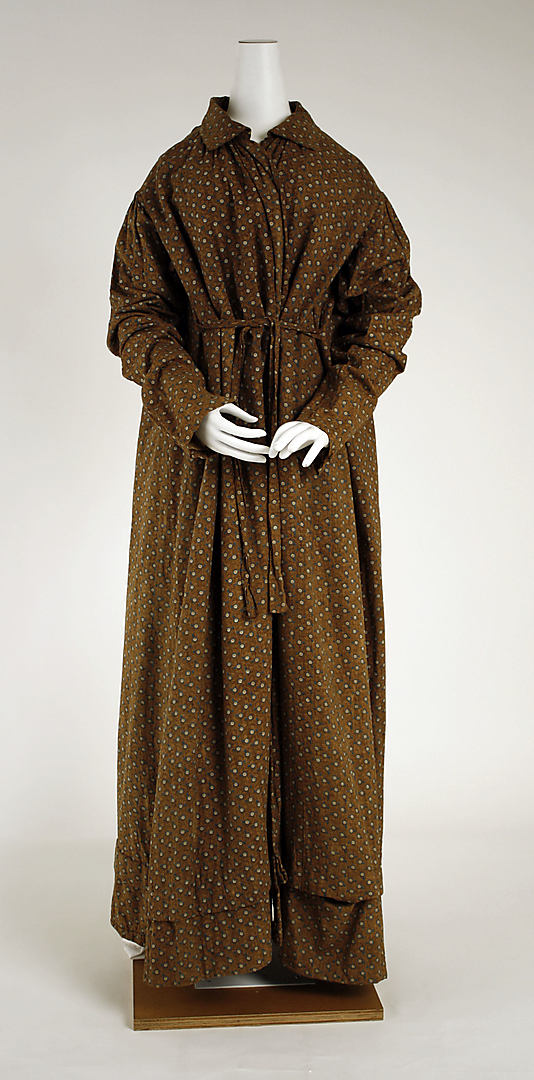
1810-23 dresssing gown. Image @Met Museum

At times the teagown gave rise to temptation, for a woman could entertain in private and not need the services of her maid:

Worn between five and seven oclock,  gave rise to the French phrase ‘cinq à sept‘. This referred to the hours when lovers were received, the only time of day when a maid wouldn’t need to be there to help you undress and therefore discover your secret. – “Style”, The World of Downton Abbey, Jessica Fellowes

Early 19th century dressing gown. Image @Met Museum

Attired in her tea-gown, a soft flowing robe of filmy chiffon or fine silk, trimmed with an abundance of lace and often free of corsetry, the hostess must have been a tempting prospect for many men. Such loose gowns afforded women great comfort, ease of access and a tremendous sense of femininity. Little wonder then that whilst hemlines rose and fell the tea-gown, which had appeared in England as early as 1875 lingered on until the 1920s. – Edwardian tea gowns, fashion era

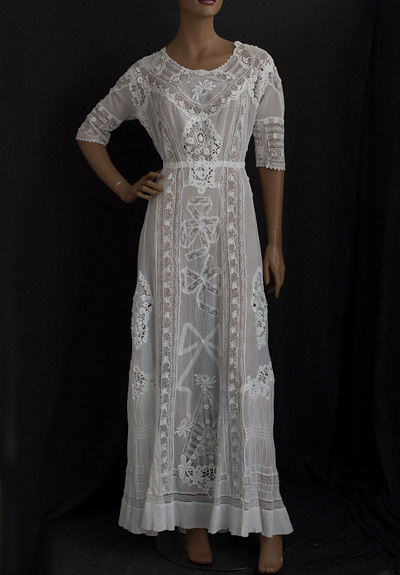
This Lingerie-style dress embellished with Irish crochet, c.1905 (below) can be seen in more detail on Vintage Texiles. Made of sheer cotton decorated with lace and ruffles, this sheer dress required a slip.

Edwardian teagown, 1905. Image @Vintage Textile

More on the topic:

Read more on the topic: Tea Gowns, Edwardian Promenade

Image of an early 19th century dressing gown at the Met Museum

Read Full Post »

(Hint: for quicker download, click on title of this article.) As viewers of Downton Abbey, we think we have gotten to know Highclere Castle and its setting well.  Sir Barry remodelled Highclere Castle for the third earl of Carnarvon from 1839 to 1842. The architect had just finished building the Houses of Parliament. The house once looked quite different and was Georgian in feature, as this image shows.

highclere-castle-in-the-18th-century

Extensive renovations were made during the late 18th and early 19th centuries. In the mid-19th century, Henry, the 3rd earl of Carnarvon, transformed the house into a grand mansion with 60- 80 bedrooms (the sum varies according to the source) and over 120,000 square feet. The staircase, also designed by Thomas Allom, sits in the tower designed by Charles Barry.

Highclere Castle after renovation

Highclere Castle after renovation. Sir Charles Barry’s renovation was in the “High Elizabethan” style. The building was faced in Bath stone.

The Architectural Design

Architectural design for the tower of Downton Abbey by Sir Charles Barry, 1842. Image@Christie’s

The BBC said about Barry’s Houses of Parliament:

A good example of the period’s confused love affair with the past, it was summed up earlier this century as classic in inspiration, Gothic in detailing, and carried out with scrupulous adherence to the architectural detail of the Tudor period. – BBC, A British History of Architecture

This description can easily be applied to Highclere Castle with its whimsical look back to Tudor times.

The term “Jacobethan” refers to the Victorian revival of English architecture of the late 16th century and early 17th century, when Tudor architecture was being challenged by newly arrived Renaissance influences. During the 19th century there was a huge Renaissance revival movement, of which Sir Charles Barry was a great exponent – Barry described the style of Highclere as “Anglo-Italian”.[3] – Wikipedia

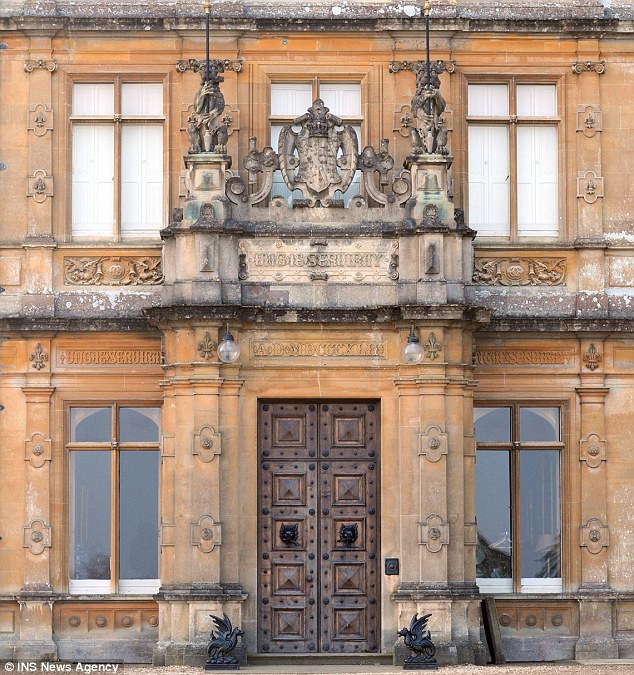
The Facade and Front Door

The front door

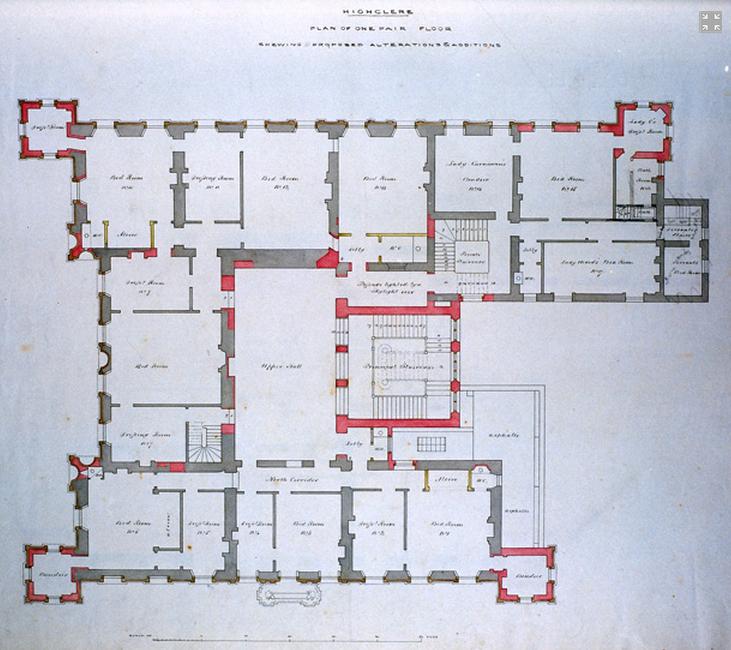
Many visitors come to this blog looking for a floor plan of Highclere Castle. This one depicted below sits on the Highclere Castle website and is a bit hard to read. Not all the rooms are currently in use, and a number, such as the music room, are available to be rented as conference rooms.

The House Plan

In the television series, the servant quarters and kitchens were not filmed at the Castle, but were constructed at Ealing studios in West London.

From The Victorian Country House by Mark Girouard.

Entrance Hall and Saloon

stairs and hall

Stairs and hall

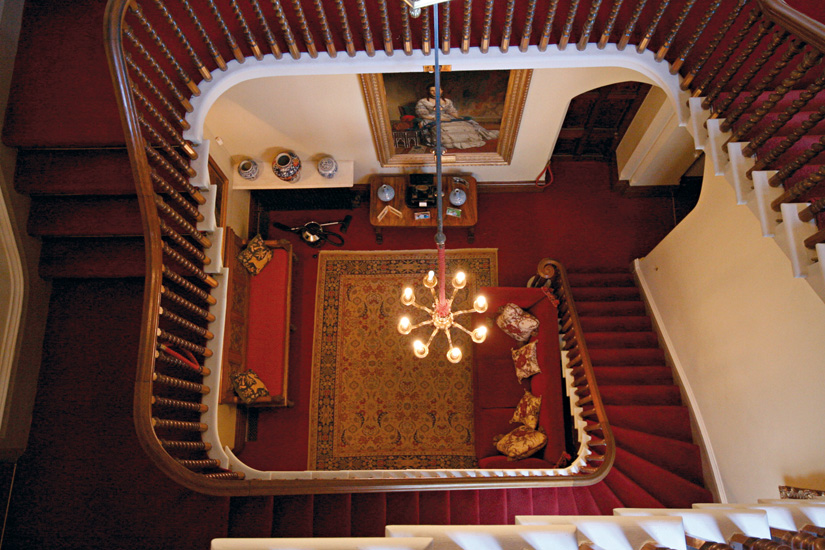
Red stairs birds eye view

Red stairs birds eye view

Pillars

Pillars

Passage above saloon leading to the bedrooms

Interior of Highclere Castle

Saloon from gallery above. The room was designed by Thomas Allom and completed in the 1860s.

Saloon seating space Picture by Paul Hilton ©

Saloon seating space Picture by Paul Hilton ©

Salloon

Saloon

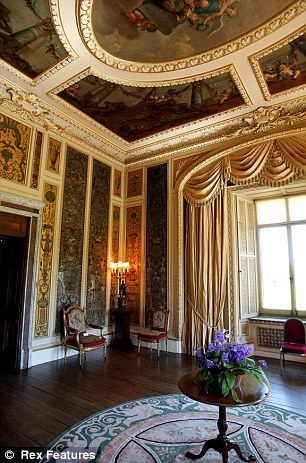
Detail of saloon ceiling

Detail of saloon ceiling

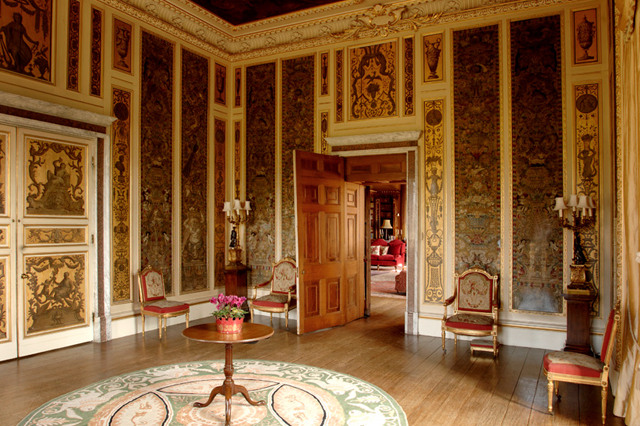
The Music Room

Music room

Music room

Music room

These days the music room is available as a conference room.*

The Library

Double library

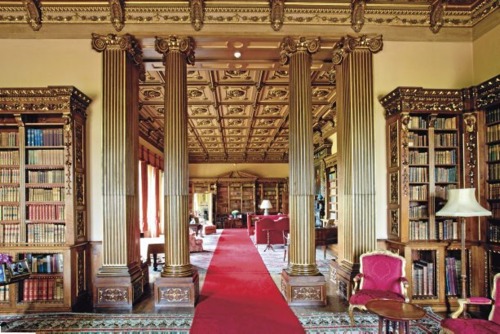
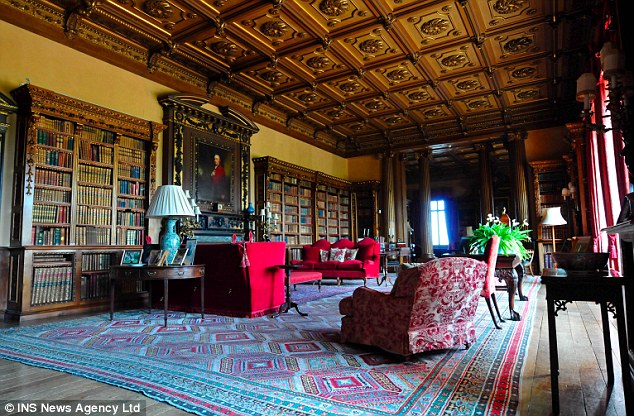
Double library with coffered celings holds over 5,000 books.

Comfortable seating within the library

Comfortable seating within the library

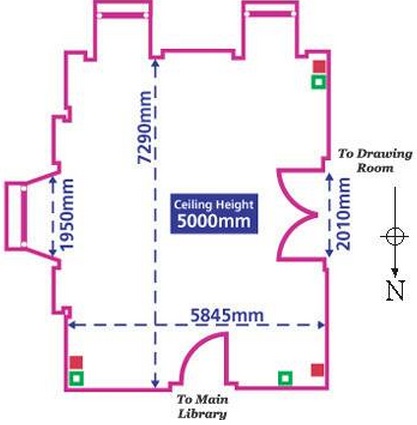
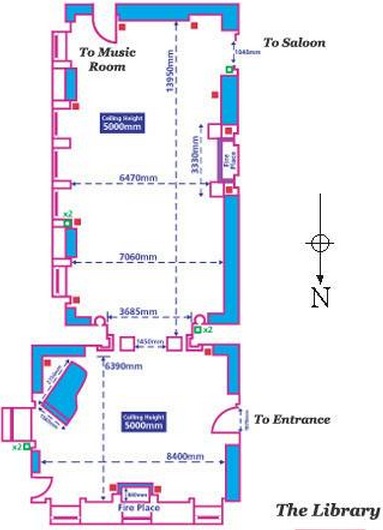
The library is unusual in that it consists of a two part room. The opening between the two areas is featured by columns. This room is also available to rent as a conference room.*

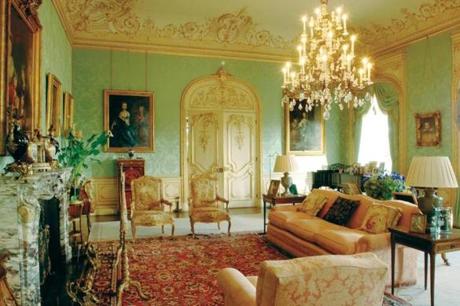
The Drawing Room

The drawing room image @Boston Globe. The drawing room was designed by Almina, the 5th Countess of Carnarvon,  in the "rococo revival" style .

The drawing room image @Boston Globe. The drawing room was designed by Almina, the 5th Countess of Carnarvon, in the “rococo revival” style .

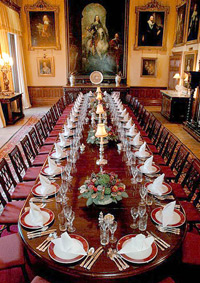
The Dining Room

Much drama is centered in the dining room. The actors often took days to film a scene, and it was quite a feat to keep the food looking fresh and to maintain continuity in both the drinking glasses and on the plates. Read Downton Abbey: Dining in Splendor for more information.

The dining room

The dining room

diningroom-highclere

Image @Conferences UK

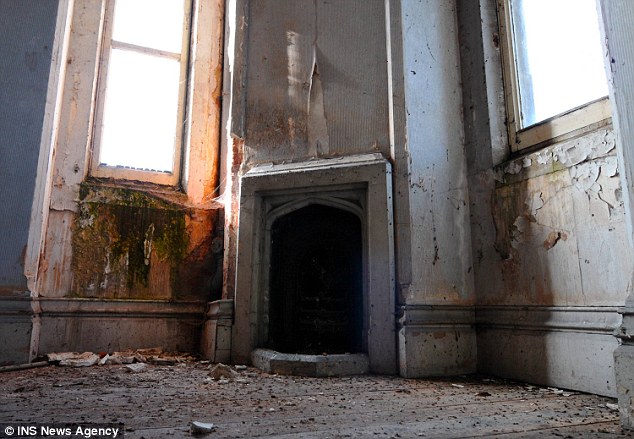
Bedrooms

Modern bedroom

Renovated bedroom

One of the bedrooms in need of renovation. Image @Daily Mail

One of the bedrooms in need of renovation. Image @Daily Mail

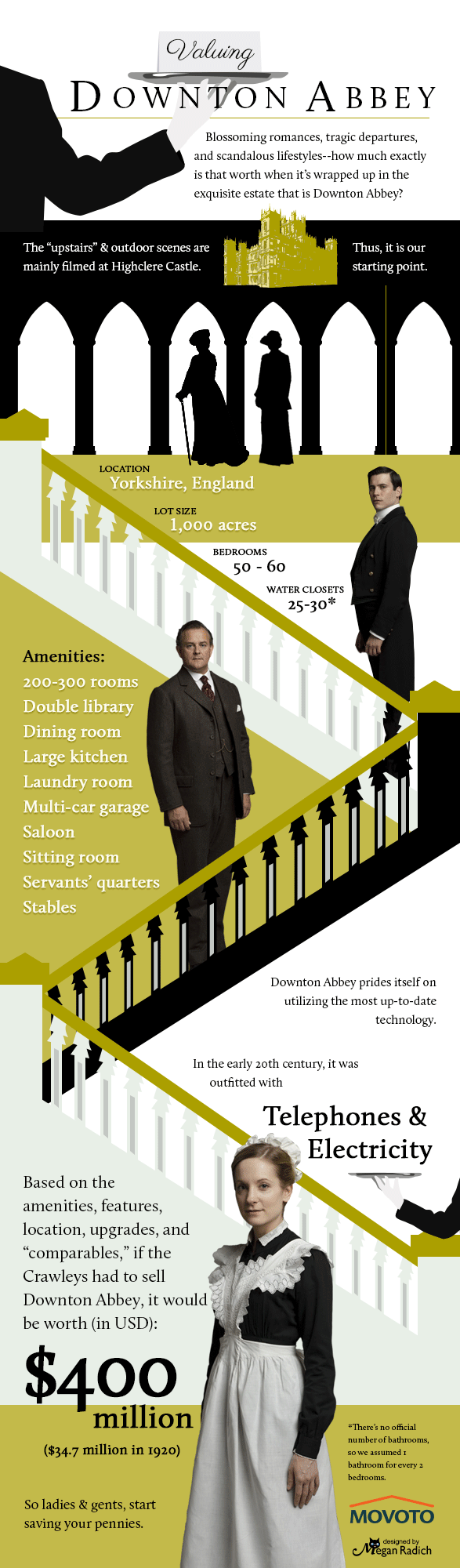
This image on Huffington Post shows more details about Downton Abbey/Highclere Castle and values the mansion:

valuingdowntonabbey

More on the topic:

Read Full Post »

It’s rare that I purchase a Jane Austen sequel. Generally, publishers will send books for review or I’ll pick up a copy at the library. When Death Comes to Pemberley was announced I did not hesitate to purchase a copy for my Kindle. P.D. James, the book’s author, is a highly regarded mystery writer with a solid record for selling mystery books to discerning mystery fans. (The book placed third on the NY Times best seller list this weekend.)

A good friend of mine, whose judgment I value, owns every single P.D. James novel and was overall satisfied with this novel. I had never read a P.D. James novel before, and she was curious to know what I thought of this book. Another Janeite friend had read it and remarked that it was very well done and followed the forensic detective work of its time. They waited to discuss the book with me until after I had finished reading it and could give my opinion. Last weekend the three of us came to the same conclusion, which was that the mystery was weak and a bit lame, and that the actual murderer was so preposterous as to be unbelievable. My question to them was: “Why would a famous author like P.D. James waste her time writing a Jane Austen sequel, especially if the mystery was less than sterling?” Both defended her decision to write this book, while I was not particularly swayed. Both were ecstatic that she had written one more book, for they fear that their author, being 90+ years old, might not have too many novels left to write. To that I said she shouldn’t have bothered.

My suspicion is that had P.D. James been an unknown author peddling her manuscript for the first time to publishers and agents, Death Comes to Pemberley would have been tossed on the slush pile and she would have received a slew of the rejection letters,  one of which might have looked like this:

Dear Ms. P.D. James,

Thank you for your submission of Death Comes to Pemberley, which we read with interest, for your writing style is quite extraordinary. I’m sorry to say that  our interest in your manuscript was killed by its long talky scenes and sparseness of  mystery plot. I don’t need to hear about the crime from potential witnesses, then learn the same information during the inquiry and then again during the trial.

You will need to solve a major  problem with the plot by writing the denouement towards the end of the story, rather than 2/3 of the way through.  After I discovered who the murderer was, I frankly did not care to sift through another five chapters so that you could tie up loose plot threads. Let me make a few suggestions for improvement before you send the manuscript on to others:

1. Check your facts. In the first chapter on the first page you referred to Mr. Collins as Mr. Bennet’s nephew. He is Mr. Bennet’s cousin.  I almost stopped reading the book right then, for the mistake and others made me wary of the quality of your research or understanding of Pride and Prejudice and its characters.

2. Show don’t tell. Yes, I understand that this is a Jane Austen sequel and that you are working with familiar characters, but you slowed your plot to a crawl with your reams of exposition at the start of the novel and, strangely, at the end. Also, your men were too talky. While I appreciate the fact that they might have spoken more formally two hundred years ago, men don’t as a general rule talk in long unbroken sentences, especially to each other.
3. Write an original novel with your own characters. Whenever you deviated from Mr. Darcy and Elizabeth and other Pride and Prejudice characters, your novel jumped to life.

Sincerely, Vic @Jane Austen’s World

Death Comes to Pemberley is yet another instance of a famous author joining the Jane Austen bandwagon. Some of you might remember Colleen McCullough jumping into the fray with her detestable The Independence of Mary Bennet, which must have garnered riches for the publisher before readers caught on. (Read my review here.) These two best-selling authors, while they rightly have earned their literary reputations, fell down in my opinion when they so cynically wrote novels that, to put it kindly, barely scraped bottom when compared to Jane Austen’s own brilliant work. Besides, what business had they to write a Jane Austen sequel? Do they really think it is all that easy?

The career of a Jane Austen sequel writer is not an easy one. Most write their books out of love for Jane Austen and her characters. Those that I have come to know through correspondence are earnest about their desire to continue Jane’s stories. They work hard for very little recompense. Unless a publisher anticipates a blockbuster novel (such as Pride and Prejudice and Zombies, a concept novel if ever there was one), most provide book advances that barely cover the cost for postage or time spent researching a topic. Once upon a time book publishers, editors, and agents invested in long-term relationships with new authors, building their reputations up slowly and giving them time to develop their talents.

Image @New Yorker

This is no longer the case. A writer has only two or three years to make money back for the publisher.*(See Laurel Ann’s comments below.)  That is a lot of pressure, considering that royalties on the published price of trade books ranging from 10%-12.5% and on paperbacks from 7.5% to 10%. Many first time authors fail to realize any profit on their books. The average first novel sells around 2,000 – 4,000 books, but the break even for publishers is around 5,000 books. Four out of five first novels fail to make money for the publisher. Authors might only earn the total amount of their advance, minus the cost of extra copies of books they have purchased for giveaways and bookmarks, and the loss of spare time as they visit book stores, libraries, reading clubs, and groups and attend conferences all over creation in order to publicize their books will never be made up. These days authors are expected to oversee their own blog, and a Facebook and twitter account as well. Many spend hours writing down answers to interview questions or being interviewed online.

As readers you will notice a big push for books several times a year, when many new titles are competing with each other. Before the holiday season this year, P.D. James received an automatic “in” from most of the major book critics; she received extremely kind reviews in my estimation. It’s almost as if even the most discerning critics didn’t bother to read her entire book. The ordinary sequel writer gets no such first-class treatment. Their eyes are glued on Amazon’s rankings, hoping they will break free from the midlist and sell enough volumes to give them a second contract for another book.

One author I talked to said she made almost no income from writing; another said she was unlikely to collect royalties this year. Another author, who lives in my city, was dropped by her publisher despite glowing reviews, only to be picked up by another publisher. For these authors, their writing careers must seem like an unpredictable roller coaster ride.

While I am not a great fan of Jane Austen sequels and prequels, I do salute these writers, who follow their passion. Many have written a truly enjoyable story that I can wholeheartedly promote. I can’t exactly say the same of Death Comes to Pemberley. Sorry Ms. James, but I give this book only 2 out of 5 regency tea cups.

For more information about the life of a writer, read The New Literary Lottery. This NY Magazine article by Alex Williams is a bit dated, but fascinating.


Read Full Post »

Dear Readers, Happy Holidays! If you happen to stand under a sprig of mistletoe (these days it is most likely artificial), you will probably hug or kiss the person standing nearest you. This tradition did not appear in English literature until the 18th century. The practice of gathering mistletoe began in the second century BC with the Druids in ancient Britain. They gathered the parasitic plant at the start of winter from the sacred oak as a symbol of hope, peace, and harmony. Sprigs were hung in homes to herald good fortune. The plants were also used for medicinal purposes to promote female fertility and as an antidote for poison. Today we associate mistletoe boughs with Christmas. Gathered on this page are a few quotes from various sources.

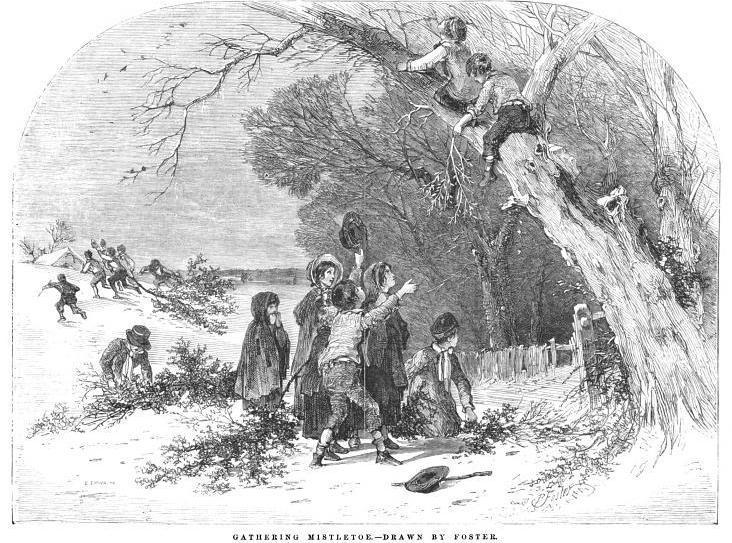
Illustrated London News, Dec 20, 1851

The Mistletoe Season

Down South for the past month all the boys and girls who want to earn money have been gathering mistletoe.

Weeks before the Christmas-time, these young people begin to hunt the woods for mistletoe. Having found it, they watch it growing. If they find that some one else watching the same bunch, they announce it is their mistletoe.

The mistletoe grows on the tree, but is no more a part of the tree than the moss with which Northern children are familiar, or vines that climb up the outside of the tree. The mistletoe grows high up in the tree and, if out on a slender branch, must be reached after with a stick and pulled off gently. Even then it is not out of danger, for the beauty is marred if the little plant falls to the ground. –  New outlook, Volume 52, edited by Alfred Emanuel Smith, Francis Walton Outlook Publishing Company, Inc., U.S., 1895, p. 1146

Mistletoe sprigs decorated chandeliers, doorways, and ceilings.

A ball of mistletoe, ornamented with ribbons, would be hung around Christmastime, and no unmarried girl could refuse a kiss if she was underneath it. At every kiss, the boy would pluck one of the mistletoe berries, and when there were no more berries, the ball was taken down until the next year. If a girl didn’t receive a mistletoe kiss by the time the ball was taken down, she couldn’t expect to marry in the following year. So the kiss could be a promise of marriage or a symbol of admiration, but it was also a kind of mystical fortune-telling trick. – Apartment Therapy – History of the Mistletoe

Gathering mistletoe in Nomandy

The best time for gathering mistletoe is in November after a few frosts have fallen and before the sap freezes, though it may be gathered and used at any period of the year. When gathered it should at once be spread out to dry as it will mould in a very short time if kept in a box or sack. It is best to dry it in the shade. – United States medical investigator1878,  p 132.

Kiss under the mistletoe

Mistletoe grew in England and the United States. The common mistletoe of England grew on orchard trees and forest trees, and seldom on oak trees, which is why Druids revered it for its rarity. Mistletoe sapped the strength of apple trees in Brittany and Normandy. There it was gathered for the London market. The American mistletoe grows on deciduous trees, especially the tupelo poplar and red maple, from New Jersey, southern Indiana and east Kansas, to the Gulf. –  The Standard reference work: for the home, school and library, Volume 5, edited by Harold Melvin Stanford Standard Education Society, 1921

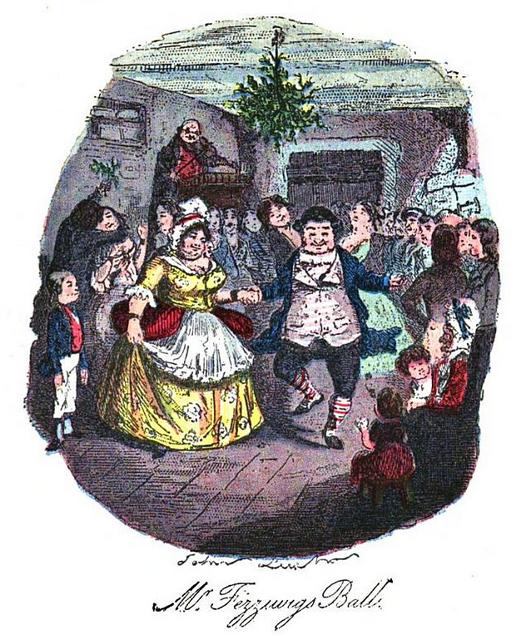
Mr Fezziwig's ball, John Leech, A Christmas Carol by Dickens

By the Victorian era, there was scarcely a house or cottage that did not have mistletoe at Christmas time.

Down with the rosemary, and so,

Down with the baies and Mistletoe;

Down with the holly, ivie, all,

Wherewith ye dressed the Christmas Hall.

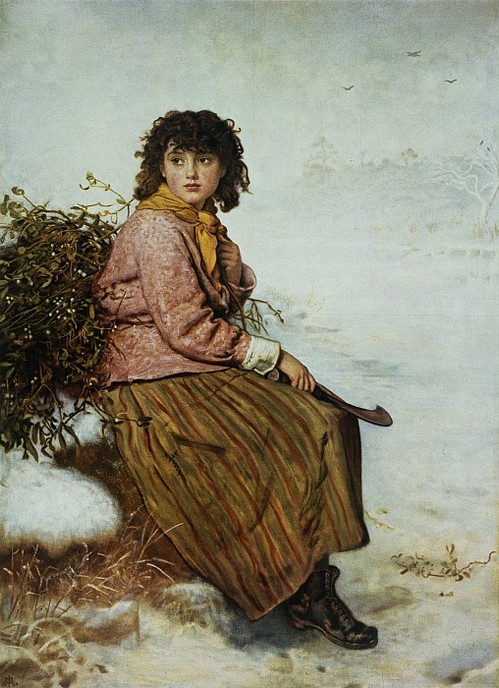
19th c. mistletoe gatherer

The damsel donn’d her kirtle sheen;

The hall was dress’d with holly green,

Forth to the wood did merry men go

To gather in the Mistletoe.”

– English botany, or, coloured figures of British plants, Volume 4, By James Sowerby G. Bell, 1873

Kiss under the mistletoe

Happy Christmas Eve and Christmas Day to All!

Read Full Post »

« Newer Posts - Older Posts »