Feeds:
Posts
Comments

Archive for the ‘Anglican Church’ Category

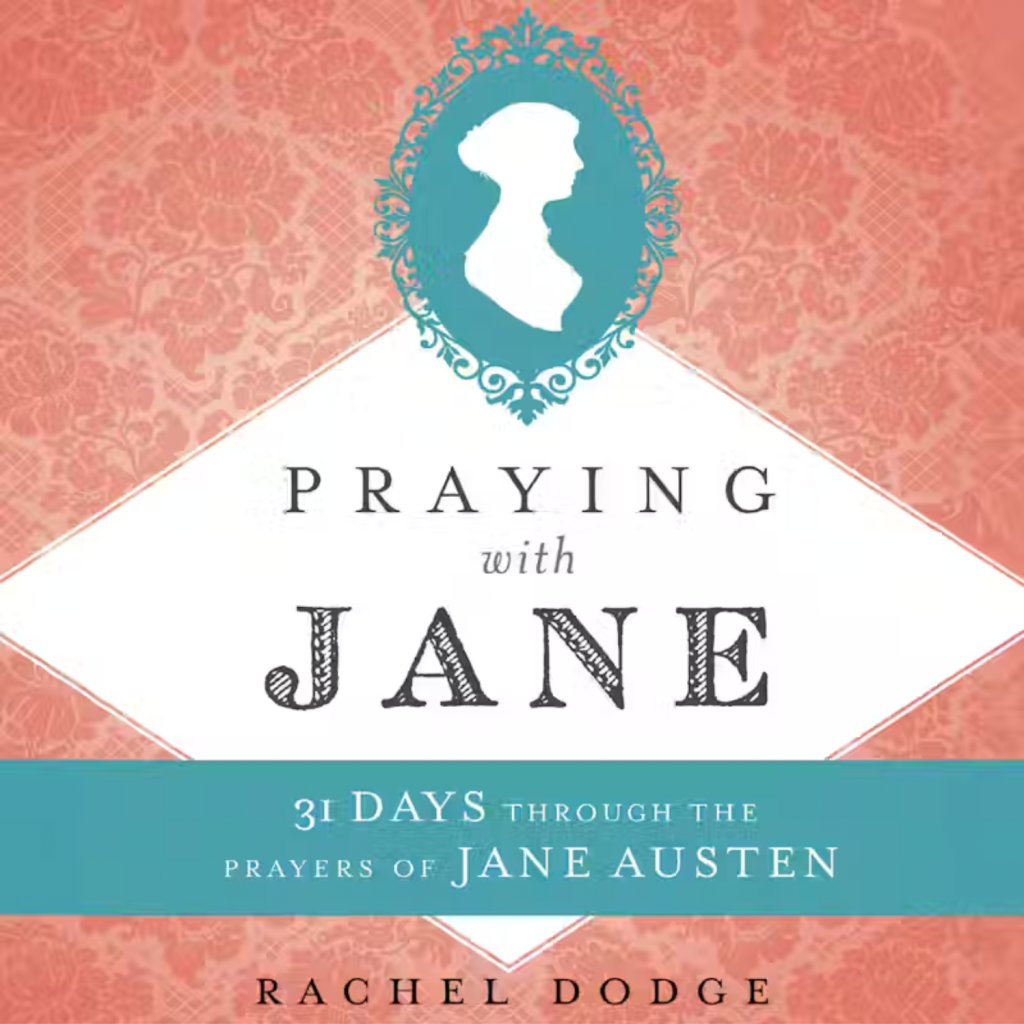
In honor of Jane Austen’s 250th anniversary year, I’m happy to announce a new audiobook project: The Praying with Jane Audiobook featuring narration by actress Amanda Root and author Rachel Dodge (yours truly). Published by ONE Audiobooks, this title is available on all major audiobook platforms.

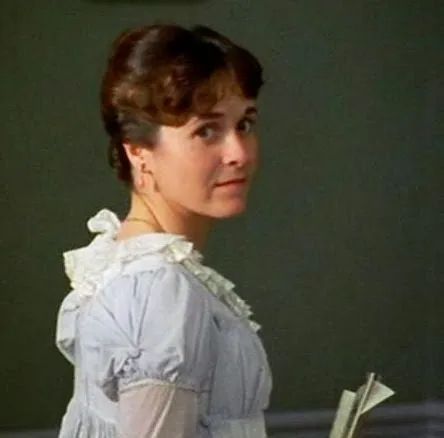
Amanda Root is best known by Austen fans around the world for her starring role as Anne Elliot in the acclaimed 1995 BBC adaptation of Jane Austen’s Persuasion. Root claimed audience hearts opposite Ciarán Hinds, as Captain Wentworth, and has held them ever since.

Proceeds from this anniversary project will be donated directly to the Jane Austen House Museum to further Jane Austen’s lasting legacy.

Persuasion film adaptation with Amanda Root (1995).
Amanda Root and Rachel Dodge, Kansas City AGM.

Audiobook Description

In this 31-day devotional, you will get an in-depth look at Jane Austen’s prayers. Her faith comes to life through her exquisite prayers, touching biographical anecdotes, intimate excerpts from family letters and memoirs, illuminating scenes from her novels, and spiritual insights. Austen’s prayers read by British film and voice actress Amanda Root; text read by author Rachel Dodge.

You can listen to a sample of Jane Austen’s Prayer 1 here, read by actress Amanda Root:

Purchase Here

Proceeds will be donated to the Jane Austen House Museum.

Amanda Root Bio

Amanda Root is an English stage and screen actress and a former voice actress for children’s programs. Root is known for her starring role in the 1995 BBC film adaptation of Jane Austen’s Persuasion, her role in the British TV comedy All About Me (2002), as Miranda, alongside Richard Lumsden in 2004, and for voicing Sophie in The BFG (1989). She trained for the stage at Webber Douglas Academy of Dramatic Art. (IMBD Mini Bio)

Rachel Dodge Bio

Rachel Dodge teaches writing classes, speaks at libraries, teas, and conferences, and writes for Jane Austen’s World blog. She is the bestselling, award-winning author of The Anne of Green Gables DevotionalThe Little Women DevotionalThe Secret Garden Devotional, and Praying with Jane: 31 Days Through the Prayers of Jane Austen. She has narrated numerous book titles, including the Praying with Jane Audiobook with actress Amanda Root. A true kindred spirit at heart, Rachel loves books, bonnets, and ballgowns. Visit her online at www.RachelDodge.com.

Read Full Post »

Interviewed by Brenda S. Cox

“As soon as he can light upon a bishop, he will be ordained. I wonder what curacy he will get!”–Anne Steele, about Edward Ferrars in Sense and Sensibility.

A few days ago, I told you about a fascinating new book on Henry Austen. The author is a retired Church of England bishop, living in Farnham, where Henry Austen served as perpetual curate of the parish church. (A perpetual curate was a curate, substituting for the rector or vicar holding the living of that church. “Perpetual” meant that he could not be fired; he could keep his job for life, just as a rector or vicar did. However, his salary was still only a portion of the tithes that supported the main, absentee clergyman.)

I asked the Right Reverend Dr. Christopher Herbert, who is now a Visiting Professor of Christian Ethics at Surrey University, about his journey in writing this book.

Jane Austen’s Favourite Brother, Henry, was written by an Anglican bishop, Christopher Herbert

Jane Austen’s World: Rev. Herbert, what led you to write Jane Austen’s Favourite Brother, Henry?  How did you get interested in Henry Austen?

Rev. Herbert: In retirement I live in Farnham, Surrey, only a few miles from Chawton. I am the Patron of the Farnham Castle Trust; Farnham Castle was once one of the major homes/palaces of the Bishops of Winchester. At a Trustees’ meeting, discussing how to attract more visitors to the Castle and Farnham, I wondered if there might be some connection with Chawton and Jane Austen. The other Trustees did not know of any, but a friend pointed out an article in the Farnham Herald mentioning a man called Henry Austen christening a baby in the parish church of St Andrew’s. [JAW: This story opens Herbert’s book.]

I followed this up, checking the Parish Registers at the Surrey History Centre, and found many signatures in Henry’s hand—and of course, he was Jane’s brother. I was fascinated. Who was he? How did he become a Perpetual Curate in Farnham? What was his story?

At that point, all that I had were his dates of birth and death, and a few insights from Wikipedia. I had no intention of writing a book about him, but the more I researched his life, the more intriguing Henry became. By the way, my book’s publication in the 250th Anniversary Year was pure chance. I had no idea that was coming up when I raised my initial question!

JAW: How long did it take you to research and write the book?  What were some of the most interesting sources you found?

I took well over two years to research and write the book. That might seem a short period of time. However, in my earlier work as a diocesan bishop, with over 400 churches in my diocese, plus membership of the House of Lords and other national and international responsibilities, I was accustomed to working very rapidly to fulfil all my duties. I also read for [pursued/studied for] an MPhil [Master of Philosophy] and a PhD in Medieval Art History at the University of Leicester whilst I was a bishop, and again, had been able to read and digest and write rapidly. So, I had some of the requisite research skills, and I loved the research process—that joy of discovering new and unexpected jewels.

My most useful primary sources were obtained from the Hampshire County Record Office where I was able to trawl through a great deal of original material, plus similar material such as the Parish Registers of St Andrew’s, Farnham, at the Surrey History Centre.

For secondary sources, I read biographies of Jane Austen by people such as Claire Tomalin, and David Cecil, and accessed the huge online resources of JASNA, etc. I was helped greatly by the staff at Jane Austen’s House, Chawton, and, of course, re-read all of Jane’s novels, plus the utterly invaluable edited version of Jane’s letters by Deirdre Le Faye and invaluable and scholarly papers by people such as yourself [Brenda Cox], John Avery Jones, et al.

Of course, as is often and frustratingly the case, after my book had been published, I came across some more primary material at Winchester College. The researcher’s life, as you know, is littered with ‘if onlys’. [I encouraged him to find a place online to publish his further research.]

Amongst the most interesting material were the Parish Registers of Bentley and Farnham. Those gave me enlightening insights about the lives of Henry and his parishioners.

JAW: What did you learn about Henry that interested you the most?

Apart from my obvious personal affinity with Henry as a clergyman, it was his time as a dealer in Army Commissions, a Banker, and a Tax Collector which I loved researching. I am not an economic historian and so my research in this area was very challenging. I would need to re-train in economic history to begin to fully understand every detail. This was the most difficult part to write, trying to get my head around the economic and financial landscape within which Henry worked.

Beneath all the top-layer elements of his life, I enjoyed delving beneath the wealthy surface and speculating on Henry’s motivations and methods of work. Walking the streets of London and investigating where he lived during this phase of his life was hugely enjoyable.

Following Henry through his banking downfall and his approach to his bishop to discuss the possibility of ordination required a great deal of ‘inner work’ on my part  to comprehend how and why that happened. I have interviewed hundreds of ordinands in my life. It was fascinating trying to get into the mindset of Henry’s bishop, Bishop Brownlow North, who lived in very different times to my own. Like Henry, Bishop North worked with different cultural assumptions than ours. It is such a challenge to try to stretch one’s sympathetic imagination into another era.

By contrast, and bathetically*, it was the fact of Henry having almost 1,000 bottles of wine in his cellars which sticks in my mind!

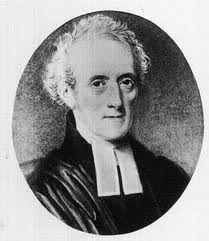
Henry Austen as a Clergyman later in life. Public domain via wikimedia.

JAW: What was something interesting you learned about Jane Austen herself in writing the book?

Oddly, it was spending time exploring Steventon and realising how isolated the Rectory and the village were in the late 18th and early 19th centuries. I had, of course, been to Jane Austen’s House in Chawton a number of times, but in my mind’s eye I had imagined Steventon as a quintessential English Village: village green, church, a few farmsteads, a pub, and even, perhaps, a game of cricket. That idea was completely shattered when I visited Steventon. The cultural life inside the Rectory must have been a great contrast to the isolated, scattered cottages of the poor inhabitants of the village. 

My understanding of the life of Cassandra Austen (Leigh) [Jane’s mother] grew as I thought of her coping with her own children plus the students boarding with them—all that food, oversight of the washing of bedding and getting it dry, all that hullabaloo inside the house during term-time. When did she have a moment to herself?  I began to wonder, as Jane watched her mother, how much Jane recognised the sheer logistical task her mother undertook to keep the ship happy, afloat and moving in the right direction.

This was the most fun part of the book to write, showing the inside of Steventon Rectory with all the liveliness and learning of Jane, Henry, and their siblings.

And, of course, Jane’s letters are an absolute delight. If only there were more…if only…

JAW: If you were able to meet Henry Austen personally, what do you think you would like about him? What would you want to ask him? What parts of his character might you find difficult or less pleasant?

I would enjoy his sense of humour, his generosity towards, and affection for, Jane, and his affection for Liza [his wife Eliza] and her son, Hastings. Not being a risk taker myself, I would love to hear about his own understanding of the nature of financial risk and entrepreneurship. When did he see the storm clouds brewing? Was ordination always at the back of his mind? Was it a kind of attempt to ‘give back’ to society, having enjoyed and then lost the fruits of worldly success?

I would find his undoubted attraction to the aristocratic level of society difficult, but I fully recognise that it was the 18th/early 19th century way. And when he was Perpetual Curate, I suspect I would have found his lack of awareness of the Farnham Workhouse very difficult. However, in fairness, I must add that it might simply be lack of evidence which leads me to suppose that he was not at his best with the poor and impoverished. So much information has been lost. I could be entirely wrong. 

JAW: Why do you think he was Jane’s favourite Brother?

I will say the idea for the title of the book was not mine, it was my publisher’s, but I am entirely happy with it. Why was Henry Jane’s favourite? He was obviously very close to her and looked to her for help whenever he hit a difficult or tragic patch in his life. They shared the same sense of humour, the same love of the quirks of society, the same interest in humanity. And it was Henry who went out of his way to ensure that her books were published. Besides, who but a favourite brother would actually volunteer to read Proofs!?

JAW: What would you like to tell potential readers about your book?

I hope that if they love Jane Austen, my book will reveal some lesser-known aspects of Regency society which might enhance their understanding of Jane and her novels. In brief, context really matters. But, most importantly of all, if my book leads to people reading or re-reading Jane, my hopes will have been more than fulfilled.

JAW: Thanks very much, Christopher! I loved Jane Austen’s Favourite Brother, Henry, and I think our readers will also.

Jane Austen’s Favourite Brother, Henry, by Christopher Herbert, is now available from the publisher, Pen & Sword, and from Amazon in the US and in the UK in hardcover. The Kindle version will be released September 30, 2025.

You can find out more about Dr. Herbert at https://en.wikipedia.org/wiki/Christopher_Herbert and https://www.chpublishing.co.uk/authors/christopher-herbert Since those lists of accomplishments, he has also been involved in the Royal Hospital for Neurodisability in London and the Lyme Resource Centre, a charity based in Scotland raising awareness of the growing incidence of Lyme disease and co-infections in Scotland and elsewhere in the UK.

*I looked up bathetic. It means “producing an unintentional effect of anticlimax.” Nice word!

Brenda S. Cox is the author of Fashionable Goodness: Christianity in Jane Austen’s England. She also blogs at Faith, Science, Joy, and Jane Austen.

Read Full Post »

By Brenda S. Cox

“Edward & I settled that you went to St. Paul’s Covent Garden, on Sunday.”—Jane Austen, letter to Cassandra from Godmersham Park, Oct. 26, 1813

Covent Garden

We’ve been visiting London churches mentioned in Austen’s novels. Now let’s go to one mentioned in her letters. In the fall of 1813, Jane was staying with her brother Edward and his family at Godmersham Park. Cassandra was visiting their brother Henry at 10 Henrietta Street, Covent Garden, London. He lived in a flat above his bank. (For locations Henry lived in London, see Jane Austen’s Visits to London.) Covent Garden was known for its fruit and vegetable market, as well as, unfortunately, its prostitutes.

Jane Austen’s London offered two official theatres, at Drury Lane and Covent Garden. Both were in the church parish served by St. Paul’s Covent Garden, and Austen saw plays at both. She was planning to see a play at the Covent Garden theatre when she visited Henry a month earlier:

“Fanny and the two little girls are gone to take places for to-night at Covent Garden; “Clandestine Marriage” and “Midas.” The latter will be a fine show for L. and M.” (Lizzie and Marianne)—Sept. 15, 1813 (Fanny was the eldest daughter of Jane’s brother Edward Austen Knight; her mother had died five years earlier. Lizzie and Marianne were Fanny’s younger sisters. Edward was with them but staying at a nearby hotel.)

Jane and Edward assumed Cassandra would go to church at St. Paul’s Covent Garden, since it was Henry’s parish church. Jane probably attended that church herself when any of her visits to Henrietta Street lasted over a Sunday. She and her family regularly attended church on Sundays, wherever they were.

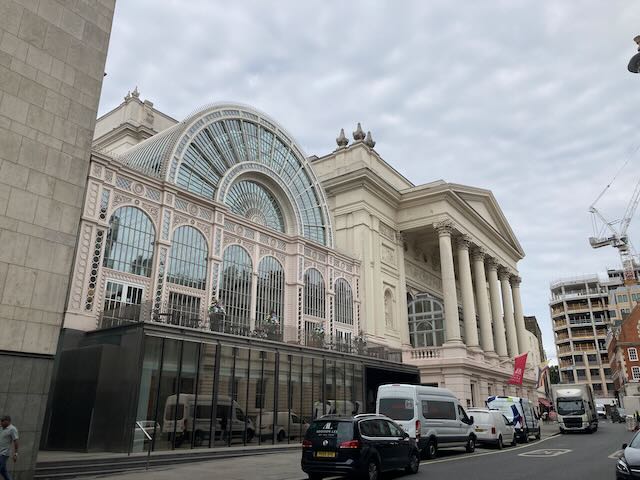
The old Covent Garden Theatre building is at the center of the modern Royal Opera House.

The Actors’ Church

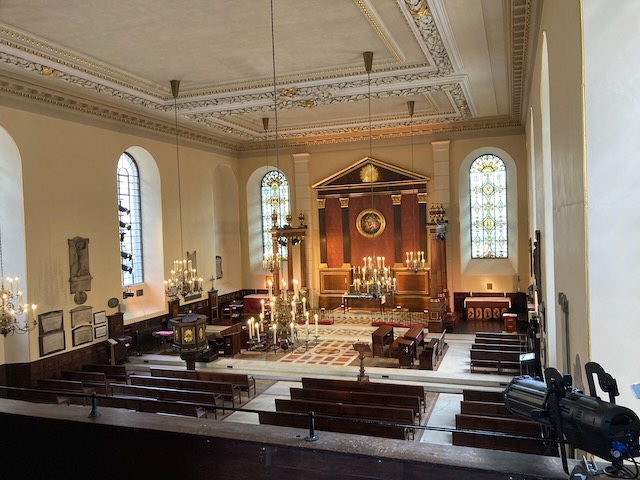
The Covent Garden area today offers more than twenty theatres. St. Paul’s, called “The Actors’ Church,” hosts concerts and plays in the church and in its walled garden. They have an in-house professional theatre company, Iris Theatre. The church’s summer schedule for this year includes Sense and Sensibility and Pride and Prejudice, along with several Shakespeare productions and children’s shows. To accommodate such events, the church replaced deteriorating Victorian pews with custom-made movable and stackable pews.

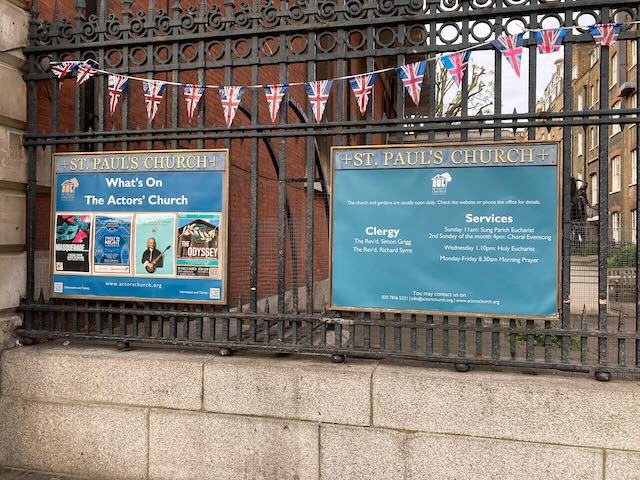
Signs announce upcoming shows and services at St. Paul’s Covent Garden, the Actors’ Church.

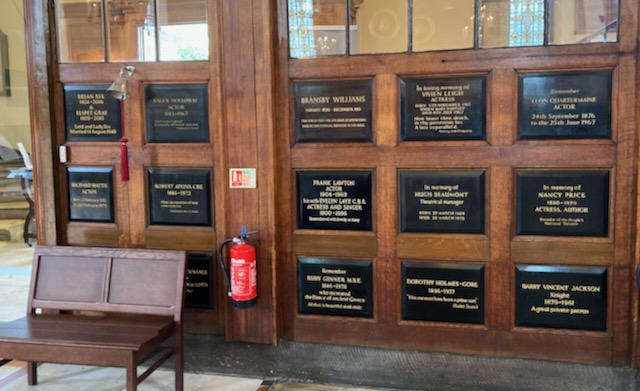
The inside of the church commemorates famous entertainers wherever you look. Hundreds of plaques adorn the walls of the church, the backs of the pews, and the garden benches and walls.

Wall plaques at St. Paul’s Covent Garden. Vivien Leigh’s is in the top right center.

Some plaques are memorials to the church’s leaders and parishioners, as you would see in other English churches. But most remind visitors of famous people such as Vivien Leigh (star of Gone with the Wind), Boris Karloff (who played Frankenstein’s monster), Thomas Arne (who wrote “Rule, Britannia” around 1740), Sir Charles Chaplin (Charlie Chaplin), and others.

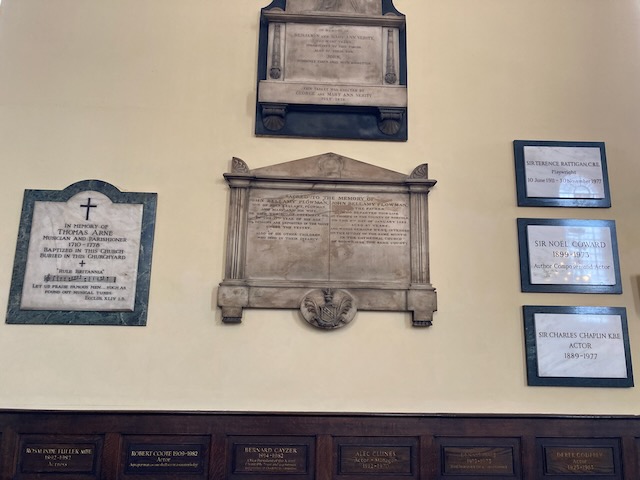
A variety of memorials line the walls of St. Paul’s Covent Garden. The central memorial is to John Bellamy Plowman, his son who died in 1811 at age 17, his son’s wife, and six children who died in infancy. The monument above it is from 1879. The grey and white plaque to the left is to Thomas Arne, “musician and parishioner,” 1710-1778, who wrote the anthem “Rule Britannia.” To the right are three twentieth century plaques, honoring playwright Sir Terence Rattigan; author, composer, and actor Sir Noel Coward; and actor Sir Charles Chaplin. A line of more modern brown plaques is below.

Besides actors and actresses, plaques commemorate dancers, singers, directors, theatre managers, patrons, choreographers, drama teachers, playwrights, and even a “critic, journalist, wit.” One woman is listed as “Actress, Producer, Supernova.” The church charges hefty fees to install these plaques (around £3000 for a plaque on the wall). These fees have kept the church solvent.

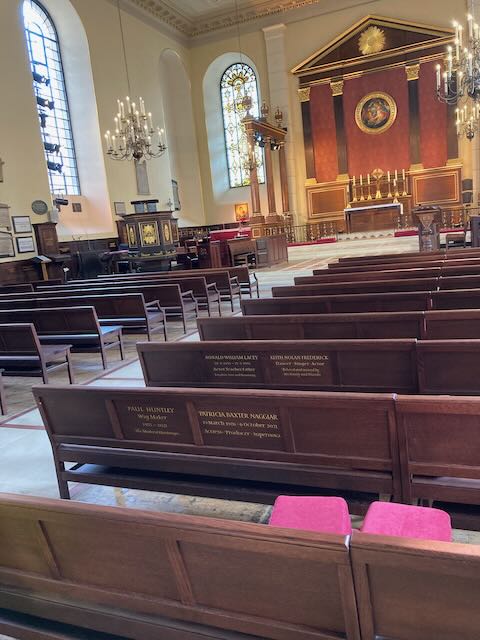
Memorials on the backs of pews at St. Paul’s Covent Garden

History

The church was designed by Inigo Jones and consecrated to St. Paul in 1638.

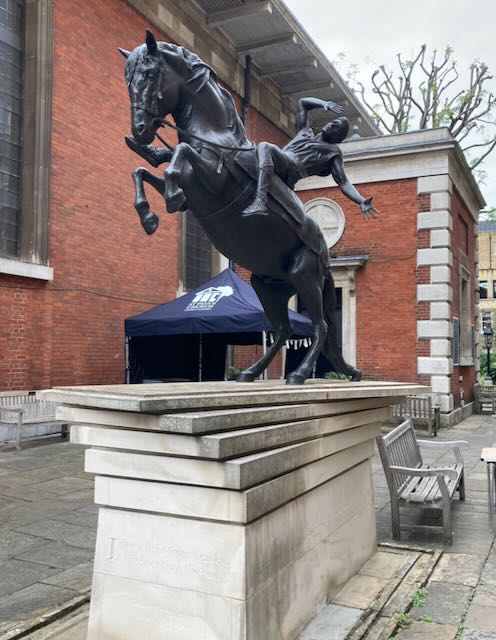
Covent Garden churchyard statue of St. Paul seeing a vision on the road to Damascus.

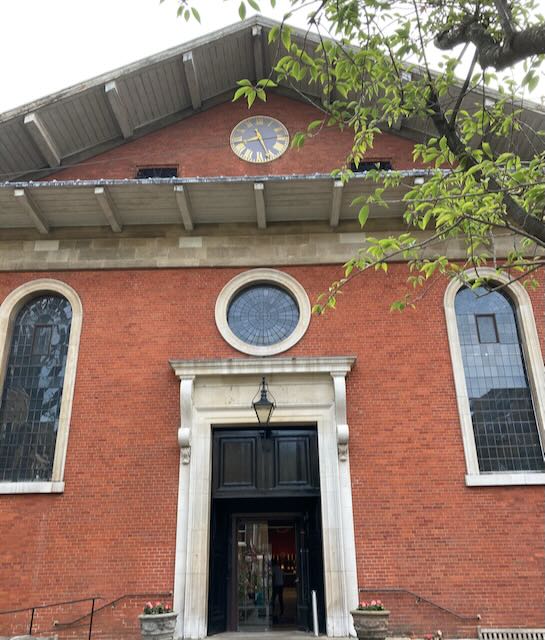
Jones designed it with a great East Door into the main piazza of Covent Garden. However, that would have put the altar at the west end of the church, which went against Christian tradition. At the last moment, the Bishop of London decreed that the altar had to be in the east end of the church, so the East Door doesn’t open. Entry is through the churchyard, from the sides of the building.

Front of St. Paul’s Covent Garden, with the false door in the center.

Various famous people are buried in the churchyard, including the painter JMW Turner and the first victim of the Great Plague of London, who died in 1665. In the 1850s, Parliament stopped all burials in central London churches. At that time, the headstones were removed and the gardens laid out as they are today.

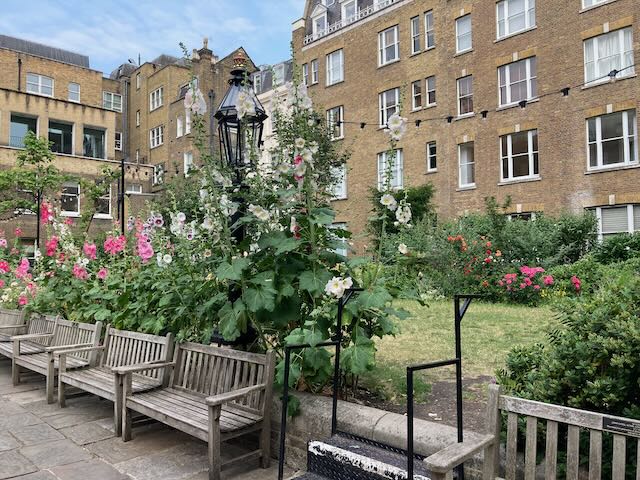
Lovely garden in the churchyard of St. Paul’s Covent Garden

A fire destroyed much of the church in 1795, but it was rebuilt so that today it is much as Austen would have seen it.

Entrance from the churchyard of St. Paul’s Covent Garden.

Rectors

When Jane Austen was there, Edward Embry was the rector, from 1810-1817. She might have heard him preach, but she does not mention him in her letters. His portrait is in the National Gallery.

The rector who kindly showed us around when we visited was Rev. Simon Grigg, who has been rector since 2006. His bio says “When not in church you will usually find him in a bar, a theatre or the gym.” The assistant rector, Rev. Richard Syms, is a professional actor and theatre manager as well as a priest.

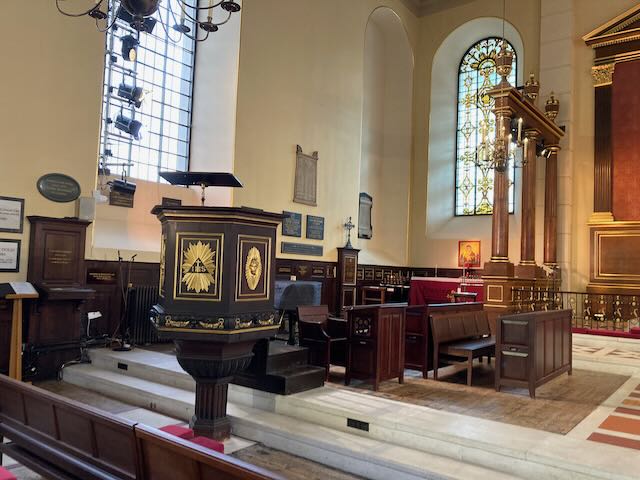
The pulpit of St. Paul’s Covent Garden was designed by Grinling Gibbons (1648-1721) or his students.

Worship

The church offers communion services on Sundays and Wednesdays, and brief Morning Prayer services Tuesday through Friday. Their choir sings Choral Evensong once a month. Rev. Grigg told us that attendance on Sundays is about 50 people, plus those who attend online. The church seats 200.

Chancel of St. Paul’s Covent Garden. Note the camera on the right.

They have larger services for Easter and for midnight mass on Christmas Eve. Of course they also host weddings, baptisms, and funerals. According to their website, “St Paul’s is well known because of its memorial services for members of the theatrical and entertainment community, but we also offer them for the local community.”

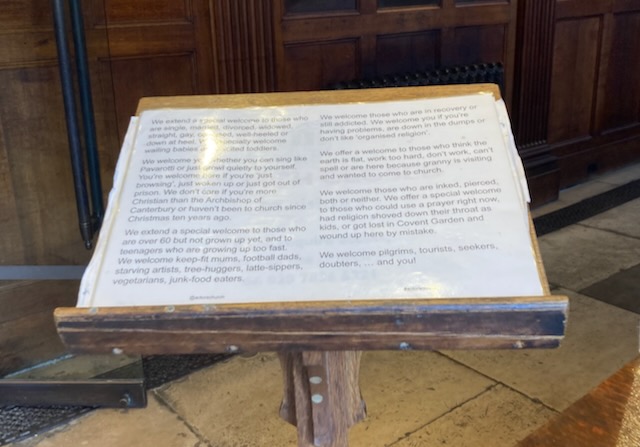
Welcome sign to St. Paul’s Covent Garden; text is below.

Inclusion

The church seeks to be inclusive, according to their website and this entry sign:

“We extend a special welcome to those who are single, married, divorced, widowed, straight, gay, confused, well-heeled or down at heel. We especially welcome wailing babies and excited toddlers.

We welcome you whether you can sing like Pavarotti or just growl quietly to yourself. You’re welcome here if you’re ‘just browsing’, just woken up or just got out of prison. We don’t care if you’re more Christian than the Archbishop of Canterbury or haven’t been to church since Christmas ten years ago.

We extend a special welcome to those who are over 60 but not grown up yet, and to teenagers who are growing up too fast. We welcome keep-fit mums, football dads, starving artists, tree-huggers, latte-sippers, vegetarians, junk-food eaters.

We welcome those who are in recovery or still addicted. We welcome you if you are having problems, are down in the dumps, or don’t like ‘organized religion’.

We offer a welcome to those who think the earth is flat, work too hard, don’t work, can’t spell or are here because granny is visiting and wanted to come to church.

We welcome those who are inked, pierced, both or neither. We offer a special welcome to those who could use a prayer right now, had religion shoved down their throats as kids, or got lost in Covent Garden and wound up here by mistake.

We welcome pilgrims, tourists, seekers, doubters, . . . and you!”

No doubt Jane Austen and her family would have felt welcome in the church, especially with their love of the theatre.

All photos in this post ©Brenda S. Cox, 2025

More Information about St. Paul’s Covent Garden

Physical dedications 

Self-Guided Tour, explaining parts of the church and giving prayers 

Visitor Information and schedule of events 

History of the church 

Churches Mentioned by Name in Jane Austen’s Novels

Garrison Chapel

St. Swithin’s, Walcot and other churches in Northanger Abbey

St. George’s, Hanover Square

London Churches in Austen’s Novels

Austen Family Churches

Steventon

Chawton

Deane

Hamstall Ridware and Austen’s First Cousin, Edward Cooper

Adlestrop and the Leigh Family

Stoneleigh Abbey Chapel and Mansfield Park

Great Bookham and Austen’s Godfather, Rev. Samuel Cooke

Ashe and the Lefroy Family


Brenda S. Cox is the author of Fashionable Goodness: Christianity in Jane Austen’s England. She also blogs at Faith, Science, Joy, and Jane Austen.

Read Full Post »

by Brenda S. Cox

“My dear child, commend Dr. Grant to the deanery of Westminster or St. Paul’s, and I should be as glad of your nurseryman and poulterer as you could be.”—Mrs. Grant to Mary Crawford, Mansfield Park, chapter 22

Churches Mentioned in Mansfield Park

Four real churches are mentioned in Mansfield Park, which talks extensively about the church and clergy. I’ve written about the Garrison Chapel, where the Prices and Henry Crawford went to church. A few days ago, I posted about a church in London, St. George’s, Hanover Square, the wedding venue that Mary Crawford wants to show Fanny. 

Two more real London churches are mentioned in Mansfield Park. Mrs. Grant speaks of the two most well-known churches in England, Westminster Abbey and St. Paul’s Cathedral. Mary Crawford tells her sister to greet the nurseryman (who took care of plants) and the poulterer (who provided poultry), but her sister tells her there are no such people in Mansfield. The Grants will need to move to the big city to get such help. She hopes that someone will “commend Dr. Grant to the deanery of Westminster or St. Paul’s,” so they can move to London.

The “deanery” is the office of the dean, the head clergyman of a major church.

Mrs. Grant finally gets that opportunity:

“Dr. Grant, through an interest on which he had almost ceased to form hopes, succeeded to a stall in Westminster, which, as affording an occasion for leaving Mansfield, an excuse for residence in London, and an increase of income to answer the expenses of the change, was highly acceptable to those who went and those who staid.”— Mansfield Park, chapter 48

Dr. Grant, as he had hoped, moves up in the church hierarchy to a prestigious church.  He’s been the rector of a small country church at Mansfield Park. He will still receive the tithe income from that church until he dies, when Edmund will become rector. But Dr. Grant has connections to people with influence who can get him a higher church position. The church worked much like the Navy, where Henry Crawford’s uncle, the Admiral, gets William Price a promotion.

Westminster Abbey

One of Dr. Grant’s friends, or more likely a friend of a friend, gets him a “stall in Westminster,” meaning a position as a prebendary. A prebendary was a church official who sat in a prebendal stall, a seat of honor in the church. The position came with income from a “prebend,” specific church possessions.

Stalls in Westminster Abbey, 1908. Image Credit: Rev. Thomas Davidson 1856-1923 (ed.), Public domain, via Wikimedia Commons

Westminster Abbey is, of course, the church in London where monarchs are crowned, as King Charles III was not long ago. All English coronations have taken place there since 1066. It is not a cathedral or a parish church. Instead it is a “Royal Peculiar,” with a dean like other large churches, but under the direct supervision of the monarch rather than a bishop or archbishop.

Westminster Abbey in London, a “Royal Peculiar” directly under the Crown. Credit: Σπάρτακος, CC BY-SA 3.0, via Wikimedia Commons

Westminster Abbey is also, of course, a place where many famous people are buried and memorialized. While Jane Austen is buried in Winchester Cathedral, there is a small plaque commemorating her in Poet’s Corner in Westminster Abbey, adjacent to Shakespeare’s memorial.

St. Paul’s Cathedral

St. Paul’s Cathedral, the other place where Dr. Grant hoped to get a position, is the cathedral of the diocese of London. (A diocese is a geographical group of parishes, led by a bishop, whose “seat” is at the cathedral for the diocese.) The history of the church reflects the history of London.

One interesting fact: women were first ordained as priests in the Church of England in 1994, and St. Paul’s first clergywoman was appointed in 1997. Now the Lord Bishop of London is a woman, installed in 2018, with her seat, of course, at St. Paul’s. She is called the Right Reverend and Right Honorable Dame Sarah Mullally, and she is a member of the House of Lords. No doubt Jane Austen would be amazed.

St. Paul’s Cathedral, image ©Brenda S. Cox, 2025

St. Clement’s in Pride and Prejudice

One more London church is mentioned in Jane Austen’s novels. In Pride and Prejudice, Lydia tells her sisters,

“We were married you know, at St. Clement’s, because Wickham’s lodgings were in that parish. And it was settled that we should all be there by eleven o’clock.” 

We don’t know for sure which St. Clement’s in London Austen has in mind. An old nursery rhyme goes, “Oranges and lemons, say the bells of St. Clement’s,” and two churches claim to be the St. Clement’s in the rhyme.

It seems most likely that Austen was referring to St. Clement Danes in the Strand, which served a large parish. The parish included areas of cheap lodgings and less savory areas, where Wickham could have afforded lodgings. It was also some distance from Gracechurch Street where the Gardiners lived, better concealing Wickham and Lydia from her family. (Source: Pat Rogers, editor of the Cambridge Pride and Prejudice.)

Another option, according to Rogers, is St. Clement’s Eastcheap on the east side of Clement’s Lane. However, this was a tiny parish only a block from Gracechurch Street, so was less likely to be the parish Wickham chose to lodge in.

The rhyme goes on to talk about not being able to pay a debt until one gets rich, at some unknown future time. Quite appropriate for Wickham, who was deep in debt but always hoping to get rich. 

St. Clement Danes in the Strand, possible location for Lydia and Wickham’s wedding. Image credit: Stephen Richards / St Clement Danes, Strand / CC BY-SA 2.0

Faith in London Today

Another surprise for Jane Austen: In Mansfield Park, Edmund Bertram states, “We do not look in great cities for our best morality.” He implies that there was more virtue in the countryside and more vice in London. That was probably true in Austen’s time, according to all I have read.

However, a survey a few years ago indicated that the opposite is now true: “London is now more religious and socially conservative than the rest of Britain.” According to that survey, Londoners pray more, attend religious services more, and are more conservative on moral questions than those outside London. Also, Christian Londoners help their neighbours and give to charity more than non-religious Londoners. Of course, London is also a diverse religious environment, with people practicing various religious faiths, which are less common outside of the capital.

The London churches Austen mentions in Mansfield Park are still thriving.

Other churches mentioned by name in Jane Austen’s novels and letters

Garrison Chapel

St. Swithin’s, Walcot and other churches in Northanger Abbey

St. George’s, Hanover Square

St. Paul’s, Covent Garden: Actors’ Church

Austen Family Churches

Steventon

Chawton

Deane

Hamstall Ridware and Austen’s First Cousin, Edward Cooper

Adlestrop and the Leigh Family

Stoneleigh Abbey Chapel and Mansfield Park

Great Bookham and Austen’s Godfather, Rev. Samuel Cooke

Ashe and the Lefroy Family

Read Full Post »

By Brenda S. Cox

“. . . perhaps you would not mind passing through London, and seeing the inside of St. George’s, Hanover Square. Only keep your cousin Edmund from me at such a time: I should not like to be tempted.”—Mary Crawford, Mansfield Park, chapter 43

Mansfield Park includes much more discussion of the church than any other Austen novel. Not surprisingly, it also names more real churches than the other novels do.

In an earlier post we explored the Garrison Chapel, where Fanny Price and her family worship in Portsmouth. Henry Crawford attends with them on his visit. Perhaps this symbolizes his attempts to reform himself and become worthy of Fanny; attempts that ultimately fail.

Remains of the Garrison Chapel in Portsmouth where the Prices and Henry Crawford worshiped.

Henry’s sister Mary names another real church in a letter to Fanny. She wants Fanny to let her and Henry take Fanny back to Mansfield from Portsmouth, where Fanny has been staying with her family. Fanny is unhappy and unhealthy, but will not commit the impropriety of going back to Mansfield Park before her uncle sends for her. Mary wants to take Fanny to see Henry’s estate and then pass through London on the way to Mansfield.

She suggests visiting St. George’s, Hanover Square. This was a popular church for weddings among the upper classes of London. Mary hopes Fanny will marry Henry there. At the same time, Mary says it might tempt her to marry Edmund. She doesn’t want to marry a clergyman, or a second son who will not inherit an estate, but she is attracted to Edmund.

St. George’s Hanover Square exterior. According to the church website, “The classical front with six great Corinthian columns supporting a pediment represented a new trend in English Church design.”

St. George’s, Hanover Square Today

During a recent visit to London, I had the privilege of worshiping at St. George’s, Hanover Square on a Sunday morning. The service was a Sung Eucharist, a Communion service in traditional language, with beautiful singing from the choir and impressive organ music. During the service, the congregation renewed their baptismal vows.

St. George’s Hanover Square interior. The painting of the Last Supper over the altar, and the surrounding carvings, were installed in 1724. The seven silver hanging lights in the church represent the seven lamps of fire burning before God’s throne, according to the book of Revelation in the Bible.

The church also offers brief midday services from the Book of Common Prayer on weekdays and several other Communion services during the week. Weekday “Morning Calm” services are held during termtime, as “a short period of reflection, contemplation, and relaxation before the challenges of the day begin.”

Nowadays the area around Hanover Square is mostly offices and businesses. I was told that most people in the current congregation live farther away, since few people live close to the church now.

The signboard for St. George’s Hanover Square lists services, extensive opening hours, and rules such as no drugs in the church and no sleeping on pews.

Wealthy Mayfair

Hanover Square is in Mayfair. In Austen’s England, many wealthy people had large houses in Mayfair or surrounding areas. In Sense and Sensibility, the Palmers live in Hanover Square, while the Middletons, Mrs. Ferrars, and Willoughby live nearby in Mayfair. Mrs. Jennings and John and Fanny Dashwood live in Marylebone, an area just north of Mayfair. It developed when Mayfair could no longer accommodate all those who wanted fashionable, elegant housing. (Source: The Annotated Sense and Sensibility, David Shapard.)

St. George’s is the parish church of Mayfair, where the wealthy worshiped. In 1711, Parliament had passed an Act for the building of fifty new churches in and around London. The wealthy of Mayfair petitioned for a church, which was completed in 1725. The patron saint of the church is St. George, a Christian martyr of the third century who is also the patron saint of England.

Rectors of St. George’s Hanover Square during Austen’s time and thereafter. Some held other influential church positions as well.

The parish was large, with a vestry of 101 vestrymen. These included 7 dukes, 14 earls, 7 barons, and 26 other titled people. A vestry, led by the church’s rector and churchwardens, decides matters relating to the church and the secular parish. (Mr. Knightley, Mr. Weston, Mr. Cole, and Mr. Cox are apparently on the vestry for their parish, as they are “busy over parish business” in Emma.) The St. George’s, Hanover Square vestry dealt with local issues including street lighting, refuse disposal, nightwatchmen, and a workhouse for the poor.

St. George’s Hanover Square eagle lectern. Many churches of Austen’s time had lecterns similar to this, where the Bible was read to the congregation. (The eagle symbolized the Word of God because supposedly it could fly directly into the sun without closing its eyes, so it was like the Bible, leading people to God with eyes open. Eagles’ wings also symbolized carrying the gospel to the ends of the earth.)
Pulpit of St. George’s, Hanover Square

Rich and Poor

While the wealthy owned mansions in the area, most spent only the winter in London, passing the rest of the year on their country estates. The back alleys behind the mansions teemed with poverty and misery year-round. In the early 1800s, the Evangelical movement began to awaken the church to the needs of the poor. St. George’s established a parish school for poor children in 1804, supported by public subscriptions. Later in the century, the church initiated and supported extensive projects to help the working classes of the area.

But the wealthy ran the church in Austen’s time. Around the gallery (balcony) are listed the churchwardens, year by year. Anglican churches generally have two elected churchwardens, responsible for financial accounts, movable property of the church, keeping order, and other administrative responsibilities. The churchwardens listed on St. George’s galleries for the 1700s and early 1800s sound impressive: Viscounts, Earls, Lords, Sirs, Honorables, and Esquires.

St. George’s Hanover Square balcony listing early churchwardens. Many were titled men.

Music

The composer George Friderick Handel lived about a four minute walk from the church. He helped choose the organ and organist for the new church. He had a pew there and worshiped at St. George’s until he died. He wrote the Messiah in his house nearby on Brook Street, which is now a museum.

St. George’s Hanover Square organ pipes; a new organ was installed in 1972. The original organ had 1514 pipes and three manuals (keyboards for the hands). It cost £500 in 1725.

Weddings

Since it was at the heart of the wealthy district, St. George’s, Hanover Square was the popular place for weddings of the wealthy and influential. In 1816, the church hosted 1,063 weddings! Famous people including Percy Bysshe Shelley, Benjamin Disraeli, George Eliot (Mary Lewes), and Theodore Roosevelt were married at St. George’s. Mary Crawford was likely staying near there with her wealthy London friends, and she may have attended church there. So it was the first place she thought of for her own and her brother’s weddings. It is still a popular venue for weddings, though not as much so as in Austen’s time.

On Thursday, we’ll look at the other two real churches mentioned in Mansfield Park, the two most famous churches in England. Do you know which ones they are? We’ll also consider which London church Lydia and Wickham married in!

All images above ©Brenda S. Cox, 2025.

Churches mentioned by name in Jane Austen’s novels and letters

Garrison Chapel

St. Swithin’s, Walcot and other churches in Northanger Abbey

London Churches in Austen’s Novels

St. George’s, Hanover Square

St. Paul’s, Covent Garden: Actors’ Church

Austen Family Churches

Steventon

Chawton

Deane

Hamstall Ridware and Austen’s First Cousin, Edward Cooper

Adlestrop and the Leigh Family

Stoneleigh Abbey Chapel and Mansfield Park

Great Bookham and Austen’s Godfather, Rev. Samuel Cooke

Ashe and the Lefroy Family

Read Full Post »

Older Posts »