Feeds:
Posts
Comments

Archive for the ‘Georgian Life’ Category


Bootmaker, 1845


He wore green trousers and a red jacket and his hat was leather with a narrow brim and a purple band all around the crown. He was sitting on a wooden stool, hammering away at a pair of boots that he was making, with the tools of his trade all laid out beside him: the lap-stone, the stirrup, the whet-board, the pincers and the nippers. As he worked he sang a little song to himself, to go with the rhythm of the hammering:

A Gentle Craft that hath the Art,
To steal soon into a Lady’s Heart.
Here you may see what Guile can do,
The Crown doth stoop to th’ Maker of a Shoe.

The Other End of the Rainbow, David Gardiner


16th Century Shoemaker Shop


In the Middle Ages, tradesmen formed guilds that protected their trades. Those who worked with fine leather were known as Cordwainers,  named after the very finest leather that was imported from Cordoba, Spain. In later years, those who processed leather formed their own guild, but  shoemakers retained the name of Cordwainer. Cobblers were distinct from Cordwainers, for they only repaired shoes, but over the years, this distinction began to weaken.  – Cordwainers: History.
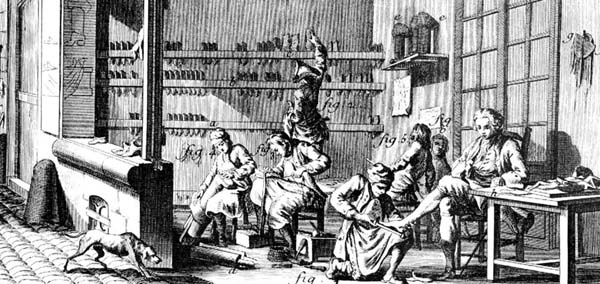
 

18th Century Shoe Shop


At the time, the shoemaking trade consisted of division according to the type of shoes made: men’s, women’s, and shoes for workers, such as night-soil men and slaughterhouse men. There were different operations performed by different persons: cutting leathers, sewing uppers, and joining heel and sole. And there were production sites, such as shop masters and cellar, garret and stall masters. Shoe masters employed many people in large operations that hired many workers (there were only 600 or 700 of these), but over 30,000 individuals worked as journeymen, countryworkers, apprentices and cheap garret masters.*


Shoe Seller, 1840


By the 18th century, most boot and shoemakers barely made a subsistence wage. The majority of individuals who made shoes worked for very low wages, about 9s or 10 s a week. Many could barely afford their own lodging, and if they did, the accommodations were mean and poor.  The wages, while low for men, were even lower for women – who worked in shoe closing and shoe binding – and for children.*
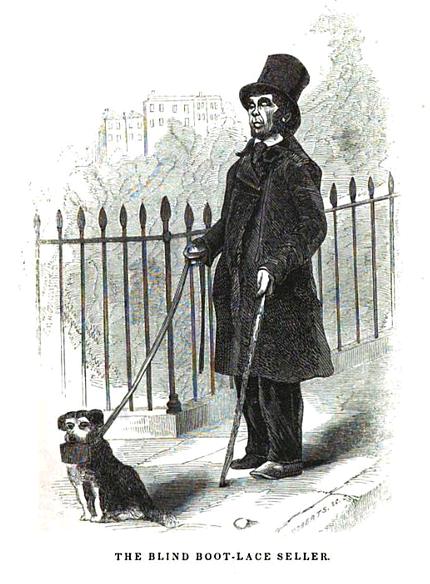
 

Blind bootlace seller, Mayhew


The life of a shoemaker was a hard scrabble life, for their trade depended on leather, the purchase of which required money or credit. Some shoemakers were known to stretch their goods by reducing the thickness of the leather used for heels and soles. Others, desperate to feed their families, would steal food or clothing and be jailed or, worse, hung after they were caught.*  -*London Hanged: crime and civil society in the eighteenth century, Peter Linebaugh
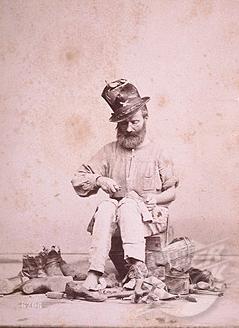
 

19th century shoe cobbler


Yet the shoemaking business was not totally abysmal:


Shoes over the 18th Century**


Shoemaking flourished in the 18th century, and boot- and shoe-makers were the most numerous of all Salisbury craftsmen throughout the 19th century and until the First World War. It was said that in the later 19th century ‘in hundreds of houses the shoe-binders, the closers and finishers were busy week in week out’. The business with the longest history is Moore Brothers, whose origins can be found in William Moore, boot and shoemaker in 1822 and 1830, and Henry Rowe, established in Catherine Street in 1842, who had moved by 1867 to Silver Street. By 1875 these premises were occupied by Rowe, Moore and Moore, a firm which subsequently became James and William Moore Brothers. The firm moved to its present premises in the New Canal at the end of the 19th century.  – Salisbury Economic History Since 1621


Yellow silk shoes with buckles, French, c. 1760's. @Bata Shoe Museum


Early in the Georgian era the fashion for high heels (as much as 3″) made it difficult for cobblers to make “paired lasts” for left and right shoes. The “last” of the shoe is footprint of the shoe, which can be straight or without a left or right side. Many of the 18th and 19th century shoes and boots were produced on straight lasts. As the person wore the shoes, they “molded” to the foot, creating a left side and right side over time. –  The Bootmaker


1810-1820 woven straw shoes


After the French Revolution, shoe heels began to disappear, symbolizing that everyone was born on the same level. Delicate silk uppers began to be replaced by more affordable, sturdier leathers.


1891 silk shoe made with straight lasts***.


But the shoes continued to be made with straight lasts, a technique that continued into the 20th century.
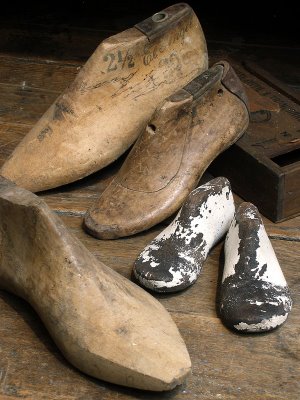
 

Vintage shoe lasts


As late as 1850 most shoes were made on absolutely straight lasts, there being no difference between the right and the left shoe. Breaking in a new pair of shoes was not easy. There were but two widths to a size; a basic last was used to produce what was known as a “slim” shoe. When it was necessary to make a “fat” or “stout” shoe the shoemaker placed over the cone of the last a pad of leather to create the additional foot room needed. – Fashion Through Time, History of Your Shoes


Shoemaker's shop, 1849


Tools used by bootmakers and cobblers included: awls for punching holes in leather; hot burnishers that rubbed soles and heels to a shine; sole knives that shaped soles; stretching pliers which stretched the leather upppers; marking wheels to mark where the needle should go throught the sole, and size sticks to measure the foot. “By 1750 shoemakers were making shoes in different sizes for anyone who wanted to buy them. Before that they only made shoes on special order.” – Tradesmen/shoemaker.

Sources:
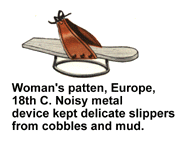
 

Pattens went out of fashion in the early 19th century. Jane Austen recalled their noise on cobblestones in Bath. It was common for women to trip while wearing this awkward device.
 

Read Full Post »

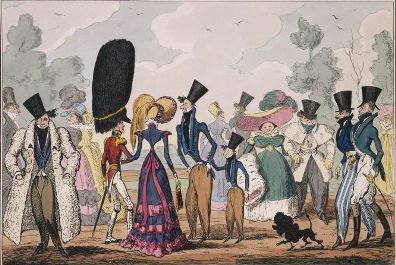
The Parks of London by Mary Elizabeth Brandon, 1868, on Dandyism.net discusses the dandies parading up and down London’s fashionable parks. After visiting that site, return to read some of my older posts about Hyde Park and the pleasure gardens.

More on the Topic:

Read Full Post »

Along with Austenprose, this blog is celebrating Georgette Heyer’s 108th birthday on August 16th. Look for Laurel Ann’s interview with me on her blog that day! Her questions were quite challenging.

The recent reviews featured on Laurel Ann’s blog echo some of the reviews that have been published in recent years on this blog. For your enjoyment and in celebration of the Austenprose event, we are reviving some of our favorite Georgette Heyer reviews.

Read more Georgette Heyer reviews by a wide variety of bloggers on Austenprose.

Read Full Post »

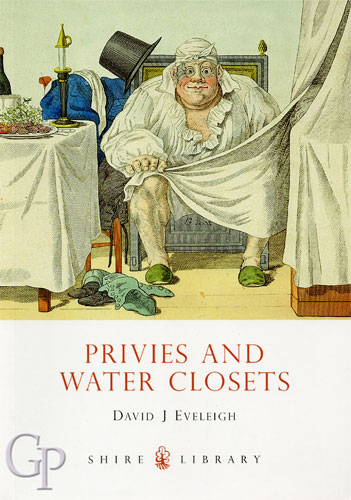
I have reviewed several Shire Library books this past year and have yet to be disappointed. Case in point, Privies and Water Closets by David J. Eveleigh, an excellent small book on the history of fixed and portable sanitation and waste management. I have discovered that this topic is of everlasting curiosity and many of my readers have asked questions similar to the following: How well  did our ancestors manage without indoor bathrooms or running water? This book largely answers the question.

Starting with the 17th and 18th centuries, Mr. Everleigh traces the history of sanitation and the problems our ancestors had in handling waste sewage. While the topic may not seem glamorous, it is hugely fascinating, for sanitation management was intricately connected to the safety of a community’s water supply and the populace’s overall health and well-being. He classified the earliest sanitation methods as either portable or fixed.

Portable Solutions

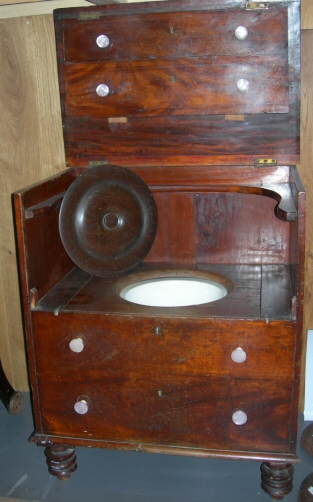
Chamber pots were the easiest method of sanitation. Placed under beds, or a commode or closet stool, the contents could be easily emptied into a covered slop pail and carried outside. In the 17th and 18th century small rooms or closets were introduced that adjoined the bedrooms. These areas were outfitted with a comfortable commode, under which a pan would be placed.

16th century water closet

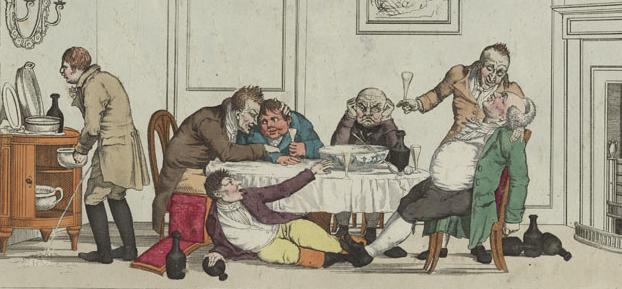
The wealthy did not handle the chamber pots, leaving the servants to clean up after them.  Chamber pots were not always so well situated, as the image below shows (p. 8).

L'apres Dinee des Anglais

English gentlemen, known for their prodigious drinking habits, were wont to relieve themselves where they were – in the dining room, for instance, or in a common room of a public inn – where they did not always aim straight and true (as the young man at left), much to the chagrin and disbelief of French travelers, some of whom wrote about this unsanitary habit.

Fixed Solutions

The privy was a fixed out house (or necessary house or house of office), with no water supply or drain and usually located some distance away from the house. A fixed wooden seat with a rounded hole was placed directly over the cesspit or “void.” Occasionally privies were attached to the side of a building, projecting out from a top floor, or reached through on outdoor entry on the ground floor of a service wing. More often than not they were placed at some distance from the main house at the far end of a garden or yard, where its contents could be used to “enrich” flower and vegetable beds.

Earth closet contents were put on the garden, Chawton Cottage. Photo courtesy Tony Grant**

In cities, neighboring privies were placed side by side in yards and drained into a common cesspool located under an alley that ran between the row of cottages or townhouses. In rich to middle class households, nightsoilmen would be paid to cart the waste away when the household was sleeping. This service was quite expensive, and quite often neglected in poorer districts where the lower classes could not (and landlords would not) hire these men until the cesspools were filled to overflowing.

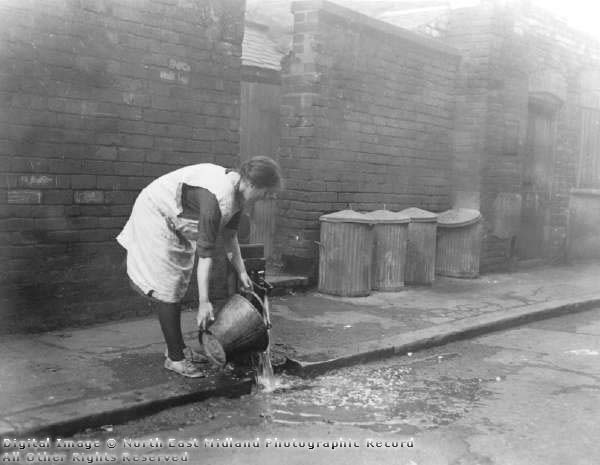
A woman obtains water from a well situated near garbage cans and outdoor privies, which can be seen through the opening in the wall. (Image taken in 1931!)***

Lack of sanitation led to diseases like typhoid, dysentery, and cholera. It was common in the slum districts for cess pools to be left unlined or partially finished, allowing liquid sewage to seep into and contaminate a nearby well, cistern, or other common form of water supply. In cities the public privy was often the only “necessary” available and was shared by a number of households, sometimes as many as sixty-five. The crowding and lack of maintenance and emptying of wastes led to disease and death.

Alley with open sewer drain and privies for the surrounding houses

In Privies and Waterclosets, Mr. Eveleigh traces the improvements in street sewers, indoor plumbing and running water, and sanitary habits throughout the nineteenth century, especially after the second great cholera epidemic in Bermondsey, London in 1849, which killed 13,000 and was the result of water contaminated by raw sewage.

While the book consists of only 64 pages, authors of historical novels will find it a fascinating and welcome addition to their research library. I give this book three out of three Regency fans.

Pages: 64
Published: 2008, Shire Library 479, Shire Publications, UK
150mm x 210mm, soft cover, indexed, new
ISBN 978-0-7478-0702-5

Additional links:

*Image of water closet: Abertillery and District Museum

**Image of Chawton Cottage garden, Tony Grant, London Calling – Personal Hygiene in Jane Austen’s Day

***Image of woman at well, North East Midland Photographic Record, The University of Nottingham, 1931 (This is a correction.)

Read Full Post »

Georgette Heyer’s Regency World by Jennifer Kloester is available August 1.

This extremely interesting compendium of insights and knowledge came my way by One Who Knows how much a fan of Georgette Heyer and Jane Austen I am. Neatly organized into chapters by topic, Kloester provides basic information on the life upper class men and women lived in the Regency Era. Using the historical knowledge she accrued while writing her dissertation on Georgette Heyer, she provides the background on what the Regency was. In Chapter 14, she writes brief, pithy biographical sketches of the Royal family, as well as other real people who appear throughout the Heyer Regency books: Edward Hughes “Golden Ball” Hughes, Sally Jersey, Lady Castlereagh, George Bryan (Beau) Brummell, and noted authors of the day. Her sketches of the Royals are most helpful, for this was an era filled with Royal siblings, offspring and mistresses.

I also enjoyed the chapters on fashion and shopping; the sketches of the various outfits will be most helpful to those readers who do not have a strong foundation in the history of fashion. While men’s fashions began their evolution into the suits of today, women during the Regency enjoyed a rare period of less constriction and heavy underpinnings. Definitions and sketches of pelisses, morning and promenade dresses give good clues to what the characters wear.

Throughout the book, Kloester clarifies definitions by referring to some of Heyer’s Regency novels. So we are reminded that Abigail Wendover first appears to us in Black Sheep dressed in the latest thing in carriage dresses, and that Freddy Standen’s perfectly cut coat and satin knee breeches were identified as just the thing for an appearance at Almack’s. That fine institution of the Marriage Mart is also explained and clarified with references to Cotillion, The Grand Sophy, Friday’s Child, Regency Buck, and Frederica. These references give a nice context to a somewhat dry discussion, and keep the reader engaged in the book.

It is a helpful source of information for the fan of Heyer, for her books are set strongly within the period; Heyer was a meticulous researcher and avid historian. While she defines terms contextually, readers may need a little more information than Heyer provides. Kloester gives it in good doses, enlivened by references to books they may have read, or will be likely to read soon.

It is not, however, the definitive guide for all fans of Austen and Heyer it purports to be. Jane Austen does not set her books in the Beau Monde, or ton, as does Heyer, and her references to clothing, furnishings, and travel are sparse. She is writing in the period, not of the period, and is more interested in the people and their actions than the stuff of their lives. The book does not cite references beyond the mentions in the Heyer books, although Kloester does include an extensive list of resources for someone who wishes to pursue Regency research in Appendix 5. It is not a scholarly work, but an informative one. Her Heyer citations are helpful, if one has read the particular book, and only informative of where to find such an object or how the neck cloth is tied, if not. That being said, the book is filled with tasty little nuggets of information. I enjoyed her brief insights and explanations on the wide-ranging topics.

Reviewed by Lady Anne

Inquiring Readers: Lady Anne is my special friend. I have read Georgette Heyer since I turned 22, and I have read all of her books at least once. But Lady Anne has read Georgette Heyer novels every night for at least 30 years. She knows the plots and dialogs inside and out; and can name every character of all her favorite Georgette Heyer books, including the mysteries and histories. She graciously agreed to review Jennifer Kloester’s book while I tended to a family emergency.

Jane Austen’s World reviews of Georgette Heyer’s novels

For the month of August, join Austenprose‘s celebration of Georgette Heyer!

Read Full Post »

« Newer Posts - Older Posts »