Feeds:
Posts
Comments

Archive for the ‘History’ Category

Fire!

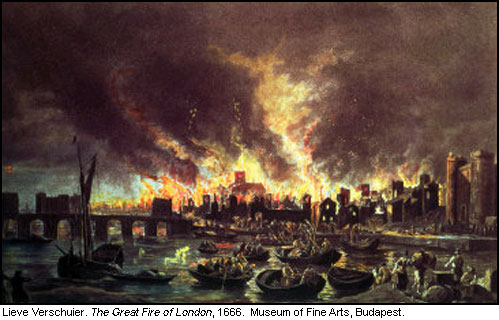
Can there be a more frightening word in Georgian London?  The great fire in 1666 changed the landscape of that city forever. Once a densely packed city riddled with overcrowded, wood-timbered houses and dark, narrow lanes, the fire led the way to a change in building regulations that ushered in brick and stone edifices, wider streets, and public squares. Even with improvements, a fire still presented a horrifically dangerous situation.
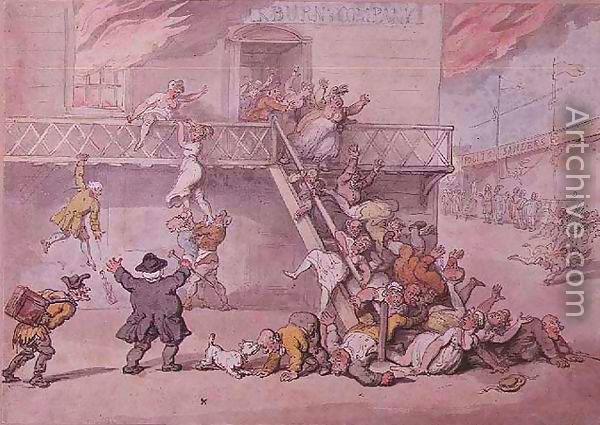
Thomas Rowlandson captures the scene with such realism in “Inn Yard on Fire” that one can smell the smoke and fear, and hear the horses neighing, people screaming, furniture breaking, and wagon wheels squealing as guests and staff run around trying to save themselves, their possessions, and each other.
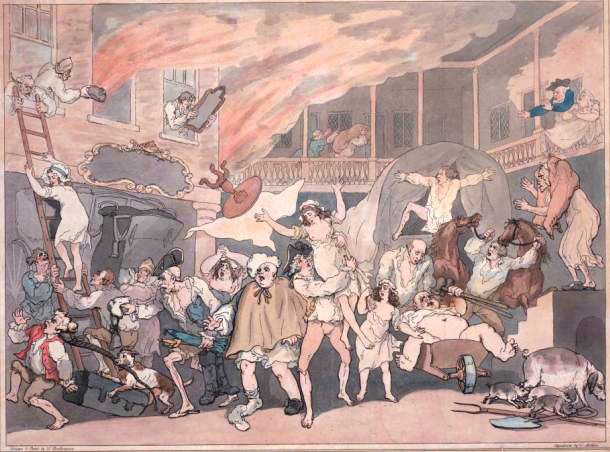
Fire at the Inn, by Thomas Rowlandson

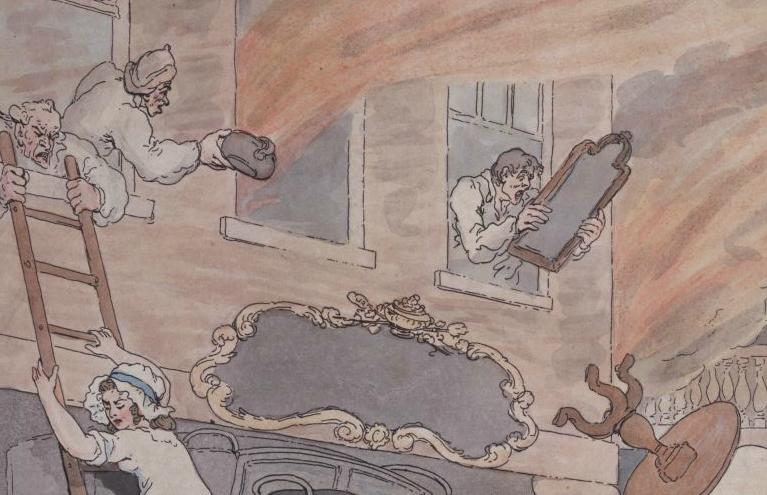
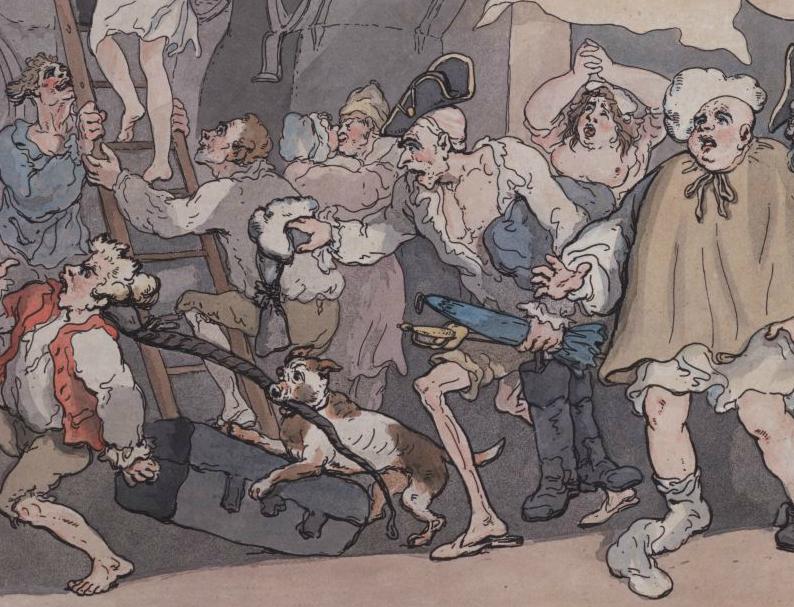
Panic and pandemonium ensue. A man contemplates tossing a mirror from the second story, another pours his ineffectual chamber pot over the flames. A side table has been tossed through the window, while an anxious woman descends a ladder.
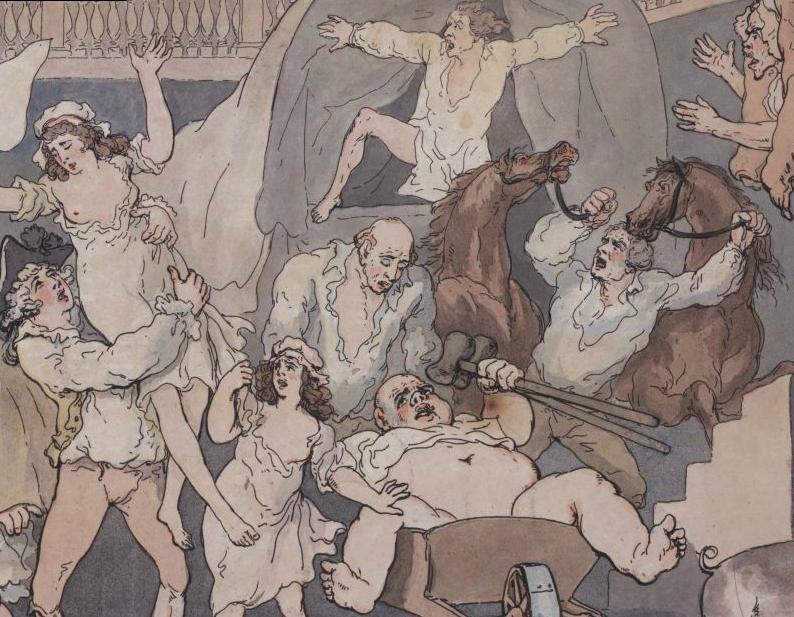
People are in various states of dress and undress. Some help others, some are  overcome with panic. A disabled man is carried from danger in a wheel barrow, while a groom tries to calm two terrified horses.
Elements in Rowlandson’s cartoon show a direct association with classical language and Tobias Smollet. The young man saving the girl in distress is reminiscent of Giambologna’s statue of the Rape of the Sabine Women, as well as Peregrine Pickle’s heroic actions towards Emilia.
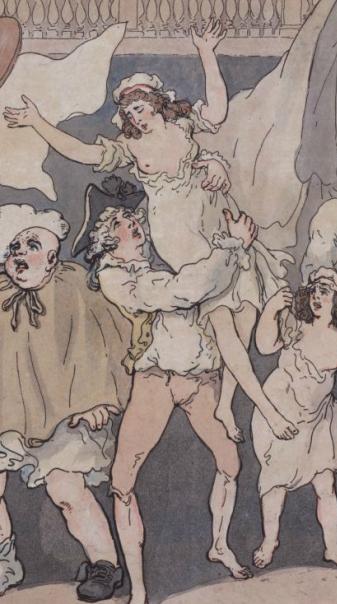
Rowlandson
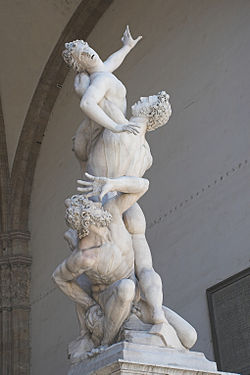
Rape of the Sabine Women
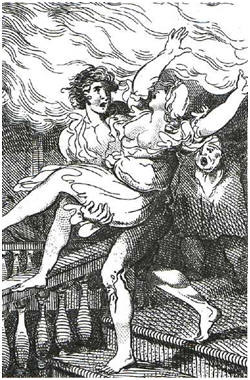
Peregrine Pickle saves Emilia. Image @A World History of Art

Once a fire had gained as much ground as depicted in this illustration, there was little chance of saving the building. Rowlandson shows some people carrying out their belongings, while others were barely able to get dressed. By now an alarm had probably been sounded in the community. Bucket brigades, in which people were arrayed in long lines to the nearest well and passed buckets in a continuous motion, could probably put out a minor fire, but not one of this magnitude. In the 1800s, almost 150 years after the great fire, there was still no centralized fire brigade.
In 1680, a property developer named Nicholas Barbon introduced the first fire insurance, which initially insured buildings but not furniture, fittings, or goods.  Insurance companies began to proliferate and formed private fire brigades to protect their customers’ property.
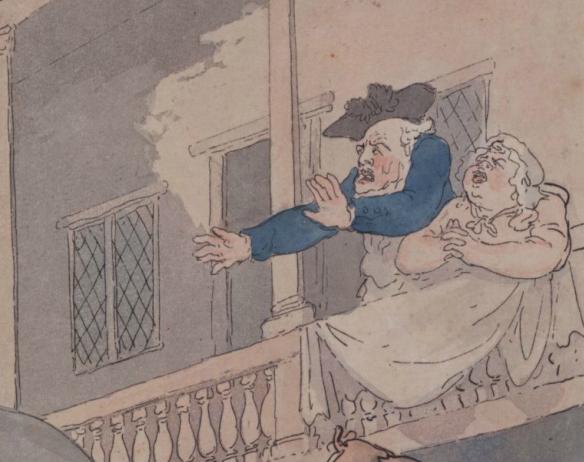
Is this praying elderly couple trapped on the balcony?

In Rowlandson’s cartoon the most the inn keeper can hope for is that the brigade arrives in time to save his structure – if he is insured.  This was easier said than done, for many of London’s streets were not named, since many people could not read, and insured properties were difficult to find.
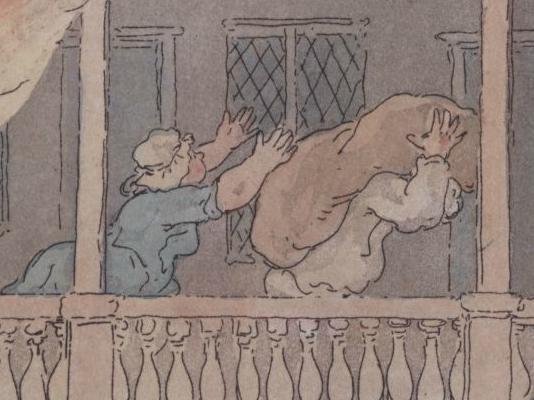
A couple on the second floor frantically attempt to save their belongings.

In the early 1800s the fire mark was developed. These plaques, sometimes brightly painted, would signal which properties were protected by insurance firms. Each fire brigade had its own unique plaque.
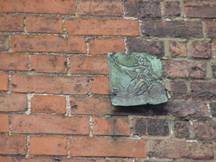
Fire mark on a building

If a fire started, the Fire Brigade was called. They looked for the fire mark and, provided it was the right one, the fire would be dealt with. Often the buildings were left to burn until the right company attended! Many of these insurance companies were to merge, including those of London, which merged in 1833 to form The London Fire Engine Establishment, whose first Fire Chief was James Braidwood. Braidwood had come to London after holding the position of the Chief Officer of Edinburgh Fire brigade. Edinburgh’s authorities had formed the first properly organised brigade in 1824. – History of the UK Fire and Rescue Service
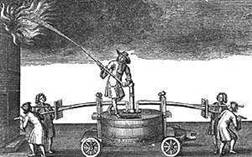
There were quite a few fire brigades operating in London in the early 19th century and competition was keen. The companies hired sailors and watermen as part-time employees. An advantage of serving in this position was that these men were protected from being pressed into service, a not inconsiderable benefit during the Napoleonic wars.
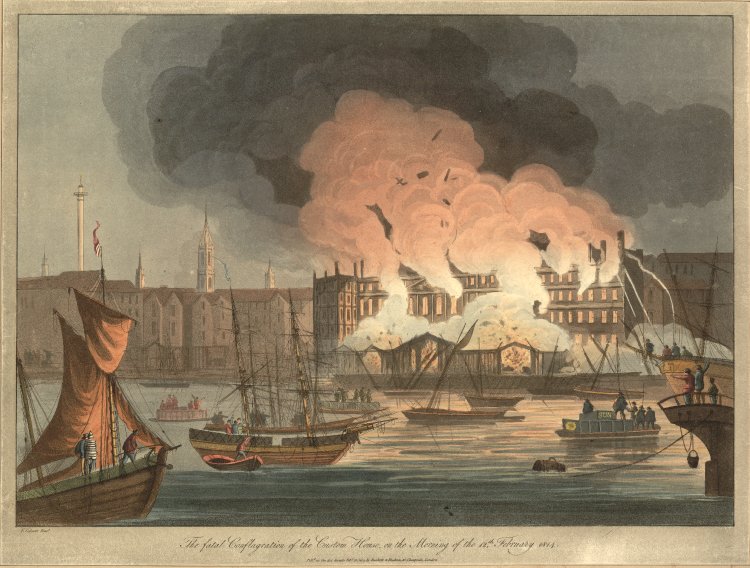
Fighting the fire at the Customs House in February 1814.Image@British Museum

Buildings that had no insurance protection were left to burn, although attempts were made to save the surrounding buildings. Firemarks were essential to identify insured buildings:
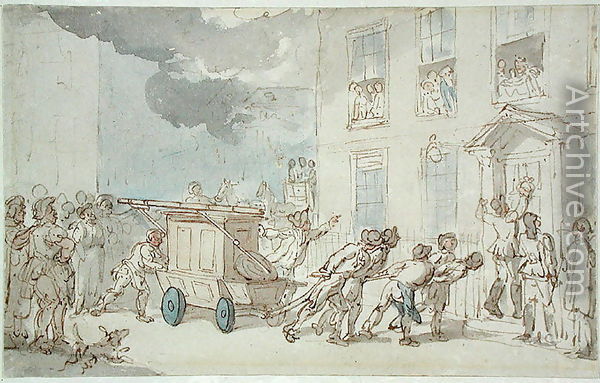
Arrival of the fire engine, Thomas Rowlandson

Designs included, for Sun Fire Office: a large sun with a face; the Royal Exchange Assurance: their building; and Phoenix: obviously Phoenix rising from the ashes. Later fire marks were made of tin, copper, or similar material. These are more often called fire plates. They were more an advertising medium as most do not have a policy number stamped upon them. – Fire Marks: The First Logos of Insurance Companies
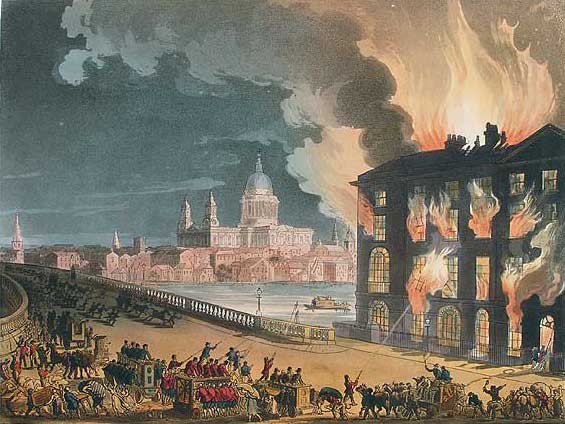
Illustration from Ackermann’s ”Microcosm of London” (1808) drawn by Thomas Rowlandson and Augustus Pugin. Firefighters are tackling a fire which has broken out in houses at the Blackfriars Bridge. Teams of men operate hand pumped equipment. Image @Wikipedia

In 1833 companies in London merged to form The London Fire Engine Establishment, the first step to the various fire brigades being taken over by local government.
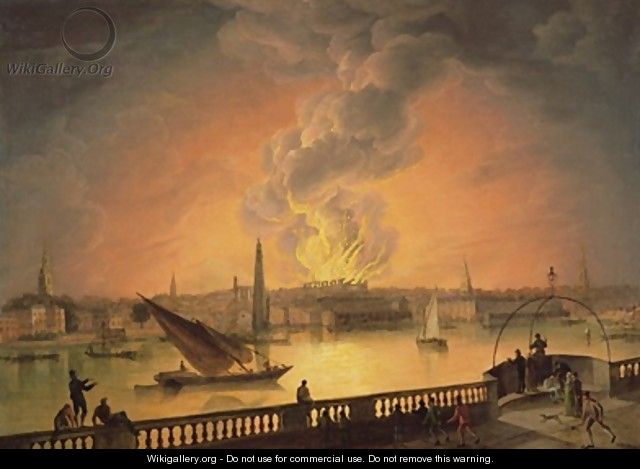
The Burning of Drury Lane Theatre from Westminster Bridge 1809. Artist unknown.  Image property of the Museum of London.

Equipment was still very basic but in 1721, Richard Newsham patented a ‘new water engine for the quenching and extinguishing of fires’. The pump provided a continuous jet of water with more force than before. This new fire engine became a standard until the early 19th century.
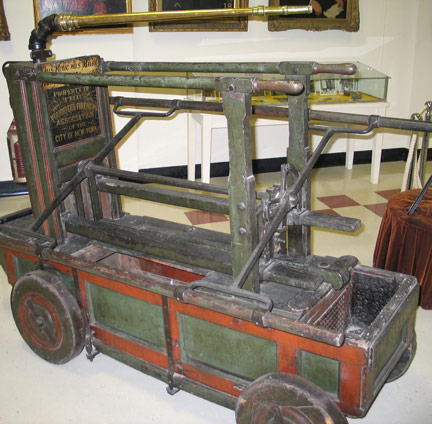
Newsham’s wood pumper, ca. 1731.

The men used the handles to pump the water from a lead-lined trough in the main body of the equipment. The apparatus was quite heavy and difficult to maneuver, but it represented a huge step forward in fire fighting technology. People continually ran back and forth to a water source to fill the trough with water. You could also attach a hose to aim the water to a specific location. During this time, however, hose-making was still in its infancy and many leaked. Water buckets and axes to hack out trapped people and create fire free perimeters were still regarded as standard fire fighting equipment.
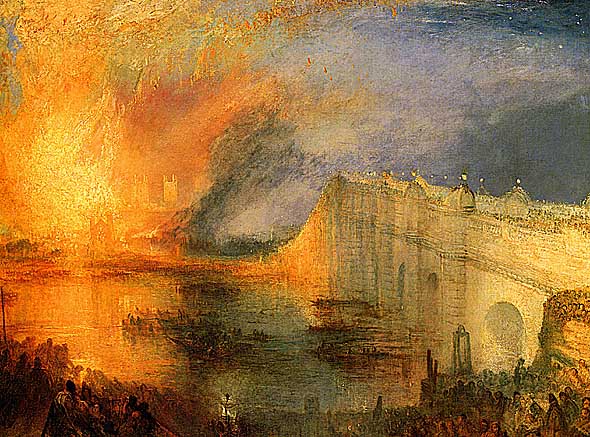
The Burning of the Houses of Parliament, 1834 by William Mallord Turner. Such an event must have provided a spectacular yet horrifying scene for onlookers.

Steam powered appliances were first introduced in the 1850s, allowing a greater quantity of water to be guided onto a fire. With the invention of the internal combustion engine, these appliances were replaced in the early 1900s.
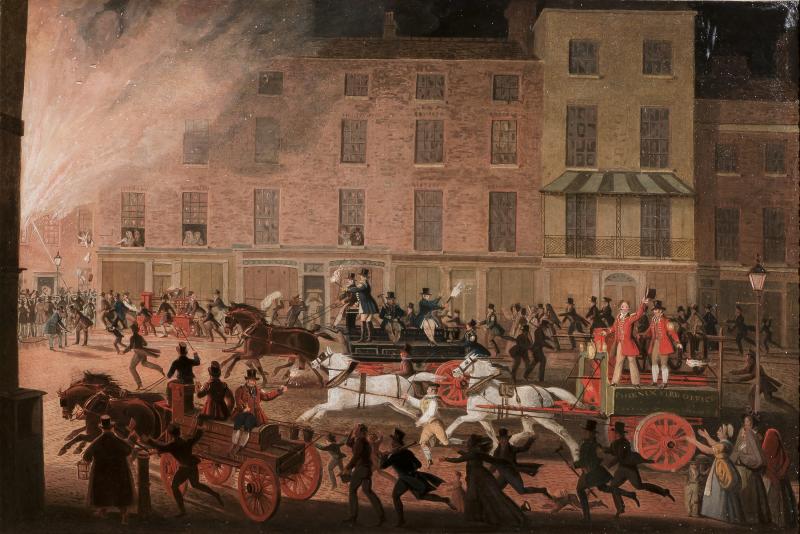
James Pollard (British, 1797-1867) London fire engines: The noble protectors of lives and property, 1823. Image @Olympia Art Antiques

This image by James Pollard, and engraved by R. Reeve, shows several insurance brigades hurrying to a fire.

The firemen, of the time, had little training and wore brightly coloured uniforms to distinguish themselves between the different brigades. During large fires they would become very tired through continual pumping of the appliances, and would offer bystanders ‘beer tokens’ in return for their help. – Insurance Firemen and their Equipment
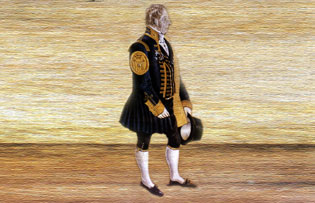
Each company provided different liveries for their men, so that the fire fighters could easily be identified with a particular firm.All insurance firemen wore a large badge on their shoulder to show which insurance company they worked for.
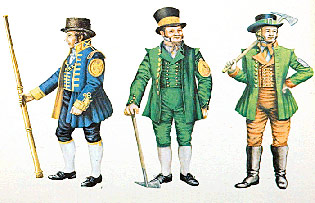
Three uniforms of insurance firemen. All wear a badge

More on the topic:

Cockburn’s theatre on fire, another dramatic caricature by Rowlandson.
Read Full Post »

Inquiring readers: Paul Emanuelli has frequently contributed his comments on this blog. Little did I know that he was an author! He has graciously sent in his thoughts about Bath, the city in which he has set his historical crime novel. Paul writes about Bath in his own blog, unpublishedwriterblog. It is well worth a visit!

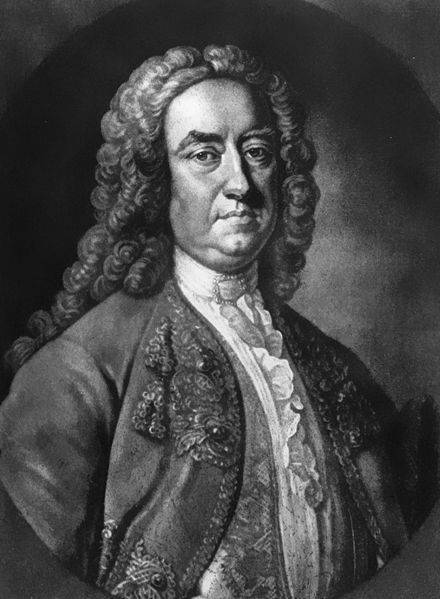
Beau Nash turned the city of Bath into the most fashionable resort in 18th-century England. In his role as Master of Ceremonies he organised the premier social events in the city and chose who should, and should not be invited. He established a select list of people who he defined as the cream of Society, and more importantly he changed the social conventions of the city.

Richard Beau Nash

Nash broke down the old order dominated by the nobility and gentry, and promoted the nouveaux- riches. Whereas in other cities the growing number of wealthy industrialists and tradespeople were still looked down on because of their background, in Bath, Nash welcomed them as elite members of society.

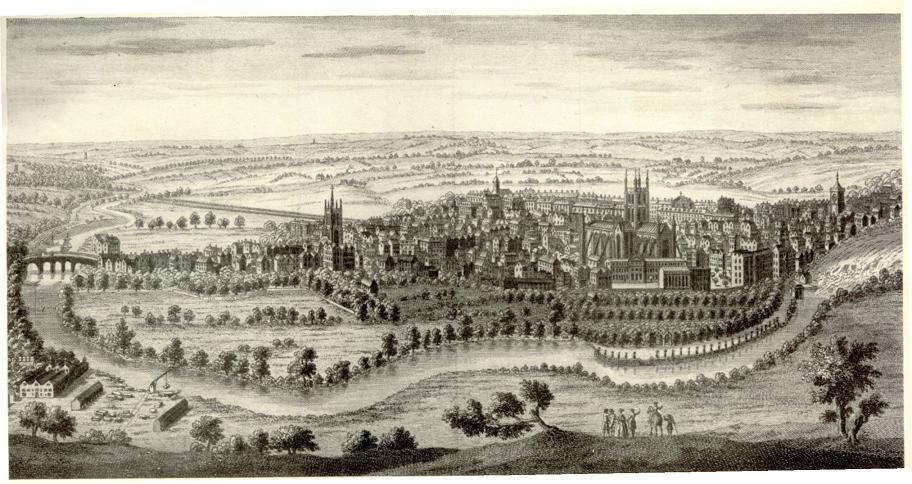
Bath in the 18th century at the time of Beau Nash

For years the city thrived on the wealth of visitors who stayed for the Season. The affluent tourists rented houses and apartments and all the trappings that went with them; crockery and cutlery, silver-ware and ornaments, horses and carriages, servants and attendants. Prominent architects designed fine buildings and the city grew. Milsom Street became one of the most prestigious shopping areas in the country.

Milsom Street and Bond Street with Portraits of Bath Swells.

By 1801, when Jane Austen moved to Bath, the city was the 9th largest in England, with a population of 33,000. Yet the city’s fortunes had already begun to decline. Bath had changed in character and atmosphere. It was becoming less fashionable and the wealthy were visiting less often, and their stays were becoming shorter.

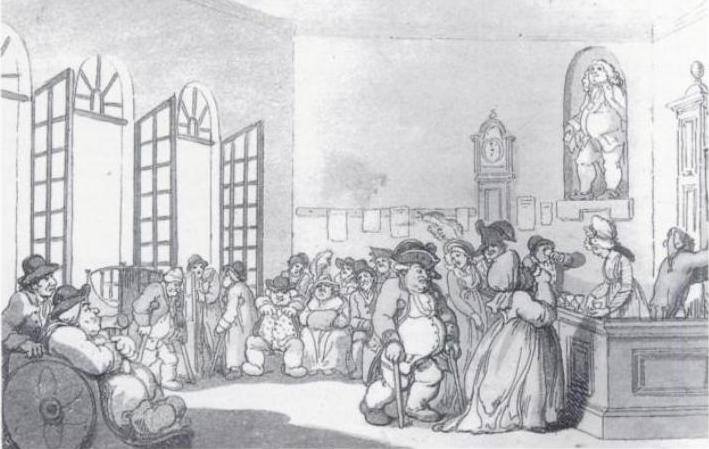
Thomas Rowlandson’s caricature of the Comforts of Bath. The classes noticeably mingled as they awaited drinking the waters in the Pump Room. (Notice the patient in the wheel chair on the left and the sedan chair next to him, which was carried inside the room.) Nash’s statue is in the niche at the top right. You can still see it today.

Built in a bowl of seven hills, Bath’s ever-growing population was increasingly crowded into a relatively small area. It’s little wonder that when Jane Austen moved to the city, she wrote to her sister, Cassandra saying, “The first view of Bath in fine weather does not answer my expectations; … the appearance of the place from the top of Kingsdown was all vapour, shadow, smoke, and confusion.”

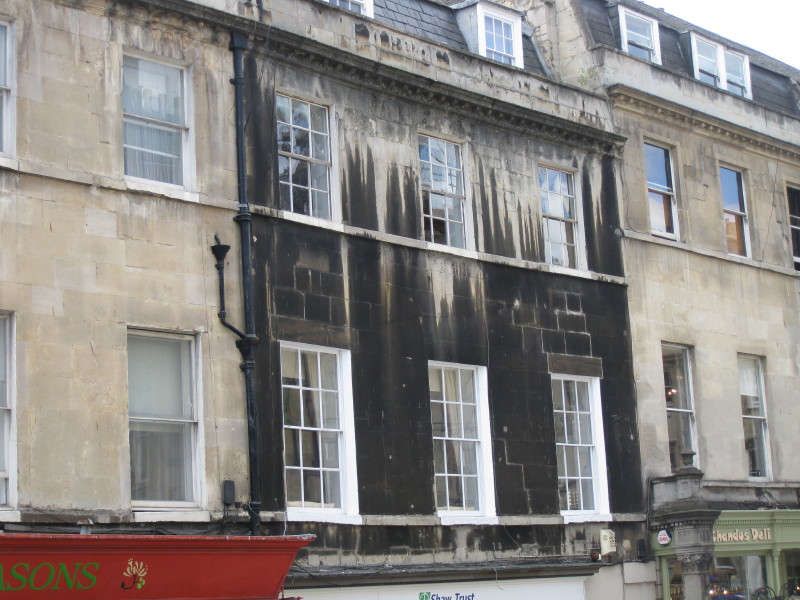
Coal soot darkened the creamy colored stone of the buildings.

Perhaps it is unsurprising that it seemed, “all smoke” when every household depended on coal fires for warmth, that it was “all confusion” when its roads were congested with carts and carriages. And in Georgian cities, once you set foot on the streets there was no escaping the poor drainage and lack of decent sanitation and sewerage systems. As Austen said in a letter to her sister, “We stopped in Paragon (a prestigious address where her wealthy uncle lived) as we came along, but it was too wet and dirty for us to get out.”

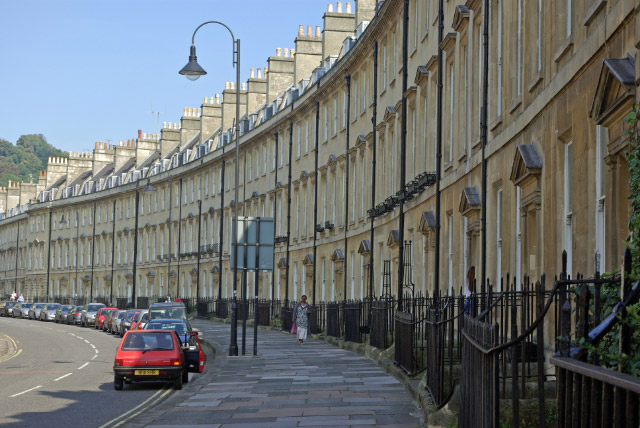
The Paragon, Bath.

By the time Persuasion was published in 1817, the larger part of Bath’s population was working class. Industry was thriving in the city, supplying the many fine shops in Milsom Street and drawing people from the countryside to fill the jobs created. Yet the people who worked in the factories and sweat-shops, the costermongers and shop-assistants, the building labourers and hotel staff were, for the most part, poorly paid.

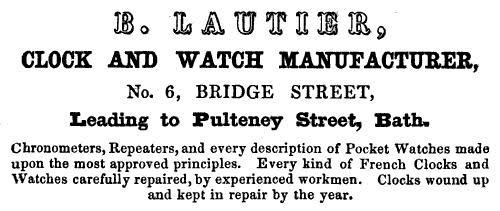
Advertisement for B. Lautier Goldsmith Shop in Bath, 1848

The only housing they could afford was overcrowded and poorly maintained, and the slum areas around Avon Street were increasing in size, as quickly as they were deteriorating in quality and appearance. By 1850, the rookery of hovels and cheap boarding-houses in and around Avon Street were home to almost a quarter of the Bath’s population.

Bath had grown considerably by the 1850’s, the date of this illustration.

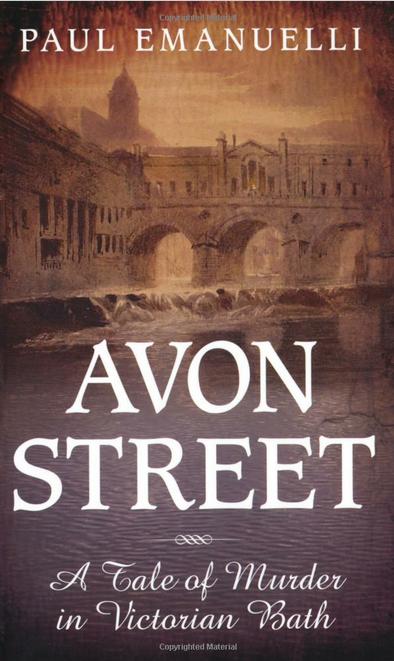
My novel, Avon Street is set in Bath in 1850. But Bath isn’t just a setting. It is a character in its own right. In writing Avon Street, I have tried to take the reader beyond the Georgian facades, and reveal a city, where wealth and elegance were never far from poverty and squalor. Bath was a city, where things were often not as they seemed, where people as Austen said, could “be important at comparatively little cost.” In short it is the ideal setting for a story of confidence tricksters and crime, intrigue and betrayal. A city where enemies can seem all-powerful, and friends are sometimes found where least expected.

Image of Avon Street.

In Persuasion Anne Elliot visits a friend in Westgate Buildings despite Sir Walter’s warning of its unsuitableness – “Everything that revolts other people, low company, paltry rooms, foul air, disgusting associations are inviting to you.” (Click here to see an image of Westgate Buildings in 1900.) It seemed only fitting that the first chapter of my book be set in the same location, on the borders of the Avon Street area.

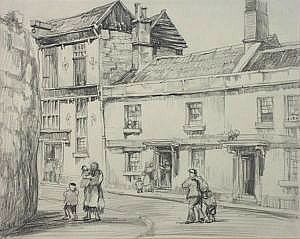
Pickwick Mews, Avon Street, in 1923. Image @The Victoria Art Gallery

More about Avon Street and Paul Emanuelli: Why Avon Street?

Avon Street: Purchase information

Paperback: 352 pages

Publisher: The History Press Ltd (1 Feb 2012)

Language English

ISBN-10: 0752465546

ISBN-13: 978-0752465548

Read Full Post »

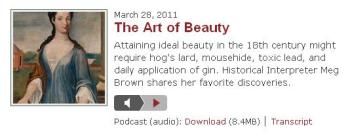
This 12-minute podcast from Colonial Williamsburg Podcasts discusses The Art of Beauty in the 18th century. My previous post featured a recap of the Shire Book, Beauty and Cosmetics 1550-1950 by Sarah Jane Downing. The podcast compliments that post to a tee!

Read the transcript at this link. Find other podcasts at the Colonial Williamsburg Past and Present Podcast. The categories sit in the sidebar on the right.

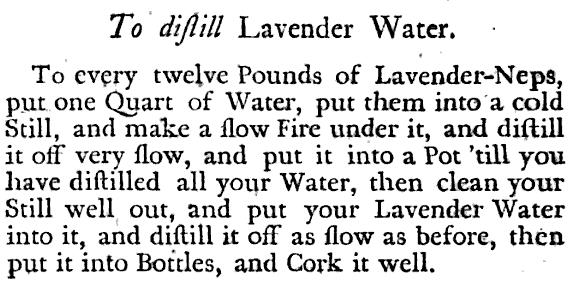
Lavender Water recipe from The experienced English house-keeper: for the use and ease of ladies, house-keepers, cooks, &c, Elizabeth Raffald, confectioner … Manchester, 1769.

Read Full Post »

Gentle Readers, Patty of Brandy Parfums frequently contributes articles of interest to this blog. Her latest post is about Anonymous, the film about the authorship of Shakespeare’s plays, which recently opened in theatres.

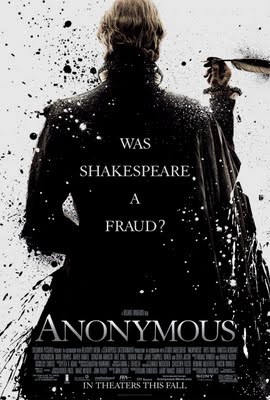
Film Poster

Introduction  – Instead of writing a traditional plot-spoiler review of Anonymous, which can be found in many newspapers and magazines, I’ve written what I think will be more useful – a short guide to Shakespeare authorship. Enjoy! – Patricia Saffran

Jamie Campbell Bower as the young earl of Oxford

A Guide to Shakespeare Authorship

Jane Austen knew Shakespeare’s plays well and based a number of her novels on Shakespeare’s characters and plot devices. Stephen Derry writes about these many references in his paper for the Jane Austen Society of North America, ‘Jane Austen’s Use of Measure for Measure in Sense and Sensibility.’ Derry begins his paper by saying -In Mansfield Park, Edmund Bertram declares that one is familiar with Shakespeare in a degree from one’s earliest years. His celebrated passages are quoted by everybody we all talk Shakespeare, use his similes, and describe with his descriptions.

Tudor England

Knowing of Jane Austen’s profound knowledge of Shakespeare should give those who love her works a keen interest in all things Shakespeare – and in this new movie, which brings the Elizabethan period to life. This is the first time a major movie studio has taken a leap, with an elaborate period production, costumes, and star-studded cast, to delve into the question plaguing scholars for centuries, as to who the author of  Shakespeare’s plays really was.

Joely Richardson as a young Elizabeth I and Jamie Campbell Bower as a young Earl of Oxford

The gamble has payed off, as this is a truly sensational
movie. It takes place during the succession of Queen Elizabeth I, and the Essex Rebellion against her – a period of turmoil and political instability. During this period, being the author of a play with politically loaded or satirical material was dangerous. Some authors chose anonymity………

Shakespeare authorship as an area of inquiry is not new. While making a list of the greatest Elizabethan poets, Henry Peacham in The Compleat Gentleman published in 1622, when the First Folio was being created, lists Edward de Vere, the Earl of Oxford, first on his list and does not include Shakespeare at all. Many believe that this was Peacham’s way of hinting that Edward de Vere, not William Shakespeare, wrote the plays and poetry.

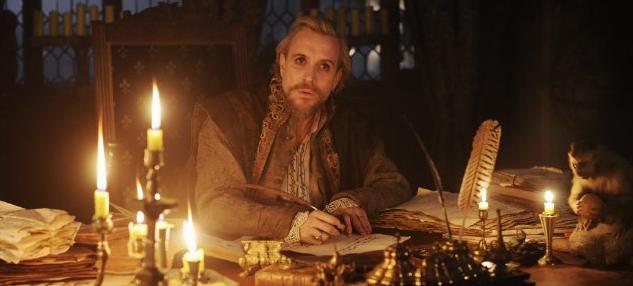
Rafe Spall as William Shakespeare

More recently, in the past 150 years, there have been many notable actors, writers, and Supreme Court judges who have questioned William Shakespeare as the author of the plays. Among them are Mark Twain, Leslie Howard, Charlie Chaplin, Orson Welles, Sigmund Freud, Charles Dickens, Walt Whitman, Henry James, J. Thomas Looney, Michael York, Sandra Day O’Connor, Harry A. Blackmun, and John Paul Stevens. Besides de Vere and William Shakespeare, the other main candidates to have written the plays are Bacon, Marlowe, and Neville.

Rhys Ifans as the mature Earl of Oxford

A fantastic short video by the director of Anonymous, Roland Emmerich, summarizes ten reasons why it is implausible that the Stratford William Shakespeare wrote the plays. For some, the main reason is that unlike all other great authors of the period, no letters exist either to or from Shakespeare.

Preview: Was Shakespeare a Fraud?

A new book coming out November 8th continues to examine the question of Shakespeare authorship – The Shakespeare Guide to Italy by Richard Paul Roe, paints the Stratford man who never left England as an improbable author of the many distinctively Italian plays.

Vanessa Redgrave as the mature Elizabeth I

Current scholars, and by extension many of their now journalist proteges, who defend William Shakespeare as the author of the plays, are extremely defensive and say there is no room for doubt. Time will likely make the world more receptive to exploring Shakespeare authorship, but for now Anonymous will inspire interest in this fascinating field. I highly recommend this film.

For more on Shakespeare and Shakespeare Authorship:

About the film:

Anonymous, the new movie about Edward de Vere, the Earl of Oxford, as the true author of Shakespeare’s plays. With Rhys Ifans, Vanessa Redgrave, David Thewlis, and along with those who actively support authorship studies, Derek Jacobi and Mark Rylance. Directed and produced by Roland Emmerich, released by Columbia.

Read Full Post »

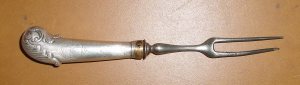
Poor Miss Manners is always having to explains why Americans hold forks in their right hands as opposed to Europeans, who use their left hand to spear their food. Have American table manners deteriorated? Or are we following an historic tradition?

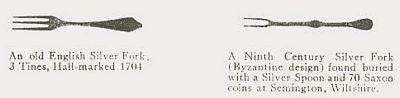
Image @Silver Collect Blog*

To answer that question we need to go back to ancient times when two-tined kitchen forks were used to help carve and serve meat. (We still require the assistance of large two-tined forks when barbecuing foods on a gas or coal grill.) In the 7th century the people in the Middle East began to use forks when dining, and by the 10th through the 11th centuries such usage had become quite common. The Italians were introduced to the fork in the 11th century.

One tale of the introduction of the fork to Western Europe credits Maria Argyropoulina, the Greek niece of Byzantine Emperor Basil II, who brought a case of golden forks to Venice in 1004, when she was to be married to the son of the Doge. She shocked guests at the wedding feast by using a fork, leading one priest to comment, “God in his wisdom has provided man with natural forks — his fingers. Therefore it is an insult to Him to substitute artificial metal forks for them when eating.” Italian clerics viewed it as God’s vengeance when Argyropoulina died of the plague two years later. – Early British Table Silver: A Short History

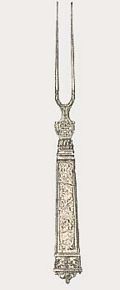
Image @Silver Collect Blog

It took 500 years for the implement to be used widely in that land. The French had their first look at the fork in 1533 when Catherine de Medici brought them from Italy upon the occasion of her marriage. The fork was at first thought to be an affectation, thus its adoption was slow, as it was in England after Thomas Coryate brought the implement back in 1608 from one of his travels to Italy. He observed that at their meals Italians  “use a little forks when they cut the meats.” Early table forks were small and two-pronged, but the sharp straight tines were unable to hold much food, inspiring mockery.  “Why should a person need a fork when God had given him hands?” one Englishman asked. (History of the Fork).  Ben Johnson satirized the fork in 1616 in The Devil is an Ass for “the sparing of napkins.”

One wonders how the Europeans ate their food without a fork. If you’ve ever attended a reproduction of a medieval banquet you have an idea. People used knives to spear food, spoons to scoop up, and fingers to grab. Only one implement was used at a time, and it was held in the right hand.

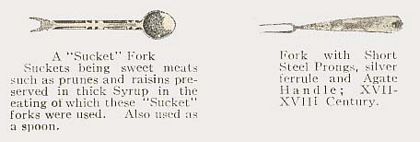
Slowly but surely the fork began to make inroads upon the dining table. As is the usual case, the wealthy began to adopt the new implement first. The upper crust began to impress their guests with forks made of expensive materials. Called suckett forks, they were used to protect the hands from sticky and messy foods or foods that stained the hands, like mulberries. By the mid 1600s, forks had become luxury items and were considered to be marks of fashion.   At the end of the 17th century and beginning of the 18th century the three-tined fork was introduced. The “sherbet course”, introduced in the early 1700’s, was created to wash the single fork for the next course.” (The History of the Fork)

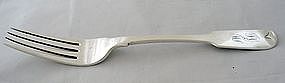
Image @Silver Collect Blog*

Four-tined prongs became popular in the 1750s.  These tines were curved and served as a scoop, reducing the need for the spoon. By the time Jane Austen and her family had moved from Steventon to Bath, the four-tined fork was also being made in Germany and England and had traveled to the Americas. In the mid 19th century specialized forks were produced for every kind of food, including cakes and fish.

Table fork, 1771

This short history still does not explain why Americans and Europeans hold their forks in different hands. History Matters: Cutlery provides an insight:

Cardinal Richelieu of France supposedly was so disgusted by a frequent dinner guest’s habit of picking his teeth with his knife that he had the tips of the man’s knives ground down. The fashion-conscious French court picked up on this style and followed suit. In 1699, to reduce the risk of dinnertime knife fights, French King Louis XIV banned pointed knives outright. Since blunted knives were useless for spearing food in the old two-knife dining style, forks replaced the knife held in the left hand.

The newfangled blunt knives reached the American colonies in the early 1700s, where few forks were available. Americans were forced to use upside-down spoons to steady food for cutting. They would then switch the spoon to the right hand, flipping it to use as a scoop. Even after forks became everyday utensils, this “zigzag” style (as Emily Post called it in the 1920s) continues to divide American eaters’ customs from the Continental style of dining. (Shifting the fork to the right hand after cutting is considered uncouth by Europeans.) – (This passage seems to have used The Uncommon Origins of the Common Fork as its source.)

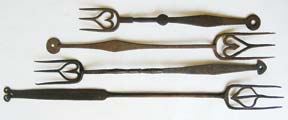
18th C. flesh forks for broiling meat

In a recent Washington Post advice column, Miss Manners contends that Americans follow the correct European way of eating centuries ago and that it was the Europeans who sped things up by keeping the fork in the left hand as they cut their food with the right hand. She concludes her advice with this thought:

Those who point out that the European manner is more efficient are right. Those who claim it is older or more sophisticated — etiquette has never considered getting food into the mouth faster a mark of refinement — are wrong. – Miss Manners: Fork’s History is not a big Mystery

Silver serving fork, 1825

Read Full Post »

« Newer Posts - Older Posts »