Feeds:
Posts
Comments

Archive for the ‘jane austen’ Category

I’ve previously discussed the difficulties and dangers of travel in the Regency era in a number of posts on this blog, but the Lancaster Sands in Lanchashire presented a variety of difficulties for even the most knowledgeable traveler. My first introduction to this region was via a William Turner painting, Lancaster Sands, painted ca. 1826. I was struck by the laborers and villagers walking alongside a coach in shallow water. Why would a coach travel so slowly that pedestrians could keep pace?
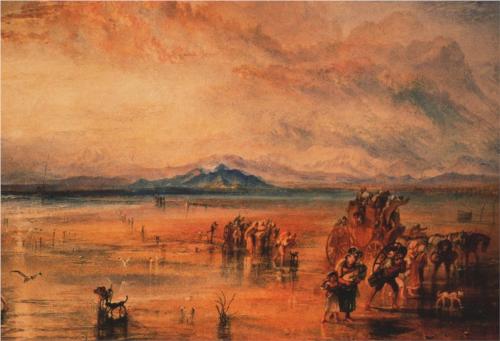
Lancaster Sands, William Turner. Image @Wiki Paintings. Birminham Museum and Art Gallery
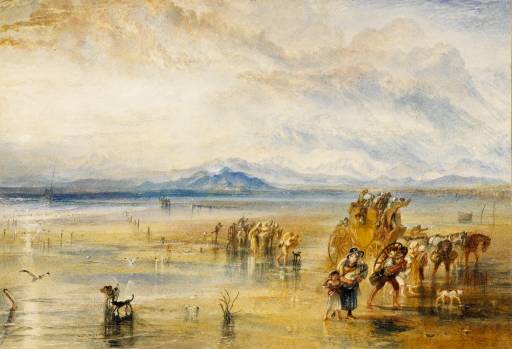
Thumbnail showing truer colors of Turner’s painting.

As it turns out, the crossing over the Lancaster Sands to reach Ulverston was fraught with danger, especially after heavy rains. In the early 19th century travelers crossed this watery passage in the Lake District at low tide, for this was the shorter (but more dangerous) route.

The sands forming the Bay of Morecambe, covered by the sea at high water, are crossed every day by travellers whose time or inclination leads them to choose this route rather than one more circuitous, and nearly thrice the distance, inland. – The Sands, John Roby

The crossing was extremely hazardous due to shifting sands and the timing of the departure had to be perfect:

“Coach services, scheduled to accommodate the changing tides, ran between hotels in Lancaster and Ulverston. In 1820, one traveller relates, he was rudely awakened in his Lancaster hotel at five in the morning when the coach driver burst into his bedroom shouting, “For God’s sake make haste! The tide is down … if you delay we shall all be drowned.” – The Pleasures and Treasures of Britain: A Discerning Traveller’s Companion (Google eBook)David Kemp Dundurn, Jan 12, 1992 – p. 307
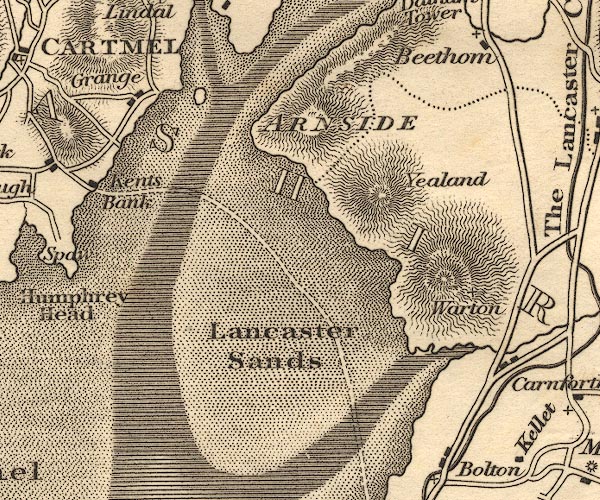
Otley Map, Lancaster Sands, 1818. Image @Portsmouth University.

Today, as over 150 years ago,  the Sands Road requires a guide to help travelers negotiate the dangerous tide floods.

Before the railway was made, the old way of crossing the sands from Lancaster to Ulverstone must have been very striking, both from the character of the scenery around and a sense of danger, which cannot but have given something of the piquancy of adventure to the journey. The channels are constantly shifting, particularly after heavy rains, when they are perilously uncertain. For many centuries past, two guides have conducted travellers over them. Their duty is to observe the changes, and find fordable points. In all seasons and states of the weather this was their duty, and in times of storm and fog it must have been fraught with danger. These guides were anciently appointed by the Prior of Cartmel, and received synodal and Peter-pence for their maintenance. They are now paid from the revenues of the duchy. The office of guide has been so long held by a family of the name of Carter, that the country people have given that name to the office itself. A gentleman, crossing from Lancaster, once asked the guide if “Carters” were never lost on the sands. “I never knew any lost,” said the guide; “there’s one or two drowned now and then, but they’re generally found somewhere i’th bed when th’ tide goes out.” A certain ancient mariner, called Nuttall, who lives at Grange, on the Cartmel shore, told me that “people who get their living by ‘following the sands,’ hardly ever die in their beds. They end their days on the sands- and even their horses and carts are generally lost there. I have helped,” said he, “to pull horses and coaches, ay, and, guides too, out of the sands. The channel,” he continued, “is seldom two days together in one place. You may make a chart one day, and, before the ink is dry, it will have shifted.” I found, indeed, by inquiry, that those who have travelled the sands longest, are always most afraid of them ; and that these silent currents, which shimmer so beautifully in the sunshine, have been “the ribs of death” to thousands. – Over Sands to the Lakes by Edwin Waugh, 1860, Internet archive

Today, signs warn visitors about the passage, stating: “This route has natural hazards, seek local guidance.”  The following link shows modern images of the route (Lake Guide Sands Road), which is still crossed today with experienced guides.  A 19th century visitor related that:

It is safest to cross at spring-tides; the water then is more completely drained out, and the force of the tide sweeps the bottom clean from mud and sediment. – The Sands, John Roby

Many who took this route in days of yore, such as William Wordsworth, found the trip to be so memorable that it lived in their memory for a long time. Turner created a number of striking images of the dangerous crossing. In all of them, the pedestrians and riders stayed close to the coach as guides gauged how and where the sands had shifted with the last tides or storms. Brogs, or broken branches of furze, left by previous guides visually led the way. You can see a few of them placed in the lower right corner of Turner’s painting below.
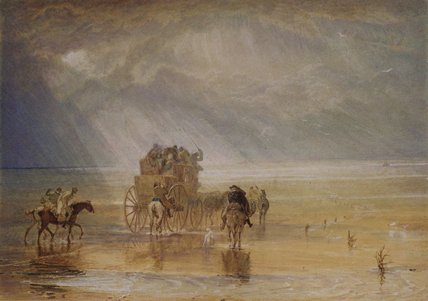
In this dramatic painting, Turner shows the Lancaster coach struggling across the sands and being overtaken by the incoming tide in a rainstorm. (Birmingham Museum and Art Gallery). One can imagine the panic of the passengers upon seeing the incoming water, and the struggles of the horses as they pulled their heavy loads along the soft sands.
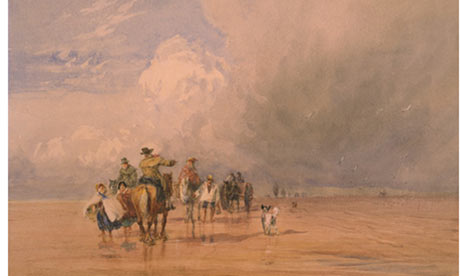
Painter David Cox also painted the Lancaster Sands crossing. His images are less romantic than Turner’s, but dramatic nevertheless:  Lancaster Sands by David Cox, 1835. The route through the sands were ever-changing. The guides tested the way daily, looking for shifts in the channels and for quick sand, but even the most experienced could not prevent the drowning of carriages and coaches and the deaths of people who were caught by the incoming tides or who were trapped in quagmires. Graves in local cemeteries are testament to the many lives that were lost during these crossings.
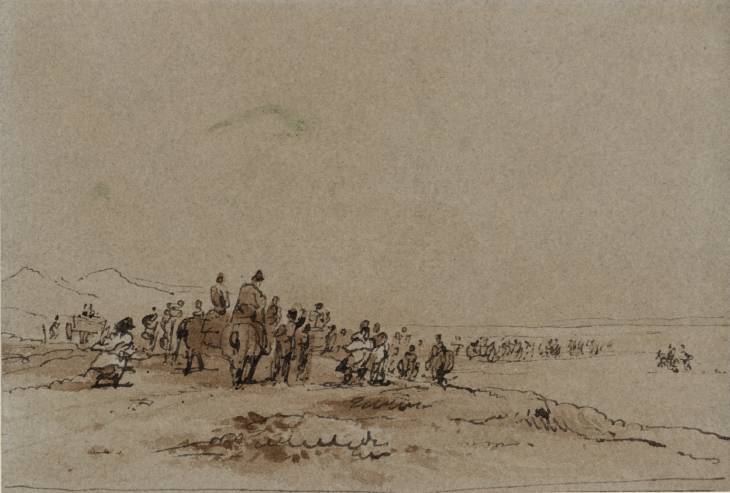
David Cox, Sketch for Crossing Lancaster Sands. Image @Tate Britain

By the mid-19th century, the railroads provided a safer and faster route. Today, the crossing over the sands is a voluntary one and taken for the experience or thrill, not out of necessity.
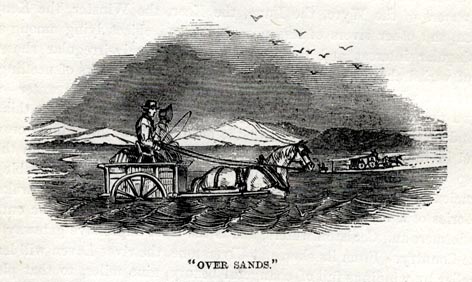
Image of a carriage traversing the Sands in high tides from Waugh’s book.

More on the topic:

This site shows modern images of the Lancaster Sands: Sands Road at Low Water

Old Cumbria Gazzeteer: Lancaster Sands Road 

Read Full Post »

The two first dances, however, brought a return of distress; they were dances of mortification. Mr. Collins, awkward and solemn, apologizing instead of attending, and often moving wrong without being aware of it, gave her all the shame and misery which a disagreeable partner for a couple of dances can give. The moment of her release from him was ecstasy. – Elizabeth Bennet dancing with Mr. Collins at the Netherfield Ball

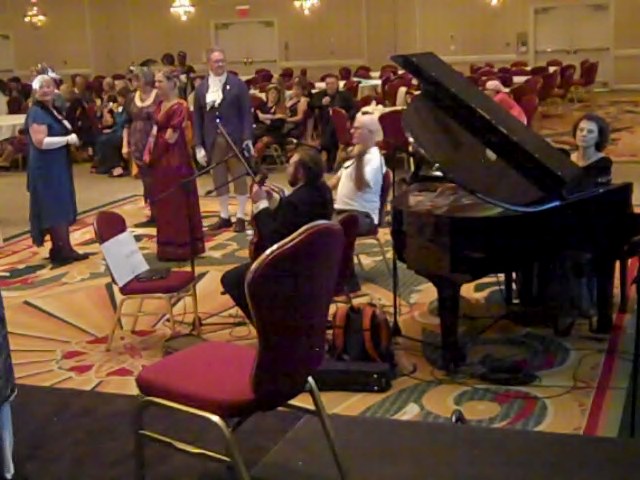
Mr. Collins could have used the services of the excellent caller at the Regency Ball at the JASNA AGM in Brooklyn. Had he been able to follow her direction (or had he learned his dance steps as a child, as did most well-bred Regency children), then he would not have made Elizabeth feel such shame about her partner. When I attended my first Regency ball, I felt as delighted as a child in a candy store at Christmas. The costumes and music lent authenticity to the event. Even those in modern dress (like myself) felt welcome.

As you can see from the clip, individuals with a wide range of dancing talent were present. The caller, or calling master, taught the steps, people practiced, and then they danced to the lovely music provided by the trio.

Caller at the Regency Ball

An important social element was the calling of the dance by the leading lady (a position of honor), who would determine the figures, steps, and music to be danced. The rest of the set would listen to the calling dancing master or pick up the dance by observing the leading couple. Austen mentions in her letters instances in which she and her partner called the dance. – Regency Dance, Wikipedia

I love the next clip, in which the caller sensed a lack of concentration on behalf of her audience. Listen to her final words!

With so many people in one room, and (in those days) the heat from the candles, ballrooms tended to become hot. Flimsy gowns provided little advantage for over-heated bodies restrained by corsets; time and again fans came to the rescue, as in this short scene. The poor men simply had to grin and bear it and sweat the night away, for, believe me, an evening of dance with two sets per dance partner, could be quite strenuous.

After learning the various moves, the group danced the set. The musicians (a trio in this instance) then struck up the music and the dancers progressed through the set, the movements beautiful to behold. My humble flip camera did not do much justice to the proceedings, and could capture only a few of the moments. If you have never attended a Regency ball and are a Jane Austen fan, I suggest that you find a group in your area.

This experience makes Austen’s ballroom scenes come alive as I reread the passages. One also experiences the social aspects of the dance – the dancers themselves, the people arranged on the sidelines watching, the musicians, and the outer rooms, where others assembled and talked  or sought refreshment. In former days, game rooms would be set up for those who opted not to dance.

More images below. If anyone knows the names of the people I captured, please send them on! Thank you.

This slideshow requires JavaScript.

Read Full Post »

Lisa Brown. Image @Edward Voytovich. Click on image for a larger view.

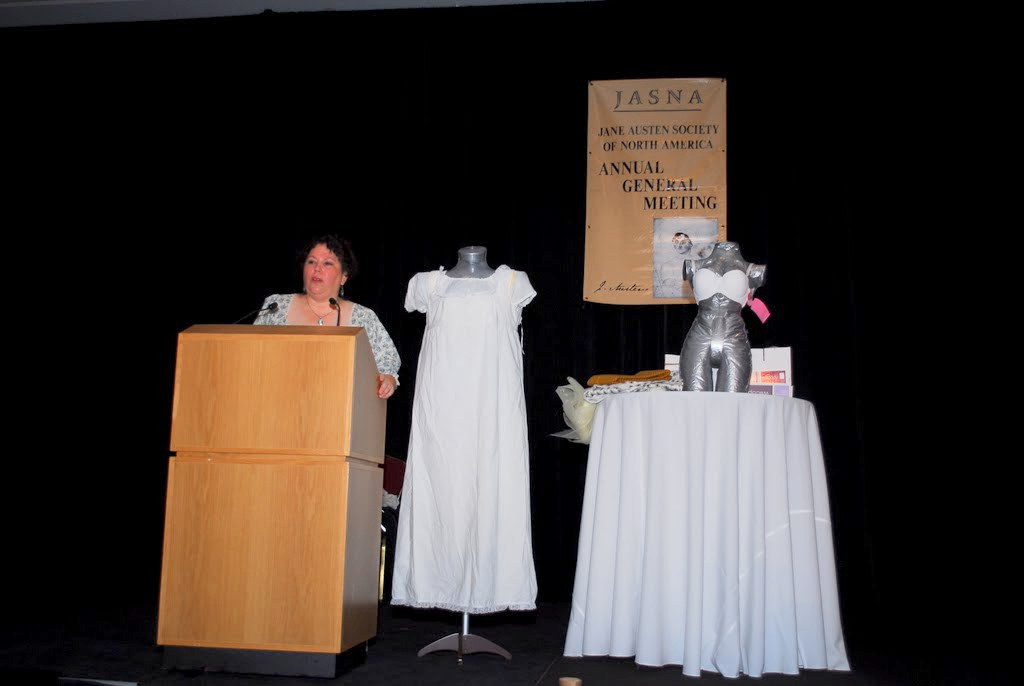
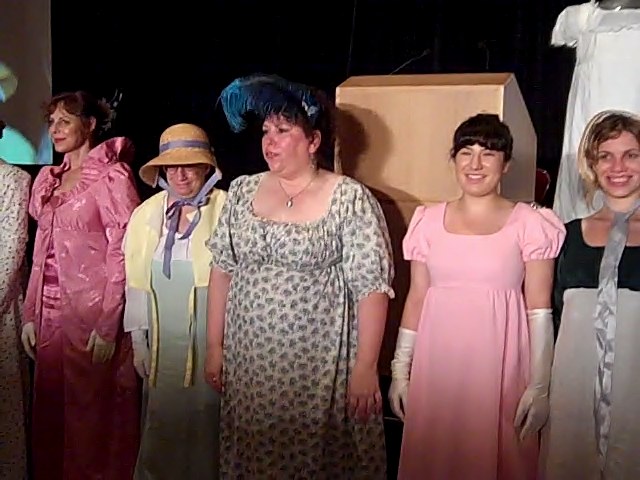
Inquiring readers. My first JASNA AGM in Brooklyn started out with a bang. Not only did I room with the wonderful Deb Barnum (Jane Austen in Vermont), but the first workshop I attended was given by Lisa Brown, co-coordinator of the Rochester and Syracuse Regions of JASNA (and the official photographer at the AGM, it seems). She presented a fashion show and workshop demonstration of Regency fashions, including detailed instructions on how to rework 1970s and 1980s gowns into very creditable Regency costumes. A similar custom was studiously followed by Regency ladies, such as the Miss Bennets and Miss Austens, whose income precluded them from custom ordering as many handmade gowns as they liked. Two hundred years ago, cloth and trim were quite expensive, although changes wrought by the Industrial Revolution in weaving, dying cloth, and creating off the rack gowns would make clothes more affordable as the 19th century progressed. Jane Austen wrote frequently of refurbishing a new bonnet or reworking a gown to suit an occasion.

Lisa Brown stands in the center of her models

Lisa graciously gave me permission to use the videos I took of her fashion show and from my notes. The personal impressions are mine.

The back of Lisa’s gown with the drawstring details. Note the floral print.

The Layers of a Regency gown

In Regency fashion, it’s all about lift and undergarments. The distinctive Regency “shelf” was created with straps tied from the side (not center) and short stays with busks and wires. The stays were drawn from the bottom to the top, and as the stays tightened the bosom (shelf) rose. During the extended Regency era (1795-1820) women wore fewer clothes than their mothers and aunts. Sheer fabrics, exposed bosoms, and bare arms in the evening were the hallmarks of the Regency style.

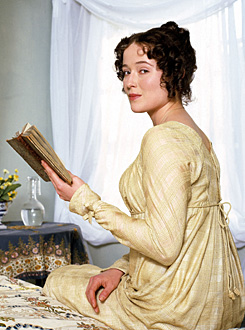
This image of Jennifer Ehle as Elizabeth Bennet shows her wearing a day gown with long sleeves. Note the gathering in the back and the silhouette of her Regency shelf bosom

The typical dress layers included (from skin side out): a simple shift made of sturdy cotton or linen that could withstand repeated laundering; short stays; a petticoat; and a gown. While women wore stocking and garters, under drawers were not generally worn until later in the 19th century. If a woman opted to wear them, they would be crotchless (mostly for convenience.)

Regency gown fashion show

In this video Sarah wears a 1970s dress found in a vintage shop and a period bonnet. The sleeves look modern, but the overall effect is very charming. Sarah is the author of the delightful post: I was a Model in a Regency Jane Austen Fashion Show.

Nadia wears a modern reworked holiday dress that converted nicely into a Regency style costume. I felt that the skirt lacked authenticity in that there was no gathering of the fabric in the back.

Julie wears a simple gray gown. To me the accessories turned this vintage dress into a Regency look, for the dress details were too sleek to be authentic.

Joyce in a green silk tafetta that could have used some trim or a shawl or something to turn this dress into a show stopper.

Jaclyn’s brown tafetta dress is one of my favorites. The gloves, bonnet, puffy sleeves, low scooped neck, and slight gathering in the back added realistic touches.

Jane wears a cotton dress with spencer jacket and long ties. I imagine Mrs. Austen might have looked much like her.

Meg looks like she is going to market. On stage she showed her reversible cape, which she took off for the runway. Her outfit is typical of a married lady who, after her marriage, begins to wear a cap. After turning 27,  unmarried women don caps as well, much like Jane Austen and her sister Cassandra. Meg also wears a delicate fichu, an item typically worn during the day. It can be tucked in or worn out. The fichu indicated casual day dress. If a lady with a limited wardrobe wished to dress up for the evening, she would take off her fichu and add dressier accessories to spruce up her look.

Aniela is also off to market. On stage she wore a spencer, a spinster’s cap, and a tucked-in fichu, a garment appropriate for all ages. Walking down the runway, you can see her fan on a little chain. Angela is a resourceful young woman, who found her short, form-fitting “spencer” at Forever 21. All she needed to do to turn this day gown into evening wear was to take off her cap and fichu, change from short gloves to long gloves, and change her jewelry. Voila! She is ready to visit neighbors for dinner and join in a dance! Notice the Van Dyke points on her sleeve.

Lynn Marie wears a spencer and parasol. Lisa cautioned that only umbrellas made in the 40s, 50s, or 60s would do as Regency parasols. Umbrellas from that time period were still made pagoda style, with the fabric coming up to the top of the frame. Notice how Lynn Marie’s dress has the gathered pleats in the back. If you choose to make a dress with a print pattern make sure that the prints are small and set far apart. Modern prints are often too large and set too closely together. In choosing cloth to make Regency gowns and for the sake of authenticity, Lisa also warned us to stay away from fabrics that are reminiscent of the two Lauras – Laura Ingalls Wilder and Laura Ashley. Hah!

Joyce wears a dark sleeveless pelisse with a long train. An elegant look that flows beautifully when she walks.

Nadia wears long sleeves during day and gloves. Dark fabric was chosen for daywear, since the color was easier to keep clean. Lighter colors, such as whites and pastels, were worn at night. White was a symbol of wealth since laundering took a great deal of time and effort. A white gown easily became soiled and required enormous maintenance to keep pristine (imagine how dirty those trains must have become even if the woman was confined to walking indoors.) Jane Austen’s audience knew exactly how pampered Eleanor Tilney was when her character was described as wearing only white.

In her second costume, Sarah wears a long sleeved dress and a quaint Amish straw bonnet with lining, flowers, and a ribbon. Trims were expensive and transferred from dress to dress, on the neck or sleeves, or at the bottom of a dress. Between 1805-1815, embellishments at the hem increased from 1″ of trim to 2″, to 3″ or more in 1817, the year Jane Austen died.

Jaclyn’s polyester pink 1970s gown turns into a pretty Regency ball gown. Today’s enterprising seamstress can order Indian muslin in specialty stores and find sheer netting overlays at curtain shops.

Julie’s pink gown is based on Empress Josephine’s coronation gown. The elaborate satin overdress is worn over a simpler dress underneath.

Aniela wears a pretty pale dress, very simple in design. Her day look includes short gloves and a basket.  This dress can easily be converted for a night time look by adding the right accessories.

Lynn Marie wears a dramatic ball dress from David’s Bridal. It was an age when showing one’s ankles was deemed scandalous, but showcasing one’s bosom was not. In fact, the Regency shelf was a display area on which a possible suitor could feast his eyes and the lady in question could show off her pretty necklace as well as her womanly assets.

Proper jewelry for that era consisted of small round shapes, such as seed pearls, small crosses, and delicate stones. To resemble a proper Regency miss, one should not wear posts or hoop earrings, long chains of pearls, or chokers, which were a Victorian affectation. Choose flat-heeled ballet style shoes or slippers, and half-boots with outer wear.

More on the topic:

This slideshow requires JavaScript.

Read Full Post »

Inquiring readers, periodically Christine Stewart sends us her impressions in her quest to understand Jane Austen and study her novels and life in Embarking on a Course of Study. Here is her latest submission. Sandy Lerner, whose successful career as co-founder of Cisco Systems provided her with the fortune to renovate Chawton House, Edward Austen Knight’s  second grand house, and found Chawton House Library, spoke about Jane Austen’s concept of money and wealth in “Money Then and Now: Has Anything Changed?” at the JASNA AGM in NYC earlier this month. While I found her talk to be riveting (the salon was packed) and thought-provoking, some of us disagreed with a number of points she made. (More about that speech in a later post.) Christine also recently heard Sandy speak at Goucher College. Here are her impressions.

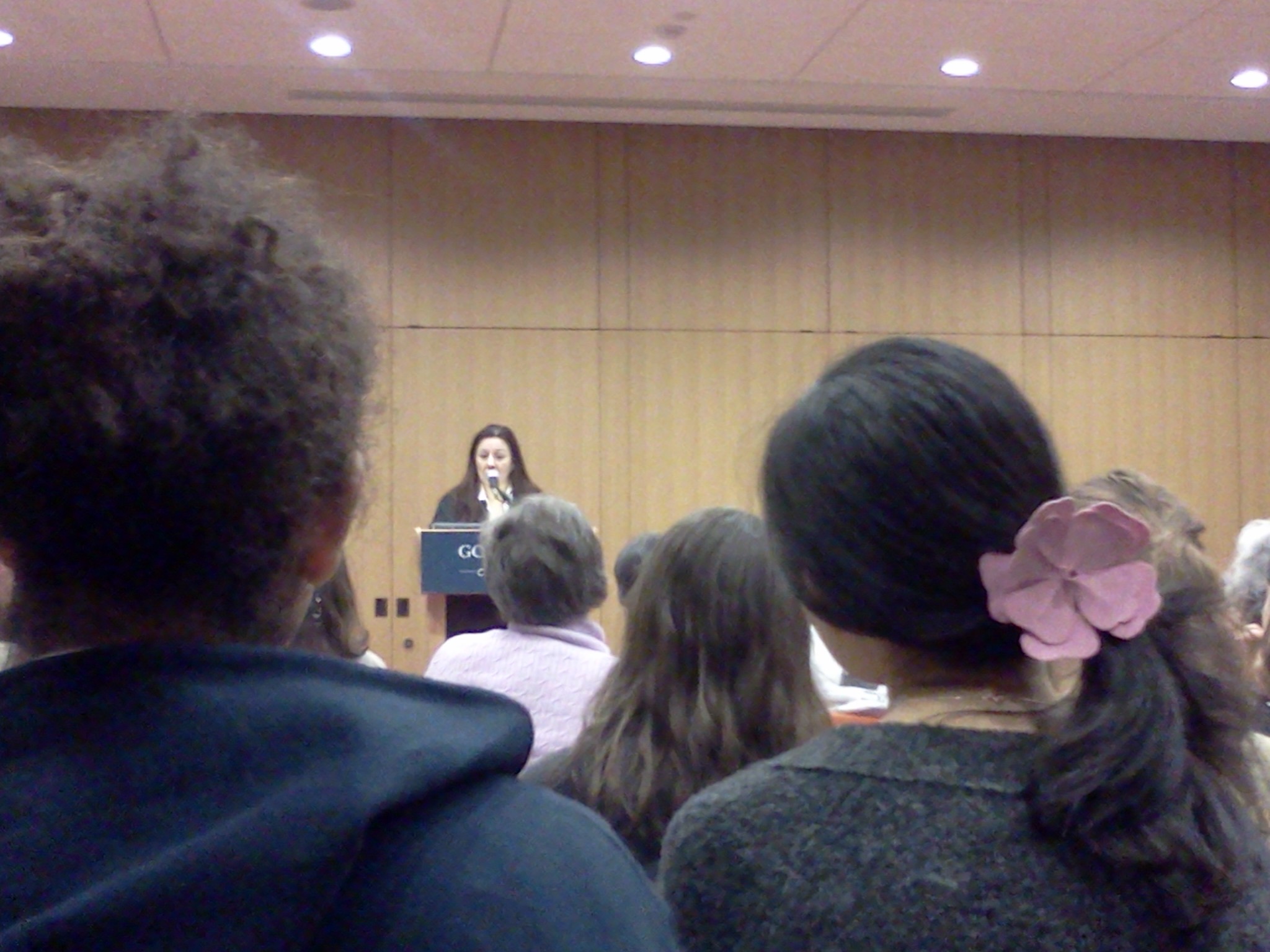
Sandy Lerner, savior of Chawton House, now Library, author of the P&P sequel, Second Impressions, visited Goucher last night to give a talk, a reading, and sign copies of her book.

Sandy Lerner at Goucher, image @Christine Stewart

About Sandy Lerner

If you’re not familiar with Lerner:  “Lerner in 1992 bought and restored an estate once owned by Jane Austen’s brother, called Chawton House, in Hampshire, England. She has transformed it into the Center for the Study of Early English Women’s Writing, and is currently underwriting the digitization of the works of female authors who lived in England between 1600 and 1830. The 10,000 volumes, not all of them novels, include works by Austen, Mary Shelley, Frances Sheridan and Maria Edgeworth, among many others, as well as a collection of cookbooks by Quakers.” (Piedmont Maverick by Suzanne Gannon). Lerner co-founded Cisco Systems with her (now ex) husband, and later a cosmetic company called Urban Decay, which sold unusual (at the time) nail colors like green and blue. Their slogan was ‘Does Pink Make You Puke?’ She once posed naked on horseback for Forbes Magazine. In short, she is an interesting, eccentric, wicked smart woman who owns a farm in Ayrshire, Virginia. She bought a 125 year lease on Chawton House in 1993.

My friend Clare and I went to the talk at Goucher College in the (still shiny and new!) Athenaeum. This is where Alberta Burke’s famous Jane Austen Collection  is housed. The Batza Room, where the Jane Austen Scholars talk every two years, was packed (50-75 people). So were the chairs. We were all pretty much sitting on top of each other, so that made it rather unpleasant when a man reeking of onions and gin sat down next to poor Clare. She bore it bravely, but we joked about how much we wished women still carried lavender scented handkerchiefs to bury their noses in.

Goucher’s president Sanford (Sandy) Ungar was there, which always signals that the visitor is a big deal, as if we didn’t know! Outside the door, the table was laden with the very prettily bound books (sort of blue and leathery looking) and elaborate bookmarks from Chawton Library, which you received when you bought the book. I couldn’t get a clear shot of the table because of the swarm of people.

Sandy Lerner at Goucher College

When Lerner took the podium, the first thing she said was that she had just decided what she was going to talk about, which might give you an indication of how well prepared she was. Clare and I enjoyed the talk, for what it was, a quick summary of her love of Austen and buying Chawton and what it is today, and a quick recap of writing the book, with some lamenting about not receiving the proper reviews, how agents and editors won’t talk to her, because she self-published. I think she spoke for, maybe 15 minutes?  (My notes on her talk will follow the post.) There was an awkward pause and she offered to read, but didn’t have a book (!). One was borrowed from the audience and she read for 10 minutes, a very quick scene between Lady Catherine de Bourgh and Colonel Fitzwilliam.

Read more for my notes about writing the book on my blog, Embarking on a Course of Studyhttp://www.embarkingonacourseofstudy.com/2012/10/sandy-lerner-visits-goucher-second-impressions.html

Read Full Post »

The Emporium at JASNA’s 2012 AGM in NYC provided several delightful surprises, among which was meeting the staff of Jane Austen’s World Magazine and Chawton House Library a their respective booths. Jane Austen’s Regency World editor, Tim Bullamore, was selling a variety of magazines and books. The music you hear in the background of the first video is William Herschel’s Sonata in D Op4 No4, which came with the March/April 2010 edition of the magazine. Tim also spoke about Sex, Money and Power in Death Obituaries in the Time of Jane Austen, which I will discuss in more detail in a later post. (Music: With permission from Tim Bullamore, CD from Mar/Apr issue of Jane Austen’s Regency World.)

The staff of Chawton House Library, shown behind the second booth, were  the Chief Executive Officer, Mr. Stephen Lawrence, Director of Research, Dr. Gillian Dow, and Director of Development, Ms. Eleanor Marsden (in the last scene with Mr. Lawrence) were also at their stations during various times throughout the conference. It was a pleasure to meet them. Janeites will know Dr. Dow, who also lectures at the University of Southampton in England, from her articles and books on Jane Austen and women’ studies. I have had the pleasure in the past to email Stephen Lawrence about permissions from Chawton House, most particularly in reproducing images of Edward Austen Knight’s suit, which required extensive restoration. Read my article here.

Edward Austen Knight’s Frock coat with lining. Image @Chawton House

Some of the items I purchased from both booths are shown in the video below. I was most particularly pleased to purchase The Compleat Housewife by Elizabeth Smith, reissued by Chawton House. I also purchased four back issues of Jane Austen’s Regency World Magazine. You will also see the lovely Sense and Sensibility the Musical booklets, which I used to take notes, the Conference workshop guide, and a tin of tea distributed by the Minneapolis MN JASNA group, where the 2013 AGM meeting will be held. Topic? Pride and Prejudice, of course.

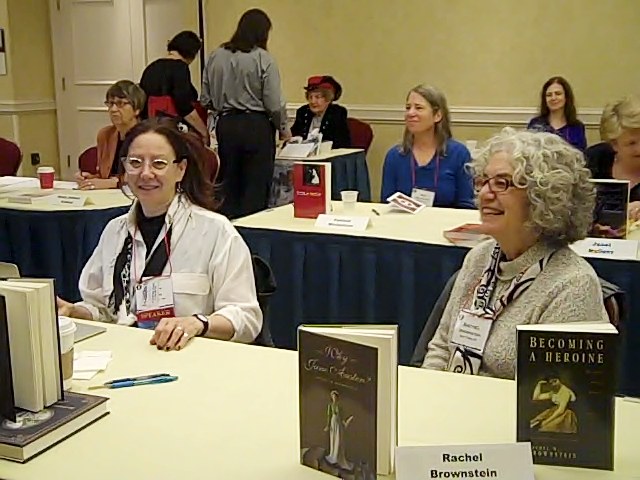
Sandy Lerner, shown left below, one of the keynote speakers, is the driving force behind the resurrection of Chawton House, Edward Austen Knight’s second grand house, and Chawton House library.

Sandy Lerner, author of Second Impressions, and Rachel Brownstein, author of Why Jane Austen? at the author’s book signing at JASNA AGM

Second Impressions is written by Ava Farmer, Sandra Lerner’s nome de plume. Profits from the sale of this book go to the Chawton House library.

Read Full Post »

« Newer Posts - Older Posts »