Feeds:
Posts
Comments

Archive for the ‘Jane Austen’s life’ Category

18th Century toddler

Gentle Readers; This post is in honor of Jane Austen’s 235th birthday. I have joined a group of bloggers in a blogfabulous celebration, and their links will sit at the bottom of this post. Leave your comments on our blogs for an opportunity to win an array of unique prizes! Copyright @Jane Austen’s World

Jane Austen was born on December 16, 1775 during one of the harshest winters that would be recorded in recent memory in England. A premature cold wave prompted naturalist Gilbert White to observe that the trees in Selborne were looking “quite naked” as early as November 11th. Despite the cold snap, there would still be periods of mild weather. The day that Mrs. George Austen went into labor with her 7th child, White noted, “Fog, sun, sweet day.”

During the latter half of the 18th century, all but a handful of births occurred in the home, but by 1775, the practice of midwifery had changed. Physicians were rapidly taking over obstetrics, replacing the midwive and relegating her to work with only the lower classes or those who lived in areas where a doctor or even an apothecary were not available.

In fact, many women of that era gave birth without the services of a doctor or midwife. Steventon Rectory, the Austen family home, lay seven miles away from the nearest village of Basingstoke, and so on the eventful night that baby Jane was born, the Austen family did not bother to summon a physician.

An 18th century pregnant woman’s corset could be loosened from both front and back. Image from @What clothes reveal: the language of clothing in colonial and federal America, by Linda Baumgarten

Hogarth’s image of a pregnant woman

Mrs. Austen gave birth to her second daughter in her own bedroom. She was attended, I surmise, by female friends and family members, such as her sister-in-law, Philadelphia, which was the tradition of the time. As a matter of course (and sisterhood), female friends and relatives helped to assist in the birth. In England, women who lay in bed while giving birth would lie in a Sims position, or on the side with their knees curled up. One historical source speculated that having a baby in bed could be a messy event and doubted that many women before the age of plastic would risk sullying their sheets and precious feather mattresses by remaining in bed during the final stages of the birth process. This made sense to me, and so I searched for alternate images.

Birthing stools or chairs with sloping backs, which allowed gravity to help pull the baby through the birth canal, had been used for centuries.

16th century woodcut of woman giving birth. The chair is sloped to allow her to lean back.

Birthing attendants also used various positions during labor, as in this 19th century image, which shows an American frontier scene, with the husband holding his wife in a half seated, half leaning position as the midwive and two female companions assisted with the birth.

19th century birth, with husband and attendants

No one recorded precisely how many hours Mrs. Austen took to deliver baby Jane, but one can imagine that during her labor a cozy fire warmed the bedroom on that bitterly cold night,  twine and scissors lay on a nearby table, plenty of fresh water and linen rags stood at the ready, and baby linens were laid near a cradle.  Jane’s birth, which was expected in November, was swift and uneventful. Soon after she entered the world, baby Jane was cleaned, dressed and placed next to her mother in bed or inside her cradle, and wrapped snugly in a long quilted gown and a mantle. 

18th century infant shirt and bonnets, Christie’s

Reverend George Austen baptised his new daughter on December 17th in his home, as he had done with his other children. Then, as Mrs. Austen rested, he wrote notes announcing the birth to friends and acquaintances. For the only time in her life, he publicly called his new daughter “Jenny.” (One wonders if during private family time this nickname stuck.)
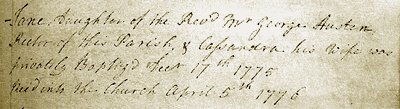
On April 5th, baby Jane was formally christened in St. Nicholas church, wearing a square-necked, sleeveless gown of fine cotton that probably opened in front. She would also have been wrapped in a pretty christening blanket.

18th century silver rattles, baby walker, and oak cradle. 

In 1775, fewer babies were swaddled, but the practice took a long time to die off.

Throughout the nineteenth century, the medical profession recommended a less constraining form of swaddling. In this type of swaddling, often practiced by the middle classes, the infant was able to move its legs and the arms were kept free from restraints, although mothers were still advised to keep the swaddling band to support the baby’s back. Baby clothing also became more comfortable.” – Swaddling, FAQ

Babies wore linen clouts, the 18th century form of a thick cloth diaper, which was pinned with straight pins (ouch) or tied with with lacings. The clout was covered by a pilcher, a garment that offered another layer of protection. Today’s pilcher has a plastic lining to prevent urine from leaking through. (Do recall from a previous post, that the 18th century attitude towards urine was different than ours in that urea was regarded as a disinfectant.)

Cap, napkin and pilch. Image @Sharon Ann Burnston’s website

While Georgian attitudes towards sanitation differed from ours, parents did recognize that a baby’s tiny bald head needed extra protection in cold, drafty houses. Caps decorated with hollie point lace protected a baby’s fragile head

Holly point lace caps for infants

Tiny linen shirts and long quilted bed gowns that opened in the front and extended beyond their legs (long clothes) warmed their tender bodies. These baby linens were also decorated with hollie point lace. (Hollie point was a whitework embroidery technique that was popular in the middle ages for church lace, and that was used after the 17th century for baby garments and baby blankets.)

18th c. baby dresses, Sturbridge

During this age of Industrial Revolution, ready-made baby items became more easily available and affordable. Childbed linens and baby clothes could now be purchased in shops or warehouses. Recycling of old clothes and cloths was definitely practiced, and it is without doubt that Mrs. Austen re-used Cassie’s outgrown clothes and bedlinens for baby Jane. Aside from needing a goodly number of clouts, the Austens would already possess most of the baby items their tiny daughter would need.

A day after giving birth to baby Jane, Mrs. Cassandra Austen was pronounced out of danger. Finally able to relax (even from her daily duties, which were overseen by friends or her sister-in-law, Philadelphia, perhaps) she would begin a lying in period to regain her strength. The mother, while resting during the lying in period, would be visited by her female friends, who would help look after the baby or help the mother through the grieving period (if the infant died.) This lying in period traditionally lasted a month, but for some sturdier (more impatient) mothers this period would last only a few weeks. Mothers whose infants died might not emerge for several months more. Ever the good hostess, biscuits and tea would be served to entertain visitors at set times.

Short gown maternity garment. Image @Fashions of Motherhood

Mrs. Austen would open her short gown (which fastened in front) and suckle Jane. But as with all their children, the Austens would send the new baby away to be fostered, a remarkable act of faith in a year when almost half of the more than 20,000 recorded deaths in England were those of infants. I have read articles in which a contemporary writer asserts that a Georgian parents’ grief over a child’s death was not as acute as ours, since so many infants died during that period. But much historical evidence shows that such a sweeping statement is simply not true. Georgian parents loved their children as much as today’s parents and grieved deeply for them. While they were painfully aware of the horrendous mortality rates for infants, this foreknowledge did not assuage their profound sense of loss when a child died.

Infant gown with removable sleeves, emuseum collection, Colonial Williamsburg

Infant’s gown with removable sleeves

Despite the possibility of their child not surviving infancy, the Austens had been in the habit of sending their children away just three months after their births to “a good woman at Deane”, a village close to Steventon. Giving a child over to a wet nurse had once been a common custom, but by 1775 this habit was fading as fast for the gentry as the use of a midwife. For the first crucial months, however, Mrs. Austen would breast feed baby Jane and take care of her personally.

Frost on trees in Hampshire

Baby Jane’s first winter on earth was bitter cold. Gilbert White noted that severe weather, with severe frost and snow, affected most of Europe from 9th Jan through 2nd Feb, 1776, and that the Thames was frozen for some time. A stormy February followed. The prolonged cold spell was broken by interludes of mild temperatures and melting snow, but these did not last long. Snow fall was often considerable, with frequent drifting, and daytime temperatures often dipped below freezing.

St. Nicholas (Chawton) across the fields. Image @Tony Grant

With such a prolonged cold snap, was it any wonder that the Austens kept baby Jane at Steventon until April 5th of that year? In contrast, Cassandra, who was born on January 9, 1773, had been with her foster mother for eight weeks by June 6th. While Edward-Austen Leigh wrote somewhat disapprovingly of his grandparents’ habit of fostering out their children, they must have made the right choices, for all the Austen children survived their infancy. Despite his censure, Edward observed that little Jane’s parents did not neglect her: “The infant was daily visited by one or both of its parents, and frequently brought to them at the parsonage, but the cottage [at Deane] was its home.”

Baby Jane might have resembled Gen Cadwallader’s daughter, 1772, by Peale

Author Irene Collins in Jane Austen, The Parson’s Daughter, identifies “the good woman at Deane” as Elizabeth Littleworth, the wife of a farmworker at Cheesedown, located between Deane and Steventon. These country folks remained close to the Austens for years, for in 1789 Jane acted as godmother to their eldest grandchild and stood as witness to the wedding of John Littleworth’s brother. Like the Martins in Emma, the Littleworths belonged to a lower social station, and the Austens, however grateful for their services, would not have socialized as equals with them.

Child wih leading strings, stays with cardboard stiffening, and child wearing a pudding cap

The Austen children stayed with the Littleworths until they started to walk and talk and could “be regarded as rational beings.” Henry returned to Steventon Rectory at fourteen months, and Cassy and Jane were returned when they reached two years of age.

Walking a toddler on leading strings. Image @Williamsburgrose

When baby Jane was ready to walk and crawl (about the time when she would be returned to her family) her mother would change her out of long clothes into short clothes. Short clothes were ankle length and allowed chubby legs the freedom of movement they needed to practice toddling. Toddlers also wore clothes with “leading strings” and pudding caps, which were padded.

A very fine pudding cap. Image @Metropolitan Museum

These caps, a sort of bumper guard, if you will, prevented injury to a toddler’s head if it fell or bumped into objects as it learned to walk (or so it was hoped).

“Like many mothers at the time, Mrs. Austen recorded her children’s progress in terms of dress. When Cassandra was taken out of her long gown and put instead into ‘petticoats’ (a frock and slip which finished at the ankles), her mother regarded it as a sign that she had left babyhood and would soon be learning to walk. From the petticoat stage, there was little change in girls’ clothing, except that the waistline of the frock went higher and the neckline lower.” – Irene Collins in Jane Austen, The Parson’s Daughter

18th Century Doll

Toddler Jane and her older sister Cassie also wore corsets. Yes, you read the word correctly. The tiny corsets, stiffened with cardboard, were thought to promote posture and help with walking.

Putting stays on young girls and boys was not seen as harsh, but rather as insurance that their figures would develop the correct form, with chest out and shoulders down. While boys usually wore stays only in early childhood, they were considered essential for females throughout their lives. – Philadelphia Museum of Art

These two tiny 18th century girls are wearing corsets

Since these early days, tiny Cassy and baby Jane, barely three years apart, developed a lifelong bond. Cassy most likely played with her younger sister as she would a doll and looked over her. By all accounts, their childhood at Steventon Rectory was happy and relaxed, with the children called by pet names, eating meals at the table, and visiting friends and relatives with their parents. Luckily for the Austen children, attitude towards childhood had begun to change and children were no longer dressed or perceived to be small adults. They were allowed to dress as children and, if they did not live in dire poverty, live a relatively carefree childhood compared to the children from generations before.

Would Mrs. Austen and her two daughters have resembled the Archibald Bulloch family? Painted in 1775 by Henry Bendridge, High Museum of Art, Atlanta.
 

Read Full Post »

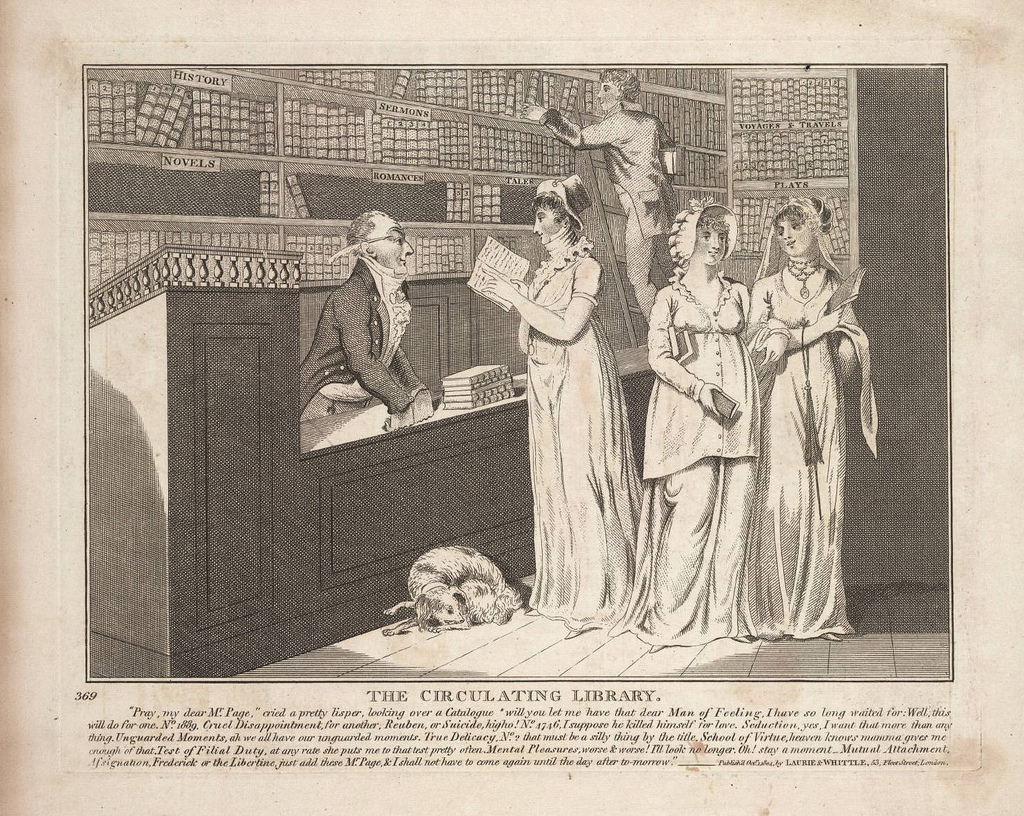
Circulating libraries in the 18th and 19th century were associated with leisure, and were found  in cities and towns with a population of 2,000 and upward. They were as much of an attraction in wealthy resorts, where people came to relax and look after their health, as in cities and small towns, like Basingstoke, where Jane Austen subscribed to Mrs. Martin’s circulating library.

In 1801, it was said that there were 1,000 circulating libraries in Britain. Book shops abounded as well, but in 1815 a 3-volume novel cost the equivalent of $100 today. Such a price placed a novel beyond the reach of most people. Worried about a second edition for Mansfield Park, Jane Austen wrote in 1814:

“People are more ready to borrow and praise, than to buy –which I cannot wonder at.”

Circulating libraries made books accessible to many more people at an affordable price.  For two guineas a year, a patron could check out two volumes. Which meant that for the price of one book, a patron could read up to 26 volumes per year.

By 1800, most copies of a novel’s edition were sold to the libraries, which were flourishing businesses to be found in every major English city and town, and which promoted the sale of books during a period when their price rose relative to the cost of living. The libraries created a market for the publishers’ product and encouraged readers to read more by charging them an annual subscription fee that would entitle them to check out a specified number of volumes at one time. – Lee Ericson, The Economy of Novel Reading

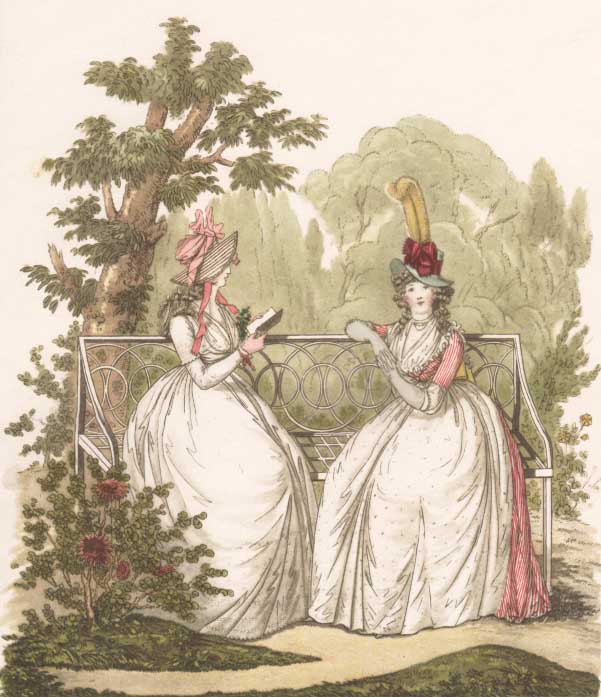
The leisurely classes had plenty of time for reading, late 18th c.

The practice of borrowing books was not a new concept in the Regency era. Records from the 17th century show that people were borrowing books from booksellers. As early as 1735, Samuel Fancourt advertised a circulating library in Salisbury for his religious books and pamphlets.

Circulating libraries attracted many patrons, even those who did not necessarily come to borrow or book or read, for they were also places for fashionable people to “hang out” and meet others.

In the resorts the circulating libraries became fashionable daytime lounges where ladies could see others and be seen, where raffles were held and games were played, and where expensive merchandise could be purchased.  – Lee Ericson, The Economy of Novel Reading

Jane Austen well knew the attractions of libraries at sea side resorts. Mrs. Whitby’s Circulating Library operated in Sanditon, and Lydia visited one in Brighton.  In her letters to Cassandra, Jane frequently mentioned circulating libraries, in particular visiting one in Southampton.

Circulating Library and Reading Room, Milsom Street, Bath. Image, Tony Grant

Circulating libraries tended to be located in a convenient location in the center of a resort. Newcomers would find out about them from guide books, such as the one in Brighton. The Royal Colonade Library advertised itself as thus:

MESSRS. WRIGHT AND SON’S ROYAL COLONADE LIBRARY, MUSIC SALOON, AND READING ROOMS.

This establishment is situated in North-street, at the corner of the New Road, and contains between seven and eight thousand volumes of History, Biography, Novels, French and Italian, and all the best Modern Publications. The Reading Room is frequented both by Ladies and Gentlemen, and is daily supplied with a profusion of London morning and evening papers, besides the French and weekly English journals, magazines, reviews, and general popular periodicals. – Brighton As It Is, 1836

In 1836, Cassandra Austen would have been familiar with the costs associated with the Royal Colonade Library’s terms of subscriptions:

Terms of subscription

By the end of the 18th century, Scarborough, a resortt located in the county of North Yorkshire, boasted several circulating libraries. The town’s population had risen to 7,067 by 1811, and one can imagine that, with the many leisurely hours available to tourists and visitors, these libraries managed a booming business.


A circulating library in Scarborough around 1818, from Poetical Sketches of Scarborough

The Poetical Sketches of Scarborough, first published in 1813, features twenty-one illustrations of humorous subjects about the many features available in the resort, including a satiric poem about the Circulating Library:

As in life’s tide by careful fate
The mind is made to circulate
Just so each watering place supplies
It’s CIRCULATING LIBRARIES:

Where charming volumes may be had
Of good indifferent and bad
And some small towns on Britain’s shore
Can boast of book shops half a score
Scarbro and with much truth may boast
Her’s good as any on our coast
AINSWORTH’S or SCAUM’S no matter which
Or WHITING’S all in learning rich
Afford a more than common measure
Of pleasant intellectual treasure

One wonders if the following publication could be checked out a Scarborough circulating library at the turn of the 19th century, for the book was written by a local schoolmaster:

A Short Grammar of The English Language. In Two Parts By John Hornsey. Schoolmaster, Scarborough.

THE publick are much indebted to Mr Hornsey for this able and excellent compendium of English grammar. We acknowledge that we perused it with singular satisfaction; and are well persuaded that a more useful introduction to the English language cannot be placed in the hands of our youth. That this work should reach a second edition, did not excite our wonder; may it pass through many succeeding ones!- The Nichols, John.Gentleman’s Magazine, Vol 86, 1799, p 1144.

Read Full Post »

Gentle Reader: This Father’s Day weekend, I salute Jane Austen’s father, George Austen. This post, which I wrote three years ago, has been resurrected and updated for this occasion.

Rev. George Austen was by all accounts a handsome man. Anna LeFroy, Jane’s niece wrote,

I have always understood that he was considered extremely handsome, and it was a beauty which stood by him all his life. At the time when I have the most perfect recollection of him he must have been hard upon seventy, but his hair in its milk-whiteness might have belonged to a much older man. It was very beautiful, with short curls about the ears. His eyes were not large, but of a peculiar and bright hazel. My aunt Jane’s were something like them, but none of the children had precisely the same excepting my uncle Henry.”

George Austen was born in 1731. His mother died in childbirth and his father died a year after marrying a new wife, who did not want the responsibility of taking care of the young lad. George then lived with an aunt in Tonbridge and earned a Fellowship to study at St. John’s. Smart, ambitious, and self-made (with the support of his uncle Francis), he received a Bachelor of Arts, a Master of Arts, and a Bachelor of Divinity degree at Oxford. Considered good looking all his life, he was called “the handsome proctor” as he worked as an assistant chaplain, dean of arts, and Greek lecturer while going to school.

George first met Cassandra Leigh in Oxford when she was visiting her uncle Theophilus, a renowned scholar. After marrying Cassandra in Bath, George became rector in several country parishes, including Steventon. The family grew by leaps and bounds, and eventually he and Cassandra had six sons and two daughters.

Shortly after Jane was born, her father said: “She is to be Jenny, and seems to me as if she would be as like Henry, as Cassy is to Neddy.” But the little girl was known as Jane all her life.

By all accounts George and Cassandra Austen had a happy marriage. His annual income from the combined tithes of Steventon and the neighboring village of Deane was modest. With so many mouths to feed, the family was not wealthy. To augment the family income,  George Austen opened a boarding school at Steventon Rectory for the sons of local gentlemen, and sold produce from his farm.

George Austen presents his son Edward to the Knights, who adopted him. This was a common practice in that era. Image from Chawton House.

Rev. Austen, a doting father to all his children, encouraged Cassandra and Jane to read from his extensive library, and taught his boys in his boarding school. For entertainment, the family read to each other, played games, and produced poetry, novels, and plays. James, the eldest son, an accomplished writer and poet, was considered to be the “writer” of the family, especially by his mother, Cassandra, who doted on him. George Austen was proud of his youngest daughter’s accomplishments, and tried to get First Impressions, the first draft of  Pride and Prejudice published. The “Memoir of Jane Austen” by Edward Austen-Leigh contains a letter from George Austen to Mr. Cadell, publisher, dated November 1797, in which he describes the work as a “manuscript novel comprising three volumes, about the length of Miss Burney’s ‘Evelina'” and asks Mr. Cadell if he would like to see the work with a view to entering into some arrangement for its publication, “either at the author’s risk or otherwise.” Unfortunately, nothing came of this query, but P&P became hugely popular among the friends and family who read it before it was published. The original 3-part manuscript no longer exists, and a much shorter form of the novel was finally published in 1813, long after George’s death and only four short years before Jane’s fatal illness.
Rev. George Austen died unexpectedly in Bath on  January 1, 1805, where the Austen family had moved after living in Steventon for over 30 years. This move did not sit well with Jane, who, as legend goes, fainted when she learned that the family was moving to Bath. (The silhouettes above are of George and Cassandra, who had not aged well). Rev. Austen did not linger long after falling ill, and on January 21,  Jane Austen would write sorrowfully to her brother, Frank, one of two sailors in the family:

“We have lost an excellent Father. An illness of only eight and forty hours carried him off yesterday morning between ten and eleven. His tenderness as a father, who can do justice to?” – Sir Francis William Austen

Rev. Austen was buried in St. Swithin churchyard in Bath. The inscription on his grave reads:

Under this stone rests the remains of
the Revd. George Austen
Rector of Steventon and Deane in Hampshire
who departed this life
the 1st. of January 1805
aged 75 years.”

Double click on this grave marker to read the words. (From: Find a Grave Memorial. Image of George and his grave is from this site.)

More on the topic:

The Austen Family:

Read Full Post »

This weekend as we celebrate Mother’s Day, my thoughts turn to Cassandra Austen,  wife of Rev. George Austen and mother of Jane Austen. Cassandra was related to the Leighs of Stoneleigh Abbey.  In 1806, the recently widowed Mrs. Austen visited Adlestrop Rectory in Gloucestershire with her two daughters, where they stayed with her cousins Rev. Thomas Leigh and his sister Elizabeth.  During their visit,  Rev. Thomas Leigh learned that the Hon. Mary Leigh of Stoneleigh Abbey had died and that he would inherit the great house, whose origins go back to 1154. The Austen women traveled with Rev. Leigh to Warwickshire. In the following letter, Mrs. Austen writes glowingly about their stay at the mansion:

“STONELEIGH ABBEY,
“August 13, 1806.

“MY DEAR MARY, – The very day after I wrote you my last letter, Mr. Hill wrote his intention of being at Adlestrop with Mrs. Hill on Monday, the 4th, and his wish that Mr. Leigh and family should return with him to Stoneleigh the following day, as there was much business for the executors awaiting them at the Abbey, and he was hurried for time. All this accordingly took place, and here we found ourselves on Tuesday (that is yesterday se’nnight) eating fish, venison, and all manner of good things, in a large and noble parlour, hung round with family portraits. The house is larger than I could have supposed. We cannot find our way about it – I mean the best part; as to the offices, which were the Abbey, Mr. Leigh almost despairs of ever finding his way about them. I have proposed his setting up direction posts at the angles. I had expected to find everything about the place very fine and all that, but I had no idea of its being so beautiful. I had pictured to myself long avenues, dark rookeries, and dismal yew trees, but here are no such dismal things. The Avon runs near the house, amidst green meadows, bounded by large and beautiful woods, full of delightful walks.

Stoneleigh Abbey, 1808, Humphrey Repton

“At nine in the morning we say our prayers in a handsome chapel, of which the pulpit, &c. &c., is now hung with black. Then follows breakfast, consisting of chocolate, coffee, and tea, plum cake, pound cake, hot rolls, cold rolls, bread and butter, and dry toast for me. The house steward, a fine, large, respectable-looking man, orders all these matters. Mr. Leigh and Mr. Hill are busy a great part of the morning. We walk a good deal, for the woods are impenetrable to the sun, even in the middle of an August day. I do not fail to spend some part of every day in the kitchen garden, where the quantity of small fruit exceeds anything you can form an idea of. This large family, with the assistance of a great many blackbirds and thrushes, cannot prevent it from rotting on the trees. The gardens contain four acres and a half. The ponds supply excellent fish, the park excellent venison; there is great quantity of rabbits, pigeons, and all sorts of poultry. There is a delightful dairy, where is made butter, good Warwickshire cheese and cream ditto. One manservant is called the baker, and does nothing but brew and bake. The number of casks in the strong-beer cellar is beyond imagination; those in the small-beer cellar bear no proportion, though, by the bye, the small beer might be called ale without misnomer. This is an odd sort of letter. I write just as things come into my head, a bit now and a bit then.

Stoneleigh Abbey, Gatehouse. 1807

“Now I wish to give you some idea of the inside of this vast house – first premising that there are forty-five windows in front, which is quite straight, with a flat roof, fifteen in a row. You go up a considerable flight of steps to the door, for some of the offices are underground, and enter a large hall. On the right hand is the dining-room and within that the breakfast-room, where we generally sit; and reason good, ’tis the only room besides the chapel, which looks towards the view. On the left hand of the hall is the best drawing-room and within a smaller one. These rooms are rather gloomy with brown wainscot and dark crimson furniture, so we never use them except to walk through to the old picture gallery. Behind the smaller drawing-room is the state-bedchamber – an alarming apartment, with its high, dark crimson velvet bed, just fit for an heroine. The old gallery opens into it. Behind the hall and parlours there is a passage all across the house, three staircases and two small sitting-rooms. There are twenty-six bedchambers in the new part of the house and a great many, some very good ones, in the old.

Bedroom, Stoneleigh Abbey

There is also another gallery, fitted up with modern prints on a buff paper, and a large billiard-room. Every part of the house and offices is kept so clean, that were you to cut your finger I do not think you could find a cobweb to wrap it up in. I need not have written this long letter, for I have a presentiment that if these good people live until next year you will see it all with your own eyes.

Arch, Stoneleigh Manor, Repton, 1807

“Our visit has been a most pleasant one. We all seem in good humour, disposed to be pleased and endeavouring to be agreeable, and I hope we succeed. Poor Lady Saye and Sele, to be sure, is rather tormenting, though sometimes amusing, and affords Jane many a good laugh, but she fatigues me sadly on the whole. To-morrow we depart. We have seen the remains of Kenilworth, which afforded us much entertainment, and I expect still more from the sight of Warwick Castle, which we are going to see to-day. The Hills are gone, and my cousin, George Cook, is come. A Mr. Holt Leigh was here yesterday and gave us all franks. He is member for, and lives at, Wigan in Lancashire, and is a great friend of young Mr. Leigh’s, and I believe a distant cousin. He is a single man on the wrong side of forty, chatty and well-bred and has a large estate. There are so many legacies to pay and so many demands that I do not think Mr. Leigh will find that he has more money than he knows what to do with this year, whatever he may do next. The funeral expenses, proving the will, and putting the servants in both houses in mourning must come to a considerable sum; there were eighteen men servants.” – Letter, Hill, Jane Austen: Her Homes and Her Friends

More on the topic:

Images: Plants info

Bedroom image: UK Student Life

Add to DeliciousAdd to DiggAdd to FaceBookAdd to Google BookmarkAdd to RedditAdd to StumbleUponAdd to TechnoratiAdd to Twitter

Read Full Post »

… or music Jane listened to. Recently Jane Austen’s Regency World Magazine sent a CD along with the issue. The songs include music popular in Jane’s time. I’ve included this musical number from YouTube: Thomas Arne’s “Where the Bee Sucks”, sung by a young lady named Sarah.

Jane Austen in Vermont has posted the list of songs on a CD that subscribers to Jane Austen’s Regency World magazine received in the last issue.

Read Full Post »

« Newer Posts - Older Posts »