This Jane Austen blog brings Jane Austen, her novels, and the Regency Period alive through food, dress, social customs, and other 19th C. historical details related to this topic.
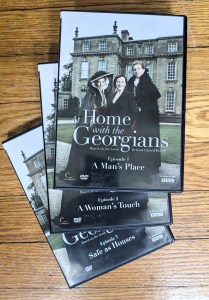
Inquiring readers: At the end of 2010, PBS sent Jane Austen’s World blog many DVDs for review. Most dealt with Jane Austen or the Georgian/Regency era. Close to fifteen years have passed since the series “At Home With the Georgians” first aired in the US. Recently I started to think that a new audience of Jane Austen fans might not be aware of this marvelous series, which presented the private lives, courtships, and marriages of Georgian men and women in 18th Century England. This series was developed in a variety of ways: by reading original sources, such as letters, discussions with experts, museum displays, and visiting the houses and regions where the British from all classes once lived.

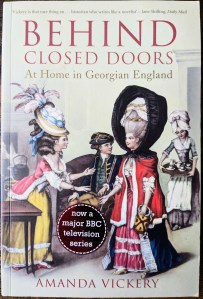
This three part series is based on Amanda Vickery’s book, Behind Closed Doors: At Home in Georgian England, a thoroughly informative and academic effort. Vickery is also the host of this visually stunning show. About the Georgian household she states that a home “reflected your taste, your values, your moral character, and the state of your marriage.” This concise introduction sums up the series. A man’s home ownership determines his position. For example, a rented home could determine his status. If he rented the entire house, from top to bottom, he could not only attract a wife, he would also be viewed as a full citizen qualified to vote. Bachelors who rented rooms in squalid areas of town, were at the bottom of the matrimonial ladder, always yearning to improve their circumstances.
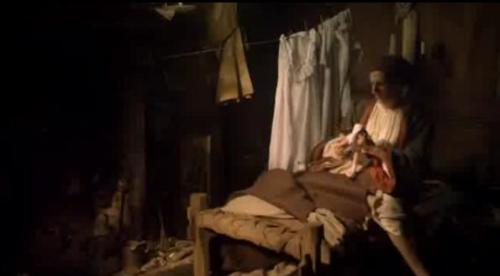
Bachelor fantasizing about a home and family. (DVD scene)
Marrying well was the major focus for Georgian women. Spinster ladies who were unsuccessful in finding a husband, led lives of dependency. Austen described their lot beautifully in her letters and novels.
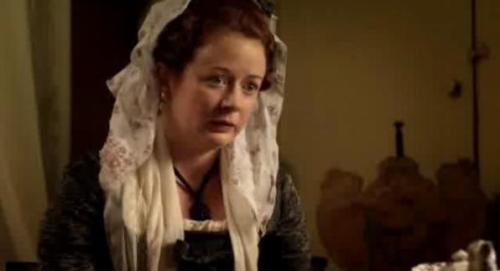
Gertrude Saville, a very sad spinster (DVD Scene)
Finding a husband and raising a family were a Georgian woman’s main ambitions. As for the man, all he really needed for happiness was “a wife and a fire.” His primary focus early in life was to set up the kind of household that enabled him to woo a woman successfully.
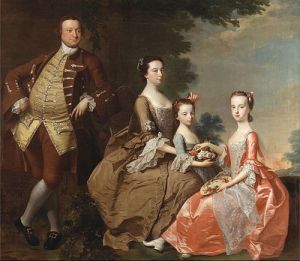
A proper Georgian Family. Thomas Hudson,The Thistlethwayte Family, ca. 1758. Yale Center for British Art
The third video has a much darker tone than the first two, but its content is equally as fascinating. In it, Vickery discusses how the home provided safety during the night, especially in cities, towns, and rural communities that were dark after sundown and badly lit at night in an age before electricity.
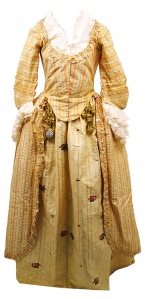
Georgian dress with chatelaines attached to her bodice and skirt
While the wife carried the keys and other instruments, such as sewing scissors, inside the home during the day to perform her housewifely duties (notice the instruments attached to the bodice in the image), the husband’s responsibility was to walk around the house every night, and lock the doors and windows to prevent intruders from entering. As the 18th century progressed, crimes, including relatively minor ones of theft, were punished more harshly. Serious robberies and break ins led increasingly to brutal imprisonment or a death sentence.
The “At Home With the Georgians” videos are divided into the following three topics. Click on the links to read our full reviews.
A Woman’s Touch, reviewed by Tony Grant, a frequent contributor to this blog. Read it at this link.
Safe as Houses, reviewed by Vic, with photo contributions from Tony Grant. Read it at this link.
Where to view the videos today
DVDs of these videos are available at Amazon and eBay. Roku Channel and Tubi offer free views, although if I recall correctly, they come with ads. One YouTube channel features at least the first two videos: A Man’s Place and A Woman’s Touch. Click on soniab1’s YouTube channel to see them.
About Amanda Vickery
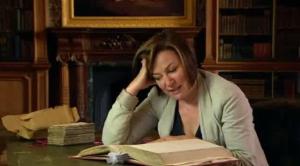
Amanda Vickery reading letters & documents
Amanda Jane Vickery FBA is an English historian, writer, radio and television presenter, and professor of early modern history at Queen Mary, University of London. Source: Wikipedia
I can hardly believe we’ve arrived at November in Jane Austen’s World! After 10 months of this series, it’s proved an experience I won’t soon forget. What a fantastic journey! As we turn now to Jane Austen’s life, letters, and novels in the month of November, I can’t wait to explore Jane’s Regency world in the fall!
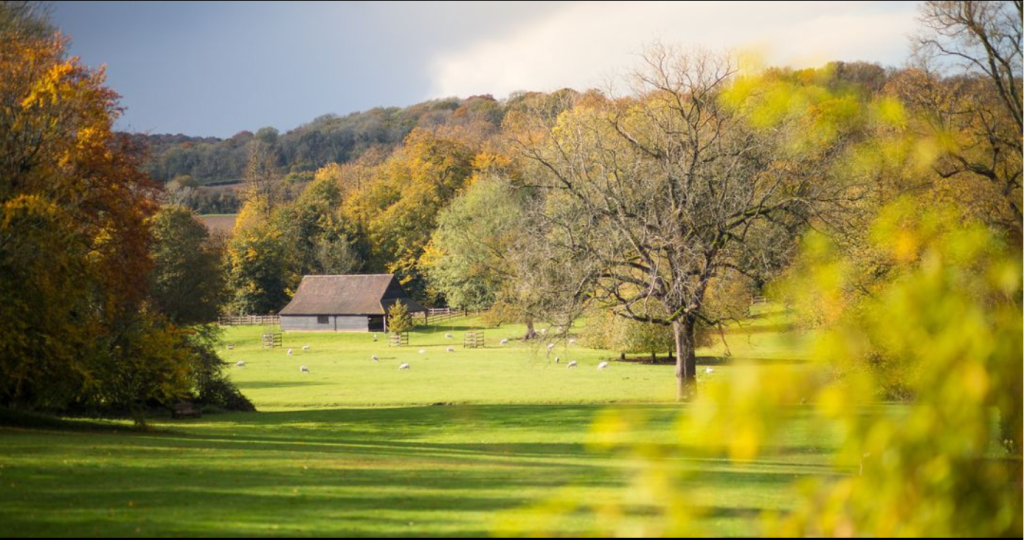
As is our tradition, let’s first take a look at Jane Austen’s beautiful Hampshire countryside this time of year. As you might imagine, the yellow and golds of fall are on display and the weather has changed. Here is a gorgeous photo of the Chawton landscape this time of year:
November is the time for crisp weather, rain, and pretty fall colors. I found this lovely description of November weather in Austen’s letters:
Castle Square (21 November 1808):
“How could you have a wet day on Thursday? With us it was a prince of days, the most delightful we have had for weeks; soft, bright, with a brisk wind from the southwest; everybody was out and talking of spring, and Martha and I did not know how to turn back. On Friday evening we had some very blowing weather,—from six to nine; I think we never heard it worse, even here. And one night we had so much rain that it forced its way again into the store-closet; and though the evil was comparatively slight and the mischief nothing, I had some employment the next day in drying parcels, etc. I have now moved still more out of the way.”
Wouldn’t you love to walk with Jane in that beautiful soft, bright day with its brisk wind! I’ve enjoyed quite a few similar walks this past week where I live and it’s exhilarating.
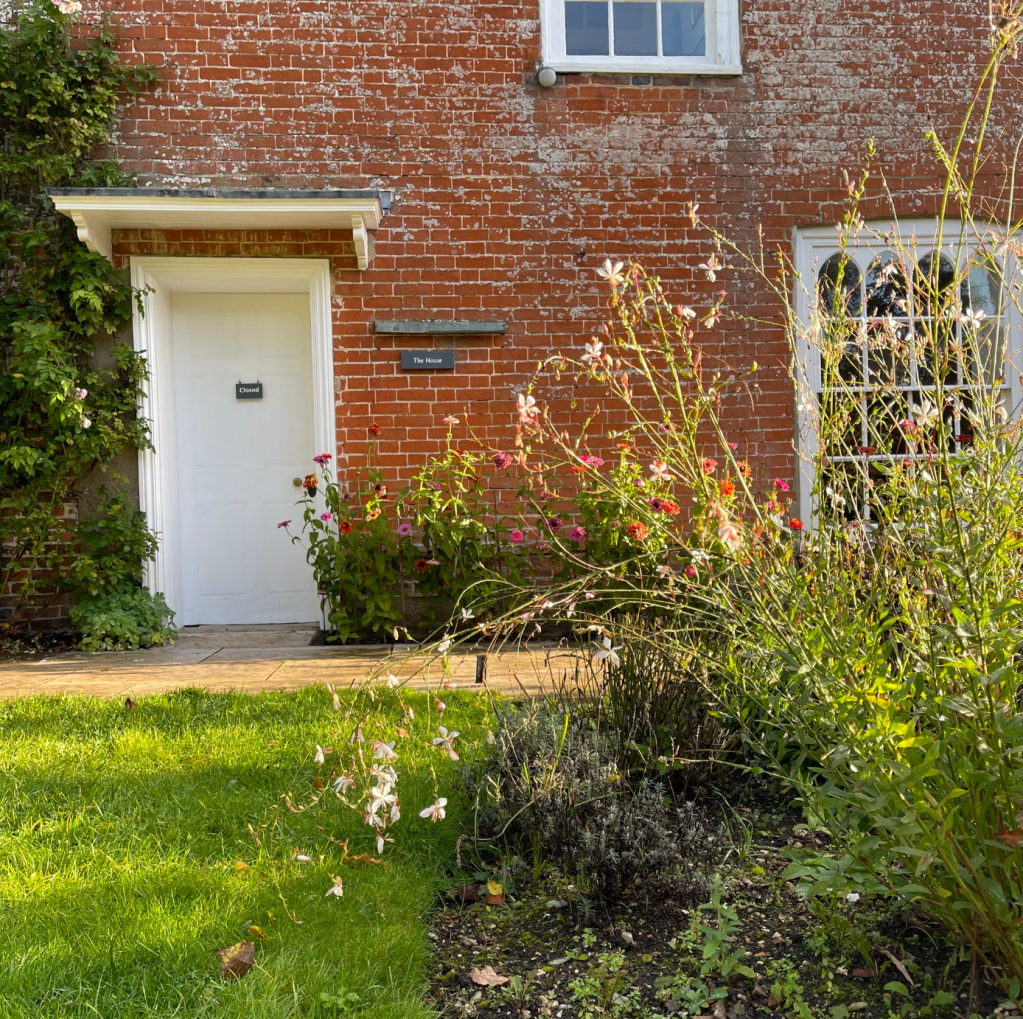
Jane Austen’s House Museum and gardens are always so pretty. Here is a recent November photo:
We don’t have many letters from the month of November in Austen’s collection of surviving letters, but November produces a few interesting details such as these:
20 November 1800 (Steventon):
Night out: “Your letter took me quite by surprise this morning; you are very welcome, however, and I am very much obliged to you. I believe I drank too much wine last night at Hurstbourne; I know not how else to account for the shaking of my hand to-day. You will kindly make allowance therefore for any indistinctness of writing, by attributing it to this venial error. Naughty Charles did not come on Tuesday, but good Charles came yesterday morning. About two o’clock he walked in on a Gosport hack. His feeling equal to such a fatigue is a good sign, and his feeling no fatigue in it a still better. He walked down to Deane to dinner; he danced the whole evening, and to-day is no more tired than a gentleman ought to be.“
Dance partners lacking: “There were only twelve dances, of which I danced nine, and was merely prevented from dancing the rest by the want of a partner. We began at ten, supped at one, and were at Deane before five. There were but fifty people in the room; very few families indeed from our side of the county, and not many more from the other. My partners were the two St. Johns, Hooper, Holder, and a very prodigious Mr. Mathew, with whom I called the last, and whom I liked the best of my little stock.”
Jane’s appearance for the ball: “Mary said that I looked very well last night. I wore my aunt’s gown and handkerchief, and my hair was at least tidy, which was all my ambition.”
21 November 1808 (Castle Square):
First thoughts on Chawton Cottage: “There are six bedchambers at Chawton; Henry wrote to my mother the other day, and luckily mentioned the number, which is just what we wanted to be assured of. He speaks also of garrets for store-places, one of which she immediately planned fitting up for Edward’s man-servant; and now perhaps it must be for our own; for she is already quite reconciled to our keeping one. The difficulty of doing without one had been thought of before. His name shall be Robert, if you please.”
Chawton Cottage by Ellen Hill
November in Jane Austen’s Novels
Sense and Sensibility
Lucy Steele Visits Barton Park: Elinor tells Marianne, “I have known it these four months. When Lucy first came to Barton Park last November, she told me in confidence of her engagement.”
Pride and Prejudice
Mr. Collins Visits Longbourn: He writes to Mr. Bennet: “If you should have no objection to receive me into your house, I propose myself the satisfaction of waiting on you and your family, Monday, November 18th, by four o’clock, and shall probably trespass on your hospitality till the Saturday se’nnight following, which I can do without any inconvenience, as Lady Catherine is far from objecting to my occasional absence on a Sunday, provided that some other clergyman is engaged to do the duty of the day.”
Mr. Darcy and Mr. Bingley leave Netherfield in November: “How very suddenly you all quitted Netherfield last November, Mr. Darcy! It must have been a most agreeable surprise to Mr. Bingley to see you all after him so soon; for, if I recollect right, he went but the day before. He and his sisters were well, I hope, when you left London?”
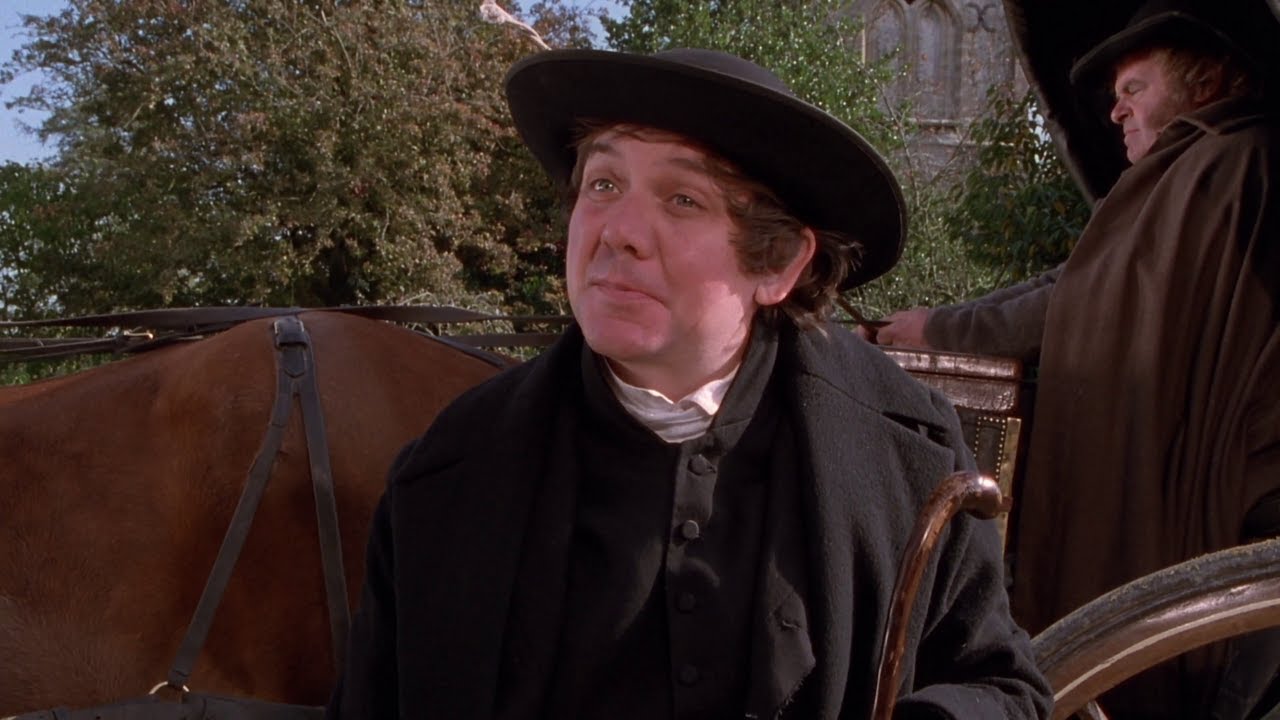
Mr. Collins comes to Longbourn, Pride & Prejudice (1995).
Mansfield Park
Sir Thomas returns home: “November was the black month fixed for his return. Sir Thomas wrote of it with as much decision as experience and anxiety could authorise. His business was so nearly concluded as to justify him in proposing to take his passage in the September packet, and he consequently looked forward with the hope of being with his beloved family again early in November.”
Maria marries in November: “Mrs. Rushworth was quite ready to retire, and make way for the fortunate young woman whom her dear son had selected; and very early in November removed herself, her maid, her footman, and her chariot, with true dowager propriety, to Bath, there to parade over the wonders of Sotherton in her evening parties; enjoying them as thoroughly, perhaps, in the animation of a card-table, as she had ever done on the spot; and before the middle of the same month the ceremony had taken place which gave Sotherton another mistress.”
November gloom and dirt (mud): “Not only at home did [Fanny’s] value increase (‘with the departure of her cousins’), but at the Parsonage too. In that house, which she had hardly entered twice a year since Mr. Norris’s death, she became a welcome, an invited guest, and in the gloom and dirt of a November day, most acceptable to Mary Crawford.”
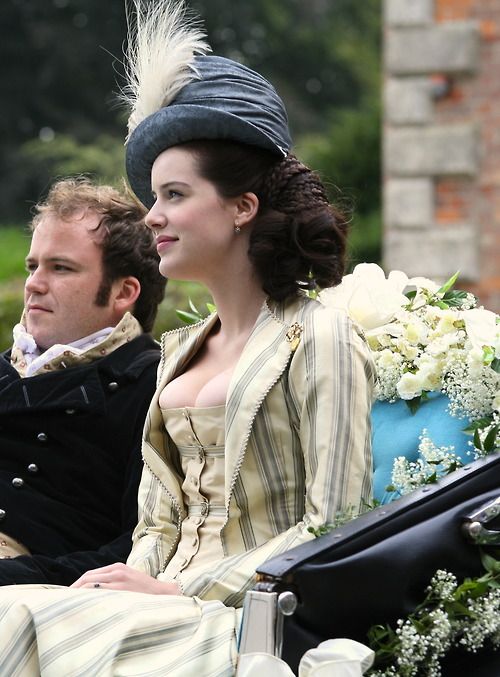
Michelle Ryan as Maria Bertram in Mansfield Park.
Emma
Mr. Woodhouse argues autumn colds: “That has been a good deal the case, my dear; but not to the degree you mention. Perry says that colds have been very general, but not so heavy as he has very often known them in November. Perry does not call it altogether a sickly season.”
Jane Fairfax catches a November cold: “Jane caught a bad cold, poor thing! so long ago as the 7th of November, (as I am going to read to you,) and has never been well since. A long time, is not it, for a cold to hang upon her? She never mentioned it before, because she would not alarm us. Just like her! so considerate!—But however, she is so far from well, that her kind friends the Campbells think she had better come home, and try an air that always agrees with her; and they have no doubt that three or four months at Highbury will entirely cure her—and it is certainly a great deal better that she should come here, than go to Ireland, if she is unwell. Nobody could nurse her, as we should do.”
Emma and Mr. Knightley must return from their seaside honeymoon by November, so that Isabella and her husband can stay at Hartfield with Mr. Woodhouse:
“[Emma and Mr. Knightley] had determined that their marriage ought to be concluded while John and Isabella were still at Hartfield, to allow them the fortnight’s absence in a tour to the seaside, which was the plan.”
“But Mr. John Knightley must be in London again by the end of the first week in November.”
“[Emma] was able to fix her wedding-day—and Mr. Elton was called on, within a month from the marriage of Mr. and Mrs. Robert Martin (in September), to join the hands of Mr. Knightley and Miss Woodhouse.”
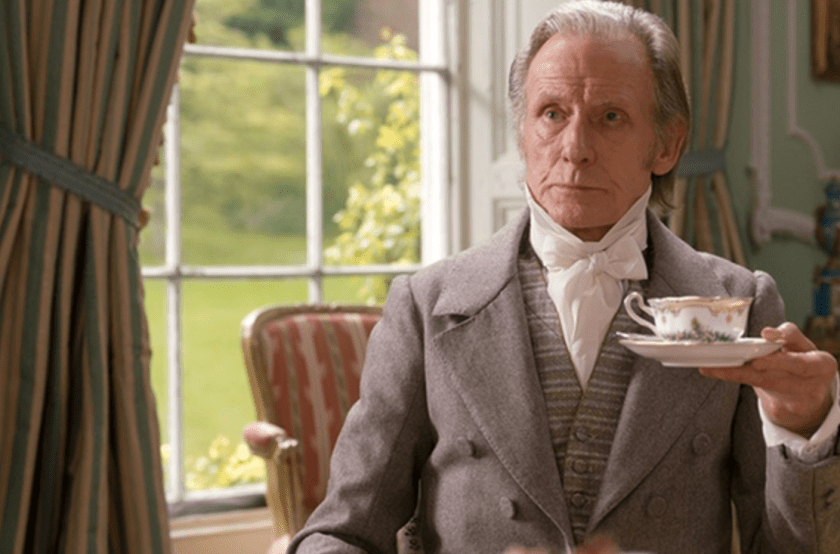
Bill Nighy as Mr. Woodhouse in Emma (2020).
November Dates of Importance
And now for our monthly round-up of November dates of importance relating to Jane and her family:
Family News:
November 1796: Jane’s brother James Austen engaged to Mary Lloyd, a close family friend.
17 November 1798: James Austen’s son, James-Edward, born.
November 1797: Edward Austen moves his family from Rowling to Godmersham Park in Kent.
Historic Dates:
9 November 1799: Napoleon becomes First Consul of France.
20 November 1815: The Treaty of Paris is signed, officially ending Napoleonic wars.
Writing:
1 November 1797: Jane’s father, Reverend Austen, offers “First Impressions” to Thomas Cadell, a London publisher, but is ultimately unsuccessful.
November 1797: Austen begins revisions on “Elinor and Marianne,” which later becomes Sense and Sensibility.
November 1813: 2nd editions of Pride and Prejudice and Sense and Sensibility released.
November 1813:Mansfield Park accepted for publication (most likely).
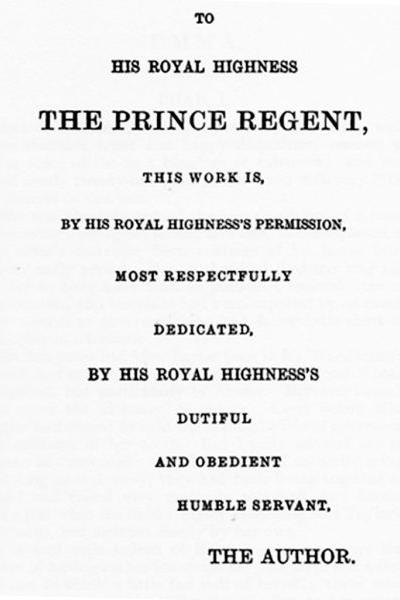
13 November 1815: Austen visits the Prince Regent’s Library at Carlton House, where she receives the invitation to dedicate a future novel to him.
Jane Austen reluctantly dedicated Emma to the Prince Regent, at his request.
Sorrows: I am happy to report that I could not find any major family sorrows during the month of November in the family history, biographies, or letters.
Looking Toward December
This truly has been an enormous joy each month, and as this is the penultimate post for this series, I cannot tell you all how excited I am to round out the series next month as we explore December in Jane Austen’s World, Jane’s birthday, and all things Regency Christmas!
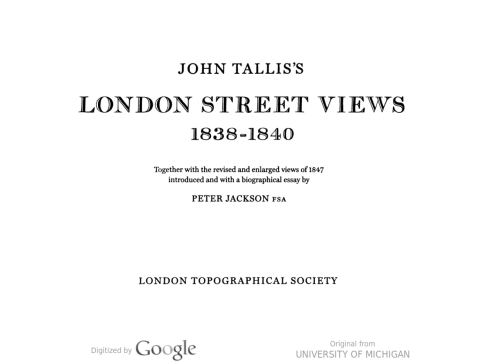
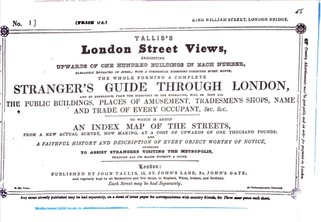
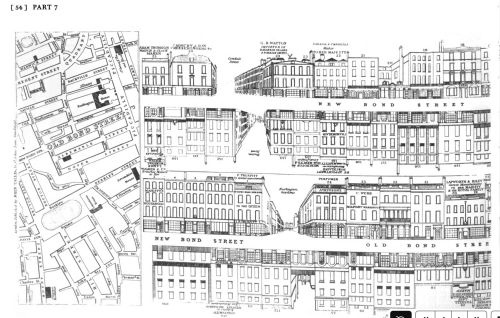
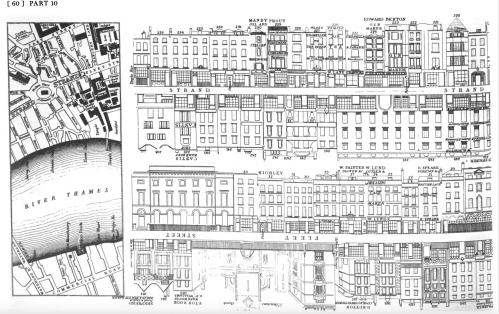
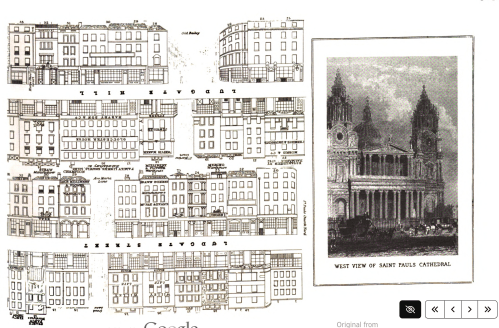
For over 10 years I have searched for a full digitized copy of John Tallis’s London street views, 1838-1840. It is 328 pages long and includes an introduction with a biographical essay of Tallis by Peter Jackson.This book, digitized by Google from an original copy owned by the University of Michigan, also includes revised and enlarged views of 1847 London.
Purpose of this Blog Post:
The resources in this post are aimed at the interests of:
Authors who are researching details of London’s streets and maps during the Regency era and Early Victorian London, as well as contemporary paintings and illustrations from that period.
Faculty and teacher research.
Student learning regarding research and uncovering historical details.
Our readers’ curiosity and for those who are interested in learning more about 19th century London.
Our story: HathiTrust was founded in 2008 as a not-for-profit collaborative of academic and research libraries now preserving 18+ million digitized items in the HathiTrust Digital Library. We offer reading access to the fullest extent allowable by U.S. and international copyright law, text and data mining tools for the entire corpus, and other emerging services based on the combined collection.”
HathiTrust digital library: The HathiTrust Digital Library is home to millions of digitized books and publications. Our team works diligently alongside research institutions to preserve and grow this collection while providing lawful access to visitors around the world.”
This very useful site also offers links to many more books from the past, where you’ll find a rich source of 18+ million unique and historic books that have been digitized. Forty per cent can be read by the public, and copyrights and access are explicitly explained. See “How to Search and Access.”
In addition:
Find thousands of Images at the London Picture Archive, which is managed by The London Archives on behalf of the City of LondonCorporation.
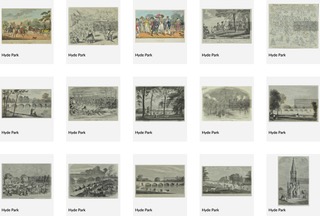
For Example, when I typed “Hyde Park” in this site’s search bar, a wealth of images appeared that gave life to Austen’s era. Combined with the Tallis maps, these resources provide a more comprehensive view of life during the Regency era as it was, as opposed to reproductions in today’s film sets, lets say. (Also see Horwood’s Maps in the link at the end of this post.)
New Bond Street
River Thames
West view of St. Paul’s Cathedral and surrounding streets
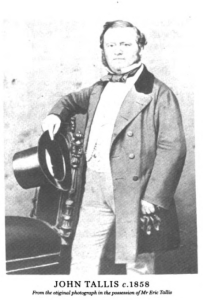
Who is John Tallis?:
John Tallis: 1816-1876
The biographic introduction to this book by Peter Jackson includes a vast amount of information about his life. (Image @ Hathi Trust)
Other information about Tallis:
“The Life of John Tallis – Map Maker and Cartographer”: biography excerpt from the Old Maps Library blog
“Tallis … produced a series of street views of central London that are breathtaking. His images showed detailed views of the streets using the facades of the buildings. These street views are much like we use Google street view today, giving us a sense of what the city looked like in the early Victorian era.”
“Tallis was born in Stourbridge, Worcestershire in 1817, and moved to London in about 1841… A blue plaque commemorates his final residence at 233, New Cross Road. He died in 3 June 1876.”
“My idea of good company, Mr. Elliot, is the company of clever, well-informed people, who have a great deal of conversation; that is what I call good company.”—Anne Elliot, Persuasion
This year I enjoyed plenty of “good company” at the yearly Jane Austen Festival in Bath. Every September, Janeites gather from around the world to enjoy a wide range of events.
Program cover for the Jane Austen Festival, 2024, in Bath.
After a few pre-Festival events, the 2024 Jane Austen Festival officially kicked off with a Grand Regency Costumed Promenade on Saturday morning. Organizers were expecting 1100 people in full Regency dress. We walked through Bath, from the Holbourne Museum at Sydney Gardens (near one of the Austen’s homes in Bath) all the way up to the Assembly Rooms (the “Upper Rooms” in Austen’s time).
Soldiers and musicians led the parade. The promenaders, including men and women, boys and girls, swept up the wide streets. The weather was cool and sunny, unlike the first time I attended the Festival, when it was rainy and I ended up with a muddy petticoat, like Elizabeth Bennet!
More than a thousand people in Regency dress promenade the streets of Bath at the Jane Austen Festival.
The promenade ended at the Festival Fayre in the Assembly Rooms. All kinds of Regency goods were on offer, from the wonderful Jane Austen’s Regency World Magazine to gloves, bonnets, socks, dresses, jewelry, and much more.
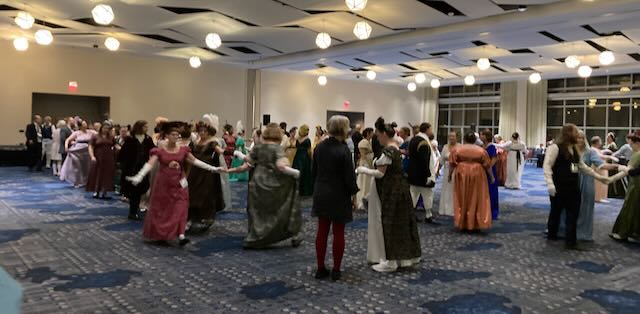
I was fortunate enough to have a ticket to the Netherfield Ball that evening. A dance workshop prepared us in the afternoon. It was quite a treat to get to dance in the Assembly Rooms! (Outside of Festival dates, the Rooms are now closed most of the time, since the Fashion Museum moved out, but tours are offered occasionally.)
If you’ve never tried Regency dancing, the basics are not too difficult. The dance workshop gave good preparation, and the caller walked us through each dance before we danced it. You switch partners often, and ladies often dance with ladies, since gentlemen are always scarce. We all occasionally make mistakes, laugh about them, and keep dancing. This is true of all the Austen dances I’ve been to, in England and America.
This year’s Festival included three balls: one for experienced dancers on the first Friday, the Netherfield Ball I attended on the first Saturday, and a Northanger Abbey Gothic Soiree on the second Saturday, plus many dance workshops and demonstrations. Lots of dancing!
A mini-promenade rounded out the festival on the final Sunday, for those who missed the main promenade.
Ladies and gentlemen lined up for a country dance at the Netherfield Ball in the Bath Assembly Rooms. Jane Austen Festival, 2024.
Many wonderful events were offered. I could only attend a small fraction of them. Here are the types of events. I’ll tell you about a few of the ones I got to participate in, then list others to give you a taste.
Tours
Though I know Bath fairly well, I signed up for an interesting tour called “Romantic chic lit or radical writer.” The guide took us around to Austen-related sites in Bath, speculating about Austen’s more radical leanings and challenges in her life.
Other tours offered, for those who wanted to see more of Bath and its surroundings: theatrical walking tour with dramatic entertainment; minibus tour to Hampshire to see places Jane Austen lived; variety of walking tours of Bath; canal cruise; minibus tour to “Meryton” and “Longbourn”; Jane Austen’s Bath homes; ghost walk; “Beastly Bath,” focusing on disagreeable aspects of the city in Austen’s time; walking tour to nearby Weston; twilight tour of the delightful No. 1 Royal Crescent, set up as an eighteenth century home; Gothic novel tour; and tour of Parade House in Trowbridge.
Workshops
I enjoyed “Singing with Jane Austen.” We learned and sang together songs from Austen’s time. Some were silly children’s songs, others songs from Austen’s music teacher.
Other workshops offered, for those who like hands-on activities: dancing, croquet, silhouette embroidery, building Northanger Abbey (drawing gothic buildings), fencing, bonnet and turban making, fabric dyeing, parasol making, Regency games, reticule making, Regency hand sewing, and making a spencer.
Musical Events
At a lovely concert in the Assembly Rooms, we got to hear music from Austen’s own collection, played on the harp and pianoforte. What a treat that was, especially hearing a harp like the one Mary Crawford enchanted Edmund with.
One of my favorite events was a demonstration of popular dances throughout Austen’s lifetime. The Jane Austen Dancers, in “Dancing in the Footsteps of Jane Austen,” danced them all for us, from the minuet to the waltz. They even showed us the “reel” that Mr. Darcy challenged Elizabeth to enjoy.
Gillian Dooley also spoke on Jane Austen and Music, playing and singing some of the songs. I missed that one, but I look forward to hearing her at the JASNA AGM.
Concert at the Assembly Rooms with Lisa Timbs – Square Piano, Annemarie Rhys Jones – Harp, and Verity Joy – Soprano.
Jane Austen Dancers, demonstrating dances of Jane Austen’s time chronologically, at St. Swithin’s Church.
Church
The “Regency Church Service” at Bath Abbey on the first Sunday included Regency church music, and many of us dressed in Regency clothes to attend. Evensong that afternoon was another chance to enjoy a lovely worship service sung by a choir of young people and adults.
Talks
I had the privilege of talking about the church in “Why Mr. Collins: The Church and Clergy in Austen’s England.” The wonderful venue was St. Swithin’s Church: the church where Austen’s parents were married, where William Wilberforce got married, and where Austen’s father is buried, as well as Fanny Burney. It’s also mentioned in Northanger Abbey as Walcot Church, since it is the parish church of Walcot.
Later in the week, I enjoyed hearing Lizzie Dunford of the Jane Austen House talk about Jane Austen and classic fairytales.
John Mullan also gave two fascinating talks, one on dancing in the novels, and one on dialogue in the novels. He shed light on many relevant quotes from the novels.
I learned more about Regency health and taking the waters at the new Bath Medical Museum. This museum is tiny and has limited opening hours, but includes helpful information and exhibits.
Other talks, for those who like me who love to learn all they can about Jane Austen’s world, covered: fashion; Jane Austen and London; the Assembly Rooms: “Romance, Rows, and Riots”; social rules about love, courtship, and marriage; movie locations; “Race for an Heir,” the royal family in Austen’s time; Austen’s life; and the theatre.
Demonstrations
I loved “Stargazing at the Herschel Museum of Astronomy with the Bath Astronomers.” We got to explore this delightful museum, early home of William and Caroline Herschel. William Herschel discovered the planet Uranus from his backyard at this building. His sister Caroline, the first professional woman astronomer, discovered a number of comets. Once it got dark, we trooped outside where we saw the space station pass overhead, watched stars, and learned about heavenly bodies from astronomers. We were all sorry to leave when the next group arrived.
In another demonstration, “a whole campful of soldiers” was set up to demonstrate drills and marching. Talks on soldiers’ wives and on dueling gave more insight into soldiers’ lives.
The militia lining up for the Promenade at the Jane Austen Festival in Bath. His Majesty’s 33rd Regiment of Foot graced us with their presence.
Accessories
I appreciate people who collect Regency items and are willing to show them to us, explain them, and even let us handle them. Two of my favorite talks were on “Rummaging through the Reticule,” showing examples of the many items a Regency lady might carry in her reticule, and “Stand and Deliver! Desirable Dress Accessories in the Georgian Age,” showing items a Regency gentleman might carry, and which a highwayman might steal. I wasn’t able to attend “The Etiquette of Dining,” but it included demonstrations with period “silver, porcelain, and domestic items.”
Mark Wallis displays men’s accessories that a highwayman might have taken. Jane Austen Festival, Bath, 2024.
Discussions
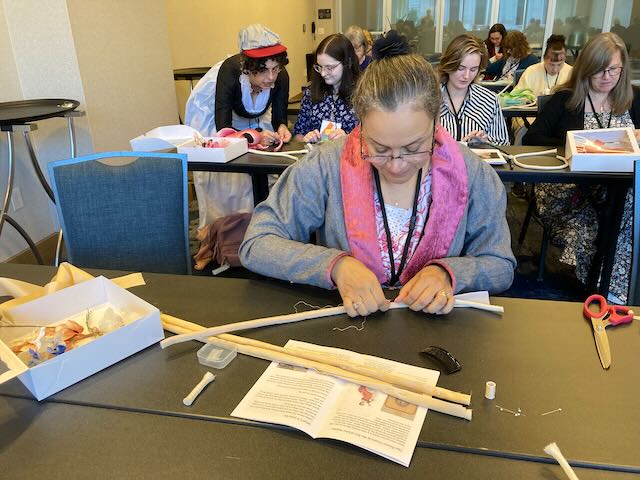
It was great fun throughout the Festival to meet with other people passionate about Jane Austen and discuss her works and life together. At “Sew Chatty,” we brought our current sewing projects so we could sew together and chat, as women in Austen’s day did. “Book clubs” also met to discuss Pride and Prejudice and Mansfield Park. Our group had a lively discussion of Mansfield Park, touching on the characters of Fanny Price, Mary Crawford, Mrs. Price, and others. We wondered whether or not Fanny has a flaw to overcome and grows as a character during the novel. (What do you think?)
Ladies sewing and chatting together at “Sew Chatty” in the Coppa Club at the Bath Townhouse.
Food was shared, of course, at Regency breakfasts, a Sunday afternoon picnic, and high teas at “Highbury” (in the Jane Austen Centre Regency Tea Room). Other participants went on their own to enjoy tea or a meal at the Pump Room.
Other events included a Regency hair salon, a murder mystery with the audience as detectives, and several shows, including “Lady Susan.” Visitors also of course enjoyed the Roman Baths, the Royal Crescent, and other sights around Bath.
Overall I think a great time was had by all. Kudos to Georgia Delve, the Festival Director (and one of the Jane Austen Dancers), and her wonderful team who organized it all and kept everyone in the right places!
The Jane Austen Festival is a delightful opportunity to connect with other Janeites, learn, and have fun. Next year’s Festival will be Sept. 12-21. Since 2025 is the 250th anniversary of Jane Austen’s birth, special celebrations will be held and a large crowd is expected, so book your accommodations early. (I use booking.com; no doubt there are other good options.) If you’re planning to go, I recommend that you become a Festival Friend, for £35, to get first priority on booking popular events like balls; those tickets sell out quickly.
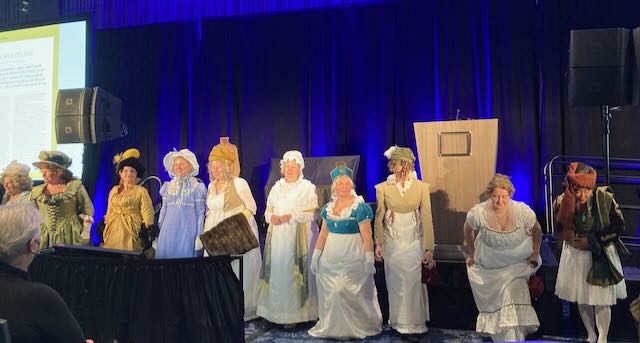
Regency dress is required for certain events—balls and promenades—but optional for others. For most events, some people dressed up, others didn’t. I was impressed that many people wore their Regency clothes around Bath all week long. I wasn’t quite that dedicated, myself. I did get great ideas for new outfits, though.
If you attended the Festival this year or in previous years, please tell us what your favorite events were.
“I have seen nobody in London yet with such a long chin as Dr Syntax” (Jane Austen, March 2, 1814).
I just finished reading, cover to cover, a brand-new book which is over 200 years old. The Tour of Doctor Syntax in Search of the Picturesque, by William Combe, is a classic which Jane Austen herself enjoyed. But it’s out in a new edition, with wonderful illustrations, explanations, and comments.
A fun new annotated version of The Tour of Doctor Syntax, including parallels with Jane Austen’s novels!
The story in verse was first published from 1809-1811 as a series in Ackermann’s Poetical Magazine. Ackermann had a series of prints by the great caricaturist Thomas Rowlandson. They featured a country clergyman with a long pointed chin and a tall white wig traveling through the countryside. Ackermann gave Combe the illustrations for each issue of the magazine, and Combe wrote a section of the story to go with them. He didn’t know ahead of time what the pictures would be for the next issue, but somehow he came up with a coherent story. One interesting facet is that Rowlandson apparently intended to satirize the clergy, but Combe made Syntax into a good, learned man, a little silly, but lovable.
A book version came out in 1812. Dr. Syntax was wildly popular and stayed in print, with multiple printings and editions, well into the 1800s.
This new version of The Tour of Doctor Syntax was edited and annotated by an advanced high school class and their professor, Dr. Ben Wiebracht. Ben actually discovered Dr. Syntax through one of my posts right here at Jane Austen’s World. Recognizing its potential for his class on “Jane Austen and Her World,” he asked Vic Sanborn, owner and primary writer of this website, and myself, to share with his class. Vic owns some lovely Rowlandson prints. We both loved connecting with such bright and interested students, who asked knowledgeable questions.
The Book
They’ve done a brilliant job with the book. It starts with a biography of William Combe and the history of the book itself. Combe’s challenges as a writer in Austen’s age were fascinating to me, as a writer myself. A clear introduction explains “the picturesque,” which is mentioned in Austen’s novels. Parallel to the text are straightforward explanations of difficult terms and phrases. That makes them easy to quickly reference. A glossary in the back gives terms previously defined.
The best part, for me, are comments pointing out parallels with Jane Austen’s work. I can’t even begin to list these, but there are many great insights. Some are about the clergy in Austen’s work, since Syntax is an underpaid country curate like Charles Hayter of Persuasion. Many comments have to do with the “picturesque,” “improvement” and country estates ranging from Sotherton to Pemberley. Others relate to the class system, Gothic novels, and other topics.
The full text of the poem/story is opposite explanations, comments, and illustrations, making them easy to access. The Tour of Doctor Syntax, 2024.
“Doctor Syntax Tumbling into the Lake,” by Thomas Rowlandson. One of the lovely full-page illustrations for this new version of The Tour of Doctor Syntax.
Victorian illustration, 1838, of the same scene, by Alfred Crowquill. The Tour of Doctor Syntax includes both the Rowlandson and Crowquill illustrations.
I also loved the illustrations. The editors chose the best versions they could find of each of the full-page, hand-colored pictures by Rowlandson that were the basis of the book. They added illustrations from a later Victorian version, as well as other entertaining and illuminating cartoons and pictures from the time.
Interview with the Editor
I’ll let Dr. Wiebracht himself tell you more about how this book came about.
Ben, please tell me about your class that produced this book.
The class is called “Jane Austen and Her World” and it’s designed for advanced juniors and seniors. The goal is to see Austen’s novels not as sealed-off masterpieces, floating in a historical vacuum, but as windows into her world. Most class days, our Austen reading is accompanied by shorter texts designed to create a sense of context and show how Austen was in conversation with her contemporaries. For instance:
We pair Austen’s account of Bath in Northanger Abbey with a number of late 18th-c. satires of Bath, 18th-c. dance music, and illustrations of the city by Rowlandson and others.
We pair Catherine’s pseudo-Gothic adventures in Vol. II with excerpts from The Monk, The Castle of Otranto, and The Mysteries of Udolpho.
We pair the private theatricals in Mansfield Park with a viewing of a performance of Lover’s Vows, as well as specimens of anti-theatrical criticism from the period, including a satire on private theatricals by Jane’s brothers!
We pair the discussion of landscape gardening in Mansfield Park with images from Humphry Repton’s famous “red books” showing “before and after” estate grounds.
The idea is to understand Austen in a deeper way by developing the practice of “reading outward.” And we incorporate that principle in our work for the class. Instead of the usual school essays, students work with me to create a critical edition of a neglected text from Austen’s time, with annotations and other resources that draw connections between the text and Austen’s life and work.
The class enrolled 16 students (the maximum). They hailed from all over the country and world: Japan, China, and many different U.S. states. This was my first time teaching the course, though I developed the core ideas in an Austen unit for a previous course. In the future, I will probably teach the course every three years. The book project in particular is a heavy lift, and I’m not capable of it every year!
How did you end up studying Dr. Syntax along with Jane Austen?
I have to back up a bit here. In the course of an Austen unit for a previous class, students and I had created a critical edition of a long-forgotten 1795 poem called Bath: An Adumbration in Rhyme. We used that book to launch a new series called “Forgotten Contemporaries of Jane Austen.” Its goals are:
to recover neglected but valuable texts from Austen’s time, and
to trace new connections between Austen and her contemporaries.
As I was preparing my Austen class, I settled on Doctor Syntax (first brought to my attention in JAW by one of your articles!) for three reasons.
First, the poem had undeniable literary-historical importance – one of the all-out bestsellers of the Regency. A critical edition, I thought, was long overdue.
Second, many of its themes – from the plight of poor clergy to the “picturesque” – were major concerns of Austen’s novels, too.
Finally, the poem was simply a really good read. Combe’s verses are light, fun, and at times even touching, and Rowlandson’s accompanying illustrations are some of his best work. In every way, the poem deserved to be revived!
What do you hope readers will gain from the book?
There are a lot of things I hope people take away! One would be a deeper appreciation of just how engaged Austen was in the debates and issues of her day. Sometimes Austen is talked about as something of a provincial writer, sealed off from the wider Regency world, modestly toiling away on her “pictures of domestic life in country villages,” as she once put it. But when we keep in mind just how much of a smash hit Doctor Syntax was, and when we consider the many, many parallels between this work and Austen’s novels, which our edition lays out in detail, then we see Austen differently. She now starts looking like a very savvy writer, who understood what the major issues of the day were, what readers were interested in. To be sure, she stuck to her convictions and drew on her own experience and observations, but she did so in a way designed to appeal to a broad, national readership.
I’m also excited for people to meet this poet William Combe, who had one of the most interesting lives of any Regency writer. He was a remarkable literary talent. He doesn’t fit the mold of the “Romantic poet,” which is one reason he might be overlooked. Instead he offers a light, generous humor that shows us that Regency poetry wasn’t all about Byronic heroes and Wordsworthian dreamers. There was a sociable, comic side to the poetry of the period. Combe represents that comic side particularly well.
Finally, I would love it if this book inspired other teacher-scholars to undertake collaborative research with their students – especially at the upper-high-school level. There are so many benefits. For students, it’s a more rewarding and enjoyable approach to literary scholarship than the usual school essays. For teachers, it’s a welcome relief from the role of “judge/grader” – instead you get to teach through co-creation, as is done in most trades through the apprenticeship model. And for the reading public, there’s the benefit of the work produced! I am convinced that student involvement, with the right guidance and leadership from the teacher, leads to better scholarship. It certainly has in my experience.
By the way, while we don’t offer a Kindle edition, we do offer a free etext in the form of a downloadable PDF on our website. We decided from the beginning to be an open-access publisher, in part to make it easier for teachers with low-income students to assign our books. The best way to use the e-text is to enable the 2-page view in your pdf reader – that way the text and notes are neatly parallel, as in the physical book. The etext can also be used as a supplement to the physical book – for instance if you want to do a text search for a particular word.
How did you and the students share the work on this project?
Each student was responsible to annotate one of the poem’s 26 cantos, about ten pages of text. I did the other ten cantos myself. Students also had one or more additional responsibilities, which included:
Researching aspects of Combe’s life
Researching Gilpin and the picturesque
Compiling chronologies
Drawing maps
Designing the cover
Editing the text according to scholarly standards
My job was twofold. First, I offered regular feedback on work in progress, helping students learn how to navigate library databases, write good, concise annotations, etc. I also did the parts of the book that were a bit beyond the reach of high-school students, even excellent ones, which all the students who worked on this book were! For example, I wrote most of the introductory materials, as well as some of the trickier annotations. I helped with the final prose, too, to ensure continuity of voice. That doesn’t mean, though, that the best stuff is mine. Many of the best, most insightful annotations in the book are entirely by students, and every one of my students has some of their own writing, their own voice in the final book – which was a major priority for me. And just as students benefited from my feedback, I benefitted from theirs. They fully earned their editor credits in the final book.
Final Thoughts
Dr. Wiebracht and his class did an amazing job. I highly recommend this book, which is available on Amazon and from Jane Austen Books at a discount. I have not yet read the earlier book in the series, Bath: An Adumbration in Rhyme, but now I want to get hold of that and read it, too!
If you’re at the JASNA AGM this month, you can hear Ben and some of his students speak, and get them to sign your copy of the book. (Unfortunately I’m speaking in a slot opposite theirs, as well as other excellent speakers at that time, so you’ll have to choose! It’s always challenging.) Their talk is also available in the virtual version of the AGM.
The price is very reasonable for a book with color illustrations. I hope you’ll get a chance to enjoy and learn from this lovely book!
Fashionable Goodness: Christianity in Jane Austen's England is now available! By JAW contributor Brenda S. Cox. See Review. Available from Amazon and Jane Austen Books.
Available through December 31st, 2025. Click on image for details, and share this poster with other teachers and students!
The Obituary of Charlotte Collins by Andrew Capes
Click on image to read the story.
Comments
“My idea of good company…is the company of clever, well-informed people, who have a great deal of conversation.” – Jane Austen, Persuasion
Gentle readers: Please feel free to post your comments and continue the conversation! Due to SPAM, we will no longer accept comments on posts after 30 days of publication. In some instances, links will be removed from comments as well.
Administrators and Contributors
Vic Sanborn, founder of this blog, is supported by a team of talented and knowledgeable writers about Jane Austen and the Regency era. They are:
Tony Grant, who now contributes his photos from London and England
Click on their names to enter their own blogs.
In addition, we thank the many experts and authors who frequently contribute their posts and opinions, and who continue to do so freely or at our request.
Click here to enter the page. Topics include Regency fashion, historic foods, Jane Austen societies, British sites, related topics. Click on image.
May we suggest?
Hello, my name is Vic and I live in Maryland, USA. I have adored Jane Austen almost all of my life. I am a proud lifetime member of the Jane Austen Society of North America. This blog is a personal blog written and edited by me and my team. We do not accept any form of cash advertising, sponsorship, or paid topic insertions. However, we do accept and keep books and CDs to review.
If you would like to share a new site, or point out an error, please email us. (Yes, we are fallible. We'll own up to our mistakes and will make the corrections with a polite smile on our faces.) Write us at
Thank you for visiting this blog. Your comments and suggestions are most welcome.
Project Gutenberg: eBook of Stage-coach and Mail in Days of Yore, Volume 2 (of 2), by Charles G. Harper
STAGE-COACH AND MAIL IN DAYS OF YORE: A PICTURESQUE HISTORY
OF THE COACHING AGE, VOL. II, By CHARLES G. HARPER. 1903. Click on this link.