Feeds:
Posts
Comments

Archive for the ‘Jane Austen’s World’ Category

The valet (rhymes with pallet) is a personal manservant who tends to his master’s every need, from a clean room to seeing to his clothes to making sure that his entire day goes smoothly from the moment he rises to the time he goes to bed. Also known as a gentleman’s gentleman, the valet is the closest male equivalent to a lady’s maid.

Mr. Darcy (Colin Firth) dresses with the help of his valet, who stands ready to put on his coat. In this scene, Mr. Darcy changes his mind and chooses another coat before visiting Elizabeth at the inn. Image @Pride and Prejudice, 1995

Mrs. Beeton describes a valet’s duties in her excellent 1861 book on household management:

His day commences by seeing that his master’s dressing-room is in order; that the housemaid has swept and dusted it properly; that the fire is lighted and burns cheerfully; and some time before his master is expected, he will do well to throw up the sash [open the window] to admit fresh air, closing it, however, in time to recover the temperature which he knows hismaster prefers. It is now his duty to place the body-linen on the horse before the fire, to be aired properly;

Edwardian clothes horse. Image @Denhams.com

to lay the trousers intended to be worn, carefully brushed and cleaned, on the back of his master’s chair; while the coat and waistcoat, carefully brushed and folded, and the collar cleaned, are laid in their place ready to be put on when required. All the articles of the toilet should be in their places, the razors properly set and stropped, and hot water ready for use.

Barry Lyndon (Ryan O’Neal). While the master shaves, his footmen assist him, making sure his implements are at hand. His valet would have overseen the arrangements and will sharpen the razor and clean the shaving brush after Barry has finished shaving. Image @Barry Lyndon

Gentlemen generally prefer performing the operation of shaving themselves, but a valet should be prepared to do it if required; and he should be a good hairdresser. Shaving over, he has to brush the hair, beard and moustache, where that appendage is encouraged, arranging the whole simply and gracefully, according to the age and style of the countenance. Every fortnight, or three weeks at the utmost, the hair should be cut, and the points of the whiskers trimmed as often as required. A good valet will now present the various articles of the toilet as they are wanted; afterwards, the body-linen. Neck-tie, which he will put on, if required, and, afterwards, waist-coat, coat, and boots, in suitable order, and carefully brushed and polished.”

Other valet duties:

Ian Kelly (Brummel) and Ryan Early in Beau Brummel (2006 play)

  • As his master goes out, the valet hands him his gloves and hat, opens the door for him, and receives his orders for the rest of the day.
  • He puts his master’s dressing-room in order, cleaning combs and brushes, folding clothes and putting them in drawers.
  • If his master has no clothes sense, the valet will select suitable clothes, making sure they are clean, particularly the collars, and maintained in good repair.
  • He consults with the tailor, perfumer, and linen-draper.
  • He awaits his master’s return, making sure that his drawing room is picked up by the maids, and dusted and swept by them, and that the room is made ready with a lit fire and candles.
Credit: Courtesy of © Carnival Film & Television Limited 2012 for MASTERPIECE

Bates (Brendan Coyle) assists Lord Grantham (Hugh Bonneville) in Downton Abbey. A valet and his master become close over the years. Image @Downton Chaser

  • The valet stands ready to help his master dress for dinner or any other occasion.
  • He makes sure that the washing table is ready, filling the ewer and carafe with fresh water, and placing the basin towels, brushes, hot water, and shaving apparatus near at hand.
  • In case of wet weather, when his master has returned from riding, the valet lays out a change of dry linen and clothing, and is ready to assist his master out of the damp clothing.
  • He helps his master prepare for journeys, packing enough linen and other clothing for the trip. At the Inns, he takes charge of his master’s comfort as he would at home, and has everything ready to assist his master in dressing and undressing.
  • If no footmen is available during the journey, the valet will also see to these services, even at table.
Bates at the moment he is informed that he must leave Lord Grantham's service. Despite their long association, it was imperative that a valet was physically capable of performing all his duties, including standing in as footman when the occasion required. Bates' reliance on a cane prevented him from carrying a tray. (We all have learned that Lord Grantham is a softie and kept Bates on.) Credit: Courtesy of © Carnival Film & Television Limited 2012 for MASTERPIECE

Bates at the moment he is informed that he must leave Lord Grantham’s service. Despite their long association, it was imperative that a valet was physically capable of performing all his duties, including standing in as footman when the occasion required. Bates’ reliance on a cane prevented him from carrying a tray. (We all have learned that Lord Grantham is a softie and kept Bates on.) Credit: Courtesy of © Carnival Film & Television Limited 2012 for MASTERPIECE

The valet keeps his master’s clothes in good repair:

  • Hats are kept well brushed on the outside with a soft brush, and wiped inside with a clean handerchief.
  • Clothes placed in a wardrobe are covered with brown holland or linen wrappers to secure them from dust.
  • He places boots and shoes cleaned by the under footman in the dressing room.
  • Slippers are aired by the fire.
  • As soon as his master finishes shaving, the valet will clean the razor and brushes.
  • Before he hangs damp clothing by the fire, he rubs the cloth with a sponge until the smoothness of the nap is restored. If the clothes are allowed to dry before brushing, then later brushing might not remove the roughness.
Credit: Courtesy of © Carnival Film & Television Limited 2012 for MASTERPIECE

In Downton Abbey, Matthew resists Molesley’s services, causing an undue amount of stress to the butler, who also acts as his valet. Credit: Courtesy of © Nick Wall/Carnival Film & Television Limited 2012 for MASTERPIECE

Valets in humbler households:

The butler in a second or third rate establishment takes on the duties of the house steward, valet, and footman as well. He is likely to pay market bills, assist his master in dressing, serve at table and oversee the wine and silver, and superintend other male servants.

Sources:

Read Full Post »

Tea is always served by the host/hostess or a friend, never by servants. Tea is never poured out, then passed several cups at a time, the way coffee may be, because it cools very quickly. Instead, it is always taken by the guest directly from the hands of the pourer.” – Etiquette Scholar

The ceremony of making tea is almost always included in costume dramas like Downton Abbey or a Jane Austen film, such as Emma. When Maggie Smith as the Dowager Countess of Grantham invited her daughter-in-law, Cora (Elizabeth McGovern), to the Dower House for tea in Downton Abbey, the arranged time was most likely at four o’clock in the afternoon.


Cora and the Dowager Countess sit down to tea

In one particular scene, the two women entered the drawing room in which a small table had been laid out with an elaborate tea set, fine china, and silver spoons. An assortment of tiny sandwiches, cookies, and scones were arranged upon a beautiful batttenburg lace tablecloth that covered the table. Low tea (an Edwardian dowager would never have said high tea) was meant to blunt the appetite before dinner.

The duchess pours boiling water over the tea leaves in the tea pot

A tea ceremony provided an intimate setting between the hostess and her guests, for it was the hostess who prepared and served the tea, catering to each guest and handing them their custom-prepared tea one cup at a time. In this time honored ritual, one of the most important questions the dowager would ask was: “Would you care for weak tea or strong tea?” Cora’s preference would guide the Countess in the next stage of tea preparation, for if she said “strong tea,” then the Dowager would pour the tea as she had prepared it into Cora’s cup. Had Cora said “weak tea”, the Countess would pour a smaller quantitiy of the brew into the china cup, then top it off with hot water.

Cora eats a crustless sandwich as her mother-in-law prepares the tea

The Dowager would then ask her guest how much milk and sugar to add. She would have poured boiling water over the tea leaves in a tea pot, and steeped the leaves for three minutes, all the while conversing with her guests. At this point the water was no longer boiling. Then the Countess would pour in the milk. (If she poured it in first, she would have found it difficult to judge the strength of the tea by its color.) Hudson, the butler in Upstairs, Downstairs, said about pouring milk into tea: “Those of us downstairs put the milk in first, while those upstairs put the milk in last.”

In this instance, the Dowager leaves her guest in the middle of serving tea, a faux pas

History of Low Tea

On September 25, 1660, Samuel Pepys recorded: “did send for a cupp of tee (a China drink) of which I had never drank before.” By June 1667, tea was considered to be a healthy drink. One day Pepys arrived home to find his wife making tea, which his apothecary had found good for her cold.

Emma, 1996 (with Kate Beckinsale). Emma and Harriet drink tea during Mrs. Elton's first visit

Samuel Johnson was a self-described “hardened and shameless tea drinker, who has, for twenty years diluted his meals with only the infusion of this fascinating plant; whose kettle has scarcely time to cool; who with tea muses the evening, with tea solaces the midnight, and with tea welcomes the morning.” His chronicler James Boswell observed that “It was perfectly normal for him to drink sixteen cups in very quick succession, and I suppose no person ever enjoyed with more relisht the infusion of that fragrant leaf than did Johnson.”

Silver tea set by Odiot, Paris, circa 1880. Image @A.Pash and Sons, Mayfair

Until the 1760’s, only the rich could afford teapots, which were made of silver. Then in 1765 Queen Charlotte commissioned Josiah Wedgwood to create a tea service made from his quality cream colored earthenware, which he named Queen’s Ware (with the Queen’s permission, of course) and gave to her as a gift. From that moment on he was the Queen’s potter. Wedgwood’s creamware was thin, attractive and durable. After receiving the Queen’s patronage, his firm became quite famous. The attractive new tableware quickly became popular, and by 1775 other manufacturers, including those on the Continent, had widely copied Wedgwood, imitating Queensware and creating increasingly fanciful teapots. It is said that this tableware was instrumental in spreading the popularity of tea.

Wedgwood Queensware, c. 1790. Image @Christies

In 1840, the Duchess of Bedford began serving tea with refreshments in the afternoon to appease her appetite before dinner, and the custom of afternoon tea, or low tea, took off. To read more about drinking tea between the 18th and mid-19th centuries, read my post about Tea in the Regency Era.

Some interesting facts about tea:

  • Notice, this is a change: The difference between high tea and low tea: Low, or afternoon, tea is served at four o’clock with light snacks, such as sandwiches, cookies, and scones. High tea is a full meal served with tea, including meat, bread, side dishes and dessert on a table of regular height. Hence high tea.

16th century tea bowl, Korea

  • Tea cups at first were fashioned after Chinese bowls without handles or saucers. In the mid 1750-s, a handle was added to prevent ladies from burning their fingers.
  • A saucer was once a small dish for sauce. During the Dowager Countess’s day, it was acceptable to pour tea into a cup’s saucer to cool the beverage before drinking it.
  • In the late 17th century, a lady would lay her spoon across the top of her cup to signal that she was through drinking. Other signals included turning the cup upside down, or tapping the spoon against the side of the cup.
  • Filling the cup with tea almost to the rim is considered a faux pas.

"Might I give you this cup?" The Dowager hands her tea to Moseley while visiting Matthew Crawley.

Sources:

Read Full Post »


Thomas Lawrence Exhibit, National Portrait Gallery, London. Image @Tony Grant

Gentle readers, if you are lucky enough to be near London you have only a few days to see the exhibit at the National Portait Gallery of the splendid painter, Thomas Lawrence. This is Tony Grant’s (London Calling) review of the show.

On entering the exhibition you are met with the bright gaze from a young Thomas Lawrence.

Self Portrait, Sir Thomas Lawrence, 1788 Image @PRA

Under the title of the exhibition, “Regency Power & Brilliance,” hangs a self-portrait, of oil on canvas, completed in the years 1787 – 1786 when Lawrence was 19 years of age. It is typical of Lawrence’s style that it is new and innovative for it’s time. Lawrence is sitting with his body facing to the right and his head turned to look at you the viewer over his right shoulder. The stare is steady, confident and penetrating. His face is almost illuminated and glows brightly out of the picture.


Bristol in the 18th century

Thomas Lawrence was the leading portrait artist of the Regency period. Born in 1769 at 6 Redcross Street, Bristol, he came from a humble background. His father was also called Thomas Lawrence and his mother was Lucy Read, the daughter of a clergyman. Thomas’s father had several jobs, including innkeeper at the White Lion in Bristol. Later became the innkeeper of the Black Bear in Devizes where famous writers and artists, including David Garrick the actor and theatre owner, on their way to Bath, would stay. The young Thomas Lawrence would meet them.

Devices Heritage .orgThe Black Bear in Devices

Thomas was the entertainment in the inn. He would recite poetry and use his natural talent for sketching people to amuse and interest them. When the senior Lawrence became bankrupt, the family moved to Bath where the younger Thomas Lawrence took over being the breadwinner for the family by selling his sketches and miniature oval portraits in pastel and chalk. Some of the wealthy people in Bath commissioned his work. From an early age Thomas had had prodigious natural talents for sketching and reciting poetry. Wealthy people allowed him to study their collections of paintings and Lawrence’s drawing of a copy of Raphael’s Transfiguration was awarded a silver gilt palette and a prize of 5 guineas by the Society of Arts in London. In 1787 he moved to London where he was introduced to Joshua Reynolds. He started exhibiting at the Royal Academy exhibitions held at Somerset House and his career took off.

Royal Academy at Somerset House, Viewing Art, Rowlandson

The period in history that Lawrence came to prominence was also to have an affect on his development as an artist. There was much turmoil and political change. There was The French Revolution and the long wars against France. Once these came to an end, Thomas was able to travel across Europe. He did this commissioned by the Prince Regent, later George IV. He was able to make portraits of many of the great names of the time – generals, Emperors and the Pope. On his return from Europe in 1820 he was elected as the president of the Royal Academy and produced some of the best portraits of the time. Unexpectedly he died in January 1830 and was honoured with a state funeral.

What is evident in this exhibition is Lawrence’s original ideas, his naturalism and his particular use of colours.

Elizabeth Farrren, Thomas Lawrence. Image @Met Museum

One of his early portraits, when he had only begun his career in London in 1790, was of Elizabeth Farren. He was only 21 at the time and this particular portrait attracted peoples interest. It shows a full length portrait of a slender, beautiful young girl caught in the act of walking through a rural landscape of trees and pathways with her dizzy blond head high in the dramatic surroundings of a stormy sky and dressed in a shimmering three quarter length white silk shawl over a long white gauze like garment. With this portrait and with all the others in the exhibition, for all the costume, dress and surroundings they might have, what always stands out, like an illuminated beacon, is the face of the person in the portrait. This is the most important part. It shows the persons character, and personality. Elizabeth has pale smooth skin, bright red lips and eyes that smile at you the viewer.


Emilia, Lady Cahir, later Countess of Glengall, Thomas Lawrence

What is evident with all the pictures in this exhibition is that when you are standing looking at one of these portraits, no matter how many other people there are in the gallery, it’s just the two of you. You could almost have a conversation together. The paintings certainly allow you to relate to them in a very personal way. I think this is true of all of Thomas’s portraits. Many of the portraits of beautiful young women, as with the Elisabeth Farron portrait, show them, young, always beautiful but often unmarried. The full title to this particular portrait is, Elizabeth Farron, later Countess of Derby. There are a lot of portraits with the name and then the phrase,.. “later the duchess of…” appended to the end. These portraits must have served an important part of the marriage trade. I certainly felt my blood rising at the sight of some of these beauties.

Three Colleagues, Thomas Lawrence

Thomas Lawrence showed great originality. One of his portraits of 1806, of Sir Francis Baring, John Baring, his brother and Charles wall, shows three businessmen contemplating business. It’s extraordinary. They have their work set out in front of them spread on a table and they are planning, scheming, thinking, working things out. It is an action packed picture. Although they are not walking or physically moving anywhere in the picture, things are happening, great decisions are being made right there in front of you. The different angles and poise of each character is quite disconcerting at first. It is not smooth and elegant. It shows action of thought, creativity and influence.


Charles William Vane Stewart, 3rd Marquess of Londonderry

Another thing I noticed and it became a quest for me to find in each portrait throughout the exhibition, was Lawrence’s use of the three colours red, white and black. At first I thought, why would he include these in every picture he painted. They do create very dramatic atmospheres. The Elizabeth Farron portrait has bright red lips, masses of white in her dress and one small pitch black shoe poking from under the hem of her dress but many of the other portraits have great swathes of each of these three colours.


Arthur Atherley, Thomas Lawrence

The title of the exhibition is, “Regency Power and Brilliance.” Lawrence paints many of the leading figures of that period from right across Europe. You might think, well how does the power bit enter into portraits of individuals? If you want to see ultimate overarching power embodied in an individual human being you only have to look at the faces in Lawrence’s portraits. All the men show this in their eyes, their demeanour. One small room in the gallery has three portraits of three different men. Arthur Atherley is a youth of about twenty who has just left Eton College, one of the top public schools. He is shown in 1792. The next shows Robert Banks Jenkinson 2nd Earl of Liverpool. This one is painted when the sitter was in his late twenties.


Robert Banks Jenkinson, 2nd Earl of Liverpool

The final picture shows, Edward Thurlow, Baron Thurlow. It was painted in 1802 when he was in his early seventies and he had retired. They are the different stages of a mans life. Arthur Atherley has a precocious energy, a steady stare revealing a sense of utter belief in his powers and where and what he is about to achieve in life. There is no swerving of thought or doubt. He is totally assured of his position and power in life. It’s quite unnerving to see this unwavering belief looking you right in the eye especially from somebody so young. I kept coming back to this portrait. He has long luxurious black hair, a bright red ornate coat and a bright luminous white neckerchief. The three colours work in a very dramatic way in this picture. Robert Banks is a thin spider like creature, slightly twisted and turning his face towards you from the picture, dressed in black from head to foot. A white pale face looking straight at you, looking into your very soul. He looks full of energy. He wants to get things done with his rolls of documents before him. His personality is like a force of nature almost leaping out of the portrait at you. He can get things done. No doubt about that.

Baron Thurlow, Thomas Lawrence

Finally Edward Thurlow, at first looks, benign, very pleasant and friendly and almost smiling but the eyes are piercing and forceful. He is friendly but you couldn’t cross him. He wants talent, imagination, achievement and hard work from anybody who works for him. The three portraits, although of different people, could almost be the same person at different times of their life. In that small room in the gallery it’s quite an encounter. You could almost feel, coming away, that you have been for a tough penetrating job interview.


Master Lambton, Thomas Lawrence

Lawrence’s women fall into various categories. He obviously liked women and children too. There are quite a few pictures showing children. The children are active, playing, interacting, sometimes in a precocious way towards their mother or father in the pictures. He shows real children, not posed children.

Mrs. Jens (Isabella) Wolff, Thomas Lawrence

His friend Isabella Wolf, who may have been his lover, is shown in two portraits. He drew and painted her over many years. The painting of her done in 1803 shows her examining some Michaelangelo prints. She was also separated from her husband. So this picture shows an intellectually curious women who also has broken the bounds of society in her personal life. There are also portraits of Queen Charlotte and Princess Sophia. Royalty is a theme that runs through the exhibition.


John, Lord Mountstuart, Thomas Lawrence

The picture that is most controversial is that of John, Lord Mountstuart.. He was a young politician and had lived in Spain for a while because he was the son of Britain’s ambassador to Spain. Lawrence painted him in 1795 when he had just returned from Spain. In many ways the picture is shocking. It is a full-length, life size portrait. It is hung so that at eye level you are confronted by a pair of very muscular legs showing all the muscular contours sheathed in very tight black leggings. As you look up you are confronted by a rather large black shining bulge in the crotch area. The top half of his body is swathed dramatically in a swirling fur trimmed embroidered black cloak with a dark jowelled, bright eyed, ruddy cheeked quite beautiful face surmounting the whole confection. It is a very erotic picture to say the least. It has lead to questions about Thomas Lawrence’s sexuality. But if you took one of his female portraits, almost any of them, you can say the same thing. Sensuality and a slight erotic air pervade many of Lawrence’s pictures.


George IV when Prince of Wales, Thomas Lawrence

There are fifty-four pictures in this exhibition and each of the people portrayed in them are a delight to be with and a pleasure to spend time with. Some other characters you may care to come across are Arthur Wellesley, The Duke of Wellington, King George IV as King and also as Prince Regent, Field Marshall Blucher, who lead the Prussian forces who pursued Napoleon, Charles, the Archduke of Austria and Pope Pius VII and many more delightful and very interesting people.

Pope Pius VII, Thomas Lawrence

I have tried to give you a taste and flavour of this exhibition. (Click here to see a PDF document of more paintings in the exhibit.) It is not something you can grade from good to bad, give a level to, say you must see it, or not see it, or apply any subjective or objective assessment like that. What I can say though, if you do get a chance to see it, be prepared to meet real people face to face in those portraits. You will have some very interesting encounters along the way. You will learn something about power, personality, individual characters and yes, brilliance.

Read Full Post »

Lady Sarah Jersey

Gentle Readers: In my sidebar I call myself an amateur historian, an apt term as this post will attest. I try to quote from older sources, but this can sometimes backfire. Captain Gronow, for example, whose words I quoted for this post via John Ashton (1890) and Lewis Saul Benjamin (1909), wrote down his memories about the Regency era in 1863, a half century after the events occurred.  Gronow’s memory, unfortunately, was faulty in a few particulars, especially in recalling the names of the patronesses of Almack’s in 1814, and why they turned the Duke of Wellington away. I have placed a number of updates in the original post.

Any individual who has read a novel set in Regency England knows about the assembly rooms at Almack’s and the club’s exclusivity. While Almack’s was notorious for its stale refreshments and thin lemonade in the supper room, the Beau Monde never minded, for the idea was to hob nob with the right people, trot out one’s eligible daughters, and make the best marriages possible given their dowries and family connections. Looks and a personality had very little to do with a young lady’s success in her first season OUT, but a pleasing countenance matched with a fortune would swiftly speed up the unification of great estates or the purchase of a worthy title.

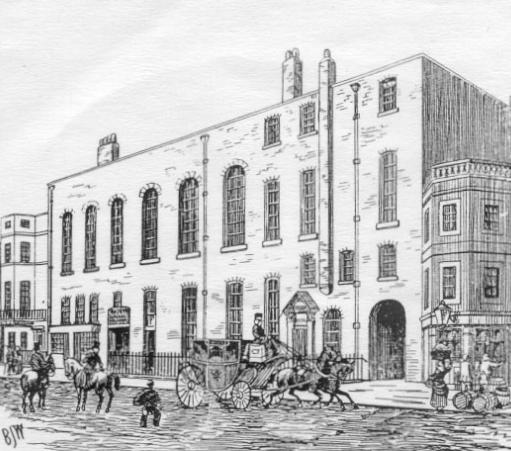
Almack's, Pall Mall, opened in 1765

The Patronesses of Almack’s guarded entry to the club like Valkeries prepared to do battle. No one, not even the Duke of Wellington, would dare to step a foot inside the establishment without a proper voucher, and, indeed, he was turned away once for wearing *gasp* trousers instead of knee breeches. But is this true? Please keep on reading.

This passage from Social England Under the Regency by John Ashton (p 383) is quite telling:

*The Duke of Wellington

Of course the Creme de la creme went to Almack’s, but numberless were the Peris who sighed to enter that Paradise, and could not. Capt. Gronow, writing of 1814, says: “At the present time one can hardly conceive the importance which was attached to getting admission to Almack’s, the seventh heaven of the fashionable world. Of the three hundred officers of the Foot Guards, not more than half a dozen were honoured with vouchers of admission to this exclusive temple of the beau monde, the gates of which were guarded by lady patronesses whose smiles or frowns consigned men and women to happiness or despair. These lady patronesses were the Ladies Castlereagh, Jersey, Cowper, and Sefton; … and the Countess Lieven.” (Note: At that time, two other patronesses included Lady Downshire and Lady Bathurst.)

Cruikshank, Longitude (Countess Lieven) and Latitude (in capri-length pantaloons) at Almack's.

In a Newspaper of May 12, 1817, we read – “The rigorous rule of entry established at Almack’s Rooms produced a curious incident at the last Ball – The Marquis and Marchioness of W__r, the Marchioness of T__, Lady Charlotte C__ and her daughter, had all been so imprudent as to come to the rooms without tickets, and though so intimately known to the Lady Managers, and so perfectly unexceptionable, they were politely requested to withdraw, and accordingly they all submitted to the injunction. Again at the beginning of the season of 1819, we find these female tyrants issuing the following ukase: “An order has been issued, we understand, by the Lady Patronesses of Almack’s, to prevent the admission of Gentlemen in Trowsers and Cossacks to the balls on Wednesdays, at the same time allowing an exception to those Gentlemen who may be knock kneed or otherwise deformed.” But the male sex were equal to the occasion as we find in the following lines: –

TO THE LADY PATRONESSES OF ALMACK’S

Tired of our trousers are ye grown?

But since to them your anger reaches,

Is it because tis so well known

You always love to wear the breeches.

*Image from Highest Life in London: Tom and Jerry Sporting a Toe among the Corinthians at Almack's in the West, by I. Robert and George Cruikshank, 1821

Update:  Regency Researcher, Nancy Mayer, was kind enough to contact me and set a few facts straight. I have placed her explanations in the update/update below. In the above image, the young bucks are wearing dark suits with dark, close-fitted trousers (Beau Brummel’s influence), while the older men are still in buff-colored knee breeches.

If anyone knows the true story about the Duke and his trousers, please contact me. One conjecture is that Wellington was turned away for arriving after midnight. (Read more about the Patronesses’ edict on trousers in this link to The Beaux of the Regency, Vol. 1.)

Update/Update: Pantaloons, which fitted snug to the leg, came in two lengths: capri and long. A strap under the foot kept long pantaloons in place. (The image below shows the strap.) Thus, the men in the image above were wearing tight pantaloons, for trousers at the time were slightly looser and would have sported gussets that extended the fabric low over the shoe.

Pantaloons with straps, 1821. Image @Republic of Pemberley

In 1814, the date Gronow recollected, trousers (below) were acceptable for day wear only. Pantaloons were worn as evening wear.

Nancy Mayer, a Regency researcher who provided much of the updated information, wrote in a second note: “Luttrell’s poem on Almack’s was published around 1819. According to the verse about the “trowsers”, I think trousers didn’t become an issue until after 1817, at least. Sometimes it is hard to tell if the men are wearing trousers or the longer pantaloons with the strap under the foot. Most of the Lords in the picture of the Trial of Queen Caroline 1820 are wearing trousers or the long pantaloons.”


Trouser with gussets, day wear, 1813

More on the topic:

*Images: Carolyn McDowell

Read Full Post »

Copright @Jane Austen’s World. Written by Tony Grant, London Calling

Two of the greatest writers of the late 18th century and early 19th century were Jane Austen and William Wordsworth. We think we know Jane Austen’s primary influences and encouragement in her writing. They are found amongst the members of her family, the villages, towns and great houses she visited constantly near where she lived and the people she interacted with in those diverse places. She was a keen observer and knew them all intimately. Claire Tomalin in her biography, “Jane Austen, A life,” says that Jane wrote

“… tightly constructed stories that cover a short span of time…….Jane Austen also chose to write about small families.”

Dorothy Wordsworth

About, 250 miles north, there lived a young lady called Dorothy Wordsworth. She was a little older than Jane by five years. Dorothy’s brother was William Wordsworth and for a while they lived together in a tiny cottage they called Dove Cottage set in the wild and desolate scenery of The Lake District. Dorothy and William Wordsworth wrote about their emotional and intellectual response to nature and the landscape around them. While living at Dove Cottage in the Lake District, Dorothy was the muse, support, encourager and inspiration for her brother.

Dove Cottage, Grasmere. Image @Tony Grant

William often read Dorothy’s journal and drew inspiration for his poems from it.
We might ask why and how did these two writers have such different responses to the world about them?

Jane Austen by Cassandra Austen

Jane was born into a lively and vibrant family of six brothers and one sister. It was a boisterous environment and aunts, uncles and neighbours were an additional group of relationships that were there, interested and ready to be involved with the new addition to the family. Family life was paramount in Jane’s existence from the start. All her senses were filled with it. Reading Gilbert Whites journals and letters makes us aware of the rich natural world all around her in her Hampshire village of Steventon, but although Jane would have been brought up in this natural environment, and she would have taken notice and interest in it, the life of family was the overriding power that carried her along. And so from an early start her environment filled her thoughts feelings and imagination. Claire Tomalin reminds us that,

“Not only was she one of eight, she lived with a perpetual awareness of a cousinage extending over many counties and even beyond England.”

Some examples of her writing show the intensity with which she was concerned with conversation and relationships as her primary focus. In Persuasion, the little Dorset coastal port of Lyme Regis plays a major role. In a letter to Cassandra written on Friday 14th, September, 1814, Jane says,

I called yesterday morning-( ought it not in strict propriety be termed yester – Morning?) on Miss Armstrong & was introduced to her father & mother. Like other young ladies she is considerably genteeler than her parents; Mrs Armstrong sat darning a pr of stockings the whole of my visit-.But I do not mention this at home , lest a warning should act as an example.-We afterwards walked on the Cobb; she is very conversable in a common way; I do perceive wit or genius- but she has Sense and some degree of Taste,& her manners are very engaging. She seems to like people too easily- she thought the Downes pleasant…”

In Persuasion, Jane writes about Anne Elliott, Captain Harville, Captain Wentworth,and Louisa Musgrove walking on the Cobb. The scenery is definitely noticed, but the main preoccupation is conversation and social interaction;

“but as they drew near The Cobb there was such a general wish to walk along it once more, all were so inclined…”

The Cobb at Lyme with Grannies Teeth. Image @Tony Grant

At this point they did not know how this walk along the Cobb would affect their whole situation, but the pull of this great physical presence was important and drew them to it as a social group conversing and interacting, their relationships developing. In both Jane’s letters above to Cassandra, and in this extract from Persuasion, it’s the relationships that are paramount. The Cobb is the setting for both. We can see in these two extracts how relationships play their part in Jane’s real life and Jane’s fictional life. Her own world is the inspiration for her fictional world.

Henry Austen

Her family must have helped and encouraged her. Claire Tomalin writes,

Jane Austen managed the day-to-day routines of a novelist with an efficiency and discipline worthy of her naval brothers. The famous account of her working habits, given by her nephew, credits her with almost miraculous powers in stopping and starting under interruption.(her nephews account describes how she would stop and hide her small pieces of paper under a blotter at the slightest interruption and she used the sound of a creaking door as people entered the house to signal to her.)The picture is admirable, exasperating, painful and can only be half true………..there must have been times when the other inhabitants of the cottage protected her silence with something more than the creaking door……encouragement and practical help came from Henry….. Henry’s army connections may have helped to make the deal with
( Egerton the publisher) and Henry and Eliza’s money paid for the printing.”

Grasmere Lake

Just over two hundred and fifty miles north of Steventon, in the County of Cumbria, also know as the Lake District, during the same period of time, lived Dorothy and William Wordsworth. They lived in various houses but the most famous is a small cottage, called Dove Cottage at Grasmere, next to Grasmere Lake. It is surrounded by the steep hills and small mountains and streams of the Lake District, the Scafell Pikes, and Dungeon Ghyll. The sights and sounds they lived with were those of tumbling water as it dropped down mountain falls, the hiss of fast-moving mountain streams, and the wild rugged terrain of the Lake District’s fells, crags, tarns, and ghylls.

William Wordsworth, Benjamin Robert Haydon. Image @National Portrait Gallery

Like Jane, William was born into a large family (on the 7th April, 1770). He was the second of five children born to John Wordsworth and Ann Cookson in a large house in the centre of Cockermouth, his father being the legal representative for James Lowther, the 1st Earl of Lonsdale. At the bottom of the garden was a wild stream and this is one of the first things that attracted William’s attention. Dorothy his younger sister was born a year later. She was to become his mentor and supporter throughout her life. Their brothers did well in life as indeed Jane’s brothers did. John Wordsworth became a naval captain but was lost at sea in 1805, the youngest, Christopher became master of Trinity College Cambridge. William himself went to St John’s College Cambridge and achieved his bachelor degree in 1791. Richard became a lawyer. None of the children in the family got close to their father who remained distant to them. Williams’ father did, however, encourage William to read poetry and William, similar to Jane at the Steventon Rectory, had access to his father’s extensive library.

To illustrate the influences and the type of encouragement that William drew on to write his poetry, the time that Dorothy and he lived at Dove Cottage is a prime period to focus on.

Dorothy kept a journal covering the years they spent together at Dove Cottage. She opens the journal in the year 1800. It is May 14th, a Wednesday.

“I resolve to write a journal of the time till William and John return and I set about keeping my resolve, because I will not quarrel with myself, and because I shall give William pleasure by it when he comes home again.”

This start to her journal gives us an insight into her total dedication towards her brother. It is written for William’s pleasure, not hers. She was a selfless soul. William, and indeed their friend and poet Coleridge, who also came to live in the lake District, often referred to Dorothy’s journal. It is almost as though William used his sister’s writing to affirm his own responses and feelings about nature.

Here is an extract that shows how William’s poems and Dorothy’s journal are connected. Dorothy would have written this first of course. It is written beautifully and with passion. It shows her connection to nature.

April 15th 1801

“ When we were in the woods beyond Gowbarrow Park we saw a few daffodils close to the waterside. We fancied that the lake had floated the seeds ashore, and that the little colony had so sprung up. But as we went along there were more and yet more; and at last under the boughs of the trees, we saw that there was a long belt of them along the shore, about the breadth of a country turnpike road. I never saw daffodils so beautiful. They grew among the mossy stones about and about them; some rested their heads upon these stones as on a pillow for weariness; and the rest tossed and reeled and danced, and seemed as if they verily laughed with the wind, that blew upon them over the lake; they looked so gay, ever glancing, ever changing.”

Lake District daffodils

Remember that William and Dorothy were together on this walk and saw the same sight. Soon after this entry William wrote this. It is the second verse of, The Daffodils;

Continuous as the stars that shine
And twinkle on the Milky Way,
They stretched in never ending line
Along the margin of a bay
Ten thousand saw I at a glance
Tossing their heads in sprightly dance”

It appears apparent that Dorothy’s words are used by William. “Tossed”, “danced”, repeat Dorothy’s imagery. He is relying on Dorothy’s emotional response as much as his own. They were very close as brother and sister and would have talked about their feelings of the event. But William’s heightened emotional response in this poem is the same as Dorothy’s.

It worked both ways. Williams’s poetry informed Dorothy’s emotional response too. On Monday may 26th, 1800, Mary writes;

I walked toward Rydal, and turned aside at my favourite field. The air and the lake were still……I could distinguish objects, the woods trees and houses. Two or three different kinds of birds sang at intervals on the opposite shore. I sate til I could hardly drag myself away. I grew so sad. “When pleasant thoughts,”……

Here Dorothy begins to quote a poem William had written two years earlier in 1798

I heard a thousand blended notes,
While in a grove I sate reclined,
In that sweet mood when pleasant thoughts
Bring sad thoughts to the mind.”

She is virtually re-enacting the poem. And of course Dorothy’s journal may well have informed Williams writing of the poem in the first place.

It is easy to see William Wordworths poems, in a quick superficial reading, as merely nice emotional descriptions of nature. Of course they are far more than that. Dorothy herself in her journal warns us that when reading William’s poems, to “look deep.”

In this article I wanted to show the different influences of two of the greatest writers of the late eighteenth century and early nineteenth century. It was not meant to be an analysis of their writing. However, to be fair to William Wordsworth it should be pointed out that his poems must be read carefully and a few times over. You begin to notice his emotional attachment to nature – he calls it his soul “linking” with the spirit of the natural world. It is ultimately about man’s connection with nature and being able to communicate with it, empathise with it, and know that you are part of it.  Wordsworth warns,

“And much it grieved my heart to think

What man has made of man.”

This sounds very modern and apt for our own times.

Jane Austen and William Wordsworth appear to be two very different writers, but I think placing them together shows that one is deeply concerned with the interrelationships of families and small communities and the other is deeply concerned about man’s relationship with nature. The themes and focus of Jane Austen’s and William Wordsworth’s writing were opposite, but they were closely connected too. Both writers wrote about what affected and concerned them as human beings. They show the human response to two different aspects of the world we live in and that we all share. It is interesting to note that Wordsworth obviously related and socialised with people and that Jane obviously noticed and interacted with the natural world about her in Hampshire, but both had a different emotional and intellectual responses to the world they inhabited rooted in their own personal experiences.

References:

Austen J. ( first published 1818) `(1998) Persuasion ; Penguin Classics

Clark C. (ed) (1986) Home At Grasmere : extracts from the journal of Dorothy Wordsworth ( written between 1800 and 1803) and from the poems of William Wordsworth: Penguin Classics

Le Faye D. (1995) Jane Austen’s letters (New Edition): Oxford University Press

Tomlin C. (2000) Jane Austen A Life: Penguin Books

Read Full Post »

« Newer Posts - Older Posts »