This Jane Austen blog brings Jane Austen, her novels, and the Regency Period alive through food, dress, social customs, and other 19th C. historical details related to this topic.
This Saturday, December 16th, we wish Jane Austen a very happy birthday! Austen fans and groups around the globe will unite this weekend to celebrate our favorite author, her incredible life, and the novels she wrote.
Here are a few ways you can join in the fun!
Design: Rachel Dodge; Image: James Edward Austen-Leigh, Memoir of Jane Austen, London 1870, Wikimedia Commons.
Schedule a Jane-a-Thon
When is the last time you took a full day off to read Jane Austen’s beloved novels? I can’t imagine a better way to honor her life and celebrate her birthday!
My daughter schedules 24-hour read-alongs with her best friend whenever she has a break from school. I could never handle 24 hours of reading without falling asleep (ah, to be young!), but when I watch them gather their snacks, make their reading schedule, and read around the clock together for a full 24 hours, I always find it inspiring. Don’t you?
Schedules permitting, perhaps you might block off a day or half a day and devote yourself to a Jane-a-thon! Can you imagine spending the whole day with your nose in a Jane Austen novel (or two)?
You might also take a tour of her novels: You could read your favorite portions of each novel, read all the opening chapters and compare Austen’s style in each, or read all of the final chapters and see which one is most satisfying.
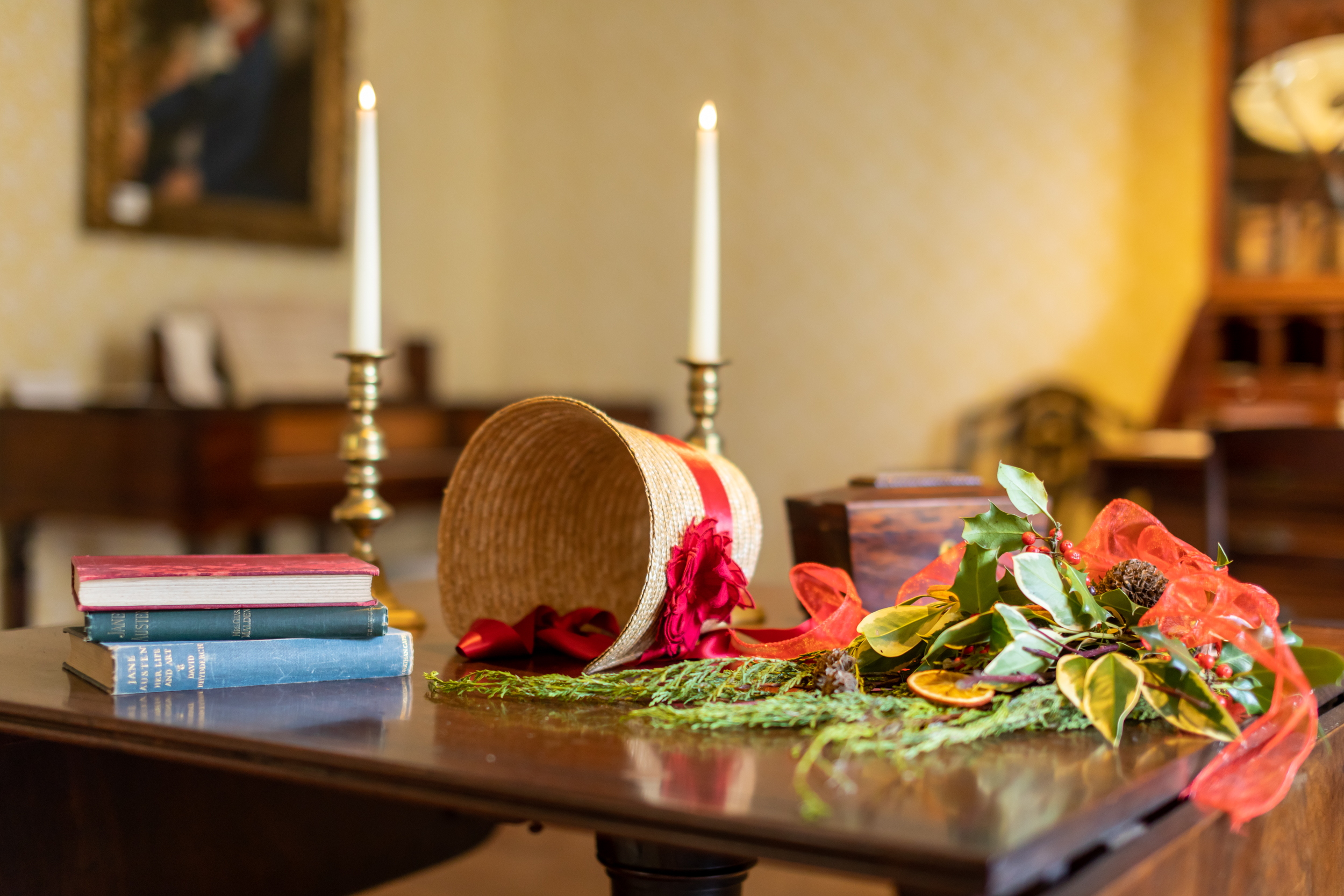
Photo: Rachel Dodge
Watch the Films
Another favorite way to celebrate Austen is to have a movie marathon. You can do this alone or with a friend (or a group of friends)! If you want to do a true marathon, you can try to cover all six novels in a day or pick one novel and watch several versions to compare them.
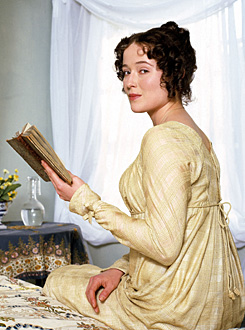
I personally love to turn on the 6-hour, BBC version of Pride and Prejudice (1995) and get some of my Christmas projects done! It’s the prefect movie to watch while you wrap gifts, stuff Christmas cards, bake cookies, or work on other projects.
Jennifer Ehle as Elizabeth Bennet, Pride and Prejudice (1995).
Eat Good Food!
Whether you’re reading Austen’s novels, watching the movie adaptations, or honoring Jane in other creative ways, you must buy or make a few treats to eat in honor of Jane. A traditional English tea can be prepared with homemade or store bought cakes, scones, sandwiches, or other tasty treats.
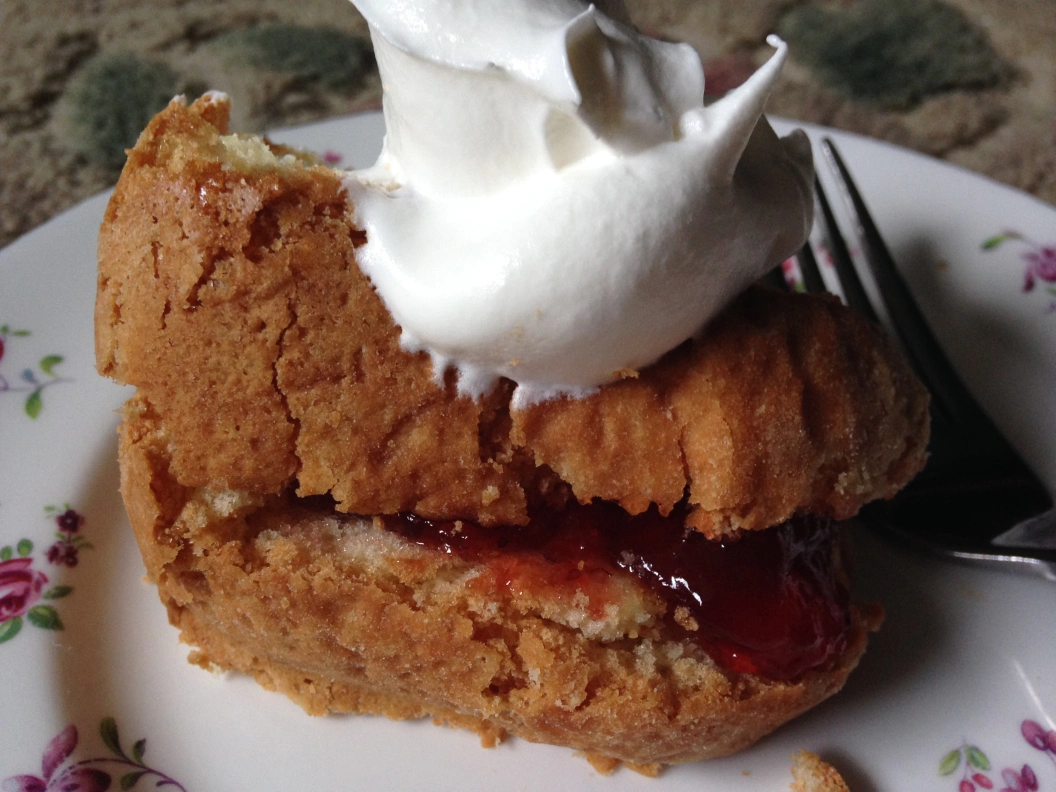
Truly adventurous bakers might try their hand at traditional Regency baked goods. There are many recipes online, in the many Jane Austen cookbooks that have been published over the years, and in several tea time books devoted to Jane Austen. Here is one of my favorites!
This recipe from Bite From the Past looks lovely. Angela Hursh provides helpful step-by-step instructions for making the recipe for Jane Austen’s Sponge Cake from Cooking with Jane Austen and Friends by Laura Boyle (now out of print).
Join the Party!
If you really want to go all-out, Jane Austen’s Virtual Birthday Party, hosted by Jane Austen’s House Museum, is a much-loved annual tradition. If you’ve never joined the party online, there is room for everyone! Jane’s birthday falls on Saturday this year, so reserve your spot and set your alarm (depending on your time zone).
Party guests will enjoy fabulous music, fascinating talks, beautiful readings, and all sorts of fun and games in the spirit of Jane Austen and her family.
Description from JAHM: “We’ll be joined by some very special guests! Enjoy a mini keynote by fabulous historian and broadcaster Lucinda Hawksley, a quick dive into Georgian prints by historian Alice Loxton, a dramatic reading by actor Rebecca Tanwen, a sneak peak into the making of the Jane Austen collection at Moorcroft Pottery, a reading by Jessica Bull from her debut novel Miss Austen Investigates, and beautiful music by pianist Laura Klein!”
Regency attire strongly encouraged!
Party Details:
Date: Saturday 16 December Time: 8pm – 9pm (GMT) Location: This event takes place online. Join in from the comfort of your own home! Tickets: £10
Note: This event will be recorded so ticket holders can enjoy it at a later date if needed!
Finally, one tangible way to celebrate Jane Austen’s birthday is to consider giving a gift in her honor to Jane Austen’s House Museum. Chawton Cottage is lovely, secluded, and historic. I’ve visited the house several times, and it is an absolute treasure for Jane Austen fans. This is one simple way we can all play a part in preserving Jane Austen’s legacy both now and in the future.
The House Museum’s current Courtyard Restoration Appeal is designed to help raise funds toward repairing and restoring the roofs of the courtyard buildings, including the Bakehouse, cellars, offices, store rooms, and privy! You can find out more here.
Wherever your plans take you this weekend, I hope you’ll join me and everyone here at Jane Austen’s World in honoring and celebrating our Jane on her birthday. She has given us so much, and we all love her tremendously.
This post features the recollections about a severely cold winter in 1794/95 by three Englishmen: Rutland squire, Thomas Barker, the Rev James Woodforde, a country parson whose diary (1759-1802) provides valuable first hand insights, and an event described by Matthew Flinders, listed in the Lincolnshire Archives. Interestingly, their observations, which read like today’s text messages, will intrigue the modern reader.
The weather in central England during the fall of 1794 started out warmly. Barker recorded:
“The autumn though wet was mild; swallows and martins did not go away till about October 18; the autumnal flowers continued till December, anemones were then in flower; winter and spring flowers were forward, and the leaves of the spring crocus appeared.”
Reverend James Woodforde came to Weston Longville, a small village north of Norwich, in 1775 and remained as rector until his death in 1803. During this time he kept a diary of his life as a country parson. While he mostly focused on parish visits, food, and the people and villages in his surroundings, he concentrated many of his observations on the weather from October to March 1794/95. His descriptions dovetailed nicely with Barker’s notes. In the next two passages Woodforde also mentioned the rains in October and flowers in November:
“The Rain that Fell yesterday [October 6] rose the Water at Foxford & East Mills quite high, Nancy very much alarmed and frightened therewith as it came almost into our little Cart.”
and
“Nov. 30, Sunday …. Mem. a Primrose in my Garden in full bloom, seen by myself and my Niece.”
Thomas Barker then referred to the sudden change in the balmy weather:
“But in the latter half of December the scene altered, and the frost began; it was a mixture of severe and moderate frost, falling and melting snows, and floods, with hard frost and breaks; the beginning of a very severe winter … for a quarter of a year, yet now without a thawing day or two now and then in January…”
Pastor Woodforde wrote a sequence of descriptions on weather events and how they impacted his life. One gains a visceral sense of how the intense and unrelenting cold invaded houses and affected the inhabitants down to their bones.
Dec 25, Thursday, X-mas day….It was very cold indeed this Morning, and the Snow in many Places quite deep, with an E. Wind. About 11. this Morning I walked to Church and read Prayers & administered the Holy Sacrament. Had but few Communicants the Weather was so bad….The Weather being so severely cold, which I could never escape from feeling its effects at all times, affected me so much this Morning, that made me faint away…..Mr Howlett after Service, very kindly offered to drive me home in his Cart, but as I was better I declined it, however hope that I shall not forget his civility….
and
Jan. 15, Thursday….Got up this morning very bad indeed in the Gout in my right foot….The Weather Most piercing, severe frost, with Wind & some Snow, the Wind from the East and very rough…I had my bed warmed to night & a fire in my bed-Room….Obliged to put on my great Shoe, lined with flannel. The Weather very much against me besides.
and
Jan. 21, Wednesday….The last Night, the most severest yet, extreme cold. So cold that the Poultry kept in the Cart-Shed and obliged to be driven out to be fed….
Image of George Morland, 1763-1804, British Winter Landscape with Figures, ca. 1785 Yale Center for British Art, Public Domain
Jan. 23, Friday….The Weather more severe than ever, it froze apples within doors, tho’ covered with a thick carpet. The cold to day was the severest I ever felt. The Thermometer in my Study, with a fire, down to No. 46….
and
Jan. 25, Sunday….The Ice in the Pond in the Yard which is broke every Morning for the Horses, froze two Inches in thickness last Night, when broke this morning.
The pastor also wrote that a terrible storm took the thatch off the barn and stripped the tiles from his roof. On the 28th he described a “very severe frost indeed. It freezes sharply within doors,” and he related the sad news of two women who “froze to death Saturday last going home from Norwich market to their home.”
Early February provided a smidgen of hope:
Feb. 8, Sunday…..Weather much altered, very foggy and a cold Thawe, with very small Rain, all the whole day. I hope to God that now We shall no more have any severe Frosts this Year…
Woodforde’s hopes were premature, however. Thomas Barker observed that a thaw for four or five days from February 8 to 12:
“…took away a great part of the snow, and made a greater flood than any remembered, which did more damage to the bridges all over the kingdom than was ever known yet without taking away all the ice and snow; the frost returned again as hard as before, and with a less break near the end of February …”
The Lincolnshire Archives provides a description from Matthew Flinders, who wrote about the abnormal winter and great flooding as the snow melted. His observations add dimension to Barker’s and Woodforde’s writings, for he referred to the misery that farmers and peasants must have felt. He also mentioned the war raging in the background, which affected all Englishmen during this period.:
“…This has been the severest winter in these climates known in living memory… the snow began at Xmas Eve – and continued with intervals most of the time. I think I may say more has fallen than in the last 7 years together and several times more on the ground, than has been since the great snow in 1767 when it was a yard deep on the level… very great damage has been done on the breaking up of the frost by the floods – numbers of bridges being broke down, and large tracts of land overflowed – no such flooded known since the memorable year 1764. Great injury done to the farmers – much sowed wheat destroyed & the poor much distressed – tho’ there were very liberal subscriptions in many towns. This added to the distress occasioned by the War – has given the times an alarming aspect w’ch I hope God in his good time will remove.” [Lincolnshire Archives] – Extreme weather events in focus: White Christmases
The flooding was ruinous to the winter crops. Pastor Woodforde also worried that the poor people would suffer from the effects.
More recently, John Kington from the University of East Anglia states that the cold in January 1795:
…was exceptionally severe, it was not until Christmas Eve 1794 [as previously related] that the very cold conditions set in The frost then lasted, but without breaks, until late March. The cold was most intense in January, which resulted in the coldest January (-3.1°C) in the Central England Temperatures series (Manley 1974). – The Severe winter of 1794/95 in England, Climatic Research Unit, University of East Anglia, Norwich
An article in The Guardian dated Jan 01, 2022 provides the following information about the cold’s impact on people:
The coldest January since 1659, when records began in England, was in 1795 when rivers including the Thames and Severn froze over. The temperature barely rose above freezing all month.
and
Country parsons, who fed poor people at Christmas, gave them a shilling each to buy food for January. Grain was in already in short supply because of a dry summer and hunger became so widespread that the following spring there were bread riots. (Read more on this topic later in this post.)
The thaw previously mentioned on February 8 by Parson Woodforde and Thomas Barker resulted in floods that devastated lands in Norwich, near the Pastor’s parish, but also farther west in Shrewsbury. Shrophsire Star.com features a facsimile of the news published on February 13, 1795. The following information are excerpts from that facsimile, which you can read in full at this link to the article.
In consequence of the sudden thaw after so long a frost, the Severn has overflowed its banks to a higher degree than ever was known in the memory of man. This town is, therefore now nearly an island; neither the Mail-Coach or any other carriages could get out of town on Wednesday morning, the water being so deep at both the bridges….
and
…Great quantities of timber have been carried away by the violence of the flood; several houses are fell in, and the furniture entirely swept off;…the inhabitants….cannot leave their habitations but by boats; a number of horses, cattle and pigs have been drowned…
and
Great praise is due to several humane Gentleman, who were active in assisting the poor people whose dwellings were inundated. Several boats loaded with fresh meat, bread and cheese, etc. were sent for the relief of such poor persons who could not leave their habitations, and which was given to them thro’ their chamber windows.
The flooding did not reflect the full extent of the damage from the east of central England to the west, for the “thaw” did not last. A cold spell ten days later froze the Severn to such an extent that John Kington wrote:
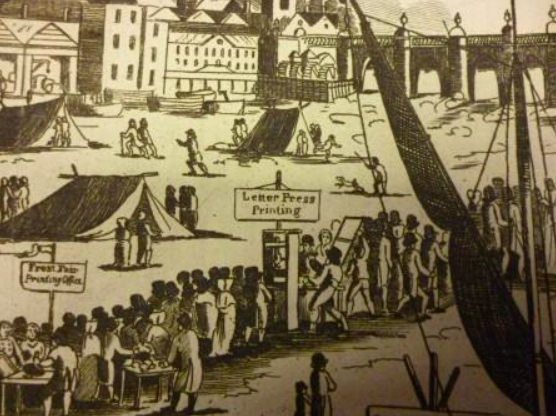
On the 23rd [of January], the Severn [river] was frozen and a printing press, after the fashion set on the Thames, was set up on the ice.
The River Severn, which is the longest river in England, experienced thick frosts during the “mini” ice age of the 16th, 17th, and 18th centuries. By 1795 at least ten frost fairs were held on the Thames River. Communities along the Seven, while not as organized as those along the Thames, held frost fairs in 1620, 1622, 1795, and lastly in 1855. – Wyre Forest Net
Despite the hardships from the hard freezes, these “frost fairs” provided winter entertainments in the form of food tents, sports, and games. Paper souvenirs were printed on the ice. They all but shouted for posterity — “I was at the Frost Fair at the Severn in 1795!” These mementos could be simple or more elaborate, depending on the amount of money the fair goer could afford to spend. The image below of a Frost Fair on the Thames River shows a long line of revelers waiting at the printing press for their choices. Other images in the links provided below depict simple or more elaborate souvenirs saved by fair goers.
Close up of a printing press set up on ice on the Thames River.The British Library, Printing on Ice
This link leads to four affordable paper souvenirs printed on a sheet. Click to view. This elaborate Frost Fair souvenir was printed in 1740. Click here.
In his Memoir of that winter, Pastor Woodforde did not mention a Frost Fair, but he continued to observe the weather in his diary. On Feb. 18 he wrote:
Wednesday….Very hard Frost, with strong Easterly Winds, a black Frost*. Every Vegetable seems affected by it. A cold this day almost, as any this Winter. I felt it before I got up this Morning, pain within me. It froze very sharp within doors all the day long. Dinner to day odds and ends, but very good. Had a fire again in My bedchamber to night, tho’ I had left if off some time, bitter cold to night.
*a dry, non visible killing frost that turns vegetation black (Oxford Languages)
Feb. 20, Friday….This Day is said to be this most cutting this Winter. It snowed the whole Day, but small & very drifting. The cold this day affected us this day so much that it gave us pains all over us, within & without and were even cold tho’ sitting by a good fire….
and
Feb. 22, Sunday….Severe, cold Weather still continues, froze again within doors. In the Afternoon some Snow. I am afraid now that we shall have more of it–The New Moon being now three Days old, and no appearance of a change.
The weather was unrelenting. Pastor Woodforde went on to say that although he meant to make an appearance at church, the weather continued on so severely and with so much snow on the ground that he “sent word to my Parishioners that there would be no service.”
His journal mentioned only one final entry in my edition of his memoirs regarding these severe winter events:
March 13, Friday….Ground covered with Snow this Morning, having a great deal of Snow in the Night. The Morning was fair but Air very cold. A 4th Winter….
A fourth winter indeed. Thomas Barker picked up the narrative:
… it continued into March. It was in general a calm frost, with vast quantities of snow coming and going, so that though it was pretty thick at times, it never lay so deep as it sometimes does. But perhaps some of the deep pits of snow and beds of ice were not entirely gone at the end of March.”
The effects of this cold weather on the populace did not end with a warming spring.
“Grain was already scarce thanks to a hot and dry summer in 1794, but Britain was at war with revolutionary France, too, which disrupted imports and raised food prices even higher. The Gentlemen’s Magazine, a popular periodical from the time, warned of “unprecedented inclemency” – How British people weathered exceptionally cold winters, University of Liverpool Research News, 04 January 2021
Some rich landowners feared an uprising due to the scarcity of food, bread, and fuel.
Land agent William Gould’s diary entry for January 21 1795 notes that he was instructed to give money, coal, beef and bread to the hungry around the Duke of Portland’s Welbeck estate in Nottinghamshire. Elsewhere in the county, Reverend Samuel Hopkinson bought peat turf (a kind of fuel) to distribute to the poor on behalf of Earl Fitzwilliam. – University of Liverpool Research News, 2021
Even with this ‘minimal’ support, the general populace suffered and bread riots ensued the following spring.
“Your letter to Adlestrop may perhaps bring you information from the spot . . .”–Jane Austen writing to her sister Cassandra about a relative in Adlestrop they loved, Elizabeth Leigh, who was very ill. Jan. 10, 1809
I’ve just finished a fascinating little book, Jane Austen & Adlestrop: Her Other Family, by Victoria Huxley. Huxley tells the stories of Austen’s Leigh relatives alongside frequent quotes from Austen’s works as well as other contemporary sources. I highly recommend this book, but I’ll share some highlights.
We know Jane Austen didn’t take her characters or situations directly from life. And yet, for every author, the experiences we have and hear about, and the people we know and know of, are all grist for the mill. They come together in new shapes and forms as we write. Jane Austen was close to her Leigh relatives, so it’s not surprising their lives fed into her novels in various ways.
The Leigh Family
Jane’s mother Cassandra Leigh Austen was from an old family descended from a Lord Mayor of London, Sir Thomas Leigh (1498-1571). During Sir Thomas’s lifetime, King Henry VIII dissolved the monasteries, making much land available for purchase. Sir Thomas invested widely. When he died, he owned extensive lands in four counties plus London.
His eldest son, Rowland, inherited Adlestrop and the lands around it in Gloucestershire (north of Oxford). His second son, Thomas, inherited Stoneleigh, Hamstall Ridware, and other estates in Staffordshire (north of Gloucestershire). The Adlestrop line remained country squires, while the Stoneleigh line gained a peerage by supporting Charles I in the English Civil War. They became far wealthier than the Adlestrop Leighs. By Jane Austen’s time, the Stoneleigh estate was worth around £17,000 a year, more than the income of wealthy Mr. Rushworth (£13,000) or Mr. Darcy (£10,000)!
I won’t inflict the whole family tree on you, as they repeated the same names over and over. Some of their favorite names were Thomas, Theophilus, James, Cassandra, and Mary. Cassandra Leigh Austen’s father was Rev. Thomas Leigh (1696-1764), and her mother’s maiden name was Jane Walker. Cassandra Leigh also had a sister named Jane, a sister-in-law named Jane, and, our favorite, a daughter named Jane (plus a daughter named Cassandra, and two first cousins named Cassandra). Jane Walker brought the Perrot family’s wealth into the family. [In the following, whenever I say “Cassandra Leigh” or “Cassandra Leigh Austen,” I mean our Jane Austen’s mother, not her sister.]
Adlestrop is now best known for a poem written in 1914 by Edward Thomas, who died three years later in World War I. His train stopped there briefly, and the poem describes the natural beauties of the area, the “willows, willow-herb, and grass” and a blackbird singing. Adlestrop is still a small, rural town, as it was in Austen’s time.
The squire of the manor, Adlestrop Park, during Jane’s lifetime was James Henry Leigh, who inherited in 1774, when he was only nine years old. His uncle, Rev. Thomas Leigh, was his guardian and the rector of Adlestrop at that time. He was Cassandra Leigh’s first cousin. Rev. Thomas lived with his wife Mary and his unmarried sister Elizabeth, who was the godmother of Jane’s sister Cassandra.
Apparently Cassandra Leigh was closer to Rev. Thomas than to James Henry. On their visits, the Austens always stayed in the rectory, not in the great house. They would certainly have attended the Adlestrop church, where Rev. Thomas preached. Jane Austen first visited Adlestrop in 1794, when she was 19. She visited again five years later, in 1799, and then in 1806, when she was 31. Throughout the years, the Austen and Leigh families kept in touch through letters.
Many of Cassandra Leigh’s relatives were clergymen*, including her father, an uncle, two cousins, a brother-in-law, and a nephew. Leigh family members were patrons of various church livings connected with their extensive properties, and bestowed those livings on relatives, as was customary. In Austen’s novels, for example, both Henry Tilney and Edmund Bertram receive livings from their fathers. Livings might also be given by more distant relations. The Honorable Mary Leigh, for example, gave Edward Cooper (Jane Austen’s cousin) his living at Hamstall Ridware in Staffordshire.
In 1806, the last member of the Stoneleigh branch of the Leigh family, the Honorable Mary Leigh, died, and Rev. Thomas Leigh, inherited. Mrs. Austen [Cassandra Leigh, who was Rev. Thomas’s first cousin], with her daughters Jane and Cassandra, were visiting Rev. Thomas at the time, and they traveled with him to take possession of Stoneleigh. The Abbey made a strong impression on Jane and her family. Mrs. Austen wrote letters describing its wonders.
When Rev. Leigh inherited Stoneleigh Abbey, he gave a settlement to another claimant*, Jane’s uncle, James Leigh-Perrot (Cassandra Leigh’s brother). The understanding was that rich Mr. Leigh-Perrot would share this settlement with the needy Austens and Coopers. However, he did not. Jane attributed this lack of generosity to Mrs. Leigh-Perrot; perhaps she was caricatured as selfish Fanny Dashwood of Sense and Sensibility. You can find more details in “Jane Austen’s Leigh Family: Stories behind the Stories.”
When James Leigh-Perrot died, he left almost everything to his wife. Eventually, when Mrs. Leigh-Perrot died in 1836, some of her estate went to Jane’s nephew, James’s son James Edward. He had to take the name Leigh, becoming James Edward Austen-Leigh.
Next month I’ll post more pictures of Stoneleigh Abbey and talk about its possible parallels with Sotherton and Northanger Abbey in Austen’s novels.
“Improvements” of land and property often meant providing more “picturesque,” more “natural” views, according to the ideas promoted by Gilpin at the time. In Mansfield Park, Mr. Rushworth wants to get the well-known expert, Humphry Repton, to improve his estate. Henry Crawford has already improved his own estate, and he advises Edmund Bertram on improving his parsonage. In Sense and Sensibility, Mrs. Dashwood talks often of making improvements to Barton Cottage, but she never has the funds for it. John and Fanny Dashwood do spend their money making improvements to Norland, which Elinor and Marianne don’t think much of. Mr. Collins makes improvements to his parsonage. Elizabeth is impressed that the Darcys have shown good taste in improving Pemberley, inside and out.
Austen more strongly commends personal “improvement,” though, improvement in mind, in manners, in education.
Austen would have known first-hand about Repton and his improvements from her cousins in Adlestrop and Stoneleigh. Rev. Thomas Leigh and his nephew employed Repton to make improvements to the manor, rectory, and surrounding lands of Adlestrop. Records show payments to Repton between 1798 and 1812.
Rev. Leigh “improved” his parsonage at Adlestrop by moving his front door to another side of the house, so the principal rooms would face the pretty valley. He also destroyed “a dirty farmyard and house which came within a few yards of the Windows.” Similarly, in Mansfield Park, Henry Crawford tells Edmund Bertram that he must improve his parsonage: “The farmyard must be cleared away entirely, and planted up to shut out the blacksmith’s shop. The house must be turned to front the east instead of the north—the entrance and principal rooms, I mean, must be on that side, where the view is really very pretty.” He also recommends combining gardens, changing a stream, and moving a road.
Rev. Thomas Leigh enclosed neighbouring land (with permission), adding it to his church living, and created a small lake from some flooded ground. As Huxley says, “Now he had a ‘Pleasure Ground’ to rival his brother’s” (at the Adlestrop estate). He moved roads and paths, as Mr. Knightley is planning to do in Emma. Jane Austen would have seen these improvements first hand during her visits. Sometimes she might have felt, like Mary Crawford, that all was “dirt and confusion, without a gravel walk to step on, or a bench fit for use” because of all the changes in process. However, as Mr. Collins did for his visitors, no doubt Rev. Leigh proudly took the Austen family on a thorough tour of his parsonage and its gardens, pointing out with pride all the improvements he was making.
In 1799, some land was exchanged between the church and the manor. In return, James Henry paid to build and fence a better church road and enclose the churchyard with a stone wall. In 1800, Repton was hired to unite the gardens of the rectory and Adlestrop Park, to improve the views. Dr. Grant in Mansfield Park also extends a wall and makes a plantation “to shut out the churchyard,” improving the view from the parsonage.
Austen would have heard about Repton’s later “improvements” in Stoneleigh Abbey’s grounds, which Thomas Leigh set about once he moved in. Repton’s “Red Book,” showing the suggested improvements, is still in existence. You can see a video of it here. Not all of Repton’s recommendations were followed, but some were.
The Leighs and Persuasion
Two other stories from the Leigh family are echoed in Persuasion. At one point, the Adlestrop family was deep in debt and needed to “retrench” in order not to lose the estate. They rented out the manor and moved to Holland for some years, until their finances were in order. Sir Walter and his family, of course, only moved to Bath; we wonder if they will ever make it back to Kellynch!
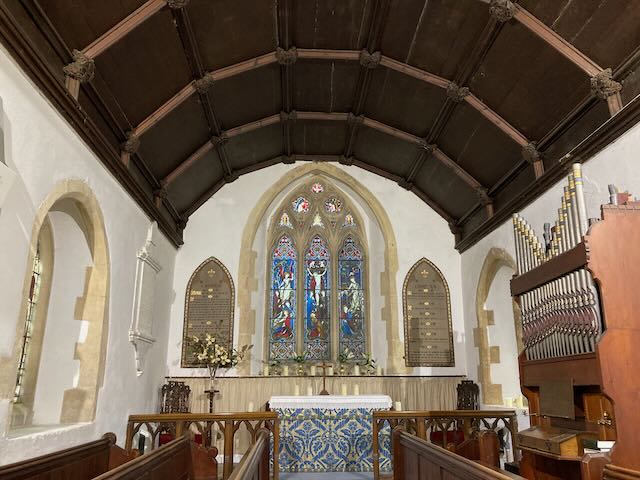
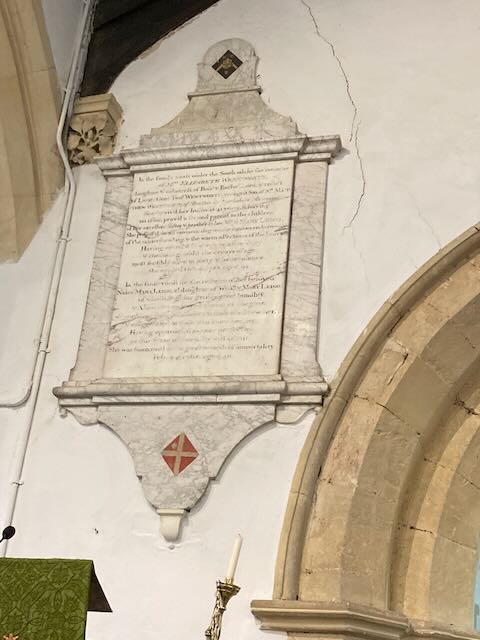
The Leighs also had an aunt who fell in love with an army officer. The family disapproved because of his lack of money. She married him secretly before he went off to war. When he returned as–guess who? Captain Wentworth!– she finally got her family’s approval. Elizabeth Wentworth and her Captain became wealthy and were benefactors to their Leigh relatives. The largest marble tablet in the Adlestrop church, just behind the pulpit, memorializes Elizabeth Wentworth.
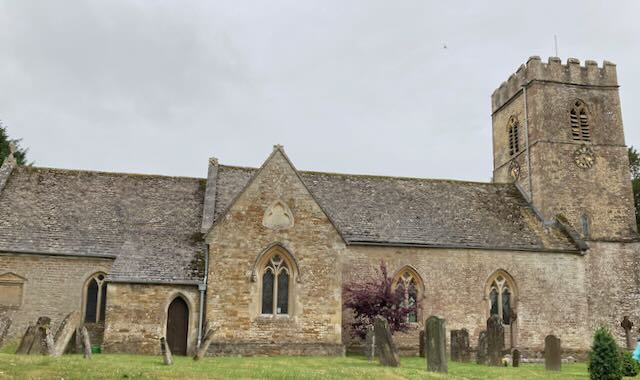
The church, St. Mary Magdalene, at Adlestrop is well worth a visit. The church dates from the thirteenth century, though much of it was rebuilt in the 1750s. In the Victorian period, the window traceries were replaced, and stained glass windows and a clock added. The church is one of seven in the Evenlode Vale Benefice. Services are usually held at St. Mary Magdalene twice a month. Like other country churches, a handful of the faithful attend regular services, while larger crowds come to special services at Harvest and Christmas. We don’t know about attendance numbers in Austen’s time. Supposedly, by 1851, “‘all parishioners without exception‘ attended church at least once a week” (Huxley, 201).
The rectory where Jane and her family stayed is now called Adlestrop House, and, along with Adlestrop Park, still belongs to the Leigh family. Both are very close to the church, but are not open to the public. The lands were originally monastic lands owned by Evesham Abbey.
The Old Schoolhouse opposite the church was built after Austen’s time. However, Austen probably saw the earlier charity school, supported by donations from the Leigh family and other local gentry. In 1803, sixteen children learned reading, knitting, and other marketable skills at that “school of industry.” By 1818 there was a day school for boys and another for girls. A Sunday school attended by 52 children was supported by a bequest from Rev. Thomas Leigh (Huxley, 203). (Sunday schools taught reading and other basic skills to working-class children, who were only free on Sundays.)
The last chapter of Jane Austen & Adlestrop takes readers on a tour of Adlestrop today, still a sleepy country village, but with history around every corner.
Adlestrop Park, the manor, etching in 1818, from Historic England.
* Claimants for the Stoneleigh Abbey estate (this is complicated, sorry! You can find a chart of these relationships in Jane Austen & Adlestrop, by Victoria Huxley, or in Jane Austen and the Clergy, by Irene Collins):
Theophilus Leigh (died 1724), of the Adlestrop Leighs (great-great grandson of the Lord Mayor), had 14 children.
Theophilus’s oldest son, William, had a son named James (who died in 1774). James had one son (Theophilus’s grandson), James Henry (1765-1823). William’s second son was Rev. Thomas Leigh (1734-1813), rector of Adlestrop, who had no children.
Theophilus’s next surviving son, Dr. Theophilus Leigh (died 1785), was a clergyman and Master of Balliol at Oxford. He had no sons who survived childhood. One of his daughters married Rev. Thomas Leigh of Adlestrop, and another married Rev. Samuel Cooke, Jane Austen’s godfather.
Theophilus’s next son, also Rev. Thomas Leigh (died 1764), was Cassandra Leigh Austen’s father. He had a son, James Leigh-Perrot (1735-1817), just a year younger than Rev. Thomas Leigh of Adlestrop. James had added “Perrot” to his last name to get an inheritance from his wife’s family.
So in 1806, the closest living male heirs were Rev. Thomas Leigh of Adlestrop, who inherited the estate, then he passed it to his nephew James Henry Leigh. They gave money to James Leigh-Perrot, the third claimant, to pay off his claim.
This week the United States celebrates Thanksgiving, a holiday in honor of families and friendship. For the most part, we lay aside our differences and grievances, and give thanks for what we have. The poor, aged, and lonely are not forgotten. Community soup kitchens are filled with volunteers, and many are turned away because of the sheer volume who want to serve their less fortunate brethren.
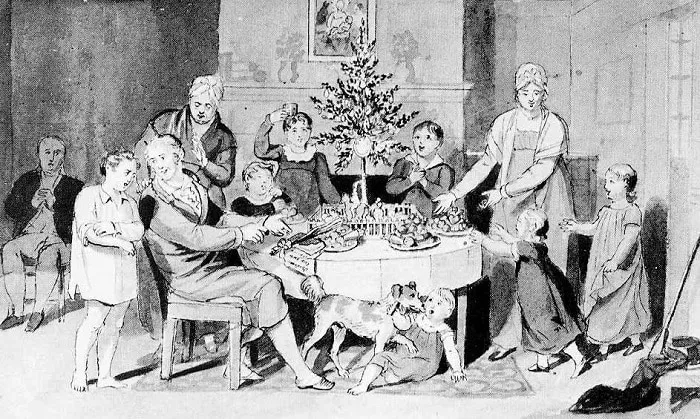
This annual North American feast is reminiscent of the British Christmas dinners celebrated in Jane Austen’s day. In Emma, Mr Elton states:
This is quite the season indeed for friendly meetings. At Christmas, everybody invites their friends about them, and people think little of even the worst weather.”
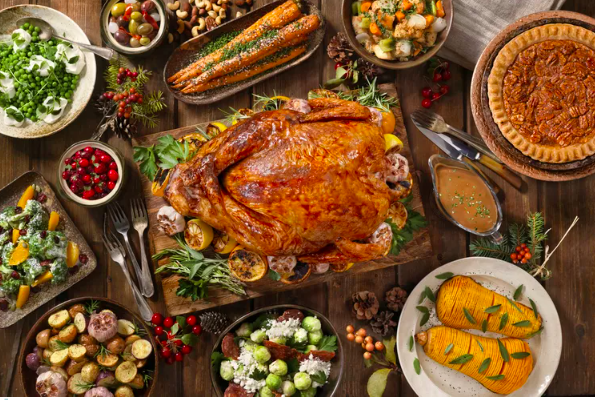
If we substitute Christmas for Thanksgiving, Austen’s phrase applies just as well. Foods offered on the Georgian Christmas table and Colonial thanksgiving tables in the U.S. and Canada have been remarkably similar from the 17th century on: Soup, cheese, nuts, turkey, goose, duck, mashed potato, yams, fresh cranberries, dried fruits, pumpkin and mince pies.
Image of traditional Thanksgiving foods. iStock image, LauriPatterson.
We North Americans have our British ancestors to thank for this tradition, so closely tied to these countries’ respective fall harvests. Earlier ripening explains why Canada’s Thanksgiving falls on the second Monday of October, almost two months before its southern neighbor, the US, celebrates this event.
Canadian Thanksgiving:
One can only envision the reaction of explorer Martin Frobisher and his men when, in three voyages to Canada to find a northwest passage to Asia, they encountered the immensity, richness, and diversity of flora and fauna, and countless miles of almost untouched forests, lakes, and fields populated by an abundance of wildlife. These natural riches must have overwhelmed their senses, prompting them to give thanks in a tradition still celebrated today. The reality was less than elaborate:
In 1578, … privateer and mariner Sir Martin Frobisher was the first European to celebrate “Thanksgiving” with his crew. The meal was decidedly less glamorous than today’s feasts: mostly salt beef, biscuits and mushy peas. The locale, too, was less inviting. Frobisher and his men celebrated in current-day Nunavut, likely aboard one of the 15 ships that had set sail to discover a northwest passage to Asia’s trading areas. – A Short History of Thanksgiving in Canada, Ottawa Citizen
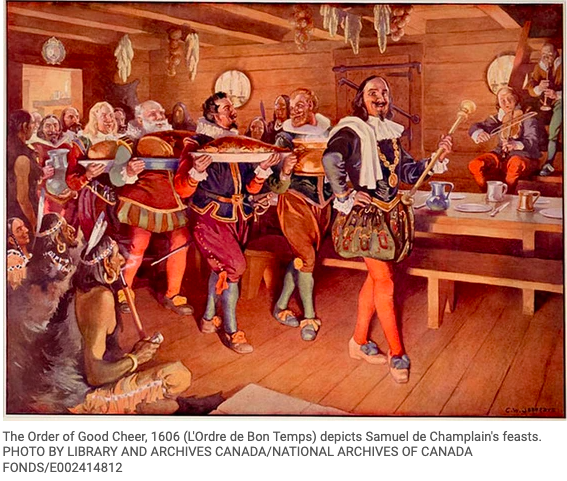
Explorer Samuel de Champlain organized a thanksgiving celebration in the early 17th century which is more reminiscent of today’s ceremonies than Frobisher’s. To prevent scurvy, Champlain introduced a variety of foods that included fresh vegetables and fruits high in vitamin C, such as cranberries. Since the 18th century, Nova Scotia’s Thanksgiving meals have resembled today’s variety of foods. But this is not the full story. Without indigenous Indians, neither the Canadian explorers nor the pilgrims would have survived long enough to present a meal of any great variety.
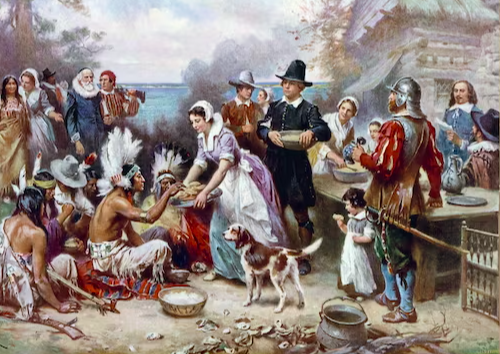
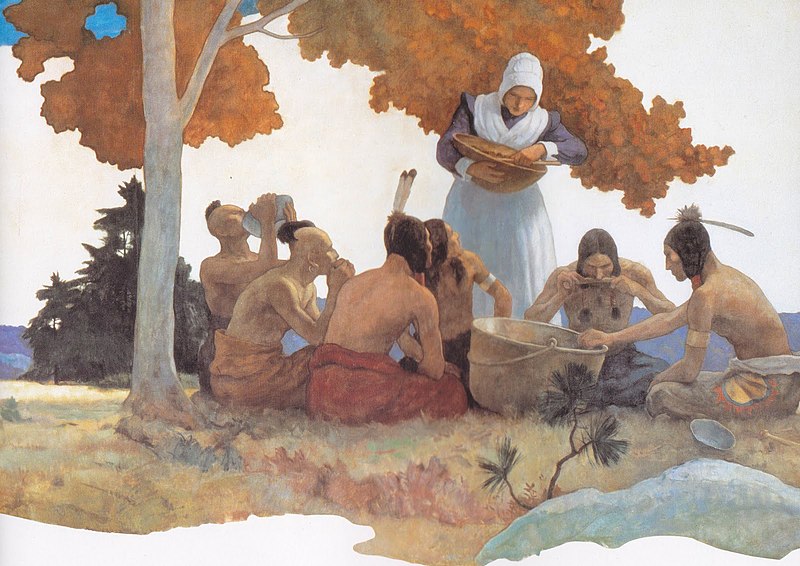
In contrast to the happy scene depicted in the storybook image above, settlers and indigenous warriors experienced devastating losses from natural causes – the settlers from starvation and the tribes from the loss of as much as 50 to 90 percent of their population to the epidemics the Europeans brought with them. The pilgrims and Wampanoags joined forces to strengthen their numbers and to fight off possible attacks from other Indian tribes. And so the Wampanoags taught settlers to plant corn and other vegetables and to use herring for fertilizer. Under their tutelage, the pilgrims learned to fish for cod and bass, build housing with the materials at hand, and trade and barter for products they could not produce.
Detail of an NC Wyeth painting, Wikimedia Commons
After the bountiful result of their hard labor, the pilgrims commemorated their success with a series of feasts that featured the riches of their fall harvest. The chief of the Wampanoags, Massasoit, attended the event for three days with 90 men. They brought five deer, which were roasted, and played games in celebration. According to an article in the National Endowment for the Humanities entitled Who Were the Pilgrims Who Celebrated the First Thanksgiving? | The National Endowment for the Humanities this was the true first American Thanksgiving.
Interestingly, in 1862 President Lincoln declared the turkey to be the official meat for the Thanksgiving dinner table. Before this time, there was no consensus. U.S. dinner tables had featured venison, ham, pheasant, duck, oysters, and other choices preferred regionally, such as bison. Personally, I like turkey once a year. At Christmas, I prefer ham.
When one examines the traditional Traditional Christmas dinner menu featured in this BBC Good Food website, one recognizes how close the three nations still are in their traditional celebratory food offerings. Oh, variations have crept in. Local foods are offered in abundance (in Maryland crab cakes and seafood recipes are heavily featured, and Tex Mex recipes are also making an appearance, especially at the appetizer and dessert tables.) But overall, we U.S. Americans are staying with the traditional holiday feast on the 4th Thursday in November.
Author Syrie James’s Jane Austen quote is apropos for both holiday feasts:
After Jane Austen’s Christmas guests had departed in January 1807, Jane wrote to her sister, Cassandra, “I shall be left to the comfortable disposal of my time, to ease of mind from the torments of rice puddings and apple dumplings, and probably to regret that I did not take more pains to please them all.”
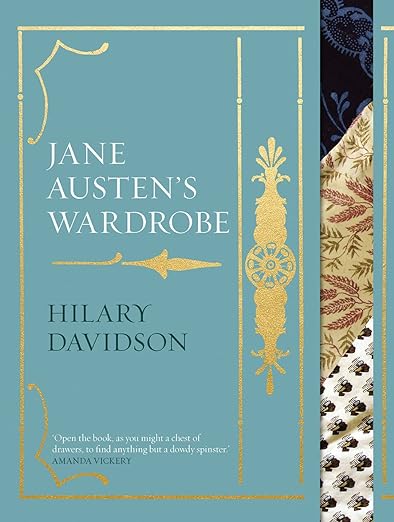
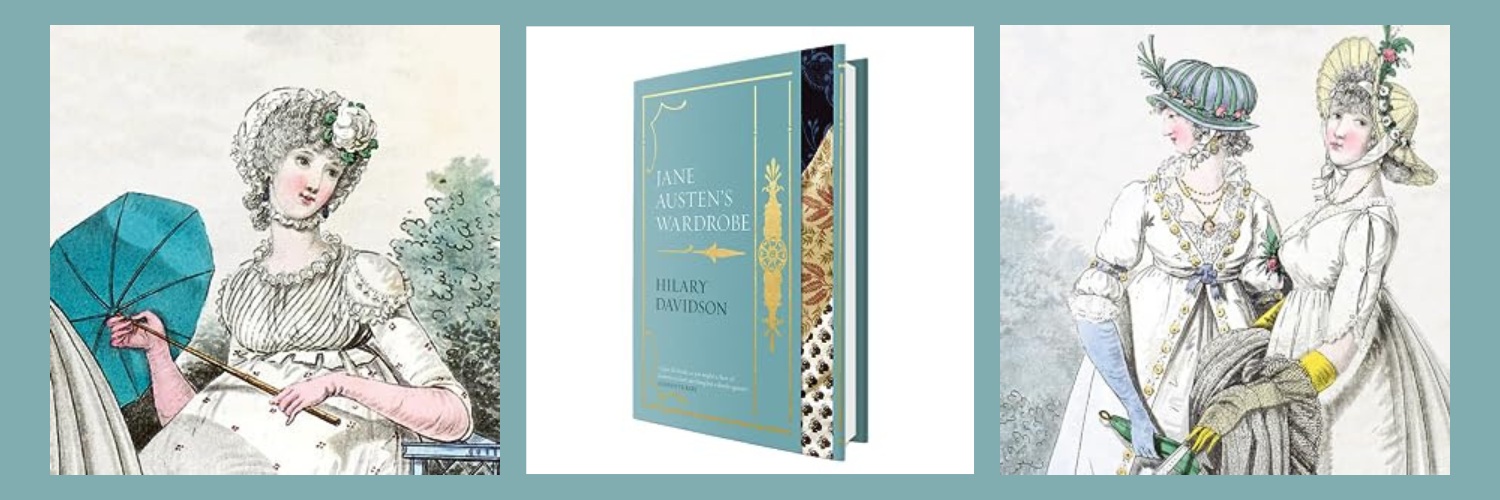
Dear readers, I have an exquisite new book to share with you today: Jane Austen’s Wardrobe by Hilary Davidson!
Filled with incredible photos and written information, it’s one of the most detailed books I’ve seen in a long time on this topic. Not only is it beautiful, it is filled with fascinating information on one of my most favorite topics.
This is my new favorite book on Jane Austen’s Regency Fashion. I know I’ll continue to pour over it for years to come!
Austen’s Wardrobe by Category
Within the pages of this lovely book, Davidson works her way through Austen’s personal wardrobe chronologically, from head to toe. Davidson’s system for cataloging Austen’s wardrobe is fascinating! For those of us who delight in a linear and/or chronological order to a wide and varied topic, Davidson definitely checks all the boxes.
First, she breaks all of Austen’s clothing down into the following categories:
Clothes Press: Gowns
Closet: Spencers, Pelisses and Outer Garments
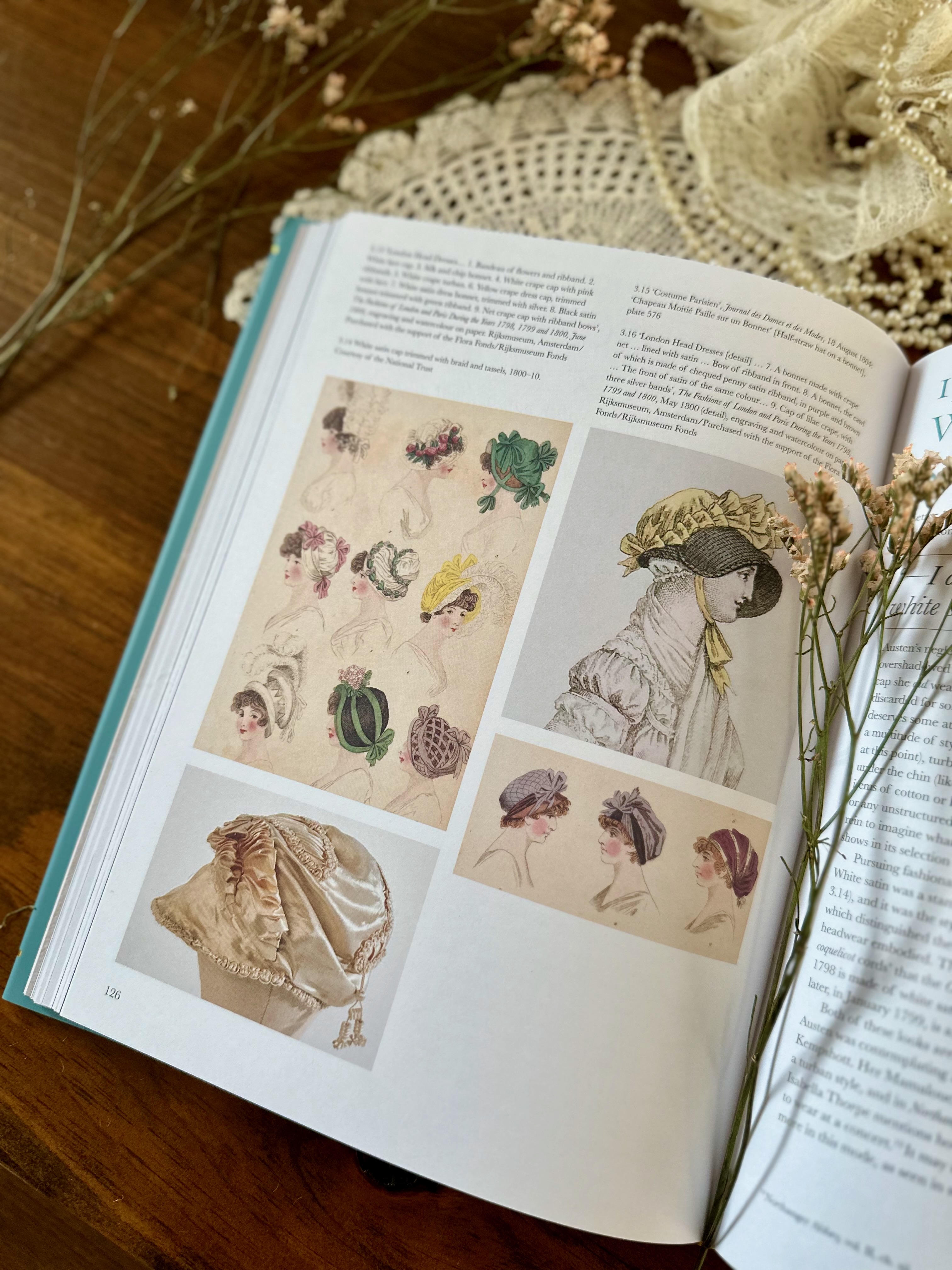
Band Box: Hats, Caps and Bonnets
Shelves: Shawls, Tippets, Cloaks and Shoes
Dressing Table: Gloves, Fans, Flowers, Trims and Handkerchiefs
Jewelery Box: Necklaces, Rings and Bracelets
Drawers: Undergarments and Nightwear
Davidson even includes several pages of sketches, descriptions, and explanations for Jane’s “Portrait Gown” – which I found completely engrossing.
Austen’s Letters Quoted
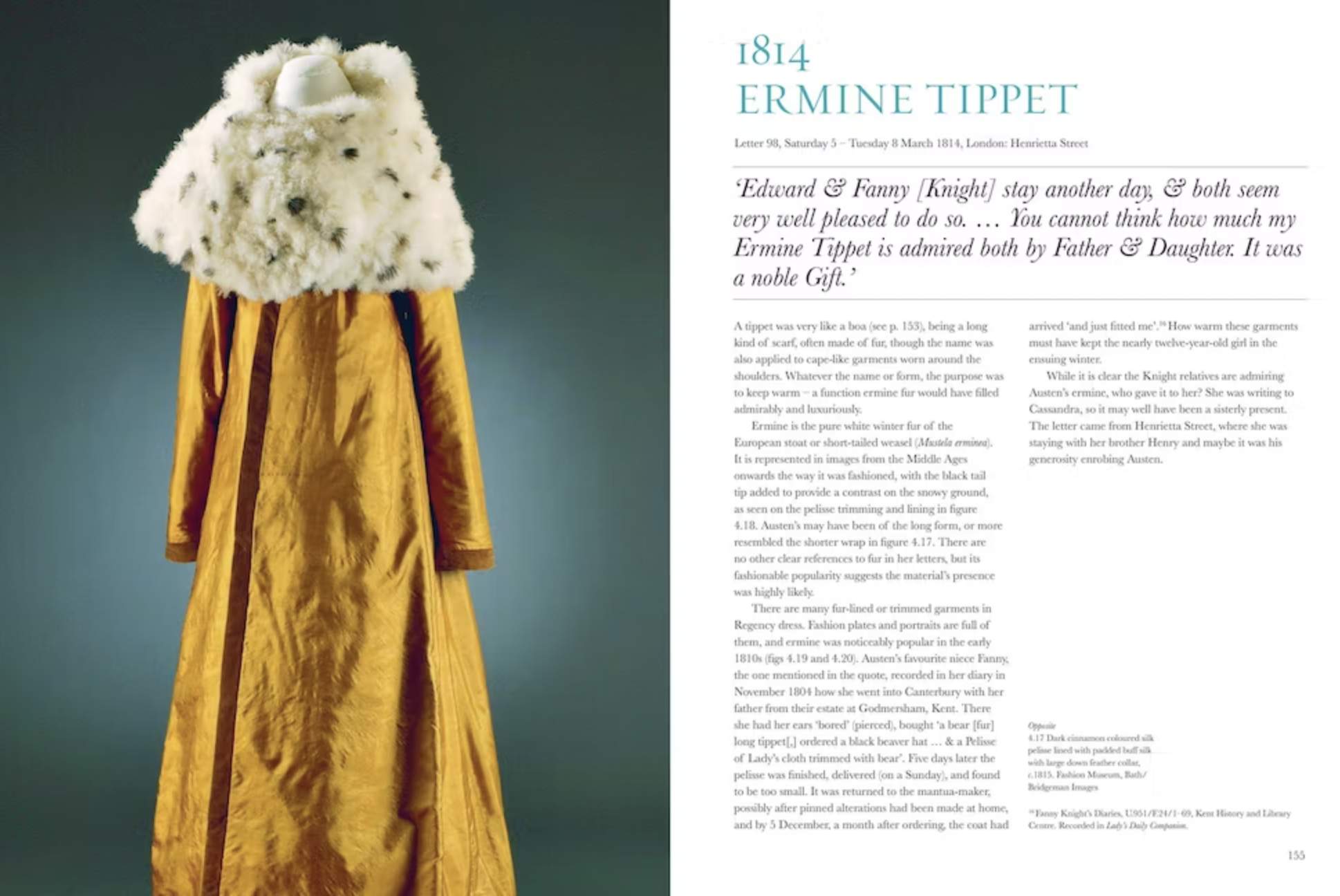
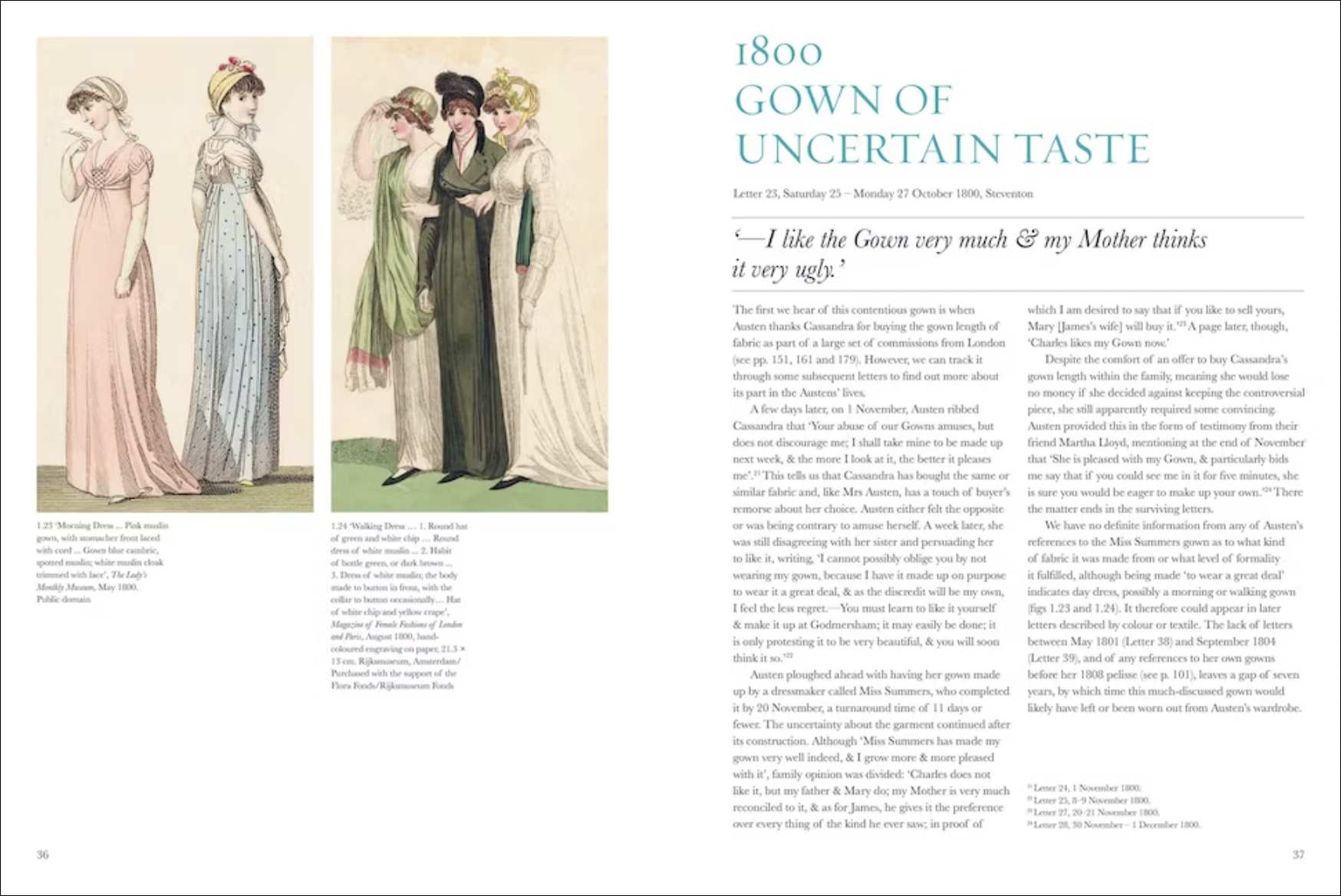
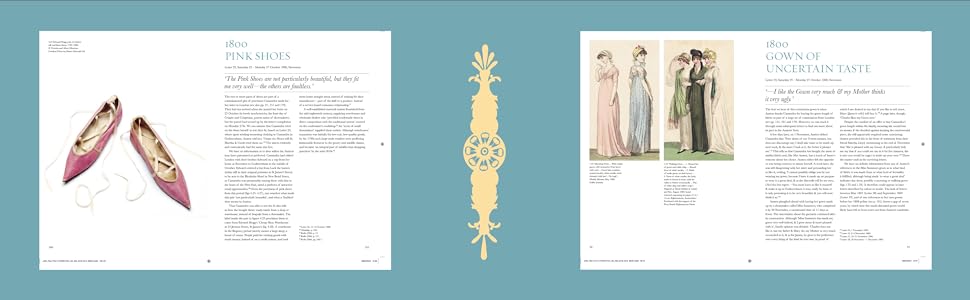
Next, Davidson utilizes Austen’s personal letters to explore every inch of Austen’s wardrobe, working her way through each category in chronological order. To do this, she shares one quote at time, citing portions of letters that mention Austen’s clothing. Then, for each article of clothing, every hat, and every piece of jewelry, she explains that quote in great detail and provides photos to aid our understanding.
For instance, Austen writes this in Letter 65:
“I can easily suppose that your six weeks here will be fully occupied, were it only in lengthening the waists of your gowns. I have pretty well arranged my spring & summer plans of that kind, & mean to wear out my spotted Muslin before I go. –You will exclaim at this–but mine has signs of feebleness, which with a little care may come to something.”
Davidson provides photos of spotted muslin fabric swatches and a photo of a dress made of spotted muslin, dated 1805-10. Then she explains the muslin fabric, provides quotes from Austen’s novels about muslin dresses, and explains Austen’s quote. She goes over the dress styles, what was involved in “lengthening the waist” of a gown, the meaning of “worked” fabric, and the ins and outs of fragile fabrics of that time period, including how women used belts to cover holes in the fabric when a waist was lengthened.
I found this incredibly interesting because I’ve always been curious about Austen’s extensive quotes about her dresses and hats in her letters. The result is a delightful (and sometimes hilarious) tour through Jane Austen’s closet in her own words, with pictures and explanations to match!
Here are several more examples, provided by Yale University Press:
Informative and Beautiful
Like many of Austen’s heroines, this book is both intelligent and beautiful. Inside and out, this book is absolutely stunning. The photos provide a detailed look into Jane Austen’s clothing that is hard to find, especially all in one place. This book feels like a worldwide museum tour of all the most exquisite clothing artifacts from Austen’s time.
This is the perfect addition to any Jane Austen library – and it will look gorgeous on your coffee table!
Book Description
Hilary Davidson delves into the clothing of one of the world’s great authors, providing unique and intimate insight into her everyday life and material world.
Acclaimed dress historian and Austen expert Hilary Davidson reveals, for the first time, the wardrobe of one of the world’s most celebrated authors. Despite her acknowledged brilliance on the page, Jane Austen has all too often been accused of dowdiness in her appearance. Drawing on Austen’s 161 known letters, as well as her own surviving garments and accessories, this book assembles examples of the variety of clothes she would have possessed—from gowns and coats to shoes and undergarments—to tell a very different story.
The Jane Austen Hilary Davidson discovers is alert to fashion trends but thrifty and eager to reuse and repurpose clothing. Her renowned irony and wit peppers her letters, describing clothes, shopping, and taste. Jane Austen’s Wardrobe offers the rare pleasure of a glimpse inside the closet of a stylish dresser and perpetually fascinating writer.
About the Author
Hilary Davidson is a dress, textile and fashion historian and curator. Her work encompasses making and knowing, things and theory, with an extraordinary understanding of how historic clothing objects come to be and how they function in culture.
Hilary is equally skilled in analysing historical and archaeological material culture artefacts; presenting engaging, fascinating talks to diverse audiences; and producing influential academic research.
Her extensive experience includes:
Scholarly research
Lecturing, teaching and public talks
Broadcasting and journalism
Historic dressmaking
Hilary trained as a bespoke shoemaker in her native Australia before completing a Masters in the History of Textiles and Dress at Winchester School of Art (University of Southampton) in 2004. Since graduating, Hilary’s practice has concerned the relationship between theoretical and highly material approaches to dress history, especially in the early modern and medieval periods.
As a skilled and meticulous handsewer, she has created replica clothing projects for a number of museums, including a ground-breaking replication of Jane Austen’s pelisse. At the same time she lectured extensively on fashion history, theory and culture, on semiotics, and cultural mythologies, especially red shoes.
In 2007 Hilary became curator of fashion and decorative arts at the Museum of London. She contributed to the £20 million permanent gallery redevelopment opening in 2010, and curated an exhibition on pirates, while continuing to publish, teach and lecture in the UK and internationally. In collaboration with Museum of London Archaeology, Hilary began analysing archaeological textiles and continues to cross disciplines by consulting in this area in England and Australia. She also worked on the AHRC 5-star rated Early Modern Dress and Textiles Network (2007-2009) and from 2011 has appeared as an expert on a number of BBC historical television programmes, and as a frequent radio guest speaker in London and Sydney.
From 2012 Hilary worked between Sydney and London as a freelance curator, historian, broadcaster, teacher, lecturer, consultant and designer, while working on a PhD in Archaeology at La Trobe University, Melbourne. In addition to historical studies she has been a jewellery designer, graphic designer, photographer, gallerist, and worked in retail fashion and vintage clothing. In 2022 she moved to New York City to take up the role of Associate Professor and Chair of the MA Fashion and Textile Studies: History, Theory, Museum Practice at the Fashion Institute of Technology.
Hilary has taught and lectured extensively, including at the University of Southampton, Central St Martins, the University of Cambridge, the University of Glasgow, New York University London, The American University Paris, Fashion Design Studio TAFE Sydney and the National Institute of Dramatic Art (NIDA), Sydney. She speaks regularly at academic conferences and to the public. Her first monograph book was Dress in the Age of Jane Austen (2019) followed by Jane Austen’s Wardrobe in 2023. Her extensive publications can be found on Academia and ResearchGate.
To Order the Book:
You can order the book by clicking HERE or by clicking the image below:
Recommended Book Gift
I hope you’ve enjoyed this short tour of this stunning new book by Hilary Davidson. If you’re looking for a gift for a fellow Jane Austen fan, or if your friends or family members need an idea for a gift for you this holiday season, I highly recommend this one!
Fashionable Goodness: Christianity in Jane Austen's England is now available! By JAW contributor Brenda S. Cox. See Review. Available from Amazon and Jane Austen Books.
Available through December 31st, 2025. Click on image for details, and share this poster with other teachers and students!
The Obituary of Charlotte Collins by Andrew Capes
Click on image to read the story.
Comments
“My idea of good company…is the company of clever, well-informed people, who have a great deal of conversation.” – Jane Austen, Persuasion
Gentle readers: Please feel free to post your comments and continue the conversation! Due to SPAM, we will no longer accept comments on posts after 30 days of publication. In some instances, links will be removed from comments as well.
Administrators and Contributors
Vic Sanborn, founder of this blog, is supported by a team of talented and knowledgeable writers about Jane Austen and the Regency era. They are:
Tony Grant, who now contributes his photos from London and England
Click on their names to enter their own blogs.
In addition, we thank the many experts and authors who frequently contribute their posts and opinions, and who continue to do so freely or at our request.
Click here to enter the page. Topics include Regency fashion, historic foods, Jane Austen societies, British sites, related topics. Click on image.
May we suggest?
Hello, my name is Vic and I live in Maryland, USA. I have adored Jane Austen almost all of my life. I am a proud lifetime member of the Jane Austen Society of North America. This blog is a personal blog written and edited by me and my team. We do not accept any form of cash advertising, sponsorship, or paid topic insertions. However, we do accept and keep books and CDs to review.
If you would like to share a new site, or point out an error, please email us. (Yes, we are fallible. We'll own up to our mistakes and will make the corrections with a polite smile on our faces.) Write us at
Thank you for visiting this blog. Your comments and suggestions are most welcome.
Project Gutenberg: eBook of Stage-coach and Mail in Days of Yore, Volume 2 (of 2), by Charles G. Harper
STAGE-COACH AND MAIL IN DAYS OF YORE: A PICTURESQUE HISTORY
OF THE COACHING AGE, VOL. II, By CHARLES G. HARPER. 1903. Click on this link.
























 Jane Austen's World