Feeds:
Posts
Comments

Archive for the ‘Jane Austen’s World’ Category

by Brenda S. Cox

“Of these three, and indeed of all, Miss Lambe was beyond comparison the most important and precious, as she paid in proportion to her fortune. She was about seventeen, half mulatto, chilly and tender, had a maid of her own, was to have the best room in the lodgings, and was always of the first consequence in every plan of Mrs. Griffiths.” – Sanditon

This is the only time Jane Austen clearly introduces a black or mixed-race character in her fiction. And we don’t know what direction she was going to go with this young lady. (Though obviously the producers of Sanditon have made their own speculations, as have the authors of completions of the novel. My favorite completion, by the way, is here.)

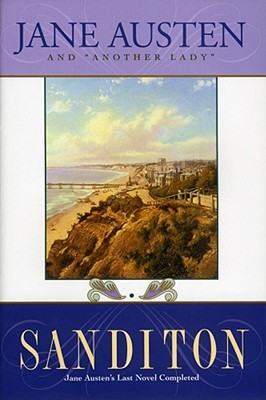
My favorite completion of Jane Austen’s Sanditon is by Jane Austen and “Another Lady.”

Austen’s inclusion of a mixed-race character raises questions for us today:

  • How many black and mixed-race people were there in Austen’s England?
  • Is she likely to have known any of them?
  • What were their lives like?
  • How did Austen’s society view them and treat them?

I’ve been doing a lot of reading on this topic, and it’s hard to find solid answers. However, the series of posts that I’m starting today will look at the question from different angles. We’ll start today with some indications from fiction of Austen’s time. Then we’ll look at statistics from official records, using Kathleen Chater’s Untold Histories.  We’ll also look at what art of the time can tell us, and consider the lives of some individual black and mixed-race people. Each of these lenses will give us a little clearer picture of black people’s lives in Austen’s England.

Miss Lambe

Miss Lambe is “half mulatto.” Nowadays “mulatto” is an offensive term, as it is based on the word “mule”; mixed-race people were believed to be sterile like mules. (Though there must have been plenty of evidence to the contrary!) But I don’t think Austen is using it pejoratively. She is simply describing Miss Lambe’s background. It sounds like Miss Lambe had a parent who was half-black and half-white, most likely her mother, and a white parent. Such pairings were quite common in the West Indies. A plantation owner might well leave his wealth to a mixed-race child.

Austen calls Miss Lambe “chilly and tender.” “Chilly” probably meant that the weather of England was too cold for her, compared to the West Indies where she grew up. “Tender” probably meant that she was delicate, easily becoming ill. Though as I imagine Miss Lambe, I like to think that “tender” also meant she was kind and gentle.

Austen sometimes describes people, such as Marianne Dashwood and Henry Tilney, as having a “brown” complexion. There’s been some speculation that she may mean to imply mixed racial backgrounds. That’s possible, but it seems a little unlikely to me. It sounds like Austen is just describing minor variations in skin tones. She usually pairs “brown” skin with dark eyes and dark hair. In one other reference, Miss Bingley says Elizabeth Bennet has become “brown and coarse.” Darcy says she is tanned from traveling in the summer.

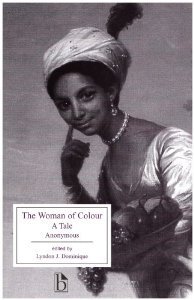
The Woman of Colour is an anonymous novel published in 1808 about an heiress like Miss Lambe. The modern version edited by Lyndon J. Dominique includes much helpful background information and excerpts from other fiction and nonfiction of the time.

Back to Miss Lambe. We can get some idea of what her life might have been like from a novel of the time. The Woman of Colour: A Tale  was published anonymously in London in 1808, nine years before Austen began writing Sanditon. Professor Lyndon J. Dominique has edited a modern version, full of helpful background information.

Modern scholars speculate that the writer was herself a “woman of colour,” the mixed-race daughter of a West Indies planter, but we don’t know for sure who wrote the book. “People of color” may be used today to describe people of various races. However, eighteenth-century British people used it to refer to certain groups of free people in the Americas. Some included free black people, but others used the term only for those of mixed race (p. 21 in The Woman of Colour).

The novel is a series of letters from Olivia Fairfield to her former governess in Jamaica. Olivia, the daughter of a white plantation owner and a black slave, is on her way to England. Her loving father knows that because of her skin color she will never be treated as an equal by the planters of Jamaica. So he arranges that after his death she will travel to England. In England, laws and attitudes toward mixed-race people were less harsh, and tender-hearted Olivia wouldn’t have to see the suffering of the black people she identifies with. Her father, in his will, has arranged for her to marry her cousin, who will then inherit her fortune.

Already we find an interesting contrast. While black people were often treated horrifically in the West Indies, they found more acceptance in England itself.

Prejudices

The story shows some examples of prejudices that black and mixed-race people experienced in England at this time. Olivia and her black maid are called names, and yet they earn a place in society.

At her first English ball, Olivia is “an object of pretty general curiosity” (84). She says, “My colour, you know, renders me remarkable” (84). People stare at her “as if they had been invited purposely to see the untamed savage at a shilling a piece!” However, one gentleman, who calls her a “native,” adds, “In native elegance unrivalled! . . . More grace, more expression, more characteristic dignity, I never yet beheld in one female figure!” His friend calls her a “sable goddess.” Olivia enjoys the dancing, but complains that rather than rational people, she finds only “folly and dissimulation” (88).

Olivia’s maid Dido is a black woman. Though not enslaved, she seems the stereotype of the faithful black slave. She speaks in “half-broken language” (57), presumably a Jamaican dialect. She loves Olivia dearly and serves her faithfully. Olivia also loves Dido. In town, Dido says she is called names like “blacky” and “wowsky” and “squabby” and “guashy,” “and all because she has a skin not quite so white,–God Almighty help them all.” (“Wowski” was the name of an American Indian woman in a novel of 1787; “Quasheba” was the name of dark-skinned characters in novels of 1767 and 1798.) Dido says even a maid treats her like a slave. But she looks forward to their home in the countryside, where she will be the housekeeper and be in charge. Once in the country, she wins the affection of the “peasants” with her warm heart (105).

Olivia’s husband’s young nephew George thinks Olivia’s skin is “dirty” and Dido’s even dirtier. Olivia explains to him, “The same God that made you made me . . . the poor black woman—the whole world—and every creature in it! A great part of the world is peopled by creatures with skins as black as Dido’s, and as yellow as mine. God chose it should be so, and we cannot make our skins white, any more than you can make yours black” (79).

They go on to discuss the evils of slavery. The child has heard the coachman saying that “black slaves are no better than horses over there,” and Olivia explains, “Those black slaves are, by some cruel masters, obliged to work like horses . . . but God Almighty created them men, equal with their masters, if they had the same advantages, and the same blessings of education.” Olivia says that human feelings and religious principles, as well as “kindred claims,” impel her to pray for the end of slavery, the emancipation of her brethren (80-81).

Once Olivia is married and living in the countryside, she meets “East Indian Nabobs,” a family who made their fortune in India, and finds them proud and selfish. However, she is completely accepted into the social circles of her area. The most prejudice she experiences is from her sister-in-law, who is a conniving, selfish woman.

The Woman of Colour: A Tale  shows some of the prejudices against black and mixed-race people in England. Nevertheless, it also implies that people of color were fully accepted in English society, particularly if they had wealth, like Austen’s Miss Lambe.

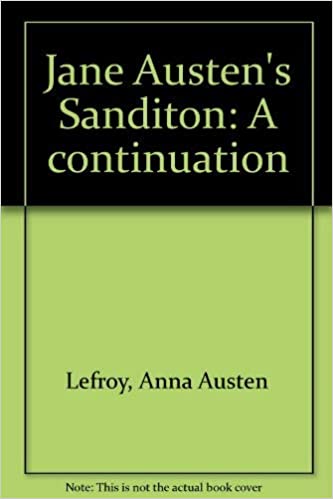
Jane Austen’s niece Anna Austen Lefroy made the earliest attempt to complete Sanditon.

Religious Themes

The novel has many Christian themes. At this time, Christians in England, led by William Wilberforce’s “Clapham Sect,” were pushing strongly to abolish the slave trade and then slavery. Literature was one of their most important means of raising public awareness and calling for compassion for oppressed people. Evangelical Hannah More was writing tracts like “The Sorrows of Yamba: or, The Negro Woman’s Lament,” a story about an enslaved woman whose baby died in her arms on a slave ship. William Cowper, Jane Austen’s beloved poet, wrote poems condemning slavery. Cowper wrote, “We have no slaves at home – then why abroad? . . . 
Slaves cannot breathe in England; if their lungs Receive our air, that moment they are free,
They touch our country and their shackles fall.” (This wasn’t strictly true, in legal terms, but was widely believed. It does point out the radical difference, though, between British colonies where slavery was part of the economy, and Britain itself.) While we don’t know who wrote The Woman of Colour, the book seems to fit with other such literature that put a human face on enslaved peoples and called for Christian compassion toward them.

Olivia’s mother was her father’s slave and his mistress. He taught her Christian faith, which she accepted eagerly. But she also learned from the church that her relationship with him was wrong, since they weren’t married. She confronted him, but he was too proud and too prejudiced to marry her. She died in childbirth. Olivia’s father raised her, gave her a good education, then sent her to England.

Her cousin Augustus, a good man, is at first repelled by Olivia’s dark complexion. However, he soon realizes that she has “a noble and dignified soul.”

Olivia is “a stranger in a strange land, where she is more likely to receive contumely [contempt] than consideration . . . a superior being, and . . . the child of humanity, the citizen of the world, with a heart teeming with benevolence and mercy towards every living creature!—She is accomplished and elegant; but her accomplishments are not the superficial acquirements of the day,–they are the result of application and genius in unison” (102-3).

In fact, Augustus and Olivia, both epitomes of beauty, intelligence, and virtue, seem to be made for each other. They marry and live happily. But—I won’t spoil it—something happens to destroy their happiness. Interestingly, the person who destroys their marriage is motivated by greed, jealousy, and class prejudices, not racial prejudices.

Olivia ends up alone, but she bears it well and peacefully. Throughout the story, she turns to God in all her trials and fears. The story ends by spelling out the moral: In times of calamity, we should seek God. Faith in God can enable us to become resigned to any hard situation.

The original editor adds that if the book can “teach [even] one skeptical European to look with a compassionate eye towards the despised native of Africa—then, whether Olivia Fairfield’s be a real or an imaginary character, I shall not regret that I have edited the Letters of a Woman of Colour!” (189)

Another cover for Sanditon completed by “Another Lady”; other completions are also available by other authors.

Other Fiction of Austen’s Time

Lyndon J. Dominique, who edited the modern version of The Woman of Colour: A Tale, provides a timeline of “Women of Color in Drama and Long Prose Fiction” from 1605 to 1861. He lists 37 publications during Austen’s lifetime with black or mixed-race characters, including Sanditon. It seems likely that as an avid reader, Austen was probably familiar with some of these, or earlier ones.

Dominique includes excerpts from a few of these works, including:

Lucy Peacock’s “The Creole” (1786). A creole heiress (who may be white or mixed-race) loses her fortune to an unscrupulous husband. Only her “honest negroes” console her (196). Again there is a Christian message. The creole lady writes, “Surely . . . we have no right to tyrannize over, and treat as brutes, those who will doubtless one day be made partakers with us of an immortality. Have they not the same faculties, the same passions, and the same innate sense of good and evil? Should we, then, who are enlightened by the holy precepts of Christianity, refuse to stretch forth the friendly hand, to point these human affections to the most laudable purposes, the glory of God, and the real advantage of society?” (196) She frees her slaves.

Agnes Musgrave’s Solemn Injunctions (1798).  At a boarding school, a girl is jealous of a talented, amiable young lady from the West Indies. So she “insinuates” that the girl has black ancestry and should be rejected. The other West Indian girls bring the prejudices of the islands with them to school. “In the West Indies the distinction is kept up by the women with so scrupulous an exactness, as never to mix, on equal terms, with people so descended”: they would not mix with any “child of mixed blood whose ancestors within the fourth degree of descent were negroes” (215). Here again the prejudices of the West Indies are much stronger than the prejudices of England.

Other stories include mixed-race heiresses like Olivia who are beautiful, well-educated, and virtuous Christians. They also include people who condemn “vulgar” black people. It appears that some of these stories, like The Woman of Colour, were written at least partly to help counteract prejudices and support anti-slavery causes.

I suspect Jane Austen’s Miss Lambe would have been a more balanced character then those we find in other novels of the time. Austen did not write stereotypes. However, Austen was strongly opposed to slavery* and probably would have presented Miss Lambe positively.

The Woman of Colour also includes nonfiction excerpts of the time which confirm some of the attitudes and situations represented in the novel. For example, a copy of a Jamaican planter’s will, leaving his fortune to his “reputed daughters” born of his black mistress, shows that there were mixed-race West Indian heiresses.

Next month we’ll look at who the black people in England were at this time, how they got there, and what social classes they belonged to. Scholar Kathleen Chater searched through a huge number of primary sources to find that information, so I’ll share some of that with you, from her book Untold Histories.

If you are familiar with other fiction of Austen’s era that includes black characters, tell us about those characters! Or, if you’ve read The Woman of Colour, what did you learn from it or think about it?

Learning More

On Friday, April 9, from 5:00 – 6:30 PM EDT, Professor Dominique will be giving an online seminar on “Political Blackness in The Woman of Colour,” discussing the novel he edited. You can sign up at Jane Austen & Co. The recorded talk is now available there.

If you want to start exploring more on this topic on your own, in the tabs above, under History, scroll down until you find the section I’ve added on Black History, or see Resources. It will give you a wide variety of resources to start investigating.

*I don’t intend to look at slavery in the British colonies, or abolition, in this series, but you’ll also find sources addressing those areas among the resources listed. “Austen and Antigua—Slavery in Her Time”  is a good discussion of Jane Austen’s comments on slavery and her family’s connections with slave plantations.

You can connect with Brenda S. Cox, the author of this article, at Faith, Science, Joy, and Jane Austen or on Facebook.

Read Full Post »

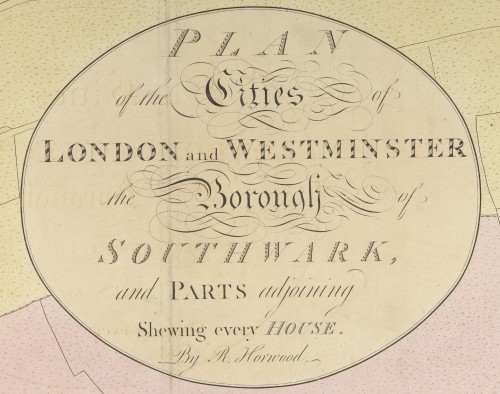
Inquiring readers, I can’t gush enough about this website, which started out as a research project by Matthew Sangster “to explore the life and culture in London in the late 18th and early 19th centuries.” I discovered the site when I wanted to trace Jane Austen’s trip from her brother Henry’s house on Henrietta Street to Carlton House, the home of the Prince Regent, after the Prince’s librarian, James Stanier Clarke, invited her to visit in 1815, just as she was completing the final touches on Emma. I found the route in Horwood’s Plan of the Cities of London and Westminster in the Borough of Southwark, and Parts Adjoining Shewing every House (1792-99).

Logo of the title

Horwood’s Plan of the Cities of London and Westminster in the Borough of Southwark, and Parts Adjoining Shewing every House (1792-99).

Romantic London, the website, is divided into a number of topics of vast interest to historians, lovers of Jane Austen and the Regency era, authors, researchers, and teachers and students. In addition to Horwood’s Plan, Sangster offers tabs entitled Harrris’s List (1788), Antiquities (1791), Picturesque Tour (1792-1801), Modern London (1804), Microcosm (1804–10), Life in London (1821), and Wordsworth’s Prelude (1850). He includes a blog and provides an email address for those with questions.

It is worth your while to read the introduction to each section, starting with Introducing Romantic London. I’ll describe a few of the wonderful features on this site, and will leave the rest for you to discover on your own.

Horwood’s Map (1792-9):

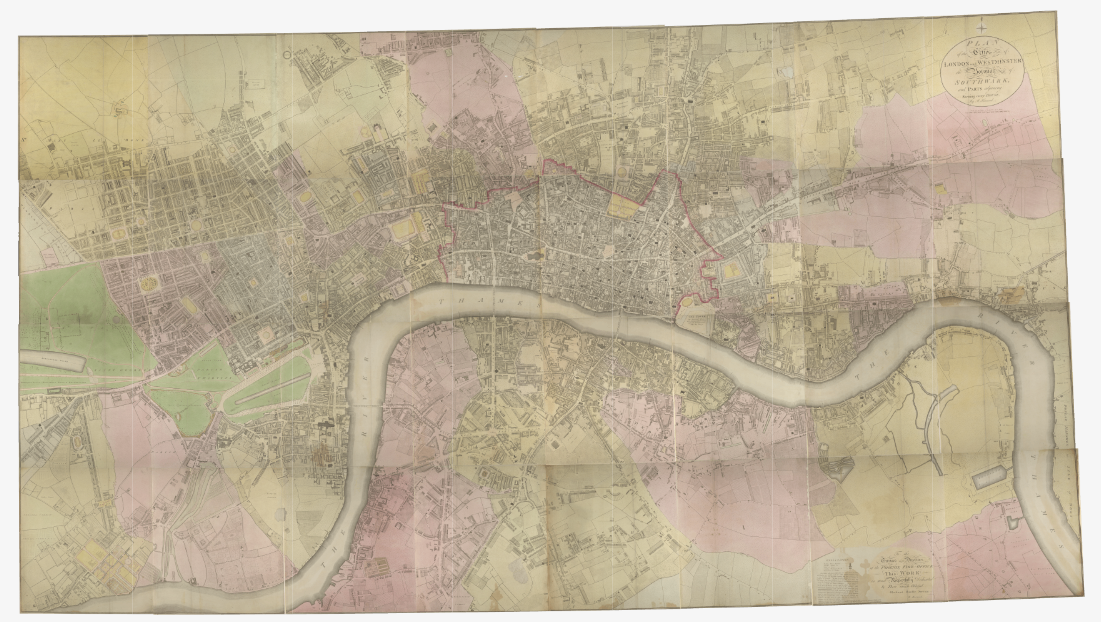
Image of the full Horwood Map

Notice the 32 pages that comprise Horwood’s Map. Image from Sangster’s website.

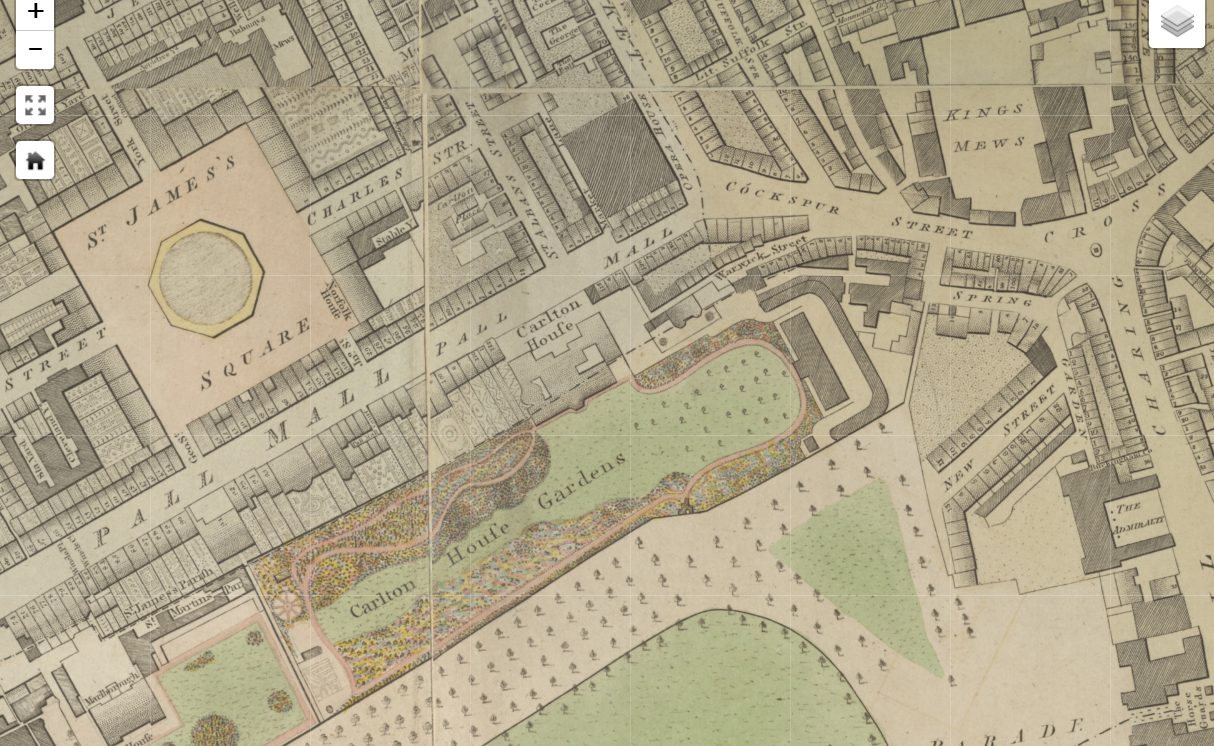
The entire map, as drawn, is composed of grids or 32 sheets. All one needs to do with this digital map is to place a cursor over an area. I chose one near Mayfair, and pressed “+” until I honed in on Carlton House. Click anywhere on this map and explore to your heart’s content.

Closeup of Carlton House and surroundings, with pale coloration of grass, trees, and squares

Detail of Carlton House, Carlton House Gardens, St. James’s Square, and Kings Mews.

The level of detail in this close up image is simply amazing. We see Carlton House and Carlton House Gardens in a bird’s eye view. All houses, with their back yards, stables or mews, common areas and gardens are delineated. Pale colors mark squares, grassy areas, and trees.

Included in this tab is a history and texts that show how Sangster uses Horwood’s Map for his and our benefit. As an example, let’s study the tab, Modern London, which is an 1804 guide to the city, published by Richard Phillips.

Modern London (1804):

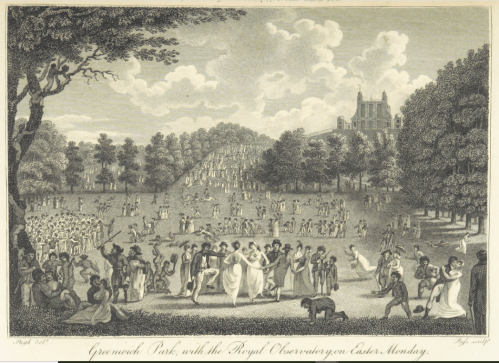
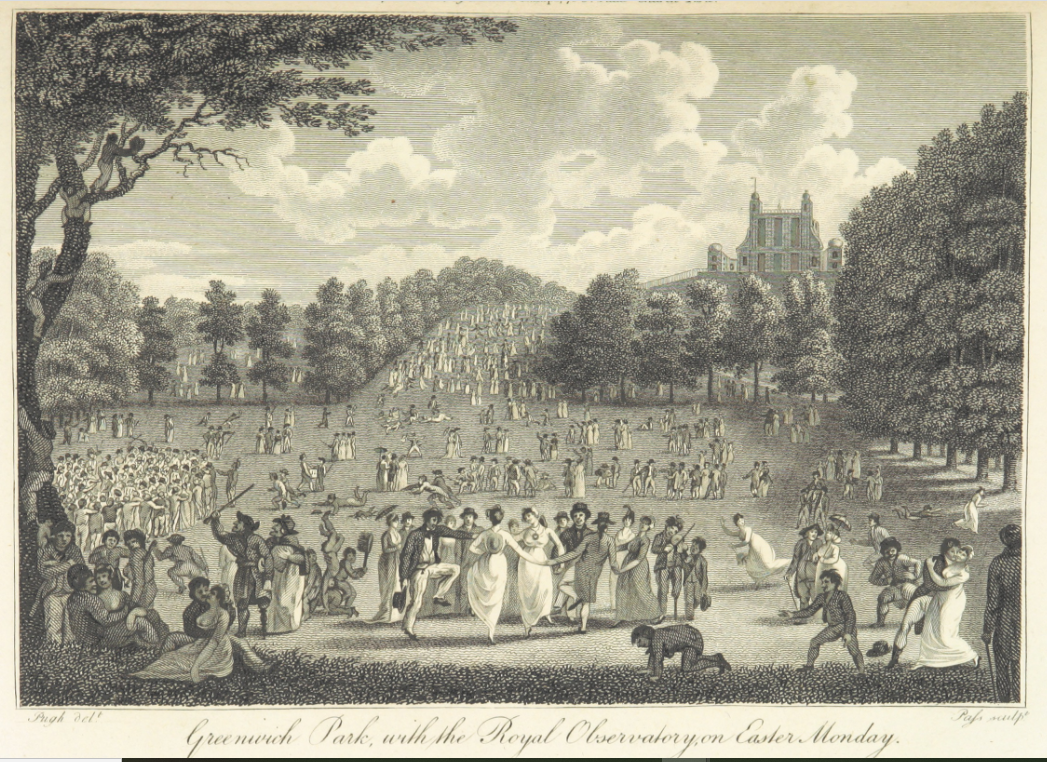
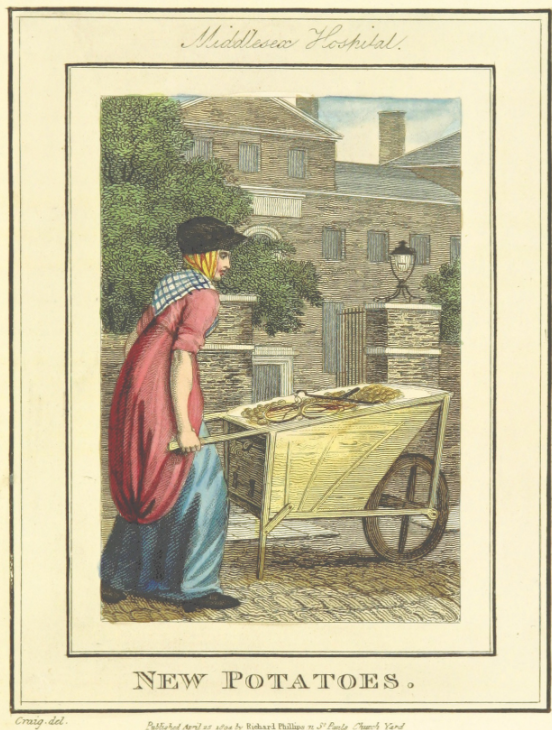
While the guide was written by Richard Phillips, the 22 views of key buildings and landscapes were engraved from designs by Edward Pugh and images of street traders and seller by William Marshall Craig. Many of us are already familiar with these images, but where were they exactly located? This tab answers that question in detail.

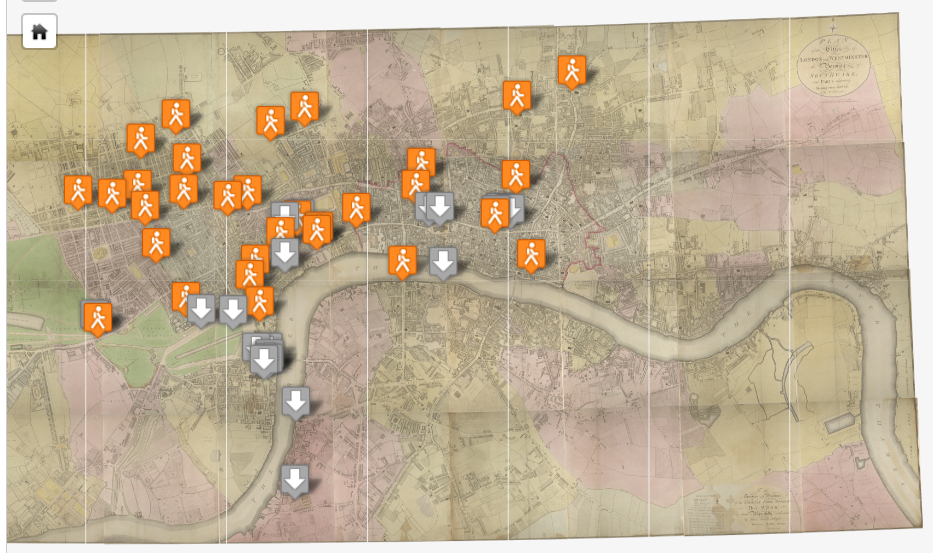
Orange markers and gray arrows superimposed over the entire Horwood's Map

Markers showing the locations described in Modern London

Superimposed on Horwood’s entire map are orange hiker tabs and gray arrow tabs. Hover your cursor over one, and the location is identified with a title of the images created by Pugh or Craig.

Black and white engraving of Greenwich Park with crowds celebrating Easter

Greenwich Park with the Royal Observatory on Easter Monday, Modern London, Edward Pugh

A street trader image:

Image of woman, dressed in red and blue, pushing a wheelbarrow with new potatoes past Middlesex Hospital

New Potatoes, Middlesex Hospital, by William Marshall Craig

Other tabs of note:

All the tabs lead to information for those of us interested in Austen’s era. In this section, I will detail only a few—those with images of and information about London created during Austen’s life. Each tab is designed like the one described in Modern London. You will first see Horwood’s Map with corresponding tabs, and then the engravings or lithographs and their descriptions (if they exist).

  • Antiquities (1791-1800) by John Thomas Smith shows plates of buildings, architectural details, and objects found in London.
  • Malton’s Picturesque Tour (1792-1801) consists of black and white engravings of major buildings and thoroughfares. 
  • Microcosm of London features images of Rudolph Ackermann’s famous Microcosm of London (1808-10). 
  • Select Views, or Select Views of London; with Historical and Descriptive Sketches of Some of the Most Interesting of its Public Buildings (1816) compiled by John B. Papworth and published by Rudolph Ackermann. 

In conclusion:

One reason this site excites me is that with Horwood’s map I can trace Austen’s visits to the places she and her family mentioned while staying with Henry in London, such as the Wedgwood Shop in Regent’s street. In the accompanying images that sit at the bottom of the various tabs, I can view how London looked in her day, and read contemporary accounts about these locations.

I am struck by how quickly London turns from city streets to rural surroundings; how closely houses are stacked together in the city’s center, each with their own chimneys and need for refuse removal. I can imagine how, on dry windy days, the dust from unpaved streets must have settled everywhere, and the smell of urine and feces from horses and cattle driven by drovers to Smithfield Market must have permeated through every nook and cranny, and windows and door cracks on hot summer days.

This map and the accompanying images, along with current accounts and subsequent histories, provide us (as readers and authors), with a way to follow the movements of historical and fictional people who resided in the largest city in Europe. It will also allow me to map my next visit to London, and choose specific locations to visit as I learn more about the time in which Jane Austen and her contemporaries lived.

Resources

British Library: Online Gallery: Plan of the Cities of LONDON and WESTMINSTER, Richard Horwood, 1795, includes a zoomable image, full size printable image, and a short history.

Layers of London: London Maps: Choose historical maps of London, and overlay them with information about a range of topics and themes.

Read Full Post »

Inquiring readers: I saw Emma. 2020 last March with my friend and neighbor, Jane, who was delighted with her first exposure to Austen’s favorite heroine. I began to write about the film, but laid the post aside when COVID-19 began to spread rapidly. I recently re-watched the DVD multiple times. The more I viewed the movie, the more I appreciated director Autumn de Wilde’s choices for retelling Emma’s story.

Many admirable reviews have already been written about this film and Autumn de Wilde’s directing, acting, fashion, sets and locations. The comedic and more absurd scenes were those that stayed longest with me. They, and the sumptuousness of the film’s photography, set it apart from other Emma adaptations. Here, in no particular order, are my thoughts.

Emma. 2020 begins with a contraction of Austen’s opening line:

Emma Woodhouse, handsome, clever, and rich, with a comfortable home and happy disposition, seemed to unite some of the best blessings of existence; and had lived nearly twenty-one years in the world with very little to distress or vex her.

The first scene demonstrates much of Austen’s opening statement. At dawn, just before sunrise, we see Emma walking across a lawn with a female servant and a footman, who holds a lantern to light the way. Inside a greenhouse, our heroine points to flowers, which the servant snips. While the scene is not in the book, Autumn de Wilde economically sets the stage for the viewer. Only a high born lady behaves in this manner, for Emma could have cut the blooms herself. I laughed silently in the theater; in private viewings I laughed out loud.

This sequence demonstrates that Emma is beautiful and rich, and that a rare life event has come to distress her—the loss of a beloved governess and mother figure. Miss Taylor is to wed Mr. Weston and move to his house, hence Emma’s reason for choosing the flowers for the wedding bouquet. The scene also demonstrates de Wilde’s eye for art and beauty. The colors and setting of this scene, and its quiet calm remind me of one of my favorite paintings by John Singer Sargent, although its subject matter is different.

Painting of Carnation, Lily, Lily, Rose 1885-6 John Singer Sargent. The Tate Gallery. Public domain image.

Carnation, Lily, Lily, Rose 1885-6 John Singer Sargent. The Tate Gallery. Public domain image, Wikimedia Commons

Inside the wedding chapel, we see the citizens of Highbury and their reverential attitude towards the Woodhouses as they take their seats in the front row pew. We also meet Mr. Elton (Josh O’Conor), whose exaggerated gestures and hand movements are a sight to behold, and Miss Bates, played to perfection by comedian Miranda Hart. More about both later.

But, But, Butt!

We first see Mr George Knightley (Johnny Flynn) astride his fine steed heading towards his magnificent house (Wilton House). He walks to his chambers through an exquisite interior filled with furniture draped in Holland covers, and enters his personal rooms. His valet awaits him as he undresses. My heart flutters, females around me gasp, and male viewers wonder what all the fuss is about, as we feast our eyes on Mr Knightley’s sculpted backside. He casually shaves in the nude and washes himself from a basin, then is dressed by his manservant. His attitude in this intimate setting is as casual as Emma’s when she directed someone else to cut flowers for her.

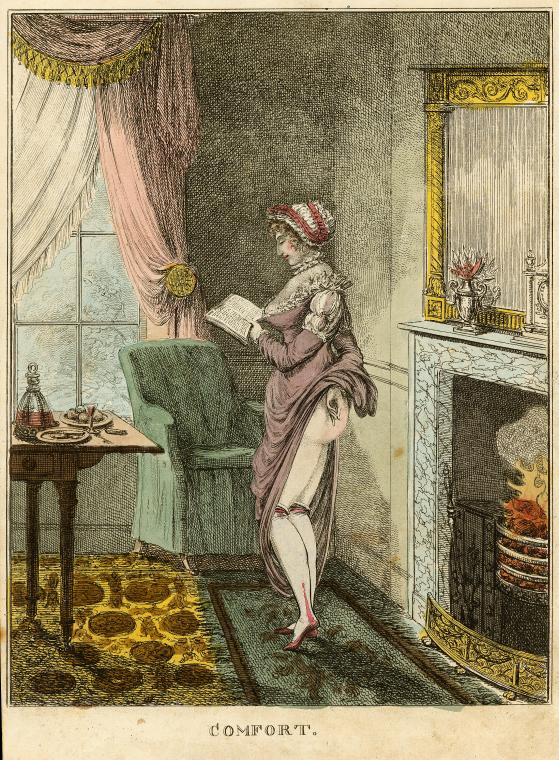
In another scene, a lady’s maid, who has just finished dressing Emma, leaves her alone. As she warms herself in front of the fire, we see that Regency ladies did not wear underpants. These items were considered shocking, for ladies wore stockings and a chemise under their gowns, while knickers and drawers were worn only by lower and working class women. This is the most flesh that any Emma in any film adaptation has shown, albeit in profile. I wonder if de Wilde drew inspiration from this 1796 caricature entitled “Comfort” by Matthew G. Lewis?

print cartoon of a lady warming her bare backside near a fire.

Comfort, 1796, M.G. Lewis. New York Public Library digital collection, Public domain print.

The heroine and hero, Emma Woodhouse and Mr George Knightley

Anya Taylor-Joy (Emma), possesses the fine acting skills necessary to play this complex young woman. After seeing her in The Queen’s Gambit, I (we all) predict a stellar career for this young actress, who was 23 when she was cast. Her expressive face changes like a chameleon’s, and her unusual features–beautiful at times, but not so pretty when she’s being haughty, argumentative, angry, or devious–sets her apart from the other blander-faced actresses who have portrayed Emma.

Taylor-Joy, as well as 36-year-old Johnny Flynn (Mr Knightley) are well cast for their roles and each other. George Knightley, the hero of the piece, is 16 years older than Emma, a not unrealistic age difference given that it was common for a young woman to marry an older man in Austen’s day. In this film, the actors are physically well matched. Both are unusually handsome people who share an undeniable chemistry on screen. This attractive combination overcomes any distaste the viewer might have towards Mr Knightley’s tendency to preach at Emma like a stuffy old uncle, or to her misguided and almost ruinous interference in Harriet Smith’s life.

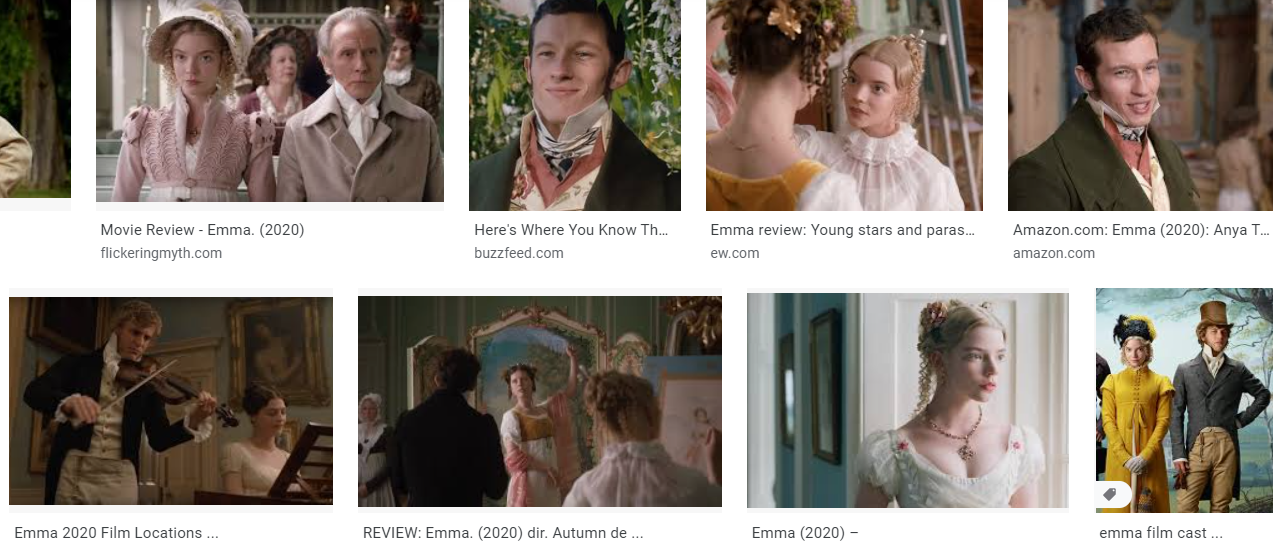
Screenshot of the actors in the film

Screenshot of thumbnail images for Emma. 2020

Mr. Woodhouse transformed

Mr. Woodhouse, played by Bill Nighy, is still the fearful hypochondriac Austen created, but in this film the man is broadly comical, which audiences acquainted with Nighy’s acting roles would naturally expect. Austen readers will not quite recognize Nighy’s Mr. Woodhouse, whose first entrance as a vigorous man, bounding down the stairway and landing with a jump, is a surprise and good for a chuckle. Emma caters to him as usual, but more as a fussy daughter than as someone caring for an infirm man old before his time. Nighy’s facial ticks and physical mannerisms are priceless, but his outer awareness of Emma’s needs and emotions, while touching in the film, are not in Austen’s book (unless I missed something). The actor’s interpretation is of a pampered man who spends his cozy, privileged life in fear of germs, drafts, and rich foods, and losing the last of his family (an adoring daughter) to marriage. He wants his comforts to stay exactly the same.

Bartholomew and James, the draft dodgers

Nighy and the two footmen, Batholomew and James, form a Regency version of the Marx brothers, and provide a series of comedic interludes. While the two footmen never speak, viewers know from their expressions and physical mannerism exactly what they’re thinking. Aside from their usual footmen duties, which are onerous, they are in charge of anticipating Mr Woodhouse’s every need and defending him from drafts—whether from a window or cold air entering an insufficiently heated room, or to hide their master behind a series of screens to provide privacy for Emma and George Knightley at the end of the film. (Austen’s Mr Woodhouse would not have been so observant.) 

Mr Woodhouse surrounded by screens to protect him from drafts

Publicity still of Mr Woodhouse protected from drafts

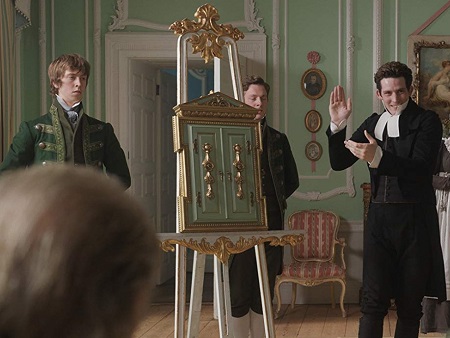
B & J’s crowning moment comes when they unveil Emma’s simple watercolor portrait of Harriet in a too ornate frame selected by Mr Elton. As they reveal the portrait within the awful frame, their eyebrows twitch, their eyes brighten with excitement, and their mouths and cheeks emanate humorous contempt. A tight-lipped Mr Knightley, knowing what Mr Elton intends, remains sternly quiet.

James and Bartholomew flank the frame as Mr Elton is about to reveal its contents.

The moment before James and Bartholomew reveal the portrait in Mr Elton’s frame. Detail of publicity still.

Food, food, glorious food

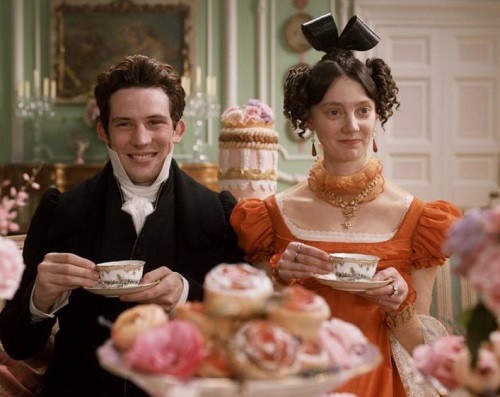
Regency tables were indeed laden with an outrageous variety and quantity of foods during special occasions, such as a wedding breakfast, private ball, or holiday dinner. In this film, the food served during tea service was over the top insane. During Austen’s era, afternoon tea was meant to be a small stopgap meal between breakfast and a dinner that was served quite late by the upper classes. Emma would have offered visitors, such as Harriet and the Eltons, simple sandwiches, biscuits, and small cakes with a cuppa.

Still, it gave me a chuckle to see Harriet Smith’s eyes bug out at the sight of all the goodies on the tables in front of her and behind her, and look to Emma for direction on when to start eating, which never came. Better yet, in a later scene in honor of Mr Elton’s new bride, both tables groaned with even more sponge and tea cakes, cucumber sandwiches, strawberries, cookies, crumpets, chocolate truffles, and more. When Mr. Elton reaches for a cookie, Mrs Elton instantly slaps her caro sposo’s hand away, telling us in no uncertain terms who wears the knickers in that family!

Image of Mr and Mrs Elton taking tea

Mr and Mrs Elton at Emma’s tea. Publicity still, cropped

The most memorable table scene is reserved for Miss Bates, who shouts at a dinner in honor of Miss Fairfax, “MOTHER, YOU MUST SAMPLE THE TART!” Whereupon Mr Woodhouse persuades the always silent, nearly deaf Mrs Bates to sample something less rich so as not to upset the digestion. (Miss Hart’s unforgettable delivery earned a place in the film’s promotional ads.) 

He loves me, he loves me not. Oh, no! I love another man! Oh, drat. I was wrong.

Harriet Smith is Emma’s naive victim and putty her hands. Played by Mia Goth, she is, in my opinion, the best Harriet of all the actresses who have portrayed her. After Miss Taylor wed Mr. Weston (whose successful union Emma credits herself for achieving), she casts around for another match making opportunity and settles on Harriet, the natural daughter of an unknown somebody. Despite Mr Knightey’s warnings, Emma convinces herself of Harriet’s noble connections and takes the gullible young girl under her wing.

Mia Goth’s interpretation of this naive and fickle young woman, so easily persuaded by her betters, is priceless—from her wide-eyed expressions, innocent reactions, cute duck-ish gait, to her puppy-ish adoration of Emma. More importantly, this Harriet’s inconstancy is believable, for she craves Emma’s approval. In short order, she falls for Mr. Martin, rejects his sincere proposal of marriage (in the hope of pleasing Emma); is persuaded to fall for Mr. Elton, only to soulfully mourn his rejection; then falls for Mr Knightley when he asks her to dance after Mr Elton cuts her to the quick at the Weston’s ball. When she realizes she was wrong in her perception about Mr Knightley returning her affection, she is easily persuaded to fall for Mr Martin again after he renews his pledge of love and offer of wedded bliss. (Whew, gentle reader, that was a mouthful!)

Pretty maids in a row

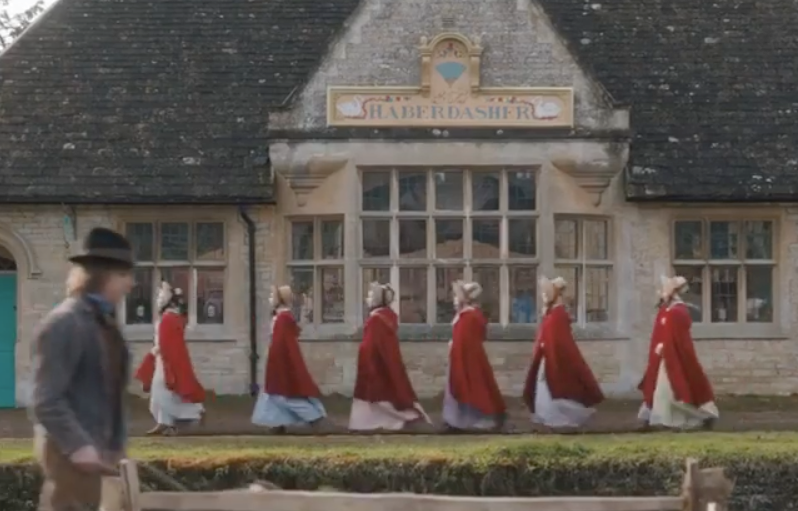
The one visual that instantly brings Emma. 2020 to our minds is of the long line of young ladies in Mrs Goddard’s boarding school walking around Highbury (Lower Slaughter) and the countryside in bright red robes, which were actually popular during this period, and dutifully following Mrs Goddard, with Harriet Smith among them. Their frequent appearances puts a smile on my face, but they also eerily remind me of A Handmaid’s Tale.

Image of a line of girls in red robes

screenshot of girls following Mrs Goddard two by two through Highbury

Miss Bates and her jabbering

Miss Bates in both book and film regurgitates inane reams of monopolizing blather. Miranda Hart plays the spinster to perfection. Despite her character’s deficiencies as a sensible communicator, Miranda projects Miss Bates’s tenderheartedness and vulnerability at the same time. When Emma is corralled by Miss Bates in the haberdashery shop, her face barely disguises her chagrin and she does all but turns somersaults to get away. Miss Bates, not deterred, follows Emma around the shop, babbling all the while.

Miss Bates plays a crucial role in the pivotal Box Hill scene (Leith Hill in the film), where Emma cruelly points out the spinster’s talent in making more than three dull statements. Almost instantly Emma realizes how callous she sounded. As Miss Bates fights off tears, the silence in the group is so awkward that even Augusta Elton holds her tongue. No one spares Emma any sympathy. After Mr Knightley tells her angrily, “It was badly done, indeed!” he reminds her of Miss Bates’s humble situation and lower status. Sitting alone in her carriage, she finally begins to understand how others see her and the picture isn’t pretty.

The Eltons

We now come to the Eltons, a comically awful couple written for the film much as Jane Austen envisioned them–ridiculous and puffed up with their own consequence. I recall reading somewhere that Augusta Elton (Tanya Reynolds) mirrors Emma’s worst traits stretched to the nth degree. It is fitting that this nouveau riche upstart, whose father made his fortune in trade, has a brother-in-law named Mr Suckling. Autumn de Wilde chose to dress Augusta in an exaggerated way. She wears too much jewelry and chooses gowns with too many ribbons and ruffles and too bright colors. Her hairstyle did not exist until at least 7-12 years after Emma was published, but it suits the character to a tee.

Mr Elton leaves Highbury in a huff after Emma forcefully rejects his proposal. This comedy of misunderstandings resulted from Emma believing he was wooing Harriet, when in fact he was wooing her. Alone in a carriage with his love, and away from Harriet or any other interference, Mr Elton declares his undying devotion. Emma is horrified, and reminds him of Harriet. Mr Elton, still dewy-eyed, says unctuously, “Who can think of Miss Smith when Miss Woodhouse is near?” Taylor-Joy is outraged and disgusted at the same time, and all but blurts out “Ewww!” before decisively rejecting him. The true Mr Elton appears instantly—a nasty, mean, and spiteful man. Pounding the carriage roof he shouts, “Stop the carriage!” When it doesn’t stop soon enough, he screams, “STOP THE CARRIAGE!” Before he knows it, he’s left out in the snow, leaving Emma clueless as to how she read the tea leaves wrong. The constancy of his love becomes clear when he is engaged to the very rich Augusta within four weeks of meeting her!

A dance, and a proposal in the nosebleed section

Mr Knightley and Emma fall in love dancing in a scene at the Weston’s ball that is exactly right and, oh, so romantic. She witnesses him rescuing Harriet from Mr Elton’s cruel rejection of the young girl as a dance partner, and dances with her himself. Emma turns all mushy inside thinking of Mr Knightley as, well, a knight. They dance. They fall in love…but, wait. How can this be? It is not the end of the film!

A few more misunderstandings ensue, causing our hero and heroine to pull away, despite their burning desire for each other. Mr Knightley believes that Emma harbors real feelings for Frank Churchill. Meanwhile, she has discovered that Harriet has fallen in love with her knight. Then Mr Knightley learns of Frank’s engagement to Jane Fairfax, and rushes to Hartfield to console Emma. Emma feels guilty about Harriet and… well, see for yourself:

I learned one new medical fact in a google search: Nosebleeds can indeed result from stress or anxiety. Rumor has it that Anya Taylor-Joy had a nosebleed on cue. What an actress!

A tisket, a tasket, humble pie in my basket

Emma’s visits with baskets for her victims mark turning points in her self-awareness. After the disastrous picnic at Box Hill, she visits Miss Bates in her small rooms. The spinster is gracious and grateful for the food, which makes Emma feel even worse. This is a true humble pie moment.

Her next basket visit is to Mr Martin’s farm to apologize. It is just as cringe worthy. She carries a freshly killed goose, some jams or jellies, and her rolled up watercolor of Harriet. Her arrival in person with kind words and a gift signify strong hints meant to encourage the farmer to try his suit with Harriet again. Thankfully, he takes the hint.

All’s well that ends well

Mr Knighley and Emma marry in a lovely wedding. Mr Woodhouse is not unhappy, knowing that Mr Knightley will come to live at Hartfield so that Emma won’t move away. The Westons have a baby, and Harriet Smith will meet her papa (finally), who turns out to be a tradesman. She and Mr Martin are seen as a couple at church. The ending is fittingly romantic, and my heart flutters once again.

In conclusion and in all seriousness

Emma. 2020 is director Autumn de Wilde’s first full length feature film. Before this project, she’d directed music videos and published several books. She is also well-known for her work as a portrait photographer. In this film, she told Emma’s story in a little over 2 hours. Many plot lines from Austen’s second longest book were cut, and a number, such as the opening sequence and bullet pudding game, deviate completely from the novel. The divisions into the four seasons is a smart way to show the passage of time, and the film’s fashions, locations, and sets are breathtaking. Historians caution viewers in general that the houses in Austen films, especially Wilton House, are too grand for her characters, who are often country gentry. Wilton House is the seat of the Earls of Pembroke, a peerage title first created in the 12th century. While Mr. Knightley is quite wealthy, it beggars belief that he could afford a house as grand as this, but this story is filmed as a fairy tale after all.

Additional Resources:

View ten short clips of movie scenes from Focus Features https://www.youtube.com/results?search_query=Emma+2020+focus+features

Read Full Post »

By Brenda S. Cox

“I would rather do anything than be teacher at a school” — Elizabeth Watson in The Watsons

No doubt you’ve heard how restrictive Austen’s world was for women. When a woman got married, all her wealth became the property of her husband (unless she had a good lawyer who arranged things differently). A lady without money or a husband might end up a governess (Jane Fairfax compares that to slavery) or a teacher at a girl’s school (Elizabeth Watson would “rather do anything than be a teacher at a school”). A man could divorce his wife by accusing her of adultery (even if there wasn’t what we would consider clear proof), but a woman was almost never able to divorce her husband.

Despite all that, there were outstanding women of the Georgian era who broke through those barriers. Some were widows, some were single, some were married.

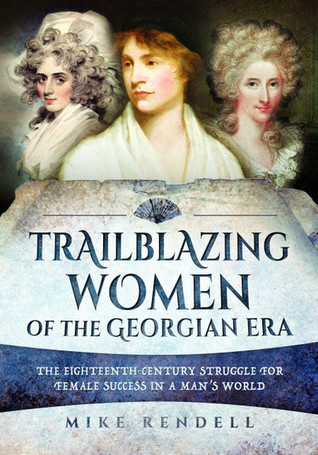
Two fascinating books tell us about some of these boundary-breaking women. Mike Rendell’s Trailblazing Women of the Georgian Era (Pen & Sword 2018) brings us seventeen women from the eighteenth-century who made outstanding contributions in Arts & Literature; The Scientific World; Business & Commerce; and Reform and Education. Rendell explains the legal position of women in Austen’s world, and after each short biography gives a wider picture. For example, at the end of the chapter on Lady Mary Wortley Montagu, who promoted smallpox inoculation in England, we learn more about smallpox, “the most dreadful scourge of the human species” (according to Edward Jenner, who developed vaccinations). At the end of Trailblazing Women, Rendell continues the saga of women’s achievements in England, into the present.

Trailblazing Women of the Georgian Era, by Mike Rendell, tells the story of 17 boundary-breaking women.

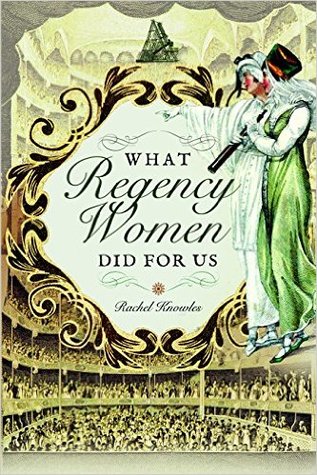
In a complementary book, What Regency Women Did For Us (Pen & Sword 2017), Rachel Knowles shares the lives of twelve Regency women who made an impact on their communities and on our world today. Knowles does not give such wide coverage as Rendell, but tells the fascinating story of each woman in more depth. She is more focused on the Regency period, while Rendell adds earlier women from the 18th century.

What Regency Women Did For Us, by Rachel Knowles, tells the stories of a dozen Regency women who impacted our world today.

Rendell and Knowles chose some of the same women and some different ones. Both introduce actress Sarah Siddons, scientific book writer Jane Marcet, engineer/inventor Sarah Guppy, artificial stone manufacturer Eleanor Coade, and prison reformer Elizabeth Fry. Rendell adds businesswomen, writers, an anti-slavery campaigner (Lady Middleton), and others, while Knowles adds mountaineer Mary Parminter, fossilist Mary Anning, astronomer Caroline Herschel, our own Jane Austen, and more.

Let’s look at a few of my favorites, out of all these fascinating women.

Jane Marcet: Author of Science Books for Women

Rendell identifies Jane Marcet as a “scientific book writer,” while Knowles calls her “Faraday’s teacher.” I love that Marcet wrote science books for girls and women in an age when many thought that reading and arithmetic, embroidery and music, were all that women needed to know. I can imagine Fanny Price reading Marcet’s books and developing her love for the natural world.

Like Jane Marcet, I love chemistry, and I love to write about complex issues, making them clear and understandable. So Marcet seems like a kindred spirit to me. Her husband was a doctor who enjoyed chemistry. They attended lectures together at the Royal Institution in London to hear Humphry Davy explain the latest chemical discoveries. Jane Marcet had been given a basic grounding in science at home and even learned some Latin, which Regency girls rarely studied.  However, she still needed her husband’s help in understanding the scientific vocabulary that Davy and other lecturers used.

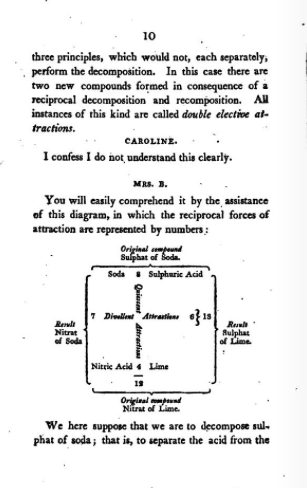
A page from Jane Marcet’s Conversations in Chemistry, which taught science to young women and many young men, using discussions, pictures, and everyday examples.

Marcet wrote a book, Conversations on Chemistry, to help other women understand those lectures. In dialogues between a woman teacher and two female students, Marcet explains basic chemical concepts in clear language with everyday illustrations. Practical experiments, questions and answers, and Jane Marcet’s own illustrations make the book even easier to understand. She published it anonymously in 1805 (as Jane Austen published her books anonymously), but her name was later added to it. The book was very popular in both England and America.

Conversations on Chemistry became a standard school textbook for teaching science to girls, as well as for teaching at home. But Marcet’s book didn’t just benefit girls. Boys without access to much schooling also learned from it. Marcet’s book introduced Michael Faraday, who had little formal education, to chemistry. Faraday went on to make major discoveries in chemistry and electricity and also lectured to the public at the Royal Institution.

Jane Marcet went on to write popular books teaching economics, natural philosophy (science), and botany, as well as Conversations on the Evidences of Christianity. She helped revolutionize education, particularly for women, making these subjects accessible to all.

Hester Bateman: Silversmith and Business Owner

When I visited colonial Williamsburg during the 2019 JASNA AGM, I was surprised to learn that most eighteenth-century trades included women. In England, Hester Bateman was a well-known silversmith, with her own company. Like many Georgian women who made names for themselves, her career began when her husband died. He was a silver worker who taught his wife to assist him. She was illiterate herself, but he bequeathed his tools to her, rather than to their sons, and she immediately took over the business, calling it “Hester Bateman and Company.” She registered her own mark, “HB,” which still identifies her work today.

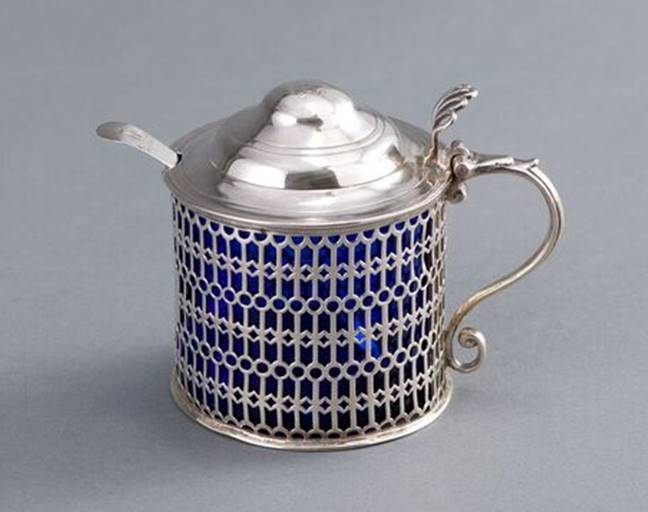
Hester Bateman developed beautiful, simple, classical designs for the dining rooms and tea tables of the upwardly-mobile middle classes. Her family business expanded into  a workshop across the backs of three houses. She and her company produced many thousands of silver objects. Her sons, daughter-in-law, and grandchildren eventually took over the prosperous business. But Hester herself ran the company until she died at age 82.

This mustard-pot is lined with blue glass so the mustard does not react with the silver. It was made in 1774 by Hester Bateman, a lady silversmith with her own mark. Lauren Rogers Museum of Art, gift of Thomas M. and Harriet S. Gibbons, used by permission.

In Trailblazing Women of the Georgian Era, Rendell tells us about other Georgian businesswomen who made lace, sold stocks, manufactured artificial stone (used for anything from tiny ornaments to giant statues), owned a print shop, wrote and sold cookbooks, and manufactured chocolates. He even includes a “bigamist, litigant and courtesan,” Teresia ‘Con’ Phillips, as a businesswoman, to show the limited avenues available for women. He wonders why there were not more Georgian businesswomen. However, I’m impressed that, despite the restrictions on women owning property and having their own money, there were so many Georgian businesswomen that we still know about today.

Madame Tussaud: Artist and Businesswoman

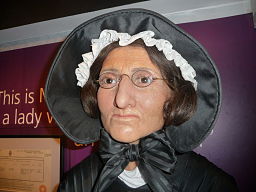
Rachel Knowles calls Marie Tussaud “Entrepreneur Extraordinaire.” Madame Tussaud was a talented artist and craftswoman as well as a smart and creative businesswoman.The wax museums she developed are still popular today.

Waxwork of Marie Tussaud, at Madame Tussaud’s in London. Photo by Immanuel Giel, CC BY-SA 3.0 via Wikimedia Commons

Marie’s mother was housekeeper to a Swiss doctor, Philippe Curtius, who adopted Marie as his daughter. Curtius made wax models to show the anatomy of the human body. His models were so successful that he left medicine and set up a waxworks in Paris. He taught Marie how to make wax models and how to run a business. During the French Revolution, Marie and Curtius made wax models of the royal family, of people who had been guillotined, and of prisoners and revolutionaries. Marie took impressions of people’s heads shortly after they were cut off—quite a gruesome job.

When Curtius died, he left his waxworks and other property to Marie. She married François Tussaud, but her marriage settlement ensured that she kept control of her own property—that was unusual in France, as in England. It was a good move, since her husband turned out to be irresponsible with money. In 1802 she moved her exhibition to England. Her husband stayed in France, and she eventually gave him her French property, but she kept the waxworks and her income from it.

After some difficult years and an unprofitable partnership with an English businessman, Madame Tussaud developed her exhibition into a popular traveling show. In 1833 she set up a permanent exhibit in London. Her sons took it over—she transferred it into their names to keep her husband from getting it.  The waxworks survived the centuries and Madame Tussaud’s is still one of the most popular attractions in London, with related wax museums around the world.

In What Regency Women Did for Us, Knowles includes other women with unusual stories, such as Harriet Mellon, the penniless Irish peasant who became a wealthy banker and left a fortune to a Victorian woman philanthropist. Mary Parminter, another unusual Regency woman, took the Grand Tour of Europe (usually a men’s activity) with her cousins while they were unmarried, and climbed mountains. Mary stayed single, keeping control of her extensive fortune and using it to build a lovely chapel and provide homes for independent single women.

If you have been thinking that teaching and writing were the only occupations open to Georgian and Regency women, these two books will open your eyes. Many women pushed outside the boundaries of societal expectations and left lasting legacies. In both Mike Rendell’s Trailblazing Women of the Georgian Era and Rachel Knowles’ What Regency Women Did For Us you will meet many such women and enjoy their exciting stories.

You can find Mike Rendell at Georgian Gentleman. Rendell has written books on other aspects of Georgian society, including Journal of a Georgian Gentleman.

You can find Rachel Knowles at Regency History. For an additional review of What Regency Women Did For Us, see “Women of Science, Women of Faith.” Rachel has also written a fun Regency novel, A Perfect Matchand is about to release a second book in the series, A Reason for Romance.

You can connect with Brenda S. Cox, the author of this article, at Faith, Science, Joy, and Jane Austen or on Facebook.

Read Full Post »

When I visited Bath in the U.K., I made a point of seeing No. 1 Royal Crescent, a fascinating museum whose interior was decorated in the Georgian style of the late 18th century/early 19th century. One had the feeling when entering the house that it may have been inhabited by people Jane Austen might have met in the Pump Room or the Upper Assembly Rooms. 

Completion of the Royal Crescent, Thomas Malton, 1769. No. 1 Royal Crescent sits towards the front.

Completion of the Royal Crescent, Thomas Malton, 1769. No. 1 Royal Crescent sits towards the front. Image in the public domain. Wikimedia.

My one lasting memory is of the kitchen and a contraption near the ceiling. It hung in the far corner near a fire place and looked like a torture instrument. Inside the wooden wheel was a stuffed dog, popularly known in its time as a turnspit dog, which represented a breed that no longer exists. They were small, long-bodied, and sturdy; had short crooked legs; and were trained to run inside a wheel that turned a roasting spit. These long-suffering, hard-working canines, resembled curs not purebreds, and saved cooks (or menial boys of the lowest servant order) the task of turning roasting spits by hand for hours. 

Turnspitdog-1862

Turnspit dog, 1862. H Weir – Illustrated Natural History, Rev JG Wood.  Image in the public domain. Wikipedia 

The dogs were first mentioned in 1576 under the name “Turnespete”(Wikipedia). Their lives were hot, tedious, strenuous, and short. They were considered more kitchen utensils than pets, this during the centuries when animal cruelty was casual and baiting animals was a sport. 

1024px-Turnspit_Dog_Working

A dog at work inside a wheel near the ceiling; from Remarks on a Tour to North and South Wales (1800). Wikipedia, public domain image

“To train the dog to run faster, a glowing coal was thrown into the wheel”- Turnspit Dogs: The Rise and Fall of the Vernepator Cur, NPR

Their breed was considered so common that its origins are unknown, although some experts think the turnspit dog was related to a terrier or perhaps the Welsh Corgi. Imagine the life of this dog–confined to a wheel for hours, forced to run near a fireplace while smelling the roasting meat of an animal that was out of their reach, tired, aching, and thirsting for water. 

“The wheels were put up quite high on the wall, far from the fire in order for the dogs not to overheat and faint.”- NPR

As we all know, heat rises, so one wonders how well that placement worked! Turnspit dogs worked in alternating teams of two and were regularly relieved by an equally hardworking companion dog. They often were given Sundays off, not because their owners cared about their well being, but because they acted as foot warmers in cold church pews (Kitchensisters). One must imagine their relief for these few hours of rest.

turnspit-2-e1453334578380-Whiskey-Barkpost

Whiskey, the last known turnspit dog, now on view in the Abergavenny Museum in Wales.

These tiny unloved dogs were prevalent in the mid 18th century, but by 1900 mechanical spit turning machines replaced them. Since they were considered ugly and lowly, their breed became extinct. Whiskey, the last known surviving turnspit dog, lives on as a taxidermied specimen in the Abergavenny Museum in Wales. 

As an interesting footnote, in the United States the plight of the turnspit dog inspired the founding of the SPCA (Society for the Prevention of Cruelty to Animals).

“In 1850, founder of the ASPCA, Henry Bergh, was so moved by the appalling conditions in which the Turnspits were found in Manhattan hotels, that its horrific living conditions contributed to the birth of the organization in 1866. Coincidentally, this was around the time the dogs had become scarce, and 50 years later, they completely disappeared.”- Barkpost

Note: Before COVID-19, Vic volunteered with the local SPCA, which is a no-kill shelter. She’s also been privileged to live with two rescue dogs, both of whom were (aside from friends and family) the loves of her life. Neither dog revealed their living conditions before she adopted them.

More References:

Spit Roast Doggie, Richard Wyatt, September 21, 2014, Day by Day. Bath News Museum

A Breed You’ve Never Heard Of Is The Reason We Fight Animal Cruelty Today, Bark Post

Read Full Post »

« Newer Posts - Older Posts »