Feeds:
Posts
Comments

Archive for the ‘Jane Austen’s World’ Category

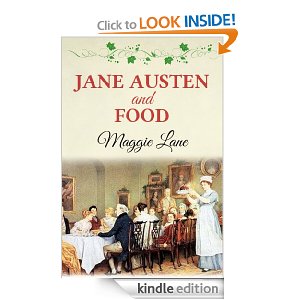
jane austen and food Jane Austen and Food by Maggie Lane is not a cookbook with recipes, but a well-researched, highly informative, and entertaining historical discussion about food, mealtimes, manners, and housekeeping in the age of Jane Austen. Lane examines Austen’s letters regarding food and drink, and how she uses both to define the characters in her novels.

Today, the Jane Austen and Food’s hardcover edition, which was first published in 1995, can be purchased on Amazon in hardcover or paperback for $85 to $129! But the kindle edition from Endeavor Press is available for a mere $2.99 – and it contains the same content as the hardcover and paperback editions. (Keep in mind that kindle apps are available for those who do not own kindles. I have downloaded the book on my iPad and android devices, for example.)

Let me explain what a bargain you will be getting with the kindle version of Maggie Lane’s thoroughly enjoyable and informative book. Jane Austen’s treatment of food yields new insights in which she creates character and establishes her moral values in her novels:

In Steventon, the glebe lands (which added to about 3 acres) supplied the Rectory with pork, mutton, wheat, peas, barley, hops, and oats and hay for the horses. The surplus in produce contributed up to £300 per year to the Austen’s income. They made their own mead and wines and preserved foods that were produced with foods in season. The only commodities that were purchased were expensive items like tea, coffee, chocolate, sugar, spices, and dried fruits.

No gentleman, single or widowed, could run his own home. He depended upon a paid housekeeper to oversee his hearth for good dinners, or, like Mr Bingley, he required a sister to keep house for him. Mr. Rushworth depended upon his mother, while Mr. Collins was in need of a wife.  When Mrs. Austen was kept away in 1770 for a month to look after her sister in childbirth, Mr. Austen wrote that “I must bear … [for] about three weeks longer, at which time I expect my housekeeper’s return.” Jane never took the responsibility of a household completely, although she assisted whenever she was needed. Composing for her was difficult during such times, and she wrote, “Composition seems to me impossible with a head full of joints of mutton and doses of rhubarb.”

In terms of food and its purchase, the Austen’s move to Bath was a shock. Slow transportation changed the quality of the food that Jane and her family were accustomed to, and the very fact that they had to purchase all their produce made them anxious, for they had lost sources of revenue in the form of farm produce, pupils, and Reverend Austen’s clerical stipend. Milk was of a poor quality due to the cows being kept in unhygienic barns, and food, purchased at the bakers, grocers, butchers, poulterers, and fishmongers was quite expensive. In addition, its cost  fluctuated.

Mrs. Austen in particular never lost her love for working in a garden. She did so at Steventon and later at Chawton Cottage, where she dug up her own potatoes and delighted in her flower borders. According to one of her great-grand-daughters: “She wore a green round frock like a day-laborer’s.”

At Chawton Cottage, the Austen women were able to find their footing again, growing their own fruit and vegetables, rearing poultry, keeping bees, baking bread, and making wine and brewing beer. Villagers recalled in later years that their dog, Link, would carry home a pail of milk in his mouth. It must be emphasized that, although Jane Austen worried about financial security, she and her sister and mother were comfortable enough to eat well and, like Emma Woodhouse, to dispense charity to those less fortunate than themselves. If Jane envied others, it was for their freedom from perpetual contrivance. In the sale of her novels, she found some relief from such worry.

In later chapters, Maggie Lane describes the history of tea, coffee, and chocolate, and how these fashionable drinks were imbibed before and during Jane Austen’s day. Austen herself only mentioned chocolate twice in her letters, but Mrs Austen during her visit to Stoneleigh Abbey wrote that their breakfast at her ancestral home consisted of “Chocolate Coffee and Tea, Plumb Cake, Pound Cake, Hot Rolls, Cold Rolls, brad and Butter, and dry toast for me.”

Breakfast, lunch, dinner, and supper are described, but Lane emphasizes that Jane barely mentions these daily events in her letters and novels. She gives scant details, especially as to the preferences of her heroines, most of whom are not concerned with the daily details of food. There are hints here and there in her novels: Willoughby takes porter at an inn during midday, and Frank Churchill imbibes spruce beer on a hot day at Donwell.

Dinner times are moved up as the Regency era progresses. In 1798, Jane writes to Cassandra that they dine at half after three, and by 1808, “we never dine now till five.” This was a gradual shift in dinner-time that took place with most families during this era, although dinner in town (London) was taken fashionably later. In addition, dinners in the early 19th century were far less splendid than those in the latter part of the century. Edward Austen-Leigh noted that there was a “far less splendid appearance than it does now.” By the time Jane wrote Mansfield Park, silver forks emerged, as well as napkins and finger glasses. In 1808 Jane wrote, “My mother has been lately adding to her possessions in plate – a whole tablespoon and a whole dessertspoon, and six whole teaspoons – which makes our sideboard border on the magnificent.”

I could go on and on describing the enormous amount of information in this ebook. Lane goes on to discuss in great detail the attitudes towards food and domesticity in Northanger Abbey, Emma, and Mansfield Park – all of which excited this reader. The characters of Emma Woodhouse, Mr. Woodhouse, Mr. Grant, Mrs. Grant, Mrs. Norris, Mr. Price, and General Tilney are elaborated in great detail in their obsession (or not) with food and general housekeeping details.
tea cups ratingIs Jane Austen and Food worth the cost of $2.99? Oh, yes. Definitely.!I paid so much more for my hardback copy several years ago and do not regret its purchase. I give this ebook a rating of 5 out of 5 Regency teacups.
Read Full Post »

13 vignettes 1790 rowlandson

Image, Royal Collection Trust/© Her Majesty Queen Elizabeth II 2013

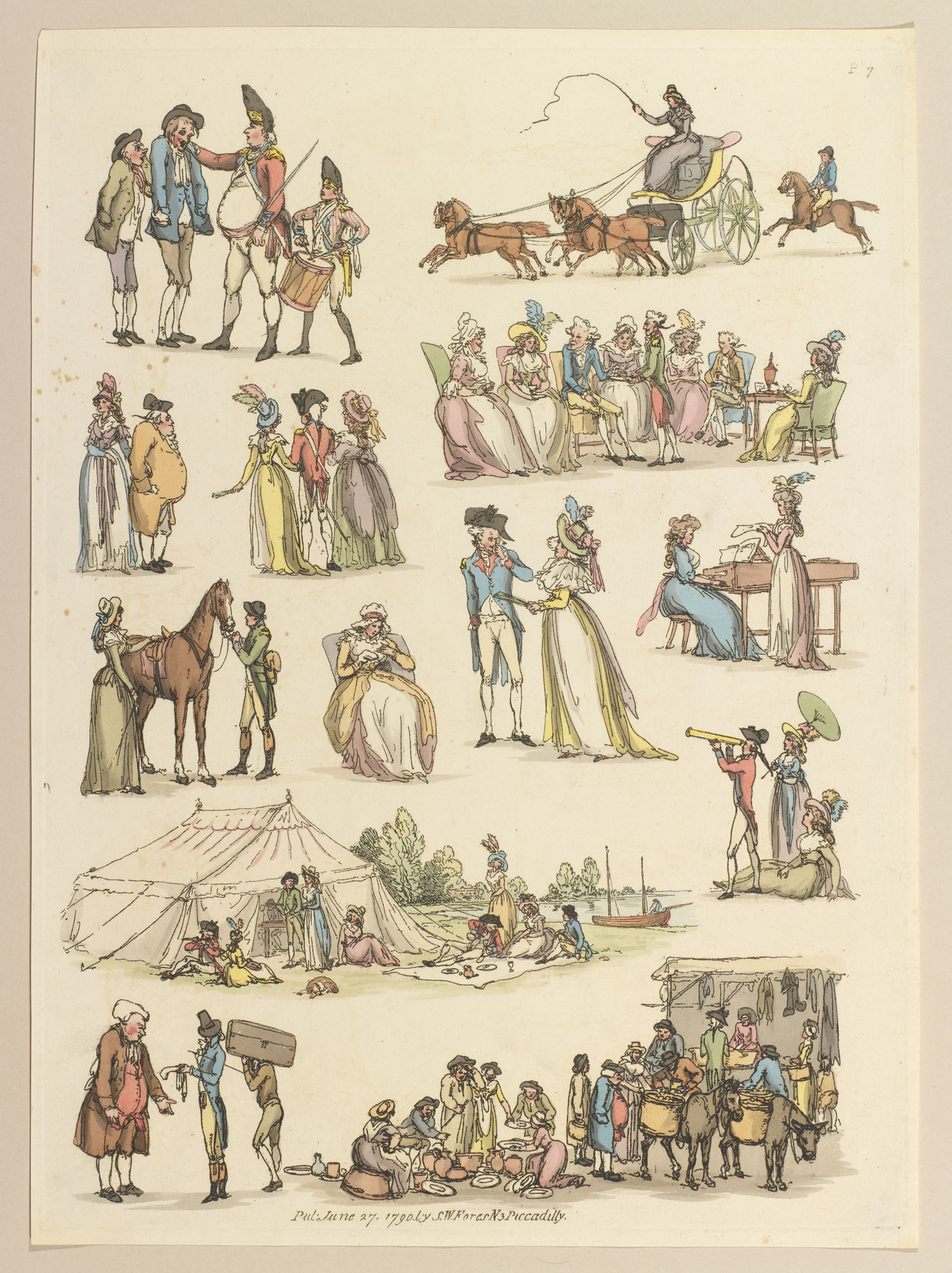
I love this 1790 hand-colored etching by Thomas Rowlandson from the Royal Collection Trust, which depicts 12 vignettes of everyday life and work in Georgian England. Sketches like these offer us a glimpse of ordinary life in the 18th century, much as photos and videos today. These vignettes are drawn from life, and unlike the serious, well-thought out poses of formal portraits, they show people of a bygone era going about their ordinary business.

In Pride and Prejudice, Jane Austen wrote of the militia visiting Meryton and Brighton. In her day, soldiers were encamped throughout Great Britain, ready to go to war at a moment’s notice or defend the homeland from invasions. Mrs. Bennet, Lydia, and Kitty were enamored with the smart bright uniforms of officers, who they regarded as quite the catch. The men passing through town provided new faces as well as relief from the routine of village life, for village folk (most of whom rarely traveled beyond the confines of their counties) moved in small and familiar social circles, for better or worse. (Mrs. Elton, anyone?)

new recruits

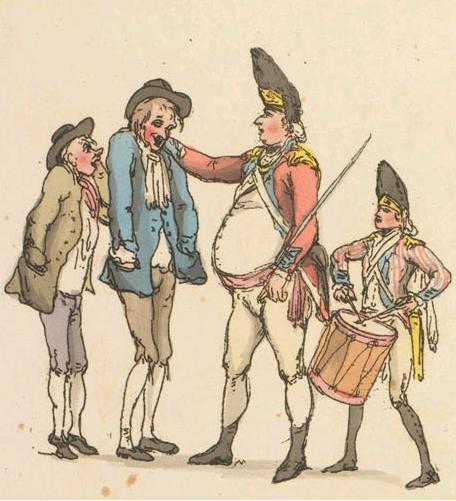
A soldier assessing new recruits for the army

The well-fed officer above assesses new recruits, who are obviously not officer material. One imagines that their lives in the army will not be as cushy as Captain Denny’s or Mr. Wickham’s, and that they would perform the most plebeian tasks.

A woman driving a phaeton

A woman driving a phaeton

High perch phaetons were the race cars of their day and a status of wealth. It is obvious that this woman is a skilled driver, but her escort remains close at hand to ensure her safety.

detail

Detail of the driver with her mannish driving habit, which was created by a tailor, not a seamstress.

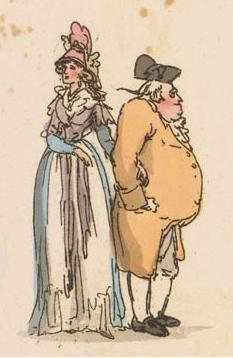
Increasingly throughout this century, women were allowed to marry for love, but ensuring one’s future as a wife could be a risky business. What if she married for love and her husband turned out to be a ne’er-do-well, barely able to support his family, as with Fanny Price’s father? Aristocratic women had no choice but to follow family dictates in order maintain the family’s status or improve their fortune. Other families sought to move up social ranks through their daughter’s mate. One wonders  in the image below if the young woman is married to her escort … or if she is simply taking a stroll with her father or uncle? We can only guess.

Couple walking. Father and daughter? Or old man with his young bride?

Couple walking. Father and daughter? Or old man with his young bride?

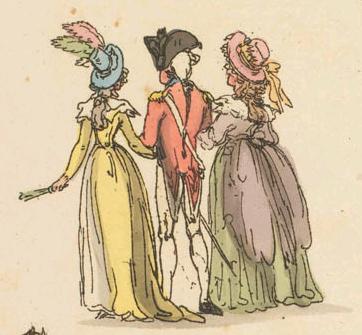
The trio below seems to be promenading along a street (or park). The women look chic in their walking outfits, the younger one wearing a hat with feathers and carrying a fan; the older woman, no doubt, making sure that her charge’s reputation remains spotless. Jane Austen began writing Northanger Abbey, Sense and Sensibility and Pride and Prejudice at the end of the 18th century, when these garments were fashionable. It’s one of the many reasons why we glimpse such a variety of costumes in various Austen film adaptations. In creating movie costumes, some costume designers choose the era in which Austen wrote the first drafts of those early novels; others choose to dress their actresses in the filmy empire gowns that were popular when the books were published.

4_1790

A solder escorting two women. Is the older woman on the right the mother of the younger woman he is courting, or her governess?

Taking tea was not as formalized a ceremony at the end of the 18th century as it would become later during the 19th century. Tea was quite an expensive commodity, kept under lock and key by the mistress of the house. At Chawton Cottage, Jane was in charge of the tea chest and making tea in the morning. Servants often brewed tea from leaves that had been used by their betters, thereby imbibing a much weaker beverage.

A tea party

A tea party

In this group, the hostess at right dispenses the tea one guest at a time, which her footman delivers to each in turn, with the ladies having been served first. It is an afternoon tea, for the ladies are not dressed for the evening. Mrs and Miss Bates would have been often invited to tea to Hartfield, but rarely to dine, a privilege reserved for more exalted guests, like Mr. Knightley. This was just the way of the world.

An equestrienne about to go on a ride

An equestrian about to go on a ride

It is hard to tell if this young woman is about to ride in Hyde Park or in the country. For both instances, she is suitably dressed.

Sewing, woman's work

An industrious woman sewing

One can only imagine how boring the daily routine was for the average Georgian woman, whose life was constrained by society’s strictures and who was not allowed to “work” for a living. Woman’s work consisted of sewing, overseeing the kitchens, or, as in Mrs. Austen’s case, actively taking a part in cooking, and making wines and preserves. While many ladies of the house did not sully their hands in the kitchen, they actively collected recipes, which they passed down to their cooks. On an interesting note, while tailors made men’s clothes, they did not sew the shirts. This task was left to the women, who hand-stitched shirts for their men and made clothing for their babies and the poor.  Jane and Cassandra Austen often made shirts for their brothers, a fact mentioned in letters.

A well-dressed couple

Flirtation: A well-dressed man peers at a woman through his eye-glass. She is without an escort and seems to encourage his perusal.

The image above causes me to believe that the woman being ogled may not be entirely suitable for polite company, or she may well be a widow who cares not a fig about her reputation. Her companion is openly eyeing her through his eye glass. To be sure, they might well be standing in the Pump Room in Bath, where they would be surrounded by a crowd of people. Can you imagine Lizzy Bennet holding still under such scrutiny? Methinks not.

A musical interlude

A musical interlude with two ladies.

Entertainment was left to professional performers, many of whom roamed from town to town, and to talented family members. One can imagine how quiet and uneventful life in the country must have been! Had Emma liked Jane Fairfax, this scene could have shown Jane playing the pianoforte as Emma sang. Women in general contributed much to a family’s entertainment.  Jane Austen wrote comedic plays in her younger years (and made up fanciful stories for her nieces and nephews as a spinster), and her mother wrote poetry. Lady Catherine de Bourgh would have been a proficient if she had ever bothered to apply herself to the pianoforte (Hah!). Modest Elizabeth Bennet considered her musical skills merely pedestrian, although Mr. Darcy was charmed by her efforts. Marianne Dashwood probably found an outlet for her passions while at the pianoforte. Austen characterized her heroines by their talents. Instead of energetically joining the family during impromptu dances, mousy Anne Elliot made herself useful at the instrument. Mary Crawford’s extraordinary talents with the harp made Edmund Bertram fall even more in love with her, whereas poor Mary Bennet committed one social faux pas after another by failing to understand that her musical talents were painful to witness.

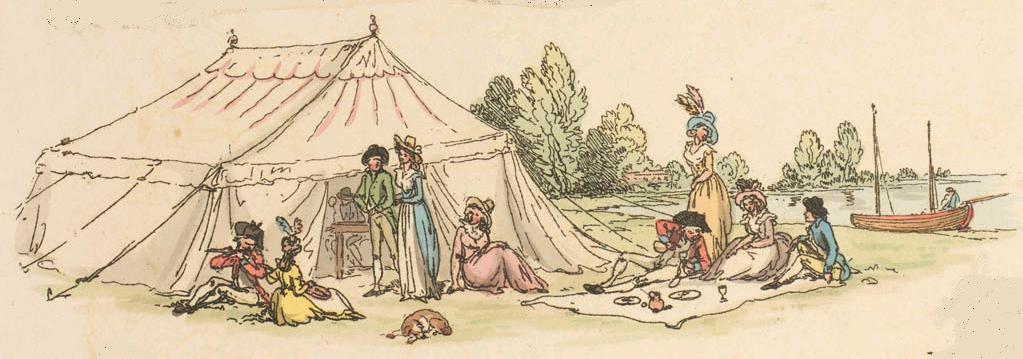
An outing

An outing in the country

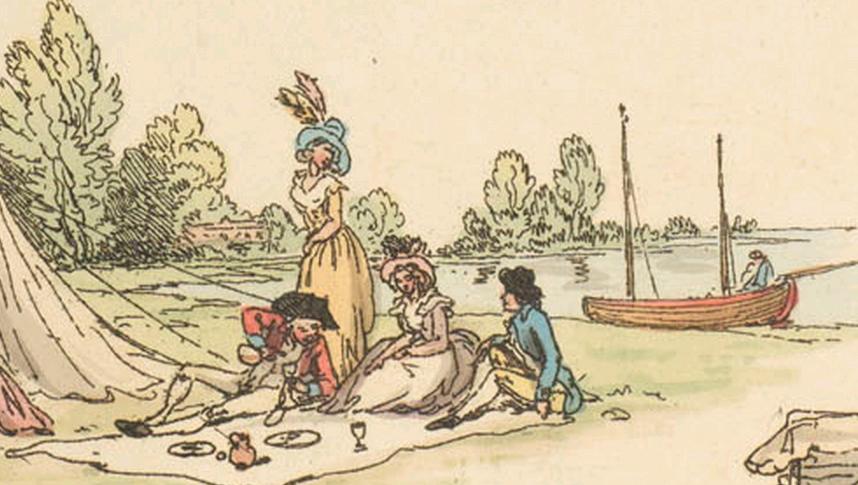
Emma’s planned outing to Box Hill was no doubt accompanied by servants, who carried the food, plates, and cutlery and laid out the repast for the party. In this scene, it seems that the soldiers performed the offices of serving the food to the ladies. Except for the boatman, I can find no evidence of servants, unless they are assembled inside the tent, which makes no sense. One soldier plays the flute to his companion, another couple promenades as they talk. A group sits on a blanket, finishing their repast and drinking wine or ale.

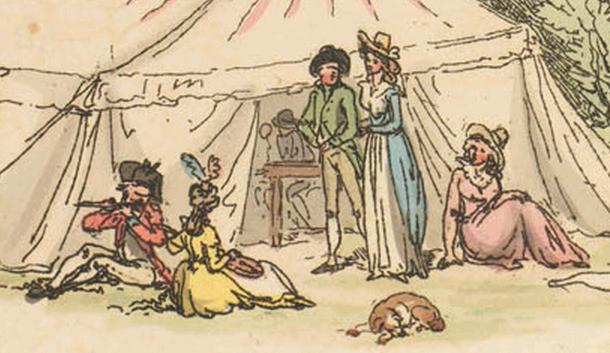
Detail

Detail of the tent, inside and out

A dog sleeps peacefully among the assembly and a female guest rests while leaning against the tent. Inside, a man sits at a table. It must have taken some effort to transport all that food and equipment, and I wonder if this was done via the boat and river earlier in the day as the rest of the party walked from the country house (visible in the background) to the picnic site. One thing is for certain, Rowlandson’s contemporaries would have known first-hand how such a picnic was contrived.

detail

Detail of the riverside, with a country house in the background.

A foppish gentleman in the image below examines a bill, while the inn keeper (?) looks on and a servant carries his case. This image must have been duplicated at many roadside inns and coach houses, and would not be unusual today. This scene was labeled “exchanging” money, which explains the merchant’s/innkeeper’s outstretched hand.

Arrival at an inn, or examining his accounts?

Arrival at an inn, or examining his accounts?

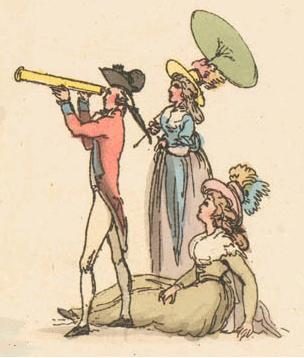
The man below is peering through a telescope at … what? A balloon ascent? Birds? A boat on the horizon? Curious minds want to know.

Bird watching or gazing at ships along the sea shore?

Bird watching or gazing at ships along the seashore?

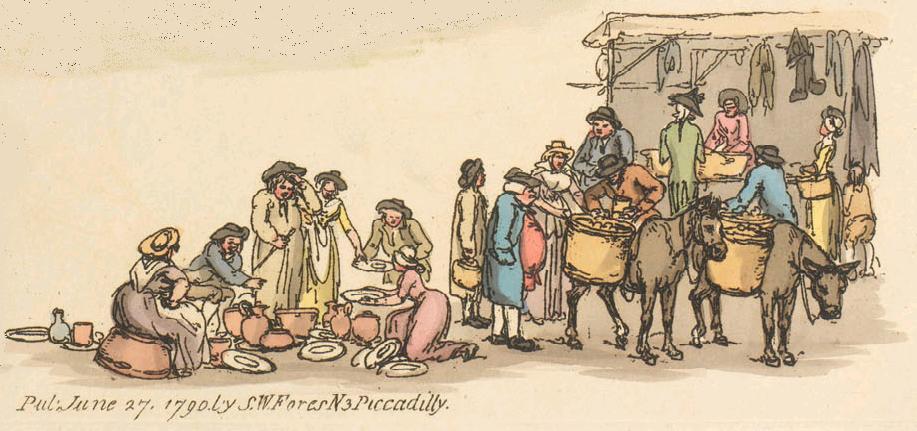
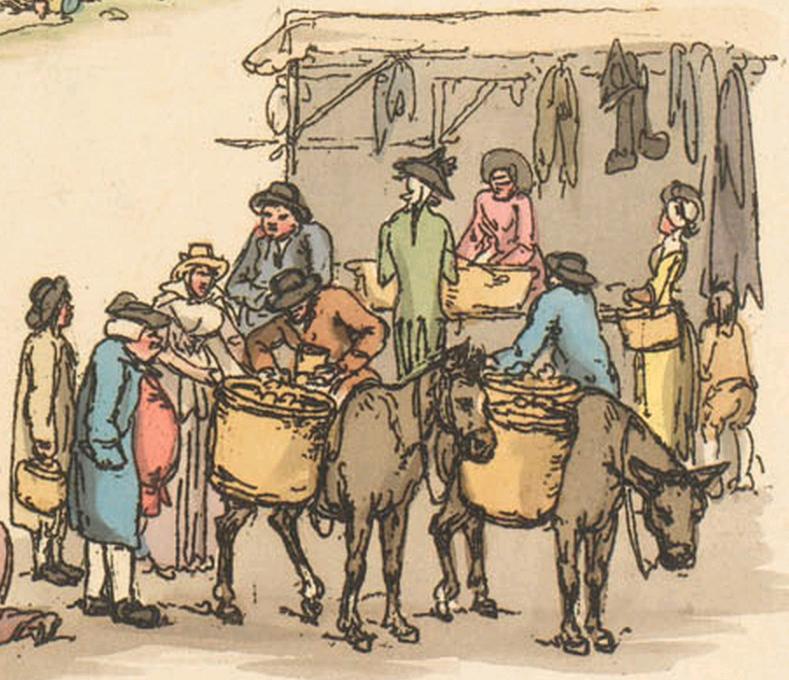
The last scene depicts vendors selling their wares, either from a stall, from containers on the pavement, or from baskets attached to donkeys. A variety of shoppers, some better dressed than others, are shown examining goods or purchasing items.

Market scene

Street vendors

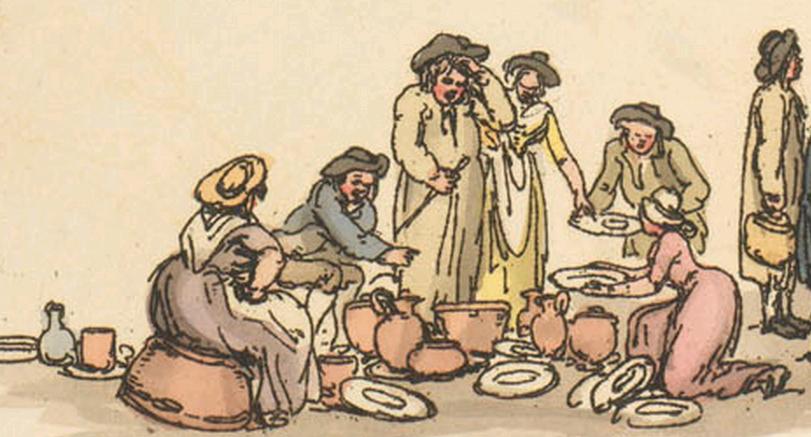
Our moderns sensibilities are struck by the unhygienic way that food was sold by street vendors back then. There were no disposable plates, so one can only assume that used plates and cups were merely wiped with a wet cloth before food was ladled out to serve another diner. Many individuals lived in small one or two room “apartments” that had no kitchens. For them, eating street food was common … if they had the money.

Street food

Street food

detail

Detail of vendors with donkeys

Items of clothing seem to be sold in the stall, while bulk food (potatoes, grain?) is carried by the donkeys. When the Austen family moved from Steventon to Bath, their diets changed drastically, for they had to depend on food purchased at local markets. They had grown their own vegetables in the country, and owned a cow and a few chickens and pigs. In Steventon, the Austen family could largely eat off the bounty of their land, stretching their budget, but in Bath they depended on food carted in from surrounding farms and milk from anemic city cows who lived in dank stalls and were put out to pasture in public parks. Purchased food was often doctored, and it was almost impossible to eat fresh seafood, unless one lived near the coast. For many reasons, including the matter of finding fresh and affordable food, Jane Austen must have been in shock the entire time she lived in Bath.

More about the image:

Creator: Thomas Rowlandson (1757-1827) (etcher)
Creation Date:
27 Jun 1790
Materials:
Hand-coloured etching
Dimensions:
38.5 x 28.0 cm
RCIN
810396

Description:
A hand-coloured print with 12 vignettes of everyday life and work. Included in the designs are: Assessing new recruits for the army; carriage driving; promenading; a tea party; horse-riding; a woman with needlework; flirtation; a woman playing the harpsichord whilst another woman sings; a picnic by a river; a man looking through a telescope; an exchange of money between one man and another man and street vendors. Plate 7.

Inscribed in the plate: Pub June 27 1790 by S.W. Fores N 3 Piccadilly. Click here to go to The Royal Collection.

Read Full Post »

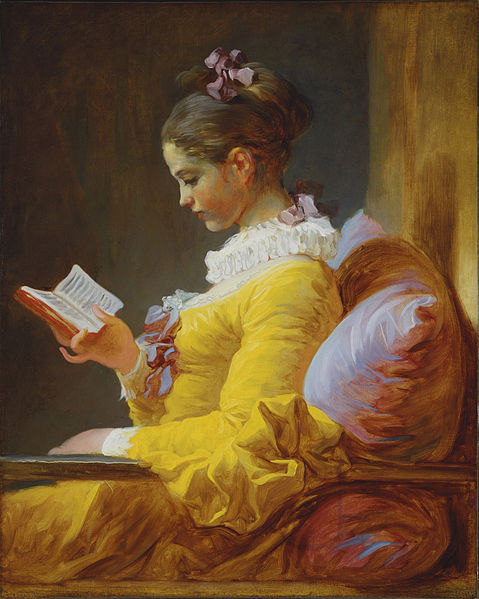
A Young Girl Reading, or The Reader (French: La Liseuse), is an 18th-century oil painting by Jean-Honoré Fragonard. Image @Wikipedia

A Young Girl Reading, or The Reader (French: La Liseuse), is an 18th-century oil painting by Jean-Honoré Fragonard. Image @Wikipedia

Happy New Year, gentle readers. I hope to write more for my blog in 2014. Thank you for your loyal readership. I cannot tell you how much I enjoy your comments and thoughts.

In winter weather, what can be a better way to pass the time than to curl up under a blanket with a good book? I’d like to recommend two books for you to purchase with the gift  money you (hopefully) received this holiday season. Both books are necessary additions in the libraries of confirmed Janeites and Jane Austen lovers, or so it is my belief. (Note: Contest closed. Congratulations Janice Jacobson!)

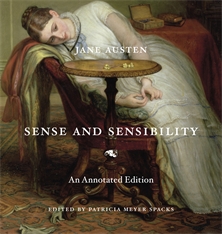
Sense and Sensibility: An Annoted Edition edited by Patricia Meyer Spacks.

The first is the 4th installment of  an incomparable anthology series of Jane Austen’s novels. Sense and Sensibility: An Annoted Edition is published by The Belknap Press of Harvard University Press and edited by noted scholar Patricia Meyer Spacks. This lush book could easy be confused for a coffee table book – the cover is so beautiful and the color images inside are of the highest quality, but the annotations are anything but superficial. Dr. Spacks’ research adds dimension to Jane Austen’s words and to an era that is long gone, and whose customs have become foreign to our modern understanding. Her observations include a comparison of characters within the novel – “Miss Steele is as acquisitive in a small way as the John Dashwoods are in a grander fashion”. She also draws a similarity between two novels, nothing that Willoughby is similar to Henry Crawford in that both men have fallen in love with the women they targeted for a light flirtation and amusement.

In her introduction, Dr. Spacks elaborates on the 18th century definition of sensibility, which was understood to be derived from the nervous system. Hence, fragile nerves, irritability, hysteria, tremors, fainting spells, and sickness at heart were closely associated with the term (as with Marianne Dashwood’s and Mrs. Bennet’s histrionics). Spacks’s introduction also delineates how Austen conceived of the book and how Elinor and Marianne cannot easily be pigeon-holed into the two separate categories. As they grow in understanding, both women possess elements of the other’s characteristic. As most of us know, Jane Austen wrote the first draft (known as Elinor and Marianne) by the time she was 20 years old. The book, written first in epistolary form, did not assume the third person narrative until 1811. Perhaps this is the reason why a number of passages in the book seem to lack detail or were uneven.

Sense_Sensibility_Spacks

Publicity materials for this annotated edition explain that:

In her notes, Spacks elucidates language and allusions that have become obscure (What are Nabobs? When is rent day?), draws comparisons to Austen’s other work and to that of her precursors, and gives an idea of how other critics have seen the novel. In her introduction and annotations, she explores Austen’s sympathy with both Elinor and Marianne, the degree to which the sisters share “sense” and “sensibility,” and how they must learn from each other. Both manage to achieve security and a degree of happiness by the novel’s end. Austen’s romance, however, reveals darker overtones, and Spacks does not leave unexamined the issue of the social and psychological restrictions of women in Austen’s era.

One get the strong sense that Spacks prefers Willoughby as a hero over Edward, whose character is rather tepid and static. Colonel Brandon’s mature patience doesn’t fare much better in some of the annotations, which also include extensive descriptions of manners, mores, and historical facts. Mundane customs are described, such as the games of whist and cassino.

Home, hearth, and space play important roles in this novel.The country side affects Edward more than Willoughby, who regards the land merely as a place in which to hunt. Edward will eventually live off the land, and happily so. Ennui, or inertia, is also evident in the novel’s characters. Spacks quotes the scholar, Isobel Armstrong, who observed that “a long, patient but sapping wait is the fate of many in this novel; Edward, Elinor, Colonel Brandon, even the unsympathetic Steeles.” Perhaps this is the reason why so few of us think of Edward as a strong hero. His character lacks decisive action. When he does make a decision, as with his unfortunate choice of fiancee, he seems stuck and unable to make a move when encountering a road block. The conniving Lucy spends considerable time waiting for Edward and hoping that Mrs. Ferrars will come around to accepting her. Most of her machinations (that of seducing Robert Ferrars) occur off the novel’s pages and we hear about her success in marrying Robert only through word of mouth.

My one complaint about this edition is that the annotations seem spare compared to Pride and Prejudice, the first annotated book edited by Dr. Spacks. To be fair, Sense and Sensibility is not as highly ranked on most reader’s lists as Persuasion, Pride and Prejudice, or Emma. It is the earliest of Jane Austen’s published novels, which may explain why the number of annotations seem to be fewer in this book. Nevertheless, I highly recommend this edition, which costs $35, a bargain considering the the number of colored illustrations and information contained therein.

Northanger Abbey is the next novel to be annotated. It will come out in spring of 2014. I cannot wait for it to be published. 

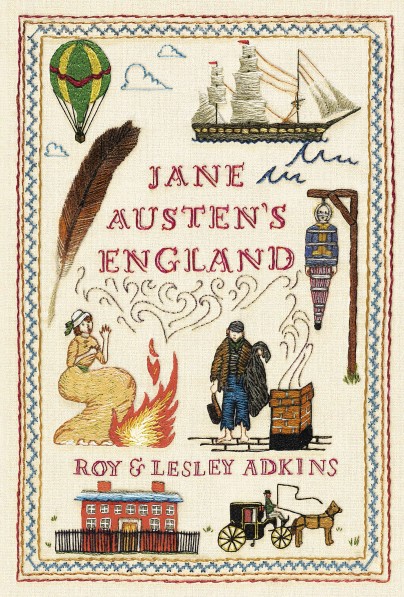
Jane Austen's England by Roy and Lesley Adkins

Jane Austen’s England by Roy and Lesley Adkins

Jane Austen’s England by Roy and Lesley Adkins

The next book on my recommended buy list is Jane Austen’s England by Roy and Lesley Adkins. Actually, I should amend my ranking, for both books are equal in my estimation. The publisher sent an uncorrected proof of  Jane Austen’s England when I was in the throes of taking care of my parents this past summer and fall, and so I read the book piecemeal, hoping to find the time to give it the review it deserved. My copy is earmarked and underlined. I have read many passages twice. Roy and Lesley Adkins have accomplished a remarkable job of research and writing that informs as well as entertains. I realize that many of you have read a number of histories associated with Jane Austen’s age and some of you will find the information repetitive. In addition, you can easily find many of the sources used for this book on the Internet or for purchase.

This book is divided into topics that follow the lives of Jane Austen and her characters. While the historic territory that the Adkins go over is not unique, their presentation is organized in such a way that all we need to do is to turn to Breeding or Toddler to Teenager to Wealth and Work and Medicine Men to find out more about the daily habits of the Austens, Jane’s characters, or the socio-economic conditions of those who lived during the Regency era. The Adkins do not subject us to mere romantic assumptions, but relate the harsh reality of life for the majority of people living during that age. The chapter on Filth minces few nice words. This was an era when outhouses abutted to sculleries, cholera was spread through contaminated water, and cesspits drained into watercourses. Men and women were known to urinate and defecate in streets. While our dear Jane did not write about these indelicacies, she must have witnessed such actions and known of many more contemporary customs that would turn our heads today. In her novels, she ignored the harsh realities of war and famine, common occurrences in her day, and assumed that her readers would seamlessly fill in the details of daily life while she concentrated on her character studies.

Topics in Jane Austen’s England  include kidnapped children, superstitions and folk wisdom, the use of Almanacs (useful for planning evening parties during a full moon), boundary stones, funeral customs, tax burdens of the rich and poor, Frost Fairs, animal fighting, animal abuse, hunting, cricket, horse races, regattas, amateur theatricals, London theatres with their noisy audiences, the cost of music tickets (two weeks wages for a servant), ballad sellers, public houses, taking snuff, state lotteries, the cessation of the Grand Tour during the Napoleonic Wars, the danger and challenges of travel and transportation, boot scrapers, toll roads, toll booths, turnpikes, surveying,  mapping England, medicine, apothecaries, the royal navy, and more. Whew!

Even though I finished the book late last month, I struggle to remember all the fascinating details that this 300+ page book contains.

For a New Year’s gift, I am holding a book giveaway of a hard back copy of Jane Austen’s England until midnight, January 7, 2014. All you need to do is leave a comment about an interesting fact you know about Regency life or Jane Austen’s era. Participants are confined to the U.S. and Canada. (So sorry!) Winners will be chosen by a random number generator. You may enter as often as you like, provided that you share another interesting bit of information about Jane Austen’s England each time you make a comment.

Happy New Year, all. Thank you for stopping by my blog.

Read Full Post »

My blog has been silent again. Just as my schedule was letting up a bit, my father fell ill. In Jane Austen’s time, extended families lived in one village and often under the same roof. Healthy family members or friends took care of the sick, elderly, and very young. In this age, when sons and daughters and siblings live far apart, taking care of a loved one is not as convenient. I took time off from work, more to help my 88 year-old mother than my father, who was in the hospital, and to take some stress off my brother, who was starting a challenging and demanding new assignment. We thought Dad had suffered a stroke. In the 18th century, his condition would have been described as apoplexy, or “paralysis caused by stroke. Sudden deprivation of all the internal and external sensation and of all motion unless of the heart and thorax.” ( Glossary of Old Medical Terms Used in the 18th and 19th Centuries)

As he came out of a restaurant bathroom, my dad forgot to walk. I happened to be there, worried that he was taking so long. He began to slur his words and hallucinated that his father, who has been dead for 40 years, was joining us for dinner. We rushed him to the emergency room, where he wound up in good hands, receiving excellent diagnostic care. After four days of tests, he was transferred to a rehab hospital for the elderly to receive 10 days of speech therapy, physical therapy, and occupational therapy.

Stroke (apoplexy) satirical art work. 1822 copy of a Charles Aubry original. Click here to go to Fine Art America to read the details.

Stroke (apoplexy) satirical art work. 1822 copy of a Charles Aubry original. Click here to go to Fine Art America to read the details.

Back in the old days, those who suffered apoplexy or stroke were not so lucky. Many died within hours of the event, if not a few weeks later. Blood letting was one cure that was thought to be effective, although in most cases the practice was harmful and weakened the patient.

Some of those who survived successive attacks, especially the young, were mistaken for being mad. Romance author, Laura Kinsale, has written a remarkable book entitled Flowers From the Storm, in which a hedonistic and haughty duke is placed by his family into a mental institution after a major stroke. His sudden inability to communicate and lack of physical control is described in detail by this talented author in a story that, 15 years after I first read it, still stands out in my mind. I imagine the fate that this fictional Duke suffered was shared by many actual people of that era.

In our case, Dad benefited from modern medicine. An MRI showed previous minor strokes, but a CAT scan proved that this was not the reason for his illness. Dad’s illness was a “neurological event” that has been attributed to the progression of his Parkinson’s disease, once known as shaking palsy; the effects of a new medication, which made him hallucinate; the poisonous interaction among the 16 some medications he was taking per day; the slow advancement of his dementia; lack of exercise; and simply old age.

Two hundred years ago, I would have lived close enough to my parents to help on a daily basis. These days, Dad will be depending on home visits from medical personnel and the loving attentions of his wife.

My, how times have changed.

More on the topic:

Read Full Post »

Recently three 19th century portraits appeared in Pinterest of individuals wearing eyeglasses. They struck me as being remarkably unique, in that so few people at the time are shown wearing these accessories. The first shows a Southern belle in Louisiana. She wears the light-framed oval shaped spectacles so popular during that era.

Jean-Joseph Vaudechamp portrait of Mrs. Antoien Julien Meffre-Rouzan, c. 1839, New Orleans

Jean-Joseph Vaudechamp portrait of Mrs. Antoien Julien Meffre-Rouzan, c. 1839, New Orleans

During the 1830’s and afterwards, a new
inexpensive metal gained popularity for the manufacture of
spectacle frames and many other items. In New York City in
1829, German chemist Louis Feuchtwanger introduced the alloy
“German silver”, composed of varying amounts of copper,
zinc and nickel. Spectacle frames of this material became widely
available after 1835. The cost and durability of German silver
spectacle frames made them very popular…History on Your Face

blondel 1835

Portrait of a Man 1835, Oil on canvas by Merry Joseph Blondel

This gentleman could be a lawyer or accountant, even Mary Bennet’s husband. What say you?

Portrait of a Lady, 1835

Portrait of a Lady, 1835

The woman in this last image could be Mary Bennet from Pride and Prejudice all grown up.

Love these paintings. Here is my Pinterest board for 18th and 19th Century Art. Enjoy: http://www.pinterest.com/janeaustenworld/18th-19th-century-art/

This article from Historic Eyewear discusses19th century American spectacles in detail.

Read Full Post »

« Newer Posts - Older Posts »