Feeds:
Posts
Comments

Archive for the ‘Popular culture’ Category

Celebrating Jane Austen’s Pride and Prejudice: 200 Years of Jane Austen’s Masterpiece, By Susannah Fullerton, published by Voyageur Press, USA 2013 (Published in the UK as Happily Ever After: Celebrating Jane Austen’s Pride and Prejudice) Available in January, 2013

200 Years of Pride and Prejudice: The Beginning

I was asked by Frances Lincoln, the UK publishing firm who published A Dance with Jane Austen (read review here) if I would write a book about 200 years of Pride and Prejudice. I had barely finished Dance and knew it would be difficult to meet the tight deadline, but how could I resist? What better way to celebrate 200 years of that wonderful novel than to write a book about what it has meant to me and to so many people and about the extraordinary afterlife it has enjoyed. And so I set to work and I can honestly say that no book has given me such joy to write. For months I was deeply immersed in the world of the Bennets, Mr Collins, Lady Catherine and Mr Darcy. I have always adored the novel, but as I wrote my own book about it, I came to appreciate it even more, to be more fully aware of its intricacies, skill and its amazing power to charm and enchant again and again and again.
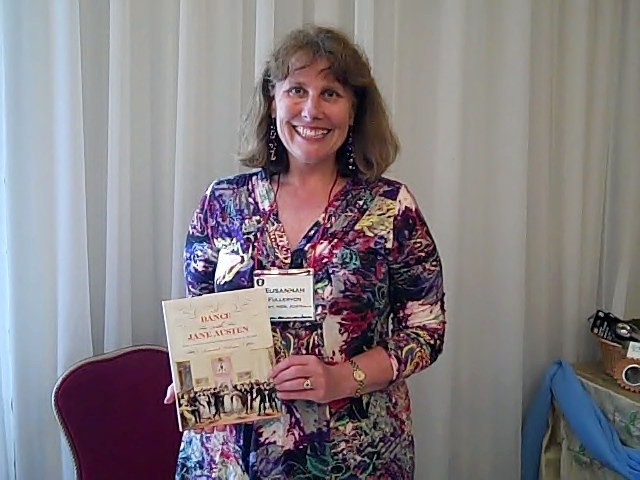
Susannah Fullerton at JASNA AGM 2012 with her new book, A Dance With Jane Austen

My book looks at many aspects of the novel. We all know that it was originally turned down, but for how long did it languish before its author again tried to get it into print? It was not a best-selling book, but from the beginning it had its admirers – who were they, and what did they say about it? I loved writing a chapter about the first sentence. Would I find enough to say, I wondered, as I sat down to write – a whole chapter about a few lines?? Could it be done? In the end, the problem was having almost too much to say, and I hope that chapter will make my readers see clearly just why that first sentence has achieved such fame.

I then turned to the characters. Every reader loves Elizabeth Bennet (I think there must be something wrong with anyone who does not fall in love with Elizabeth!), but why do we love her so, and in what ways is she so radically different from every heroine who had come before? How does her creator skilfully introduce her to us, show her growing and learning as the novel progresses, and endear her to us so greatly? And what of Mr Darcy, that archetypal romantic hero, progenitor of so many tall, dark and handsome men in romantic novels? I loved writing chapters on heroine and hero. I also explore their families and relatives – the Bennets and Mr Collins on her side, Lady Catherine, Anne, Georgiana and Colonel Fitzwilliam on his. How is each character revealed to us and what have 200 years done for them in the way of sequels and further careers?

Pride and Prejudice Translations

In the same year that Pride and Prejudice was published, the first translation appeared. It was published in a Swiss journal, written in French. Jane Austen never knew about it and received no money for it, which is probably a good thing – her own characters would have been almost unrecognisable to her in that Swiss ‘bastardisation’. Generally Pride and Prejudice fared badly for many decades in European translations, but things slowly improved and the non English-speaking world is now catching up on the delights of reading Jane Austen.
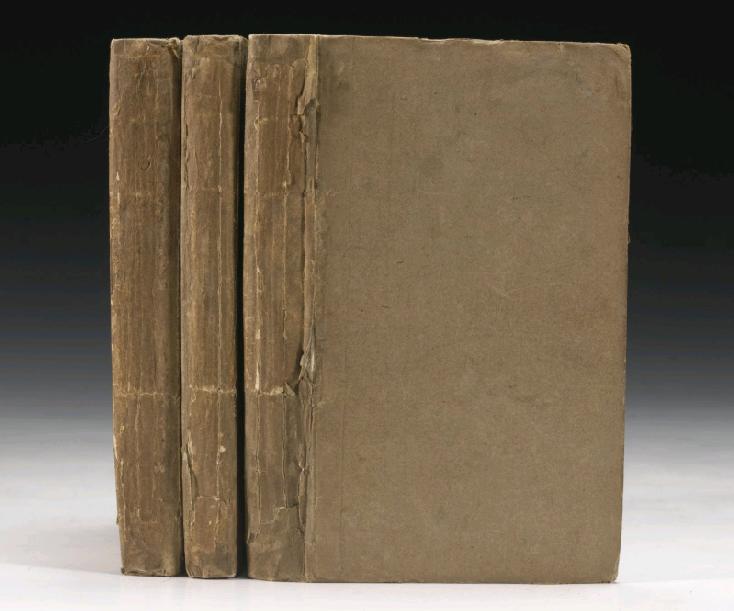
Pride and Prejudice, 1813 edition. Image @Sotheby’s

They say you should not judge a book by its cover, but many people still do, and Pride and Prejudice has had an extraordinary range of covers over 200 years. From the first edition, to the modern Chick-Lit covers, and much in between, it has been ‘packaged’ in a myriad of different ways. And as for illustrations, they range from the positively ugly (where Elizabeth isn’t handsome enough to tempt anyone at all!) to the gorgeously decorative. My book includes many of these illustrations from the familiar Hugh Thomson ones, to some that will be very new indeed to my readers.

Film Adaptations of Pride and Prejudice

We all know about the Greer Garson film version, the lovely Elizabeth Garvie TV series and the hugely popular Colin Firth BBC series, but did you also know about the Dutch TV version, the Italian one with a Mrs Bennet rather like Lucrezia Borgia, the Israeli version (modernised), and several old BBC adaptations? My chapter on the various films will tell you about those, plus modernisations such as Lost in Austen and Bride and Prejudice. And there’s a chapter on sequels. I knew there were lots of them out there, but until I began my research for this chapter I had no idea quite how many, or to what lengths some of them go. There are sequels, prequels, continuations which mix characters from all the Austen novels, modern re-tellings, zombie-infiltrated versions, and even pornographic sequels. You will be amazed at the afterlife of Darcy and Elizabeth in the minds of some sequel writers!!
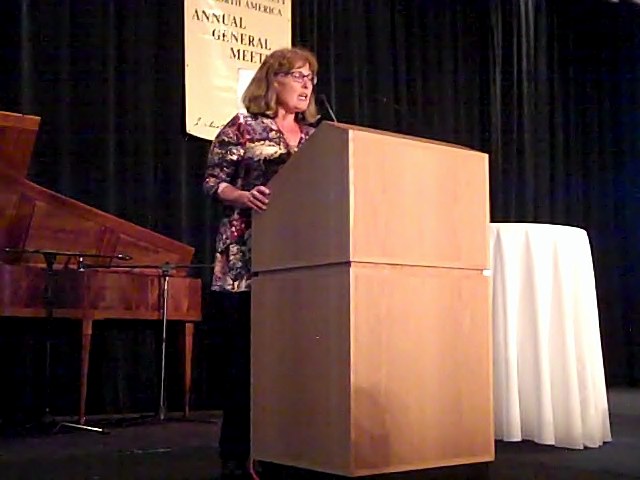
Susannah Fullerton discussing Dirty Dancing in Jane Austen’s Ballrooms at the JASNA AGM 2012 Brooklyn, NY

Today Pride and Prejudice is big business. There is the tourism it has engendered – theme tours, sightseeing in houses where films were made, swimming in a certain lake, and travel to Jane Austen museums and centres. And there is marketing – you won’t believe what items Pride and Prejudice has inspired, from soaps to clothes pegs, skateboards to romper suits. Pride and Prejudice sells things, and manufacturers have given full vent to the fancy in creating literary merchandise from the novel.

And, finally, what of Pride and Prejudice in the future? In this age of kindles and Ipads, audio versions and information on the internet, what will the future of this adored novel be? I had to speculate of course, but see if you agree with me?

Celebrating Pride and Prejudice: 200 Years of Jane Austen’s Masterpiece is, if I say so myself, a very beautiful book. The illustrations are just gorgeous and were chosen with great care, and the book is a pleasure to hold. I hope you will also love its content! I am thrilled that it has also been published by Voyageur Press, an American publisher and that I have been invited to do a lecturing tour in the USA next year to talk about it. I wrote this book for every person who has fallen in love with Pride and Prejudice , who has read and re-read it, discussed all the film versions, and who feels that Elizabeth and Darcy are a part of their lives. I do hope you will want to read it and will join me in celebrating the fact that Pride and Prejudice has lived ‘happily ever after’ for 200 years!

Susannah Fullerton
President, Jane Austen Society of Australia

Preorder the book at Amazon.

Hardcover: 240 pages
Publisher: Voyageur Press (January 1, 2013)
Language: English
ISBN-10: 0760344361
ISBN-13: 978-0760344361
Read Full Post »

The Emporium at JASNA’s 2012 AGM in NYC provided several delightful surprises, among which was meeting the staff of Jane Austen’s World Magazine and Chawton House Library a their respective booths. Jane Austen’s Regency World editor, Tim Bullamore, was selling a variety of magazines and books. The music you hear in the background of the first video is William Herschel’s Sonata in D Op4 No4, which came with the March/April 2010 edition of the magazine. Tim also spoke about Sex, Money and Power in Death Obituaries in the Time of Jane Austen, which I will discuss in more detail in a later post. (Music: With permission from Tim Bullamore, CD from Mar/Apr issue of Jane Austen’s Regency World.)

The staff of Chawton House Library, shown behind the second booth, were  the Chief Executive Officer, Mr. Stephen Lawrence, Director of Research, Dr. Gillian Dow, and Director of Development, Ms. Eleanor Marsden (in the last scene with Mr. Lawrence) were also at their stations during various times throughout the conference. It was a pleasure to meet them. Janeites will know Dr. Dow, who also lectures at the University of Southampton in England, from her articles and books on Jane Austen and women’ studies. I have had the pleasure in the past to email Stephen Lawrence about permissions from Chawton House, most particularly in reproducing images of Edward Austen Knight’s suit, which required extensive restoration. Read my article here.

Edward Austen Knight’s Frock coat with lining. Image @Chawton House

Some of the items I purchased from both booths are shown in the video below. I was most particularly pleased to purchase The Compleat Housewife by Elizabeth Smith, reissued by Chawton House. I also purchased four back issues of Jane Austen’s Regency World Magazine. You will also see the lovely Sense and Sensibility the Musical booklets, which I used to take notes, the Conference workshop guide, and a tin of tea distributed by the Minneapolis MN JASNA group, where the 2013 AGM meeting will be held. Topic? Pride and Prejudice, of course.

Sandy Lerner, shown left below, one of the keynote speakers, is the driving force behind the resurrection of Chawton House, Edward Austen Knight’s second grand house, and Chawton House library.

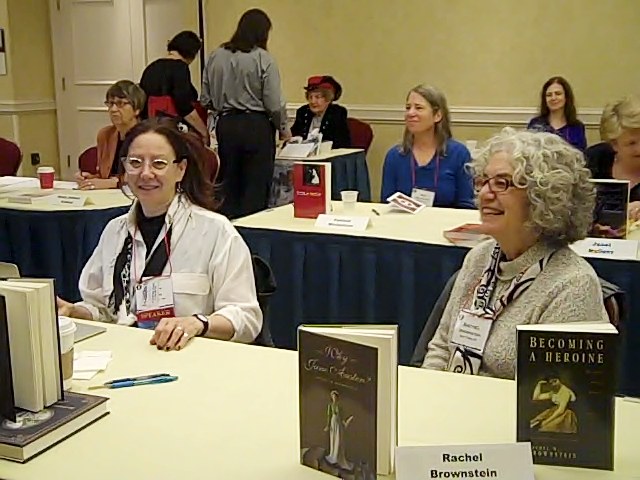
Sandy Lerner, author of Second Impressions, and Rachel Brownstein, author of Why Jane Austen? at the author’s book signing at JASNA AGM

Second Impressions is written by Ava Farmer, Sandra Lerner’s nome de plume. Profits from the sale of this book go to the Chawton House library.

Read Full Post »

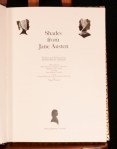
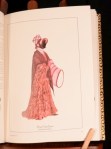
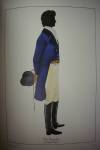
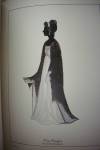
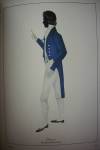
Shades from Jane Austen by Honoria Marsh was published in 1975-1976 in a series of limited editions. I saw this rare work at the silent auction table at the 2012 JASNA AGM meeting in NYC. There were many beautiful items, but this one was a standout with its colored illustrations, mostly silhouettes, and a few reproductions of Jane Austen’s writings. Bidding began at $50.00, but at the time I approached the table the price had gone up to $150.00, a bit beyond my price range but still less than the book attracts in online bookstores. The price reflects the book’s rarity, for only a few copies are available. I had seen a few illustrations before, but not the originals … until now.

The video shows a number of illustrations from the book not seen in this post. The portrayals of Jane Austen’s characters were painted by the author from life. Her sitters were either friends and acquaintances, or Jane Austen’s descendants or people associated with her! You can read their names below the title of the characters.

Part one of the book includes ‘Jane Austen’s Family in Silhouette’, a table showing Jane Austen’s Family and Chronology of Events During her Lifetime’ (written by Peggy Hickman), and Jane Austen’s family tree.

Part two includes an introduction and a discussion of Sense and Sensibility, Pride and Prejudice, Mansfield Park, Emma, Northanger Abbey and Persuasion.

Silhouette of Mrs. Gardiner

Alas, I do not know who successfully bid for the book in the silent auction or what it went for. Does anyone know?

Read Full Post »

When Upstairs Downstairs was not included in last spring’s Masterpiece Classic line up I worried that we would not have an opportunity to see the series this year. Not to worry. The first installment of six of Season Two will air this Sunday ,October 7 and end November 11, 2012.

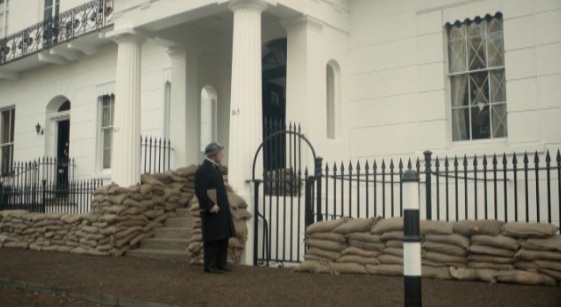
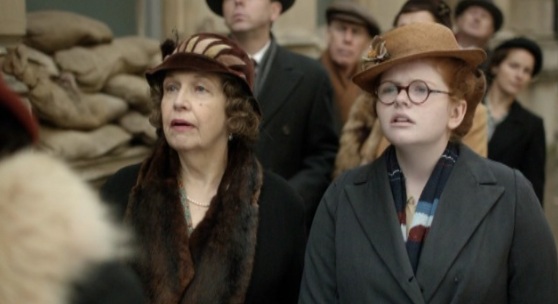
Will sandbags protect Eaton Place?

In 2010, Upstairs Downstairs aired just after the wildly popular Downton Abbey, suffering in comparison. To begin with, Downton’s budget was astronomical compared to UpDown’s.  And UpDown’s script needed to find a way to tie in to the classic and unforgettable 70’s series with Jean Marsh as Rose and Gordon Jackson as Mr. Hudson.  That series was a hard act to follow.

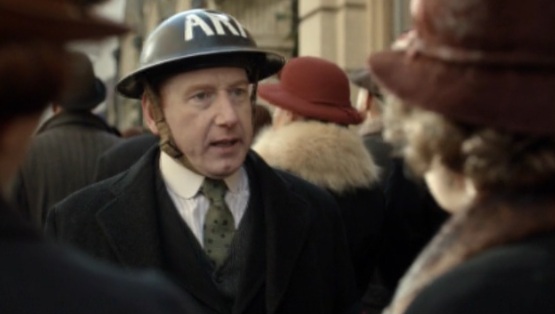
Mr. Pritchard is in charge of bomb siren warnings and other dangers. What is his secret?

This year UpDown suffered unanticipated setbacks: Jean Marsh suffered a stroke and could not continue to play Rose full time (she appears in two episodes) and Eileen Atkins (Maud, Lady Holland) decided not to return. Frankly, Eileen was the only comedic respite in Series One and the closest that UpDown came to challenging Maggie Smith’s unforgettable Violet.

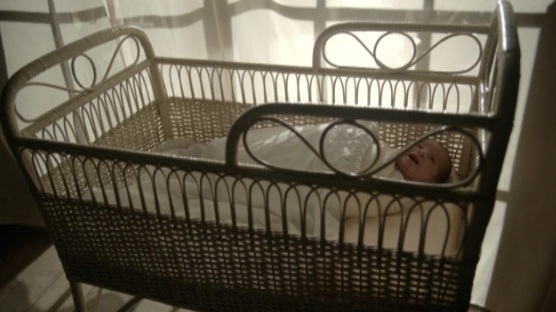
The new baby hardly plays a role in the plot, except to point out Lady Holland’s depression and long road back to health.

Season Two’s UpDown is a somber series compared to Downton, even with that show’s foray into  WW1.  At the beginning of Season 2 in UpDown, World War II is about to break wide open. Air raid drills are a fact of life. Houses are sandbagged and Londoners are preparing for war, even practicing wearing gas masks indoors.

The cook and new maid, Eunice

Nothing isquite  the same at 165 Eaton Place.

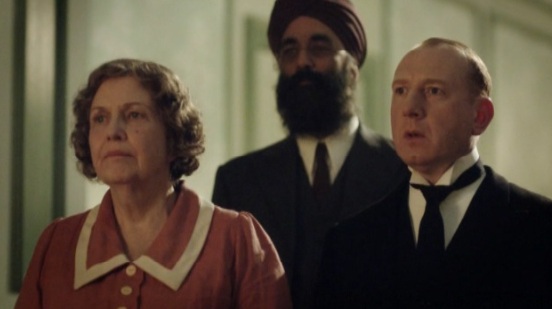
Mrs. Thackeray, Mr. Amanjit, and Mr. Pritchard. After Maude’s absence, Mr. Amanjit’s role is severely curtailed.

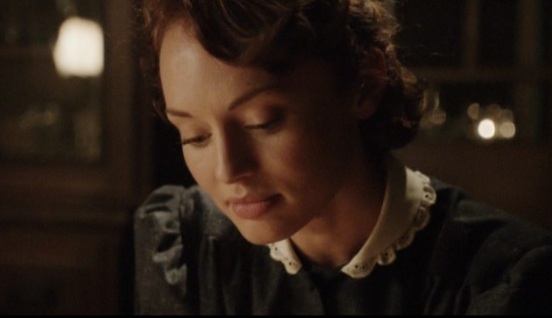
Elie Kendrick as Ivy is gone, replaced by two new maids: Eunice and Beryl.

Laurel Haddock as Beryl

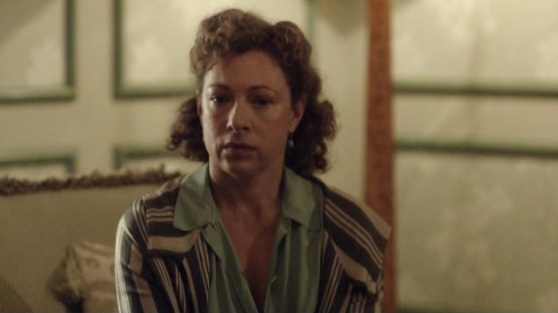
Alex Kingston has come on board as Maude’s sister,  Dr. Blanceh Mottershead, an unwanted addition as far as Hallam Holland is concerend. Hallam is conerned 24/7 with diplomacy and making sure that the Brits aren’t totally bowled over by oily German diplomacy.

Hallam beset at all fronts

Then there’s Lady Holland’s story arc. Episode One starts with the birth of the Holland’s second child and Lady Holland’s struggle to regain her health after a difficult birth, which has resulted in post partum depression (or has it?)

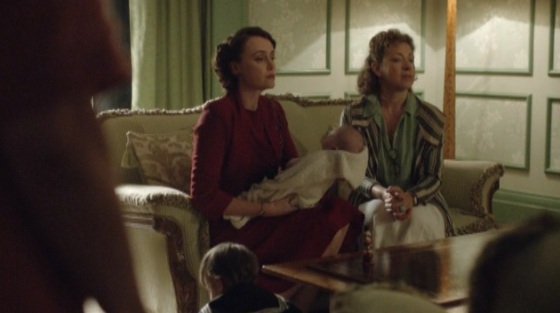
Agnes, Blanche, and baby: A happy family?

A family tableau: Agnes, Blance, and baby. A happy famoly?

A handsome Hollywood producer appreciates her charms, even as Hallam is consumed by averting the war. Agnes’s sister Persey is ankle deep in Nazis, living abroad and living the high life until Kristalnacht, when she realizes that Nazi German politics is uber false and dirty and bent on annihilating innocent Jews.

Alex Kingston as Dr Blanche Mottershead

Fans of the original series know that UpDown was never ever a precursor of Downton Abbey. It always had a rather serious bent, with comedic elements toned down or nonexistent.

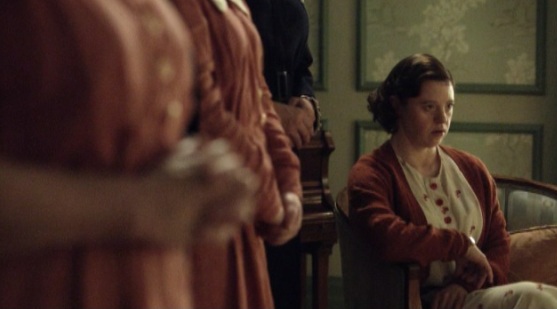
Sarah Gordy as Pamela Holland, Hallam’s long lost sister.

Downton Abby, which I adore, is in my opinion a phenomenon of our times – history mixed with rather outrageous elements that reflect our 21st century sensibilities. We cannot fault UpDown for staying true to its origins.

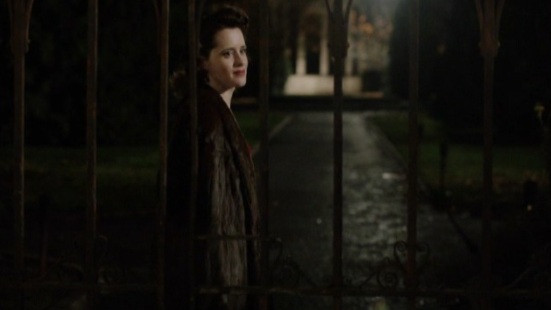
Claire Foy’s role as Lady Persey is dark this season. Who can love a mistress of the Nazis?

I watched all six episodes back to back, wanting to know how the story ends. It is sad to know that this intelligently written series was not renewed for a third season. Knowing this, I backpedaled, not allowing myself to get too invested in the story line, so that I would not be disappointed that the cliff hanger would not be resolved.

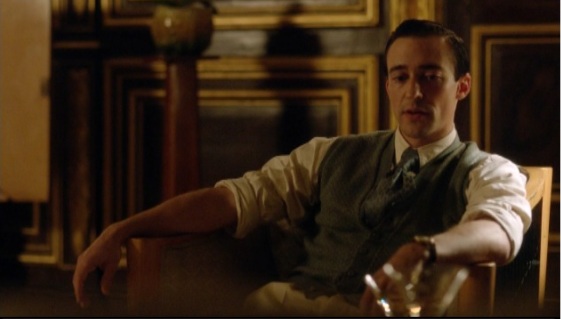
Blake Ritson as the Duke of Kent. His portrayal is highly stylized. I’m not sure I like this direction in his acting. Let me know what you think!

True to form, UpDown reverted to 1970s ways, not making a brouhaha at the end of the season, and almost tying up the story lines in a neat bow . Is Season 2 worth watching knowing that the series is at an edn? Absolutely. Click here to go to PBSs site.

Read Full Post »

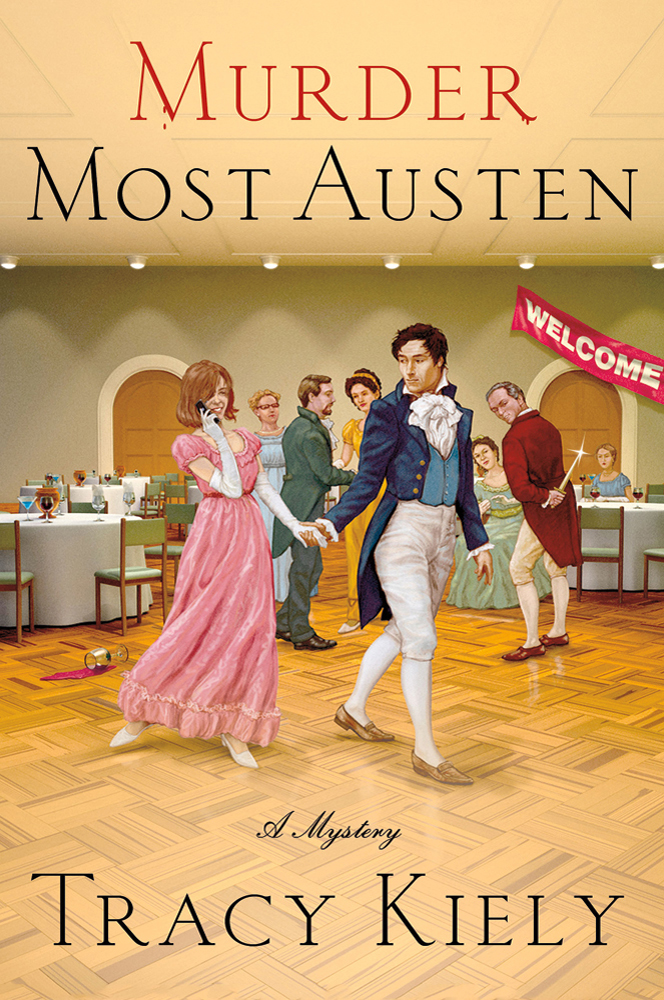
Gentle readers, My dear friend Lady Anne has reviewed Tracy Kiely’s latest mystery, Murder Most Austen. As always, you will enjoy her take on a new book. I make my politest curtsy to her and thank her kindly for her services and for her elegant writing style. (Please note: the blue links are mine; other links are WordPress Ads I do not make money from this blog, but I do receive books from publishers for review.)

Murder Most Austen is the fourth book in Tracy Kiely’s series featuring Elizabeth Parker, a twenty-something Janeite who channels Kiely’s love and knowledge of Jane Austen’s books.  Elizabeth and her Aunt Winnie, who was featured in the first of the series, often converse by trading quotes from Jane’s books.  Readers with a good knowledge of Jane’s output will enjoy this indulgence in Austenology.

In this outing, Aunt Winnie, a former financier turned innkeeper, treats Elizabeth to a trip to England for the annual Jane Austen Festival in Bath.  Elizabeth, who had been underemployed as a fact checker for a weekly newspaper, has quit her demeaning job, is considering and reconsidering moving in with her boyfriend Peter, and seems to have matured some from the preceding books.  While on the plane to Heathrow, she and Aunt Winnie, who is an outspoken and flamboyant contrast to her niece, meet two other travelers bound for the Festival, Richard Baines, a professor with some perverted views on Austen and his newest graduate student protégé, Lindsay.  The odious Baines has taken the slenderest details of what he considers evidence and what most Austen readers call satire, and decided that Jane is anti-clerical, a non-believer, and further, that she was sexually profligate, early Communist and died from syphilis.  Needless to say, most of the Janeites who hear him expound are upset, none more so that Aunt Winnie’s old friend Cora, one of those tiresome women who cannot leave an argument alone.  So when Baines is found stabbed outside the ballroom where one of the Festival balls is taking place, Cora, who had argued too loudly and drunk too much, is the prime suspect in his death.  Thus  Elizabeth, along with Aunt Winnie, try to discover who really killed the arrogant Baines.   There is no shortage of suspects:  the ex-wife, son and daughter-in-law of Baines have strong motives, as do his current wife, his assistant, and that adoring graduate student.

Kiely is an engaging writer, who draws the reader in quickly, and keeps her pace brisk.  She has a good ear for dialogue, which serves her well in establishing her characters and keeping her readers’ interest.  Unfortunately, she is not as strong in setting her scenes.  While she minutely describes the lobby and hotel room at Claridge’s, the iconic hotel in London, she has Aunt Winnie make reservations for high tea for the afternoon.  Mistake!  High tea, which sounds more elegant than tea, is not.  It usually consists of baked beans on toast, perhaps an egg and fish paste sandwiches; it is a working class or nursery supper.  Tea involves crumpets, scones, clotted cream, strawberries and other delights.  That is presumably what the ladies had at Claridge’s, but we don’t get to join them.

               Elizabeth and Winnie take a quick tourist turn through London and then proceed to Bath, but we do not get a good view of either place, which is disappointing to those of us who enjoy local color in our mysteries, or who have been there and look forward to experiencing those places through the characters’ eyes.   This story could have equally well taken place at any of the regional Jane Austen celebrations in the U.S.,  for all the good Kiely made of being in Bath and London.      

Mysteries turn on details; when well-done, they provide a clear picture of the lives of the characters: where they live, where they eat, what they do.  These must be accurate and consistent.  In Murder Most Austen, everyone uses cell phones throughout the book; in fact, the plot turns on the use of phones, and the cover illustration features a character in period dress talking on her cell.  But as everyone who has traveled knows, American cell phones do not work abroad.  The tourist needs to purchase a new phone and also get the appropriate sim card to hook into the networks in Europe.  World-traveler Winnie would know this; Elizabeth would find it out.  While they were out seeing the usual sights, they should have taken care of that necessary detail.  Kiely could simply have included a little conversation among the cell phone users about getting their international phones.   She does do a good job on the arrogant professor who tries to turn Jane 180 degrees from her usual perception by his mischaracterized “evidence.”  It’s a nice poke at those academic furors that can rage for years, but it would have been another good skewer at him to associate him with an outlandishly named University.  His unnamed school is another missing detail.

There is a certain amount of piling-on with the bad guys in Murder Most Austen, but Elizabeth solves the mystery with some good insight, and acquits herself nicely in a bit of swordplay as well.  It is nice to see that she is not as flustered and unsure of herself as she appeared in previous books in the series; a smart and capable woman makes a good detective and is fun to continue to read.  Readers who enjoyed Elizabeth’s earlier successes at crime-solving will like this one as well.  Someone not previously acquainted with Elizabeth and her problem-solving skills – she does have an excellent memory for tiny details – will enjoy getting to know her.

  • Hardcover: 304 pages
  • Publisher: Minotaur Books (September 4, 2012)
  • Language: English
  • ISBN-10: 1250007429
  • ISBN-13: 978-1250007421

Order Murder Most Austen at Amazon or at MacMillan. (Vic adds her extreme disappointment at the cost of the Kindle edition. $12.00 is a steep price, when so many other Kindle books are listed for around $7-8. )

My blog’s reviews of all of Tracy’s murder mysteries: Click here

Read Full Post »

« Newer Posts - Older Posts »