Feeds:
Posts
Comments

Archive for the ‘Regency Customs’ Category


Bootmaker, 1845


He wore green trousers and a red jacket and his hat was leather with a narrow brim and a purple band all around the crown. He was sitting on a wooden stool, hammering away at a pair of boots that he was making, with the tools of his trade all laid out beside him: the lap-stone, the stirrup, the whet-board, the pincers and the nippers. As he worked he sang a little song to himself, to go with the rhythm of the hammering:

A Gentle Craft that hath the Art,
To steal soon into a Lady’s Heart.
Here you may see what Guile can do,
The Crown doth stoop to th’ Maker of a Shoe.

The Other End of the Rainbow, David Gardiner


16th Century Shoemaker Shop


In the Middle Ages, tradesmen formed guilds that protected their trades. Those who worked with fine leather were known as Cordwainers,  named after the very finest leather that was imported from Cordoba, Spain. In later years, those who processed leather formed their own guild, but  shoemakers retained the name of Cordwainer. Cobblers were distinct from Cordwainers, for they only repaired shoes, but over the years, this distinction began to weaken.  – Cordwainers: History.
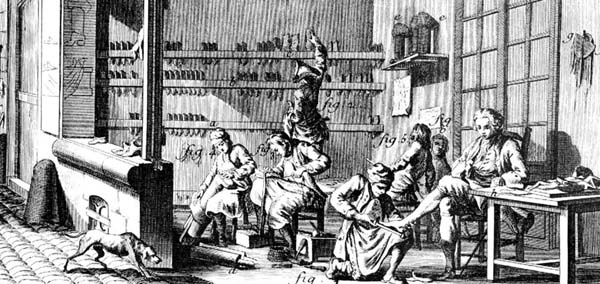
 

18th Century Shoe Shop


At the time, the shoemaking trade consisted of division according to the type of shoes made: men’s, women’s, and shoes for workers, such as night-soil men and slaughterhouse men. There were different operations performed by different persons: cutting leathers, sewing uppers, and joining heel and sole. And there were production sites, such as shop masters and cellar, garret and stall masters. Shoe masters employed many people in large operations that hired many workers (there were only 600 or 700 of these), but over 30,000 individuals worked as journeymen, countryworkers, apprentices and cheap garret masters.*


Shoe Seller, 1840


By the 18th century, most boot and shoemakers barely made a subsistence wage. The majority of individuals who made shoes worked for very low wages, about 9s or 10 s a week. Many could barely afford their own lodging, and if they did, the accommodations were mean and poor.  The wages, while low for men, were even lower for women – who worked in shoe closing and shoe binding – and for children.*
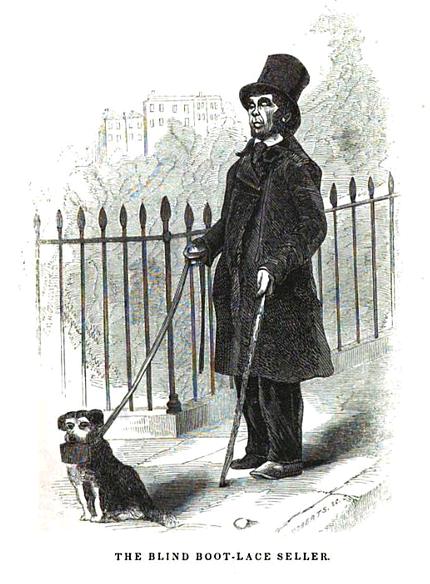
 

Blind bootlace seller, Mayhew


The life of a shoemaker was a hard scrabble life, for their trade depended on leather, the purchase of which required money or credit. Some shoemakers were known to stretch their goods by reducing the thickness of the leather used for heels and soles. Others, desperate to feed their families, would steal food or clothing and be jailed or, worse, hung after they were caught.*  -*London Hanged: crime and civil society in the eighteenth century, Peter Linebaugh
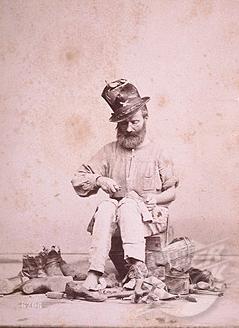
 

19th century shoe cobbler


Yet the shoemaking business was not totally abysmal:


Shoes over the 18th Century**


Shoemaking flourished in the 18th century, and boot- and shoe-makers were the most numerous of all Salisbury craftsmen throughout the 19th century and until the First World War. It was said that in the later 19th century ‘in hundreds of houses the shoe-binders, the closers and finishers were busy week in week out’. The business with the longest history is Moore Brothers, whose origins can be found in William Moore, boot and shoemaker in 1822 and 1830, and Henry Rowe, established in Catherine Street in 1842, who had moved by 1867 to Silver Street. By 1875 these premises were occupied by Rowe, Moore and Moore, a firm which subsequently became James and William Moore Brothers. The firm moved to its present premises in the New Canal at the end of the 19th century.  – Salisbury Economic History Since 1621


Yellow silk shoes with buckles, French, c. 1760's. @Bata Shoe Museum


Early in the Georgian era the fashion for high heels (as much as 3″) made it difficult for cobblers to make “paired lasts” for left and right shoes. The “last” of the shoe is footprint of the shoe, which can be straight or without a left or right side. Many of the 18th and 19th century shoes and boots were produced on straight lasts. As the person wore the shoes, they “molded” to the foot, creating a left side and right side over time. –  The Bootmaker


1810-1820 woven straw shoes


After the French Revolution, shoe heels began to disappear, symbolizing that everyone was born on the same level. Delicate silk uppers began to be replaced by more affordable, sturdier leathers.


1891 silk shoe made with straight lasts***.


But the shoes continued to be made with straight lasts, a technique that continued into the 20th century.
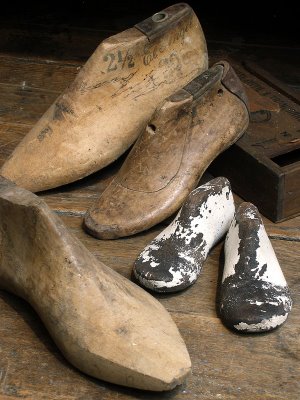
 

Vintage shoe lasts


As late as 1850 most shoes were made on absolutely straight lasts, there being no difference between the right and the left shoe. Breaking in a new pair of shoes was not easy. There were but two widths to a size; a basic last was used to produce what was known as a “slim” shoe. When it was necessary to make a “fat” or “stout” shoe the shoemaker placed over the cone of the last a pad of leather to create the additional foot room needed. – Fashion Through Time, History of Your Shoes


Shoemaker's shop, 1849


Tools used by bootmakers and cobblers included: awls for punching holes in leather; hot burnishers that rubbed soles and heels to a shine; sole knives that shaped soles; stretching pliers which stretched the leather upppers; marking wheels to mark where the needle should go throught the sole, and size sticks to measure the foot. “By 1750 shoemakers were making shoes in different sizes for anyone who wanted to buy them. Before that they only made shoes on special order.” – Tradesmen/shoemaker.

Sources:
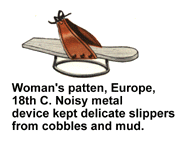
 

Pattens went out of fashion in the early 19th century. Jane Austen recalled their noise on cobblestones in Bath. It was common for women to trip while wearing this awkward device.
 

Read Full Post »

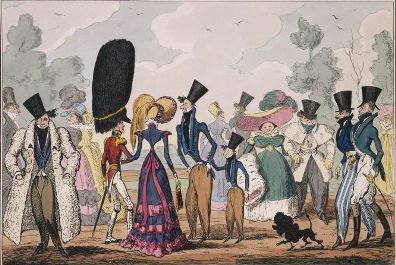
The Parks of London by Mary Elizabeth Brandon, 1868, on Dandyism.net discusses the dandies parading up and down London’s fashionable parks. After visiting that site, return to read some of my older posts about Hyde Park and the pleasure gardens.

More on the Topic:

Read Full Post »

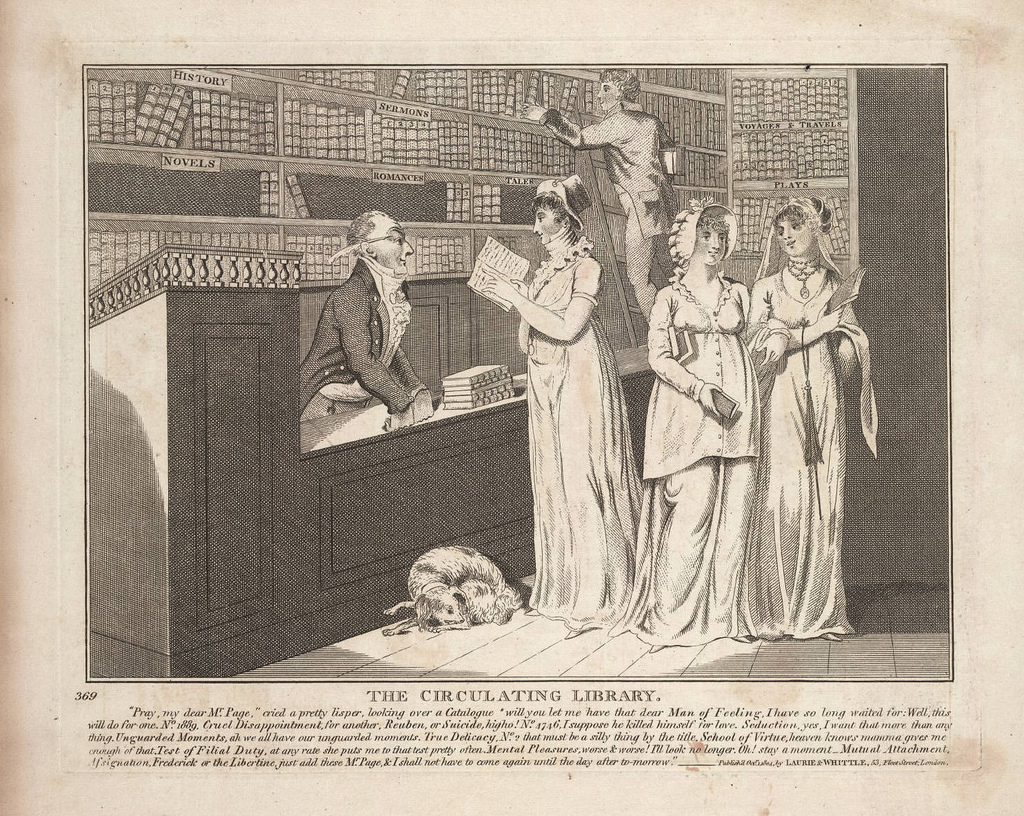
Circulating libraries in the 18th and 19th century were associated with leisure, and were found  in cities and towns with a population of 2,000 and upward. They were as much of an attraction in wealthy resorts, where people came to relax and look after their health, as in cities and small towns, like Basingstoke, where Jane Austen subscribed to Mrs. Martin’s circulating library.

In 1801, it was said that there were 1,000 circulating libraries in Britain. Book shops abounded as well, but in 1815 a 3-volume novel cost the equivalent of $100 today. Such a price placed a novel beyond the reach of most people. Worried about a second edition for Mansfield Park, Jane Austen wrote in 1814:

“People are more ready to borrow and praise, than to buy –which I cannot wonder at.”

Circulating libraries made books accessible to many more people at an affordable price.  For two guineas a year, a patron could check out two volumes. Which meant that for the price of one book, a patron could read up to 26 volumes per year.

By 1800, most copies of a novel’s edition were sold to the libraries, which were flourishing businesses to be found in every major English city and town, and which promoted the sale of books during a period when their price rose relative to the cost of living. The libraries created a market for the publishers’ product and encouraged readers to read more by charging them an annual subscription fee that would entitle them to check out a specified number of volumes at one time. – Lee Ericson, The Economy of Novel Reading

The leisurely classes had plenty of time for reading, late 18th c.

The practice of borrowing books was not a new concept in the Regency era. Records from the 17th century show that people were borrowing books from booksellers. As early as 1735, Samuel Fancourt advertised a circulating library in Salisbury for his religious books and pamphlets.

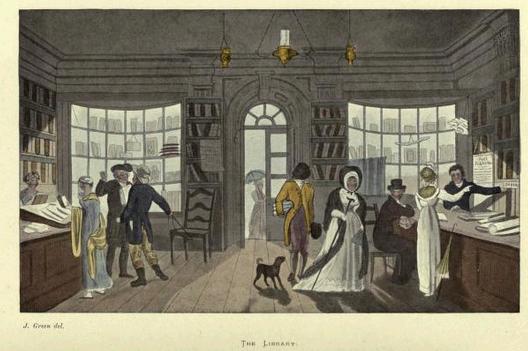
Circulating libraries attracted many patrons, even those who did not necessarily come to borrow or book or read, for they were also places for fashionable people to “hang out” and meet others.

In the resorts the circulating libraries became fashionable daytime lounges where ladies could see others and be seen, where raffles were held and games were played, and where expensive merchandise could be purchased.  – Lee Ericson, The Economy of Novel Reading

Jane Austen well knew the attractions of libraries at sea side resorts. Mrs. Whitby’s Circulating Library operated in Sanditon, and Lydia visited one in Brighton.  In her letters to Cassandra, Jane frequently mentioned circulating libraries, in particular visiting one in Southampton.

Circulating Library and Reading Room, Milsom Street, Bath. Image, Tony Grant

Circulating libraries tended to be located in a convenient location in the center of a resort. Newcomers would find out about them from guide books, such as the one in Brighton. The Royal Colonade Library advertised itself as thus:

MESSRS. WRIGHT AND SON’S ROYAL COLONADE LIBRARY, MUSIC SALOON, AND READING ROOMS.

This establishment is situated in North-street, at the corner of the New Road, and contains between seven and eight thousand volumes of History, Biography, Novels, French and Italian, and all the best Modern Publications. The Reading Room is frequented both by Ladies and Gentlemen, and is daily supplied with a profusion of London morning and evening papers, besides the French and weekly English journals, magazines, reviews, and general popular periodicals. – Brighton As It Is, 1836

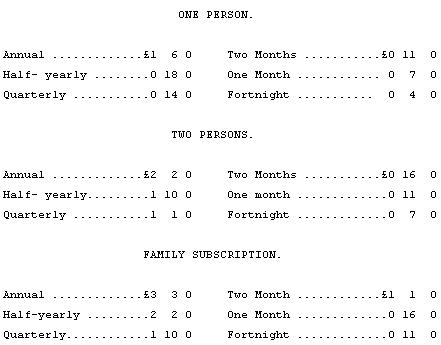
In 1836, Cassandra Austen would have been familiar with the costs associated with the Royal Colonade Library’s terms of subscriptions:

Terms of subscription

By the end of the 18th century, Scarborough, a resortt located in the county of North Yorkshire, boasted several circulating libraries. The town’s population had risen to 7,067 by 1811, and one can imagine that, with the many leisurely hours available to tourists and visitors, these libraries managed a booming business.


A circulating library in Scarborough around 1818, from Poetical Sketches of Scarborough

The Poetical Sketches of Scarborough, first published in 1813, features twenty-one illustrations of humorous subjects about the many features available in the resort, including a satiric poem about the Circulating Library:

As in life’s tide by careful fate
The mind is made to circulate
Just so each watering place supplies
It’s CIRCULATING LIBRARIES:

Where charming volumes may be had
Of good indifferent and bad
And some small towns on Britain’s shore
Can boast of book shops half a score
Scarbro and with much truth may boast
Her’s good as any on our coast
AINSWORTH’S or SCAUM’S no matter which
Or WHITING’S all in learning rich
Afford a more than common measure
Of pleasant intellectual treasure

One wonders if the following publication could be checked out a Scarborough circulating library at the turn of the 19th century, for the book was written by a local schoolmaster:

A Short Grammar of The English Language. In Two Parts By John Hornsey. Schoolmaster, Scarborough.

THE publick are much indebted to Mr Hornsey for this able and excellent compendium of English grammar. We acknowledge that we perused it with singular satisfaction; and are well persuaded that a more useful introduction to the English language cannot be placed in the hands of our youth. That this work should reach a second edition, did not excite our wonder; may it pass through many succeeding ones!- The Nichols, John.Gentleman’s Magazine, Vol 86, 1799, p 1144.

Read Full Post »

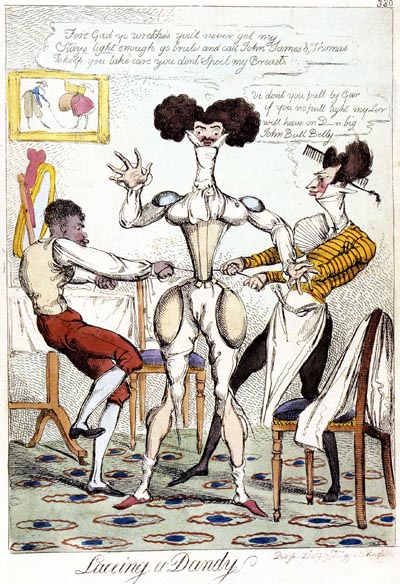
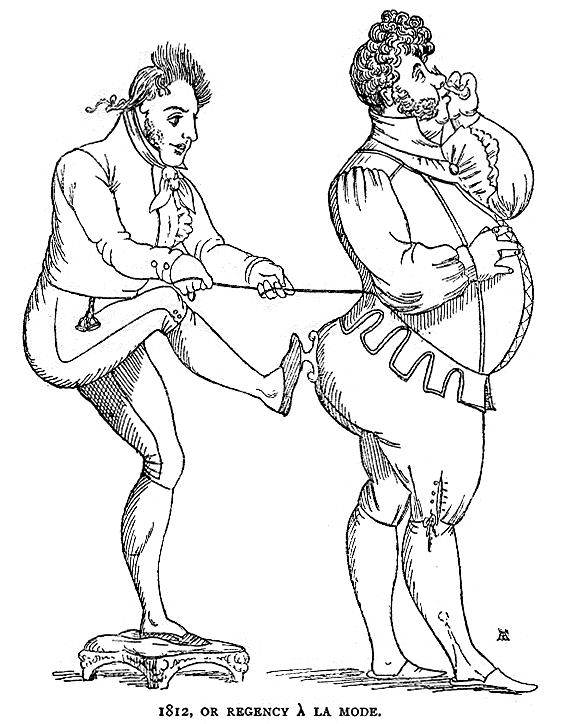
Even as women freed themselves for a short time from the confinement of corsets, the Regency dandy, following the Prince Regent’s fashion, began to constrict himself into a wasp-waisted and broad shouldered look. For men of a certain challenged physique, firm waists and tight stomachs were achieved through laced corsets. The sculpting of wide shoulders, bulging thighs, and fine calves was accomplished by well-placed pads, as the satiric image below shows.


Lacing a Dandy, 1819


There can be no doubt, indeed, that just as the large cravat resulted from defects in the royal neck, so the stays in later years became necessary to restrain the unwieldy proportions of the royal waist, and assumed by the dandies as an act of compliment to their patron. The caricatures of the day exhibit an Illustrious Personage lifted up and struggling to insert his legs into a pair of “leather”s of a size he was anxious to appear in –  which are securely lashed to the bed posts to give a sort of purchase in furtherance of his efforts – just as in 1784 stories were told of Monseigneur d’Artois, the brother of Louis XVI of France,  needing the aid of four tall lacqueys to put on and off, without creasing, his small clothes of a special make and kind. – Once a Week, Volume 10


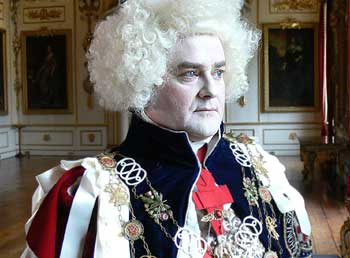
Prince Regent at his toilet, Hugh Bonneville, Beau Brummell, This Charming Man, 2008


Corsets continued to be relatively popular among the ruling and military classes for the rest of the 19th century, and retained a significant following during the first part of the 20th century.


1812 Regency a la mode


Read more on the topic:

Read Full Post »

Inquiring Readers, Adriana Zardinia, member of the Jane Austen Society of Brazil and who oversees that organization’s excellent blog, graciously sent me an English translation of her post on a Jane Austen inspired wedding. Enjoy!

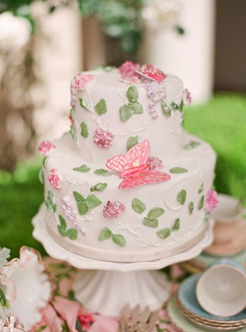
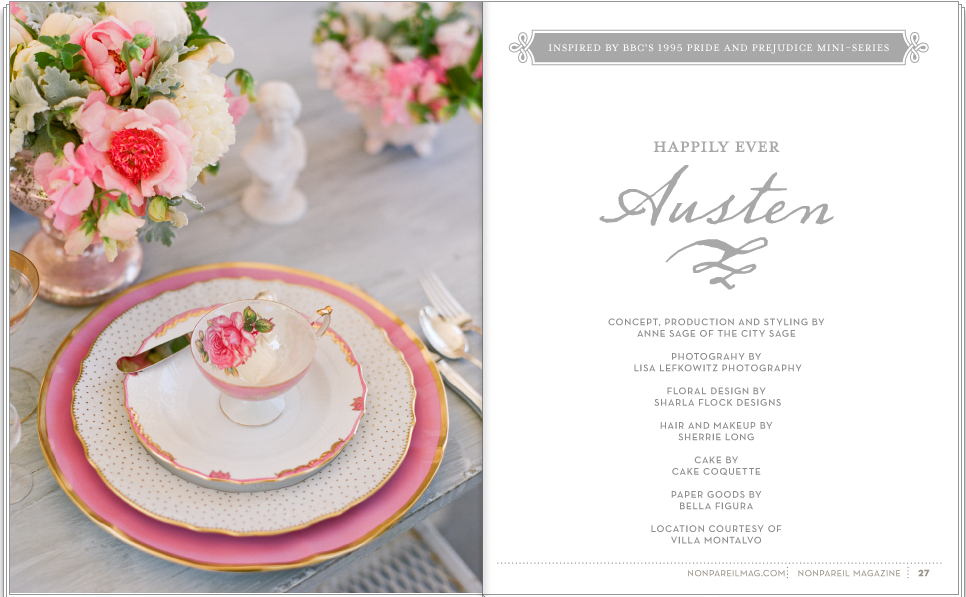
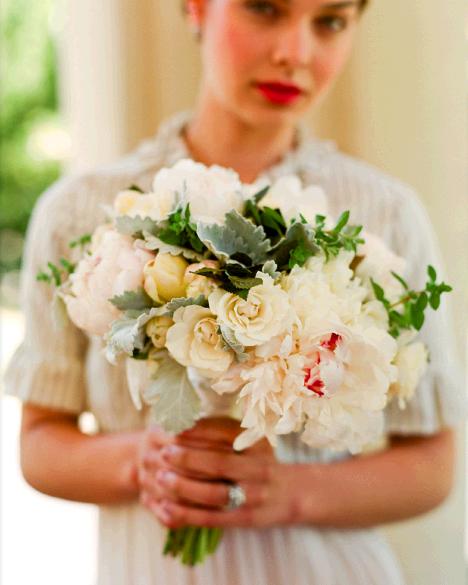
This post shows pictures from a magazine article based on Pride and Prejudice.

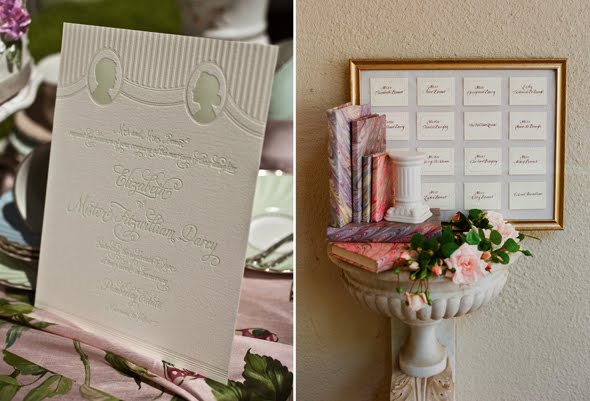
Anne, from The City Sage, showed some pictures from Nonpareil Magazine,  inspired by Jane Austen’s Pride and Prejudice, more precisely, Lizzy Bennet’s and Mr. Darcy’s wedding. Some pictures are not in the magazine’s pages and you can see them at this link.

Details of the invitation

Bride and groom

Look how perfectly chosen the flowers, candies, clothes and reception place are! See the entire article, “Happily Ever Austen”, here at this link!

Nonpareil Magazine allows you to download images and instructions for butterfly garlands and a marble table template in this link.

Adriana Zardini

http://www.jasbra.com.br

http://www.adrianazardini.blogspot.com

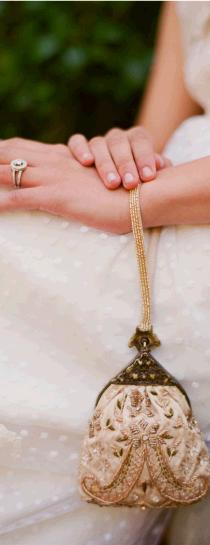
Reticule

More links on the topic

Read Full Post »

« Newer Posts - Older Posts »