Feeds:
Posts
Comments

Archive for the ‘Regency Customs’ Category

Inquiring readers: Paul Emanuelli, author of Avon Street, has contributed a post for this blog before about the City of Bath as a Character. He has graciously sent in an article about crime and an incident involving Jane Austen’s aunt, Mrs James Leigh-Perrot. Paul writes about Bath in his own blog, unpublishedwriterblog. It is well worth a visit!
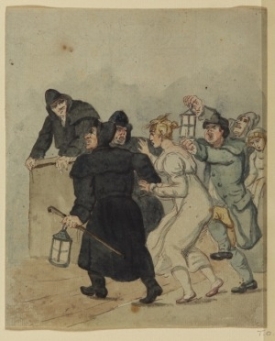
Arrest of a woman at night, 1800. Thomas Rowlandson. Image @The Proceedings of the Old Bailey

Apart from the Bow Street Runners in London there was no organised police force in 18th Century England. The capture and prosecution of criminals was largely left to their victims to deal with. Every parish was obliged to have one or two constables, but they were unpaid volunteers working only in their spare time. A victim of crime who wanted a constable to track down and arrest the perpetrator was expected to pay the expenses of their doing so.

Sometimes victims of crime hired a thief-taker to pursue the wrong-doer. Again, they were private individuals working much like latter day bounty hunters. Sometimes, thief-takers would act as go-betweens, negotiating the return of stolen goods for a fee. Many though were corrupt, actually initiating and organising the original theft in order to claim the reward for the return of goods, or extorting protection money from the criminals they were supposed to catch.
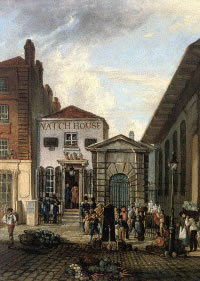
Covent Garden watchhouse. Image @The Proceedings of the Old Bailey

For the most part, unless a criminal was “caught in the act” (probably) by their intended victim it was unlikely they would be brought to justice. In the absence of a police force, the maintenance of “Law and Order” therefore came to depend more on deterrence rather than apprehension and the harshest penalty of all came to cover more and more crimes. In 1799 there were 200 offences that carried the death penalty, including the theft of items with a monetary value that exceeded five shillings.
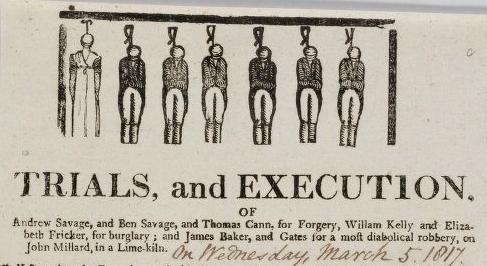
In practice, judges and juries often recognised the barbarity of the punishment in relation to the crime. Juries might determine that goods were over-priced and bring their value down below the five shilling threshold. Defendants might claim “benefit of clergy” which by virtue of stating religious belief and reading out an oath allowed the judge to exercise leniency. In other cases the Government could review the sentence. Between 1770 and 1830, 35,000 death sentences were handed down in England and Wales, but only 7000 executions were actually carried out.
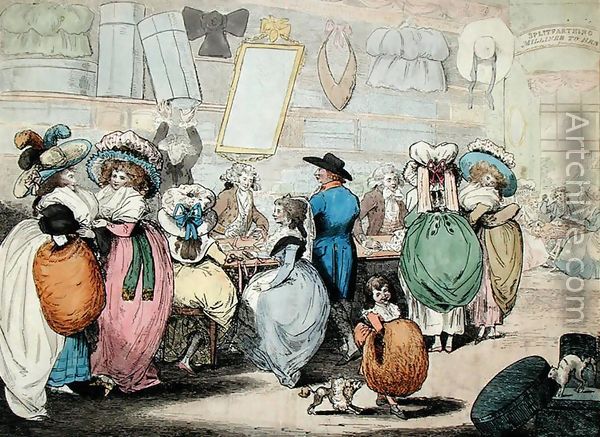
Milliners shop, after Henry Kingsbury

On the 8th August 1799, Jane Leigh-Perrot was accused of stealing a card of white lace from a millinery shop in Bath. The Leigh-Perrots, a wealthy couple, were Jane Austen’s mother’s brother and sister-in-law (Jane’s Uncle and Aunt). The white lace valued at £1 was found in Mrs Leigh-Perrot’s possession together with a card of black lace that she had bought and paid for from the same shop. Mrs Leigh-Perrot denied stealing the lace, saying that the sales clerk must have given it her by mistake when he handed over her purchase. She was nevertheless arrested on a charge of “grand theft” and the lace she was said to have stolen was worth four times the five shillings that carried the death sentence.
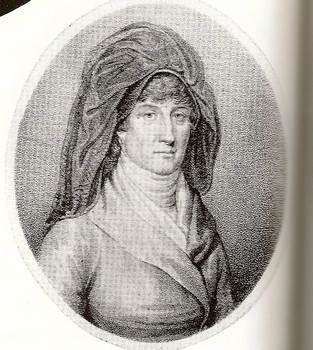
Jane Cholmeley Perrot, aka Jane Austen’s Aunt Perrot

In practice it was unlikely (given her standing) that if she had been found guilty she would have been sentenced to death. The alternatives, however, included branding or transportation to the Australian Colonies with the prospect of forced labour for 14 years. Jane Leigh-Perrot was refused bail and committed to prison on the sworn depositions of the shopkeeper. Due to her wealth, social standing and age she was allowed to stay in the house of the prison keeper, Mr Scadding, at the Somerset County Gaol in Ilchester, rather than being kept in a cell. Mrs Leigh-Perrot still wrote though that she suffered ‘Vulgarity, Dirt, Noise from morning till night’. James Leigh-Perrot insisted on remaining with her in prison.
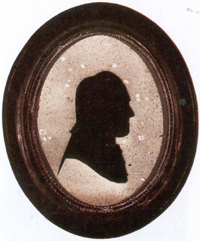
Mr James Leigh-Perrot. Image @JASA

During her trial Jane Leigh-Perrot spoke eloquently for herself. Several testimonials as to her character were also read out to the court. At the conclusion of the trial the jury took only 10 minutes to find her “Not Guilty.” It does, however, make you wonder how someone less well refined, less well-connected, less eloquent, less educated, less wealthy might have fared. The evidence of her guilt, might have been quite sufficient to send someone else to the gallows, or transported, or branded with a hot iron. She was after all caught in possession of the item and identified by the shop-keeper. In “Persuasion” Captain Harville asks Anne Elliot, ‘But how shall we prove anything?’ Anne replies, ‘We never shall.’
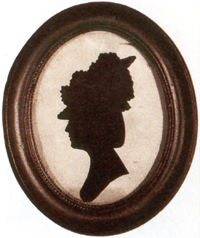
Mrs. Leigh-Perrot. Image @JASA
Read Full Post »

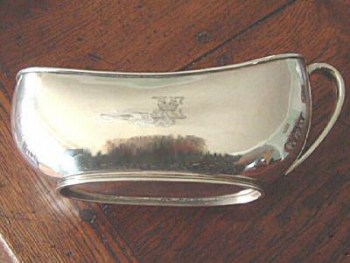
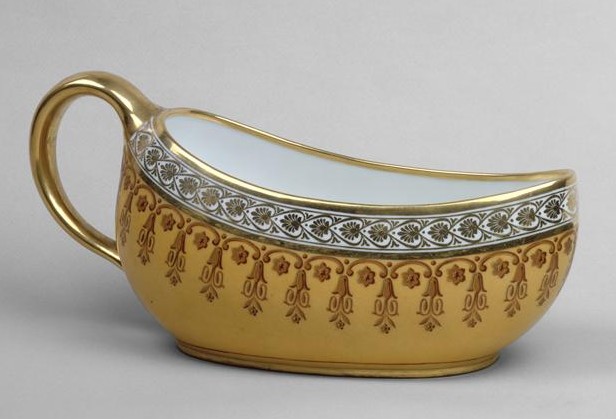
This image of a bourdaloue might be somewhat confusing to the uninitiated. Could this small and elegant vessel be a gravy boat? Or a blood-letting container?

Sevres bourdaloue, 1831.

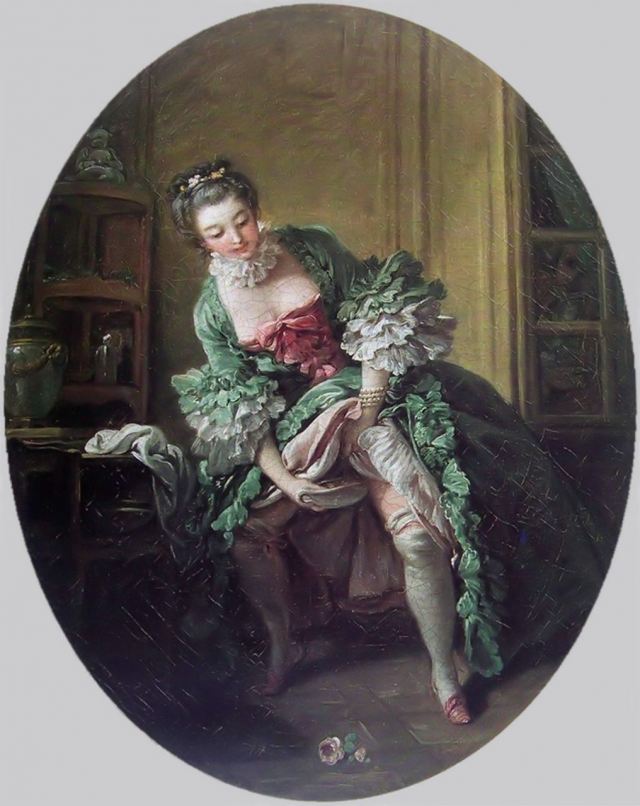
This image by Francois Boucher says it all. A fully dressed lady is relieving herself into an object called the bourdaloue or bourdalou, careful not to soil her skirts. Her maid, no doubt, stands nearby, waiting to receive the small chamber pot in order to empty it. The lady (or woman of ill repute) is in a public place – a theatre or tavern, perhaps – but certainly not a church. Wherever she is, the place has no public toilet. And so she must relieve herself standing up, taking care not to soil her skirt and petticoats.

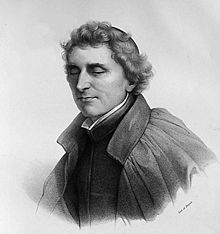
Louis Bourdaloue. Image @Wikimedia Commons

According to legend, the name of this porta potty comes from  Louis Bourdaloue (1632-1704), one of Louis XIVs Jesuit priests. His oratorical skills were reputedly so accomplished that people felt they could not miss a single word of his sermons. It is said that women sat through his masses with a bourdaloue placed under their dresses, whose skirts were held out by panniers. Since the priest’s  sermons were somewhat longwinded, the chances that ladies would need to relieve themselves were almost certain.  As a rule, churches and theatres had no toilets, and there were no breaks given during sermons. Ergo these portable urinals, which were ergonomically designed to accommodate the female body.

The vessel was oblong, rectangular, or oval in shape. A slightly raised lip at one end and a handle at the other allowed the woman to relieve herself from a squatting or standing position. The edges curved inward to avoid hurting her tenderest parts.

Sevres bourdaloue, with medallion depicting a scene from Watteau, blue lapis and framed in gold leaf. 1892.

It is a little hard to distinguish truth from fiction, so I am a bit skeptical about this apocryphal tale. Were the priest’s sermons in the early 18th century so truly awe-inspiring that a lady would squat in her pew, however discreetly, to relieve herself in front of her family and other parishioners so as not to miss a word?

In truth it was her maid who brought the vessel in, for bourdaloues were compact and came with a cover. When a lady had to relieve herself she would, I imagine, retreat discreetly to a private corner of a tall pew or to a back or side room in the church. Her maid would then hand the vessel over to her mistress, who took care not to spill any liquid on her skirts. When the lady was finished, she would hand the bourdaloue to her maid to empty its contents.  When attending a play or opera at the theatre, I imagine she would again retreat to a darker more private corner of the box to urinate.

A PAIR OF SEVRES BOURDALOUES (POTS DE CHAMBRE OVALE) CIRCA 1776,

Designed only for women, these bourdalous are quite beautiful. Made of faience or porcelain, they are decorated with flowers or painted scenes. Many are gilded. The portable pots, or coach pots as they were known in England, could be decorated inside as well.  They were quite small and compact, designed for travel, which made it easy to carry them and pack them for coach trips. They were also taken to long banquets, where ladies would scurry behind curtains when they needed to go.

Bourdalou made in France c. 1840. It has an engraved crest and a leather case to contain it. The silver bourdalou is a small urinary receptacle for female use, of compressed eliptical shape and generally made of porcelaine or earthenware, but also made occasionally of silver. Its front end has an incurved rim and, usually, stands on a simple foot ring with a simple loop handle. Also known as a coach pot in England.

Bourdaloues were used throughout the 18th and for most of the 19th century. As water closets began to be built inside homes and buildings, the use of these chamber pots began to be reduced dramatically.

Plain bourdaloue made of creamware. The shape is quite elegant.

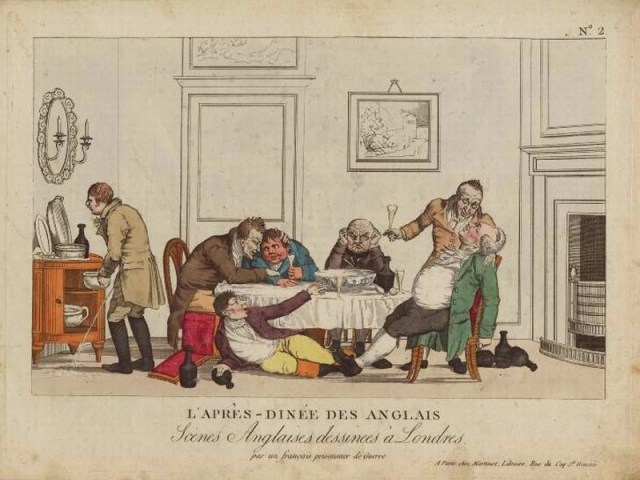
Gentlemen had it a little easier, although this satiric French cartoon, which I have shown before, depicts the disgust that Frenchmen felt towards Englishmen who freely pissed in a pot in the dining room. In this instance, the man misses the chamber pot and hits the floor. There seems to be a lack of modesty among these men, which largely holds true today.

c1816, from Fitzwilliam Museum.

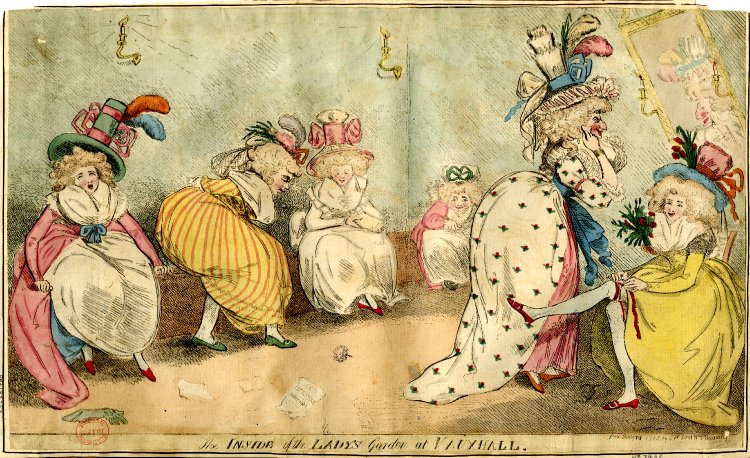
Modesty is also lacking in this cartoon of ladies relieving themselves inside a public restroom at Vauxhall Gardens. Four are arrayed on a long latrine against the wall. One lady is refreshing her make up and another is tightening her garter. If such scenes were common for upper class women in public spaces, perhaps many felt no modesty relieving themselves in church as well.

The Inside of the Lady’s Garden at Vauxhall, 1788 by SW Fores. Image @British Library. The interior of a ladies’ cloak-room. Against the wall on two sides of the room is a bench forming a latrine on which four fashionably dressed ladies are seated. On the right a woman in profile to the right, resembling Lady Archer, applies paint to her cheeks before a mirror lit by two candles. A young woman seated beside her on the extreme right ties up her garter.

Read Full Post »

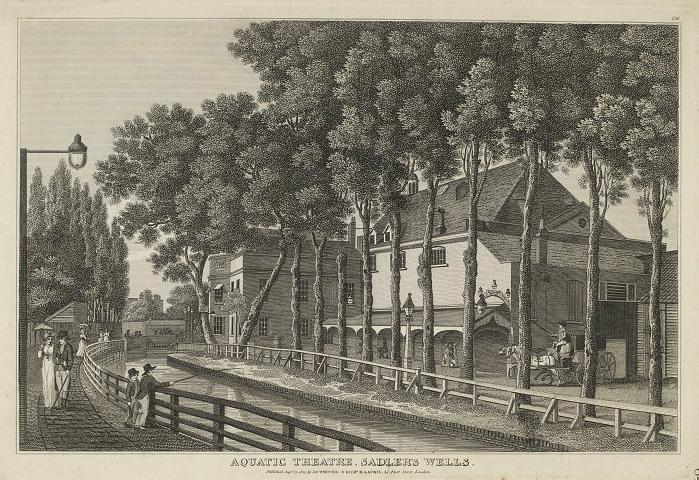
Sadler’s Wells Aquatic Theatre, 1813. copyright The V&A Museum. Click on image to view details.

Sadler’s Wells was a performing arts area located in Clerkenwell in the outskirts of London. Named after Richard Sadler, who opened a musick house there in the late 17th century, the region boasted well water thought to have medicinal qualities.

Sadler was prompted to claim that drinking the water from the wells would be effective against “dropsy, jaundice, scurvy, green sickness and other distempers to which females are liable – ulcers, fits of the mother, virgin’s fever and hypochondriacal distemper.” -Wikipedia

Six theatres have stood at this site since Sadler built his first theatre. A second theatre,  Sadler’s Wells, was constructed in 1765, which attracted summer theatre goers (the Theatre Royal offered performances only in the fall and winter.)

Interior of the theatre in 1810. One can see the water-filled tank on the stage.

In the early 19th century, Sadler’s Wells began to offer aquatic spectacles. The construction of a large tank (90x24x3 ft)  in 1804 by Charles Dibdin covered the entire area of the stage. It was flooded with water that was pumped from the nearby New River at the cost of 30 pounds per annum. This renovation allowed for the theatre to be used for naval melodramas, a popular theme, one imagines, in the days of the Napoleonic Wars and tales of Admiral Nelson’s heroism. The Siege of Gilbraltar, an ambitious spectacle, deployed 117 model ships created by the Woolwich Dockyard shipwrights and riggers, who used a scale of one inch to a foot in exact imitation of the slightest details, including the rigging. Children were cast as drowning Spanish sailors, and could be seen struggling in the waves.

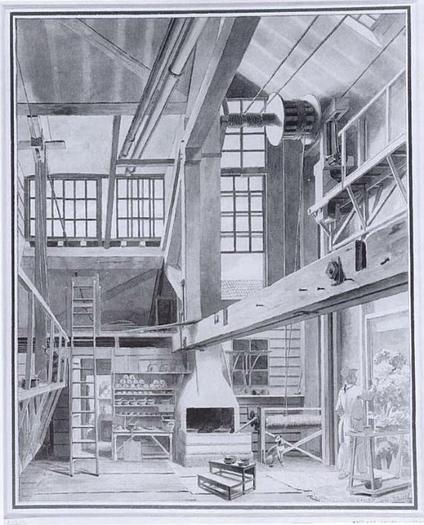
Scenic artist at work, 1790. Image @British Museum

A beautiful drop scene that filled up all the area of the proscenium showed the English fleet drawn up in battle against France and Spain. The enormous painting was used to entertain the audience during a delay while preparations were made behind stage. In order to alleviate 20 minutes of boredom between scenes, the stage slowly rose to nearly the roof of the theatre in full view. A second water tank was built on the theatre’s roof to simulate waterfalls. (With the lack of temperature control in the 19th century and windows in the main area, one can imagine that the theatre’s interior developed a powerful moldy smell in the heat of summer!)

Audience watching a play at Drury Lane, Rowlandson, 1785

The behavior of the theatre goers at Sadler’s Wells left much to be desired. As early as 1711 it was observed that members of the audience were publicly drunk, and their behavior boorish and loutish. Karl Philipp Moritz, a German traveler in England in 1782, described in his travel diary the audience in a typical British play house. Not only was the crowd rowdy between scenes and before the performance (making a “noise and uproar”), but there was a constant pelting of orange peels, for oranges were “tolerably cheap”.

Besides this perpetual pelting from the gallery, which renders and English play-house so uncomfortable, there is no end to their calling out and knocking with their sticks till the curtain is drawn up…I sometimes heard, too, the people in the lower or middle gallery quarrelling with those of the upper one. Behind me, in the pit, sat a young fop, who, in order to display his costly stone buckles with the utmost brilliancy, continually put his foot on my bench, and even sometimes upon my coat. – Karl Philipp Moritz

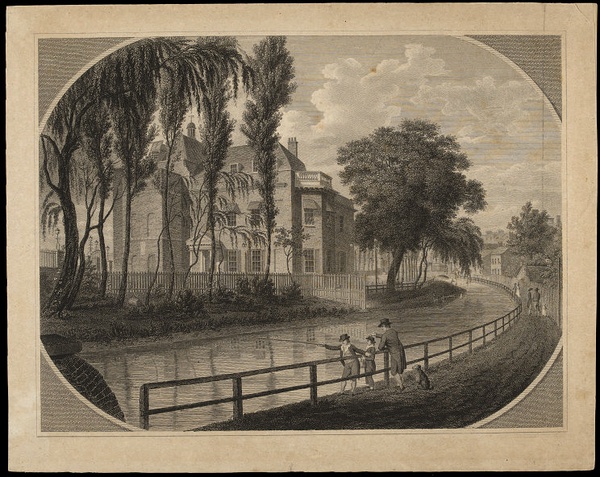
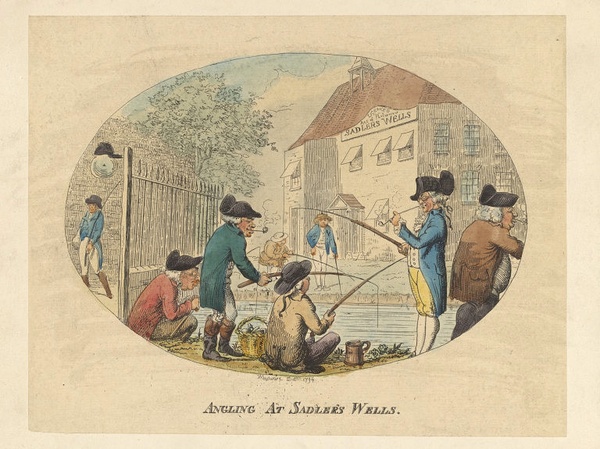
Another view of the theatre. Fishing seems to have been a popular pasttime as well.

If the Sadler’s Wells theatre audience had a particularly rowdy reputation compared to theatres in central London, one can only imagine how truly awful the experience was. The theatre slowly lost its lustre during the first half of the 19th century, for it was located in the rural outskirts of London. Without street lights and an organized police force, travel at night was dangerous, and patrons of the theatre were provided escorts as they traveled back to central London.

 Pinero’s play Trelawny of the ‘Wells’ (1898), portrays Sadler’s Wells as outmoded by the new fashion for realism. The theatre declined until, by 1875, plans to turn it into a bath house were proposed and, for a while, the new craze of roller skating was catered to, as the theatre was converted into a roller-skating rink and later a prize fight arena. The theatre was condemned as a dangerous structure in 1878. – Wikipedia

Anglers at Sadler’s Wells.

Read Full Post »

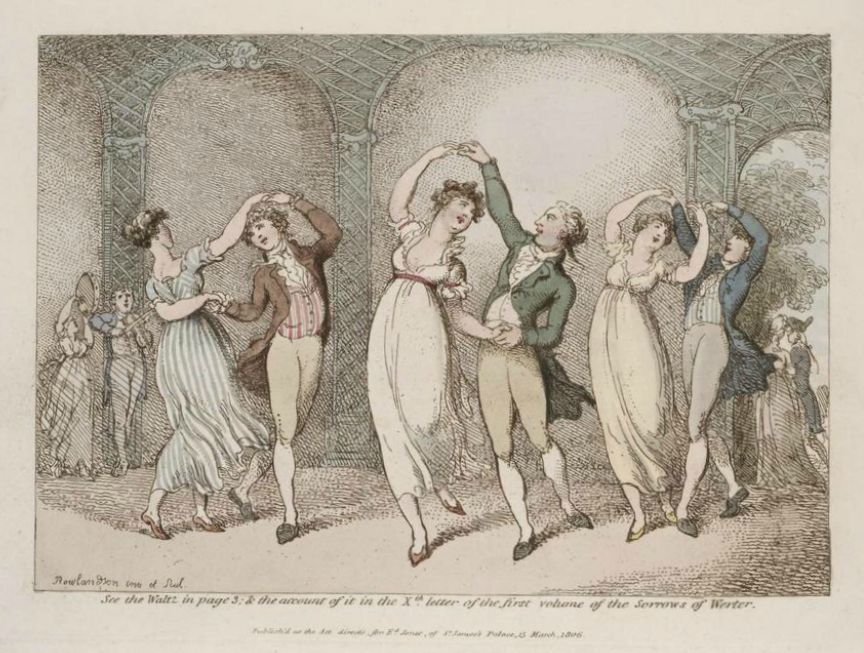
When Lady Caroline Lamb met Byron in 1812, the waltz was starting to gain traction with the more progressive elements of Society. This couples dance was considered rather racy in an age when stately group English country dances were the primary offerings at Almack’s.

Thomas Rowlandson’s image of the waltz in 1806

The vivacious and racy Lady Caroline Lamb met Lord Byron in 1812. She recalled that time in a letter she wrote 12 years later:

Devonshire House at that time was closed from my uncles death for one year – at Melbourne House where I lived the Waltzes and Quadrilles were being daily practised – Lady Jersey, Lady Cowper, the Duke of Devonshire, Miss Milbank, and a number of foreigners coming here to learn…

You may imagine what forty or fifty people dancing from 12 in the morning until near dinner time all young gay & noisy were.
In the evenings we either had opposition suppers or went out to Balls and routs – Such was the life I then led when Moore and Rogers introduced Lord Byron to me… Caroline Lamb, 1824, in a letter to Captain Thomas Medwin

It is interesting to note that Caroline mentions Lady Jersey and Lady Cowper, two of the patronesses of Almack’s, where the waltz was banned. Eventually, however, the ultra exclusive Almack’s would cave in, and by 1814 the waltz was finally sanctioned. Young ladies would still need approval before a gentleman could clasp his arm around her waist, but the doors had been opened beyond the confines of the upper classes.

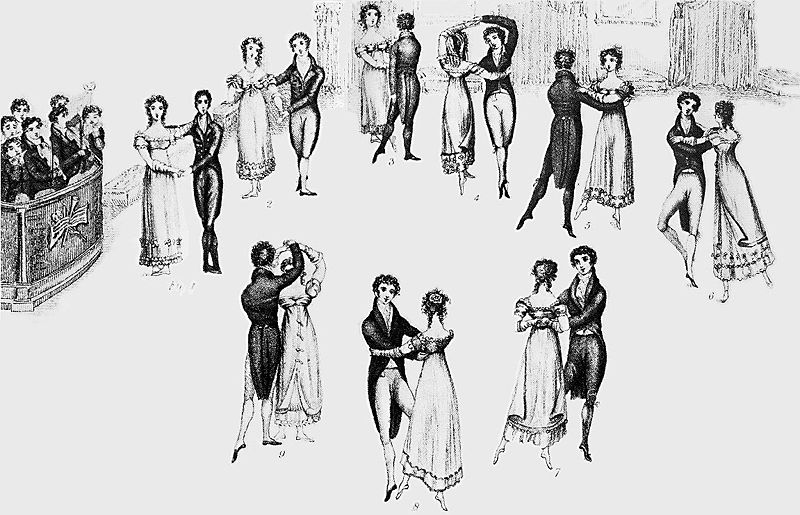
La Walze, Le Bon Genre, 1810. This caricature has a feeling of decadence.

By 1815, when Jane Austen’s Emma was published, the waltz has become so respectable that it would be danced in Highbury at the home of the Coles.

Mrs Weston, capital in her country-dances, was seated, and beginning an irresistible waltz; and Frank Churchill, coming up with most becoming gallantry to Emma, had secured her hand, and led her up to the top.” – Emma

The waltz looks gentrified in this 1816 illustration.

More on the topic:

Read Full Post »

As a blogger who is curious about all things in Jane Austen’s world and customs in her past that might have influenced her, I am still amazed at how one tiny clue points to another until I land on a series of sites that open up a whole new topic. While history foodies probably know about the elaborate lengths that pastry chefs took to please their patrons, the visual results of a full banquet are simply astounding. I can only assume that Georgian taste buds were equally pleased.

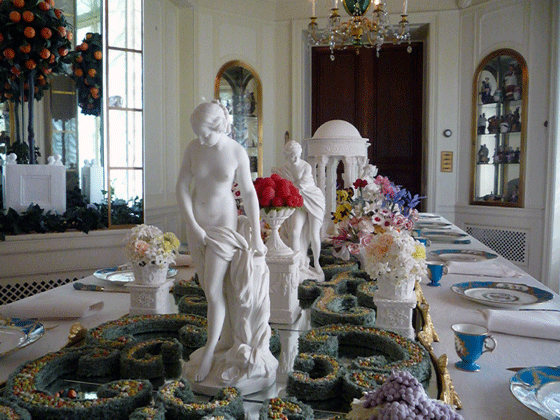
Modern chef and historian, Ivan Day, recreated a feast from the past using sugar structures and porcelain figures to arrange a fanciful garden centerpieces for the table.

I already knew about The Prince Regent’s elaborate 1811 dinner at Carlton House, which was described as thus:

“Along the centre of the table about six inches above the surface, a canal of pure water continued flowing from a silver fountain beautifully constructed at the head of the table. Its banks were covered with green moss aquatic flowers; gold and silver fish swam and sported through the bubbling current, which produced a pleasing murmur where it fell, and formed a cascade at the outlet.” – The Gentleman’s Magazine, describing the Prince Regent’s fete at Carlton House, June 19, 1811 in honor of the exiled French royal family.

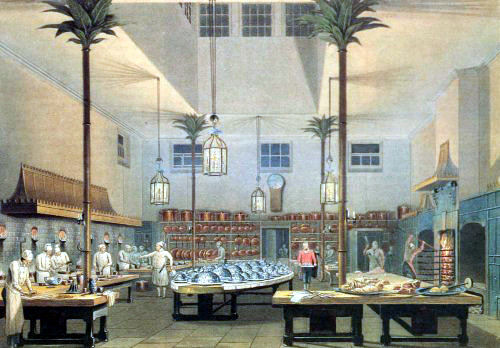
The great kitchen at the Prince Regent’s Pavilion at Brighton could accommodate creating dishes for huge and fanciful banquets.

So great was the interest that the doors of Carlton House were opened for three days in a row. But instead of satisfying the curiosity of the masses, the result was ever-increasing crowds. Chaos ensued.

‘The condescension of the Prince in extending the permission to view the arrangements for the late fete at Carlton House has nearly been attended with fatal consequences,’ reported one newspaper. Read more: http://www.dailymail.co.uk/news/article-1039063/As-Queen-opens-Palace-Ballroom-public-story-decadent-royal-banquet-ever.html#ixzz1s7ijkAEv

Detail of the design for an elaborate garden centerpiece. These engravings were showcased in Le Cannameliste Français by famed confectionary chef, Joseph Gilliers, in the mid-18th century. View the entire centerpiece here: Click on this link.

The banquet featured a recreation of a landscape at its center. Such a method of decorating a table was not new, especially when it came to desserts. Elaborate set pieces with architectural French influence were created for tables using spun sugar and Sevres bisque figures to create fantasy landscapes. Before the Napoleonic Wars, travel over the English Channel between British and French courtiers and diplomats was common, and thus the French chef’s custom of creating these elaborate centerpieces became well-known in England. Upper class households vied for highly paid (and desired) French chefs, and by the 1820s these gentlemen had by and large invaded British upper class kitchens. Their ability to create dishes that feasted both the eyes and the stomach was unrivaled.

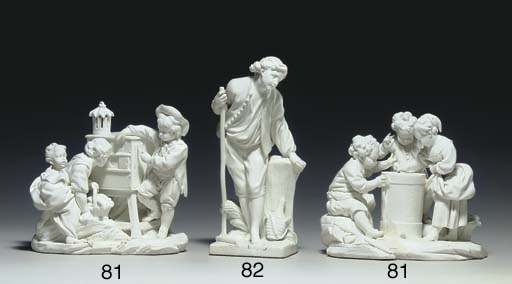
 SEVRES BISCUIT FIGURES CIRCA 1755, Modeled after François Boucher. Image @Christies.

This was an era when confectionary was considered as much a branch of the decorative arts as of cuisine, and porcelain for the table represented prestige as well as a demonstration of power. The combination of French chef, porcelain, and fanciful confectionary desserts served as symbols of prestige and wealth, for no ordinary household could offer such an extravagant display of food and panoply. (View this porcelain table centerpiece set.)

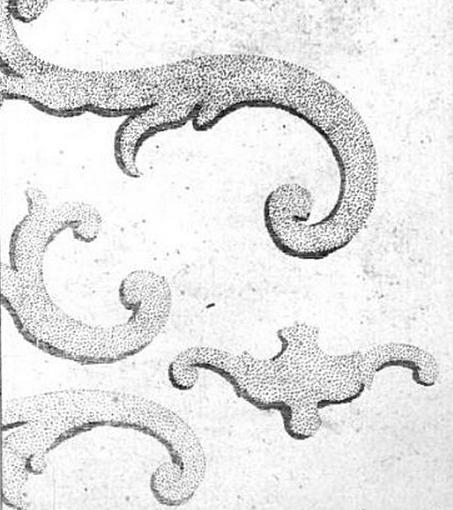
Detail of Gilliers’ templates for cut outs.

Most of the images of the banquets and figurines are copyrighted. I encourage you to click on the links to view the spectacular results of sugar and porcelain table centerpieces that mimic gardens, sculptures, and figures based on famous paintings. The fanciful recreation included redesigning tables as well.

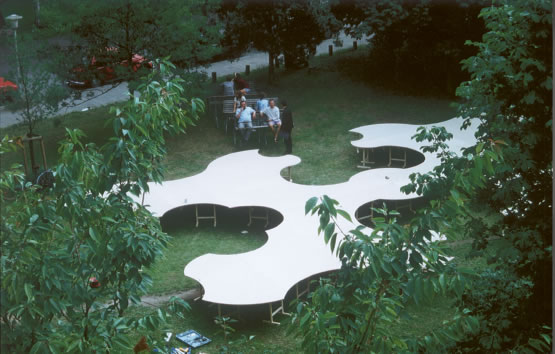
Modern version of Gilliers table. Image @Simon Beer.

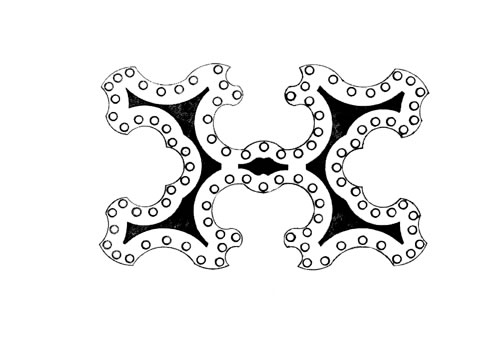
Gilliers’ 1751 sketch of the table, plus seating.

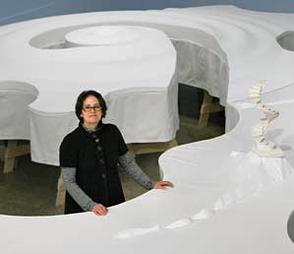
Amy Hauft, VCU sculpture department. Confectioner Joseph Gilliers conceived his 100-seat rococo fantasy for the serving of a single course — dessert — in a garden setting. The centerpiece atop the tailored white tablecloth was to be a sculpture made of sugar paste fortified with dried sturgeon bladder. There is no record that this table was ever built by Gilliers. Image@Richmond Times Dispatch

More on this fascinating topic:

Ivan Day’s  pavilion made from a “pastillage sugar paste for an exhibition at the Met in NYC two years ago. They were exact replicas of ones made for Maria Theresa, the Empress of Austria in 1740. “

Read Full Post »

« Newer Posts - Older Posts »