Feeds:
Posts
Comments

Archive for the ‘Regency Customs’ Category

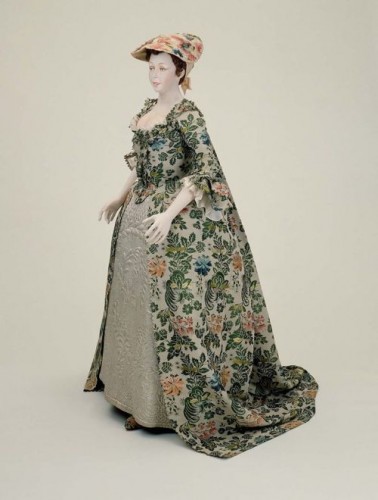
Wedding dress, 1742, Image @Boston Museum of Fine Arts

Anyone who had the opportunity to see “At Home With the Georgians” with Amanda Vickery was in for a treat. The BBC series, based upon her fabulous book, Behind Closed Doors: At Home in Georgian England, covered courtship and marriages in the 18th century in great detail. The perspectives of bachelors, spinsters, and married couples were taken into account.

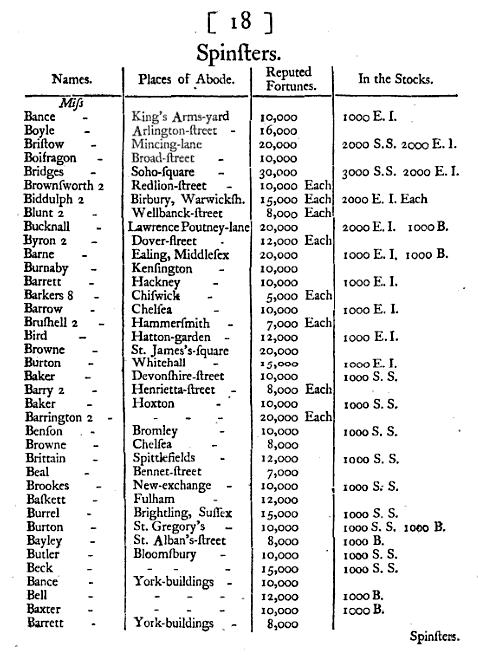
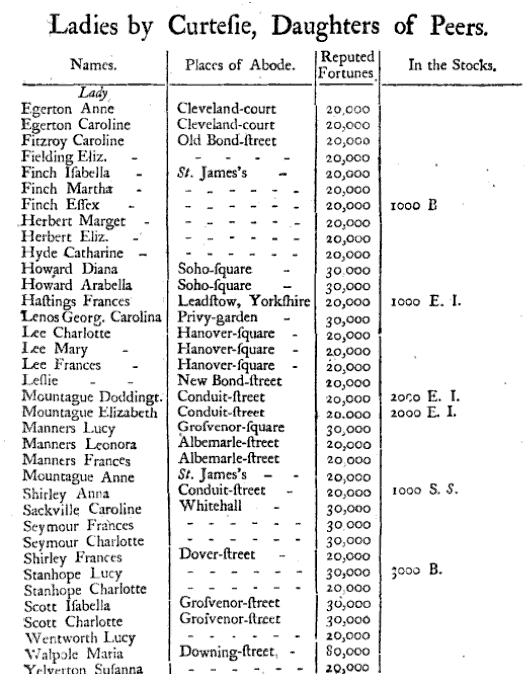
One of the most intriguing portions of the series occurred when Amanda Vickery introduced A Master-Key to the Rich Ladies Treasury or The Widower and Batchelor’s Directory by a Younger Brother, published in 1742.

The witty saying on the frontispiece describes perfectly why this book of lists was compiled:

“He took his Stand

Upon a Widow’s Jointure Land.”

The author, a younger brother who had to make his way in the world by working or marrying rich, writes these shameless words to the woman of fortune he is courting:

“Begin then Madam, hasten to begin — Bless the thrice happy Compiler, make the Happiness of a Younger Brother equal to that of his Elder, — Let the Honourable Mrs. M——n in the Connubial State shine with Splendour equal to Miss F———n in the Maiden, and tell a mistaken World that the Appellation Wife bears with it every Sound of Dignity and demands an universal Reverence;…”

This book was compiled for those  men who were unlucky to follow in their elder brothers’ shadows, for the laws of primogeniture dictated that the eldest son would inherit everything. The ladies are described in its pages with their names, where they live, the largeness of their reputed fortunes and of the stocks held in their names.

Marriage was the only option for ladies during the Georgian era, since they could not control their own fortunes or possess lands. All they “owned” was held in trust for them. Many a rich spinster or widow preferred choosing marriage over living a life alone.

One can almost hear this shameless Younger Brother courting his future bride (and plying her with gifts and poesies) as he charms her into marriage and publicly worships her with these words:

I could for ever dwell on the Repetion of your Charms, if I were not in immediate Expectation of the Possession of them: Whatever Pleasures, whatever Joys we earnestly covet, we surely anticipate of; when alone I am for ever repeating one Line of Dryden’s,

Happy, Happy Pair!”

Today many a suitor would be laughed off his knees if he said such a thing, but back then marriage was a serious business. An engagement represented the best financial arrangement that the pair could finagle. A gentleman had only a few means of making a fortune, one of which was by marrying rich, and a lady had only one means of supervising her own household, and that was in attaining the status of a wife. The Marriage Mart, as the pages in A Master Key imply, was strictly business. Oh, it helped if the people involved had pleasing countenances, good manners, and gentle hearts, but none of these attributes are discussed in this short list of women on the marriage mart in 1742.

I can imagine that many younger sons found comfort in these lists and made elaborate plans to be introduced to the women described so coolly inside of them. To these gentlemen the Younger Brother writes:

Whoever has read the Advertisements in the public Papers of Mr. C—-x, and the unknown Lady who accepted of his Proposals, will instantly acknowledge the Usefulness of the following Directory: The Dilemma that Gentleman was reduced for a Partner, determined the Compiler to set about it: He resolved to spare no Pains: He carefully examined every List of the Proprietors of the public Funds; and made afterwards the best Enquiry he was capable of, into their Fortunes exclusive: As it was impossible to give the exact Fortune of every lady in so large a List as the following, he thought proper to make in his Kalender, one Column under the Title of Reputed Fortunes.”

The Younger Brother’s advice is quite straightforward and required little embellishing:

Thus Gentlemen, have I in the following Sheets I think, opened a fair Field for Action for you; a fine Choice and a fine Collection of Ladies; — Open the Campaign directly then yourselves, that my next may be a new Sett. I have one favour to beg of you, and then I take my Leave; that no one of you, of what Degree soever, presume to attempt the Lovely Charmer I dedicate to; as to the Rest, I heartily wish you all Success …”

The Marriage Mart, I imagine, was a dance of the sexes, with the younger sons finding the best situation their charms were capable of, and the women choosing among the pool of men, hoping that their choice of mate will remain charming, moral, and kind  and not turn into a selfish, wife-beating monster.

Read Full Post »

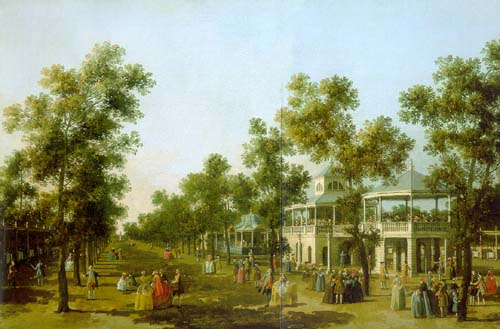
Canaletto's view of Vauxhall Gardens and the Grand Walk

Vauxhall Gardens opened in 1661. The most famous of London’s diarist’s, Samuel Pepys, recorded in his diary that he visited Vauxhall Gardens no less than twenty four times. The first time he recorded a visit to the gardens was on 29th March 1662, when Vauxhall it really was just a country inn set within a pleasant garden setting with walks and flower beds. It was approached from a path from the Thames and the Vauxhall stairs. Visitors would cross the Thames in a boat from the north bank. They generally would bring their own picnics.
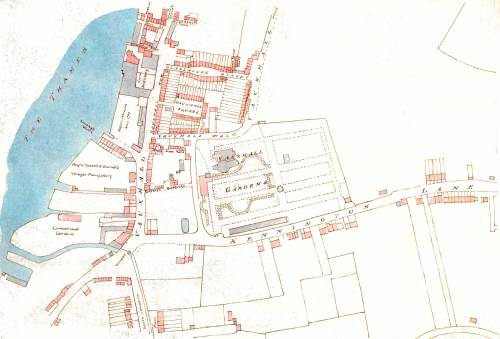
Map of Vauxhall Gardens in 1800. Click on image to enlarge. Image @Ideal Homes: History of South East Suburbs (see link below).

Amateur musicians would perform in the gardens and sometimes the visitors themselves would provide their own entertainment.  This was the first time that ordinary people could enjoy gardens like this, which was a unique social aspect at the time of Pepys. It was a freeing of social codes. Such gardens were usually found in the country estates of the nobility.
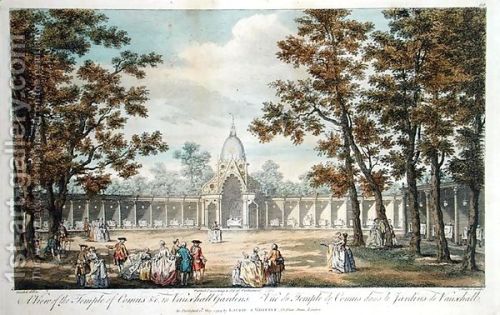
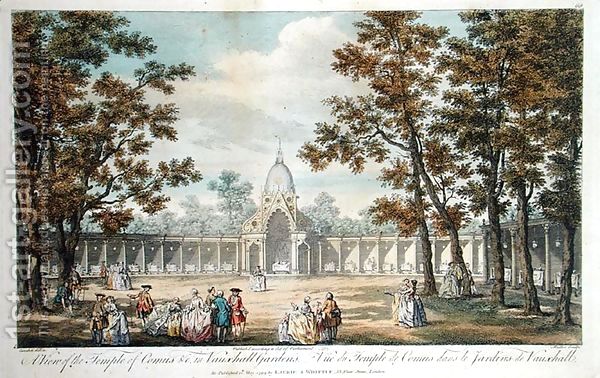
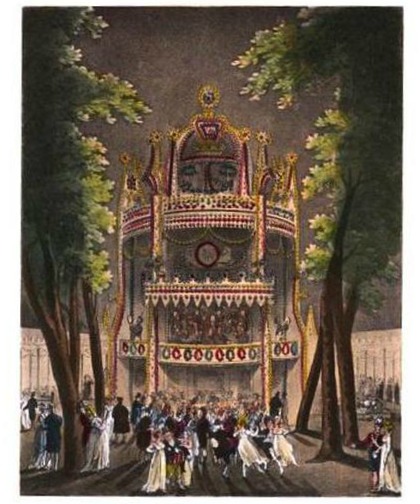
A view of the Temple of Comus at Vauxhall Gardens. Image @1st Gallery.com

People from different levels of society could meet freely and strangers could meet within the gardens. In the usual course of their lives there were strong social codes about friendships and who could talk to whom. The gardens were a place to be free of many social constraints, where males and females could meet. It was also an ideal place for the business of prostitutes.
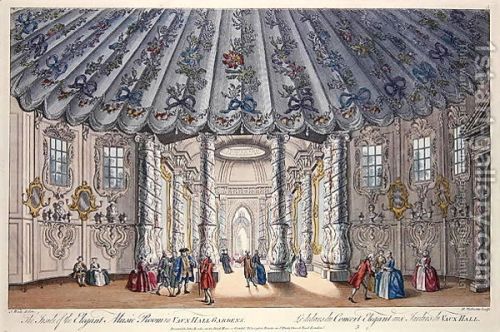
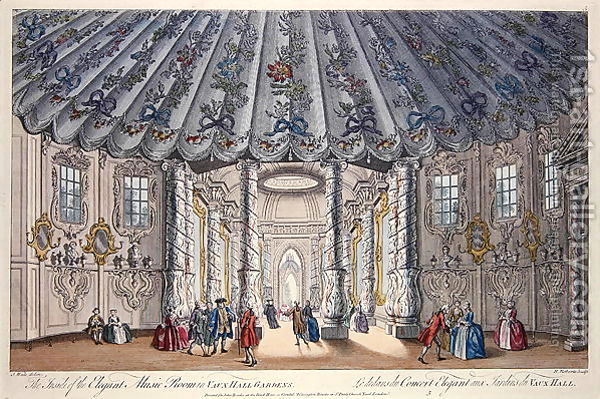
Interior view of the elegant music room at Vauxhall Gardens. Engraving by H. Roberts, 1752. Image @1st Gallery.com

Over the centuries various owners and managers oversaw Vauxhall gardens . The greatest of these was Jonathan Tyers. He came from a family of fellmongers from Bermondsey in the east End. Fellmongers were dealers in leather hides.

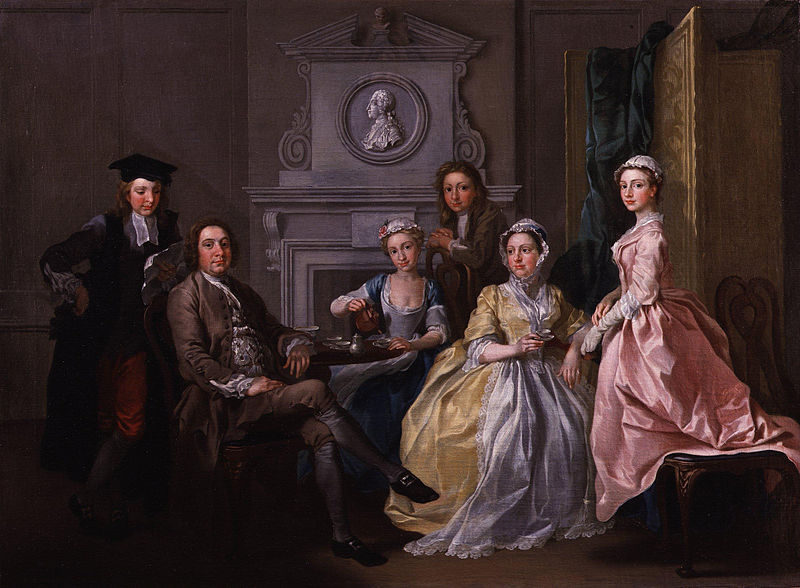
Jonathan Tyers and his family by Hayman. Image @Wikimedia Commons

Tyers was a shrewd businessman and understood how to advertise and popularise the gardens. He was also good at reinventing himself as a gentleman, landowner, wit, urbane host, and patron of the arts. He owned the gardens from 1729 to his death in 1767 and saw Vauxhall gardens at the height of its fame and popularity. His most important guest was The Prince of Wales, who had his own booth within the gardens.
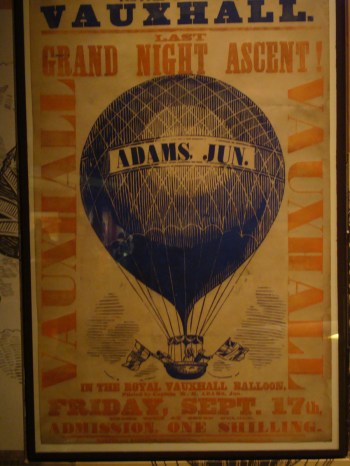
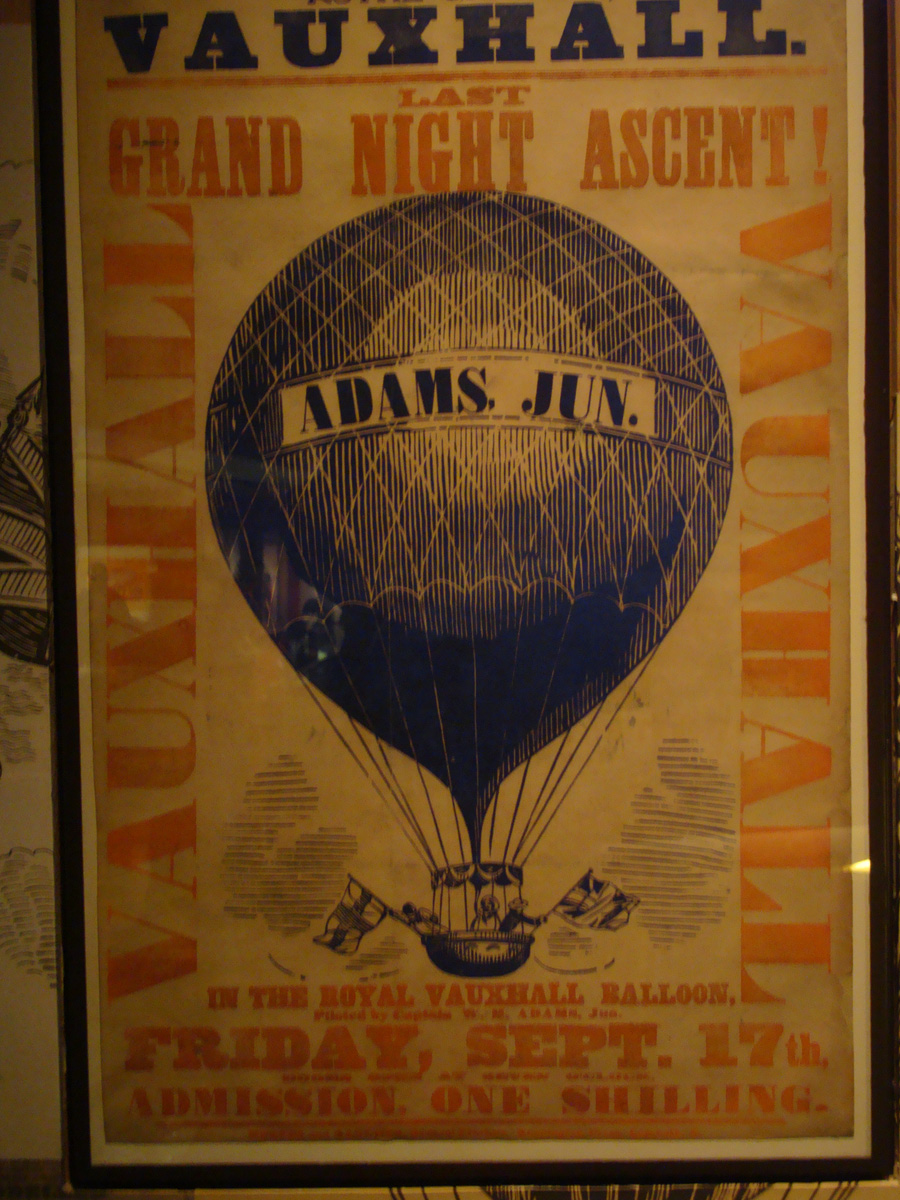
Pleasure gardens poster at The Museum of London. Image @Tony Grant

All of society, from the aristocracy, to landowners, to the ordinary working people came to Vauxhall. For special events Tyeres would raise the price to attract only certain people but generally the price was one shilling and this price remained the same for sixty years. He offered season tickets for a guinea.

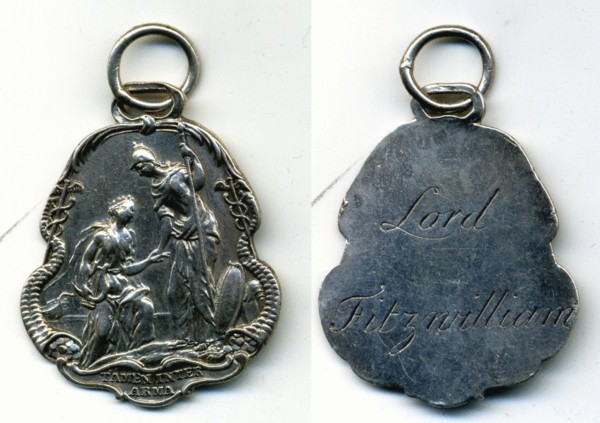
Vauxhall Garden silver pass, c. 1760

The season ticket comprised a metal tag embossed on one side with a scene of classical mythology and the other side was printed with the ticket holders name. There is quite a selection of these season tickets in various collections.
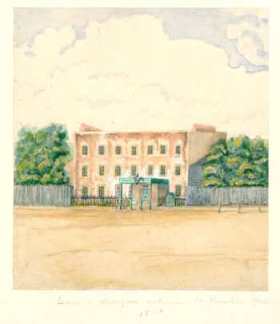
Water gate entrance to Vauxhall Pleasure Gardens

In 1740 a Vauxhall evening would begin at 7pm.The visitors would get into a boat from Westminster and alight at the Vauxhall Stairs on the south bank, very close to where Lambeth Palace, the home of the Archbishop of Canterbury, was located. Visitors would walk through the main entrance which fronted the River Thames and proceed along The Grove with the supper boxes lining the walkway on either side.
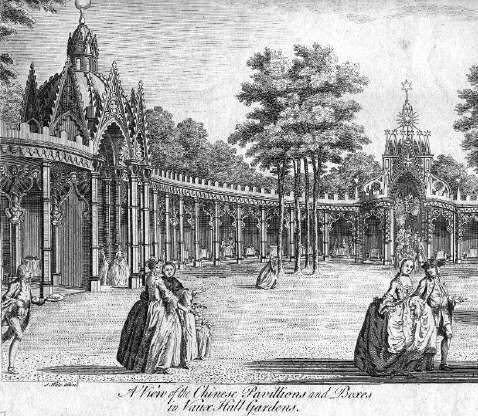
Chinese Pavillions at Vauxhall

In front of the boxes stood the orchestra building.
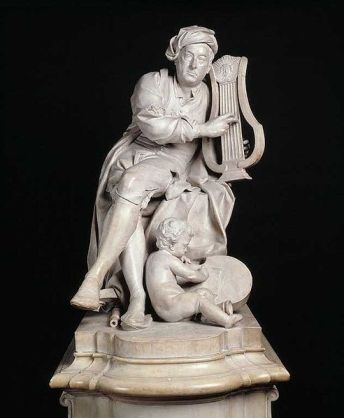
Statue of Handel by Louis-François Roubiliac, 1738. Image @V&A Museum

A statue of the composer Handel could be seen in front of this. The gardens were famous at this time for giving performances of new pieces composed by Handel or other composers well known at the time, such as Arne and Boyce.
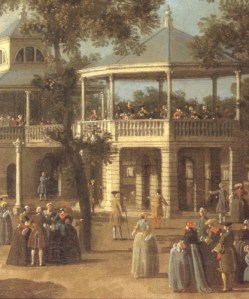
The orchestra at Vauxhall, Canaletto.

Visitors would have the chance to see wealthy people promenading through the gardens wearing the latest expensive fashions.
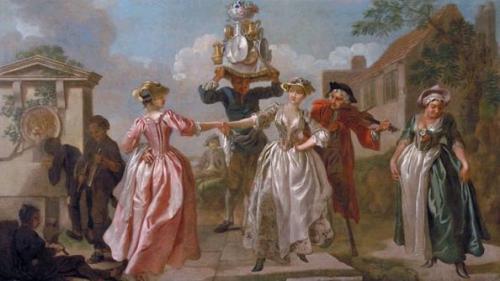
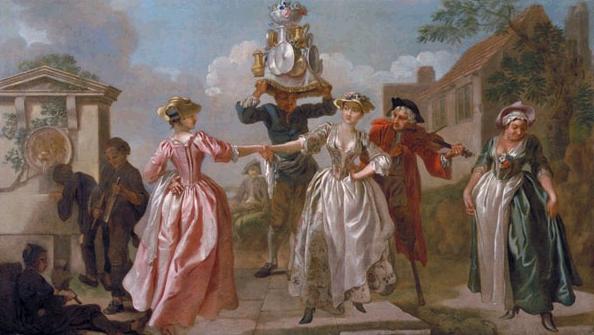
One of the surviving Vauxhall genre paintings. Image @ V&A

The fifty large supper boxes were able to entertain up to ten people to supper. Each box was decorated with an original painting. Surprisingly fourteen of these paintings still survive.
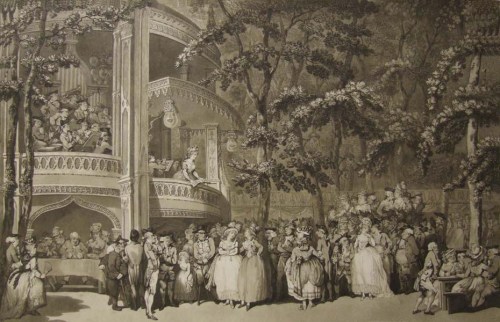
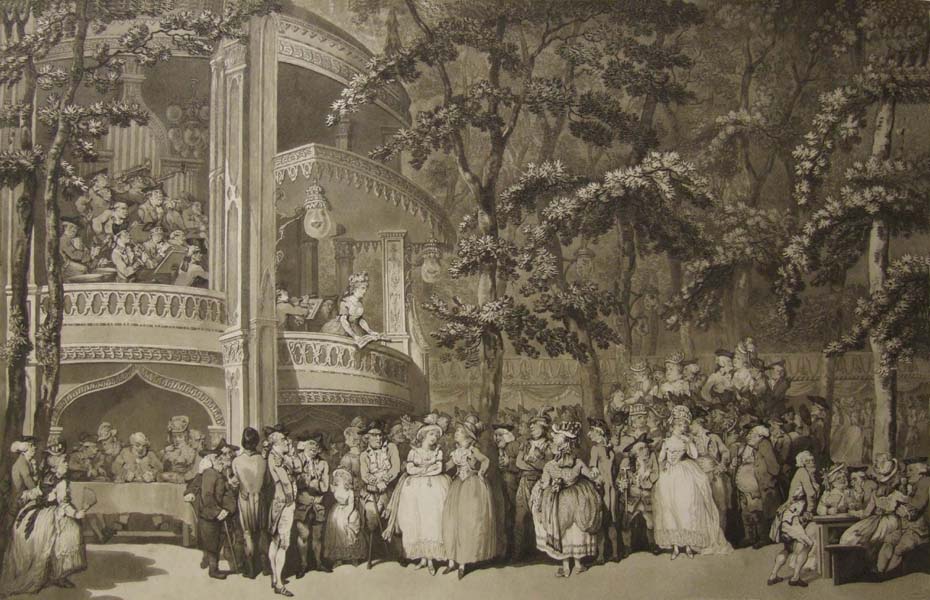
Vauxhall Gardens, Rowlandson

The Grand Walk led to the golden statue of Aurora or the Rural Downs where there was a life size statue of Milton. This reminds me of the 18th century gardens at Painshill in Surrey which have been restored very much to their former glories. At Painshill there are grand vistas, a Turkish tent, mysterious grottos near the lake, a ruined Abbey, a hermits lodging and a Roman temple as well as many large statues from Greek mythology set within groves.
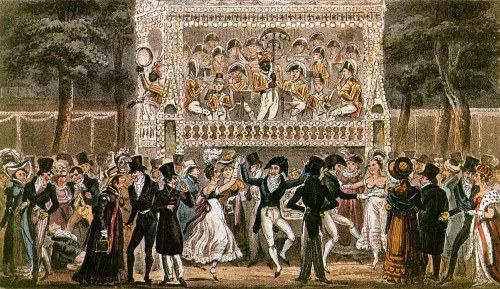
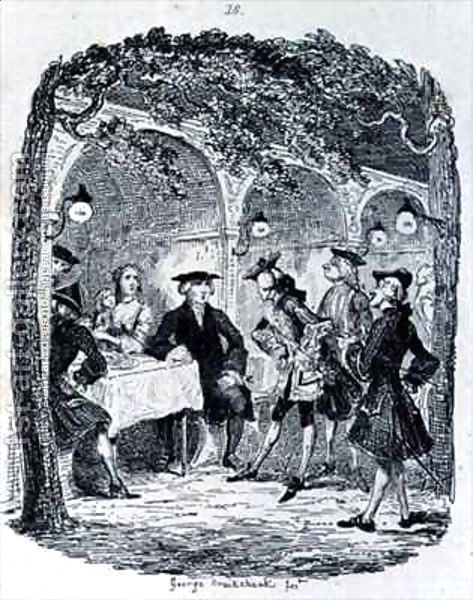
Tom and Jerry at Vauxhall

The Vauxhall experience therefore is still possible to experience. If Vauxhall was intended, as the gardens at Painshill were, then each setting was meant to create a different mood or spiritual experience. There is no record of Jane Austen visiting Vauxhall but she obviously knew about it. She stayed with her brother Henry at Hans Place which is almost directly across the Thames from Vauxhall.
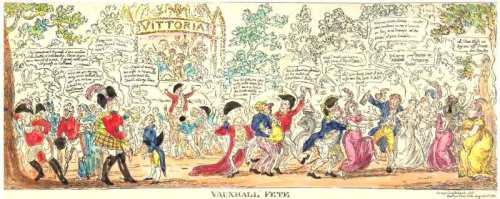
Vauxhall pleasure gardens by Cruikshank, 1813

It is about half a mile from the river bank but the lights, the sounds of the music and fire works exploding would easily have been noticed from miles around. In Mansfield Park the walk in the park at Sotherton owned by Mr Rushworth have echoes of Painshill and Vauxhall.

Night scene in a supper box at Vauxhall

The Vauxhall Supper began about 9pm as dusk fell. It comprised of Vauxhall ham, cold meats, salad, cheeses custards, tarts, cheesecakes and other puddings. As night fell during the supper a whistle was blown. Servants lit thousands of lamps positioned strategically about the gardens and illuminated the scene. The effect was sensational.
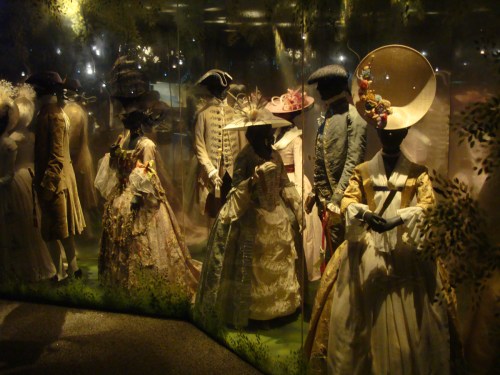
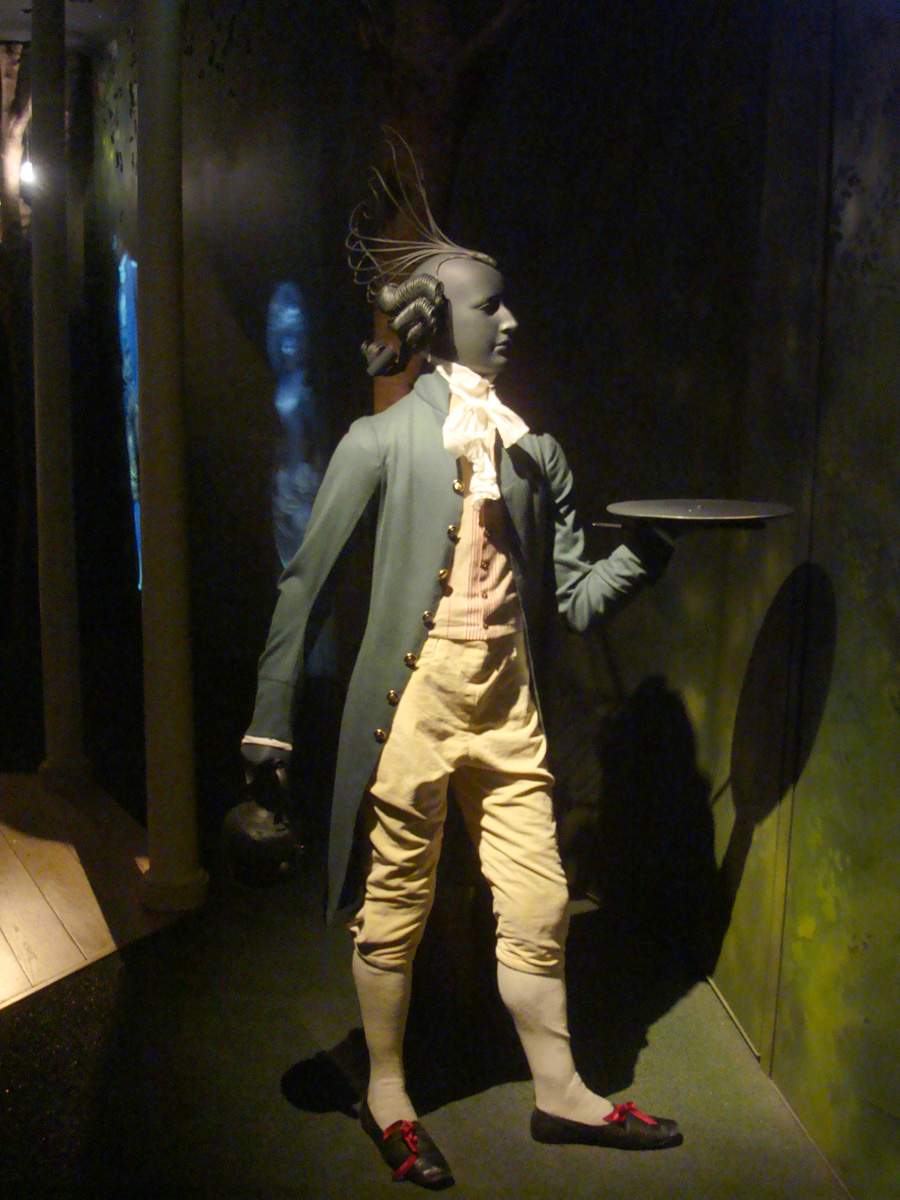
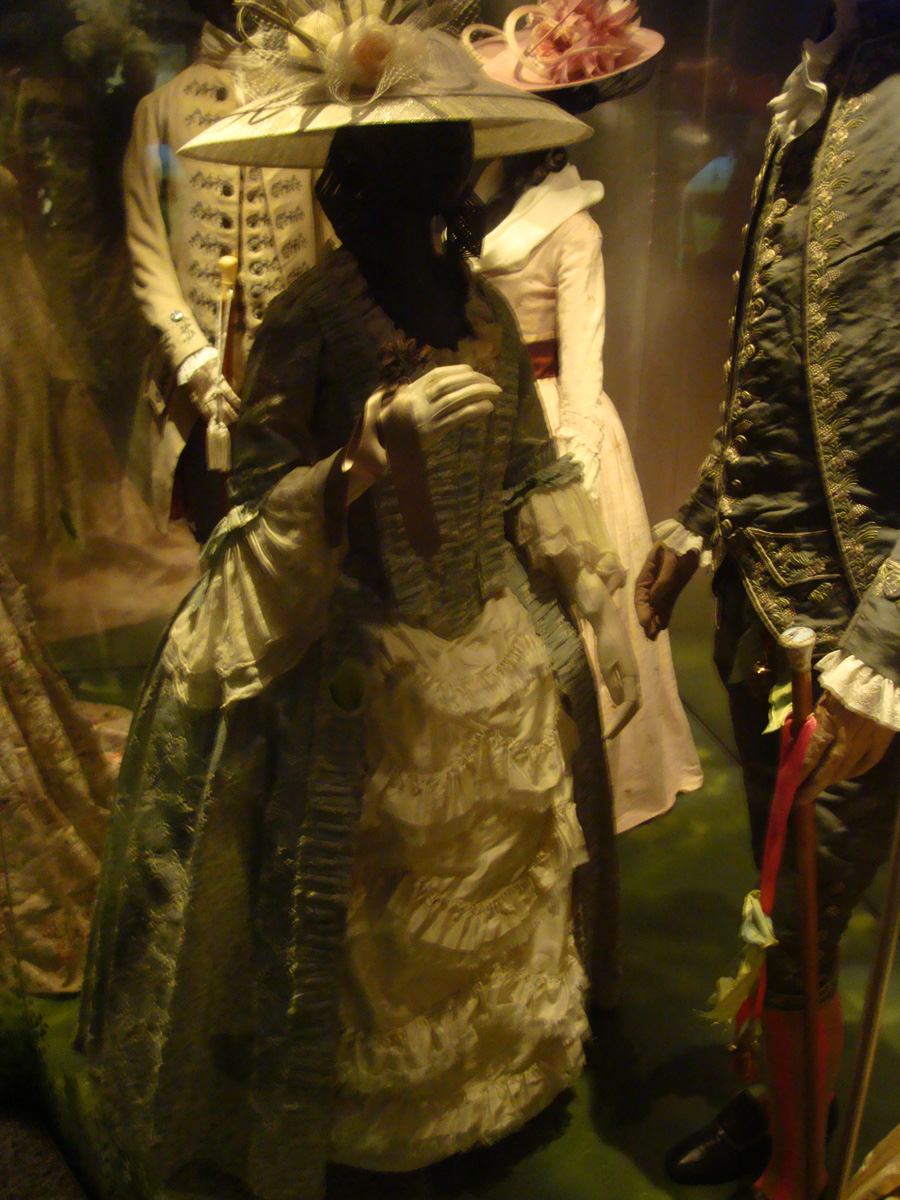
The installation at The Museum of London recreated how the costumes in Vauxhall would look at night. Hats in this exhibit by contemporary milliner Philip Treacy.

By the mid 18th century semi circular piazzas had been opened in the north and south ranges of boxes. Behind the north range of boxes Tyeres had the Rotunda built. This was a covered concert room for wet weather.
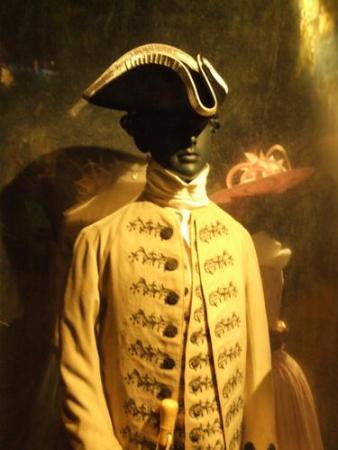
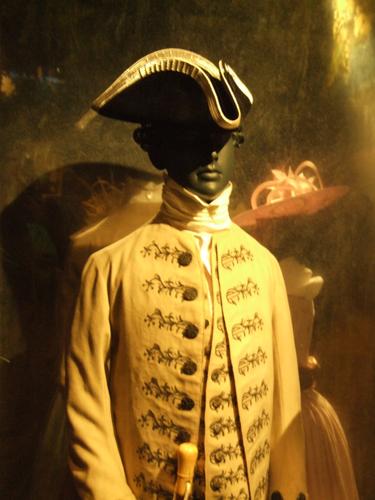
Costumes of the Vauxhall pleasure gardens, installation at The Museum of London

More costumes from the pleasure garden. This man is obviously a waiter.

Female costume. Note how the yellow light (from oil globes or candles) affected the colors of the costumes. Some colors would not show up well. People kept this effect in mind when choosing evening wear. Image @Tony Grant
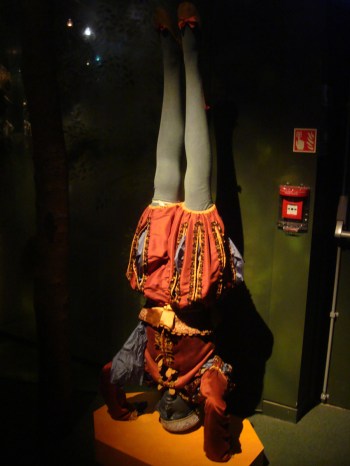
Costume of one of the entertainers. Image @Tony Grant
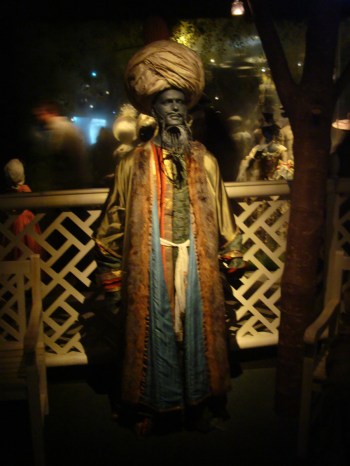
Exotic costume from the exhibit. Image @Tony Grant

Later a Pillared Saloon was added to the eastern side of the Rotunda. Within the Rotunda, Tyers got Francis Hayman to paint four huge canvases showing Britain’s victories in the Seven Years War. Each canvas was 12 feet by 15 feet. Only two oil sketches remain of the originals and an engraving is still in existence. The paintings have disappeared. Jonathan Tyers and Francis Hayman gave British art in the 1760’s its direction.
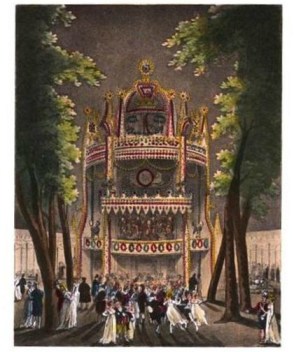
Vauxhall was also famous for its music. Many famous songs, some still known and sung today, were commissioned for the gardens. The most famous of which is, Lass of Richmond Hill. The singers became the superstars of their day, Thomas Lowe, Cecilia Arne, Joseph Vernon and Charles Dignum.
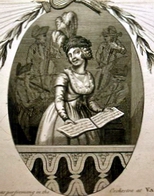
Miss Leary singing at Vauxhall, 1793-4

In 1758 the orchestra building was replaced by a neo gothic structure. The famous architect, Robert Adam, wrote to his brother:

“ I am now scheming another thing, which is a temple of Venus for Vauxhall which Mr Tyers proposes to lay £5000 upon……”

David Coke, author of a recent book on Vauxhall Gardens, wrote that this building was probably never built. Jonathen Tyers died in1767 and his children took over who themselves were followed by their children until 1822.
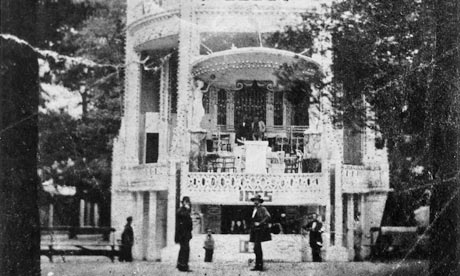
Photograph of Vauxhall in 1859. Image @The Guardian

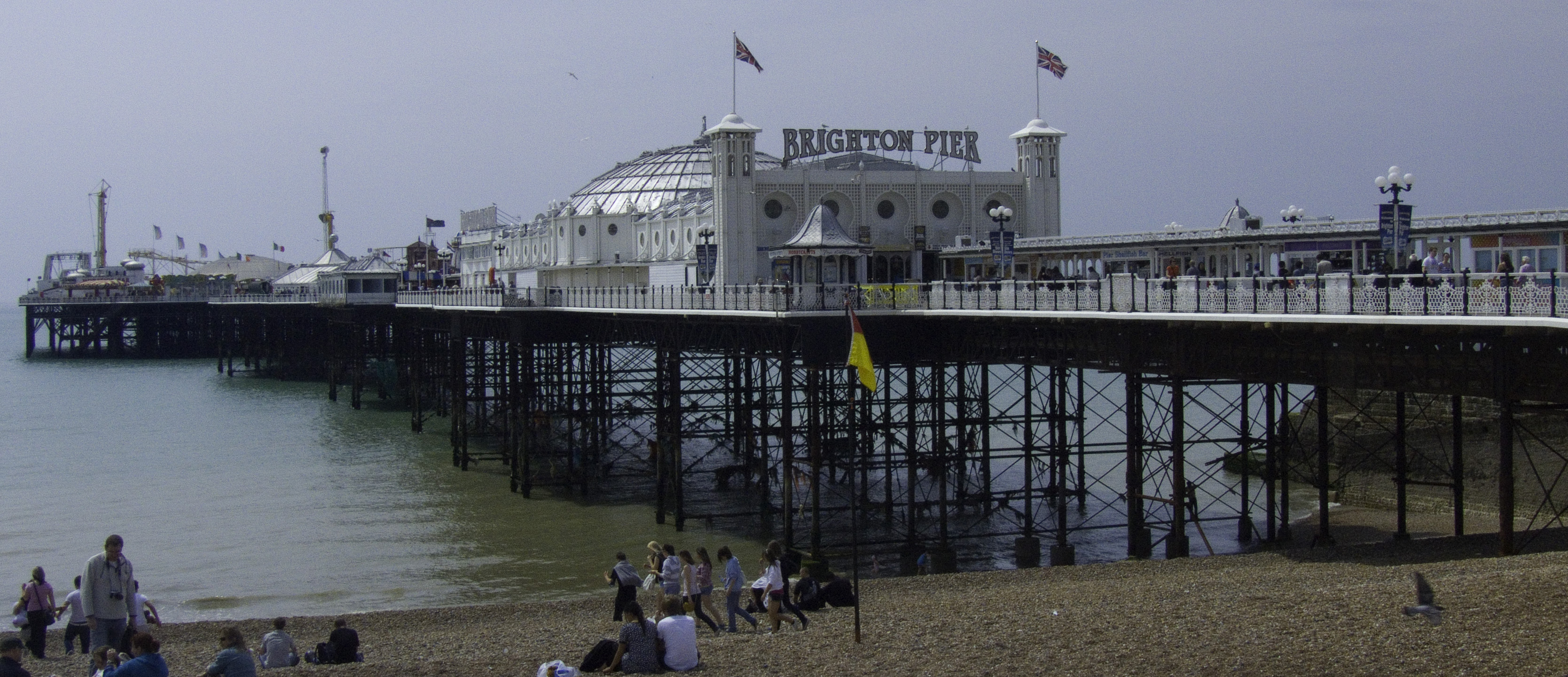
The gardens closed finally closed on 25th July 1859. By this time Vauxhall had become run down and dilapidated. Its popularity had waned. Vauxhall railway station is situated opposite to where the entrance to Vauxhall gardens was. It epitomises the changes that were occurring in the world and society. People were able to travel about the country easily. The ordinary people preferred to go to the seaside and the new entertainments that were provided at these holiday resorts. If you go to Brighton on the south coast in Sussex you can experience the delights of Brighton Pier.

Brighton Pier. Image @Tony Grant

It is a Victorian construction and many of the buildings on it date back to Victorian times. The pier has more than an echo of the Vauxhall Pleasure Gardens. These Victorian piers built at popular resorts have been described as Vauxhall piers.

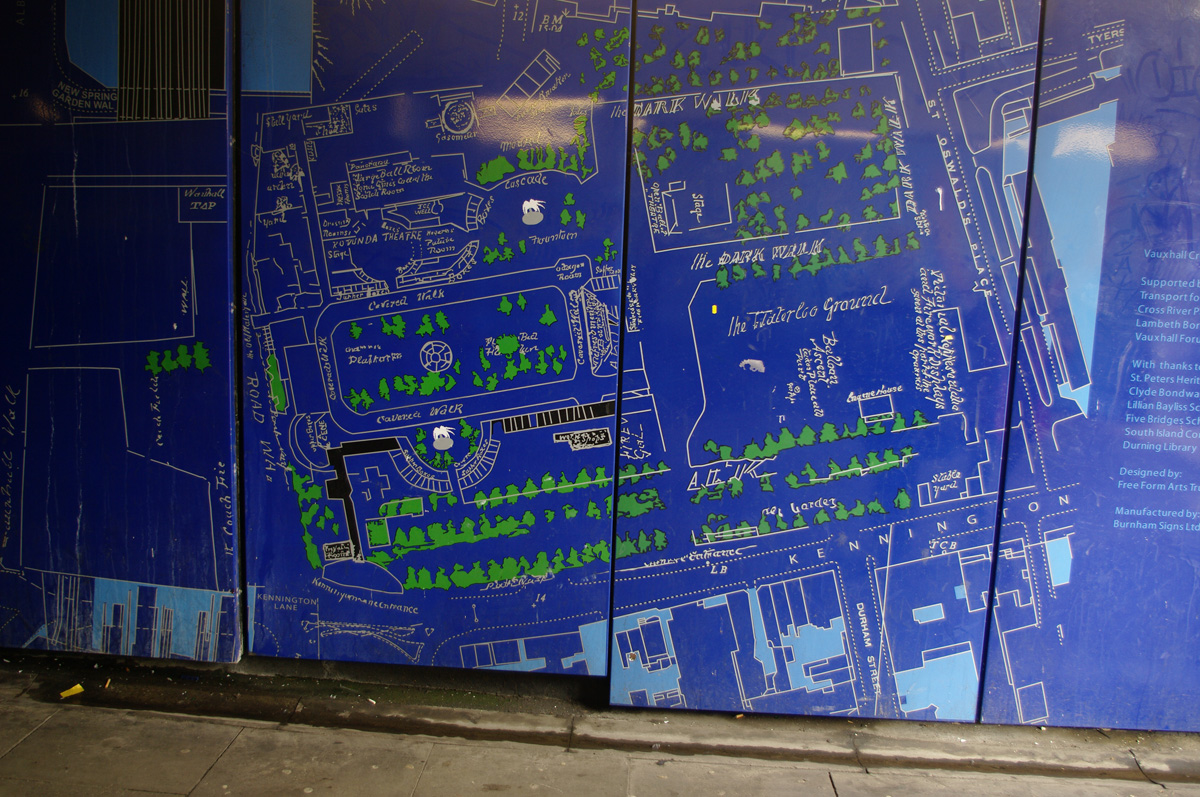
Map in Vauxhall Station showing the pleasure gardens. Image @Tony Grant

Recently I was looking at an old map showing the layout and design of Vauxhall Pleasure Gardens. I could see Kennington Road marked clearly on the map bordering the southern border of where the pleasure gardens had been. It showed the road curving slightly. It struck me that I know that part of Kennington Road well. Vauxhall is part of the London Borough of Lambeth. My wife Marilyn worked for over ten years in schools in Lambeth and often got off the train at Vauxhall and walked to her inner city school in Walnut Tree Walk next to the Lambeth Walk that is of Charley Chaplin and that song, fame. We decided that we would go for a walk around Vauxhall and see if we could find any signs or remains of the pleasure gardens.

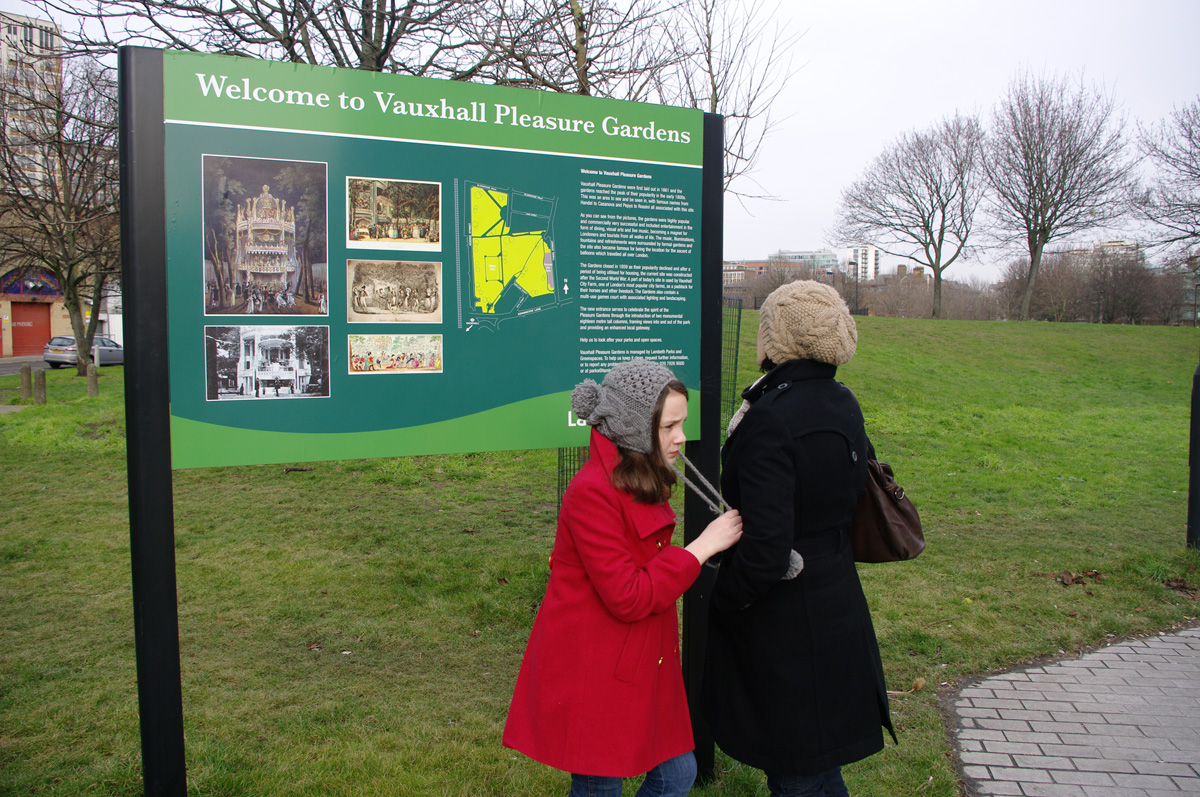
Marilyn and Abi reading the information board in the gardens

Marilyn, myself and Abigail, our youngest daughter, got off the train at Vauxhall and walked across the road to a pub which has its windows blacked out. This pub is now famous for the performance of strippers. This must be reminiscent of the courtesans who sold their bodies in the pleasure gardens of the 18th century perhaps.
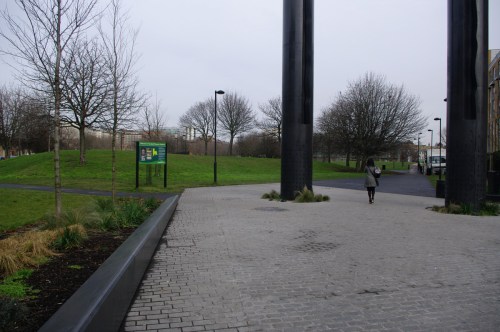
Looking across where the gardens were situated. Image @Tony Grant

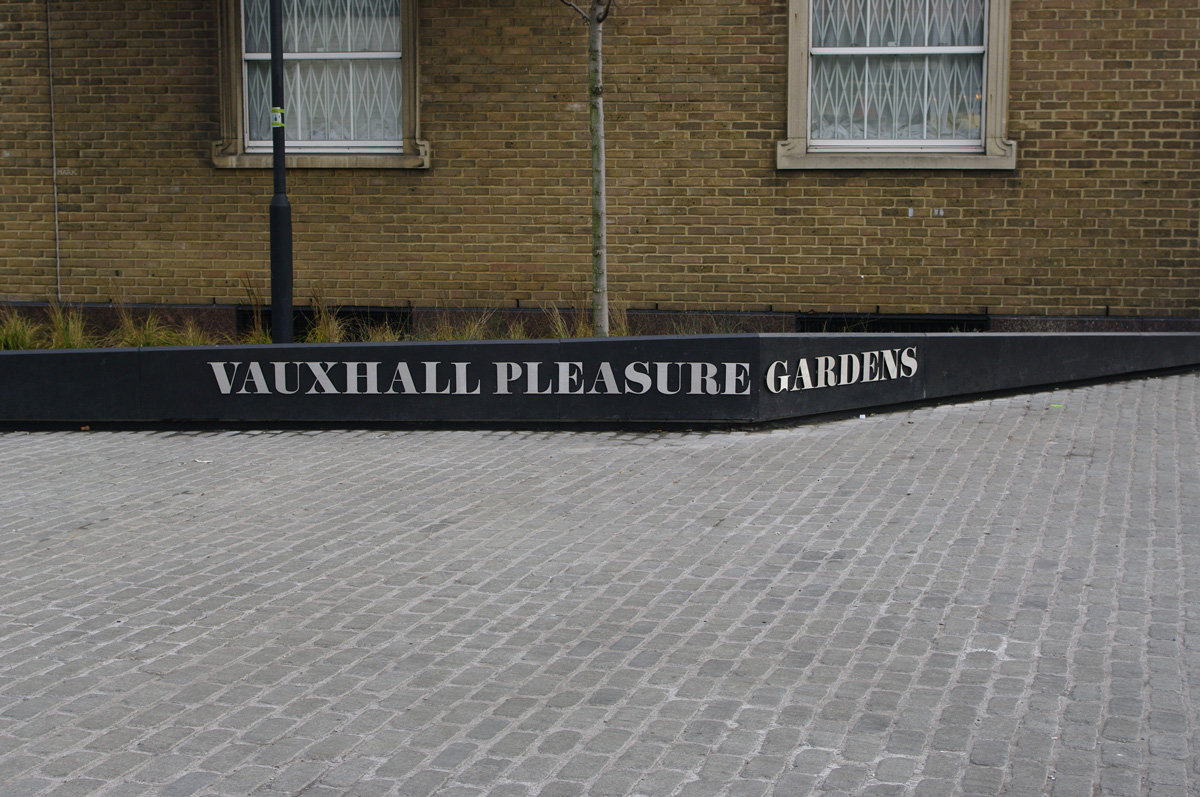
Behind the pub is a small park called Spring Park. This area was covered in Victorian terraced housing up to the second World War and then during the Blitz on London many were destroyed. After the war, to commemorate the old pleasure gardens, Lambeth Council decided to make the area into a park again. This was the site of the original pleasure gardens. We had found it. To one side you can see the green glass and concrete structure that is MI6.The entrance to the park announces that this is Vauxhall Pleasure Gardens, although it is officially called Spring Gardens. When I researched the old gardens I discovered that indeed it used to called Vauxhall Spring Gardens when it first began. There is a large sign board as you walk into Spring Gardens which provides a display of old pictures of the gardens and a history of the site.
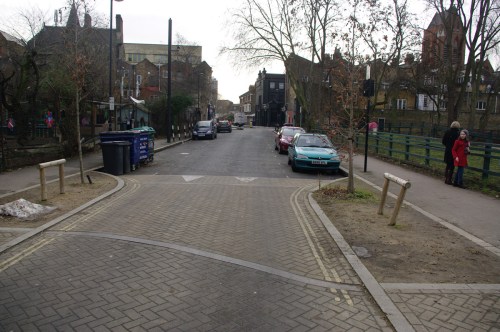
Tyers Road along the top of the present Spring Gardens

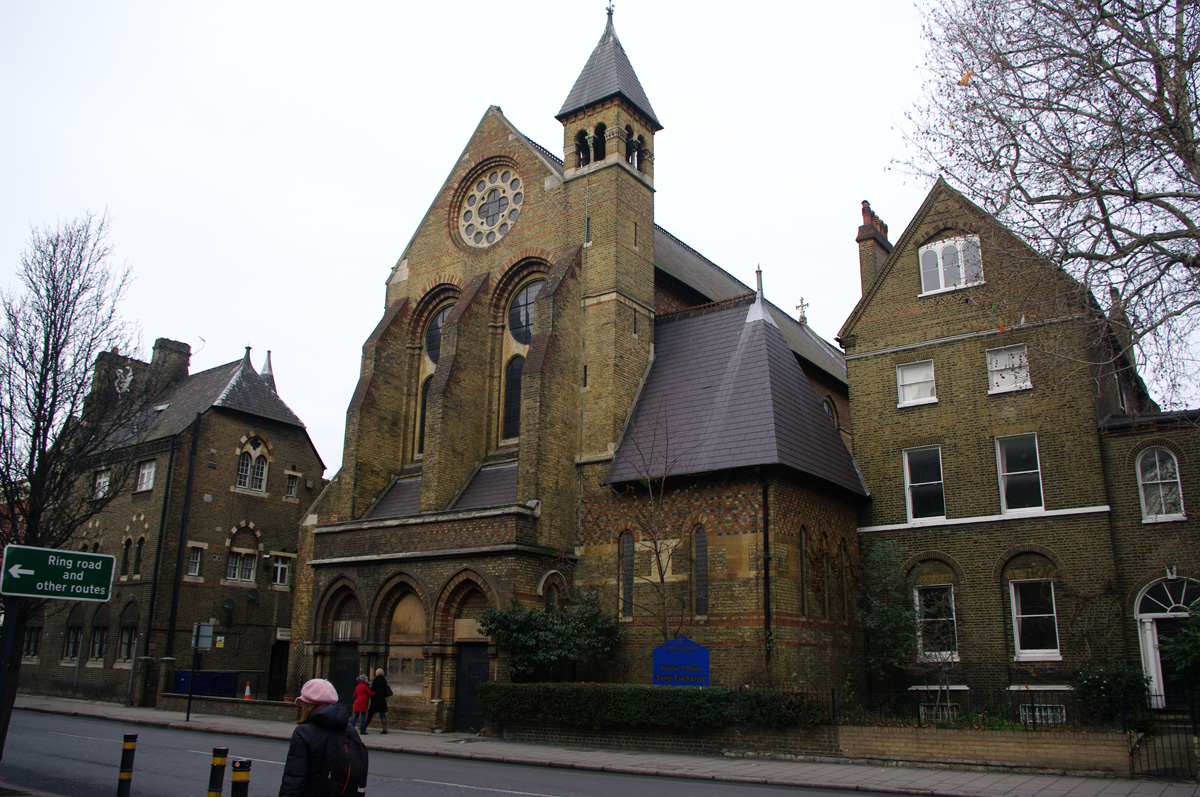
To the north of the park is Tyers Road commemorating Jonathen Tyers. There is a city farm called Vauxhall City farm on the site where the battle of Waterloo was re-enacted. In the far right eastern corner there is situated St Peter’s Church, which is reputedly on the very site of the Neptune Fountain that was placed at the end of The Grand Walk.

St. Peter's Church, Kennington Lane, on the site of the Neptune Fountain at the end of the Grand Walk. Image@Tony Grant

There are no remains of the actual pleasure gardens to be seen in the new park. Because it is an open area with walkways and grassy mounds within the park you can get a sense of the size and feel of the original pleasure gardens.
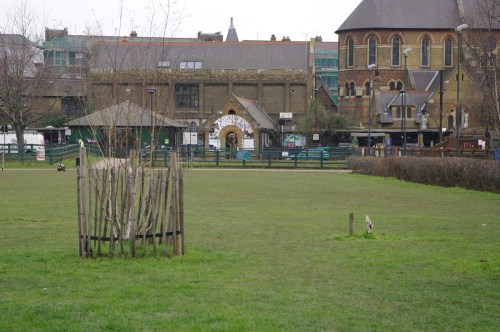
Vauxhall city farm; the site of the Waterloo grounds

Here are some quotations from people who visited the gardens at different times during its existence.

An article in The Spectator 1712:

We were now arrived at Spring-Garden, which is exquisitely pleasant at this time of the Year. When I considered the Fragrancy of the Walks and Bowers, with the Choirs of Birds that sung upon the Trees, and the loose Tribe of People that walked under their Shades, I could not but look upon the Place as a kind of Mahometan Paradise. Sir Roger told me it put him in mind of a little Coppice by his House in the Country, which his Chaplain used to call an Aviary of Nightingales.

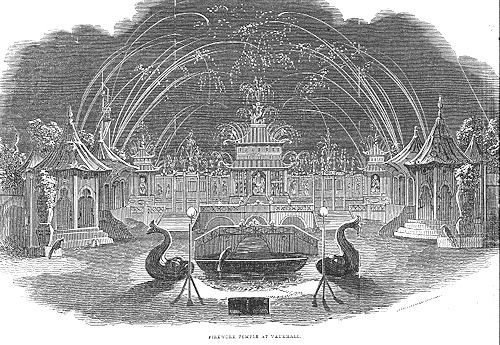
Fireworks Vauxhall Gardens, 1800

A letter to a Lord describing the Spring gardens in 1751:

These Gardens, containing about twenty Acres and a Half, make part of a Mannor, belonging to His Royal Highness the PRINCE OF WALES, as Earl of Kennington; the famous black Prince, son to our immortal Edward III, having anciently had a Palace there. —But leaving Antiquity, I shall proceed to the present State of the Spot, which is the Subject of your Lordship’s obliging Command; after observing, that the Hint of this rational and elegant Entertainment, was given by a Gentleman, whose Paintings exhibit the most useful Lessons of Morality, blended with the happiest Strokes of Humour.
Being advanc’d up the Avenue, by which we enter into the Spring-Gardens; the first Scene that catches the Eye, is a grand Visto or Alley about 900 Feet long, formed by exceedingly lofty Sycamore, Elm, and other Trees. At the Extremity of this Visto, stands a gilded Statue of Aurora, with a Ha ha; over which is a View into the adjacent Meads; where Haycocks, and Haymakers sporting, during the mowing Season, add a Beauty to the Landskip. This Alley (a noble Gravel Walk throughout) is intersected, at right Angles, by two others. One of these Alleys (at the Extremity whereof, to the Left, a [p.3] fine Picture of Ruins is seen) extends about 600 Feet; being the whole Breadth of the Garden, or Spring-Gardens, as they are commonly called, which Terms I shall use indiscriminately.
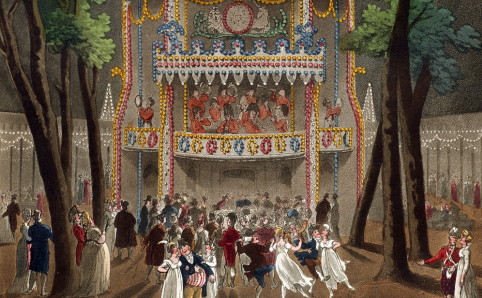
These are the thoughts of a German Prince in 1827:

Yesterday evening I went for the first time to Vauxhall, a public garden in the style of Tivoli at Paris, but on a far grander and more brilliant scale. The illumination with thousands of lamps of the most dazzling[157] colours is uncommonly splendid. Especially beautiful were large bouquets of flowers hung in the trees, formed of red, blue, yellow, and violet lamps, and the leaves and stalks of green; there were also chandeliers of a gay Turkish sort of pattern of various hues, and a temple for the music, surmounted with the royal arms and crest. Several triumphal arches were not of wood, but of cast-iron, of light transparent patterns, infinitely more elegant, and quite as rich as the former. Beyond this the gardens extended with all their variety and their exhibitions, the most remarkable of which was the battle of Waterloo.
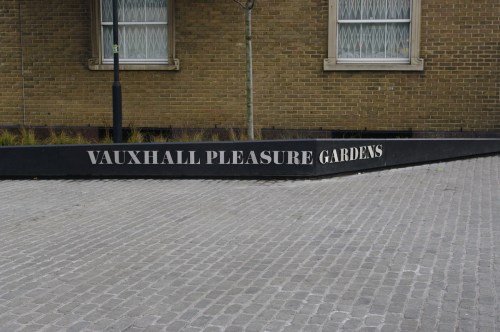
Vauxhall Pleasure Gardens entrance today. Image @Tony Grant

Here is part of a satirical poem written for the PUNCH magazine in 1859 and depicts the decline of the gardens before they were finally closed:

Comrades, you may leave me sitting in the mouldy arbour here,
With the chicken-bones before me and the empty punch-bowl near.
‘Rack’ they called the punch that in it fiercely fumed, and freely flowed:
By the pains that rack my temples, sure the name was well bestowed.
Leave me comrades, to my musings, ‘mid the mildewed timber-damps,
While from sooty branches round me splutter out the stinking lamps.
While through rent and rotten canvas sighs the bone-mill laden breeze;
And the drip-damp statues glimmer through the gaunt and ghastly trees.

And the ode goes on and on. It has become a depressing place.

Vauxhall Park looking towards the Thames. Image @Tony Grant

Written by Tony Grant, London Calling

More on the topic:

Read Full Post »
Gentle Readers, Tony Grant’s latest contribution to this blog centers around Jane Austen’s two sailor brothers. What a delightful read just before the Holidays. His blog, London Calling, is worth visiting.

Horatio Nelson as a midshipman (middie) in the year Jane Austen was born, 1775

Francis was the older of Jane’s two brothers who joined The Royal Navy. He was twelve years old in 1786 when he travelled to Portsmouth from Steventon, a mere twenty miles away, to be enrolled at The Royal Naval Academy.

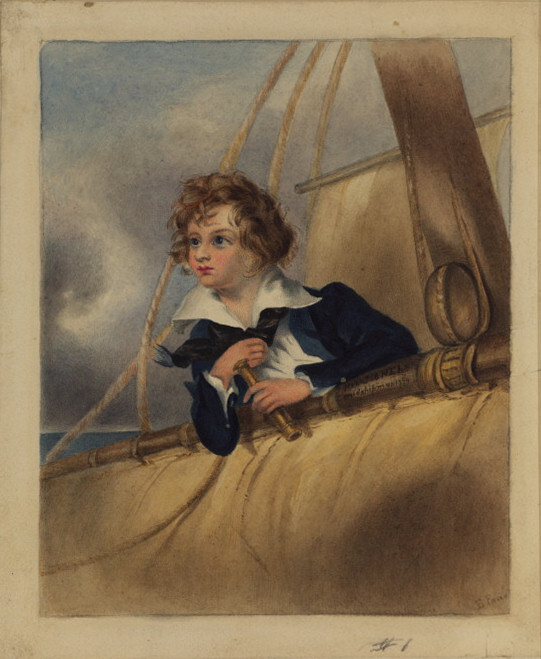
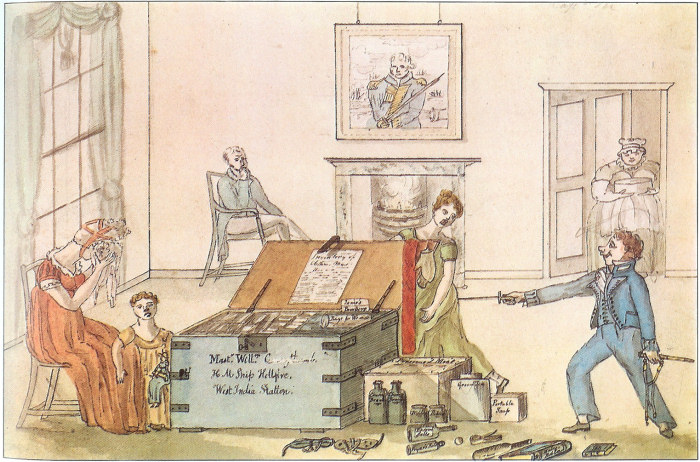
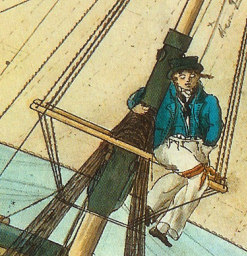
Young midshipman going off to sea. Would such a scene have been reenacted in the Austen household? Image @The Joyful Molly

His father thought it would provide a good education for Francis. The Royal Naval Academy provided a very formal education. He was taught, navigation, mapping, how to use and handle sails, the construction and architecture of ships and gunnery, ropework, communications, maritime law, weather, meteorology and watch standing. He needed a thorough knowledge of mathematics to be able to be proficient at all these skills. The mathematics he had to learn and become adept at included pure mathematics, stations, elongations of an inferior planet, reflection at plane surfaces and reflection at two plane surfaces, Euclid, algebra and trigonometry. Future officers were also taught politics and diplomacy alongside fencing, French and dancing. It was thought that these skills were needed in diplomacy and often officers of ships, arriving at far-flung parts of the world, were required to act as diplomats for Britain.

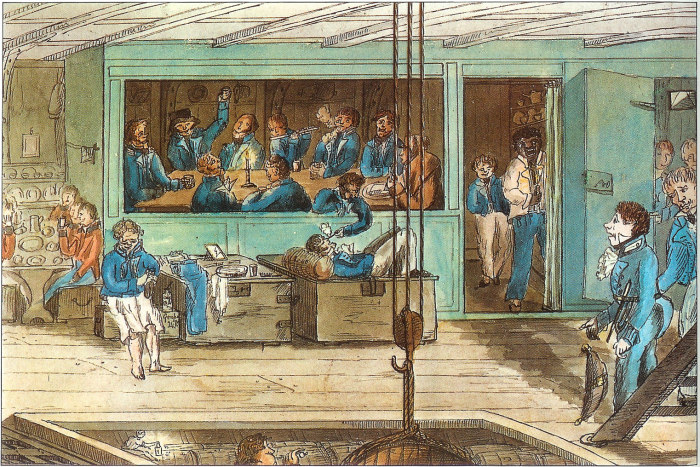
Life for middies on board ship. Image @The Joyful Molly

Jane’s brother Charles joined The Royal Navy five years after Francis and followed a similar course of education.

Life at the Royal Naval College in Portsmouth was tough. We might say more than tough, in these enlightened times. Claire Tomlin, in her biography , Jane Austen A Life, writes,

“…and Francis was at the naval school in Portsmouth. The regime there was tough, not to say brutal; discipline was maintained with a horsewhip, and there were complaints about bullying, idleness and debauchery.”

From our point of view, in the Britain of the 21st century, horse whipping and a very rigid regime of rules and punishments might be termed as abuse and a criminal offence, damaging individuals for life. I don’t think it was seen like that in the 18th century.It is difficult for us to get into the minds of people in the 18th century but the Christian religion in the form of the Anglican church as part of the state, primarily possessed the minds, hearts and actions of people in very authoritarian and draconian ways. What was written in the Bible was law. Man’s baser instincts and proclivity for the seven deadly sins of wrath, greed, sloth, pride, lust, envy, and gluttony could be legitimately beaten out of them through pain and fear. Hence the horsewhipping. This obviously created the opposite scenario too. The secret lives of people in the 18th century, particularly those who could afford it, created a world of brothels and the prostitutes of Covent Garden and the affairs and licentious living that took place in a city like Bath. It just shows that fear and pain do not create the noble perfect man, they create somebody with two diverse sides to their personality . But of course in the 18th century psychiatrists and behaviourists had not been invented . A hundred years later,the story of Jekyl and Hyde was trying to grapple with this more overtly, and Darwin was beginning to challenge the viewpoint of religious status quo through science. With the fear of wrongdoing and the prospect of going to hell, at the back of peoples minds it took strong intelligent characters to question and be creative in their views about life and living.

Claire Tomlin goes on to explain that Jane’s two brothers did not appear to mind this strict regime of corporal punishment. They were both bright and intelligent and so succeeded. They probably avoided being punished because of their abilities and being successful and probably also, as we say, by“keeping their heads down.”

Middie sleeping on duty. Image @The Joyful Molly

The two brothers, during their careers saw action and provided a diplomatic service in many places across the globe including, the Mediterranean, the Adriatic, the Indian Ocean, the North and South Atlantic, the China Seas, the Caribbean and in South American waters.

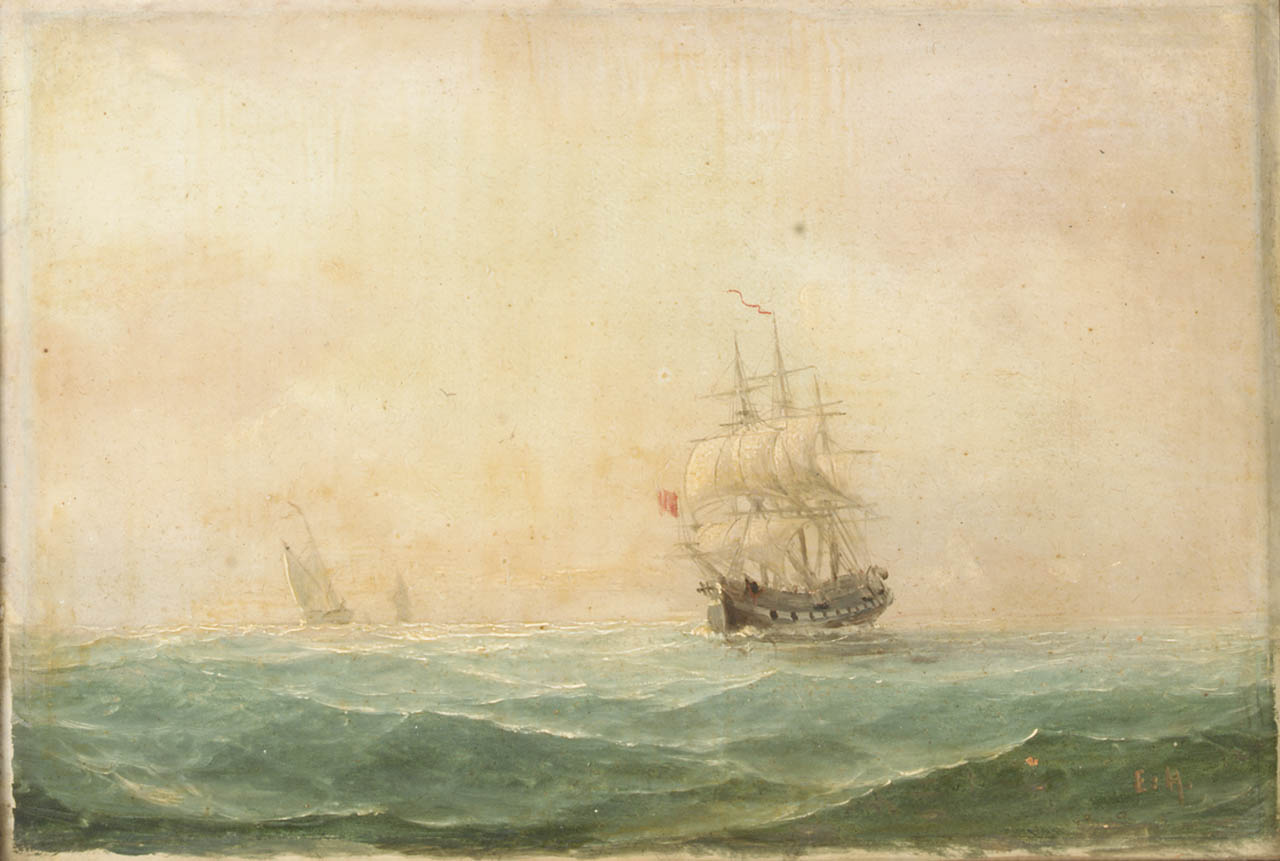
Frigate before the wind

The Royal Navy provided a very rigid hierarchical career structure. Once an officer had progressed past midshipman to Lieutenant, their career was often guaranteed. They progressed because of age and endurance. As people above them advanced, they moved in to fill their positions. Nowadays the Royal Navy and every professional and modern navy promotes their officers depending on their abilities. In the 18th century ability was not taken into account. Skilled people like Admiral Nelson or Jane’s two brothers rose through the hierarchy, but not because they were necessarily deemed as more able than others. Officers were in the navy virtually until they died, and as long as they stayed alive they progressed up the career ladder.

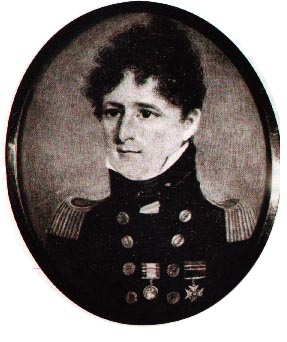
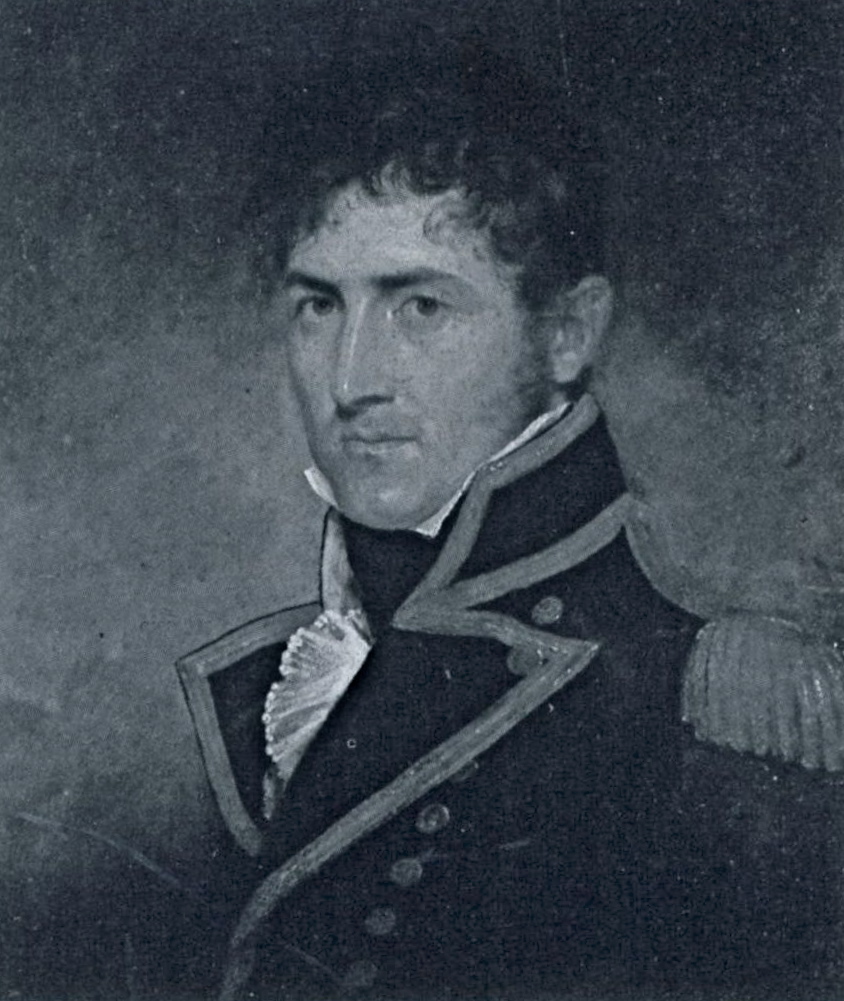
Francis Austen

Francis and Charles both rose through the ranks. Francis eventually became a full admiral and was the Commander in Chief of The North American and West Indian fleet. He became the Senior Admiral of the Fleet in 1868 when he was 89 years old. That seems ridiculous to us now. Unfortunately, Francis, did not have a very good opinion of Americans. He disapproved of the men spitting and didn’t like the flippant attitude of the women. The American women were not as cultured and sedate as his dear sister, Jane.

Charles Austen

Francis was unhappy about his career. Many things passed him by or were too slow in coming,  such as the position of Senior Admiral of the Fleet. His deepest regret was that he missed being at The Battle of Trafalgar with Nelson. His ship was there, but at the time he was ordered to perform another duty ashore.

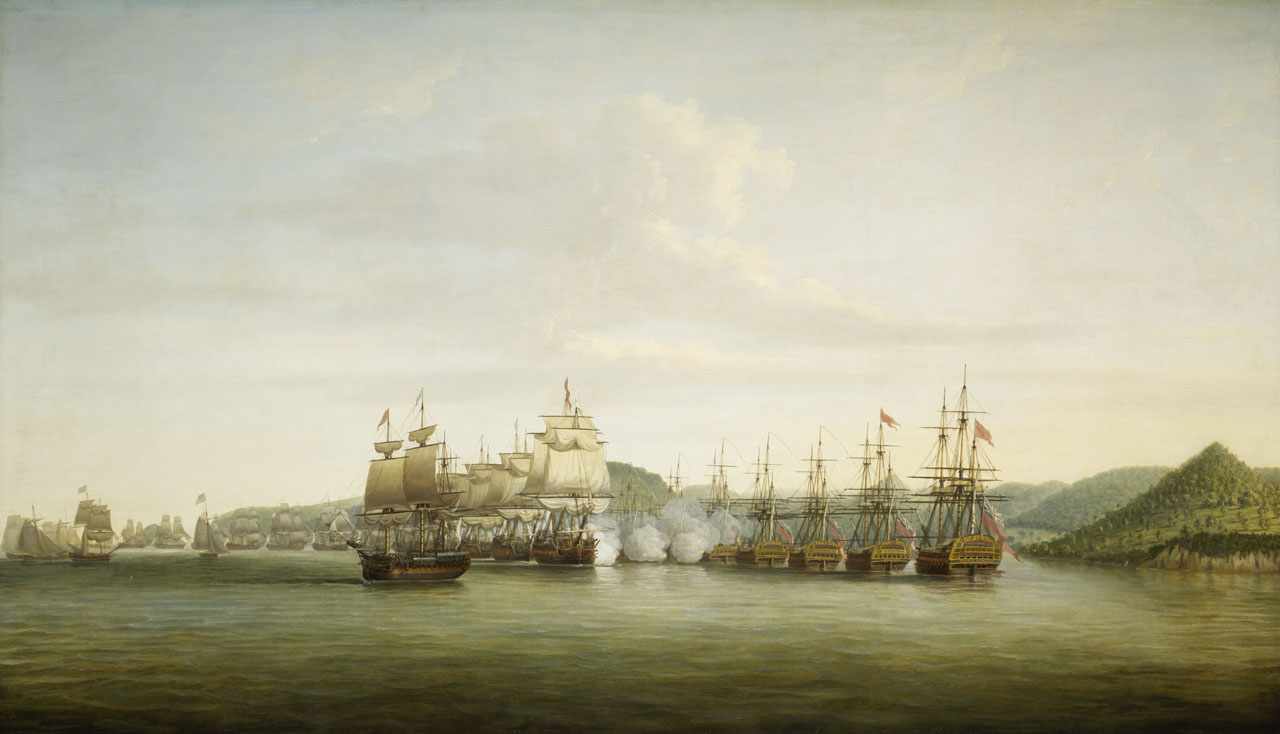
Barringtons action at St. Lucia 1778

Jane Austen includes Royal Naval characters in her novels, Persuasion and Mansfield Park. She had a great deal of affection for her brothers and knew a lot about the navy through them. Like her brothers, her naval characters were honest and chivalrous.

More on the topic

Read Full Post »
Poor Miss Manners is always having to explains why Americans hold forks in their right hands as opposed to Europeans, who use their left hand to spear their food. Have American table manners deteriorated? Or are we following an historic tradition?

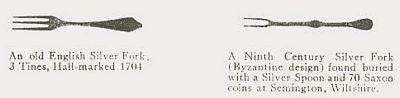
Image @Silver Collect Blog*

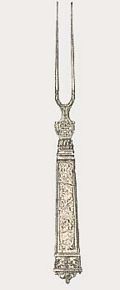
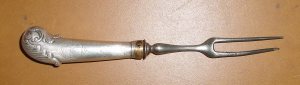
To answer that question we need to go back to ancient times when two-tined kitchen forks were used to help carve and serve meat. (We still require the assistance of large two-tined forks when barbecuing foods on a gas or coal grill.) In the 7th century the people in the Middle East began to use forks when dining, and by the 10th through the 11th centuries such usage had become quite common. The Italians were introduced to the fork in the 11th century.

One tale of the introduction of the fork to Western Europe credits Maria Argyropoulina, the Greek niece of Byzantine Emperor Basil II, who brought a case of golden forks to Venice in 1004, when she was to be married to the son of the Doge. She shocked guests at the wedding feast by using a fork, leading one priest to comment, “God in his wisdom has provided man with natural forks — his fingers. Therefore it is an insult to Him to substitute artificial metal forks for them when eating.” Italian clerics viewed it as God’s vengeance when Argyropoulina died of the plague two years later. – Early British Table Silver: A Short History

Image @Silver Collect Blog

It took 500 years for the implement to be used widely in that land. The French had their first look at the fork in 1533 when Catherine de Medici brought them from Italy upon the occasion of her marriage. The fork was at first thought to be an affectation, thus its adoption was slow, as it was in England after Thomas Coryate brought the implement back in 1608 from one of his travels to Italy. He observed that at their meals Italians  “use a little forks when they cut the meats.” Early table forks were small and two-pronged, but the sharp straight tines were unable to hold much food, inspiring mockery.  “Why should a person need a fork when God had given him hands?” one Englishman asked. (History of the Fork).  Ben Johnson satirized the fork in 1616 in The Devil is an Ass for “the sparing of napkins.”

One wonders how the Europeans ate their food without a fork. If you’ve ever attended a reproduction of a medieval banquet you have an idea. People used knives to spear food, spoons to scoop up, and fingers to grab. Only one implement was used at a time, and it was held in the right hand.

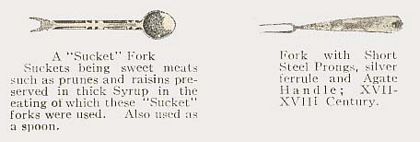
Slowly but surely the fork began to make inroads upon the dining table. As is the usual case, the wealthy began to adopt the new implement first. The upper crust began to impress their guests with forks made of expensive materials. Called suckett forks, they were used to protect the hands from sticky and messy foods or foods that stained the hands, like mulberries. By the mid 1600s, forks had become luxury items and were considered to be marks of fashion.   At the end of the 17th century and beginning of the 18th century the three-tined fork was introduced. The “sherbet course”, introduced in the early 1700’s, was created to wash the single fork for the next course.” (The History of the Fork)

Image @Silver Collect Blog*

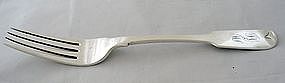
Four-tined prongs became popular in the 1750s.  These tines were curved and served as a scoop, reducing the need for the spoon. By the time Jane Austen and her family had moved from Steventon to Bath, the four-tined fork was also being made in Germany and England and had traveled to the Americas. In the mid 19th century specialized forks were produced for every kind of food, including cakes and fish.

Table fork, 1771

This short history still does not explain why Americans and Europeans hold their forks in different hands. History Matters: Cutlery provides an insight:

Cardinal Richelieu of France supposedly was so disgusted by a frequent dinner guest’s habit of picking his teeth with his knife that he had the tips of the man’s knives ground down. The fashion-conscious French court picked up on this style and followed suit. In 1699, to reduce the risk of dinnertime knife fights, French King Louis XIV banned pointed knives outright. Since blunted knives were useless for spearing food in the old two-knife dining style, forks replaced the knife held in the left hand.

The newfangled blunt knives reached the American colonies in the early 1700s, where few forks were available. Americans were forced to use upside-down spoons to steady food for cutting. They would then switch the spoon to the right hand, flipping it to use as a scoop. Even after forks became everyday utensils, this “zigzag” style (as Emily Post called it in the 1920s) continues to divide American eaters’ customs from the Continental style of dining. (Shifting the fork to the right hand after cutting is considered uncouth by Europeans.) – (This passage seems to have used The Uncommon Origins of the Common Fork as its source.)

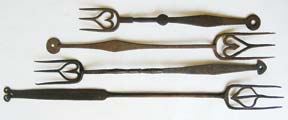
18th C. flesh forks for broiling meat

In a recent Washington Post advice column, Miss Manners contends that Americans follow the correct European way of eating centuries ago and that it was the Europeans who sped things up by keeping the fork in the left hand as they cut their food with the right hand. She concludes her advice with this thought:

Those who point out that the European manner is more efficient are right. Those who claim it is older or more sophisticated — etiquette has never considered getting food into the mouth faster a mark of refinement — are wrong. – Miss Manners: Fork’s History is not a big Mystery

Silver serving fork, 1825

Read Full Post »
Gentle readers: I am on vacation at the shore. The hot weather has cooled and the crowded beaches are empty, except for a few bathers and the shore birds. Yet, somehow my Internet connection is spotty and my ability to add images is nil. So, here is a link to an article I wrote for Suite 101 over a year ago about Martha Gunn and John Smoaker Miles, famous sea dippers who helped men and women into the sea waters at Brighton.

Martha Gunn, dipper

Martha Gunn, dipper

In 1750, Dr Richard Russell wrote a dissertation advising his patients with glandular conditions to swim in the ocean and drink the iodine-rich sea water. The Prince of Wales, who first visited Brighton in 1783, began taking the sea cure for his swollen glands on his second and third visits. Brighton was a mere 6 hours by stagecoach from London, and where the prince went, the fashionable crowd followed. The town quickly became the seaside resort of choice for people seeking a pleasant diversion, or a cure for gout and other illnesses caused by rich food and lack of exercise, and a thriving industry devoted to bathing soon developed.

Bathers were drawn into the ocean inside bathing machines constructed of wood. Men and women were required to enter the water at specified times in different sections of the beach. The women used the beaches on the east side of town near the Brighton aquarium, while the men were diverted to the west end beaches. This custom ensured that the sexes could not view each other in revealing bathing costumes, or while swimming in the nude, a practice that the men followed often and the women more infrequently

Read more at: Sea Bathing in Georgian Brighton: Martha Gunn and John ‘Smoaker’ Miles

Other posts on this topic:
Martha Gunn, Brighton’s Queen of the Dippers|

Read Full Post »

« Newer Posts - Older Posts »