Feeds:
Posts
Comments

Archive for the ‘Regency Etiquette’ Category

Gentle Readers: To celebrate the 3 millionth visitor to this blog, I will be giving away Tea With Jane Austen, a delightful and informative book by Kim Wilson. Deadline: The contest will end the moment my blog meter records 3 million or July 4th, whichever comes first! Contest Closed! Congratulations, Sherry, and thank you ALL for participating and leaving such excellent questions!

All you need to do is leave a comment and a way for me to reach you. Please address this question: If Jane Austen came over for tea, which burning question would you want to ask her?

Thank you all for visiting my blog and for making it such a joy to meet you online.

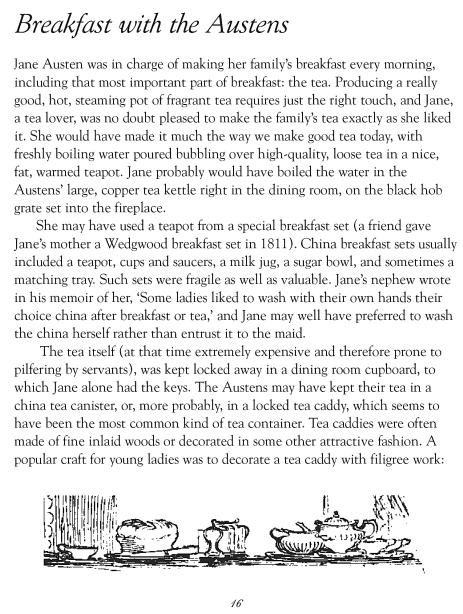
Page 16 of Tea with Jane Austen. Image @Amazon.com

Read Full Post »

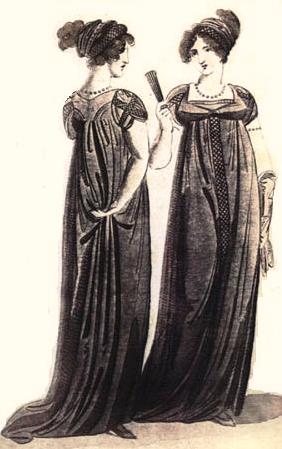
Fashionable mourning dresses, Ladies Museum, 1805

According to Jane Austen chronicler and scholar, David Nokes, when Martha Lloyd’s mother died on April 16, 1805, Jane Austen showed few signs of grief or emotion over that woman’s earthly departure. Instead, Jane wrote a jaunty verse to an uncivil (and imaginary) dressmaker. I surmise that these verses were meant more to cheer Martha up than to bring Martha’s mood down by reminding her of her loss. Mrs Austen, who was known for her droll verses, wrote a mythical reply by the dressmaker. At this time the Austen women were still reeling from Rev. Austen’s death in January and their own change in financial circumstances, having moved to more modest lodgings and becoming accustomed to a drastically reduced style of life. They would soon invite Martha to live with them in Bath. (Martha would remain with the Austen women through their move to Southampton in 1809.) After Jane’s death in 1817, Martha joined Cassandra in Chawton to help look after Mrs. Austen.

The poem that Jane wrote gives us a glimpse into how mourning clothes were made to order quickly. In this for-instance, the dressmaker, Miss Green, was slow to respond.

Lines sent to an uncivil Dress maker

Miss Lloyd has now sent to Miss Green,
As, on opening the box, may be seen,
Some yards of a Black Ploughman’s Gauze,
To be made up directly, because
Miss Lloyd must in mourning appear –
For the death of a Relative dear –
Miss Lloyd must expect to receive
This license to mourn & to grieve,
Complete, er’e the end of the week –
It is better to write than to speak – Jane Austen

Mrs. Austen’s reply as Miss Green

I’ve often made clothes
For those who write prose,
But ’tis the first time
I’ve had orders in rhyme – .
Depend on’t, fair Maid,
You shall be obeyed;
Your garment of black
Shall sit close to your back,
And in every part
I’ll exert all my art;
It shall be the neatest,
And eke the completest
That ever was seen –
Or my name is not Green! – Mrs. Cassandra Austen

Read Full Post »

Inquiring readers,

For those of you who have not yet visited Nancy Mayer’s beautiful website, you are in for a treat. Click here to enter Nancy Mayer, Regency Researcher: A most proper authority on all things Regency. Nancy has been a member of JASNA (Jane Austen Society of North America) for some time. She was a member of a local chapter in 1990-1994, then started up a new chapter in 1996, and has been the regional coordinator for northern Georgia since then. Nancy has been researching Regency England for more than twenty years, and finds Google books a big help. While she is responsible for the text on her website, Susan Newman designed the web pages and added the illustrations. Nancy graciously agreed to answer a few of my questions:

1. How and when did you become interested in Jane Austen’s novels?

This is probably heresy, but I came to Austen and her novels because I wanted to learn more about Regency life. I had heard of Pride and Prejudice and seen the old Lawrence Olivier movie, but hadn’t gone any further with it or the other novels until I became interested in the Regency period. After reading Jane Austen’s letters, and some biographical data on her, I started in on her novels. I joined a discussion group in Atlanta around 1990 and haven’t looked back since. Even after twenty years of discussing the novels there is always something new to be found. I am not one who has memorized the books and don’t read them all over every year, but I usually find some new insight each time I do.

2. Which is your favorite Jane Austen book and/or character, and why?

Persuasion. Anne Elliot is my favorite character. She is more mature than the other heroines and so doesn’t make the mistakes they do. One seldom has to blush for her. I also think Wentworth is more romantic than Darcy, but I wouldn’t want to be a sailor’s wife.

3. You are considered an authority on the topic of Jane Austen and the Regency period, and your breadth of knowledge about the era astounds me. What are some of your favorite topics to research and why?

You flatter me. The more I research the more I discover what I don’t know. I like to research marriage, titles, peerage, the law, and mourning rules. I find property law most confusing, and barely know a VanDyke fringe from a scalloped one.

One can find all sorts of period books on Google books.

I am also interested in Lord Byron who was Jane Austen’s contemporary, His life gives the masculine and aristocratic elements missing in Jane Austen’s life. Though they both were alive from 1809 to 1817, one could sometimes think they lived at different times.

4. For the casual (but avid) Jane Austen reader, what are some sources you would recommend for further reading?

  • My Dear Cassandra:The letters of Jane Austen, Selected and introduced by Penelope Hughes Hallet. Clarkston Potter Publishers or Collins & Brown 1990, ISBN 0-51758312-7
  • Some might want the complete letters edited by Deirdre Le Faye, or the ones edited by John Chapman.
  • The novels published by Oxford have great appendices. Some of the Critical editions of the novels have appendices. One should have a copy of Lover’s Vows in one’s Copy of Mansfield Park. There are annotated versions of the stories with explanations of obscure and not so obscure points, and there are even comic book editions of Pride and Prejudice and Sense and Sensibility. No matter one’s taste or interests, one should be able to find a connection with Jane Austen.
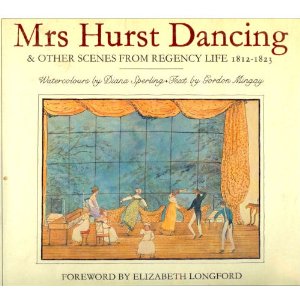
  • Mrs. Hurst Dancing by Diana Sperling. This isn’t about Jane Austen but the illustrations of the Sperling family could be those of the Younger Dashwoods or the Bennets. # ISBN-10: 0575030356 # ISBN-13: 978-0575030350. Some are exceedingly expensive, but there are remaindered copies and second-hand copies at reasonable prices.
  • Jane Austen and Her times by G.E. Mitton, originally published 1905, 2007 Barnes and Noble.
  • Also there are probably fifty books out there covering everything from Jane Austen and Art to Jane Austen and Zombies. I know of book on Jane Austen and Food, Jane Austen and Crime, Jane Austen and fashion, ( and Fashion in the Time of Jane Austen).
  • Those who like quizzes and challenges might like: Jane Austen Challenge by Helen Barton: BartonBooks (June 2009) # ISBN-10: 0952725754 # ISBN-13: 978-0952725756
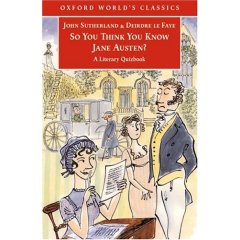
  • Also, So you Think You Know Jane Austen? By John Sutherland and Deidre le Faye Oxford University press, ISBN 0-19-280440-5

5. Would you like to share a common misconception about the Regency period with our readers, one that is wrongly perpetuated by book sources, websites, and blogs?

A general error I have found is thinking that the marriage laws, the church, and laws of inheritance were the same then as they are now. Many think the regency period was just like today, but in costume and with horses.

Nancy, thank you for sharing your wonderful insights. I hope readers will bookmark your website and visit it often. It’s best feature, as far as I am concerned, is your answers to their specific questions, like a personal researcher.

Read Full Post »

Lady Sarah Jersey

Gentle Readers: In my sidebar I call myself an amateur historian, an apt term as this post will attest. I try to quote from older sources, but this can sometimes backfire. Captain Gronow, for example, whose words I quoted for this post via John Ashton (1890) and Lewis Saul Benjamin (1909), wrote down his memories about the Regency era in 1863, a half century after the events occurred.  Gronow’s memory, unfortunately, was faulty in a few particulars, especially in recalling the names of the patronesses of Almack’s in 1814, and why they turned the Duke of Wellington away. I have placed a number of updates in the original post.

Any individual who has read a novel set in Regency England knows about the assembly rooms at Almack’s and the club’s exclusivity. While Almack’s was notorious for its stale refreshments and thin lemonade in the supper room, the Beau Monde never minded, for the idea was to hob nob with the right people, trot out one’s eligible daughters, and make the best marriages possible given their dowries and family connections. Looks and a personality had very little to do with a young lady’s success in her first season OUT, but a pleasing countenance matched with a fortune would swiftly speed up the unification of great estates or the purchase of a worthy title.

Almack's, Pall Mall, opened in 1765

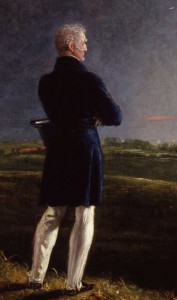
The Patronesses of Almack’s guarded entry to the club like Valkeries prepared to do battle. No one, not even the Duke of Wellington, would dare to step a foot inside the establishment without a proper voucher, and, indeed, he was turned away once for wearing *gasp* trousers instead of knee breeches. But is this true? Please keep on reading.

This passage from Social England Under the Regency by John Ashton (p 383) is quite telling:

*The Duke of Wellington

Of course the Creme de la creme went to Almack’s, but numberless were the Peris who sighed to enter that Paradise, and could not. Capt. Gronow, writing of 1814, says: “At the present time one can hardly conceive the importance which was attached to getting admission to Almack’s, the seventh heaven of the fashionable world. Of the three hundred officers of the Foot Guards, not more than half a dozen were honoured with vouchers of admission to this exclusive temple of the beau monde, the gates of which were guarded by lady patronesses whose smiles or frowns consigned men and women to happiness or despair. These lady patronesses were the Ladies Castlereagh, Jersey, Cowper, and Sefton; … and the Countess Lieven.” (Note: At that time, two other patronesses included Lady Downshire and Lady Bathurst.)

Cruikshank, Longitude (Countess Lieven) and Latitude (in capri-length pantaloons) at Almack's.

In a Newspaper of May 12, 1817, we read – “The rigorous rule of entry established at Almack’s Rooms produced a curious incident at the last Ball – The Marquis and Marchioness of W__r, the Marchioness of T__, Lady Charlotte C__ and her daughter, had all been so imprudent as to come to the rooms without tickets, and though so intimately known to the Lady Managers, and so perfectly unexceptionable, they were politely requested to withdraw, and accordingly they all submitted to the injunction. Again at the beginning of the season of 1819, we find these female tyrants issuing the following ukase: “An order has been issued, we understand, by the Lady Patronesses of Almack’s, to prevent the admission of Gentlemen in Trowsers and Cossacks to the balls on Wednesdays, at the same time allowing an exception to those Gentlemen who may be knock kneed or otherwise deformed.” But the male sex were equal to the occasion as we find in the following lines: –

TO THE LADY PATRONESSES OF ALMACK’S

Tired of our trousers are ye grown?

But since to them your anger reaches,

Is it because tis so well known

You always love to wear the breeches.

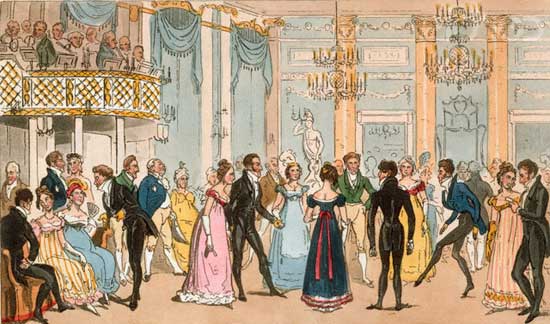
*Image from Highest Life in London: Tom and Jerry Sporting a Toe among the Corinthians at Almack's in the West, by I. Robert and George Cruikshank, 1821

Update:  Regency Researcher, Nancy Mayer, was kind enough to contact me and set a few facts straight. I have placed her explanations in the update/update below. In the above image, the young bucks are wearing dark suits with dark, close-fitted trousers (Beau Brummel’s influence), while the older men are still in buff-colored knee breeches.

If anyone knows the true story about the Duke and his trousers, please contact me. One conjecture is that Wellington was turned away for arriving after midnight. (Read more about the Patronesses’ edict on trousers in this link to The Beaux of the Regency, Vol. 1.)

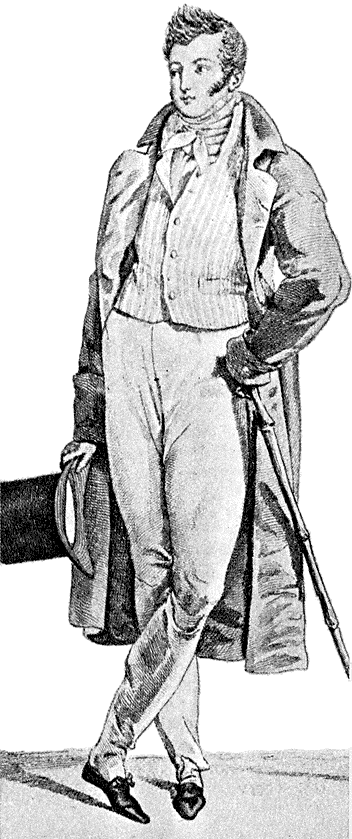
Update/Update: Pantaloons, which fitted snug to the leg, came in two lengths: capri and long. A strap under the foot kept long pantaloons in place. (The image below shows the strap.) Thus, the men in the image above were wearing tight pantaloons, for trousers at the time were slightly looser and would have sported gussets that extended the fabric low over the shoe.

Pantaloons with straps, 1821. Image @Republic of Pemberley

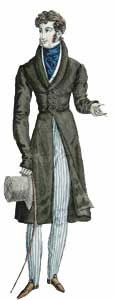
In 1814, the date Gronow recollected, trousers (below) were acceptable for day wear only. Pantaloons were worn as evening wear.

Nancy Mayer, a Regency researcher who provided much of the updated information, wrote in a second note: “Luttrell’s poem on Almack’s was published around 1819. According to the verse about the “trowsers”, I think trousers didn’t become an issue until after 1817, at least. Sometimes it is hard to tell if the men are wearing trousers or the longer pantaloons with the strap under the foot. Most of the Lords in the picture of the Trial of Queen Caroline 1820 are wearing trousers or the long pantaloons.”


Trouser with gussets, day wear, 1813

More on the topic:

*Images: Carolyn McDowell

Read Full Post »

Copyright (c) Jane Austen’s World.

Hear what a male writer has observed on the fashion of exposing the bosom! A woman, proud of her beauty, says he, may possibly be nothing but a coquet: one who makes a public display of her bosom, is something worse.” – The Mirror of  Graces, by A Lady of Distinction, 1811, p. 120

Could the above statement possibly be true in light of our modern assumptions that the Georgian bossom was displayed in all its soft glory for all to see?
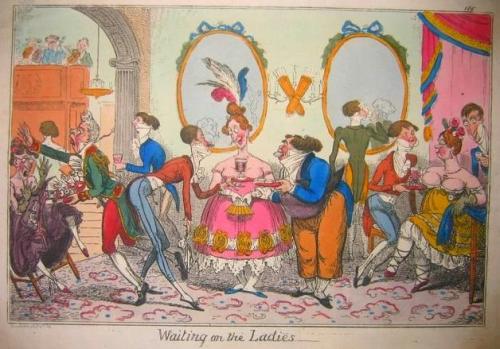
Waiting on the ladies

Our modern perception is heavily influenced by the caricatures of the period that make fun of unrestricted Regency gowns. But how much did contemporary cartoonists exaggerate? And what sort of woman would have exposed her bosom to such an extent that she would have been regarded as worse than a coquet? To be fair, the above image depicts a time (the 1820s) when the waist had gone as high as it could go under a woman’s bosom, skirts had widened and become conical shaped, and hems were festooned and decorated and shortened to reveal slippers and ankles.

Regarding the bosom, the proof is in the pudding, and the best way to assuage our curiosity is to view contemporary examples year by year.
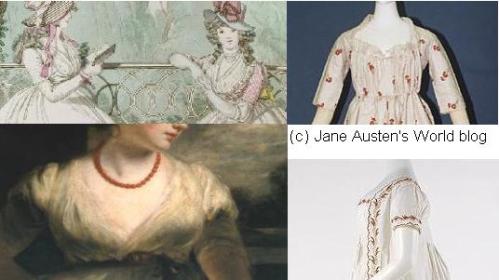
From left, upper row: 1794-1795 walking gowns. 1795-1800 round gown. From left, lower row: 1797 Countess of Oxford. 1798, round gown.

Gentle reader, as you peruse the gallery of images, please look for a pattern. You shall begin to see a distinction between day and evening dress, regardless of the time of year.
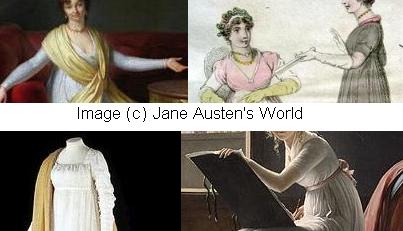
1st column, top: 1800, Salucci family. Bottom: 1800 V&A gown. 2nd column, top: 1801 April day gowns. Bottom: 1801 Marie Denise Villiers

While I believe that a variety of cleavages were on display during the Regency era (and I shall delve more into this topic later), the top left portrait of Mrs. Salucci is one of the few instances in which a shadowed cleavage is clearly painted or drawn.
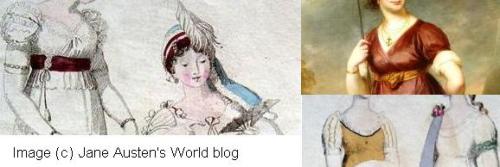
1802 Bosoms. Top right: Princess Augusta. Other two images from Ladies Monthly Museum.

Why is this? One can safely assume that a voluptuous woman with large breasts, even when wearing a dress with a modest neckline, would reveal some cleavage. Thin girls or women with small bosoms would not have as much difficulty following the rules of decorum. Before the 20th century, the feminine ideal was a woman whose curves were bounteous and whose figures were pleasingly plumb. Rich husbands and fathers were proud to show off their well-fed women. Only the poor, who toiled all day and never had enough to eat, or the sick, or those who were metabolically overchallenged, were thin and scrawny. Thus, it made sense that during the Regency heaving bosoms were de rigueur. But were they?
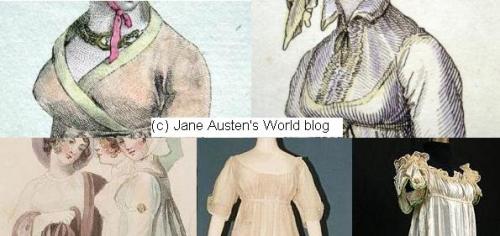
In this image I have included both French, English, and American gowns. Left to right, clockwise, starting at the top. 1803, Costume Parisien. 1803, Mirroir de la Mode. 1805, American neoclassical gown. 1805, English cotton muslin, Kyoto costume Institute. 1804, three French Promenade dresses.

Regardless of nationality, a woman could choose to be as modest (or daring) as she liked. As far as I can tell from fashion images and portraits, modesty won hands down. High necklines, chemisette inserts,  and high collars ruled the day. But night provided a different story.
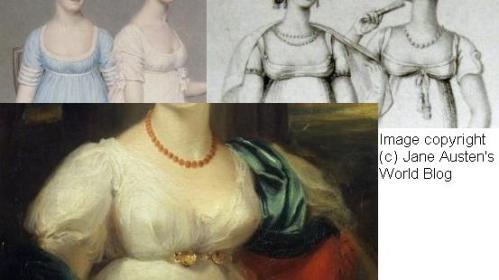
1806 gowns. Top left, Binney sisters. Top right, Opera and drawing room gowns. Bottom image, Lady Codrington.

In the above composite image of 1806 gowns, more of the bosom is revealed than in previous images. Consider the sources. The Binney sisters and Lady Codrington, who were sitting for their portraits, would have chosen their best gowns to wear. Full dress, or evening dress, revealed more skin. The third image also depicts evening wear. In those two images you can more readily understand why empire gowns created such a stir at first:

Observers of the period frequently deplored the absence of modesty conveyed by a style that was predicated on the prominence and exposure of the breasts and on the barely veiled body….Sheer, narrow dresses … caused a sensation at the beginning of the nineteenth century, more because of their contrast with the elaborate hooped costumes of previous decades than for any real immodesty. – Source: Two dresses [French] (1983.6.1,07.146.5) | Heilbrunn Timeline of Art History | The Metropolitan Museum of Art
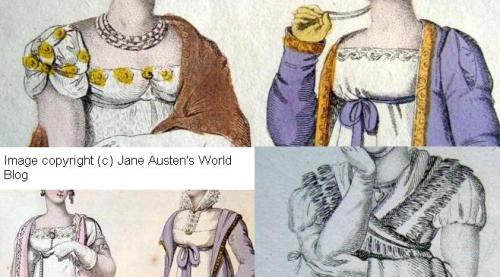
1807 Regency gown fashion plates

By now you have seen enough examples to have noticed a trend. Examine the above fashion plate images. Which necklines belong to full dress, or evening gowns, and which belong to day gowns or walking gowns? Of the five necklines, only the top left can be construed as revealing. And this neckline, depending on the size of the woman’s breasts, could be both modest or plunging.

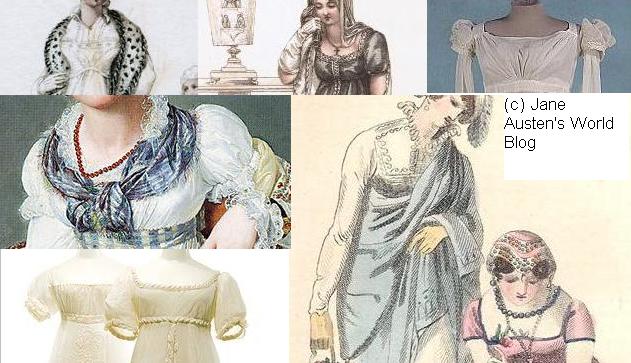
1810 Regency gowns

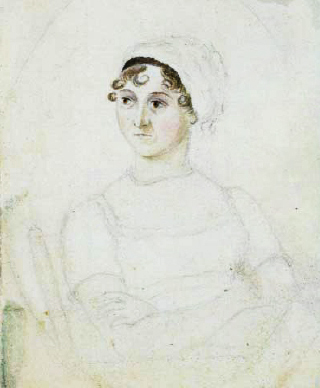
The 1810 Regency gowns demonstrate a variety of necklines and layers of clothing. As in Cassandra’s portrait of Jane Austen,  chemissetes were widely used. Fichus, shawls, tippets, and pelerines were also popular. The widow in the evening mourning gown (top middle) wears a cross that lies inside her cleavage. The white embroidered gowns (top right and lower left) demonstrate how the neckline is determined by whether the gown is worn for day (top right) or for evening (lower left, image of French gowns, Metropolitan Museum of Art.)
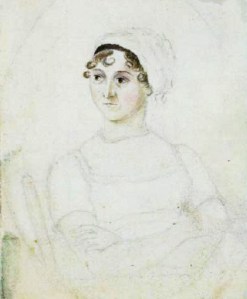
Jane Austen by Cassandra, 1810

In the image painted by Cassandra, Jane wears a simple gown, much like the Binney sisters were wearing. You can observe her chemisette under the low neckline, which created a more modest look for day time.

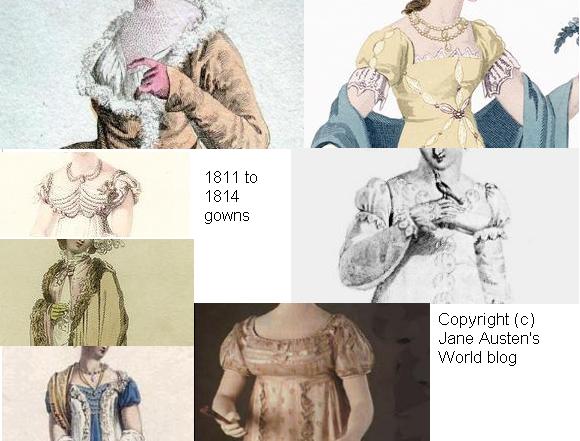
Regency gowns, 1811-1814

Princess Charlotte’s 1814 bellflower court gown (lower right), while breathtaking, did not reveal her bosom. The image of the 1812 full dress (second from top on the left) is a bit misleading, for the decorative drooping elements give the illusion that the neckline is lower than it actually is.  (In this example, it is hard to see the line of the silk fabric running across the top.) The other day gowns cover the torso quite modestly.
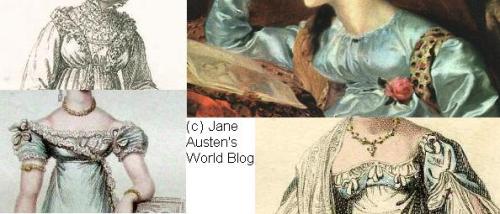
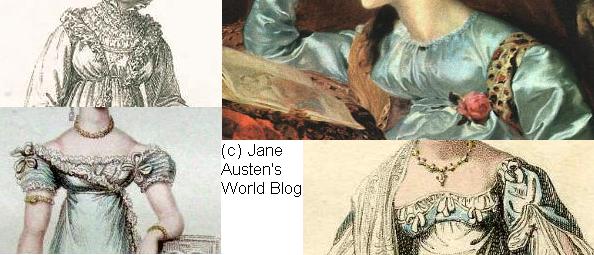
1815-1816 Regency Gowns

The high necklines of the 1815 morning gown at top left and Mrs. Jens Wolff’s 1815 satin dress at top right would make a Quaker lady proud. The two 1816 evening gowns show a relatively modest neckline (lower left) and one that could be quite daring (lower right).

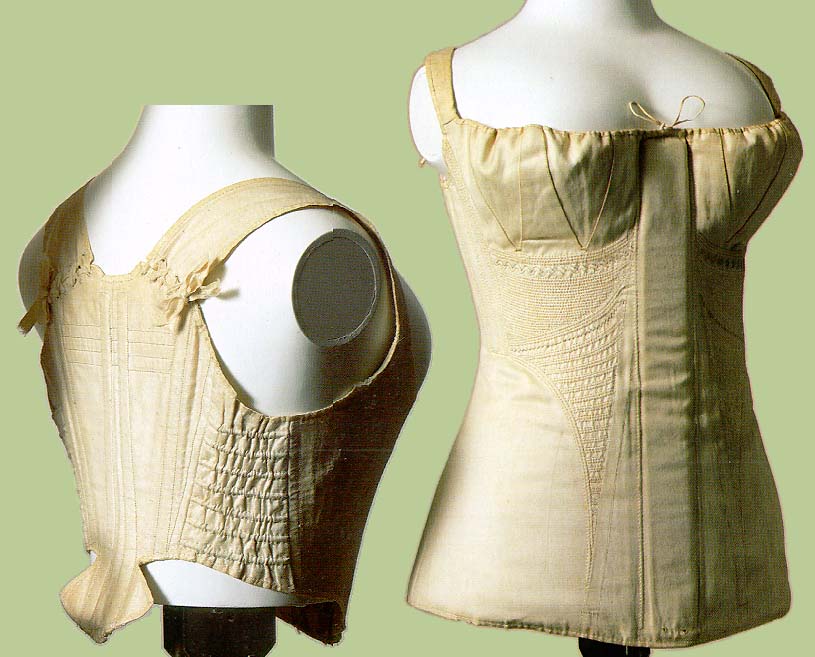
Until now I have not discussed the role that corsets played in propping up the bust line. Regency stays, which were darted and laced in the back, were quite short and were much less constricting than earlier Georgian models that cinched in the waist. The purpose of the Regency stay was to support a woman’s bust and create the distinctive Regency “shelf” silhouette.
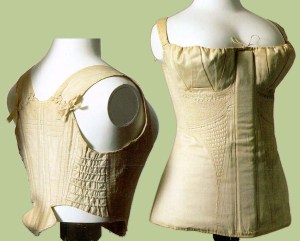
1819 stays (short on left, long on right with inserted busk). Image @ Kyoto Costume Institute

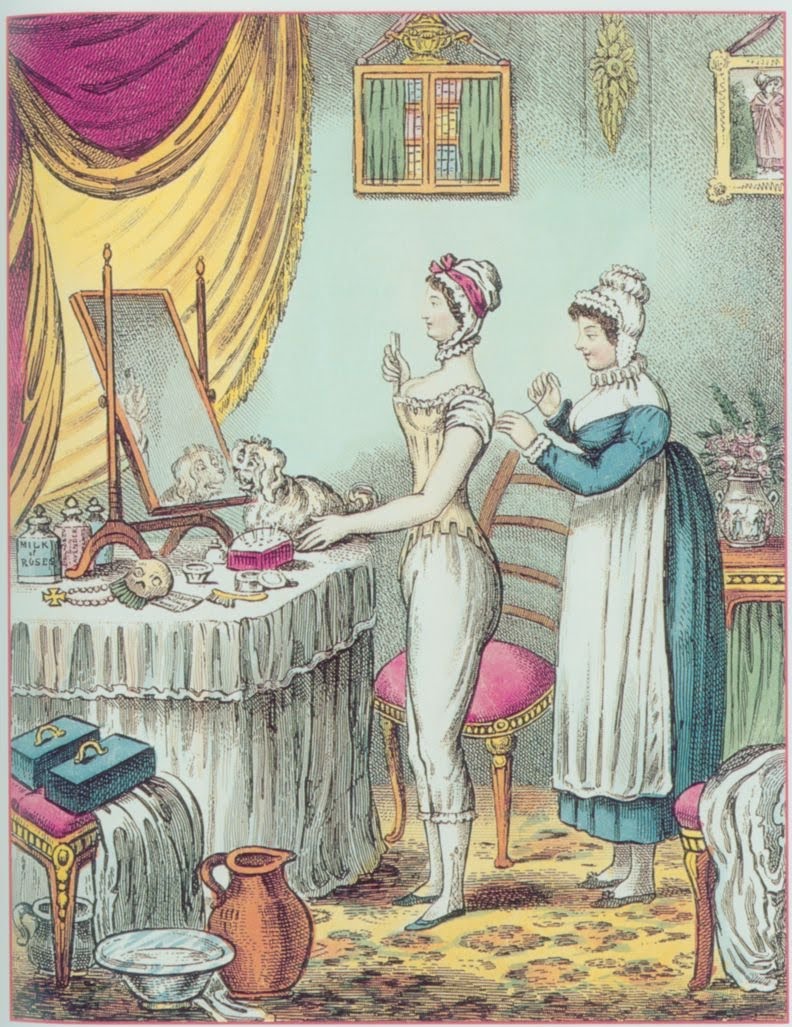
A rigid wood or bone busk, which served to separate the breasts and encourage good posture, was inserted in the stays (or corseted petticoat).
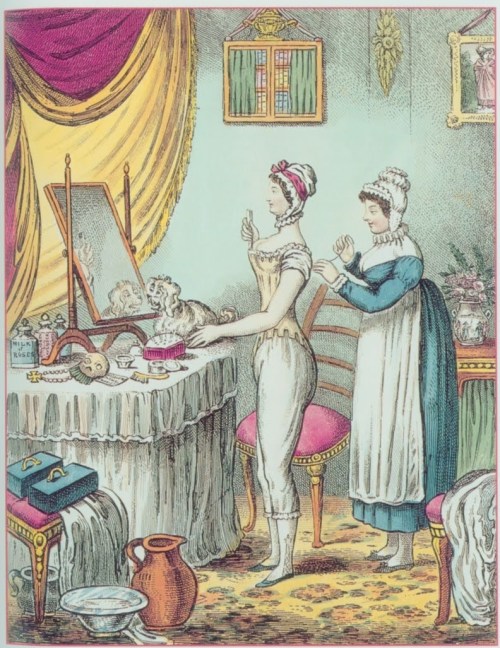
1810 German copy of James Gillray's cartoon. The lady inserts her busk as her maid ties her stays.

Busks might provide one explanation of why so few drawings and paintings of the era depict a deep, shadowed cleavage, for the breasts were splayed aside. The busks were often hand-carved and decorated by a woman’s sweetheart. The exerpt from a poem entitled: On a Juniper Tree, cut down to make Busks, waxes eloquently about the tree’s sacrifice for beauty.

She cut me down, and did translate,

My being to a happier state.

No martyr for religion died

With half that unconsidering pride;

My top was on that altar laid,

Where Love his softest offerings paid:

And was as fragrant incense burned,

My body into busks was turned:

Where I still guard the sacred store,

And of Love’s temple keep the door.

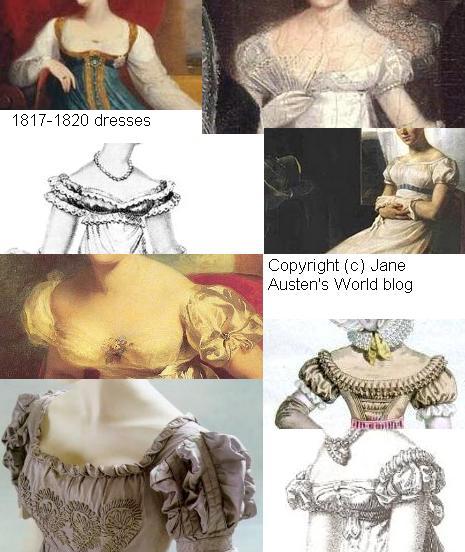
1817-1820 dresses

By 1817, the stark neoclassical outlines of empire gowns at the turn of the century had given way to a fancier more decorative outline, in which embellishments were added both at the top of the gown and at its hem. The 1817 portrait of Princess Charlotte (top left) is bittersweet, for she died in fall of that year in childbirth. Once again, the popular princess fails to exhibit her cleavage.

Rolinda Sharples’ painting of the cloak room at Clifton Assembly Rooms (top right) shows a woman with a small bust wearing a low décolleté ball dress. Countess Blessington (second from bottom, left) also wore a daring neckline for her sitting for her portrait by Thomas Lawrence. The two evening gowns at the bottom are modest, and the 1820 beige walking dress with its high ruff neck demonstrates the Tudor influences in dress embellishments. Also note the lowered waistline.
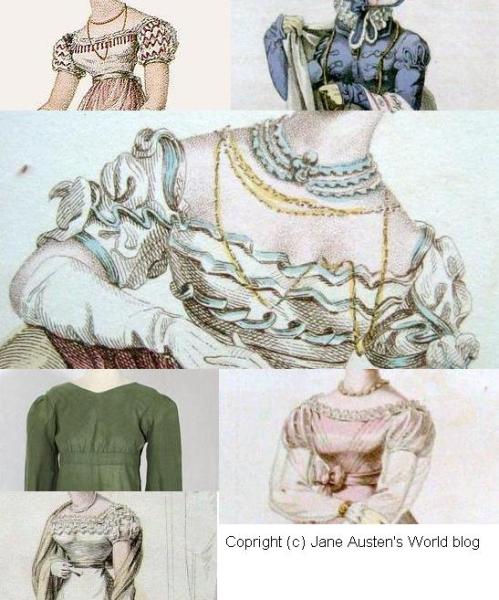
1823-1825 dresses

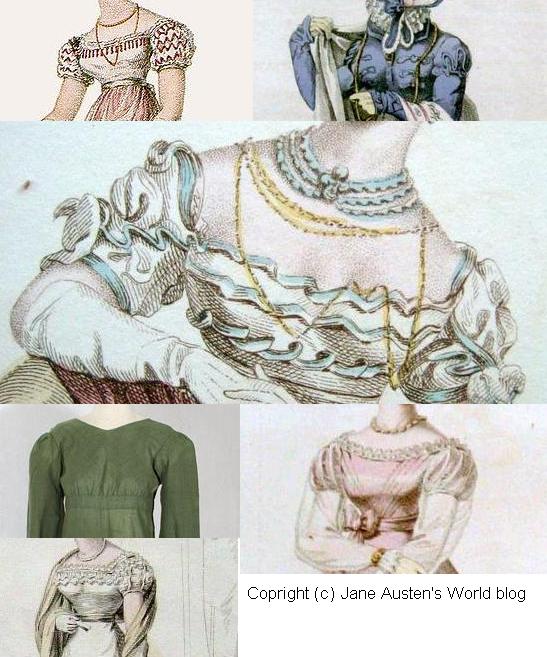
By 1823, Jane Austen had been dead for six years. She would have been shocked to see how many furlebows, tucks, rows of lace, and ribbons decorated ladies gowns. At this time, the waistline was gradually lowering back to its natural position. Gone was the neoclassical Regency empire silhouette. Note how the three ball gowns shown in this series of images provide hardly any chance for a lady to show off her cleavage.

One can see the hint of shadow of the woman’s breasts in the large 1823 La Belle Assemblee image in the center and how the artist accommodated the influence of the busk. I included the plain every day green 1825 American gown to show the kind of dress an ordinary woman would sew for herself and wear.

I hope this post has cast a light on a Regency lady’s bosom. A Lady of Distinction wrote in 1811:

Let the youthful female exhibit without shade as much of her bust as shall come within the limits of fashion, without infringing on the borders of immodesty. Let the fair of riper years appear less exposed. To sensible and tasteful women a hint is merely required.”

A tasteful hint? I can only conclude that exposing too much of one’s bosom was not considered lady-like behavior. Thin and small breasted women experienced an easier time following society’s strictures. The well-endowed had a tougher row to hoe, although an enterprising young virgin could always insert a handy nosegay to hide her feminine bounty or add  a pretty bow or a lace embellishment at the precise spot where a gentleman’s eyes should not stray.

Brazen hussies, light skirts, and women of easy virtue could bare as much skin as they pleased, having no reputation to protect. A very rich matron, whose place in society was secure, might be tempted to show more of her bosom than was prudent, but even she would refrain from displaying too many of her feminine allures before she was married!

Next, I will discuss heaving bosoms in Regency films and on book covers, and how the two media have influenced our perception of Regency bustlines.

More on the topic:

Read Full Post »
« Newer Posts - Older Posts »