Feeds:
Posts
Comments

Archive for the ‘Regency Life’ Category

Gentle Readers, Frequent contributor Tony Grant has supplied us with yet another treat: a post about door knockers. After you have read it, you will want to hop on over to his blog, London Calling, in which he describes his trip to Venice. 

The quintessential door knocker in Georgian architecture is the brass lion head with a large brass ring gripped in its mouth. It has been used as a symbol of Great Britain for centuries. Trafalgar Square has four enormous bronze lions positioned on great granite plinths at the four corners of the base of Nelson’s Column. They are made from the melted down bronze from canons captured from French ships at The Battle of Trafalgar.
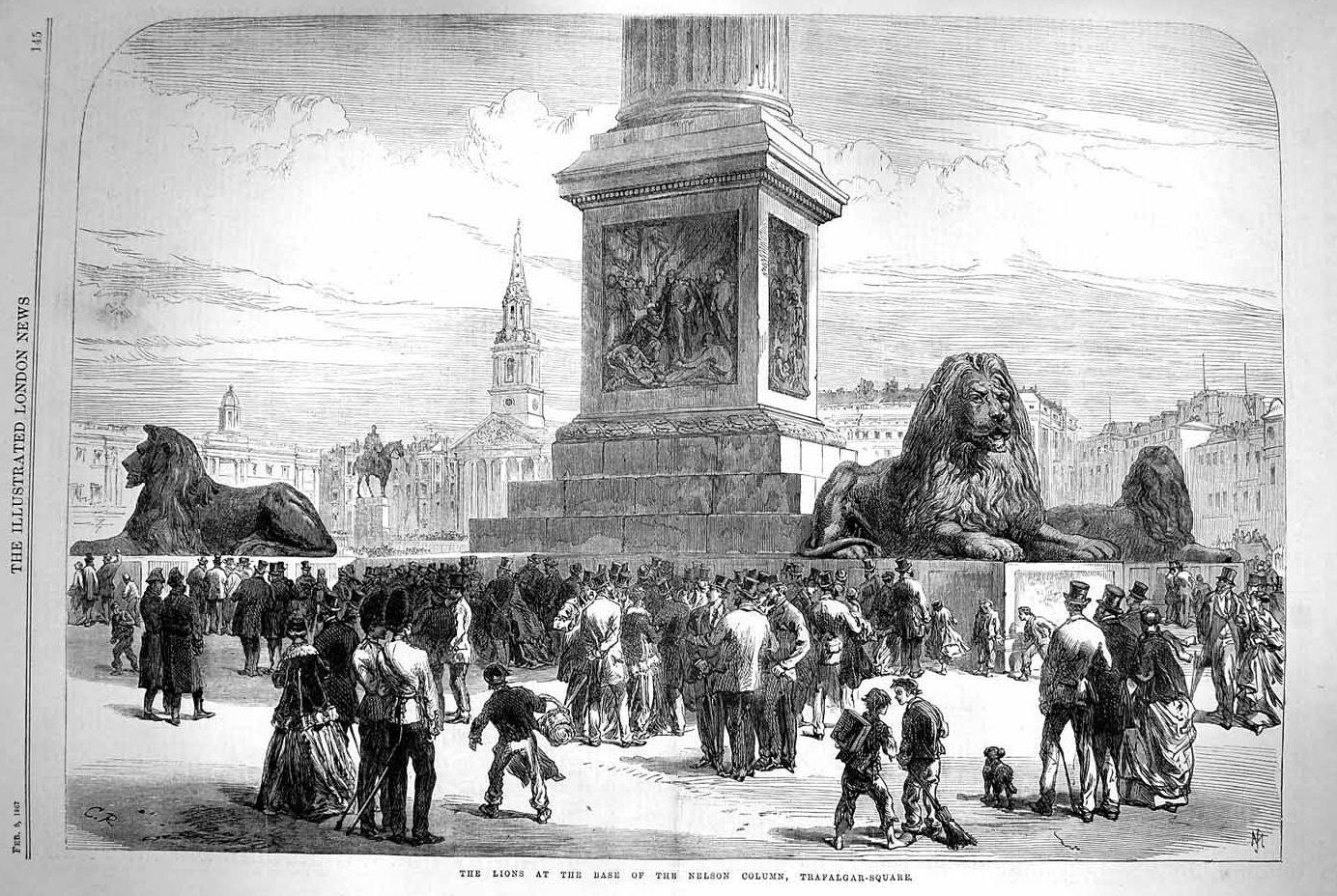
Lions at the base of Nelson's Column, Trafalgar Square. Image @The Illustrated London News

All coats of arms relating to the monarchy have lions as a prominent feature of their design, usually rampant. Lions have been used symbolically since the Paleolithic period.
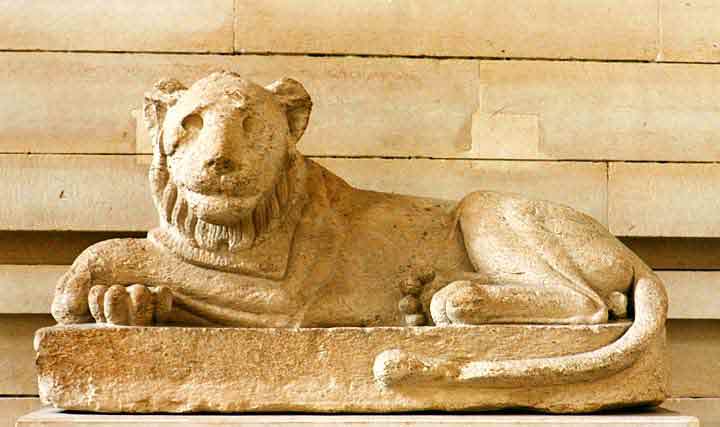
Egyptian lion sculpture carved out of limestone, Louvre

The Egyptians carved sphinxes, half man, half lion. They symbolise power and strength, courage and fortitude.

Heraldic lion

You can go to any part of London and you will come across Victorian or Georgian housing still with their original door furniture. Very often the door furniture will include a brass lion head door knocker. This could be a sign of Victorian and Georgian confidence. A sign for people of the greatest and largest empire the world has ever known. For the visitor it is their first contact with the house and a way of communicating their arrival by lifting the knocker and rapping it smartly against its back plate. The back plate to a lion head knocker is the lion’s head.
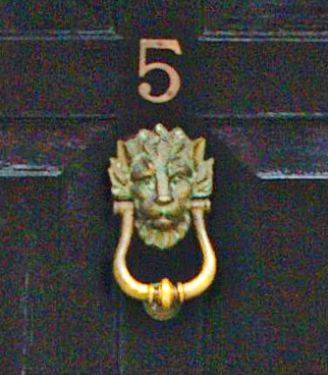
Lion door knocker. Image @Tony Grant

Knocking on a door does two things. First it makes the visitor take hold of the house. The hand grips the knocker. It is a like a handshake; a very English form of greeting. Secondly, through the sound of the knock it communicates to the occupants that somebody is visiting. The way the door is knocked can express other things too like haste, frustration, timidity or confidence.
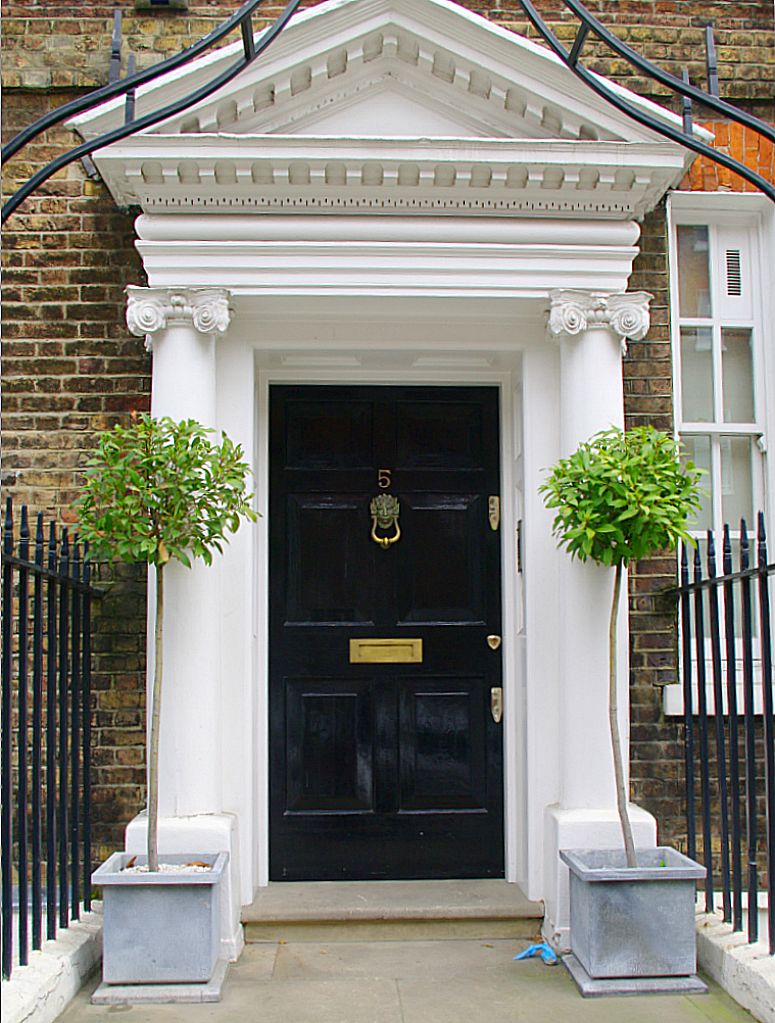
Front door with lion knocker. Image @Tony Grant

The fact that many Georgian houses have door knockers that are the originals means that we today in the 21st century, who are still using these door knockers to gain entrance, have a palpable, physical connection to people from past generations and from all classes of a past society.
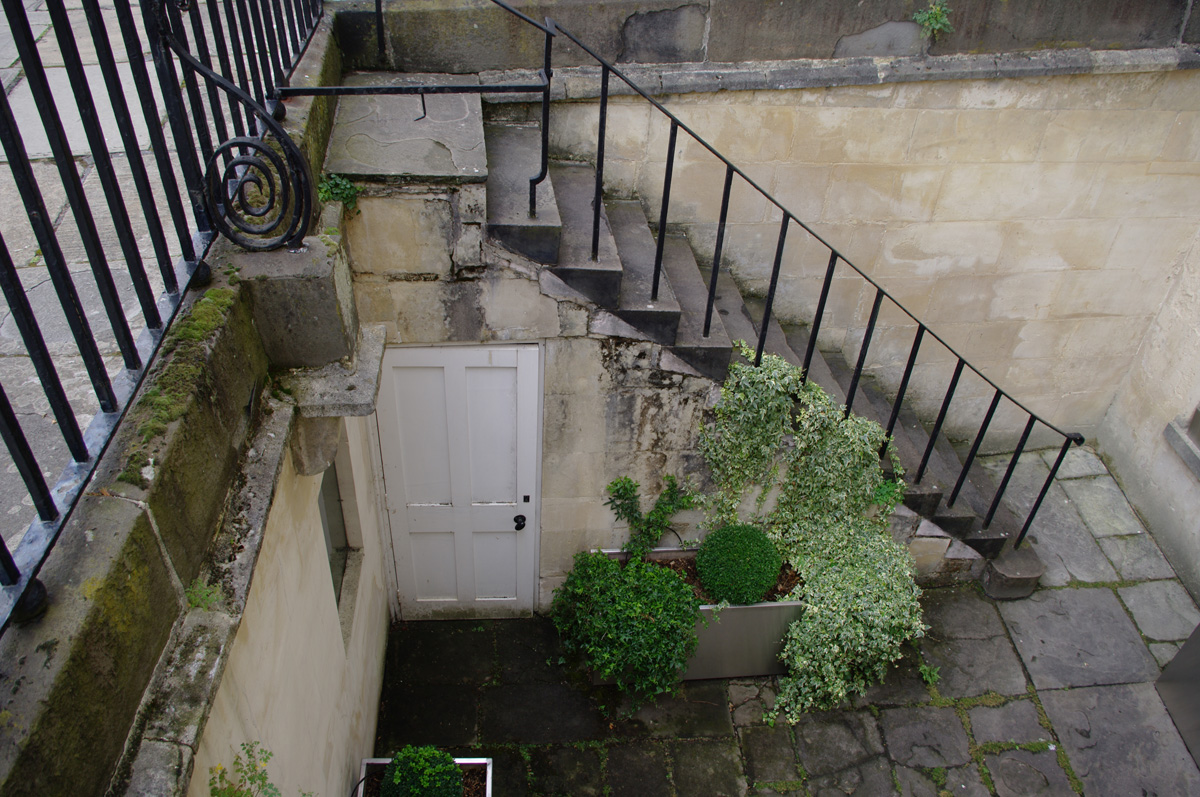
Downstairs to the servant's quarters, Bath. Image @Tony Grant

The servants belonging to the Georgian household would not have used the doorknocker of their own house. They would have slipped down the flight of stone steps near the front gate, to the servant’s quarters in the basement. However a footman or servant sent with a message or communication from another household would have used the front door knocker. The owners of the house would have knocked to alert their footman to open the door to them and their friends would have knocked to gain entrance too.
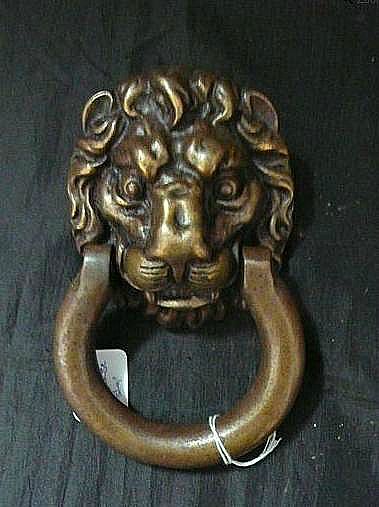
Door knocker made of brass. Image @Ruby Lane

A lot of door knockers are made from brass. Some are iron. Brass is a very special metal. It has a golden lustre when polished and expresses wealth, a friendly glow and a welcoming feel. Iron on the other hand can be aggressive and harsh. Iron against iron can cause a spark. It can rust and have unfriendly qualities. Brass on the other hand is benign. It is a malleable metal and has acoustic properties. In fact the brass door knocker on a Georgian front door can almost be regarded as a percussion instrument. The solid wooden door is the drum skin and the entrance hall behind it is the chamber within which the sound resonates and vibrates.

J. L. Settle door knocker at Portsmouth

Brass is used for many purposes, including bullet cases, artillery shell casings, horse accoutrements, locks, bearings, gears, musical instruments, horns and bells. It does not create a spark. It is low friction.

Brass is an alloy, which almost makes it a magical thing. It is an alloy of copper and zinc. The proportions can vary between the two metals to create different qualities in the brass. It is a substitutional alloy. This means that when the copper and zinc are melted together they replace some of each other’s atoms with their own atoms. Brass has been made since Roman times. You can imagine in the middle ages or earlier and perhaps even up to Georgian times people regarded blacksmiths and workers of metals almost as magicians being able to smelt ores and extract pure metals from their furnaces to make the most magical things. Brass is a difficult alloy to make, even more so than other alloys. Copper can be smelted easily but zinc cannot be smelted from it’s ore. Brass has to be created through what is called a cementation process. This is when smelted copper is mixed with the unsmelted zinc ore. This means that many impurities are included and the slag that is created has to be carefully separated during the alloy creating process. Zinc comes from rocks called hemimorphite and smithsonite. Lead is something that is also added to some brass alloys to create a different quality. However, sometimes, the lead leaches from the finished brass. Imagine that rubbing onto some unsuspecting visitors hands. Particles of lead unseen on the hands and transferred to the mouth and the digestive system.
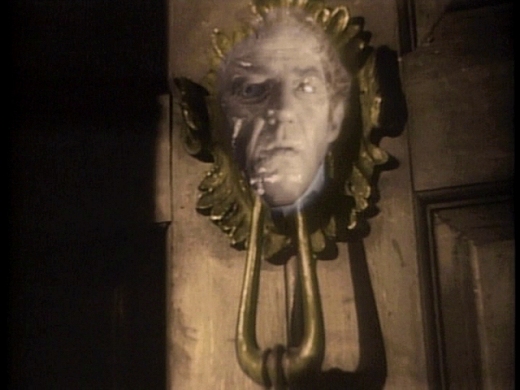

That thought lends new credence to the famous scene in Charles Dickens a Christmas Carol when Scrooge returns home on a cold misty winters night,

Now, it is a fact, that there was nothing at all particular about the knocker on the door, except that it was very large.  It is also a fact, that Scrooge had seen it, night and morning, during his whole residence in that place; also that Scrooge had as little of what is called fancy about him as any man in the city of London, even including — which is a bold word — the corporation, aldermen, and livery.  Let it also be borne in mind that Scrooge had not bestowed one thought on Marley, since his last mention of his seven years’ dead partner that afternoon.  And then let any man explain to me, if he can, how it happened that Scrooge, having his key in the lock of the door, saw in the knocker, without its undergoing any intermediate process of change — not a knocker, but Marley’s face.

Marley’s face.  It was not in impenetrable shadow as the other objects in the yard were, but had a dismal light about it, like a bad lobster in a dark cellar.  It was not angry or ferocious, but looked at Scrooge as Marley used to look: with ghostly spectacles turned up on its ghostly forehead.  The hair was curiously stirred, as if by breath or hot air; and, though the eyes were wide open, they were perfectly motionless.  That, and its livid colour, made it horrible; but its horror seemed to be in spite of the face and beyond its control, rather than a part or its own expression.
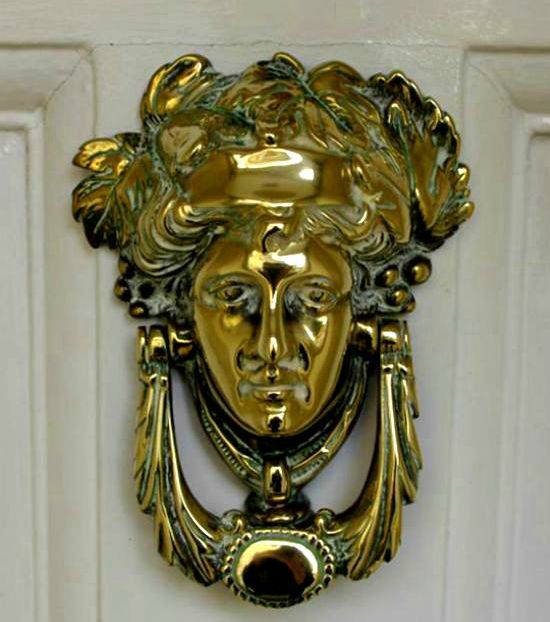
Another form of door knocker - that of a Roman god wearing a laurel wreath, Bath. Image@Tony Grant

As Scrooge looked fixedly at this phenomenon, it was a knocker again.

To say that he was not startled, or that his blood was not conscious of a terrible sensation to which it had been a stranger from infancy, would be untrue.  But he put his hand upon the key he had relinquished, turned it sturdily, walked in, and lighted his candle.”

Was it lead poisoning that was rotting Scrooges brain or just tiredness, misery, the cold and mist and darkness playing tricks with his imagination and senses?
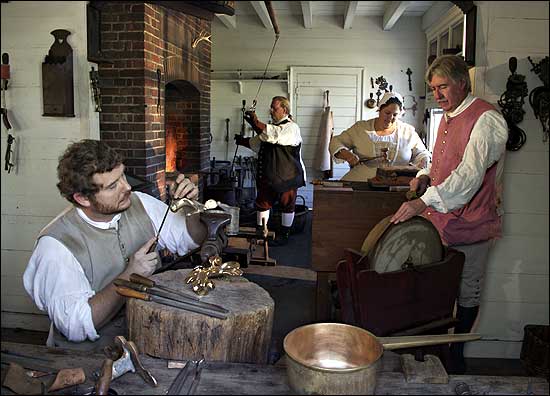
Filing a door knocker. Image @History.org Foundation Journal

To make a lion head door knocker a few technical and difficult processes have to be carried out. A mould has to be made. A carver carves a lion head pattern out of wood. A mould maker uses a box filled with a mixture of sand and clay to make a fire-proof  mould. The wooden pattern is pressed into the sand and clay composite and a lion head knocker mould is thus created. The molten alloy of copper and zinc that creates the brass is then poured into the mould and left to cool and solidify. When cold the brass knocker can be extracted and filed and sanded down to get rid of any rough surfaces. In this process, craftsmen, metal workers geologists and miners would form a trail of work and economy. Finally the finished  door knocker would have been sold to a carpenter making a door to then be sold to a builder who would fix the door in the house he made for a new purchaser.
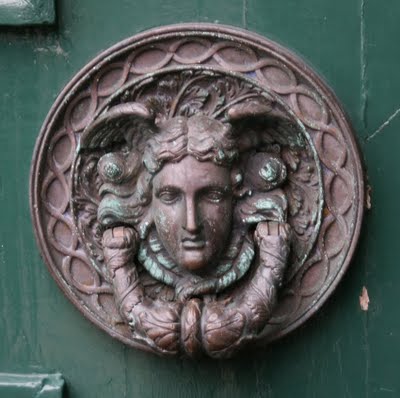
Door knocker at the Brighton dome at the Brighton Pavilion, early 19th c.

More on the topic:

Read Full Post »

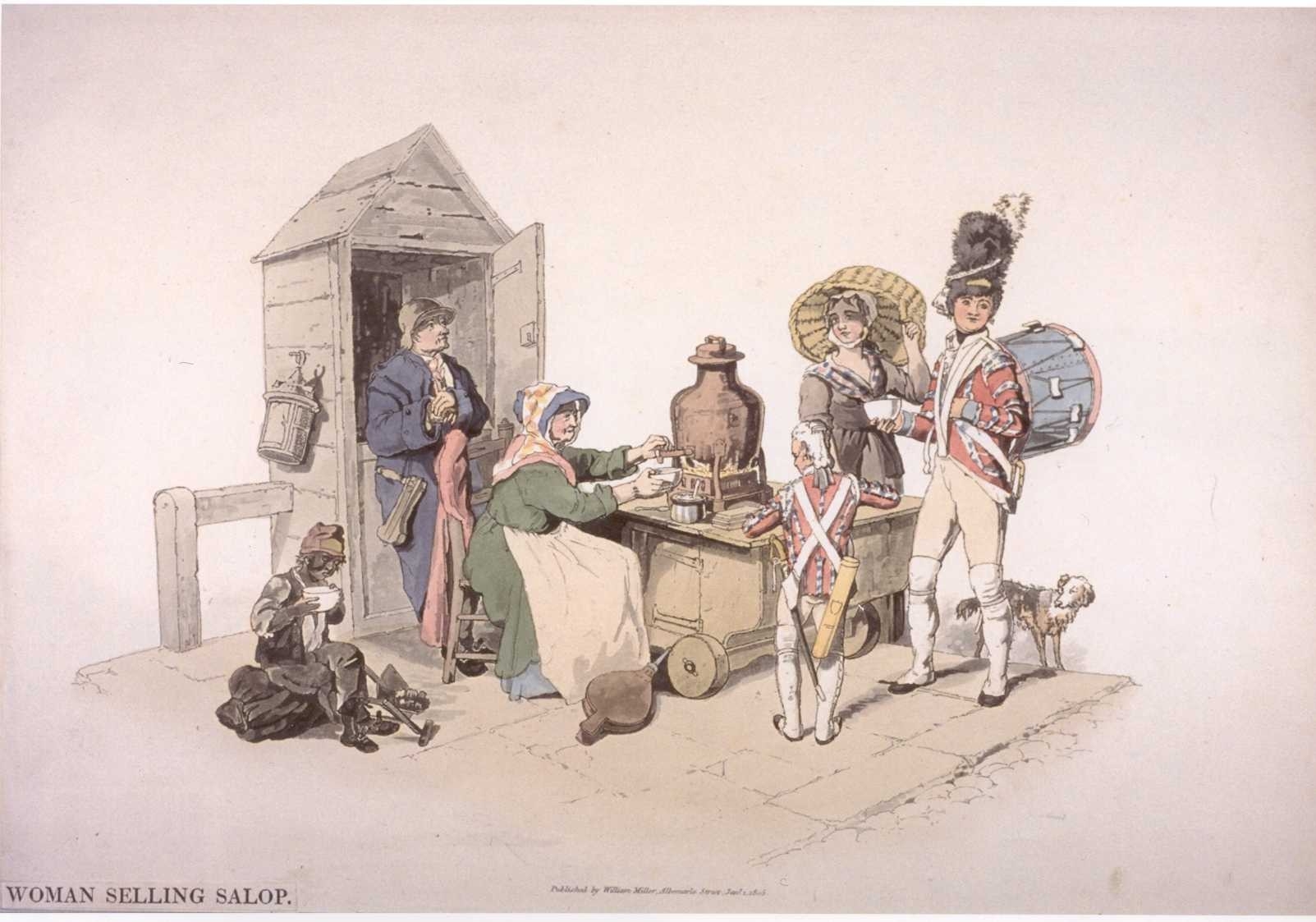
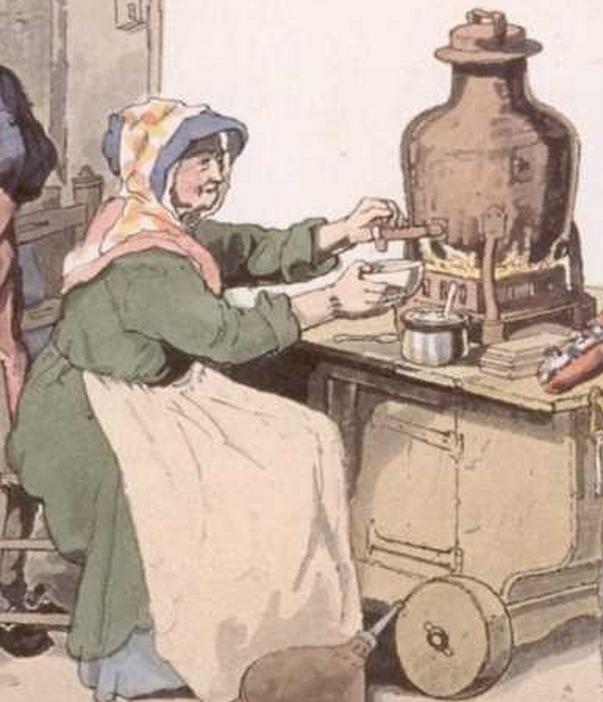
This 1808 image of an old vendor woman selling salop in London seems simple at first glance. Created by William H Pyne for The Costumes of Great Britain (one of 60 beautifully produced hand-colored drawings), the image shows the vendor surrounded by customers waiting for a warm drink, which she pours fresh and hot into white bowls from a samovar (still). One wonders if the sight was common enough for Jane Austen to have observed it during her visits to her brother Henry in London, or if she purchased the drink or had tasted it. This description shows how even a whiff of  salop caused the writer to wax eloquently about the drink, which he had liked long ago:

Suddenly we came upon a still, whence arose the steam of Early Purl, or Salop, flattering our senses. Ye Gods ! what a breakfast ! In vain a cautious scepticism suggests that the liquid was one which my palate would now shudderingly reject; perhaps so; I did not reject it then; and in memory the flavour is beatified. I feel its diffusive warmth stealing through me. I taste its unaccustomed and exquisite flavour. Tea is great, coffee greater ; chocolate, properly made, is for epicures; but these are thin and characterless compared with the salop swallowed in 1826. That was nectar, and the Hebe who poured it out was not a blear-eyed old woman, though to vulgar vision she may have presented some such aspect. – Unctuous Memories, The Cornhill Magazine, 1863 p. 613-617

The problem is not with the drawing; it is with the definition of salop, which is variously spelled salop, salep, saloop, and even sahlib. Experts have offered several explanations and recipes of the drink. I examined three sources, all of which offer different ingredients. Even dictionaries from the 19th century cannot agree with the precise meaning of the drink that was commonly served in coffee houses and stalls and on the streets of London. We can, however, agree on a few observations. A night watchman stands behind the vendor and her mobile table. Thus, salop was a typical nightly drink of Londoners.

Sold between midnight and 6-7 o’clock in the morning for some it was the probate cure of a hang-over while the early birds drank it for invigoration and warming up. (Luder H. Niemeyer)

Detail of the chimney sweep drinking salop

Salop was definitely popular during the first part of the 19th century.

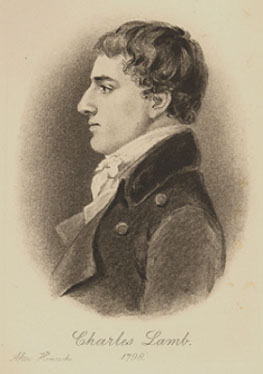
Charles Lamb, in his essay upon Chimney Sweeps, mentions the public house of Mr. Reed, on Fleet street in London, as a place where Sassafras tea (and Salop) were still served daily to customers in his time, about 1823.

The hot mixture was affordable even for the lowly chimney sweep, who is seen drinking from a bowl. But how was the drink made? The Hobson-Jobson: The Anglo-Indian Dictionary, first published in 1886,  says that salop was derived from the tubers of various species of orchis found around Europe. It had the reputation of being a restorative and highly nutritious, and a decoction of the substance, spiced and sweetened, was thought to make an agreeable drink for invalids. – p. 784.

The tea woman sitting behind her street booth – a mobile table with samovar – amidst varied customers, just filling another cup of her much demanded herb-tea. Aquatint printed in color and colored by hand for William Miller in London. 1805.

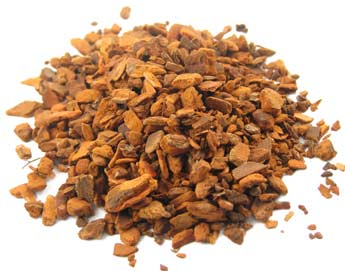
Hobson-Jobson went on to say that in 1889 a correspondent wrote that the term could also be applied to an infusion of the sassafras bark or wood. Sassafras was imported from the colonies; it did not grow in Europe.

There is also the question of what time of day people preferred to drink salop.  In 1850, a source stated that sassafras tea, flavoured with milk and sugar, was sold at daybreak in the streets of London as saloop. In 1882, The St. James’s Gazette said:

Here we knock against an ambulant salep-shop (a kind of tea that people drink on winter mornings); there against roaming oil, salt, or water-vendors, bakers carrying brown bread on wooden trays, pedlars with cakes, fellows offering dainty little bits of meat to the knowing purchaser.”

From the description, one gets the true flavor of an early morning street scene – its sights, smells, and sounds . One also gains the sense that salop was sold much like coffee today – that there was a preferred time to drink it, but that it could be obtained at all hours. But what about the recipe? Was it made with Sassafras bark or with orchis root?

Gourmet Britain says it was made with orchis root, and provides the reader with a history and recipe.  Soupabooks mentions that it was made of dried sassafras bark and offers this recipe:

To make Salop

Put a Tea spoonfull of  Salop to a Pint of Water, with 3 or 4 Blades of Mace, & some Lemmon Peel cut very thin. Boyl it, & Mill it as you do Chocolate, Sweeten it to your Taste; add some grated Nutmeg, & juice of Lemon to make it Palateable. — Mrs. B.P. Benet, Lathrop Lodge, Swindon, Wilts. From her Book of Recipes from about 1796.

Note that Mrs. B.P. Benet does not describe the Salop, but simply assumes that the reader will know what ingredient to purchase. The salop made with sassafras bark would have a slight taste of licorice.

Early American settlers learned from American Indians how to brew sassafras tea from the root bark and drank it has an herbal remedy. Later they made sassafras the original root in root beer and used it as an important ingredient in Sasparilla, a different but related beverage. Those first Sassafras supporters didn’t know how or why it tasted so good, but a few hundred years later, we do. Sassafras root contains an essential oil called safrole which imparts that characteristic licorice flavor.

Charles Lamb. Image @NNDB

Charles Lamb in his essay about Chimney Sweeps corroborates the sassafras root ingredient:

There is a composition, the groundwork of which I have understood to be the sweet wood yclept sassafras. This wood boiled down to a kind of tea, and tempered with an infusion of milk and sugar, hath to some tastes a delicacy beyond the China luxury. I know not how thy palate may relish it, I have never ventured to dip my own particular lip in a basin, a cautious premonition to the olfactories constantly whispering to me, that my stomach must infallibly, with all due courtesy, decline it. Yet I have seen palates otherwise not uninstructed in dietetical elegancies, sup it up with avidity. This is salop—the precocious herbwoman’s darling—the delight of the early gardener who transports his smoking cabbages from Hammersmith to Covent Garden’s famed piazzas—the delight, and oh ! I fear too often the envy of the unpennied sweep.” – Unctuous Memories, The Cornhill Magazine, 1863 p. 613-617

To complicate matters even more, I found this description of salop:  “The tea produced from the male root of the Ragged Robin, so-called salop, was the typical nightly drink of Londoners.” (Luder H. Niemeyer) Ragged Robin seems to be the common name for the cuckooflower lychnis, which is a perennial that has very hardy, fibrous roots. Since Ragged Robin was not mentioned in other encyclopedias, descriptions, or dictionaries that I consulted, I will discount this ingredient from the discussion.

Sassafras root bark. Image @ Vermont Fiddle Heads

The following is a sampling of definitions of Salop, Salep, or Saloop from various dictionaries:

  • an aromatic drink prepared from sassafras bark and other ingredients. – Online Encyclopedia
  •  salop (or saloop, a hot starchy drink made with an infusion of dried salep, or orchid tubers) – Science and Society Picture Library
  • An aromatic drink prepared from sassafras bark and other ingredients , at one time much used in London . – – J . Smith ( Dict . Econ . “Saloop” is a common misspelling or typo for: Salop. – Webster’s Online Dictionary
  • saloop/seuh loohp”/, n.: a hot drink prepared originally from salep but later from sassafras, together with milk and sugar. [1705-15; var. of SALEP] – Collaborative International Dictionary
  • Salep, sal′ep, n. the dried tubers of Orchis mascula: the food prepared from it.—Also Sal′op. [Ar.Salep from Arabic: سحلب saḥlab‎, is a flour made from grinding the dried tubers of the orchid genus Orchis (including species Orchis mascula and Orchis militaris). These tubers contain a nutritious starch-like polysaccharide called glucomannan. Salep flour is consumed today in beverages and desserts, in places that were formerly part of the Ottoman Turkish Empire. The term salep may also refer to any beverage made with the salep flour. – Wikipedia

So which ingredient did Pyne’s old female vendor use to make her salop? Orchis tubers, which were found in Europe, or dried Sassafras bark,which had to be imported? In any case, one shudders at the thought of the bowls that the vendor used to pour the drink in for her customers. I see no water jug near at hand to rinse the bowls after each use. Heaven knows how many germs were spread around via these used dishes, which could not be tossed aside or washed easily.

About The Costumes of Great Britain: Between 1800 and 1818, London publishers William Miller, T. M’Lean, and William Bulmer published a series of color plate books, including one that featured 60 color plates of Britain’s working classes just as the Industrial Revolution began to take off.  William H Pyne (1769-1843) was commissioned to write and illustrate the book by the publisher, William Miller. The first edition was printed in 1804, but the edition from which this coloured plate was taken was published in 1808. – Science and Society

More on the topic:

Read Full Post »

Recently I commented on a morning gown whose influences were largely from British history. In this April 1812 Ackermann fashion plate, the pink ball gown is indicative of the impact of trade and foreign travel in eastern lands and the advances of the Industrial Revolution on fashion. A young lady attending the ball would have (in her mind) come as a strong exotic eastern woman, resplendent in her turban, peasant bodice, and other rich oriental details.

Click on this fashion plate to enlarge it.

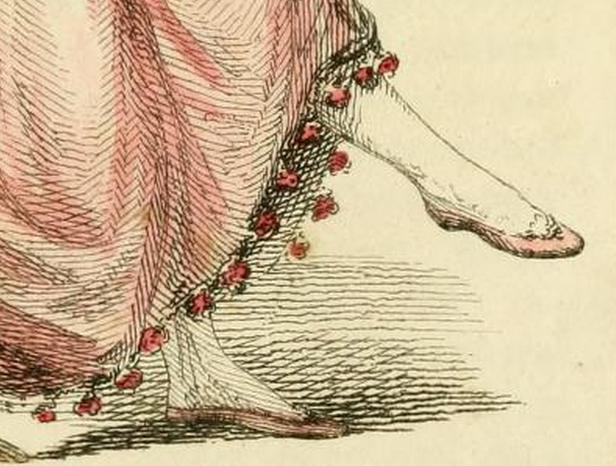
Ball Dress: a round Circassian robe of pink carpe , or gossamer net, over a white satin slip, fringed full at the feet; a peasant’s bodice of pink satin or velvet, laced in front with silver, and decorated with the same ornament. Spanish slash sleeve, embellished with white crape foldings, and finished at its terminations with bands of silver. A Spartan or Calypso helmet cap of pink frosted crape, with silver bandeaus, and embellished with tassels, and rosets to correspond. A rich neck-chain and ear-rings of Oriental gold. Fan of carved ivory. Slippers of pink kid, with correspondent clasps; and gloves of white kid: an occasional square veil of Mechlin lace.”

Detail of the Spartan or Calypso helmet cap, mechlin lace, fan, peasant bodice, and Limerick gloves.

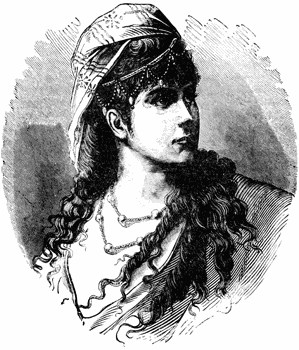
Eastern Turkish influence includes those of Circassian women, whose reputation dates back to the Ottoman Empire and the Sultan’s harem. Circassians became a common symbol of orientalism during the Romantic era. In Europe and America

 Circassians were regularly characterised as the ideal of feminine beauty in poetry, novels, and art. Cosmetic products were advertised, from the 18th century on, using the word “Circassian” in the title, or claiming that the product was based on substances used by the women of Circassia.- Wikipedia

The gossamer net represented the advances made in machine made lace during the late 18th and early 19th centuries. (Click here to read my article about net lace.)

Early 19th century dress made with embroidered black net.

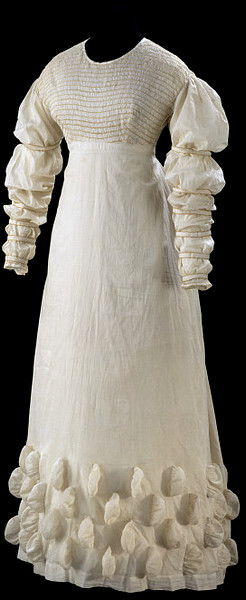
 The white crape foldings in the Spanish slash sleeves remind me of the puffs in the hem of this early 19th century gown.

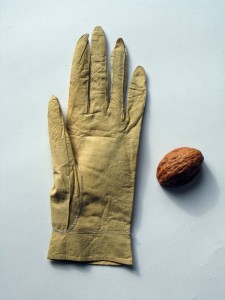
Limerick gloves were “a celebrated style of glove that became popular throughout England and Ireland during the late 18th, early 19th century. Commonly referred to as ‘chicken-skins’, the gloves were renowned for their exquisite texture. They were made from a thin strong leather derived from the skin of unborn calves and sold encased in a walnut shell.”

Limerick glove. Image @The Museum of Leathercraft.

Circassian women were regarded as strong, beautiful, and exotic, which is how the woman wearing the ball dress depicted in the Ackermann fashion plate must have felt.

Circassian woman. Image @Clipart, etc.

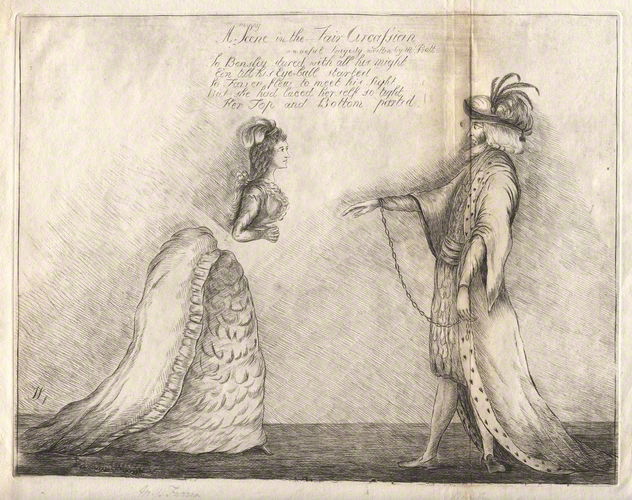
The circassian robe, or an outer garment used in ceremonial occasions, is not as evident in the fashion plate as in the dress below, where it flows over the gown’s train.

Eliza Farren in 'A Scene in the Fair Circassian' with Robert Bensley by James Sayers. Etching ca. 1781 from the National Portrait Gallery NPG D9544

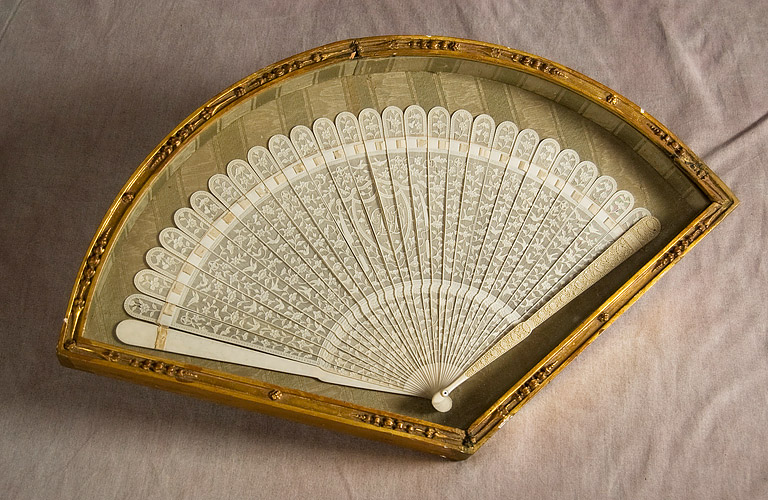
Rich lace, tassels, and an ivory fan completed our fashionable lady’s the ensemble.

Decorative imported ivory fan. Image @Independence Seaport Museum.

Detail of the hem.

More about the ball gown’s fashion influences:

Read Full Post »

Back in Jane Austen’s day travel was so difficult and laborious over poorly constructed roads that the majority of the people who lived in that century traveled no farther than 14 miles from where they lived. Most walked, and even so they had to contend with muddy roads that were almost impassible after heavy rains or breathe in choking dust during times of drought. (In cities, dusty streets would be watered down by merchants early in the morning.)

Diana Sperling, a party walking to dinner along muddy roads.

Travel at night was dangerous. Without a widespread means of lighting roads or an organized police force, night travelers were at the mercy of highwaymen. In cities, link boys were paid a half pence to carry a light in front of pedestrians, or for those on horseback and in carriages.

Georgian cast iron light fixtures, Landsdowne Crescent in Bath. Note the cones, which extinguished the light.

Lanterns hung in front of city doors or were carried. In the country, torches hung from trees lining a lane that led up to a house. Balls and parties were planned during the full moon, although a rainy or cloudy night would spoil these well-laid plans.

A link boy lights the way in the city, 1827.

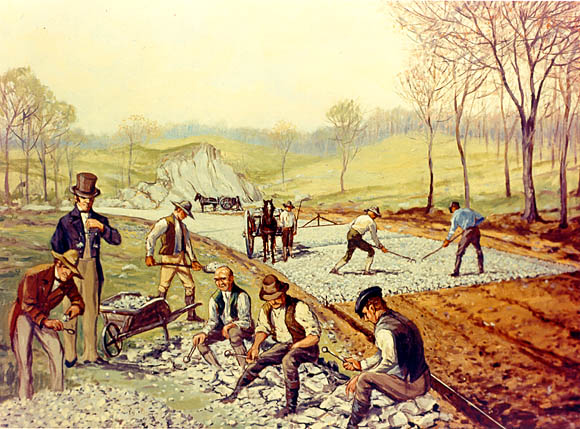
The situation would not change until the Industrial Revolution brought about such life altering inventions as gas lights, macadam roads (whose hard surface facilitated smoother travel), the steamboat, and rail travel.

The perils of overcrowding, 1812

The following descriptions of poor road conditions from Old Country Life, a book published in 1892, describes a time just after Jane Austen’s death, but one that her longer lived siblings would have known. While people’s memories of distant events are often faulty, the emotions they felt tend to stay with them. Here then are some eye witness accounts retold many decades later:

What a time people took formerly in travelling over old roads! There is a house just two miles distant from mine, by the new unmapped road. Before 1837, when that road was made, it was reached in so circuitous a manner, and by such bad lanes, and across an unbridged river, that my grandfather and his family when they dined with our neighbours, two miles off, always spent the night at their house.

Negotiating a muddy road. Image @Roads in the 18th Century

In 1762, a rich gentleman, who had lived in a house of business in Lisbon, and had made his fortune, returned to England, and resolved to revisit his paternal home in Norfolk. His wish was further stimulated by the circumstance that his sister and sole surviving relative dwelt beside one of the great broads, where he thought he might combine some shooting with the pleasure of renewing his friendships of childhood. From London to Norwich his way was tolerably smooth and prosperous, and by the aid of a mail coach he performed the journey in three days. But now commenced his difficulties. Between the capital and his sister’s dwelling lay twenty miles of country roads. He ordered a coach and six, and set forth on his fraternal quest. The six hired horses, although of strong Flanders breed, were soon engulfed in a black miry pool, his coach followed, and the merchant was dragged out of the window by two cowherds, and mounted on one of the wheelers; he was brought back to Norwich, and nothing could ever induce him to resume the search for his sister, and to revisit his ancestral home.

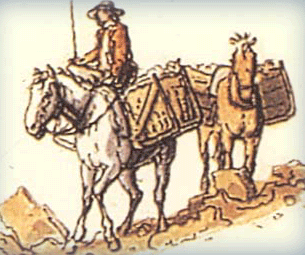
Pack horses. Image @The Rolle Canal Company

Roads were in such a poor condition that transportation over rivers and canals was preferred. If waterways were not nearby, pack horses and carrier wagons carried heavy and fragile items into areas were roads were near to impassible. Carrier wagons were sturdy wagons pulled by oxen and covered with canvas cloth.

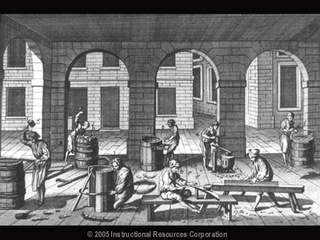
Items had to be safely packed before they could be transported. Paper was expensive and cardboard boxes had yet to be invented. Goods were carried in cloth sacks, metal canisters, leather baskets, wood barrels, sturdy trunks, or wooden crates. Additional containers were made of cloth, woven straw, crockery, glass, and tin.

18th century coopers making barrels. Image@Instructional Resources Corporation.

The safe preservation of foods in metal containers was finally realized in France in the early 1800s. In 1809, General Napoleon Bonaparte offered 12,000 francs to anyone who could preserve food for his army. Nicholas Appert, a Parisian chef and confectioner, found that food sealed in tin containers and sterilized by boiling could be preserved for long periods. A year later (1810), Peter Durand of Britain  received a patent for tinplate after devising the sealed cylindrical can. – A brief history of packaging

Fragile items like glass and china received extra protection and were wrapped in cloth or straw. Considering the poor road conditions,  it is a wonder that any of these items survived their long journeys intact. View an image and explanation of a stage wagon in this link.

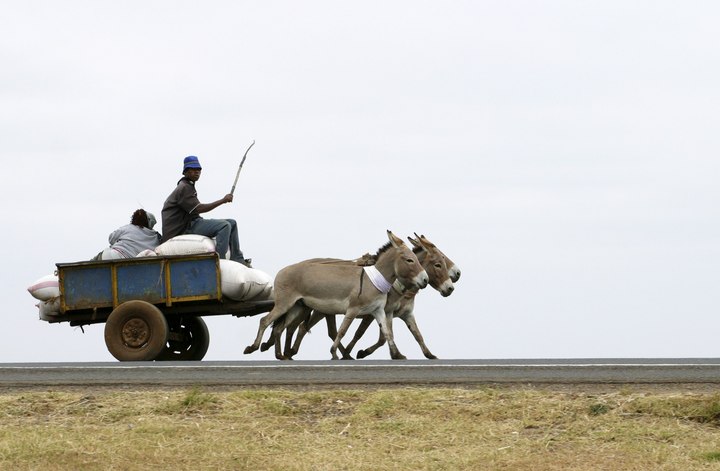
Reliable forms of old-fashioned transportation still exist in this world. Image@Washington Post

Below is a description of a carrier and his wagon.  (click here to see examples):

It is a marvel to us how the old china and glass travelled in those days; but the packer was a man of infinite care and skill in the management of fragile wares.

Does the reader remember the time when all such goods were brought by carriers? How often they got broken if intrusted to the stage-coaches, how rarely if they came by the carrier.  The carrier’s waggon was securely packed, and time was of no object to the driver, he went very slowly and very carefully over bad ground. – Old Country Life, Sabine Baring-Gould, 1892

Breakdown of the Christmas stage, a Victorian illustration. Note that oxen are strapped to an empty cart, ready to take on passengers, who are still 10 miles from their destination.

As noted before, people often spent the night when they arrived as guests for dinner. Once a person made the journey to visit relatives, they tended to stay for weeks, even months. Elizabeth Bennet’s visit with Charlotte was of several weeks duration; Cassandra Austen frequently visited her brother Edward for weeks at a time, which is when Jane would write to her.

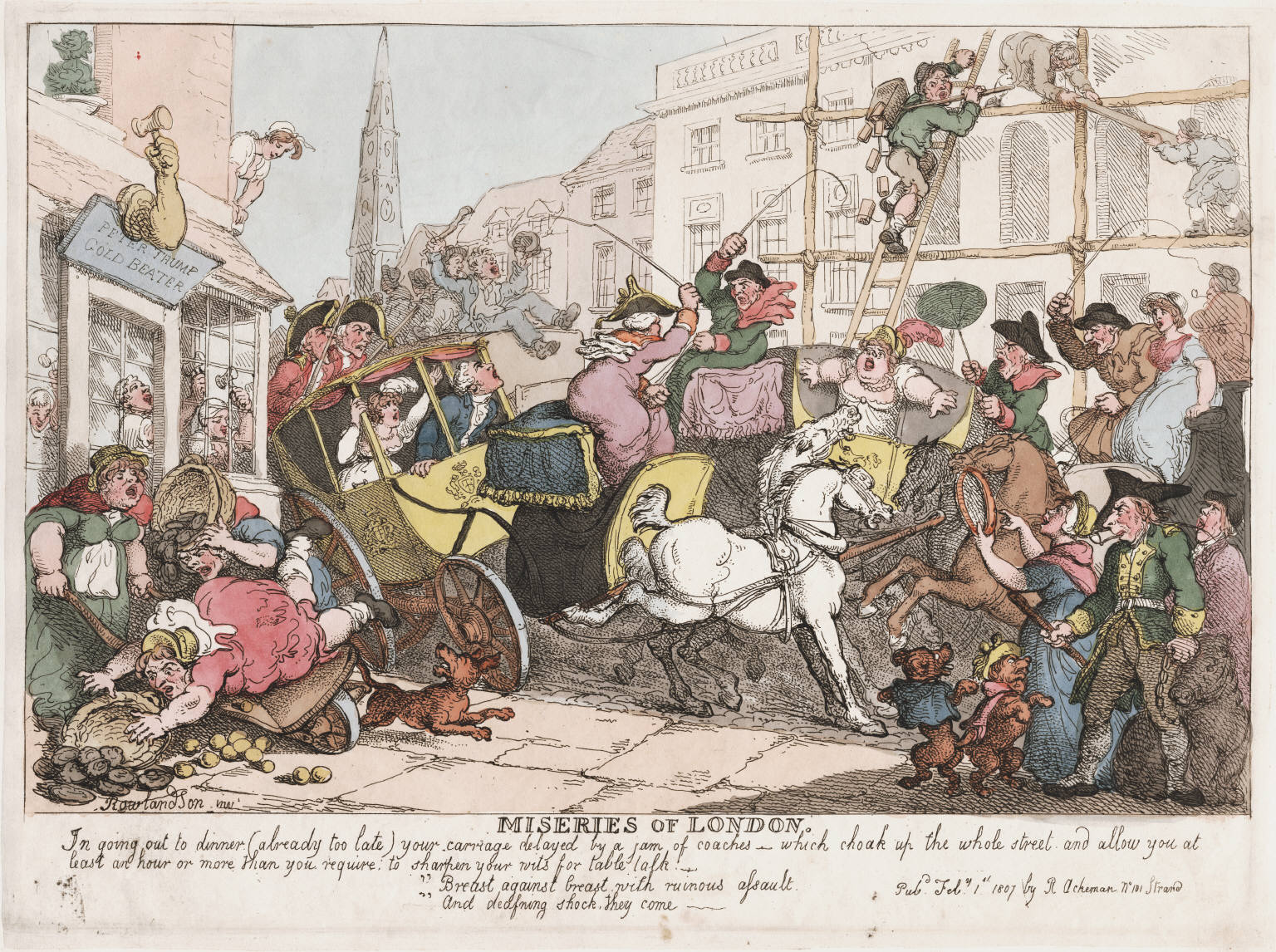
City streets were crowded and narrow. Thomas Rowlandson. The Miseries of London. 1807. Image @Lewis Walpole Library

“It is of some importance,” said Sydney Smith, “at what period a man is born. A young man alive at this period hardly knows to what improvements of human life he has been introduced; and I would bring before his notice the changes that have taken place in England since I began to breathe the breath of life—a period of seventy years. I have been nine hours sailing from Dover to Calais before the invention of steam. It took me nine hours to go from Taunton to Bath before the invention of railroads. In going from Taunton to Bath I suffered between ten thousand and twelve thousand severe contusions before stone-breaking MacAdam was born. I paid fifteen pounds in a single year for repair of carriage springs on the pavement of London, and I now glide without noise or fracture on wooden pavement. I can walk without molestation from one end of London to another; or, if tired, get into a cheap and active cab, instead of those cottages on wheels which the hackney coaches were at the beginning of my life. I forgot to add, that as the basket of the stagecoaches in which luggage was then carried had no springs, your clothes were rubbed all to pieces; and that even in the best society, one-third of the gentlemen were always drunk. I am now ashamed that I was not formerly more discontented, and am utterly surprised that all these changes and inventions did not occur two centuries ago.” – Old Country Life, Sabine Baring-Gould, 1892, p. 216

Paving a macadam road in the U.S., 1823

Read Full Post »

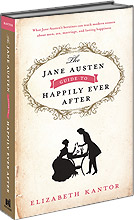
In The Jane Austen Guide to Happily Ever After, Elizabeth Kantor asks in a section about “Taking Relationships Seriously”: Can we have Jane Austen-style elegance, dignity, and happy love only with no cost to modern freedom and equality? The answer is an unqualified yes if, like Austen’s heroines, we approach romance with a rational balance to sex and love and work hard on all our relationships, not just the romantic ones. The Guide is filled with clear-eyed information and advice gleaned from Jane Austen’s novels. Sprinkled throughout the book are selected tips for Janeites. They include:
  • Don’t wait to pursue happiness in love until “some time or other” in the future.
  • If you think about “settling” — think again.
  • The very highest standards for yourself are perfectly compatible with the highest degree of respect and compassion for other people — in fact, they tend to go together.
  • In Jane Austen (and in life), when it comes to human beings, past performance is an excellent predictor of future results.
  • You are the only person you have a right to control.
There are many more kernels of truth in The Guide. Case studies of major male characters, like John Willoughby,  examine their commitment phobias, and close scrutiny of Jane’s clear-eyed heroines reveals how they get love exactly right. The pursuit of rational and permanent happiness is what sets Jane Austen heroines apart. Regard the conversation in Pride and Prejudice between Elizabeth Bennet and her sister Jane about Mr. Bingley’s sisters:

Jane: “You persist, then, in supposing his sisters influence him?”

Elizabeth: “Yes, in conjunction with his friend.”

“I cannot believe it. Why should they try to influence him? They can only wish his happiness; and if he is attached to me, no other woman can secure it.”

“Your first position is false. They may wish many things besides his happiness; they may wish his increase of wealth and consequence; they may wish him to marry a girl who has all the importance of money, great connections and pride.”

With this example, the author points out that Jane Austen’s heroines don’t get an automatic win in love. They have to negotiate their way through competing desires to earn their happiness. Austen creates heroines who are able to do this, but she also shows us women who fail. These women don’t find happiness, for they were looking for love in all the wrong places and for other qualities besides those that would make them happy in love. Thinking about young and impulsive Lydia Bennet, the reader instantly recognizes that she stands no chance of finding happiness with Mr. Wickham after the excitement of their marriage dies down and their money runs out.
Jane Austen’s heroines don’t settle, like Charlotte Lucas  did with Mr. Collins. Fanny Price, who many readers find boring, remains steadfast in her convictions about Mr. Crawford, despite a great deal of pressure from family and friends. Cynical Mary Crawford was in the market for a man with status and money, which is why she first set her sights on Tom Bertram. When Tom leaves with his father for the West Indies, Mary falls for his younger brother Edmund’s charm and sincerity, but the worldly Mary remains blind to the values that Edmund truly cares about, and she is even flippant in her observations about his desires to become a clergyman. While Edmund was willing to overlook many of her faults, in the end their values were too different for their relationship to work. As Elizabeth Kantor observes:
Jane Austen didn’t think we could make it all better by becoming cynics about love – by trying to isolate sex with all its complications from our serious hopes for our lives because we’ve given up on the bliss love promises. She wouldn’t see the point of trying to limit romance to a recreation, instead of a chance for ‘permanent happiness.’
This book is packed with similar discussions that had me thinking about Jane Austen’s novels in a new light. The chapter titles are very descriptive: “He Had No Intentions at All: How to Recognize Men Who Are ‘Just Not That into You'”  or “Don’t Fall for a False Idea of Love.” At the end of each chapter you will find a series of callouts: “Adopt an Austen Attitude;” What Would Jane Do?” and “If we REALLY Want to Bring Back Jane Austen …

If you are tempted to pick up a copy of The Jane Austen Guide to Happily Ever After one thing is for certain – you will gain a new perspective on how to approach modern romance from the advice from one of the world’s most famous regency spinsters.  I give the book 4 1/2 out of five regency teacups. For a sneak peek, go to Amazon and   read the introduction.

About the author: Elizabeth Kantor is the author of The Politically Incorrect Guide to English and American Literature and an editor for Regnery Publishing. She earned her Ph.D. in English from the University of North Carolina at Chapel Hill and an M.A. in philosophy from the Catholic University of America. She is an avid Jane Austen fan.

Order the book at Amazon.
Hardcover: 304 pages
Publisher: Regnery Publishing (April 2, 2012)
Language: English
ISBN-10: 1596987847
ISBN-13: 978-1596987845

Read Full Post »

« Newer Posts - Older Posts »