Feeds:
Posts
Comments

Archive for the ‘Regency Life’ Category

Wood floors of Brunswick House

In researching floors and floor coverings of Georgian houses, I came across these interesting tidbits of information.

During the middle ages, the floors of simple peasant households consisted of dirt. Hay and straw were strewn on top of the surface, and often cow dung and household wastes were tossed on top of the rushes. This mixture was trampled upon by the inhabitants. (During the middle ages, animals often shared the house with their human owners.) The result was a surface that became as hard as cement over time. Around the 1100s, saltpeter (potassium nitrate) was used for gunpowder, and the floors of former peasant homes provided a good source for this mineral. Mint was used as a deodorizer to cover the smell of the floors, for walking around the room and tramping onthe herb helped to spread its scent.  (A Not So Boring History of Flooring)

The interior of this Irish cottage shows the rough dirt floor. This image was taken in the late 19th century

Concrete floors were also widespread. They were made by plastering a concrete preparation over reeds that were fastened to joists. When this substance dried the concrete assumed the character of a slab of unbroken stone which was strong enough to bear a heavy load without the aid of supporting joists. This hardy substance was both fireproof and long lasting.

Pigs shown entering the Irish cottage. Late 19th century

Concrete floors eventually began to be replaced with wood floors during the Middle Ages.

We are not able to find any distinct records of wood having been employed for the boarding of the floors of dwelling-houses until towards the latter part of the middle ages, when an upper story began to be attached to middle-class houses in consequence of the increased value of land. The most abundant specimens of these early wooden floors are to be met with in London, probably for the reason that land being of higher values there than elsewhere, upperstoried houses wore more common. The name of 1′ lofts” was given to these upper storied rooms on their first introduction, from whence we have the compound word sentence of “up-a-loft,” and the word “cock-loft” has, probably, the same derivation, for wo find it now to be occasionally employed in some of the villages in the Midland counties to signify an up-stairs bedroom.- Building News and Engineering Journal, Vol 41, 1881

Wood floor planks were rough at first, and hand planed and hand finished with stone or metal. Old growth trees allowed for the maximum wood plank width (about 1-2 feet), which minimized the work required to cover a floor surface. In the 18th century, floorborads were irregular in shape and ranged in size and length. The goal was to use the smallest number of boards to cover a surface. More formal rooms used narower floorboards, indicating the wealth of the family who could afford to pay for the extra hours that craftsman took for the smaller sized boards.

Antique hemlock flooring with nail holes and saw marks.

Narrower floor boards general adoption gained rapid foothold during the Industrial Revolution after the repeal of duties place on foreign timber and the introductionof steam-powered planing machinery. In the early 1800s, production for such boards increased. The irony is that today wider floorboards have become a status symbol, for they have become more valuable as old growth trees have become scarce.

Wood floors had a variety of finishes. They were left unpainted and scrubbed with a mixture of sand and herbs. They were lymewashed, or oil painted in solid colors and stenciled. The floors were not sanded or washed or varnished during this early period. At a  later time varnishes and stains were applied to help make the wood last longer.

This charming watercolour by Diana Sperling shows the bare wood floor. It was the custom during this period to roll up the carpet and shove furniture aside for impromptu casual dancing.

In the mid 1800s decorated floor tile floors became popular in Europe. They had been used in Turkey, the Middle East, and in Dutch houses during the 1600s, and can be readily seen in Dutch interior paintings.

Floors were covered with a variety of rugs: rag rugs made of old bits of cloth; oil cloths; marble cloths; floor cloths, which were often painted to resemble carpets; and Persian rugs for the wealthy, which were prized for their color, design, and durability. Floor cloths were used in fine homes in France in the 14th century and made their appearance in England in the 17th century. Designs were often painted on them, as this U.S. example from Lakeport Plantation shows:

Floor cloth sample from Lakeport Plantation

One can see from this example how sturdy the cloth was after treatment.

Another fascinating fact is that rubber floors were used as far back as the 13th century and remained popular until the 1600s. In 1863, Frederick Walton, an English rubber manufacturer, patented linoleum, which is still made in the same way today.

Interesting fact: From ‘besom’ to broom

To sweep floors during the Middle Ages, the British used a ‘besom’ – a handful of twigs with the leaves attached. Besoms were often made of twigs from the ‘broom scrub,’ and so the sweeping implements came to be called ‘brooms’ around AD 1000.

More on the topic:

Read Full Post »

I was at the private view of the “Diorama”; it is in part a transparency; the spectator is in a dark chamber, and it is very pleasing, and has great illusion. It is without the pale of art, because its object is deception. The art pleases by reminding, not deceiving. The place was filled with foreigners, and I seemed to be in a cage of magpies. – John Constable.

Ruins of Hollyrood Chapel, one of Daguerre's paintings for an 1824 Paris diorama

Imagine a world without films or television, computers or cell phones. Where transportation was slow and costly, and only the rich could afford to travel out of the country. Then imagine a new cutting edge technology in which lifesized illusions of ancient or distant lands were recreated on large transluscent screens and scenes of beauty or disaster were enhanced with lights that simulated scenes containing fire, the changing seasons, and sunrises and sunsets. Dioramas were a 19th century version of virtual reality – spectacles that both entertained and filled the viewer with wonder. Illusionary, seemingly 3D, and augmented by concealed lights in back of the stage, these entertainments were shown in buildings designed to display them.

Photo shows people watching Daguerre's diorama. Undated illustration. Image by © Bettmann/CORBIS

In 1822, a mere 5 years after Jane Austen’s death, Louis Jacques Mandé Daguerre, introduced the first Diorama theater in Paris.

Diorama in Paris. Image @Jack and Beverley's Optical Toys

“Daguerre made large paintings of scenes and displayed they in elaborate layered stage settings along with real objects. The theater was equipped with windows and louvers that could be opened and closed to front light and back light the images. This caused transparent areas of the scene to change and new images to appear. Most often these were day to night transformations.” – Jack and Beverley’s Optical Toys

Diorama, Regent's Park

One year after Daguerre’s introduction of this wondrous new entertainment, the first diorama opened up in London in Regent’s Park. (The building still stands, but the interior has been vastly transformed.) The subject matter included landscape scenes of the grand tour, religious stories, recreations of paintings and grand architecture, and historical themes well-known to the public. The images could be made more or less bright according to the mood or atmosphere required by the theme. Props were also added for realism:

Diorama theatre

The visitors, after passing through a gloomy anteroom, were ushered into a circular chamber, apparently quite dark. One or two small shrouded lamps placed on the floor served dimly to light the way to a few descending steps and the voice of an invisible guide gave directions to walk forward. The eye soon became sufficiently accustomed to the darkness to distinguish the objects around and to perceive that there were several persons seated on benches opposite an open space resembling a large window. Through the window was seen the interior of Canterbury Cathedral undergoing partial repair with the figures of two or three workmen resting from their labours. The pillars, the arches, the stone floor and steps, stained with damp, and the planks of wood strewn on the ground, all seemed to stand out in bold relief, so solidly as not to admit a doubt of their substantiality, whilst the floor extended to the distant pillars, temptingly inviting the tread of exploring footsteps. Few could be persuaded that what they saw was a mere painting on a flat surface. The impression was strengthened by perceiving the light and shadows change, as if clouds were passing over the sun, the rays of which occasionally shone through the painted windows, casting coloured shadows on the floor. Then shortly the lightness would disappear and the former gloom again obscure the objects that had been momentarily illumined. The illusion was rendered more perfect by the sensitive condition of the eye in the darkness of the surrounding chamber.” “- The History of the Discovery of Cinematography http://www.precinemahistory.net/1800.htm

Diorama

Dioramas were created for spectacle and entertainment, and one can readily imagine Georgette Heyer’s characters attending these events during the London Season.

The popularity of the dioramas generated a debate over whether their pictures were art. The press discussed them as ‘exhibitions of art.’ But if the dioramas were art, it was a mundane art, and it rarely elevated the viewer’s taste. Indeed, if contemporary reactions are to be believed, the highest artistic achievement the diorama could attain was providing an entertaining substitute for reality. These pleasant but uncomplicated images required little or no preparation for serious thought… – Robert W. Brown.

Diorama diagram. Image @Wikipedia

This first-hand account gives the modern reader a sense of how these 30 – 50 minute light shows seemed to the viewer:

Woodcut of a diorama, day and night scenes.

A bell now rings, we find ourselves in motion; the whole theatre in which we sit, moves round till its wall closes the aperture or stage, and we are in perfect darkness; the bell rings again, a curtain rises, and we are looking on the time-worn towers, transepts, and buttresses of Notre Dame, its rose window on the left, and the water around its base reflecting back the last beams of the setting sun. Gradually these reflections disappear, the warm tints fade from the sky, and arc succeeded by the cool grey hue of twilight, and that again by night—deepening by insensible m degrees till the quay and the surrounding buildings and the water are no longer distinguishable, and Notre Dame itself scarcely reveals to us its outlines against the sky. Before we have long gazed on this scene the moon brgins to emerge slowly—very slowly, from the opposite quarter of the heavens, its first faint rays tempering apparently rather than dispersing the gloom; presently a slight radiance touches the top of one of the pinnacles of the cathedral—and glances as it were athwart the dark breast of the stream; now growing more powerful, the projections of Notre Dame throw their light and fantastic shadows over the left side of the building, until at last, bursting forth in serene unclouded majesty, the whole scene is lit up, except where the vast Cathedral interrupts its beams, on the quay here to the left, and where through the darkness the lamps are now seen, each illumining its allotted space.” – London Volumes 5-6, Edited by Charles Knight, 1843, pp. 284 – 288

Diorama, Edinburgh

By the early half of the 19th century there were five diaromas open in London. They were also popular in other British cities, as well as Breslau, Berlin, Cologne, Stockholm, and the United states. It is interesting to note that the end of the diorama’s popularity coincided with the rise of photography.

The Annual Peeps Diorama competition grows bigger every year: Easter at the National Peeps-thedral

Dioramas have shrunk in size, and today’s viewers know them only as scenes in boxes or bottles, as museum displays, or for competitions, such as the science fair or annual peeps contest.

Read Full Post »

Gentle Readers, This month I have joined the Sense and Sensibility Bicentenary Celebration on Maria Grazia’s My Jane Austen Book Club blog. Click on the banner on the sidebar to read the other articles posted each month in celebration of Jane Austen’s first published book. The first half of my post about Mr. Palmer’s observations of his fellow minor characters in the book sits here. The rest of the article sits on My Jane Austen Book Club.

I, Thomas Palmer, Esq., have been charged to analyze and discuss the traits of my fellow minor characters in Sense and Sensibility, the first of six novels by Jane Austen. I shall endeavor to do JUSTICE to that estimable author’s first published effort, which made its way to the public some 200 years ago and has never failed to be in print since.

I must first cast my thoughts upon Fanny and John Dashwood, whose miserliness oblidged the Dashwood women to leave their comfortable home at Norland to establish themselves in Barton Cottage and live a FRUGAL life in Devonshire amongst strangers. Miss Austen was a mere 20 years of age when she first conceived of this novel in epistolary form, first naming it Elinor and Marianne. That such a young author, whose knowledge of the world was CONFINED largely to books and the experiences of others, could create two such memorable characters as Fanny and John Dashwood portended her genius.

Fanny in particular is a character like no other in literature. Her manipulation of her weak husband in persuading him to abandon his PLEDGE to his father on that man’s deathbed is breathtaking in its audacity and avarice. The sequence of her skewed logic and her husband’s reaction to her CONTRIVANCE to preserve every pence of her darling son’s inheritance is matchless. Even I could not have conceived of a more cynical, darkly humorous dialog than young Miss Austen presented through these two minor characters, thereby setting the novel’s direction and tone. “People always live for ever when there is an annuity to be paid them.” One simply cannot add or take away a word to improve this utterance by Mrs. Dashwood.

The John Dashwoods represent, like so many minor characters, a FOIL – brilliantly conceived foils, to be sure – that are meant to contrast with other characters. Take my rather vulgar brother-in-law, Sir John Middleton, who is renowned for his generous impulses. Whilst the Dashwood ladies were figuratively shoved out of Norland by the John Dashwoods, Sir John, a distant relation, emerges from nowhere to offer them a hearth and home. The CONTRAST twixt the two Johns – one so weak and tight-fisted that he willing to break his vow to his dying father, the other so generous that he is forever inviting the entire neighborhood to sample the contents of his larder – cannot be ignored.

I next turn my gaze upon the Steele sisters, Lucy and Anne. Anne is a flat minor character who is doomed to learn nothing from life’s experiences, but who interjects a running COMIC gag over her obsession with Dr. Davies (he will never offer his hand in marriage). Her main purpose in the novel is to REVEAL the engagement of Lucy to Edward at a most awkward moment.

Her sister Lucy, a smarter, prettier version of Anne, is as mean, cunning and scheming a creature as I have ever come across. I had her measure from the start, I assure you. Lucy’s sole ambition is to ingratiate herself with her betters in order to take her place in SOCIETY. Knowing of Edward Ferrars’ attraction to Miss Dashwood, she makes a preemptive strike by CONFIDING her secrets to Elinor, forcing our hapless heroine to LISTEN to matters that, while they pain her deeply, she must keep to herself. Many minor characters play the role of confidante to a novel’s protagonist, but Lucy Steele turned the table on Elinor, forcing her to listen to matters that were most distasteful and hurtful. Our scheming Lucy more than turned the table on Edward, eloping with his younger brother Robert when it becomes apparent that the latter will INHERIT the Ferrars fortune of £1,000 per year. One can only cheer knowing that this feckless couple will always be dissatisfied with each other, always wanting more possessions.

To read the rest of the article, click here to enter My Jane Austen Book Club

Click here to read the other articles in this year long series:

1. January          Jennifer Becton    

Men, Marriage and Money in Sense and Sensibility

2. February      Alexa Adams         

Sense and Sensibility on Film

3. March            C. Allyn Pierson

Property and Inheritance Law in S &S 

4. April               Beth Pattillo

Lost in Sense and Sensibility

5. May                Jane Odiwe

Willoughby: a rogue on trial

6. June               Deb @JASNA Vermont

Secrets in Sense and Sensibility

7. July                Laurie Viera Rigler

Interview with Lucy Steele

8. August           Regina Jeffers       

Settling for the Compromise Marriage

9. September    Lynn Shepherd

The origins of S&S: Richardson, Jane Austen, Elinore & Marianne                                        

10. October       Meredith @Austenesque Reviews

Sense and Sensibility Fan Fiction

11. November   Vic @Jane Austen’s World  

Mr. Palmer Discusses His Fellow Minor characters in Sense and Sensibility

12. December    Laurel Ann @Austenprose

Marianne Dashwood: A passion for dead Leaves and other Sensibilities                 

Read Full Post »

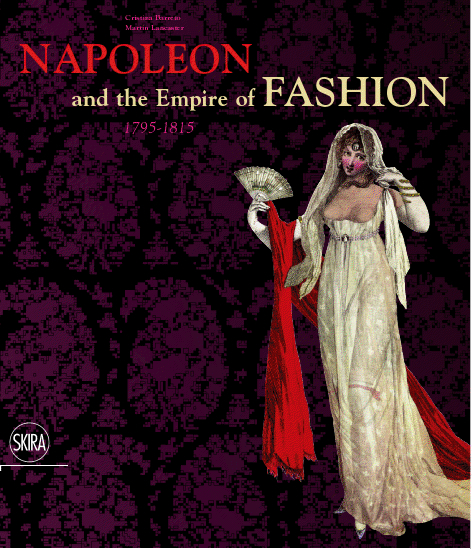
The lush fashion exhibition, Napoleon and the Empire of Fashion, closed in Milan in September. On the website, readers are still allowed to choose where they would like it to travel next!

The beautiful cameo necklace and earrings complete this evening ensemble.

The catalogue, written by Cristina Barreto and Martin Lancaster, is sumptuous and filled with color photographs. The clothes are compared to fashion illustrations of the day. One cannot get a better education of French fashion during this period than this book. This video and the link to the slide show below it show what we have missed by not traveling to Milan last spring and summer.

Napoleon’s desire to protect the garment industry in France after the French Revolution resulted in an explosion of designs that propelled the French fashion industry to the forefront, making it hugely influential. By encouraging women to purchase many gowns (so that they would not be seen in the same dress too often), France became synonymous with fashion. See the slide show of images from the exhibition by clicking on this link.

The many French fashions shown from the 1795-1810 years

Vote where you would like the exhibit to travel next. If the exhibit comes to New York, I hope to see the same mannequins. Aren’t they simply superb?

Napoleon and the Empire of Fashion in Milan

Order the catalog at Amazon: It ships within 1-3 months.

Read Full Post »

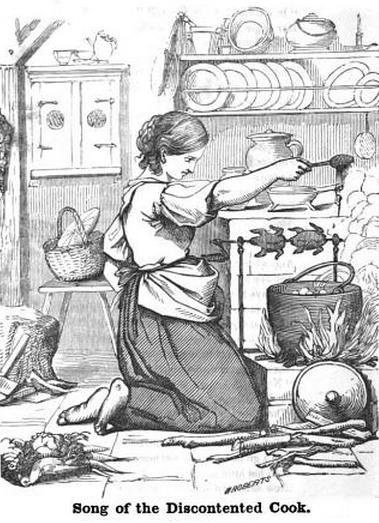
Gentle readers, this poem in a mid-19th century children’s family circle book perfectly describes the long and arduous day of an ordinary family cook.

The Discontented Cook. Image @Forrester's pictorial miscellany for the family circle edited by Mark Forrester, 1855

Oh, who would wish to be a cook,
To live in such a broil!

With all one’s pains, to cook one’s brains,
And lead a Life of toil?

“Tis, Stir the pudding, Peggy,
And give those ducks a turn;

Be quick, be quick, you lazy jade!
Else one or both will burn.

An hour before the rising sun
I’m forced to leave my bed,

To make the fires, and fry the cakes,

And get the table spread.
‘Tis, Stir the pudding, Peggy,

And give those ducks a turn;
Be quick, be quick, you lazy jade!

Else one or both will burn.

The breakfast’s scarely over,

And all things set to rights,
Before the savory haunch, or fowl,

My skill and care invites.
‘T is, Stir the pudding, Peggy,

And give those ducks a turn;
Be quick, be quick, you lazy jade!

Else one or both will burn.

And here I stand before the fire,

And turn them round and round;
And keep the kettle boiling —

I hate their very sound!
‘T is, Stir the pudding, Peggy,

And give those ducks a turn;
Be quick, be quick, you lazy jade!

Else one or both will burn.

And long before the day is spent,

I ‘m all in such a toast,
You scarce could tell which’s done the most

Myself, or what I roast!
‘Tis, Stir the pudding, Peggy,

And give those ducks a turn;
Be quick, be quick, you lazy jade’.

Else one or both will burn.

From Forrester’s Pictorial Miscellany for the Family Circle, 1855

Read Full Post »

« Newer Posts - Older Posts »