Feeds:
Posts
Comments

Archive for the ‘Regency Life’ Category

French paintings of ladies dressing and at their toilettes provide us with an insight of  how dressing rooms were once constructed and used. While we think of dressing as a private affair, William Hogarth demonstrates in his painting, Marriage à-la-mode: The Countess’s Morning Levee, how a woman of means with a large elaborate dressing room would entertain visitors while she was completing her toilette.

Image @Wikipedia

In reality, the toilette became a ritual in 18th century France for the very rich, one that had both intimate and public elements. A maid would groom and sponge bathe her lady in private, but then her mistress would devote hours to having her hair dressed, eating her breakfast from a tray, writing letters, entertaining friends, and picking the clothes she would wear for the day. The wealthier the woman, the more elaborate her morning ritual. As Hogarth showed, the custom of entertaining guests in one’s dressing room was also popular in England. In the image below, a shameless young lady is entertaining her spiritual adviser in her boudoir. His expression is priceless.

The Four Times of Day: Morning, Nicholas Lancret, 1739. Image@National Gallery, London

Wikipedia provides a history of the word “toilet”. The word did not have the same meaning back then as it does today.:

It originally referred to the toile, French for “cloth”, draped over a lady or gentleman’s shoulders while their hair was being dressed, and then (in both French and English) by extension to the various elements, and also the whole complex of operations of hairdressing and body care that centered at a dressing table, also covered by a cloth, on which stood a mirror and various brushes and containers for powder and make-up: this ensemble was also a toilette, as also was the period spent at the table, during which close friends or tradesmen were often received. The English poet Alexander Pope in The Rape of the Lock (1717) described the intricacies of a lady’s preparation:

“And now, unveil’d, the toilet stands display’d
Each silver vase in mystic order laid.”

These various senses are first recorded by the OED (Oxford English Dictionary) in rapid sequence in the later 17th century: the set of “articles required or used in dressing” 1662, the “action or process of dressing” 1681, the cloth on the table 1682, the cloth round the shoulders 1684, the table itself 1695, and the “reception of visitors by a lady during the concluding stages of her toilet” 1703 (also known as a “toilet-call”), but in the sense of a special room the earliest use is 1819, and this does not seem to include a lavatory.
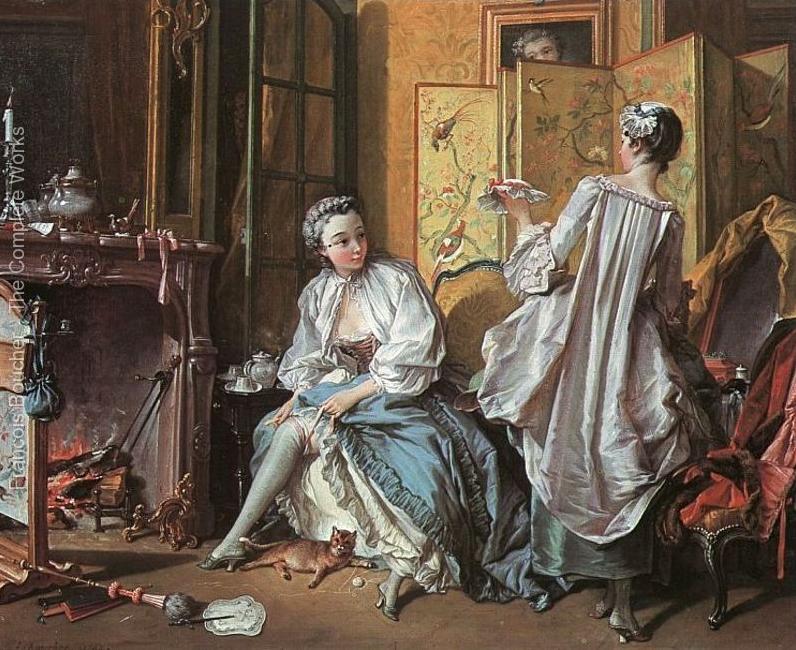
La Toilette, Boucher, 1742. Image@francoisboucher.org

Woman’s Fashions of the 18th Century fully describes the above painting by Boucher, in which the seated woman, probably a courtesan, is tying a garter over her stocking while wearing a short jacket to protect her outfit from particles of applied makeup and the powder on her wig. No visitors invade this intimate scene, which clearly shows a tray with refreshments and a decorative dressing screen behind the chair.

James Gillray portrays the progress of the toilet. Note the wash basin and water urn on the floor.

Women did use their dressing rooms at more intimate and private moments, when one presumed they would be alone. The washing of one’s face, feet and hands was a daily ritual, while bathing one’s entire body was not.  Such ablutions were done privately.  People would wash in basins. A portable hip bath would be placed in the dressing room if they decided to bathe completely.

Boilly, La Toilette Intime ou la Rose Effeuille. Image @Wikimedia Commons

While outhouses were common, the wealthy tended to use elaborate potty chairs (see image below). The French used bidets inside their dressing rooms, as shown in Boilly’s painting above. Invented by the French, their earliest recorded use was in 1710. If one wonders how women in elaborate costumes managed to go to the bathroom, this image by Boucher provides a glimpse. The handling of the bowl and upright posture was possible, for women during that era wore no underdrawers.

18th century Sheraton potty chair

Dressing rooms remained popular for a long time. In Can You Forgive Her?, Lady Glencora invites Alice Vavasor to have tea in her dressing-room, saying “You must be famished, I know. Then you can come down, or if you want to avoid two dressings you can sit over the fire up-stairs till dinner-time.” Alice follows Lady Glencora into the dressing-room, “and there found herself surrounded by an infinitude of feminine luxuries. The prettiest of tables were there;–the easiest of chairs;–the most costly of cabinets;–the quaintest of old china ornaments. It was bright with the gayest colours,–made pleasant to the eye with the binding of many books, having nymphs painted on the ceiling and little Cupids on the doors.” Lady Glencora goes on to explain, “I call it my dressing-room because in that way I can keep people out of it, but I have my brushes and soap in a little closet there, and my clothes,–my clothes are everywhere I suppose, only there are none of them here.”

Dressing room with chamber pot chair, 1765. Image@Morris Jumel House, Manhattan.

Anthony Trollope made an interesting point. During the 1860’s, when his novel was written, wealthy women changed their wardrobes more often for different functions during the day than Regency women. She invites Alice to linger in her dressing room, presumably to rest, read, and drink tea, rather than change into yet another set of clothes to join the company downstairs. Lady Glencora also indicates that the dressing room could also be a refuge away from visitors and prying eyes.

Jane Austen's bedroom. The closet with wash basin and potty sits to the left of the fireplace.

A wealthy couple might have two bedrooms (his and hers) with an adjoining sitting room. Each person would have their own dressing room. Simpler households did not have the luxury of such space. In Chawton Cottage, Jane Austen and her sister, Cassandra, shared one bedroom. Their potty and wash basin where stored in a closet.

Today’s walk in closets with adjoining bathroom most closely approximate the dressing room of yore, although people today do not tend to entertain their visitors in their closets.

Other posts on the topic:

Read Full Post »

Poor Miss Manners is always having to explains why Americans hold forks in their right hands as opposed to Europeans, who use their left hand to spear their food. Have American table manners deteriorated? Or are we following an historic tradition?

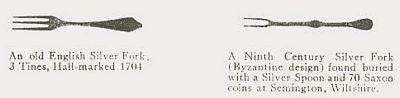
Image @Silver Collect Blog*

To answer that question we need to go back to ancient times when two-tined kitchen forks were used to help carve and serve meat. (We still require the assistance of large two-tined forks when barbecuing foods on a gas or coal grill.) In the 7th century the people in the Middle East began to use forks when dining, and by the 10th through the 11th centuries such usage had become quite common. The Italians were introduced to the fork in the 11th century.

One tale of the introduction of the fork to Western Europe credits Maria Argyropoulina, the Greek niece of Byzantine Emperor Basil II, who brought a case of golden forks to Venice in 1004, when she was to be married to the son of the Doge. She shocked guests at the wedding feast by using a fork, leading one priest to comment, “God in his wisdom has provided man with natural forks — his fingers. Therefore it is an insult to Him to substitute artificial metal forks for them when eating.” Italian clerics viewed it as God’s vengeance when Argyropoulina died of the plague two years later. – Early British Table Silver: A Short History

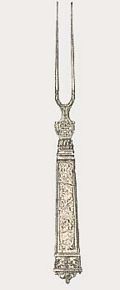
Image @Silver Collect Blog

It took 500 years for the implement to be used widely in that land. The French had their first look at the fork in 1533 when Catherine de Medici brought them from Italy upon the occasion of her marriage. The fork was at first thought to be an affectation, thus its adoption was slow, as it was in England after Thomas Coryate brought the implement back in 1608 from one of his travels to Italy. He observed that at their meals Italians  “use a little forks when they cut the meats.” Early table forks were small and two-pronged, but the sharp straight tines were unable to hold much food, inspiring mockery.  “Why should a person need a fork when God had given him hands?” one Englishman asked. (History of the Fork).  Ben Johnson satirized the fork in 1616 in The Devil is an Ass for “the sparing of napkins.”

One wonders how the Europeans ate their food without a fork. If you’ve ever attended a reproduction of a medieval banquet you have an idea. People used knives to spear food, spoons to scoop up, and fingers to grab. Only one implement was used at a time, and it was held in the right hand.

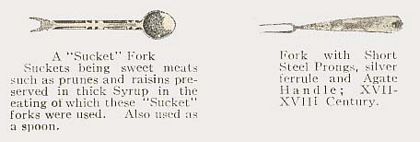
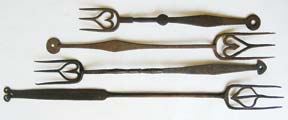
Slowly but surely the fork began to make inroads upon the dining table. As is the usual case, the wealthy began to adopt the new implement first. The upper crust began to impress their guests with forks made of expensive materials. Called suckett forks, they were used to protect the hands from sticky and messy foods or foods that stained the hands, like mulberries. By the mid 1600s, forks had become luxury items and were considered to be marks of fashion.   At the end of the 17th century and beginning of the 18th century the three-tined fork was introduced. The “sherbet course”, introduced in the early 1700’s, was created to wash the single fork for the next course.” (The History of the Fork)

Image @Silver Collect Blog*

Four-tined prongs became popular in the 1750s.  These tines were curved and served as a scoop, reducing the need for the spoon. By the time Jane Austen and her family had moved from Steventon to Bath, the four-tined fork was also being made in Germany and England and had traveled to the Americas. In the mid 19th century specialized forks were produced for every kind of food, including cakes and fish.

Table fork, 1771

This short history still does not explain why Americans and Europeans hold their forks in different hands. History Matters: Cutlery provides an insight:

Cardinal Richelieu of France supposedly was so disgusted by a frequent dinner guest’s habit of picking his teeth with his knife that he had the tips of the man’s knives ground down. The fashion-conscious French court picked up on this style and followed suit. In 1699, to reduce the risk of dinnertime knife fights, French King Louis XIV banned pointed knives outright. Since blunted knives were useless for spearing food in the old two-knife dining style, forks replaced the knife held in the left hand.

The newfangled blunt knives reached the American colonies in the early 1700s, where few forks were available. Americans were forced to use upside-down spoons to steady food for cutting. They would then switch the spoon to the right hand, flipping it to use as a scoop. Even after forks became everyday utensils, this “zigzag” style (as Emily Post called it in the 1920s) continues to divide American eaters’ customs from the Continental style of dining. (Shifting the fork to the right hand after cutting is considered uncouth by Europeans.) – (This passage seems to have used The Uncommon Origins of the Common Fork as its source.)

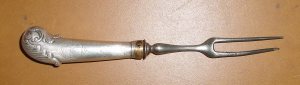
18th C. flesh forks for broiling meat

In a recent Washington Post advice column, Miss Manners contends that Americans follow the correct European way of eating centuries ago and that it was the Europeans who sped things up by keeping the fork in the left hand as they cut their food with the right hand. She concludes her advice with this thought:

Those who point out that the European manner is more efficient are right. Those who claim it is older or more sophisticated — etiquette has never considered getting food into the mouth faster a mark of refinement — are wrong. – Miss Manners: Fork’s History is not a big Mystery

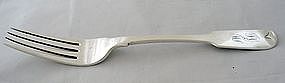
Silver serving fork, 1825

Read Full Post »

Gentle readers: I am on vacation at the shore. The hot weather has cooled and the crowded beaches are empty, except for a few bathers and the shore birds. Yet, somehow my Internet connection is spotty and my ability to add images is nil. So, here is a link to an article I wrote for Suite 101 over a year ago about Martha Gunn and John Smoaker Miles, famous sea dippers who helped men and women into the sea waters at Brighton.

Martha Gunn, dipper

Martha Gunn, dipper

In 1750, Dr Richard Russell wrote a dissertation advising his patients with glandular conditions to swim in the ocean and drink the iodine-rich sea water. The Prince of Wales, who first visited Brighton in 1783, began taking the sea cure for his swollen glands on his second and third visits. Brighton was a mere 6 hours by stagecoach from London, and where the prince went, the fashionable crowd followed. The town quickly became the seaside resort of choice for people seeking a pleasant diversion, or a cure for gout and other illnesses caused by rich food and lack of exercise, and a thriving industry devoted to bathing soon developed.

Bathers were drawn into the ocean inside bathing machines constructed of wood. Men and women were required to enter the water at specified times in different sections of the beach. The women used the beaches on the east side of town near the Brighton aquarium, while the men were diverted to the west end beaches. This custom ensured that the sexes could not view each other in revealing bathing costumes, or while swimming in the nude, a practice that the men followed often and the women more infrequently

Read more at: Sea Bathing in Georgian Brighton: Martha Gunn and John ‘Smoaker’ Miles

Other posts on this topic:
Martha Gunn, Brighton’s Queen of the Dippers|

Read Full Post »

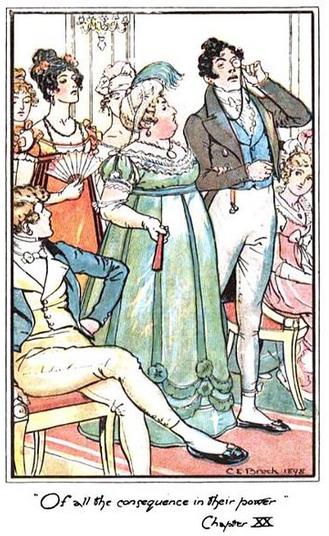
Dowager Viscountess Dalrymple makes an appearance with Sir Walter Elliot. Brock illustration.

“The Bath paper one morning announced the arrival of the Dowager Viscountess Dalrymple, and her daughter, the Honourable Miss Carteret. . . ” – Jane Austen, Persuasion

I have often wondered about dowagers and their status in Regency society in relation to widows. When did a widow become a dowager? Did all 19th century widows acquire the title? Why or why not?

Mirriam Webster Dictionary provides an answer : “Dowager – The widow of a peer, eg the Dowager Countess of Somewhere. The term was not added to a woman’s title unless and until the new holder of the title married.” The definition contains the clue. Until the new heir married, an aristocratic widow retained the title she acquired on the day of her own wedding.

Widows were legally entitled to a dower share or a third of the value of her husband’s estate after his death, for under the law of primogeniture he was the only real property owner. Dower rights meant that she would benefit for the rest of her life from a third of the income produced by a farm or from rental property on his estate:

“Under English common law and in colonial America, dower was the share of a deceased husband’s real estate to which his widow was entitled after his death. After the widow’s death, the real estate was then inherited as designated in her deceased husband’s will; she had no rights to sell or bequeath the property independently. She did have rights to income from the dower during her lifetime, including rents and including income from crops grown on the land.

One-third was the share of her late husband’s real property to which dower rights entitled her; the husband could increase the share beyond one-third in his will.

Where a mortgage or other debts offset the value of real estate and other property at the husband’s death, dower rights meant that the estate could not be settled and the property could not be sold until the widow’s death.” Women’s History 

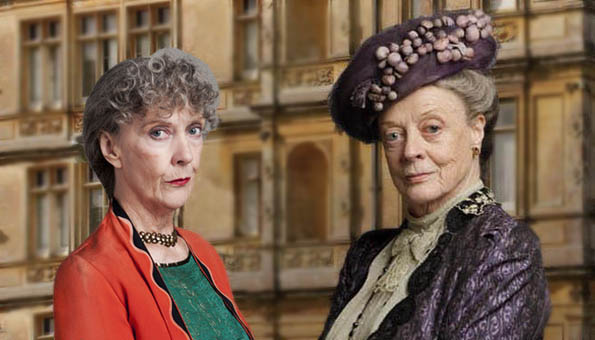
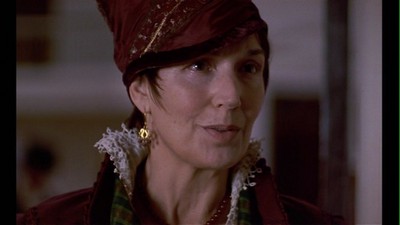
Dowager Maud, Lady Holland (Dame Eileen Atkins) and Violet, Dowager Countess of Grantham (Dame Maggie Smith) were able to live comfortably on 1/3 of the income of their husbands' estates.

Violet, the Dowager Countess of Grantham in Downton Abbey, would actively assume the title of dowager upon her son’s marriage so that there would be no confusion of having two Countesses of Grantham in the same room. But she did not always go by that title. Generally speaking the dowager would be known by the simplest title when encountered alone. Therefore, Violet would be referred to as the Countess of Grantham unless she attended the same event as her daughter -in-law. In that case, she would be referred to as the dowager countess.

Cora, Countess of Grantham

Upon the heir’s marriage, it was expected that the dowager would move from the estate into a house of her own to guarantee a smooth transition of power. This was not always the case. As Amanda Vickery made clear in her fascinating book, Behind Closed Doors: At Home in Georgian England, some brides needed to summon a great deal of patience and cunning when their mamas-in-law dragged their heels in moving to the dower house. In real life, the Dowager Duchess of Leinster chose to live at Number 14 Harley Street in London. She would leave town occasionally to stay in her cottage in Wimbledon. Eleanor Percy, the Dowager Duchess of Northumberland, was the childless widow of the 4th Duke. The dowager moved into Stanwick Park following her husband’s death in 1865, and after the 5th Duke had moved into Alnwick Castle, the ducal estate. Eleanor lived a productive life at Stanwick Park, creating elaborate gardens and cultivating fruits and flowers. Sadly, Stanwick Hall no longer stands today due to lack of fortune. – Stanwick Hall: England’s Lost Country Houses

Susan Fleetwood as Lady Russell in Persuasion

Widowhood could emancipate a woman or lead her to poverty, depending on the income she derived from her dower rights and her dowry, which was the money and goods that a bride’s father had negotiated for her upon her marriage. Take Lady Russell from Persuasion. She did not remarry again from choice. Her independent life, free from money worries, was so improved without the presence of a husband who could dictate her every move and who would have control over her possessions that she would be a fool to remarry unless she fell head over heels in love. In that event she would lose her first husband’s income as stipulated by dower rights, although she would retain her dowry and any property she received through her mother.

Mrs. Dashwood and her daughters await the arrival of her replacement as mistress of Norland.

In contrast to Lady Russell’s situation, Mrs. Dashwood’s circumstances in Sense and Sensibility were instantly reduced due to the stipulations of the estate her husband was overseeing, which decreed the inheritance would go directly to the son, regardless of how much Mr. Dashwood desired to make provisions for his second wife and daughters. This is why on his deathbed he tried to extract a promise from John Dashwood, for Mr. Dashwood had not lived long enough to save money from the income of the estate for his second family. Due to Fanny’s stinginess, Mrs. Dashwood and her daughters are left to live on the modest income from her dowry (which was barely enough to keep them comfortable) and the beautiful items that she had brought into her marriage (which she retained as her own, much to Fanny Dashwood’s chagrin).

An elopement to Gretna Green was a most foolhardy and risky step for a young heiress

The dowry was one of the reasons that it was more than foolhardy for a young woman of fortune to elope to Gretna Green. Upon marriage all her worldly goods were legally handed over to her husband. An unscrupulous man could spend every single one of her pennies – except the amount that her father had settled upon her. A young woman who eloped had no such protection, for her family, caught unawares, would not have had the time to provide for her personal welfare. Her husband could go through her fortune (and his) with impunity, leaving her penniless and without recourse after his death.

Read Full Post »

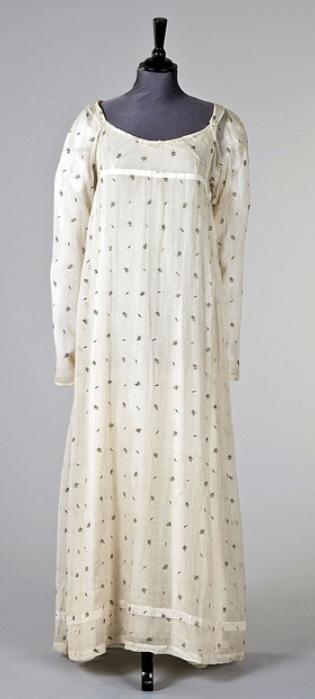
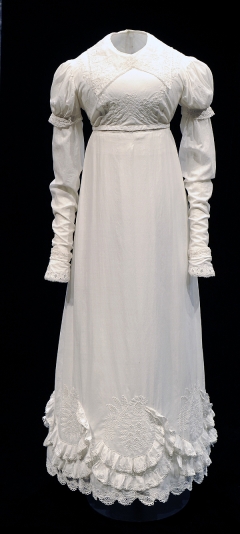
We’ve all come to associate Regency women’s fashion with delicate white muslin fabrics – sprigged muslin, spotted muslin,  checked and striped muslin, and embroidered muslin. Henry Tilney, the hero in Northanger Abbey, was well-acquainted with muslins through his sister, who wore only white.

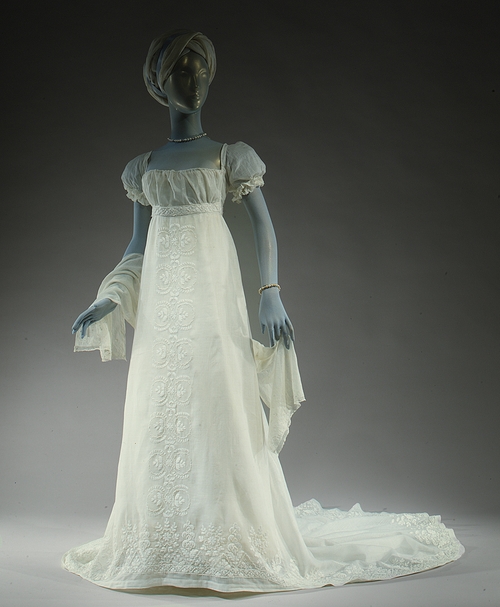
Sheer white muslin gown with whitework embroidery. Image @Vintage Textile

In the 17th century and until the late 18th century, England imported muslin, a thin cotton material, from India.  The British East India Company traded in Indian cotton, silk fabrics, and Dacca (Dhaka or modern-day Bangladesh) muslins. Muslins from Bengal, Bihar and Orissa were also imported. The delicate cloth, which first originated in the Middle East in the 9th century, was perfect for clothing and curtains in hot, arid countries. – Muslin: Encyclopedia Britannica

Muslin gown, 1816

Muslin was a finely woven light cotton fabric in plain weave without a pattern, and had identical warp and weft threads. The fabric selection is quite flexible, coming in a wide variety of weights and widths. It accepts dyes and paints so successfully that today it is often used for theatrical backdrops and photographic portraits. One observation must be made: muslins of the past were made of much finer, more delicate weave than today’s muslins. –  How Is Muslin Fabric Made?

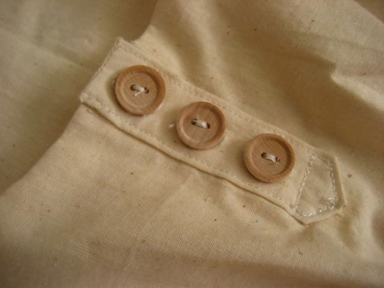
Buttons on a modern muslin fabric

Muslin gown circa 1815, Bath museum

An important feature of muslin fabrics is its ability to drape. Regency fashions were based on robes and garments from antiquity. The ability to drape and maneuver the fabric on the figure was an important feature of this cloth. Today, designers use muslin as a test garment for cutting and draping a design before creating the final dress from more expensive fabrics.

Another excellent feature of muslin is its ability to take dye, paints, and embroidery. The cloth accepted many patterns, motifs and designs that made it versatile and unique. Textile as Art

Plus the white fabric was a mark of gentility. White was difficult to keep clean or required constant cleaning. It was one thing for an aristocratic lady like Eleanor Tilney to wear white, but another for a maid to presume to wear such a high maintenance garment. Mrs Norris, that awful woman from Mansfield Park, approved of Mrs. Rushworth’s housekeeper’s action of turning away two housemaids for wearing white gowns.

Muslin evening dress. Image @Metropolitan Museum of Art

Embroidery transformed the simple white muslin gown into works of art. Whitework embroidery was particularly striking, but colored threads could be equally beautiful. The draping quality of the cloth lent itself well to columnar-shaped empire waist gowns.

Indian sprigged muslin gown, 1800. Image@Kelly Taylor Auctions Trouvais

Muslin was imported from the Far East for centuries. Then the weavers in west Scotland, who were proficient in spinning fine cottons such as linen, cambric, and lawn, began to pay attention to weaving a finer, more delicate cloth.

Sheer muslin gown, 1800. Image @Victoria & Albert Museum

Muslins, therefore (plain for the most part in Glasgow, and fancy ornamented in Paisley),were among the earliest and principal cotton fabrics produced on the looms of the west of Scotland. About the year 1780 James Monteith, the father of Henry Monteith, the founder of the great printworks at Barrowfield, and of the spinning and weaving mills at Blantyre, warped a muslin web, the first attempted in Scotland; and he set himself resolutely to try to imitate or excel the famous products of Dacca and other Indian muslin-producing centres. As the yarn which could then be produced was not fine enough for his purposes, he procured a quantity of “bird-nest” Indian yarn, “and employed James Dalziel to weave a 6-4th 12” book with a handshuttle, for which he paid him 2Id. per ell for weaving;. It is worthy of remark that the same kind of web is now wrought at 2|d. per ell The second web was wove with a-fly shuttle, which was the second used in Scotland. The Indian yarn was so difficult to wind that Christian Gray, wife of Robert Dougall, bellman, got 6s. 0 J. for winding each pound of it. When the web was finished Mr Monteith ordered a dress of it to be embroidered with gold, which had presented to Her Majesty Queen Charlotte.”1

1817 Muslin day dress. Image @Bowes Museum

Once fairly established, the muslin trade and various other cotton manufactures developed with extraordinary rapidity, and diverged into a great variety of products which were disposed of through equally numerous channels. Among the earliest staples, along with plain book muslins, came mulls, jacconets or nainsooks, and checked and striped muslins. Ginghams and pullicats formed an early and very important trade with the West Indian market, as well as for home consumption. These articles for a long period afforded the chief employment to the hand-loom weavers in the numerous villages around Glasgow and throughout the west of Scotland. The weaving of sprigged or spotted muslins and lappets was subsequently introduced, the latter not having been commenced till 1814. Although the weaving of ordinary grey calico for bleaching or printing purposes has always held .and still retains an important place among Glasgow cotton manufactures, it has never been a peculiar feature of the cotton industry; and the very extensive bleaching and print-works of the locality have always been supplied with a proportion of their material from the great cotton manufacturing districts of Lancashire. – p 501, The Encyclopaedia Britannica: a dictionary of arts, sciences, and general literature, Volume 6, Thomas Spencer Bayne, 1888.

Embroidered muslin round gown, 1795. Image @Cathy Decker

More on the topic:

Read Full Post »

« Newer Posts - Older Posts »