Feeds:
Posts
Comments

Archive for the ‘Regency Life’ Category

We’ve all come to associate Regency women’s fashion with delicate white muslin fabrics – sprigged muslin, spotted muslin,  checked and striped muslin, and embroidered muslin. Henry Tilney, the hero in Northanger Abbey, was well-acquainted with muslins through his sister, who wore only white.

Sheer white muslin gown with whitework embroidery. Image @Vintage Textile

In the 17th century and until the late 18th century, England imported muslin, a thin cotton material, from India.  The British East India Company traded in Indian cotton, silk fabrics, and Dacca (Dhaka or modern-day Bangladesh) muslins. Muslins from Bengal, Bihar and Orissa were also imported. The delicate cloth, which first originated in the Middle East in the 9th century, was perfect for clothing and curtains in hot, arid countries. – Muslin: Encyclopedia Britannica

Muslin gown, 1816

Muslin was a finely woven light cotton fabric in plain weave without a pattern, and had identical warp and weft threads. The fabric selection is quite flexible, coming in a wide variety of weights and widths. It accepts dyes and paints so successfully that today it is often used for theatrical backdrops and photographic portraits. One observation must be made: muslins of the past were made of much finer, more delicate weave than today’s muslins. –  How Is Muslin Fabric Made?

Buttons on a modern muslin fabric

Muslin gown circa 1815, Bath museum

An important feature of muslin fabrics is its ability to drape. Regency fashions were based on robes and garments from antiquity. The ability to drape and maneuver the fabric on the figure was an important feature of this cloth. Today, designers use muslin as a test garment for cutting and draping a design before creating the final dress from more expensive fabrics.

Another excellent feature of muslin is its ability to take dye, paints, and embroidery. The cloth accepted many patterns, motifs and designs that made it versatile and unique. Textile as Art

Plus the white fabric was a mark of gentility. White was difficult to keep clean or required constant cleaning. It was one thing for an aristocratic lady like Eleanor Tilney to wear white, but another for a maid to presume to wear such a high maintenance garment. Mrs Norris, that awful woman from Mansfield Park, approved of Mrs. Rushworth’s housekeeper’s action of turning away two housemaids for wearing white gowns.

Muslin evening dress. Image @Metropolitan Museum of Art

Embroidery transformed the simple white muslin gown into works of art. Whitework embroidery was particularly striking, but colored threads could be equally beautiful. The draping quality of the cloth lent itself well to columnar-shaped empire waist gowns.

Indian sprigged muslin gown, 1800. Image@Kelly Taylor Auctions Trouvais

Muslin was imported from the Far East for centuries. Then the weavers in west Scotland, who were proficient in spinning fine cottons such as linen, cambric, and lawn, began to pay attention to weaving a finer, more delicate cloth.

Sheer muslin gown, 1800. Image @Victoria & Albert Museum

Muslins, therefore (plain for the most part in Glasgow, and fancy ornamented in Paisley),were among the earliest and principal cotton fabrics produced on the looms of the west of Scotland. About the year 1780 James Monteith, the father of Henry Monteith, the founder of the great printworks at Barrowfield, and of the spinning and weaving mills at Blantyre, warped a muslin web, the first attempted in Scotland; and he set himself resolutely to try to imitate or excel the famous products of Dacca and other Indian muslin-producing centres. As the yarn which could then be produced was not fine enough for his purposes, he procured a quantity of “bird-nest” Indian yarn, “and employed James Dalziel to weave a 6-4th 12” book with a handshuttle, for which he paid him 2Id. per ell for weaving;. It is worthy of remark that the same kind of web is now wrought at 2|d. per ell The second web was wove with a-fly shuttle, which was the second used in Scotland. The Indian yarn was so difficult to wind that Christian Gray, wife of Robert Dougall, bellman, got 6s. 0 J. for winding each pound of it. When the web was finished Mr Monteith ordered a dress of it to be embroidered with gold, which had presented to Her Majesty Queen Charlotte.”1

1817 Muslin day dress. Image @Bowes Museum

Once fairly established, the muslin trade and various other cotton manufactures developed with extraordinary rapidity, and diverged into a great variety of products which were disposed of through equally numerous channels. Among the earliest staples, along with plain book muslins, came mulls, jacconets or nainsooks, and checked and striped muslins. Ginghams and pullicats formed an early and very important trade with the West Indian market, as well as for home consumption. These articles for a long period afforded the chief employment to the hand-loom weavers in the numerous villages around Glasgow and throughout the west of Scotland. The weaving of sprigged or spotted muslins and lappets was subsequently introduced, the latter not having been commenced till 1814. Although the weaving of ordinary grey calico for bleaching or printing purposes has always held .and still retains an important place among Glasgow cotton manufactures, it has never been a peculiar feature of the cotton industry; and the very extensive bleaching and print-works of the locality have always been supplied with a proportion of their material from the great cotton manufacturing districts of Lancashire. – p 501, The Encyclopaedia Britannica: a dictionary of arts, sciences, and general literature, Volume 6, Thomas Spencer Bayne, 1888.

Embroidered muslin round gown, 1795. Image @Cathy Decker

More on the topic:

Read Full Post »

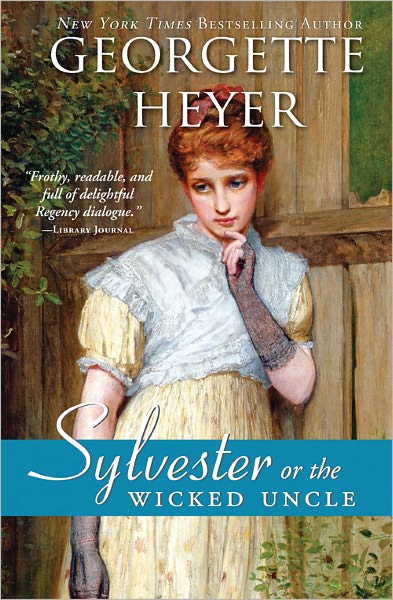
Gentle readers: Please leave a comment if you wish your name to be be eligible for a drawing of Sylvester, or the Wicked Uncle, a wonderful Regency romp by Georgette Heyer. The drawing will be held the moment electricity is restored in my house. My best estimate is that this will take another week. Only U.S. and Canadian residents are eligible. (So sorry, but the book is being sent by the publisher, who has requested this geographic restriction.) Update: Contest closed. Congratulations Rebeka! You have won a copy of Sylvester.

Sylvester, Duke of Salford thinks quite highly of himself and is pleased by his impeccable manners and easy smile, which easily influences servants to do his bidding. But Phoebe Marlow, whose mousy manner hides her bright mind and talents as an equestrienne and a writer, was not so impressed when she first met him during her coming out season. She is even less enthralled with the Duke when he arrives for a visit at her father’s estate to look her over as a possible bride.

Sylvester’s fond Mama also harbors concerns for her son, especially when Sylvester announces his intentions to marry and begins to discuss his preference for a bride with her:

‘But I’m inclined to think now that is is more important that she should be intelligent. I don’t think I could tolerate a hen-witted wife. ‘Besides I don’t mean to foist another fool on to you.’

‘I am very much obliged to you!’ she said, a good deal entertained. ‘Clever, but not beautiful: very well! Continue!’

‘No, somedegree of beauty I do demand. She must have countenance, at least, and the sort of elegance which you have, Mama.’

‘Don’t try to turn my head, you flatterer! Have you discovered among the debutantes one who is endowed with all these qualities?’

‘At first glance, I suppose a dozen, but in the end only five.’

‘Five!’

At this point Sylvester’s mama becomes concerned, for she realizes that he is choosing his life’s mate with his head, not his heart. The woman who immediately springs to her mind for her son is Phoebe Marlow, and so our cluelessly haughty (yet kind) Duke collides with the novel’s heroine, who is not in the least willing to spend any time with him, at least not until circumstances throw them together and she gets to know him better.

The plot revolves around Phoebe’s big SECRET: she has authored a book in which Sylvester, with his saturnine brows, is featured prominently as the villain. The more Phoebe gets to know Sylvester, the more she realizes how wrong she was about him and the more she worries about the book’s effect on their budding friendship (for Phoebe was uncannily accurate in her representation about certain aspects of Sylvester’s life).

Georgette Heyer takes us from the cozy settings of country mansions, to London in High Season, to Dover and over to France. A colorful array of her usual characters add liveliness to a somewhat improbable plot, including Phoebe’s good friend Tom, Sylvester’s dodo bird of a sister-in-law, Ianthe, and a supremely idiotic and over-indulged fop named Sir Nugent.

In my opinion, if you are a Georgette Heyer fan and haven’t read this book yet, you will be well advised to do so now. I give it four out of five Regency tea cups!

For a chance to win this book, leave a comment about your favorite Georgette Heyer book! Contest closed. The winner is: Rebeka!

Read Full Post »

I will be resurrecting old posts until electricity has been restored in my house. The power company promised that 95% of households will be online by Friday. In 2004, our tiny street did not receive full service until 13 days after the storm. Right now I am looking for a hot shower!!

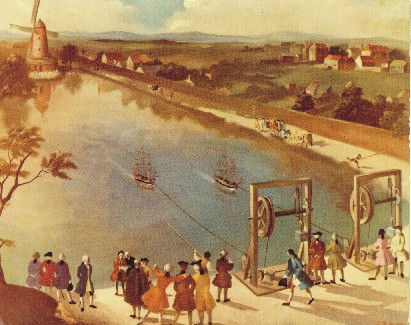
I published this post about the Peerless Pool two years ago. Perhaps my new readers might be interested in learning a few facts about a public swimming pool in London over 200 years ago. Click here to read the post.

Read Full Post »

August 16th marks Georgette Heyer’s birthday. In several comments on my book reviews some readers have made it a point to mention that Georgette is no Jane Austen and termed her novels mere romances. Ah, but they are so much more. I love her novels in part because they remind me vividly of the satirical prints that were so popular during Jane Austen’s day.  Observe the dandy at left in the print below, then read Georgette’s description of Sir Nugent!

Beside Sylvester’s quiet elegance and Major Newbury’s military cut she had been thinking that Sir Nugent presented all the appearance of a coxcomb. He was a tall man, rather willowy in build, by no means unhandsome, but so tightly laced-in at the waist, so exaggeratedly padded at the shoulders, that he looked a little ridiculous. From the striking hat set rakishly on his Corinthian crop (he had already divulged that it was the New Dash, and the latest hit of fashion) to his gleaming boots, everything he wore seemed to have been chosen for the purpose of making him conspicuous.  His extravagantly cut coat was embellished with very large and bright buttons; a glimpse of exotic colour hinted at a splended waistcoat beneath it; his breeches were of white corduroy; a diamond pin was stuck in the folds of his preposterous neckcloth; and he wore so many rings on his fingers, and so many fobs and seals dangling at his waist, that he might have been taken for a jeweller advertising his wares. – Georgette Heyer, Sylvester

Astley's Amphitheatre

Here is her passage about Astley’s Amphitheatre in Cotillion:

Though Meg might cry out against so unsophisticated an entertainment, Mr. Westruther knew Kitty well enough to be sure that she would revel in it. Had it been possible, he would unhesitatingly have taken her to Astley’s Amphitheartre, and would himself have derived a good deal of amusement, he thought, from watching her awe and delight at Grand Spectacles, and Equestrian Displays. But the Amphitheatre, like its rival, the Royal Circus, never opened until Easter Monday, by which time, Mr Westruther trusted, Kitty would have returned to Arnside.

Vauxhall Gardens, Samuel Wale, c. 1751

By way of whiling away the eveing Sherry escorted his bride to Vauxhall Gardens. Here they danced, supped in one of the booths on wafter-thin slices of ham, and rack-punch, and watched a display of fireworks. – Friday’s Child


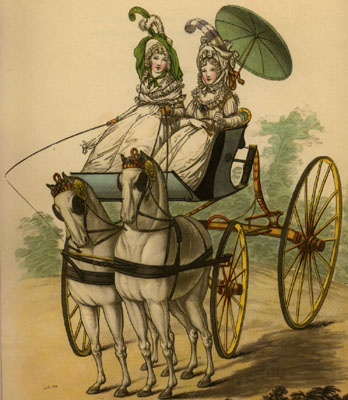
He complied with this request, backing the phaeton into place on the right of the landaulet, so that although the high perch of the phaeton made it impossible for his sister to shake hands with Frederica she was able to exchange greetings with her, and might have maintained a conversation had she not decided that to be obliged to talk to anyone sitting so far above her would soon give Frederica a stiff neck. – Frederica

A Kiss in the Kitchen, Thomas Rowlandson

‘But if she knew that you do not mind George’s having kissed me -‘

‘But I do mind!’ said Sherry, incensed.

‘Do you, Sherry?’ she asked wistfully.

‘Well, of course I do! A pretty sort of a fellow I should be if I did not!’

‘I won’t do it again,’ she promised.

‘You had better not, by Jupiter!’ – Friday’s Child

Time and again the zany plots and witty conversations in Georgette’s novels echo the Regency prints that I love to study. Yes, she is no Jane Austen, but as an interpreter of the Regency era, she is priceless.

As a birthday gift, please click on this link to read her short story, A Proposal to Cecily.

Read Full Post »

Two gentlemen shooting pheasant, 1790

When Sir Thomas Bertram returned from the East Indies, his family had been in the midst of rehearsing for Lovers Vows, the play that Fanny Price knew Sir Thomas would have nixed had he been home. Waiting for the tea tray, Lady Bertram innocently mentions the play. Tom, the heir, quickly deflects the conversation and speaks of hunting:

“The all will soon be told,” cried Tom hastily, and with affected unconcern; “but it is not worth while to bore my father with it now. You will hear enough of it tomorrow, sir. We have just been trying, by way of doing something, and amusing my mother, just within the last week, to get up a few scenes, a mere trifle. We have had such incessant rains almost since October began, that we have been nearly confined to the house for days together. I have hardly taken out a gun since the 3d. Tolerable sport the first three days, but there has been no attempting any thing since. The first day I went over Mansfield Wood, and Edmund took the copses beyond Easton, and we brought home six brace between us, and might each have killed six times as many; but we respect your pheasants, sir, I assure you, as much as you could desire. I do not think you will find your woods by any means worse stocked than they were. I never saw Mansfield Wood so full of pheasants in my life as this year. I hope you will take a day’s sport there yourself, sir, soon.” – Jane Austen, Mansfield Park

Hedgerows in the Cotswolds. Image @The Independent

The enclosure acts helped the pheasant hunters in England immensely, for enclosed lands were surrounded by hedgerows and wild thickets, which provided a nice cover for the birds.  A century earlier, the number of pheasants were in decline when woodlands were cleared and marshes were drained. Tough game laws were enacted in 1800 to preserve the number of pheasants. But with land enclosures the number of pheasants rose, for they preferred dead brush and weeds that were about knee high and that were situated near the edges of corn and grain fields. Pheasants were not native to England.

Pair of pheasants - a cock and hen

The Common Pheasant (Phasianus colchicus) was brought over by the Norman’s in the eleventh century and soon dispersed around the country, being introduced to parts of Wales, Scotland and Ireland in the late sixteenth century. By the early nineteenth century they had become the most important game bird.  – Birds of Britain 

Hunters benefited from the pheasants’ penchant for sticking to a regular feeding schedule and their habit of returning to an area where food was abundant. They would leave their nightly roost sites in the morning about two hours after sunrise and begin to exercise and move around in thick brush, dense patches of grasses, or standing cornfields. An hour after rising they could be seen foraging for food in the fields or picking at gravel or grit near roads. Nearly 90% of the pheasants would be searching for food at this time. Their unvarying schedules meant that hunters knew the precise time to set out to hunt the birds and where to find them. By mid-morning, pheasants would stop feeding and seek cover in thick brush or in trees until late afternoon. If the weather was particularly nasty, they would seek refuge in deeper cover, which explains Tom’s statement about the thick rain confining him to the house.

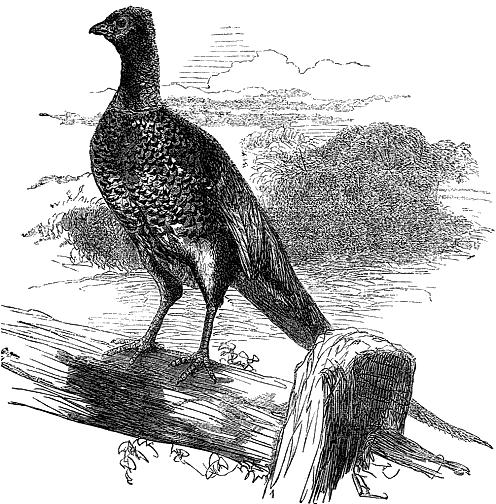
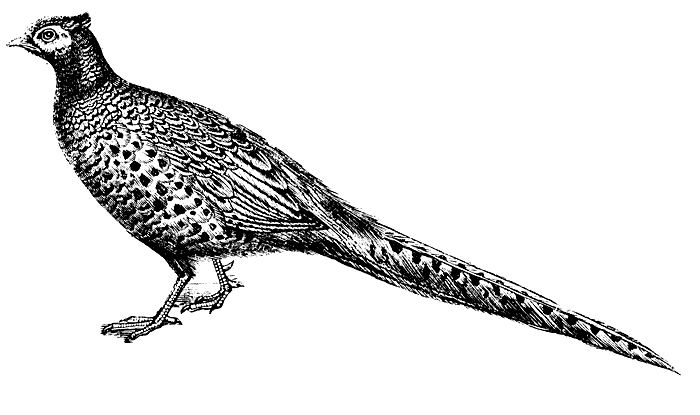
Pheasant. Image @Project Gutenberg

Pheasants that were hunkered down in large fields of standing corn were hard to hunt, for they ran through the brush to avoid their pursuers. Running is a pheasant’s preferred mode of flight, although they will burst dramatically into the air when startled with wings whirring, alerting their brethren with a kok-kok-kok call.

Detail, George Edward Lodge's Pheasants in Flight

A wily pheasant will not move, even when a dog’s nose is almost upon it. It’s color camouflages it so well in the brush that a hunter can walk right past it without ever noticing the bird. A good hunting dog will point at the pheasant, alerting its owner. And after the bird has burst into flight, will retrieve it where it fell. The oldest pheasant hunting dog breeds include Cocker Spaniels, English Setters and Pointers.

The whirring Pheasant springs,
And mounts, exulting on triumphant wings:
Ah! What avails his glossy, varying dyes,
His purple crest, and scarlet-circled eyes,
The vivid green his shining plumes unfold,
His painted wings, and breast that flames with gold.

Alexander Pope – Windsor Forest, 1713.

At mid-day, it was best for hunters to search for them resting  in their roosting placing of grassy stands and marches, and along edges of fields and ditch banks. They love to eat berries, seeds, grasses such as clover and alfafa, and insects. Pheasants eat almost any plant or animal food (grasshoppers, fly larvae, mosquitoes)  that is within reach and is abundant, although the largest percentage of their food consumption are vegetables, fruits, and grains. Their crops can contain as much as 19 grams to a whopping 50 grams of food. (Paul L. Dalke) The birds find the greatest variety of food in October. In June they graze largely on insects and grain.

Henry Thomas Alken, Pheasant Shooting

Much of their colors and size is of course influenced by their habitat and diet. The ones around cropfields tend to get larger in size and finer eating after feasting on corn, wheat, hops or other grains. Those around the woodland and wetlands make a living more on buds, berries, fruits, slugs and snails, worms and bugs, small animals like juvenile mice, snakes, lizards or even other little birds at times…- The Pheasant, Or Everyone’s Royal Bird

Hunting for pheasant occurred principally from November through January. (Just before the Upper Crust returned to London for the Season.) Locals guarded their best fowling grounds fiercely, even though game was still plentiful in England and Scotland during the 18th century. Hunters not only hunted for sport, but for food as well, so hunting had a practical nature.

Only landowners had the right to hunt. Poaching increased during times of famine and want, even though penalties were severe for poachers who were caught.

Catching a poacher, 1874. Image @Curious Sutton Crime

Only persons who met specified property qualifications, essentially gentlemen and the aristocracy, could legally hunt game (such as deer, rabbits, or pheasants). Anyone else hunting these animals, whether using nets, guns, or other animals, were committing a crime, even if they owned land upon which the game was found. Prosecutions under these statutes frequently occurred outside the courts, under summary jurisdiction, but some offences were made punishable by death under the “Black Act” (1723) and in the process brought within the jurisdiction of the Old Bailey. This Act made it a capital offence to hunt, wound, or steal deer, conies, hares, and fish in the King’s forests; break down the heads of fishponds; or simply go about armed and disguised anywhere game was kept. This act was repealed in 1823, but being armed and entering into enclosed land in order to remove game remained a crime throughout the period covered by the Proceedings  [or through 1913]. – The Proceedings of the Old Bailey

By late afternoon, around 4 hours before sunset, approximately 75% of the pheasants would return to their feeding areas. This was, obviously, another good time to go after them.

Nesting hen. Image @Game & Wildlife Conservation Trust

Hens nested on the ground; a cock might service as many as 6 mates. Although predation, hunting, and modern methods of agriculture have reduced wild thickets and roosting places, the bird is still quite successful at breeding. This tale from a book published in 1881 relates how stubbornly and persistently a hen will remain on her nest:

Although there is usually some attempt at concealment under covert, pheasants nests are not unfrequently placed even by perfectly wild birds in very exposed situations. Mr John Walton of Sholton Hall, Durham, related the following account of the singular tameness of a wild bred bird: A hen pheasant, a perfectly wild one so far as rearing is concerned, for we have no artificial processes here, selected as the site for her nest a hedge by a private cart road, where she was exposed to the constant traffic of carts farm servants and others passing and repassing her quarters, all of which she took with infinite composure. She was very soon discovered on her nest, and actually suffered herself when sitting to be stroked down her plumage by the children and others who visited her, and this without budging an inch. In fact, she seemed rather to like it. Perhaps she became a pet with the neighbours from this unusual docility, and her brood, fourteen in number, was thereby saved, for every egg was hatched, and the young birds have all got safely away. – Pheasants: Their Natural History and Practical Management

Brace of pheasants on a bank, James Hardy Jr., 19th c. Image @Christie's

In Mansfield Park, Tom mentioned returning with six brace of pheasants, which translated to six males and six females. (A pair made a brace.) Tom’s number approximates the average number of pheasants for a typical hunter, although there were spectacular exceptions:

I wonder if pheasants sat at the right hand of God along with the other game he shot in untold numbers, in judgment of Lord Ripon, known as the Best Game Shot in England.

His majesty King George V of Great Britain, a keen and avid bird shooter as world has ever seen, in 1913 has claimed over a thousand pheasants in one day, out of a total bag of 3937 in much less than a weeks worth of personal shooting. The numbers are well documented and strict records are still kept by the reputed British gamekeepers. Another grand English shooter, Lord Rippon, had bird tallies surpassing anything mankind has ever seen since: he layed claim in his gamekeeping books for almost a quarter million pheasants, shot by himself. His records tell he dispatched 222,976 pheasants in his long shooting career, between 1867 and 1913, with an average of 4774 pheasants per season. – The Pheasant, Or Everyone’s Royal Bird

Sir Thomas Elyot best described in 1536 why pheasants were a favorite game bird – because they tasted so good in the pot!

‘Fesaunt excedeth all fowles in sweetnesse and holsomnesse, and is equall to capon in nourishynge…’

Andrew Davies likes to show Jane Austen's heroes in masculine pursuits. Colonel Brandon (David Morrissey) is in hunting garb (Sense and Sensibility 2008). I can't quite make out the game birds, but it looks like he's carrying 3 braces.

More on the Topic

Engraving, Pheasant.

Read Full Post »

« Newer Posts - Older Posts »