Feeds:
Posts
Comments

Archive for the ‘Regency Life’ Category

Jane Austen’s mother, Cassandra’s

features were aristocratic; her hair was dark and her eyes an unusual tint of grey. She had an instinctive tendency to depreciate her own appearance; it was her elder sister Jane, she always insisted, who was the beauty of the family. But Cassandra did admit to a certain vanity concerning her fine patrician blade of a nose.” – Jane Austen, a family record by Deirdre Le Faye, William Austen-Leigh

However, by 1782, when her daughter Jane was only 7 years old, she was described as having lost several foreteeth, which made her look old.
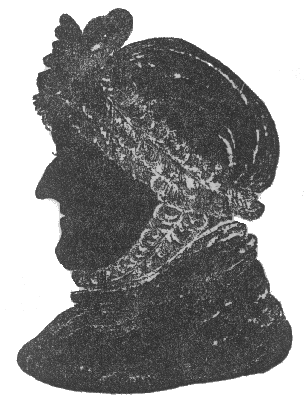
Cassandra Leigh Austen, Jane Austen's mother, with her patrician nose and missing foreteeth

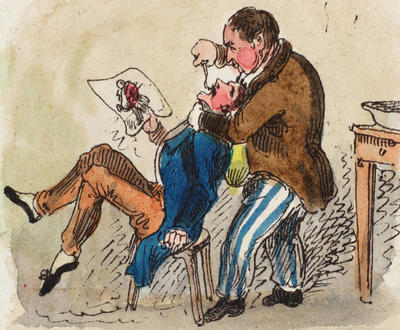
Modern dentistry was still in its infancy when Cassandra Austen gave birth to her eight children. While the wealthy could afford dentists, rural folks still depended on the village blacksmith, who only knew how to pull teeth. Market fairs sold tinctures, toothpowders and abrasive dentifrices.

Lucy Baggott, of Wychwood Books, says: ‘It was not uncommon for the local farrier to draw teeth to relieve toothache of those in desperate pain, for then the blacksmith in many rural communities doubled as a tooth drawer. ‘There were many dubious practices adopted: hot coals, string, forceps, and pliers to name a few. Children were lured to sacrifice their teeth for the supposed benefit of the wealthy in exchange for only a few shillings. One print reads: “Most money given for live teeth”. – Dental Quackery Captured in Print
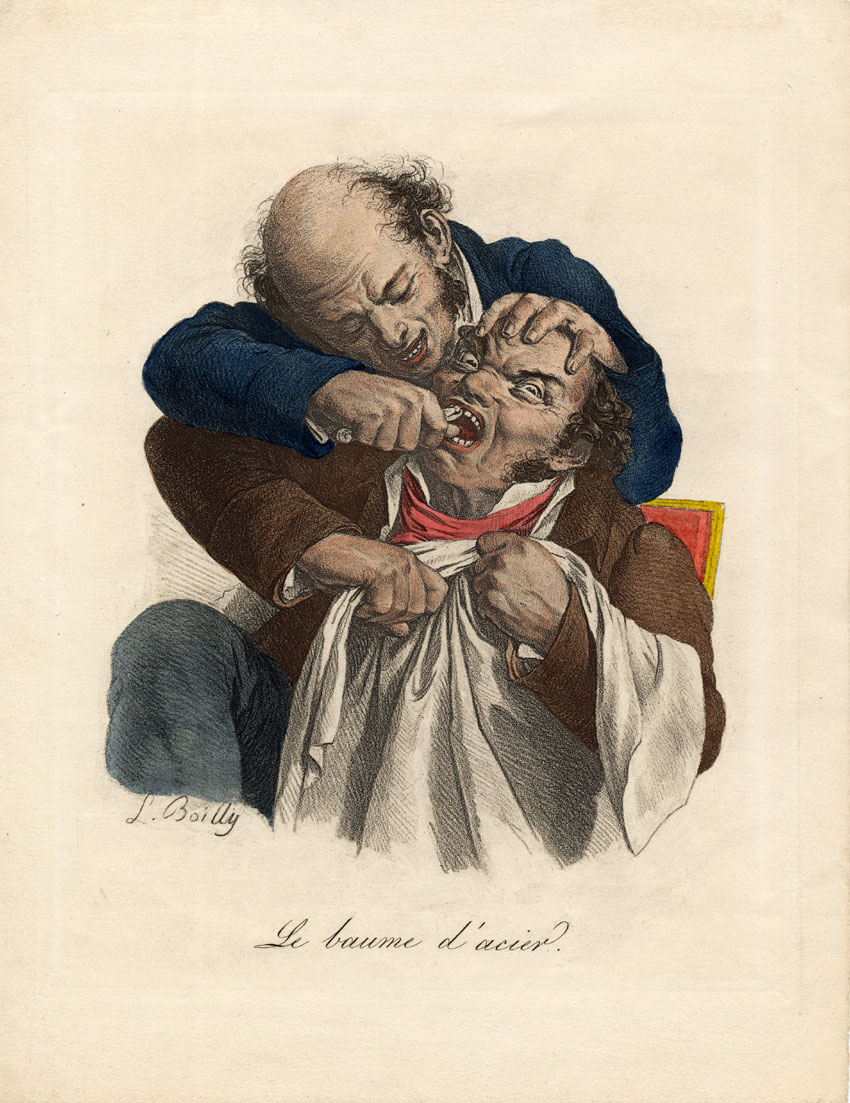
Louis-Leopold Boilly (1761-1845), Dentist Teeth Patient, 1827

We do know this: tooth extraction was painful and a most unpleasant affair before the age of ether and anesthetics.

In two letters to Cassandra, on Wednesday 15 & Thursday 16 September 1813, Jane [Austen] describes in some detail accompanying her young nieces Lizzy, Marianne and Fanny, on a visit to the London dentist Mr Spence. It was, she relates, ‘a sad business, and cost us many tears’. They attended Mr Spence twice on the Wednesday, and to their consternation had to return on the following day for yet another ‘disagreeable hour’ . Mr Spence remonstrates strongly over Lizzy’s teeth, cleaning and filing them and filling the ‘very sad hole’ between two of the front ones. But it is Marianne who suffers most: she is obliged to have two teeth extracted to make room for others to grow. – The Poor Girls and Their Teeth, A Visit to the Dentist, JASA

Tooth maintenance and dental hygiene were not a new concept. The aristocrats suffered more cavities, for they could afford sweets and foods that would eat into enamel, but they did use tooth powders, tooth picks, and toothbrushes to keep their teeth clean.

The ancient Chinese made toothbrushes with bristles from the necks of cold climate pigs. French dentists were the first Europeans to promote the use of toothbrushes in the seventeenth and early eighteenth centuries. William Addis of Clerkenwald, England, created the first mass-produced toothbrush. Toothpaste: modern toothpastes were developed in the 1800s. In 1824, a dentist named Peabody was the first person to add soap to toothpaste. John Harris first added chalk as an ingredient to toothpaste in the 1850s.- History of Dentistry

Isaac Cruikshank

The caption to the above cartoon states: Dentist. 18th century caricature of a fat dentist with his struggling, overweight female patient. The patient is begging the dentist not to pluck her teeth out like he would the feathers of a pigeon. People who eat large amounts of sugary food are often both overweight and suffer from dental decay. Image drawn in 1797 by British artist Isaac Cruikshank (1756-1811). – Science Photo Library

Tooth Extraction, William Henry Bunbury, mid-18th century

Extractions were by forceps or commonly keys, rather like a door key…When rotated it gripped the tooth tightly. This extracted the tooth – and usually gum and bone with it…Sometimes the jaws were also broken during an extraction by untrained people.”- BBC
A timeline of dentistry in the 18th and 19th centuries:

1780 – William Addis manufactured the first modern toothbrush. 1789 – Frenchman Nicolas Dubois de Chemant receives the first patent for porcelain teeth. 1790 – John Greenwood, one of George Washington’s dentists, constructs the first known dental foot engine. He adapts his mother’s foot treadle spinning wheel to rotate a drill. 1790 – Josiah Flagg, a prominent American dentist, constructs the first chair made specifically for dental patients. To a wooden Windsor chair, Flagg attaches an adjustable headrest, plus an arm extension to hold instruments. 19th Century 1801 – Richard C. Skinner writes the Treatise on the Human Teeth, the first dental book published in America. 1820 – Claudius Ash established his dental manufacturing company in London. 1825 – Samuel Stockton begins commercial manufacture of porcelain teeth. His S.S. White Dental Manufacturing Company establishes and dominates the dental supply market throughout the 19th century. – Nambibian Dental Association

Annotation of the above cartoon by Thomas Rowlandson:

This print is by Thomas Rowlandson (1756-1827) and is dated 1787. It is a satirical comment upon the real practice of rich gentlemen and ladies of the 18th century paying for teeth to be pulled from poor children and transplanted in their gums. The dentist present is portrayed as a quack. There are even two quacking ducks on the placard advertising his fake credentials. He is busy pulling teeth from the mouth of a poor young chimney sweep. Covered in soot and exhausted, he slumps in a chair. Meanwhile the dentist’s assistant transplants a tooth into a fashionably dressed young lady’s mouth. Two children can be seen leaving the room clutching their faces and obviously in pain from having their teeth extracted. As people lost most of their teeth by age 21 due to gum disease, teeth transplants were popular for some time in England although they rarely worked. – Wellcome Images

Thomas Rowlandson – A French dentist showing a specimen of his artificial teeth and false palates Coloured engraving 1811 Image @ Rowlandson, Wellcome Library

Dentures did exist:

Perhaps the most famous false-toothed American was the first president, George Washington. Popular history gave Mr. Washington wooden teeth, though this was not the case. In fact, wooden teeth are impossible; the corrosive effects of saliva would have turned them into mushy pulp before long. As a matter of fact, the first president’s false teeth came from a variety of sources, including teeth extracted from human and animal corpses. – A Short History of Dentistry

Carved ivory upper denture, late 18th century. Image @Skinner Auctioneers

As always, the upper classes had the upper hand:

The upper classes could afford a greater range of treatments, including artificial teeth (highly sought after by the sugar- consuming wealthy). Ivory dentures were popular into the 18th century, and were made from natural materials including walrus, elephant or hippopotamus ivory. Human teeth or ‘Waterloo teeth’ -sourced from battlefields or graveyards- were riveted into the base. These ill fitting and uncomfortable ivory dentures were replaced by porcelain dentures, introduced in the 1790’s. These were not successful due to their bright colours, and tendency to crack.Before the 1800’s, the practice of dentistry was still a long way from achieving professional status. This was to change in the 19th century – the most significant period in the history of dentistry to date. By 1800 there were still relatively few ‘dentists’ practicing the profession. By the middle of the 19th century the number of practicing dentists had increased markedly, although there was no legal or professional control to prevent malpractice and incompetence. Pressure for reform of the profession increased. – Thomas Rowlandson, “Transplanting Teeth (c.1790) [Engraving],” in Children and Youth in History, Item #164, http://chnm.gmu.edu/cyh/primary-sources/164 (accessed August 10, 2011). Annotated by Lynda Payne

More on This Topic:

Read Full Post »

The script in Thomas Rowlandson’s 1810 cartoon states:

“Ah! My old Friend I wish you had called
at some more convenient time but this is washing
day — I have nothing to give you but cold Fish, cold Tripe
& cold potatoes — you smell soap suds a mile!
Ah Jack, Jack you don’t know these Comforts!
you are a Bachelor!”

In Rowlandson’s image, two well fed men are seen smiling. The host is apologetic, for his guest will not get anything but cold collations, probably leftovers from the previous day. His wife and maid are seen toiling over a bucket, their hands probably raw and red from the effects of harsh lye soap. Neither of them will have the time to look to his comforts or make a hot meal, which is why he is apologizing to his unexpected guest. Since laundering was not considered man’s work, he had to “suffer” the lack of his wife’s and servant’s attentions until the wash was done.

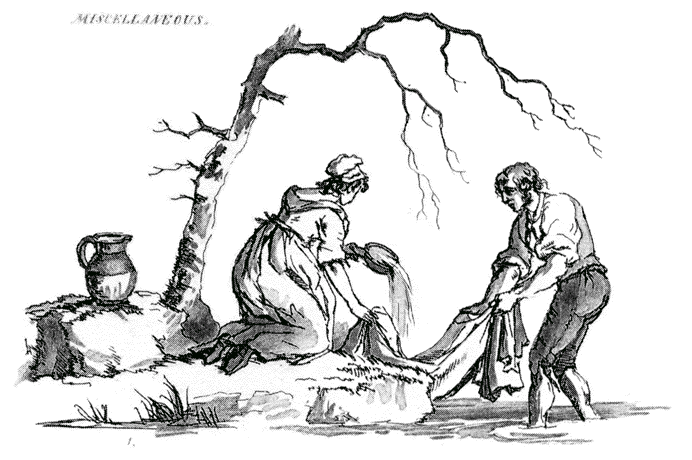
Doing the wash in a stream, 1806

First Boyle all the Cloaths with soap, and then wash them..” – John Harrower, indentured servant, writing to his wife (June 14, 1774)

Doing the wash in the Regency era was no small task, and housewives had to set aside two days to perform this dreaded duty, for it meant hauling water, boiling the cottons and linens, washing them with pungent lye soap, which burnt the skin, rinsing the clothes in clean water, which meant hauling more water from the well or a nearby stream, twisting the cloths to remove as much water as possible, hanging the clothes to dry, and then praying that rain would stay away long enough for the sun to perform its duty as a dryer. If one had to do laundry in a town or city, one had to pray that coal soot would not drift upon the clean clothes in a cramped back yard before they dried.

The Victorian scullery in a fine household included a copper for boiling water, a wringer, press, and ironing board.

Doing laundry was so enormous an undertaking, that unless the household were of a great size and boasted many servants, the mistress of the house and her daughters would frequently pitch in with the servants. There were chemises to be laundered, bed and table linens, towels, shirts, muslin dresses, handkerchiefs, socks, and the like. First the clothes would have to be treated for stains, the muslins and silks most delicately. After the wash had dried, ironing would commence, another laborious task.

Drying damp clothes over chair backs in front of a fireplace. Elizabeth Bennet and Mrs. Gardiner at the Lambton Inn, Pride and Prejudice, 1980

Chemises and shirts, which were worn next to the skin, were purposefully made with sturdier cloth so that these inner garments could withstand rougher treatment and more frequent washing. People tended to own more under garments for this reason. Outer clothes were subject to less frequent laundering because they were made of finer stuff, though one must wonder at the cleanliness of trailing hems, the edges of collars and sleeves, and armpits in the days before daily baths became popular, when air conditioning was just a distant dream, and when sweat must have stained clothes in a most visible manner. Is it no wonder that a majority of the Regency fashions that have survived to this day belonged to the rich, who probably wore their fashionable outfits once or twice before purchasing others?

 For more on the topic:

Read Full Post »

I am at a conference for the rest of the week. Workshops begin at 8:30 AM. Working backwards, this means I must be up by 5 AM to get washed and dressed, eat breakfast, drive to the training site, set up the workshop room, and be ready to greet participants (without a bleary eye) by 8:15 AM.

Upon reading my statements, early morning risers will think, “What’s so strange about that?” But for those of us who were meant to keep Regency hours, this schedule is akin to torture. I would much have preferred Jane Austen’s hours.

How the English during the Regency era spent their mornings depended on their status. The schedule of the modern day trainer or worker is, in fact, one that a servant in the 19th century would have kept, rising at dawn to haul and boil water, stoke the fires, and get the house in shape before the gentry arose. Unlike  19th century  servants, modern day folks generally eat breakfast before the workday begins. Servants, who had been toiling for at least 3-4 hours making the house ready for the day and tending to the family’s needs, would not break their fast until after the family’s breakfast dishes had been cleared and rinsed.

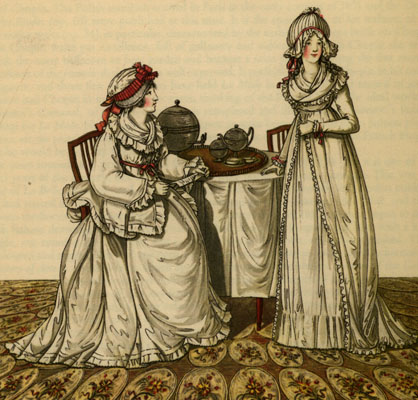
Ladies in their morning gowns at breakfast. Heideloff, 1794. Image @Fashion Gallery

Mrs. Bennet or Mr. Knightley, both country gentlemen, would rise earlier than their city counterparts, who kept later more fashionable hours. Upon rising at 7 AM, Jane Austen, for example, would not immediately sit down to breakfast. She would write letters or practice on the piano, walk in the garden to pick flowers, or even go into the village to run a short errand before sitting down with her family at 9 AM to partake of a simple breakfast consisting of rolls, breads, butter, preserves, and tea or a pot of hot chocolate. If she were on vacation or at the seaside, she might take a leisurely stroll to the beach or point of interest before partaking of the morning meal at an inn.

Mr. Darcy and Miss Bingley interrupted at breakfast, Pride and Prejudice 2005

Lady Bertram, whose day revolved around pleasing herself, would in all likelihood arise from her bed much later than Jane and remain in her dressing room with her maid until she was suitably dressed. Before breakfast, she would also consult with her housekeeper about the household plans for the day, giving her instructions to relay to the cook about the day’s meals. She might write letters in her boudoir and emerge in her morning gown and cap to eat breakfast with her family, or perhaps have it sent to her rooms on a tray.

Sir Thomas Bertram or Mr. Knightley would also delay breakfast. They might consult with their bailiffs, or check out a new horse at the stable before consuming their morning meal. General Tilney stuck to a strict schedule and had the family eat breakfast at nine. The Middletons, whose house was always filled with guests, ate breakfast at Barton Park around 10 AM. Some families sat down together, while others strolled in during a certain set time, say between 10 and 11 AM let’s say, to help themselves from dishes placed on a sideboard. One imagines that the Tilneys observed the former practice, whereas Mr. Bingley and the Middletons allowed people to wander into the breakfast room at their own pleasure. Edward Austen Knight, Jane’s rich brother, had breakfast served at 10 AM, and expected the entire family to be at the table.

By 11:30 AM, breakfast service was generally over. Town times were much different, and meals were served at a later, more fashionable hour. Often the very fashionable would stick to those hours even when in the country. Lizzie Bennet walked 3 miles to Netherfield Park after breakfast to be with her sick sister, Jane, only to encounter Mr. Bingley’s town guests just sitting down to breakfast over an hour later.

Regency family eating a meal together

The Regency definition of morning differed vastly from ours. Visiting hours were kept at set times. A family might receive visitors on Tuesdays and Thursdays, for example, or on Wednesday, between 11 AM to 3 PM. These hours were considered morning hours. When Anne Elliot arrived at Uppercross Cottage at 1:00 PM, she considered the time to be early in the morning.

Regency ladies wore morning gowns when they were at home. If a lady had no plans to go visiting or receive visitors, and simply stayed at home, she would wear her morning gown well past the hour of three, not bothering to change until dinner, when she was expected to dress more formally. Morning gowns could be made of simple dimity gowns covered by a pinafore if the lady, like Elinor Dashwood or Cassandra Austen at Chawton Cottage, was working in the kitchen or garden, or the gown could be made of finer stuff, like a delicate muslin. Ladies in morning gowns could be seen by family and guests, but they would never dare set foot in public while wearing one.

I must admit to liking Regency hours. On the weekends or on vacations, I rise late and will lounge for hours in my study/dressing room, reading or writing for my blog while sipping coffee. I’ll throw on some clothes and walk my dog Cody, and afterwards will make breakfast. I’ll then hang around the house in my ratty lounge wear, doing a little of this and a little of that, before donning more respectable garments to receive visitors, go out and shop, or visit with friends and family. If I am home all day, I’ll stay in my frayed jeans and tee shirt.

Would that my daily schedule resembled my weekend schedule! But, alas, I must work to earn my dog’s kibbles. The clock tells me I must get dressed now and be out of the door in half an hour. The powers that be decreed that our work day starts anywhere between 7 and 9 AM (even earlier for many). Obviously, considering those hours, our bosses view us more as servants than as revered guests.

I, for one, was meant to be a lady of leisure. Perhaps I shall be reincarnated as one?

More on the topic:

Sources:
Wilson, Kim. Tea With Jane Austen. Frances Lincoln LTD, ISBN: 9780711231894
Le Faye, Deirdre. Jane Austen: The World of her novels, Frances Lincoldn LTD, ISBN: 9780711222786

Read Full Post »

Today almost everywhere we turn we are inundated with ads over television and radio, in film theatres, on billboards and our computers, and magazines and store fronts. We simply cannot escape the messages put out by individuals and businesses trying to get us to buy their products and services.

W. H. Pyne, Bill sticker

The situation was the same in Jane Austen’s day. When shoppers walked to a shopping area in a city the streets would be indundated with shop signs, hired walkers wearing advertising boards, and hawkers. Advertising merchants dealt in trades that are both familiar and unfamiliar to us today: silversmiths, coal dealers, shoemakers, scum boilers, boarding houses, brewers, tavern keepers, silk merchants, coffee houses, cabinet makers, bakers, mattress makers, curriers and dealers in grindery, warper, hair dressers, woollen drapers and dealers in trimmings, victuallers, livery stable keepers, grocers, music sellers, linen drapers, beer sellers, dealer in rags, tripeman, tobacconist – well, the list goes on.

This is a raucous street scene in London at night in which the shop signs hanging over the pedestrians seem almost ominous. (Notice the slop being poured out of the window!)

There were leaflets, handbills, posters on bricks walls and glass windows seemingly almost everywhere, and advertisements in newspapers … and of course the inevitable street criers.

The bell and cry of the muffin man

Bill stickers, or external paper hangers plastered blank walls, empty shops and wooden hoards and fences with advertisement bills. But these activities were taxed. And thus enterprising merchants turned to mobile advertising and paid people to wear sandwich boards and hand carry placards. – London Street Advertising

Walking billboards in the 18th century. The young boy is wearing a sandwich board!

Extensive improvements on the printing press meant that newspapers and printed products could be churned out swiftly and more efficiently than before. Bills and posters were printed speedily and cheaply. There were frequent misspelling of words, and if more than one color was used, a frequent misplaced overlay of one color over the other. Printed ads and posters were designed to promote an event or sale, and were meant to be discarded. Bills plastered on walls and fences would soon be covered over by newer announcements.

The apothecary's newspaper advertisement mentioned all the diseases he can cure

Newspapers and advertisers focused on products that appealed to a mass market. They generally targeted themselves to the middle and upper-middle classes. By the mid-eighteenth century, the variety of ads began to increase. Ladies’ fashions as well as silver, brass, and copper items became subjects of advertisements.” – Place an Advertisement

Shop bill from the frock shop. Image @The Works of William Hogarth, 1821

Trade cards were another way that merchants informed the public about their wares. These cards came with a combination of image and text, which provided information about the location, goods and services of an establishment or business. – Eighteenth Century Centre

Wm. Neate goldsmith & jeweller trading card. Image @Bodleian Library

More on the topic:

Read Full Post »

A heatwave has us hiding inside air-conditioned rooms this week. As I gazed at a hideously yellow sky and glowering orange sun last evening, I wondered how people survived 100 degree plus days 200 years ago? They mostly suffered, I imagine! But there were ways they could deal with extreme heat.

Regency fans could be beautiful or plain. All served to move air and cool the user.

Ceilings were higher, so the heated air had a place to rise, and walls were thicker, which kept rooms and basements cooler for longer. Hand held fans were popular, and one source I found said that gentlemen would sport them as well. The rich had mechanisms in the tropics whereby ceiling fans were rotated by strings and pulled by slaves or servants.

Carnfunnock ice house

Big blocks of glacier ice or blocks of ice cut from frozen rivers were hauled up river by ship into the countryside, covered in straw and burlap, and stored in ice houses that were dug into hillsides or were largely underground.

Cutting and hauling river ice. This image is from St. Petersburg, Russia, but the custom of cutting and transporting ice was widespread.

Ice cream was available to those who could afford it in such places a Gunther’s or made at home by the cook.

John Bull and his family at an ice cafe, 1815. Image@Newcastle University

The rich would move back to their country estates for the summer, escaping the stifling heat (and smells) in the city, but ordinary people had to adjust. This morning it was announced that over 2 dozen deaths had been attributed to this latest heatwave, which covers 2/3 of the U.S. I wonder back then how many people died from the effects of such extreme weather?

Regency gentlemen at a country house. Note that they are wearing light clothes without jackets. Sitting under a gazebo, they have pitchers of water at hand. One must pity the footmen in full uniform and wig! Image@Regency House Party

Read Full Post »

« Newer Posts - Older Posts »