Feeds:
Posts
Comments

Archive for the ‘Regency Life’ Category

Inquiring readers: Recently I ran across the Contracts Prof Blog, a member of the Blog Professor Blogs network. Professor Franklin G. Snyder kindly granted me permission to reprint in full the post contributed by Professor Jeremy Telman of Valparaiso University on March 18, 2010. Professor Telman discusses a promise made in Chapter 22 of Persuasion:

Cassandra Austen's watercolor of her sister Jane, c. 1810. Image at the National Portrait Gallery, London

Promise and Contract: Jane Austen’s Take

While thinking about the problems relating to promise and contract explored by Michael Pratt, I came across this scene from Chapter 22 of Jane Austen’s Persuasion. The setting, of course, is Bath. The characters are Charles Musgrove and his wife, Mary, the pathetic, self-pitying and miserable sister of Jane Austen’s protagonist, Anne Elliot. Charles has just announced, with something like triumph, that he had procured tickets for them all to go to the theater the following evening. His wife interrupts him:

Good heavens, Charles! how can you think of such a thing? Take a box for to-morrow night! Have you forgot that we are engaged to Camden Place to-morrow night? and that we were most particularly asked to meet Lady Dalrymple and her daughter, and Mr Elliot, and all the principal family connexions, on purpose to be introduced to them? How can you be so forgetful?”

“Phoo! phoo!” replied Charles, “what’s an evening party? Never worth remembering. Your father might have asked us to dinner, I think, if he had wanted to see us. You may do as you like, but I shall go to the play.”

“Oh! Charles, I declare it will be too abominable if you do, when you promised to go.”

“No, I did not promise. I only smirked and bowed, and said the word `happy.’ There was no promise.”

To me, this example illustrates the tension between our ordinary language sense of what it means to make a promise and Professor Pratt’s focus on promissory intent. As the doctrine of promissory estoppel recognizes, manifestations that could be reasonably expected to induce reliance and do induce such reliance can create a legal obligation. But we ordinarily think of promissory estoppel as an equitable supplement to contracts law that addresses our moral intuition that, even absent a contract, it is wrong to allow people to induce others to rely to their detriment on one’s representations. I substitute the word “manifestations” for “promise” here because I think Professor Pratt is right that what the law enforces are not “promises” but legal undertakings — that is, expressions of intent to be legally bound by a statement of future intention.

So, Charles Musgrove did not “promise” in Professor Pratt’s sense, but he may have promised in the sense of the law. His manifestations might also be regarded by others in his social circle as a promise, which suggests some tension between our intuitions about what constitutes promising and Professor Pratt’s understanding of that phenomenon. I think this places me in the camp that Professor Pratt labels “deflationist.” I suppose I’ve been called worse.

In short, we might use the word “promise” to describe both statements that bind us because through them we undertake a moral obligation and moral obligations that arise because others reasonably rely on our representations regardless of our intent. Professor Pratt thinks there are good reasons for keeping these different types of moral obligation separate, but I am not persuaded that anything is gained from the distinction.
[Jeremy Telman]

Estoppel (definition from the Business Dictionary):

Legal rule of evidence (and not a cause of action) which (1) prevents a party from making an allegation or denial that contradicts what it had previously stated, or what has been legally established, as the truth, (2) supports a claim for damages of the party that had a good-faith reliance on a misleading representation of another party.

Read Full Post »

Towards the end of his life Horatio Nelson, the victor of Trafalgar, lived at Merton Place, an elegant country house set in 160 acres of landscaped grounds in what is now the London Borough of Merton in South London in an area more commonly known as South Wimbledon, where I live.

Merton Place. Image @National Maritime Museum, Greenwich

Nelson had gathered many honours for services to his country during his career. Horatio Nelson was known as  1st Viscount Nelson, 1st Duke of Bronte KB. The KB is the term for Knight of the Bath, which is a high-ranking knighthood. Knighthoods came and still come in different categories. Nelson’s knighthood was the top rank.

Admiral Lord Nelson

Nelson was born into a prosperous family in Norfolk on the 29th September 1758. His uncle, Maurice Suckling, encouraged him to join the Navy. His talent was recognised at an early age because he served with the leading naval officers of the time and he rose rapidly through the ranks. He obtained his first command in 1778 at the age of twenty. His reputation grew because of his courage and valour in battle and his ability to gather a firm grasp of naval tactics very quickly. Nelson was a sickly individual and often had periods of illness. After The Wars of American Independence he was laid off and was without a ship for a while.

Emma Hamilton in an attitude of dance

With the onset of the French Revolutionary Wars, Nelson was called back into service to serve primarily in the Mediterranean theatre of war. He fought in various minor battles just off Toulon, at the Capture of Corsica, and then was given diplomatic duties with the Italian States. On 12 September 1793, he first met Lady Hamilton. At the time, Nelson was a 35-year-old post captain and she was the 28-year-old wife of Sir William Hamilton, the British Envoy to Naples. Emma was famous as a great beauty and a performer of ”Attitudes”, based on Ancient Greek statuary. She wore diaphanous floating materials for these poses but some , which left nothing to the imagination. (What an old buffer like Sir William Hamilton was doing with a party girl, as a wife is another story!)

Nelson loses his arm

In 1797, Nelson came to prominence again as captain of HMS Captain at the Battle of Cape St Vincent. Soon after he took part in the battle of Santa Cruz de Tenerife, in which he was badly wounded and lost his right arm. He was forced to return to England to recuperate.

Extract from HMS Theseus medical officer’s journal for 25 July 1797 relating to the amputation of part of Nelson’s right arm. Image @National Archives

It is interesting to note, in the Georgian navy any badly damaged limb was always amputated. This was the only way they could prevent disease setting into the wounds. If ever you have the chance to visit HMS Victory at Portsmouth you can see the surgeon’s instruments laid out on the deal-operating table below decks.  The surgeon had two assistant surgeons and used the help of the seaman’s mates to hold him down. They experimented with alcohol as an anaesthetic but discovered that getting the injured sailor drunk made the blood thin and it wouldn’t clot. The only thing they could do at that time was to strap him down and give him a piece of leather to grip between his teeth. A scalpel paired back the skin and flesh. A caffater was used to drain the blood. The arteries were severed and then a saw was used to cut quickly through the bone. A file was used to smooth the end of the bone. The arteries were tied. The flap of skin was sewn over the stump. The stump was dipped in tar and then and only then, the man was given rum, lots of it, to get drunk. All done and dusted in 90 seconds.

In 1798 Nelson returned to action and beat Napoleons navy at the battle of The Nile. One of Nelson’s greatest achievements. He remained in the Mediterranean to support the State of Naples against a French invasion. In 1801 Nelson was ordered to go to the Baltic and this time he defeated the Danes at The Battle of Copenhagen. The Danes to this day don’t like Nelson. The Danish fleet was in port and by attacking the fleet in port a lot of the bombardment also hit the city of Copenhagen and destroyed much of the city,  killing many ordinary citizens.


HMS Victory. Image @Tony Grant

After this encounter in the north Nelson took over the blockade of the French and Spanish fleets in Toulon. They escaped and Nelson chased them to the West Indies and back without bringing them to battle. He now began the blockade of the French and Spanish in Cadiz. The end game was approaching although nobody knew that at the time. He returned to England and Merton Place for some respite with his family that had become Lady Hamilton, her husband Sir William (who was living with them),  Nelson and Emma’s daughter, Horatia. It was a scandalous arrangement for the time, but Sir William Hamilton appeared to be comfortable with the situation. That tells another story.

Sir William Hamilton, Emma, and Admiral Nelson. Image @The Nelson Society

In October  1805, Nelson returned to action off Cadiz. He was a great national hero by this time, and he journeyed in triumph from Merton Place, cheered by villagers as he made his way to Portsmouth. Normally a sea captain or admiral would have been rowed by longboat to his ship waiting at sea from the hard at Portsmouth, which is next to the dockyard entrance.

Nelson leaving Southsea beach, just outside of Portsmouth.

However, massive crowds had gathered to see Nelson leave for Cadiz. Worried about safety, he asked to leave from Southsea beach, about three quarters of a mile east of Portsmouth.  So it was Southsea he was rowed from, to a waiting ship that took him to HMS Victory off Cadiz harbour. A famous painting portrays Nelson’s departure from Southsea beach.

HMS Victory, broadside. Image @Tony Grant

People talk about “the Nelson touch,” and the superiority of the British Navy. The British navy like the British army was and is a family. Officers knew each other personally and socialised together. Nelson was going to Cadiz to meet friends, the other naval officers commanding the ships under his overall command. They knew each other’s weaknesses and strengths and Nelson played to these. He knew who could do what, exactly. It was a, “well oiled machine.” Also British gun crews trained continuously in the using and firing of their guns. They were trained thoroughly. The whole fleet worked as a well-run unit.

Trafalgar

The fact that the French and Spanish were a combined fleet made up of two navies had an inbuilt fault. Their gun crews were not so efficient. There were two languages to contend with and there was a matter of pride on each side that caused friction. The French and Spanish commanders did not know their men and captains as well as the officers in the British navy knew theirs. The British fleet was smaller but a much more efficient group. Nelson also utilised unconventional tactics. Because of the superior numbers of the opposing fleet Nelson decided not to go for a broadside attack where the two fleets would have passed each other firing side by side until one side gave in. He was outnumbered and this would not have faired well for the British fleet. Nelson decided to form his fleet into two parts, each forming a line, which sailed into the French and Spanish fleets, like two arrows fired perpendicularly to the line of French and Spanish ships.


Battle of Trafalgar

This split the opposing force into three parts. Nelson’s fleet dealt with each part separately. The Spanish and French fleet was taken unawares with this tactic and many of their ships were not able to engage the British at first. This gave time for the British to pick off the enemy, slowly destroying them almost, one by one. Nelson was victorious. A sniper high in the rigging of the mizzenmast of the French ship Redoubtable picked out Nelson and Captain Hardy standing on the poop deck of the Victory and shot Nelson. The bullet passed through his shoulder, through his lungs and severed his spine. The ships surgeon later did an autopsy to find the cause of Nelson’s death and extent of his injuries. A marine called John Pollard revenged Nelsons death by shooting the French sniper dead. He was seen falling from the mizzenmast into the shrouds hanging from the Redoubtable.


Death of Nelson

To illustrate Nelson’s shear courage and perhaps bravado, minutes before he himself was shot, an officer standing next to him had been severed in half by a cannon ball from the French ship and the blood and body parts of this unfortunate had only just been cleared away when Nelson himself was struck.

The stern of the HMS Victory. Image @Tony Grant

Most injuries and deaths in a battle of this sort were from flying splinters of wood. Victory was made from 6000 trees, 90% of which were oak but some elm, pine and fir were used. When you see the Victory and some of the massive wooden elbows, struts and planks used in it’s construction you can imagine how great sharp pieces of wood could go flying about when hit by a cannon ball going at the speed of sound. The majority of fatalities were from splinters to the head.

Nelson was not the nicest of personalities. He was proud, vain, and authoritarian but he was also extremely brave, astute and a brilliant tactician. He was loved and admired by his men and the whole of the British nation.

Bullet hole in Nelson's uniform.

If you go to The National Maritime Museum at Greenwich you can see the admirals coat Nelson was wearing when he was shot. The bullet hole is visible in the shoulder and the expensive white silk lining is heavily blood stained.

Nelson did not want a sea burial. He had the right to ask for a land burial. It would be months before The Victory would return to Portsmouth so the ships surgeon suggested they place Nelson’s body in a large cask of rum. They did this and the body remained in relatively good condition until Nelson’s state funeral and burial in the crypt of St Paul’s Cathedral. There is rather a gruesome story following Nelson’s funeral. The crew of HMS Victory are reputed to have drunk the rum Nelson’s body had been preserved in.

Nelson's crypt in St. Paul's Cathedral. Image @LIFE Magazine

So, Nelson’s final journey to super stardom and the gratitude of an adoring nation started from Merton Place in South Wimbledon.
Merton Place no longer exists and the 160 acres of land Nelson owned around Merton Place have long been sold off and used for housing over various generations.

London road today crossing what was Nelson's estate. Image @Tony Grant

Roads of Victorian, Edwardian and more modern flats and housing now covers what was once Nelson’s idyllic estate of Merton. There is much evidence still existing though, if you take the time to look.

Merton Place as it once was, also former home of Thomas Sainsbury, Lord Mayor of London. Image @Old London Maps

By 1801 Nelson had separated from his wife Fanny. He wanted to find a home where  he could entertain his friends. Lady Hamilton found Merton Place situated next to the picturesque Wandle River and Nelson paid £9000 for it.


The Wandle River. Image @Tony Grant

Nelson paid for the house’s development. Great changes to it took place in 1805. Nelson employed the architect Thomas Chawner to create a new layout. It became a double fronted house with a grand drive leading up to it.

Merton Place, parish of Merton.

Also a tributary from the Wandle River was dug leading up to the house. This was named The Nile, after Nelson’s famous victory. If you go to the site of Merton place to day there is a housing estate; houses and flats built in the 1960’s.


Nelson's estate today. Image @Tony Grant

On the very site of, “Merton Place,” is a block of flats called, “Merton Place.” On the site of the entrance to the grand drive that lead up to the house from the London Road is a pub called, The Nelson Arms.

The Nelson Arms on the site of the entrance to Merton Place. Image @Tony Grant

It is a spectacular Edwardian edifice with large tiled pictures of Nelson’s portrait and HMS Victory.


The gatehouse site today. Image @Tony Grant.

A few hundred yards form The Nelson Arms are some housing and flats that are on the site of a building that was called, The Gatehouse. The owner was a friend of Nelson’s, James Halfhide. Nelson often visited James in The Gatehouse. A little further along the London Road, leading into Tooting, is Wandle Park, the site of Wandle Park House. Lady Hamilton and Nelson are known to have visited the owner James Perry the editor and owner of the Morning Chronicle, the most successful London Newspaper in Georgian times.

St. Mary the Virgin. Image @Tony Grant

A mile west of Merton Place is the church of St Mary the Virgin, where Nelson worshipped regularly on a Sunday. The pew he used is still there.

Bell ropes, St. Mary the Virgin. Image @Tony Grant

Not far from here is a newer church called St John the Divine. Built in 1914, it was designed by the architect C. Cage to mark the anniversary of the death of Nelson. The church was built on what was part of the western extension of Nelson’s lands as a memorial to Nelson, and was financed by funds collected from local people.

St. John the Divine, Burne Jones window

It has a stained glass window designed by the pre-Raphaelite artist Edward  Burne Jones and was made at the William Morris works situated next to the Wandle River near Merton Place. The high altar is made from a piece of timber from HMS Victory.

Nelson Park. Image @Tony Grant

Next to the church is a small park with a granite monument that has an inscription recalling Nelson. This stone is flanked by two cannons which stood at the entrance to the doorway into Merton Place.

The cricket pitch at Mitcham. Image @Tony Grant

A mile and a half south of Merton Place at Mitcham, is Mitcham Cricket club, which still exists today. Some excellent pubs surround the cricket green at Mitcham and it is very relaxing to sit out in front of one of the pubs on a balmy summers day, drinking a pint of local Youngs beer, watching white flannelled cricketers hitting leather on willow.  It is one of the most famous and oldest local, amateur cricket clubs in England. Nelson watched cricket here.

Mordern Lodge. Image @Tony Grant

Going west from Mitcham Cricket club back towards Merton is Mordern Lodge. It is set back from the road and set within some beautiful grounds. It is a private residence surrounded by lawns, shrubs and trees and can be just glimpsed from the road. Here lived in the 19th century Abraham Goldsmid, an eminent Jewish banker of Anglo Dutch decent. He was a senior partner in one of the Capitals most powerful brokerage firms, Goldsmid. He had friends in high places – The Prince Regent, Sheridan, the playwright William Pitt, and the prime minister were friends, and Nelson himself was a personal, close friend. They lived virtually next to each other.

After Nelson’s death, Abraham and a group of fellow trustees gave Emma Hamilton £3,700 to save her from spiralling debt.

Eagle House. Imge @Tony Grant

A mile and a bit north of Merton Place are Wimbledon Village and Wimbledon Common. There is a very elegant and unusually designed house called Eagle House in the village, once owned by the Reverend Thomas Lancaster. Nelson visited when it was a school for young noblemen and gentlemen. After Nelson’s visit it was renamed “Nelson House School.”

Tile panel on The Nelson Arms. Image @Tony Grant

Wimbledon and South London do not look the same as in Nelson’s day but he would recognise some of it. Wimbledon Common and much of the village has not changed much since his day. He would certainly recognise some buildings, but Merton Place, the house and grounds he loved so much, no longer exist. He would think he was in some alien landscape.

Written by Jane Austen’s World contributor, Tony Grant, London Calling.


The Princess Royal Pub on the Nelson Estate. Image @Tony Grant

More on the topic

Pub sign, Princess Alexandra Pub. Image @Tony Grant

Read Full Post »

She lost her pattens in the muck
& Roger in his mind
Considered her misfortune luck
To show her he was kind
He over hitops fetched it out
& cleaned it for her foot…
From the Middle Period Poems of John Clare (1820s)

It is commonly acknowledged that country roads in the day of Jane Austen became muddy and rutted in heavy rains, and therefore nearly impassable. In cities and towns, streets required constant sweeping of horse dung and dirt by street sweepers. Ladies wearing long white gowns and soft satin or kid slippers were constantly dodging dirt, protecting their hems from wet grass, and finding ways to walk on roads and cobblestones whose condition were poor at best.

Diana Sperling's watercolor of a walk to a neighbor's house in mud

Diana Sperling painted her delightful watercolor sketches between 1812 and 1823. In two of the paintings, she shows precisely how difficult it was for ladies (and gents) to walk over poorly maintained roads – or no roads at all! One imagines that Jane Austen and her family, who were country gentry like the Sperlings, encountered similar difficulties when walking.

Charles Sperling conveys a lady over wet grass, by Diana Sperling.

In Ang Lee’s Sense and Sensibility, one can see Marianne in particular holding up her skirts and daintily traipsing over a London street as the party walks from their carriage to the Dashwood’s ball in London. I found this scene particularly interesting, for this is one of the few films that depict how difficult it was for ladies to keep their garments clean as they walked down London’s streets. Regency women must have collectively heaved a sigh of relief when hemlines became fashionably short.


Marianne Dashwood (Kate Winslet) holds up her skirt, shawl, and reticule as she walks gingerly towards the ball.


In Rolinda Sharples' Clifton Assembly Room (1817), one can see the lady on the lower right changing her slippers in the cloak room.

The problem of keeping one’s feet and skirts clean was solved by wearing pattens, although this practice was rapidly fading in the early 19th century.


Lady wearing pattens in snow. Image @City of London

In A Memoir of Jane Austen, her James Edward Austen Leigh wrote about his aunts Cassandra and Jane:

The other peculiarity was that when the roads were dirty the sisters took long walks in pattens. This defence against wet and dirt is now seldom seen. The few that remain are banished from good society and employed only in menial work…

As an illustration of the purposes which a patten was intended to serve, I add the following epigram written by Jane Austen’s uncle Mr Leigh Perrot, on reading in a newspaper of the marriage of Captain Foote to Miss Patten

Through the rough paths of life,

with a patten your guard,

May you safely and pleasantly jog,

May the knot never slip,

nor the ring press too hard,

Nor the Foot find the Patten a clog.

18th century fragment, iron shoe patten

A patten was an oval shoe iron that was riveted to a piece of wood and then strapped to the underside of a shoe. This unwieldy and loud contraption served to raise the shoe out of the mud or a dirty street.  Even a clean street would sully the hems of delicate white muslin gowns, and thus ladies would commonly wear pattens. However, these contraptions were loud. As Jane Austen described in Persuasion:

“When Lady Russell, not long afterwards, was entering Bath on a wet afternoon, and driving through the long course of streets from the Old Bridge to Camden Place, amidst the dash of other carriages, the heavy rumble of carts and drays, the bawling of newsmen, muffin-men, and milk-men, and the ceaseless clink of pattens, she made no complaint..”

Early 19th century pattens

Pattens had been banned from churches for some time. As early as 1390, the Diocese of York forbade clergy from wearing pattens and clogs in both church and in processions, considering them to be indecorous: “contra honestatem ecclesiae”*. An 18th century notice in St Margaret Pattens, the Guild Church of the Worshipful Company of Pattenmakers, requested that ladies remove their pattens on entering; other English churches had similar signs, and in one case, provided a board with pegs for ladies to hang them on. One surmises that churches banned the use of pattens because of their loud clatter on stone floors.

Early 19th century pattens. Image @Museum of Fine Arts, Boston

Constance Hill, who with her sister followed in the footsteps of Jane Austen a century after Jane’s death, described the noise of these raised iron clogs:

It is true that in bad weather ladies could walk for a short distance in pattens, which were foot-clogs supported upon an iron ring that raised the wearer a couple of inches from the ground. But these were clumsy contrivances. The rings made a clinking noise on any hard surface, and there is a notice in the vestibule of an old church in Bath, stating that “it is requested by the church-wardens that no persons walk in this church with pattens on.” – Constance Hill, Jane Austen: Her Homes and Her Friends

Pattens were clumsy platforms that raised the shoe a few inches from the ground. The most common patten after the 17th century was made from a  flat metal ring which made contact with the ground. The ring was then attached to a metal plate nailed into the wooden sole. By the 18th and 19th centuries, men’s shoes had thicker soles and the wealthier gentlemen tended to wear riding boots, and thus pattens were worn only by women and working-class men in outdoor occupations.  Soon, pattens were abandoned by ladies as well, and only the lower classes wore them as they went about their duties.

Pattens worn by a maid, 1773

There were three main types of pattens: one with a wooden ‘platform’ sole raised from the ground by either with wooden wedges or iron stands. The second variant had a flat wooden sole often hinged. The third type had a flat sole made from stacked layers of leather.*

18th century silk shoes protected by pattens. Image @Wall Street Journal

One can imagine the sad state of paths and roads the world over, which necessitated the use of such clumsy footwear in England, America, Turkey, and China, to name a few countries.

Late 19th century Chinese porcelain patten shoes

Images of pattens over the centuries:

Read Full Post »

Inquiring readers: Once upon a time, road travel was fraught with danger and a traveler could be held up by a highwayman at any time. Jerry Abershawe was such a man. Tony Grant (London Calling) writes about him in this post.

Not far from where I live, on the edge of Wimbledon Common where the Kingston Road passes, are some trees on the side of a small rise of ground. This part of the common is called Jerry’s Hill. It is named after the 18th-century highwayman called Jerry Abershawe, who frequented those parts and held up carriages on their way between Kingston and London. He was one of the last highwaymen.

Jerry's hill. The gibbet was near here. Image @Tony Grant

A highwayman was a thief who held up passers by, usually people travelling in carriages, at gun point or blunderbuss point, and relieved the passengers of their valuables. Some attacks on coaches were brutal and people were killed. Highwaymen weren’t all the dashing handsome masked desperados of fiction with the manners of a lord and a twinkle in the eye for a beautiful lady. “Stand and deliver!” was their traditional call. They chose lonely remote stretches of the highways to perform their dastardly deeds, but they also had to be sure they chose an area where there was regular traffic going to and fro or their despicable mission would be pointless. They chose places just outside towns and cities where there was a constant flow of people travelling. Wimbledon, then a small rural village on the outskirts of London and with a vast area of wild untamed common land around it, was an ideal spot.

Gibbet post at Tibbet's Corner. Image @Tony Grant

Jane Austen was travelling to London from Steventon in 1796 the year after Jerry Abershawe was executed. They were about the same age, 20 and 22 years old.

To Cassandra Austen Thursday 15 – Friday 16th September:

“….As to the mode of our travelling to Town, I want to go in a Stage Coach, but Frank will not let me. As You are likely to have the Williams’ & Lloyds with You next week, You would hardly find room for us then-. If anybody wants anything in Town, they must send their Commissions to Frank, as I shall merely pass thro’ it- The Tallow Chandler is Penlington, at the Crown & Beehive Charles Street, Covent garden.”

Travelling from Steventon, Jane would not have gone through Kingston upon Thames and the London Road leading out of Kingston where Jerry Abershawe plied his highwayman trade. However, you can understand Frank’s concerns for Jane using the stagecoach. A stagecoach carrying a variety of passengers, some undoubtedly wealthy, would have been a target for a highwayman.

From Steventon, the most direct route to London would have taken her through Basingstoke, Virginia Water, Staines, Richmond upon Thames, Hammersmith and on to Westminster and the centre of London. From Staines she would have been travelling on what was known as The Great West Road which lead directly to the second most important city after London, in Georgian times, Bristol, the centre of the slave trade. Some very wealthy merchants and members of the aristocracy would have travelled this road. It must have had its fair share of highway robbers. Stagecoaches on this road would most certainly have been prime targets. So Frank was right to refuse Jane her wish. But maybe the excitement and the risk appealed to Jane. She was young after all. It does not say in Jane’s letter how they did get to Town, but I presume it was in less conspicuous transport and with her brother.

Wimbledon Common showing Jerry's Hill

In 1813, Jane did travel along the London Road leading out of Kingston, Jerry Abershawe’s haunt. She did this many times from Chawton. There is no hint in her letters of any possible dangers but by the time she was living in Chawton, although the Kingston route was now her most direct route to Town, highwaymen were all but extinct. The toll roads had made highway robbery very difficult. Roads were manned every few miles and the people on them had paid to use them. This made it very difficult for highway robbers to make their escape along these routes so this crime virtually died out.

Jerry's Hill, London Road. Image @Tony Grant

To Cassandra Austen Wednesday 15 – Thursday 16 September 1813 Henrietta Street (1/2 past 8-)

Here I am, my dearest Cassandra, seated in the Breakfast, Dining, sitting room, beginning with all my might. Fanny will join me as soon as she is dressed & begin her Letter. We had a very good journey- Weather & Roads excellent – the three first stages for 1s – 6d & our only misadventure the being delayed about a quarter of an hour at Kingston for Horses, & being obliged to put up with a pr belonging to a Hackney Coach & their Coachman, which left no room on the Barouche Box for Lizzy, who was to have gone her last stage there as she did the first;- consequently we were all four within , which was a little crowd;-We arrived at quarter past 4 …”

This time there was no sense of Jane’s brothers putting their foot down and refusing this time to let her travel in what appeared to them in the past in an inappropriate mode of transport. The party Jane travelled with appeared to be Henry, Lizzy and Fanny. There was no sense of danger, just the excitement of the journey, and from Kingston on their last stage, the cramped conditions of four of them inside the barouche. (Imagine being squashed inside a barouche with Jane Austen. What a thought.)

The women would have passed the inn at the bottom of Kingston Hill, where Jerry Abershawe made his headquarters, before their barouche made the long rising trek up the hill onto Wimbledon Common, going past Jerry’s Hill, where I am sure the gibbet would still have been displayed on the right hand side of the road. There probably was no sign of the remains of Jerry Abershawe by that time though. His body had been pecked clean by the crows and his bones had been taken as souvenirs. His finger bones and toes bones were used in candleholders. Jerry Abershawe was the last person to have his body displayed like this on a gibbet.

Jerry Abershawe

Louis Jeremiah Abershawe(1773-3 August 1795), better known as Jerry Abershawe, terrorised travellers between London and Portsmouth in the later 18th century. He was born in Kingston upon Thames and at the age of 17 began his life of crime. He formed a gang, which was based at an inn on the London Road between Kingston and Wimbledon, at the bottom of Kingston Hill called the Bald Faced Stag. I am sure, as well as his primary occupation of highway robbery, Jerry Abershawe also managed to gain the odd carcase of a King’s deer from Richmond Park, which backed on to the Bald Face Stag Inn. The inn no longer exists, but there was a very large and comfortable pub and restaurant built there in the early 1900’s that, just a few years ago, was demolished for new housing built on the site.

Jerry had other places of refuge at Clerkenwell near Saffron Hill. He used a house called the Old House in West Street. Other highwaymen also used this house. Jack Sheppard and Jonathan Wild were known to have stayed there. It was a house renowned for its dark closets, trap doors, and sliding panels.

Clerkenwell

All attempts to bring Jerry Abershawe to justice failed until in January 1795, when he shot dead one of the constables sent to arrest him in Southwark and badly injured the other constable sent along too. Abershawe was arrested at a pub in Southwark called The Three Brewers. He was brought to trial at Surrey Assizes in July of 1795, and convicted and sentenced to death. On Monday 3 August 1795, Jerry Abershawe was hung on Kennington Common, a couple of miles from Wimbledon and then his body was set up on a gibbet on the hill overlooking the Kingston Road, which was more commonly known then as the London Road, next to Wimbledon Common near the scene of many of his highway robberies. It remained there for all passers by to see and be warned about the price to pay for evil ways.

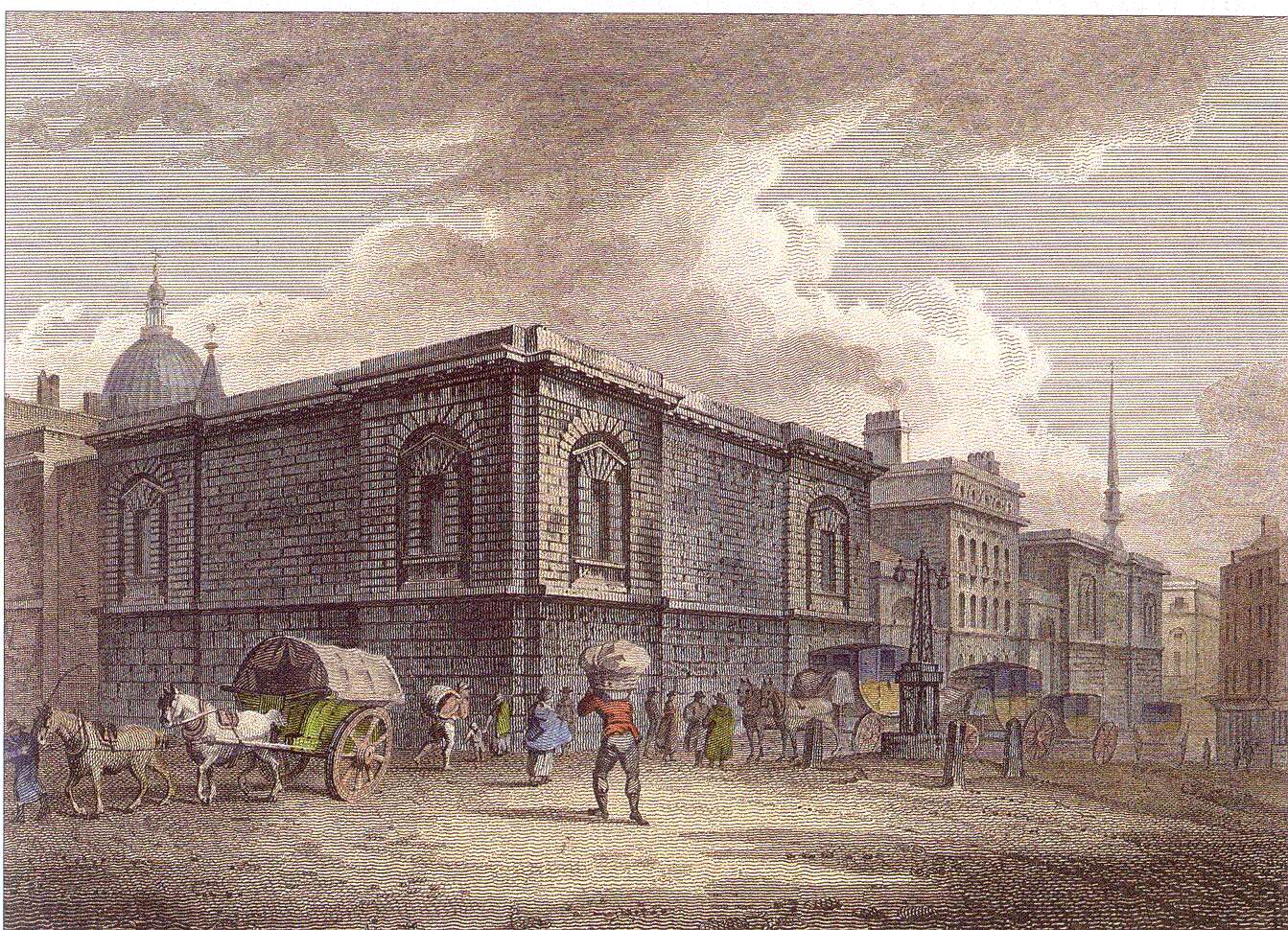
Newgate Prison

The Newgate Calendar for 1795 describes the manner of his being found guilty of murder. Newgate prison was a notorious London prison in which criminals waiting for trail would be held, and it was there that Jerry Abershawe was incarcerated before his execution.

When the judge appeared in his black cap, the emblem assumed at the time of passing sentence on convicted felons, Abershaw, with the most unbridled insolence and bravado, clapped his hat upon his head, and pulled up his breeches with a vulgar swagger; and during the whole of the ceremony, which deeply effected all present except the senseless object himself, he stared full into the face of the judge with a malicious sneer and affected contempt, and continued this conduct till he was taken, bound hand and foot from the dock, venting curses and insults on the judge and jury for having consigned him to, “murder.”

The Newgate Calendar also describes his execution on Kennington Common.

He was executed on Kennington Common, on the 3rd of August, 1795 in the presence of an immense multitude of spectators, among whom he recognised many acquaintances and confederates, to whom he bowed, nodded, and laughed with the most unfeeling indifference. He had a flower in his mouth, and his waistcoat and shin were unbuttoned, leaving his bosom open in the true style of vulgar gaiety; and talking to the mob, and venting curses on the officers, he died, as he had lived, a ruffian and a brute!”

A hanging at Tyburn 17th c.

Highwaymen especially were supposed to affect an attitude and a jocular type of behaviour called gallows humour. It seems that Jerry Abershawe went to his death displaying ribald and stentorious gallows humour.

Jerry's hill view. Image @Tony Grant

At least Jane was now safe on her journeys to London. But I wonder if she had just a small wish for the thrill of danger and would have loved to encounter Jerry on the wild wilderness of Wimbledon Common and ,”stand and deliver,” to him. If it had happened, would her novels have turned out differently in some ways?

Jane was 20 years old when Jerry died at the age of 22. Just maybe Jane would have loved the thrill of adventure on a journey with the threat of Jerry Abershawe round the next bend.

Tibbets Corner. A stylized sign commemorating Jerry Abershaw. Image @Tony Grant

Post script:

After writing this article I just couldn’t get a nagging thought out of my head.

Why and how did Jerry end up as a highway robber?

I know he was young, 22 years of age when he was caught and executed. There is no mention of family or wife or children or any sort of familial attachments. I can imagine him being brought up, an orphan, perhaps on the market streets of Kingston having to survive and live by his wits. It doesn’t take much to imagine the step into criminality to survive. He got in with the wrong lot obviously. An intelligent, bitter, hard done by, street wise kid gone wrong and obviously with a big personality. We can compare him with those who go off the tracks in our own society today. The forces for evil don’t change apparently. Obviously this is a total surmise but I feel better for it.

Tibbets Corner today - where Abershawe held up coaches. Image @Tony Grant

Read Full Post »

Scheduled for this week are:

  • A review of Mr. Darcy’s Secret and interview with author Jane Odiwe on February 7th
  • A post by Tony Grant about the highwayman, Jerry Abershawe
  • And an interview with Darcy and Fitzwilliam author Karen V. Wasylowski on February 10th.

Stay tuned for more!

Read Full Post »

« Newer Posts - Older Posts »