Feeds:
Posts
Comments

Archive for the ‘Regency style’ Category

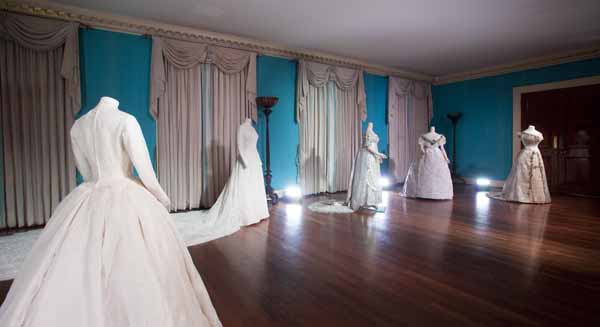
Wedding dresses in the royal collection. Princess Charlotte's gown is in the middle. Image @Daily News

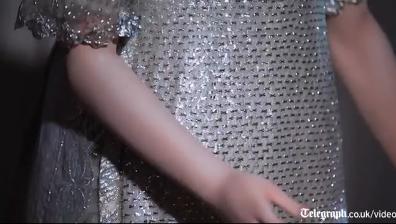
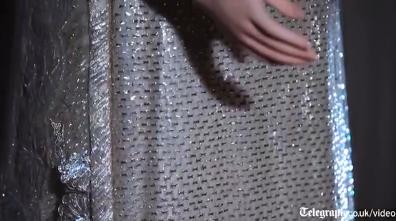
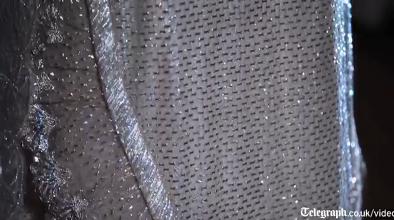
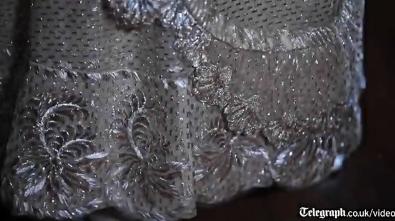
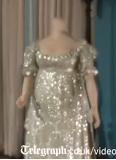
The Telegraph.co.uk features a video of five beautiful wedding dresses of the past, Queen Victoria’s and Princess Margaret’s among them, and asks the question, “How will Kate Middleton’s gown measure up to history?” Featured is Princess Charlotte’s beautiful silver wedding gown, which has not been on view for several decades and which, as the oldest wedding dress in the collection, requires quite a bit more conservation. In these images pulled from the film you can see the beautiful sheen of the silver fabric, which was meant to represent British wealth, status, and power.

It was made by Mrs Triaud of Bolton Street, from ‘cloth-of-silver’, silk bobbinet embroidered with heavy silver lamé, embellished with Brussels lace, and with embroidered flowers and shells festooning the hem.” –Telegraph.co.uk

Contemporary images simply do not do the dress justice.
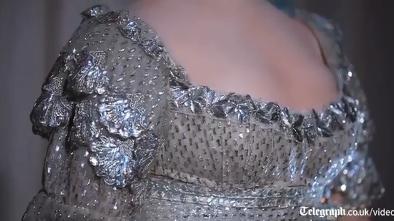
One can see in this small (blurred) image how the dress sparkles under lights. The dress required “500 hours of detailed hand-stitching in ultra-fine, mono-filament silk threads, almost invisible to the naked eye.” Those poor seamstresses must have gone blind. The Regency Fashion page carries a description of the dress and ceremony in La Belle Assemblee.

The manteau was of silver tissue lined with white satin, with a border of embroidery to answer that on the dress, and fastened in front with a splendid diamond ornament. Such was the bridal dress” … La Belle Assemblee

Princes Charlotte and Prince Leopold on their wedding day in 1816, Chapel Royal, St. James's Palace

The historic wedding dresses are among the 10,000 items in the Royal Ceremonial Dress Collection. Queen Victoria’s wedding dress will be publicly displayed in March 2012, in the new permanent exhibition at the refurbished Kensington Palace, ‘Victoria Revealed” hrp.org.uk . –  Telegraph.co.uk

In this older image you can see the gown's train. Image @Museum of London

The jewellery of the royal bride is most superb; beside the wreath, are a diamond cestus, ear- rings, and an armlet of great value, with a superb set of pearls.” – La Belle Assemblee
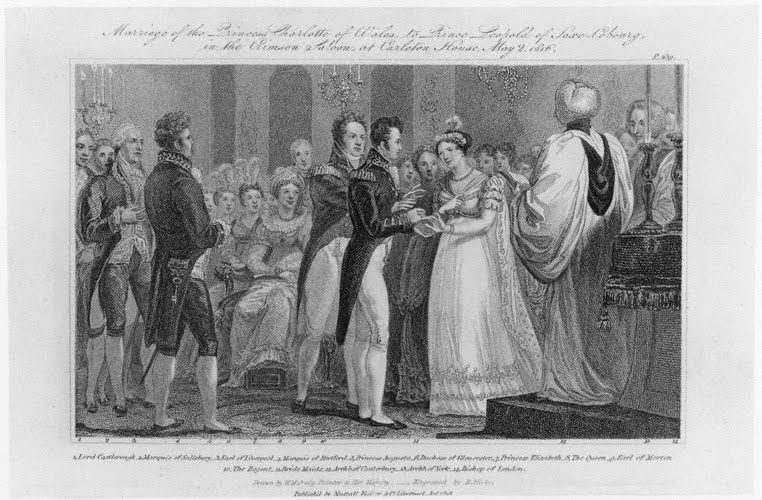
Contemporary depiction of Princess Charlotte's wedding

Sadly, the marriage did not last for even two years, due to Princess Charlotte’s death in childbirth (see article below.) Thank you, Brandy Parfums for alerting me to this video and article!

More posts about Princess Charlotte and Royal Weddings:

Read Full Post »

Gentle readers, I will be on semi-hiatus for the next few weeks, as my personal and work schedules do not permit me to concentrate as much on my blogs as I would like. For the time being I will feature past posts or link to others. When I looked at these images, I was reminded of the old-fashioned games of my childhood. Do children, I wonder, still play blind man’s bluff? Curious minds want to know.

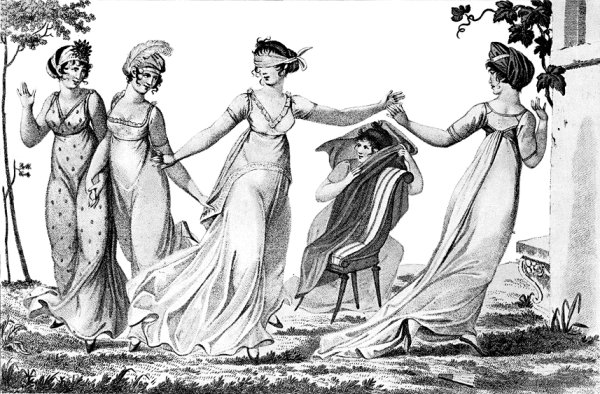
Blind Man's Bluff

The above plate came from Healthful Sports for Young Ladies by Mlle St. Sernin, a French governess, and delightfully illustrated by Jean Demosthene Dugourc (1749-1825). In blind man’s bluff, the blindfolded person must first find someone and then guess her identity. Here is a charming description from Mlle St. Sernin:

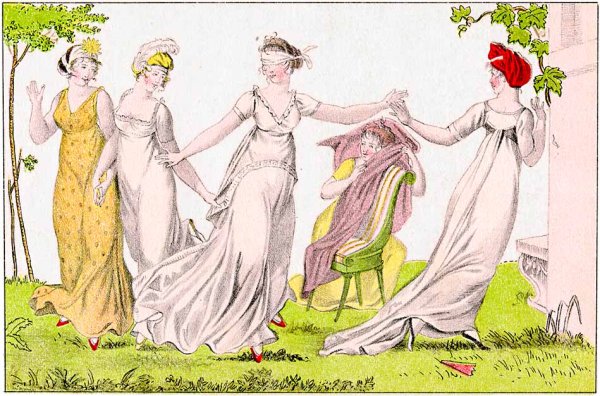
Le Bon Genre documented the social trends and leisure activities of Parisians. Below are two images from that magazine.

Black and white plate of Blind Mans Bluff, Le Bon Genre, 1803

Magazines with color plates cost more. Blind Mans Bluff, Le Bon Genre, 1803

Read Full Post »

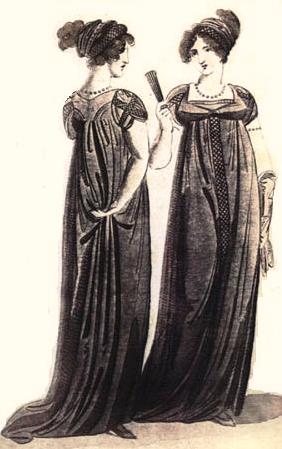
Fashionable mourning dresses, Ladies Museum, 1805

According to Jane Austen chronicler and scholar, David Nokes, when Martha Lloyd’s mother died on April 16, 1805, Jane Austen showed few signs of grief or emotion over that woman’s earthly departure. Instead, Jane wrote a jaunty verse to an uncivil (and imaginary) dressmaker. I surmise that these verses were meant more to cheer Martha up than to bring Martha’s mood down by reminding her of her loss. Mrs Austen, who was known for her droll verses, wrote a mythical reply by the dressmaker. At this time the Austen women were still reeling from Rev. Austen’s death in January and their own change in financial circumstances, having moved to more modest lodgings and becoming accustomed to a drastically reduced style of life. They would soon invite Martha to live with them in Bath. (Martha would remain with the Austen women through their move to Southampton in 1809.) After Jane’s death in 1817, Martha joined Cassandra in Chawton to help look after Mrs. Austen.

The poem that Jane wrote gives us a glimpse into how mourning clothes were made to order quickly. In this for-instance, the dressmaker, Miss Green, was slow to respond.

Lines sent to an uncivil Dress maker

Miss Lloyd has now sent to Miss Green,
As, on opening the box, may be seen,
Some yards of a Black Ploughman’s Gauze,
To be made up directly, because
Miss Lloyd must in mourning appear –
For the death of a Relative dear –
Miss Lloyd must expect to receive
This license to mourn & to grieve,
Complete, er’e the end of the week –
It is better to write than to speak – Jane Austen

Mrs. Austen’s reply as Miss Green

I’ve often made clothes
For those who write prose,
But ’tis the first time
I’ve had orders in rhyme – .
Depend on’t, fair Maid,
You shall be obeyed;
Your garment of black
Shall sit close to your back,
And in every part
I’ll exert all my art;
It shall be the neatest,
And eke the completest
That ever was seen –
Or my name is not Green! – Mrs. Cassandra Austen

Read Full Post »

18th century robe a la Francaise. Image @Rijksmuseum

During the 18th century and much of the Regency era, trains were popular on evening and court dresses, and at times on walking gowns. The length of the train shortened as the 18th century progressed, but even shorter trains swept over lawns and grounds and sidewalks. This fashion turned out to be quite expensive, for after several short walks, the fabric would be quite soiled or would need replacement. Oliver Goldsmith wrote in Citizen of the world (1760):

Nothing can be better calculated to increase the price of silk than the present manner of dressing. A lady’s train is not bought but at some expense, and after it has swept  the public walks for a very few evenings, is fit to be worn no longer, more silk must be bought in order to repair the breach, and some ladies of peculiar economy are thus found to patch up their tails eight or ten times in a season.”

One imagines that the delicate muslin trains of the Regency era were as easily wrecked by wear and tear, and that only the rich could afford such an extravagant consumption. There were ways to save one’s train. In 1996’s Emma, Gwynneth Paltrow is seen holding up her train during the dance.

Emma's train is attached to her wrist.

In Northanger Abbey, Jane Austen described how Isabella Thorpe and Catherine Morland pinned up each others trains.

They called each other by their Christian name, were always arm in arm when they walked, pinned up each other’s train for the dance, and were not to be divided in the set; and if a rainy morning deprived them of other enjoyments, they were still resolute in meeting in defiance of wet and dirt, and shut themselves up, to read novels together.”

1800 sprigged muslin gown. Image @Christies

One can only conclude that trains (or tails, as Goldsmith called them) were an extravagance that the ordinary working woman did not indulge in wearing, for until mass production made cloth more affordable, the added lengths of cloth, plus the constant need for laundering and patching, would make this fashionable feature prohibitively high for most women.

Note: That Isabella and Catherine met  “in defiance of wet and dirt” meant something, for shoes and fabrics were so delicate at the time, that ladies tended to stay indoors on rainy days.


Read Full Post »

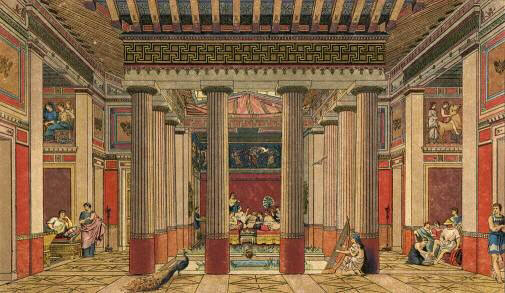
Image @The Culture Concept Circle

The era in which Jane Austen lived was a complex time in which scientific advances, the Industrial Revolution, warfare in Europe, and visits to ancient lands influenced the culture of Great Britain. These articles from The Culture Concept Circle will answer your questions about a few of the influences on the neoclassical style so prevalent during this time. Videos are included in some links.

Image @The Culture Concept Circle

Posts on this blog:

Read Full Post »

« Newer Posts - Older Posts »