Feeds:
Posts
Comments

Archive for the ‘Regency World’ Category

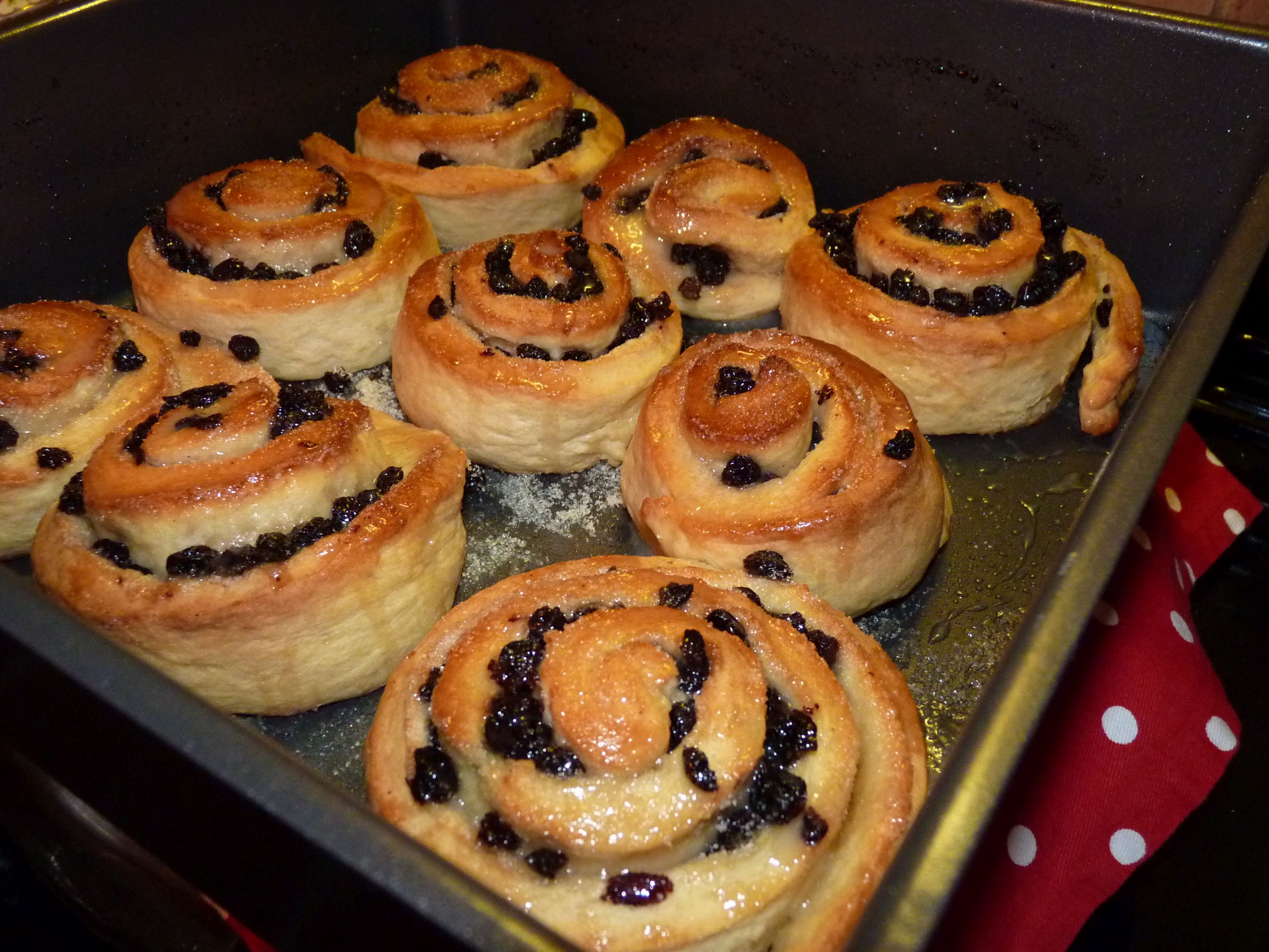
Chelsea Buns. Image courtesy @

Chelsea Buns. Image courtesy @Kathleen Corfield, The Ordinary Cook (Click on blog for the British recipe.)

Our crocuses and daffodils are blooming in Richmond, making me realize that Easter and spring and hot cross buns are just around the corner. Back in Jane Austen’s day, the Chelsea bun was the treat of choice.  These sticky sweet buns, filled with raisins and currants and topped with a sugary glaze, were sold by the tens of thousands at the famous Chelsea Bun-House on Pimlico Road near Sloane Square in London (technically Pimlico, not Chelsea), which was frequented by Royalty and the public alike.

During the last century, and early in the present, a pleasant walk across green fields, intersected with hedges and ditches, led the pedestrian from Westminster and Millbank to “The Old Bun House” at Chelsea. This far-famed establishment…stood at the end of Jew’s Row (now Pimlico Road), not far from Grosvenor Row. The building was a one-storeyed structure, with a colonnade projecting over the foot pavement, and was demolished in 1839, after having enjoyed the favour of the public for more than a century and a half. ” – Old and New London: Volume 5, Edward Walford, 1878, British History Online, Chelsea

“I soon turned the corner of a street which took me out of sight of the space on which once stood the gay Ranelagh. … Before me appeared the shop so famed for Chelsea buns, which for above thirty years I have never passed without filling my pockets. In the original of these shops—for even of Chelsea buns there are counterfeits—are preserved mementoes of domestic events in the first half of the past century. The bottle-conjuror is exhibited in a toy of his own age; portraits are also displayed of Duke William and other noted personages; a model of a British soldier, in the stiff costume of the same age; and some grotto-works, serve to indicate the taste of a former owner, and were, perhaps, intended to rival the neighbouring exhibition at Don Saltero’s. These buns have afforded a competency, and even wealth, to four generations of the same family; and it is singular that their delicate flavour, lightness, and richness, have never been successfully imitated.” – Sir Richard Phillips,  “Morning’s Walk from London to Kew,” 1817.

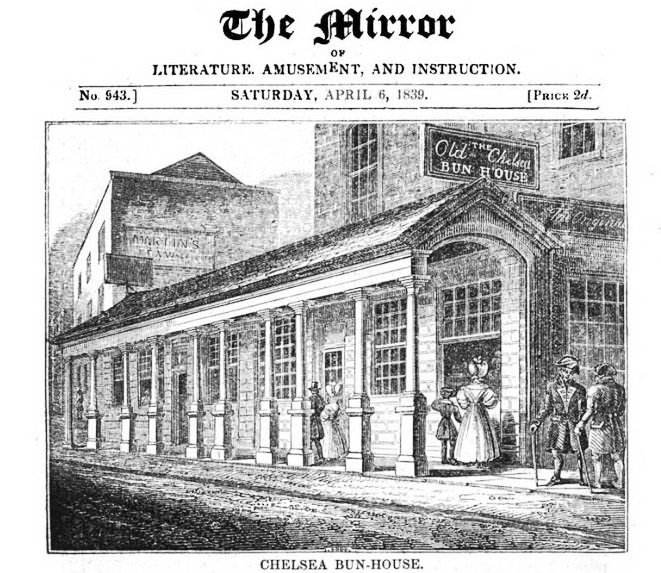
Chelsea Bun-House image from The Mirror, Google eBook

Chelsea Bun-House image from The Mirror, Google eBook

The building was fifty-two feet long, by twenty-one feet wide. The colonnade e xtended over the foot pavement into the street, and afforded a tempting shelter and resting-place to the passenger to stop and refresh himself. Latterly the floor of the colonnade was level with the road, which has probably been considerably raised; as in the old print it is represented as a platform with steps at the three doors for company to alight from their carriages. – The Gentleman’s Magazine and Historical Chronicle, Volume 11, 1839

Not all of the bun house’s customers enjoyed the sweet sticky buns, as Dean Swift attests in 1711: “Pray, are not the fine buns sold here in our town? was it not R-r-r-r-r-r-r-r-r-rrare Chelsea buns ? I bought one today in my walk ; it cost me a penny ; it was stale, and I did not like it, as the man said, [R-r-r-r-rnre] Sec.” – (Journal to Stella. May 2, 1711.)

It is not to be wondered at, that the witty Dean did not relish his stale bun ; for, to be good, it should be made with a good deal of butter, be very light, and eat hot. Chelsea Buns formed a frequent cry in the streets of London during the last century, and were as popular as the Bath Buns of the present time. The cry (or rather song) was ” Chelsea Buna, hot Cheheii Buns, rare Chelsea Buns! ” Good Friday was the day in all the year when they were most in request; and the crowds that frequented the Bunhouse on that day, is almost past belief. – Gentleman’s Magazine

The following account was written in The Mirror, April 6, 1839, the year that the original Bun-House was demolished for improvements.

CHELSEA BUN-HOUSE. This Bun-House, whose fame has extended throughout the land, was first established about the beginning of the last century; for, as early as 1712, it is thus mentioned by the celebrated Dean Swift:—”Pray are not the fine buns sold here in our town, as the rare Chelsea buns ? I bought one to-day in my walk,” &c.

The building consists of one story, fifty feet long, and fourteen feet wide. It projects into the high-way in an unsightly manner, in form of a colonade, affording a very agreeable shelter to the passenger in unfavourable weather.

The whole premises are condemned to be pulled down immediately, to make way for the proposed improvements of Chelsea and its neighbourhood, the bill for which is in committee of the House of Commons, under the superintendance of that most active member, Sir Matthew Wood.

It was the fashion formerly for the royal family, and the nobility and gentry, to visit Chelsea Bun-House in the morning. His Majesty King George the Second, Queen Caroline, and the Princesses, frequently honoured the elder Mrs. Hand with their company.

Their late Majesties King George III, and Queen Charlotte, were also much in the habit of frequenting the Bun-House when their children were young, and used to alight and sit to look around and admire the place and passing scene. The Queen presented Mrs. Hand with a silver half-gallon mug, richly enchaced, with five guineas in it, as a mark of her approbation for the attentions bestowed upon her during these visits: this testimonial was kept a long time in the family.

On the morning of Good Friday, the Bunhouse used to present a scene of great bustle; it was opened as early as four o’clock j and the concourse of people was so great, that it was difficult to approach the house; it has been estimated that more than fifty thousand persons have assembled in the neighbourhood before eight in the morning; at length it was found necessary to shut it up partially, in order to prevent the disturbances and excesses of the immense unruly and riotous London mob which congregated on those occasions. Hand-bills were printed, and constables stationed to prevent a recurrence of these scenes.

Whilst Ranelagh was in fashion, the BunHouse was much frequented by the visitors of that celebrated temple of pleasure ; but after the failure of Ranelagh, the business fell off in a great degree, and dwindled into insignificance.

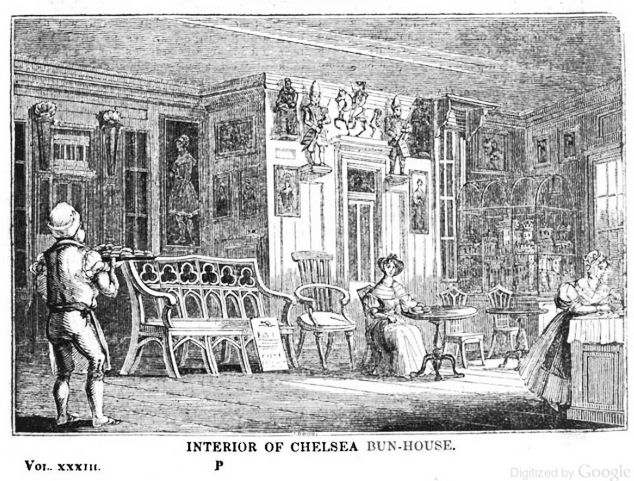
Interior of Chelsea Bun-House. Image from 1839 edition of The Mirror, Google eBook

Interior of Chelsea Bun-House. Image from 1839 edition of The Mirror, Google eBook. The inside of the Bun-House was fitted up as a museum. It might have contained some very curious articles, but the most valuable had long since disappeared.The materials of the building, with the relics of the museum, were sold by auction April 18, 1839, and the whole was immediately cleared away. – Gentleman’s Magazine

Click here to see a color drawing of the Bun-House interior at the British Museum

See another image of the Bun-House at Swann Galleries

INTERIOR Of CHELSEA BUN-HOUSE. The interior was formerly fitted up in a very singular and grotesque style, being furnished with foreign clocks, and many natural and artificial curiosities from abroad ; but most of these articles have disappeared since the decease of Mrs. Hand.

At the upper end of the shop is placed, in a large glass-case, a model of Radcliffe Church, at Bristol, cut out very curiously and elaborately in paste-board ; but the upper towers, pinnacles, &c. resemble more an eastern mosque than a Christian church.

Over the parlour door is placed an equestrian coloured statue, in lead, of William, the great Duke of Cumberland, in the military costume of the year 1745, taken just after the celebrated battle of Culloden: it is eighteen inches in height.

On each side stand two grenadier guards, presenting arms, and in the military dress of the above period, with their high sugarloaf caps, long-flap coats, and broad gerilles, and old-fashioned muskets, presenting a grotesque appearance, when compared with the neat short-cut military trim of the present day. These figures are also cast in lead, and coloured; are near four feet high, and weigh each about two hundred weight.

Underneath, on the wall, is suspended a whole-length portrait, much admired by connoisseurs, of Aurengzebe, Emperor of Persia. This is probably the work of an Italian artist, but his name is unknown.

After the death of Mrs. Hand, the business was carried on by her son, who was an eccentric character, and used to dress in a very peculiar manner,; he dealt largely in butter which he carried about the streets in a basket on his head; hot or cold, wet or dry, throughout the year, the punctual butterman made his appearance at the door, and gained the esteem of every one by his cheerful aspect and entertaining conversation ; for he was rich in village anecdote, and could relate all the vicissitudes of the neighbourhood for more than half a century.

After his decease, his elder brother came into the possession of the business; he had been bred it soldier, and was at that time one of the poor knights of Windsor, and was remarkable for his eccentric manners and costume. He left no family, nor relations, in consequence of which his property reverted to the crown…A writer in the Gentleman’s Magazine, vol. LIU. for July 1783, p. 578, speaking of Cross Buns in Passion week, observes, that ” these being, formerly at least, unleavened, may have a retrospect to the unleavened bread of the Jews, in the same manner as Lamb at Easter to the Pascal Lamb. “

Chelsea Bun-House, image @ Gentleman's Magazine and Historical Chronicle, Volume 11

Chelsea Bun-House, image @ Gentleman’s Magazine and Historical Chronicle, Volume 11. One can see the raised steps leading to three doors where ladies and gentlemen could alight comfortably from their carriages.


Apparently when Chelsea Buns were invented there were two rivals who vied for the honor of selling the best buns: the Old Chelsea Bun House or the “Real Old Original Chelsea Bun-house.” On Good Friday, long lines of people waited to purchase the buns. In 1792, the Good Friday line was so long that the Bun-House skipped selling them the following year. A notice stated:

“Royal Bun House, Chelsea, Good Friday.—No Cross Buns. Mrs. Hand respectfully informs her friends and the public, that in consequence of the great concourse of people which assembled before her house at a very early hour, on the morning of Good Friday last, by which her neighbours (with whom she has always lived in friendship and repute) have been much alarmed and annoyed; it having also been intimated, that to encourage or countenance a tumultuous assembly at this particular period might be attended with consequences more serious than have hitherto been apprehended; desirous, therefore, of testifying her regard and obedience to those laws by which she is happily protected, she is determined, though much to her loss, not to sell Cross Buns on that day to any person whatever, but Chelsea buns as usual.”

Forty six years later, the Bun-House closed its doors for good. One has to wonder today if during her many trips to London Jane Austen traveled to the Bun-House on Pimlico Road to purchase a half-dozen of these fresh-baked delicacies.

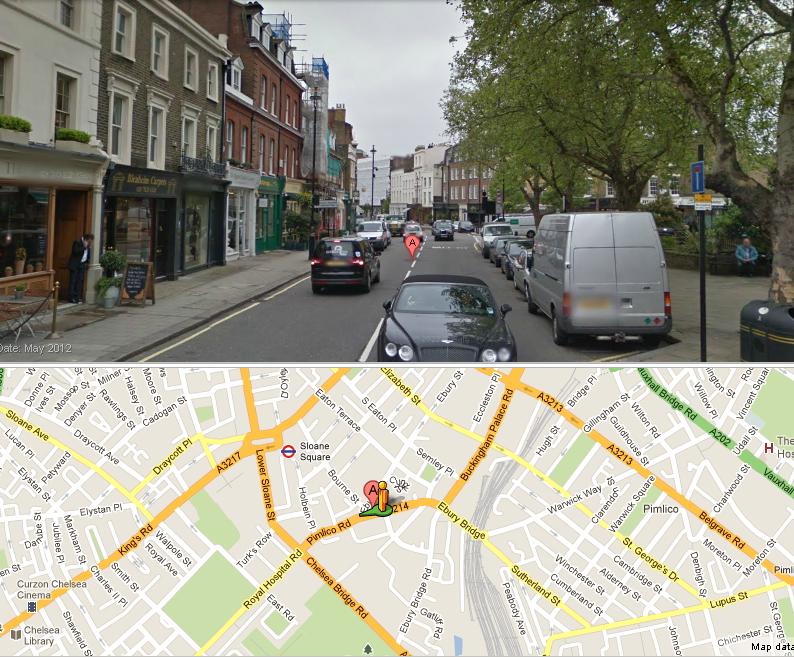
Pimlico Road in 2012

Google map image of Pimlico Road in 2012 London, near what was once Grosvenor Row.

Read more on the topic:

Read Full Post »

Fabulous Dr. Lucy Worsley discusses the Regency Era in these videos. Wonderful.

drush76's avatarThe Rush Journals

Below are links to a BBC documentary called “ELEGANCE AND DECADENCE – The Age of the Regency”. The documentary is hosted by historian Dr. Lucy Worsley, author of the 2011 book, “If Walls Could Talk, An Intimate History of the Home”.

“ELEGANCE AND DECADENCE – The Age of the Regency”

Here are the links to the documentary hosted by Dr. Worsley:

Part 1 – “Warts and All – Portrait of a Prince”

Part 2 – “Developing the Regency Brand”

Part 3 – “The Many and the Few – A Divided Decade”

View original post

Read Full Post »

Inquiring readers, Every once in a while a writer from another website contributes an article that is custom made for this blog.  Jennifer Vishnevsky, a writer for TopDentists.com, writes about false teeth and dentistry in an era when anesthetics were not yet available.

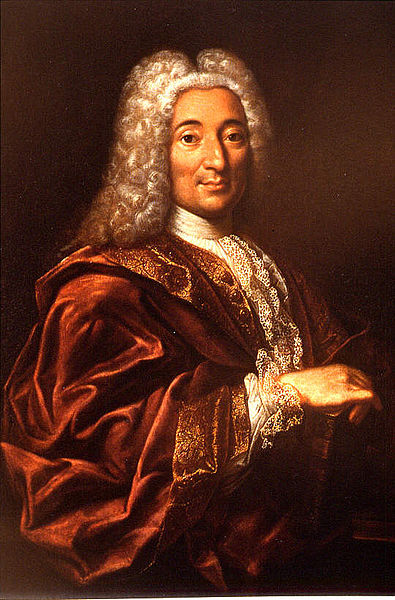
Pierre Fauchard. Image @Wikimedia

Pierre Fauchard. Image @Wikimedia

The 18th Century was a major time for advances in dentistry. It is believed that the French physician Pierre Fauchard started dentistry science as we know it today. In 1723, Fauchard published “The Surgeon Dentist, a Treatise on Teeth.” His book was the first to describe a comprehensive system for caring and treating the teeth. Thus, he is considered the father of modern dentistry. Fauchard was responsible for many developments, including the introduction of dental fillings and the use of dental prosthesis.

In 1760, John Baker, the earliest medically-trained dentist to practice in America, emigrated from England and set up practice. In the same decade, Paul Revere placed advertisements in a Boston newspaper offering his services as a dentist.

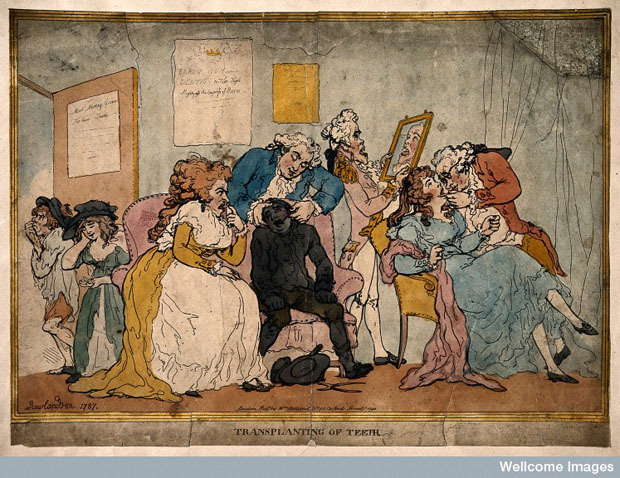
This print is by Thomas Rowlandson (1756-1827) and is dated 1787. It is a satirical comment upon the real practice of rich gentlemen and ladies of the 18th century paying for teeth to be pulled from poor children and transplanted in their gums. Image @Children and Youth in History

This print is by Thomas Rowlandson (1756-1827) and is dated 1787. It is a satirical comment upon the real practice of rich gentlemen and ladies of the 18th century paying for teeth to be pulled from poor children and transplanted in their gums. Image @Children and Youth in History

In 1790, the first dental foot engine was built by John Greenwood, son of Isaac Greenwood and one of George Washington’s dentists. It was made from an adapted foot-powered spinning wheel. This was also the year that the first specialized dental chair was invented by Josiah Flagg, who made a wooden Windsor chair with a headrest attached.

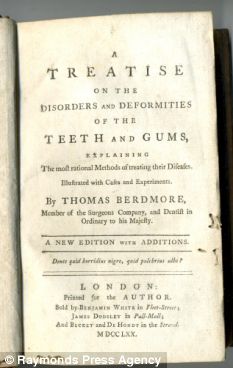
Even those treated by the best dentists were in for an agonizing time. “A Treatise on the Deformities and Disorders of the Teeth and Gums” was written in 1770 by Thomas Berdmore, who was considered to be an outstanding dentist in England. “Pass gold wire from the neighbouring teeth on either side, in such a manner as to press upon what stands out of the line.” The alternative, Berdmore suggested, was to ‘break the teeth into order by means of a strong pair of crooked pliers.”

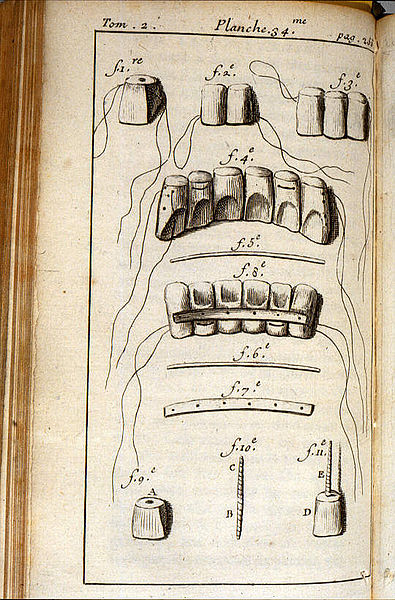
Fauchard, procedure for teeth restoration. Image @Wikimedia

Fauchard, procedure for teeth restoration. Image @Wikimedia

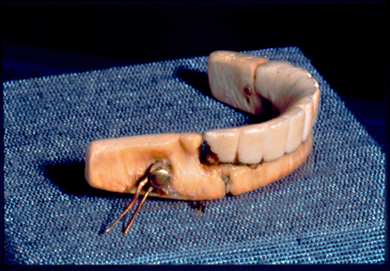
For those who could afford it, the European diet grew sweeter during the 18th Century as the use of sugar became more widespread. This exposure to sugar meant more instances of tooth decay. These dietary changes were a major factor in the development of dentures. Dentists began to experiment with ivory in order to create a better foundation for dentures. Due to advances in technology, dentists could also add gold springs and plates to the new dentures. False teeth were a novelty that was mostly unheard of in earlier centuries. Previously, problematic teeth were pulled but almost never replaced. Ivory dentures were popular in the 1700s, made from natural materials including walrus, elephant, or hippopotamus. For the wealthy, human teeth were high in demand as the preferred material for the creation of dentures. However, the teeth used in 18th Century dentures eventually rotted. There was a high demand for teeth that were deemed healthy, such as from criminals.

George Washington's dentures. Image @Samuel D. Harris National Museum of Dentistry, Baltimore

George Washington’s dentures. Image @Samuel D. Harris National Museum of Dentistry, Baltimore

One of the most famous early denture wearers was the first U.S. President George Washington. Washington began losing his teeth in his 20s, probably due to a combination of frequent illness and treatment with a medication called calomel that damaged the enamel of the teeth. Contrary to popular belief, however, Washington’s dentures were not made of wood. Washington sported some of the highest quality false teeth of the time, consisting of a denture plate made of carved hippopotamus ivory into which human teeth (along with parts of both horse and donkey teeth) were fitted. He had several other pairs of dentures during his presidency, none of which included wood in their construction.

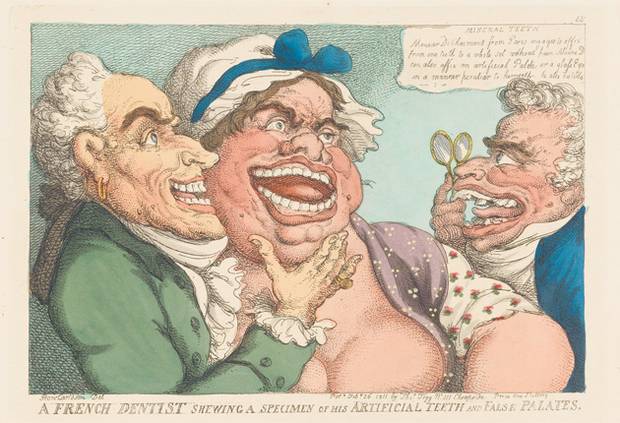
A French Dentist Showing a Specimen of His Artificial Teeth and His False Palates, Thomas Rowlandson, 1811. Image @The Independent

A French Dentist Showing a Specimen of His Artificial Teeth and His False Palates, Thomas Rowlandson, 1811. Image @The Independent

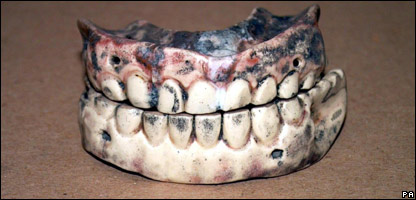
18th century porcelain dentures Image @CBBC

18th century porcelain dentures Image @CBBC

Full or even partial dentures were properly developed only during the course of the 18th Century. Dentists became better at making them fit, coming up with stronger adhesives to keep the teeth attached to them and designing them so as to prevent them from flying out of their patients’ mouths. By the late 18th century, there were yet more developments. Around 1774, Alexis Duchâteau crafted the first porcelain dentures. But these were prone to chip and also tended to appear too white to be convincing. Porcelain shaped teeth were placed onto gold plates. These were the first dentures that look similar to modern dentures. They were very white in color, but could be made in different shades.

Guest contributor Jennifer Vishnevsky is a writer for TopDentists.com, an Everyday Health website on dental health, as well as a freelancer for other lifestyle media sites.

Read Full Post »

Inquiring readers: Susannah Fullerton and I met in Brooklyn at the annual JASNA meeting, where she was promoting two books and gave two workshop presentations.  Here, then, is our share of our ongoing conversation:

Susannah, it was such a pleasure meeting you at the AGM in Brooklyn. I felt as if we had known each other for years, so instant was our connection. As we talked, I came to realize that you lecture, travel, act as guide, write, and have two books coming out in a HALF year, AND you are a wife, mother, and president of JASA (Jane Austen Society of Australia). At the conference you had boundless energy. How and where do you find the time to do it all and look so fresh and enthusiastic? I am in awe.

There’s a lovely quote in Emma when Miss Bates says, ‘It is such a happiness when good people get together – and they always do.” Vic, that’s how I felt when I met you in Brooklyn – an instant recognition that we had masses in common and would get on really well. I do have an incredibly busy life and it has been especially busy these last 2 years with 2 books to write. However, I do find it hard to say ‘no’ to lovely literary projects. I have been President of JASA for 17 years (I’m wondering if that should put me in the Guinness Book of Records?) and I have a fabulous committee, so running the society is a joy. Of course we are all very excited about next year’s big P & P anniversary. My literary tours are great fun. When you yourself get an incredible thrill from walking down the Gravel Walk in the footsteps of Anne Elliot and Capt. Wentworth, or seeing the topaz crosses at Chawton, or actually standing in the room where Jane Austen died (which I did on 2 of my literary tours) then it’s fantastic to be able to take other people on tours where they can share that same excitement. My tours are with ‘Australians Studying Abroad’, and I don’t only take tours to England but to France, Scotland and the USA as well. It’s all such fun that somehow I find the energy to do it all.

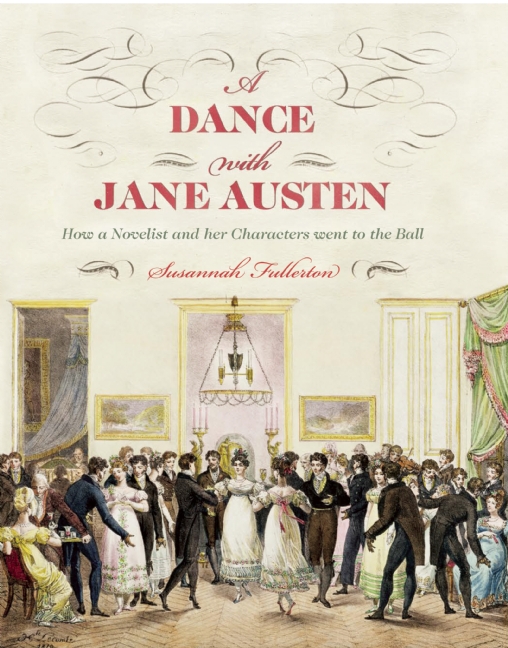
In reference to your interview on Jane Austen in Vermont, you mentioned that the time for a book about dance in Jane Austen’s time was right. I agree with you. What were some of the facts you uncovered that surprised you and that you were anxious to share with the world?

What really surprised me was that no-one had written a book on Jane Austen and dancing before now! I think what you find when you focus on one particular aspect of Jane Austen’s fiction is an increased awareness of how utterly brilliant she was. When I wrote Jane Austen and Crime I found that the tiniest bit of information about something like poaching was used by Austen in a way that had so many wider implications if you knew about the laws and perceptions of poaching at that time. In Mansfield Park Mr Rushworth boasts about his “zeal after poachers”, yet completely fails to stop Henry Crawford from ‘poaching’ his wife – the ‘poaching’ undercurrents in the novel are so brilliantly done. I found the same with dancing – when you learned exactly what behaviour was expected in a ballroom, you became so much more aware of the subtler nuances of dialogue and action. For example, it was not proper etiquette to compliment your partner on their dress or looks, because it was taken for granted that everyone would be nicely dressed at a ball. You shouldn’t praise someone for doing what it was assumed they would do anyway – ie, dress nicely. This gives extra point to Mrs Elton’s behaviour at the Crown Inn ball – of course, no-one compliments her on her dress because they are behaving properly, but Mrs Elton is desperate for such attention so she takes on the task herself: “How do you like my gown? How do you like my trimming? How has Wright done my hair?” etc. The more you delve into any aspect of Austen’s world, the more you find and you come away with an even greater awe of her incredible achievement!

Was there any information in A Dance With Jane Austen that you wished you had expanded upon but simply could not due to lack of space and time?

It could have been nice to have included more particular information about steps for individual dances, but unless you are a Regency dancer yourself, that information might be rather dull on the page – more fun to ‘do’ than to read about, I think.

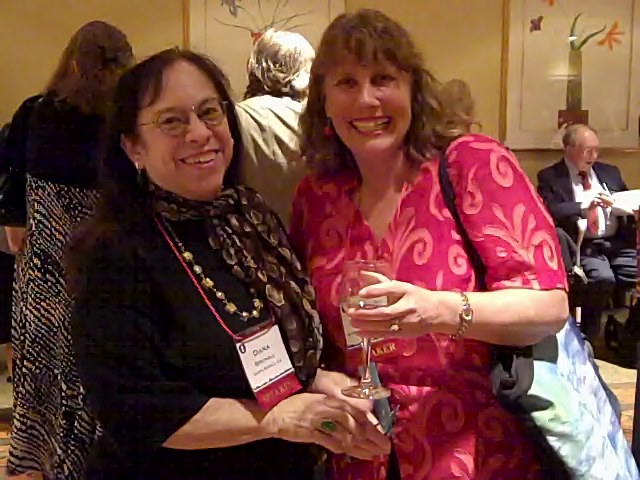
Authors Diana Birchall (l) and Susannah Fullerton (r) at the Brooklyn AGM

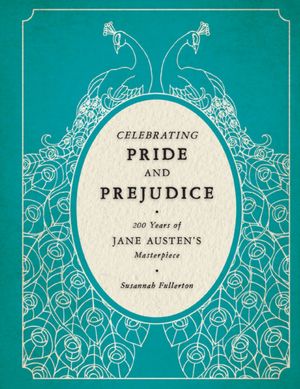
When we were at the AGM, you were promoting your next book as well, Celebrating Pride and Prejudice: 200 Years of Jane Austen’s Masterpiece. Other authors must be as curious as I am: How did you find the time to write TWO books with such close deadlines? Did you lock yourself in a closet and have food passed to you through a grate?

Just last week I received the most wonderful parcel in the post – two copies of Happily Ever After: Celebrating Jane Austen’s Pride and Prejudice and two copies of Celebrating Jane Austen’s Pride and Prejudice: 200 Years of Jane Austen’s Masterpiece. These are the UK and American editions of my new book. They are both gorgeous and I was so thrilled I danced round the kitchen with the copies in my arms! The book is dedicated to my daughter “my dearest loveliest Elinor Elizabeth” and she is really thrilled about that. Yes, it was quite a task to finish 2 books so close together. I was just finishing A Dance with Jane Austen when Frances Lincoln suddenly took up my suggestion that a book about 200 years of P & P would be a good idea. I must admit I lay awake most of that night, wondering if I could manage to do it given the tight time frame. But how could I resist? Spending 6 months with Elizabeth and Darcy was pure bliss and no book has given me so much pleasure to write. There were days when I was so involved I forgot to think about cooking dinner. Part of the joy was learning as I went along – discovering new depths and brilliancies in the novel. Just as an example – when I was writing my chapter on Elizabeth Bennet, I stopped to think about how she is first introduced to the reader. Most of us know her so well that it feels she has always been a part of our lives, but what are Elizabeth’s first words in the novel?? I had to go and check because I couldn’t actually remember the very first words she gets to speak in the text. And they are words that contradict her mother! In that age of conduct-book heroines, females who were expected to be obedient to parents, meek, silent and submissive, Elizabeth arrives on the literary scene with a contradiction!! Instantly we know that this woman is going to be different – unlike any heroine before (and of course since as well).

What should readers expect from Celebrating Pride and Prejudice that will make your book stand out from other publications about this novel?

I have tried in my book to give an all-round picture of why this novel has lasted 200 years and goes from strength to strength. I tell of its beginnings; Jane Austen’s struggles to get it out into the world; initial reactions to the book and then reactions as the 19thC continued and went into the 20thC; I have a chapter about the first sentence and why it has become so justly famous; I look at the use of letters in the text; I discuss the translations and how badly the novel fared for a long time in other languages and I look at the challenges faced by translators (would Mr and Mrs Bennet say ‘vous’ or ‘tu’ to each other? They have shared a bed and had 5 children, but still call each other Mr and Mrs – a translator has to make that sort of decision); I look at the extraordinary range of film versions (Dutch, Mormon, Spanish, Italian, Israeli etc); I look at the illustrations it has had foisted upon it over the years – some lovely and some truly terrible (and I include some fabulous pictures as examples) and the different sorts of covers it has been enclosed in; I look at P & P tourism which is now a big industry; I explore the amazing range of merchandise from baby’s nappies to skateboards, cosmetics to clothes pegs, china to jewellery etc. Some of the chapters I most enjoyed writing were about the characters of the novel – I have separate chapters on Darcy and Elizabeth, but then also include chapters on ‘her Relations’ and ‘his Relations’, and one on the ‘Other Characters’. I found that grouping them into ‘his’ and ‘her’ relatives made me think about them in a new way and helped make it clear why hero and heroine had become the sort of people they are.

Anything else you wish to add?

There is a T-shirt which has printed on it “What do you mean Mr Darcy isn’t real??” I think I need to buy that T-shirt! Elizabeth and Darcy, Mr and Mrs Bennet, Mr Collins and Lady Catherine, and all the characters of Pride and Prejudice are as real to me as the people I see every day. There is so much to celebrate about this utterly wonderful book by Jane Austen. My way of celebrating was to write a book about why it is so brilliant, and of course I very much hope that many readers will want to buy and read my book to discover just why, 200 years ago, the world became a far better place!

As always, Susannah, it is a pleasure chatting with you. I wish you nothing but the best and hope to see you during your spring tour in the U.S.! – Vic

NOTICE: CONTEST CLOSED. Congratulations Monica! Dear readers: Susannah is graciously giving away a free copy of A Dance With Jane Austen. Please leave your comment stating which Jane Austen character you would most like to dance with and why! The contest is open to all and closes at midnight November 27th, US Eastern Standard Time.

Susannah’s Books:

Preorder Celebrating Pride and Prejudice at this link.

Order A Dance With Jane Austen at this link

Order Susannah’s first book, Jane Austen and Crime, at this link

Read Full Post »

Shades from Jane Austen by Honoria Marsh was published in 1975-1976 in a series of limited editions. I saw this rare work at the silent auction table at the 2012 JASNA AGM meeting in NYC. There were many beautiful items, but this one was a standout with its colored illustrations, mostly silhouettes, and a few reproductions of Jane Austen’s writings. Bidding began at $50.00, but at the time I approached the table the price had gone up to $150.00, a bit beyond my price range but still less than the book attracts in online bookstores. The price reflects the book’s rarity, for only a few copies are available. I had seen a few illustrations before, but not the originals … until now.

The video shows a number of illustrations from the book not seen in this post. The portrayals of Jane Austen’s characters were painted by the author from life. Her sitters were either friends and acquaintances, or Jane Austen’s descendants or people associated with her! You can read their names below the title of the characters.

Part one of the book includes ‘Jane Austen’s Family in Silhouette’, a table showing Jane Austen’s Family and Chronology of Events During her Lifetime’ (written by Peggy Hickman), and Jane Austen’s family tree.

Part two includes an introduction and a discussion of Sense and Sensibility, Pride and Prejudice, Mansfield Park, Emma, Northanger Abbey and Persuasion.

Silhouette of Mrs. Gardiner

Alas, I do not know who successfully bid for the book in the silent auction or what it went for. Does anyone know?

Read Full Post »

« Newer Posts - Older Posts »