Feeds:
Posts
Comments

Archive for the ‘Travel’ Category

by Brenda S. Cox

“There must have been many precious hours of silence during which the pen was busy at the little mahogany writing-desk, (This mahogany desk, which has done good service to the public, is now in the possession of my sister, Miss Austen) while Fanny Price, or Emma Woodhouse, or Anne Elliott was growing into beauty and interest.”–A Memoir of Jane Austen by James Edward Austen-Leigh, her nephew

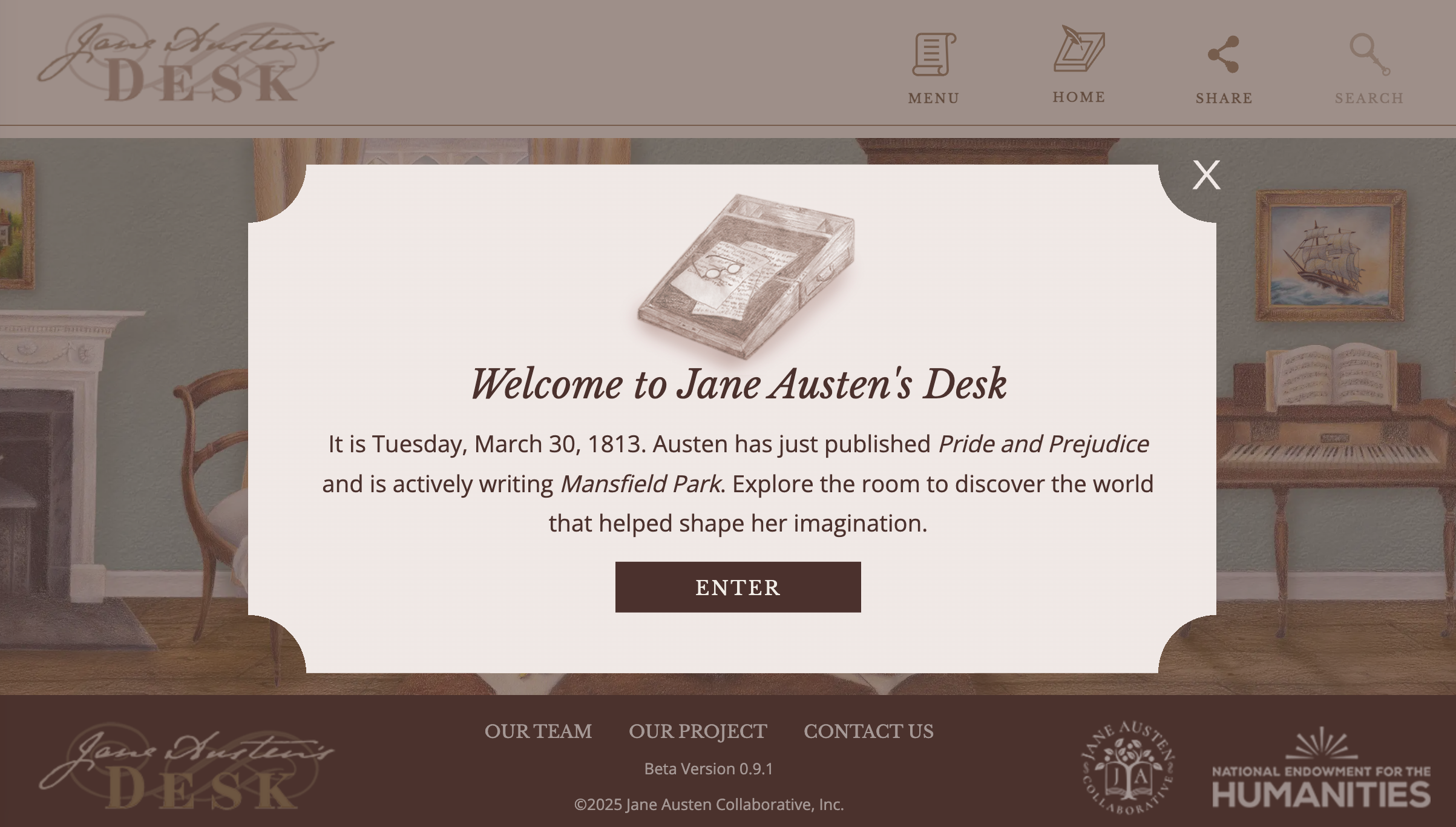
Welcome page to the website “Jane Austen’s Desk”

Wouldn’t you love to explore Jane Austen’s desk and room? Inger Brodey, Sarah Walton, and their amazing team at the Jane Austen Collaborative are recreating Jane’s desk and room for us to visit virtually.

While the website is still a beta version, I found lots of great information there. The plan is for it to become a “portal” linking to many Austen resources.

The site opens with a view of a room loosely based on the drawing room of Jane Austen’s House in Chawton

Jane Austen’s Desk

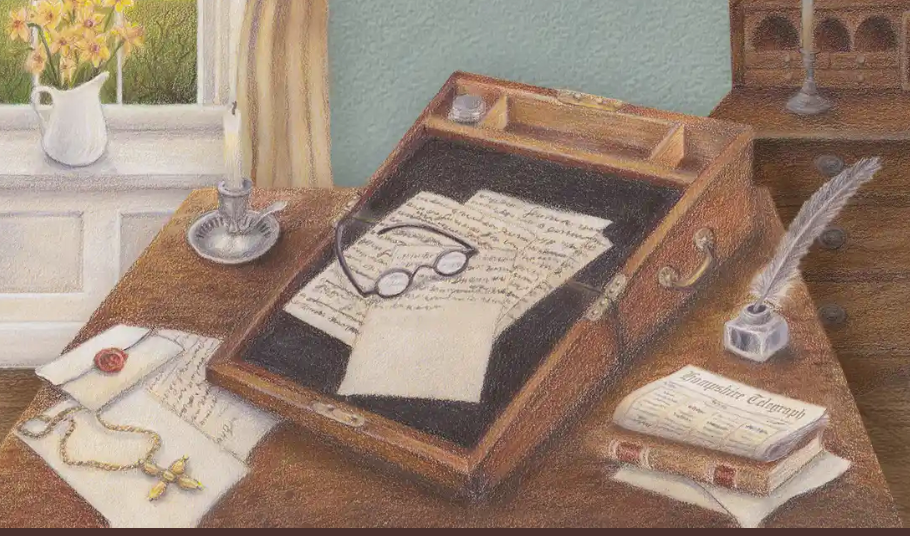
When you visit the room, you might want to start at the desk itself—Jane’s travel desk sits on a table. You’ll see manuscripts of several of the novels, which you can open and enjoy in early editions. Commentary tells more about the novel and the edition, with direct links to interesting sections like “Darcy’s list of desirable female accomplishments” and “Fanny asking about the slave trade.”

Nearby are newspapers, one of the most fun links. Several contemporary papers are included. You can hone in on a number of interesting articles, ranging from her brother Edward’s selling part of Stoneleigh Abbey, to reports of her brother Frank’s naval exploits, to the story of a swindler who pretended to be a rich person’s housekeeper!

Jane Austen’s travel desk (the real one is owned by the British Library). The manuscripts on the desk, the newspapers next to it, and the cross, take you to various resources.

The Bookshelf

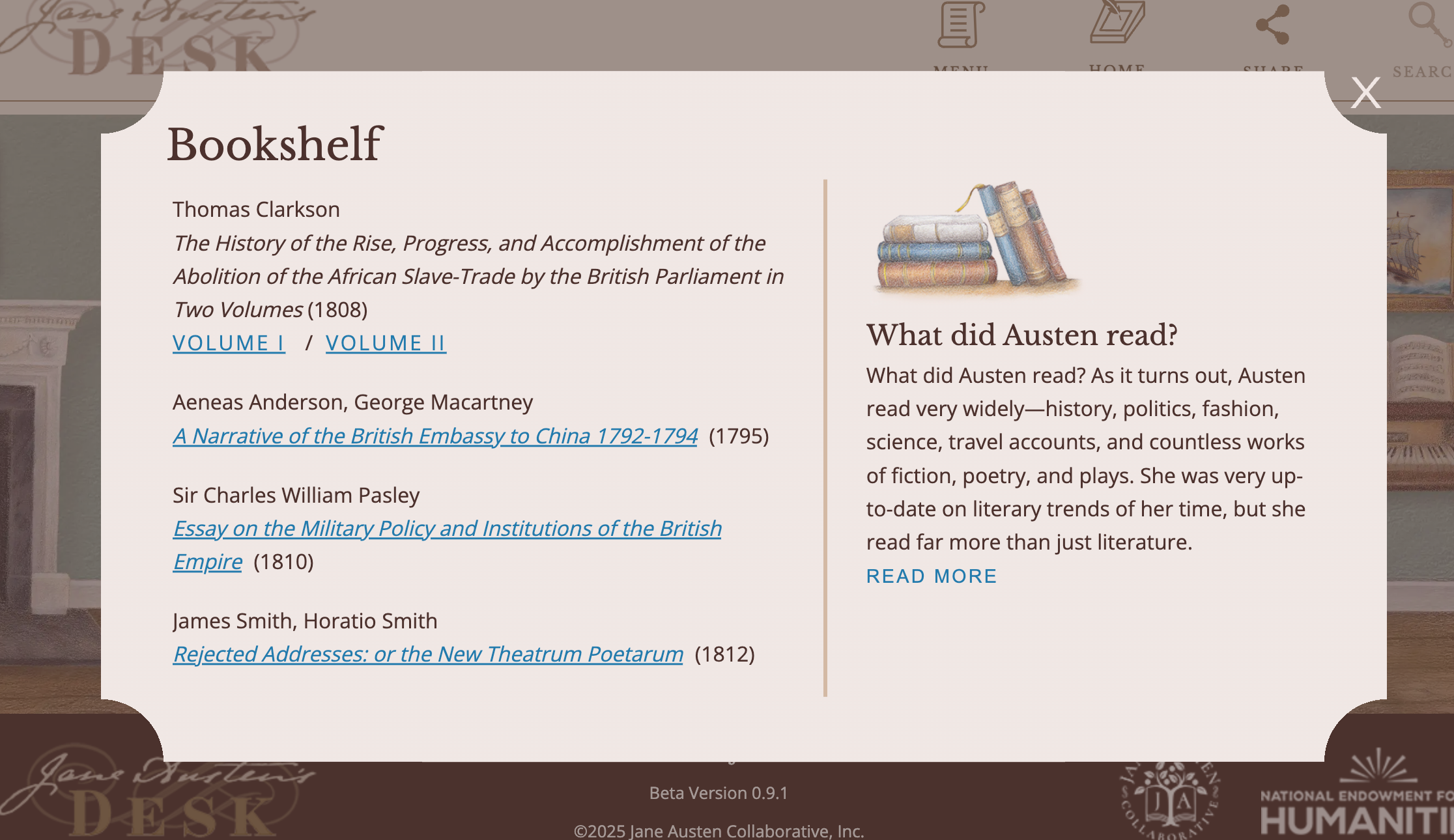
Click on the bookshelves in Rev. Austen’s bureau-bookcase , and you’ll see some books mentioned in Austen’s writings. I expect this will be expanded later. But for now, you can read from several authors Austen said she was “in love with”—Thomas Clarkson (on abolition), Sir Charles Pasley (on the military), and James and Horatio Smith (verse parodies). We also have a book that Fanny Price was reading, George Macartney on the British Embassy to China.

For each, you will find an easy-to-read early version of the book; clear commentary; pictures; and links to relevant passages in the novels and letters. Two also link to related articles. A great start if you want to explore these books connected to Austen!

Catalogs on the ledge of the bookcase open up to records of the Alton Book Society that Austen enjoyed. You’ll find lists of members, rules, and lists of the books that the members, including Austen, traded around. This gives us another peek into Austen’s life and reading.

The Bookshelf takes you to some books Austen read.

Travels

A pianoforte stands next to the bookcase. It will eventually be connected to Austen’s music.

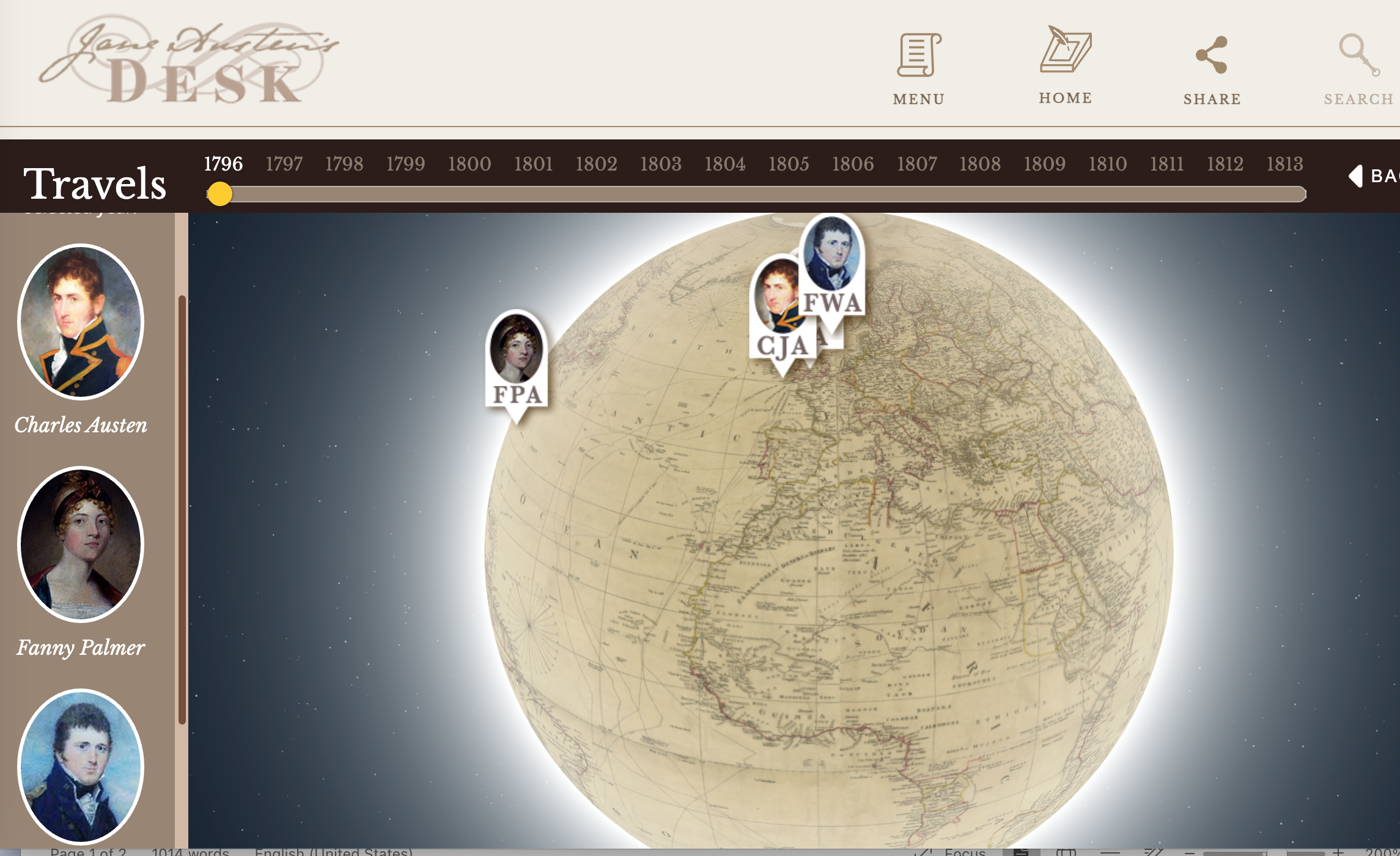
Above the pianoforte, click on the portrait of a ship on the sea. You go to a globe, where you can follow the travels of Austen’s family.

Jane Austen’s Desk, travel section. You can trace the positions of Frank and Charles Austen, Charles’s wife Fanny Palmer, and Jane Austen herself, year by year. You can also read stories about Frank and Charles’s experiences at sea.

Silhouettes on the wall connect you to Jane Austen’s family tree. If you click on the orange “i”, you get more information about each person. The plus buttons reveal more generations.

Many of these features include audio commentary as well as written commentary. For example, Lizzie Dunford of Jane Austen’s House tells us about the topaz crosses Charles brought back for his sisters.

There are great possibilities for future additions.

An Interview with Inger Brodey

Inger Brodey, who runs the Jane Austen Summer Program, tells us more about the project:

JAW: Inger, what gave you the idea for doing this website?

Inger: I was interested in Austen’s own creative process, and also in countering the myth that she was not well informed in the science and politics of her day. I found a kindred spirit in Sarah Walton, who was a grad student when we started. In the 1990s, both Sarah and I had been enchanted by JK Rowling’s website with clickable, magical elements on her desk to interact with. 

JAW: How is the website being funded?

Inger: We have received two rounds of funding from the National Endowment for the Humanities, and have applied for more. We intend to create a GoFundMe or Kickstarter campaign to seek private funding to support specific new developments, such as the learning games we have in mind. 

JAW: What are some parts you are excited about adding in the future?

Inger: The current setting is Spring 1813, while [Jane Austen] is writing Mansfield Park. Eventually we hope to add additional settings: for example, Summer or Winter 1814, when she was composing Emma; or Autumn, 1815, when Persuasion was in process. 

JAW: What are some parts that you and your team are finding challenging?

Inger: Well, it all takes much more time to create than one would imagine. We have a great team of programmers and designers, including the wonderful Harriet Wu who has drawn the site by hand. We constantly try to find the sweet spot where we can appeal to both scholars and the general public, and to all ages. Just as with our Jane Austen Summer Program, we also focus on providing tools for educators who wish to bring Jane Austen into the classroom. 

JAW: What other ideas do you have for expansion in the future?

Inger: As you can see on the site, there are many objects with potential to “animate” in the future. We are collaborating with Laura Klein to add music to the piano, Jennie Batchelor for sewing, and have plans for links to weather and agricultural information (via the scene out the window), tea culture (via the kettle), letter writing (via a folded letter), and many more. 

We applied for a grant to develop a state-of-the-art platform for navigating, reading, notating, and analyzing Austen’s novels, including the potential for crowd-sourced editions. 

As long as we can continue to find funding, I think this will be a lifelong project—there is so much potential to grow!

JAW: Thanks, Inger, we look forward to that!

The Desk, the Summer Program, and Online Talks

Gentle readers, I recommend you explore Jane Austen’s Desk. The website has not yet been configured for mobile phones, so you’ll need to access it on your computer or tablet.

When you’ve finished exploring, go back to the main page and take a survey, to possibly win a prize. The survey takes some thought and time, but you will get to give input for what you’d like to see in the future at this very helpful site.

The same Jane Austen Collaborative who created Jane Austen’s Desk also runs the Jane Austen Summer Program. This year it will be held June 19-22, 2025, in North Carolina. The theme is “Sensibility and Domesticity,” exploring “topics including medicine, birth, and domestic arts in Regency England and colonial North Carolina.” They will “focus on Austen’s first published novel, Sense and Sensibility—considering the birth of her career as a published writer as well as taking a transatlantic look at the world into which she was born.” I’m signed up, and would love to see some of you there!

Of course, even if you can’t get to North Carolina, you can always enjoy Jane Austen & Co.’s great offerings online. They are currently exploring Music in the Regency; I enjoyed a recent talk on Women & Musical Education in the Regency Era, by Kathryn Libin. Get on their mailing list for announcements of upcoming events.

They generously provide free access to recordings of their previous talks, on topics including “Austen and the Brontes,” “The Many Flavors of Jane Austen,” “Everyday Science in the Regency,” “Reading with Jane Austen,” “Asia and the Regency,” “Race and the Regency,” and “Staying Home with Jane Austen.” Something for everyone, it seems to me.

So much Jane Austen to enjoy!

Brenda S. Cox is the author of Fashionable Goodness: Christianity in Jane Austen’s England. She also blogs at Faith, Science, Joy, and Jane Austen.

Read Full Post »

Inquiring readers: We readers of Jane Austen’s novels, letters, and stories, as well as of the history of the Georgian/Regency era in England, are fairly knowledgeable about the modes of travel for the upper classes and rising middle classes – from grand carriages to fast paced curricles to the humbler donkey cart that the Austen women drove from Chawton to the nearby village of Alton (1.6 miles away). A majority of these vehicles (except perhaps for the donkey cart) were beyond the means of most of the working classes, as well as the poor. (Just one horse cost an average of £500 per year to maintain. Even Rev Austen used his horse for a variety of jobs: to visit his parishes, post letters in town, and for farm work.). So how did humbler citizens travel? What modes of transportation were affordable and available to them? 

Chawton to Alton. Google map

On Foot:

If memory serves me well (from an article I read 20 years ago), most villagers in Austen’s day moved around within an 18 mile radius (plus/minus) from where they lived. In a 2022 article (1), author Wade H. Mann discussed the distances and time people took to reach Point A to Point B. To paraphrase him, walking was the way most people used to travel, especially the poor, servants, and working people. Mann’s distances and times provide a quick perspective. For his extrapolations, he used the information he gleaned about the Bennet family in Pride and Prejudice, their walks to the village of Meryton, and the distance of Longbourn to London. In short order, he discussed:

  • Lydia’s walks to Meryton nearly every day. (Distance: 1 mile each way.) One can assume that servants who worked for the Bennets also walked those distances, if not farther, to and from their homes every morning and evening after their shifts were over. One can also imagine servants, be they male or female, being sent on frequent missions of 1 mile or more throughout the day to obtain food or medicines, and to receive packages, or deliver letters with information for merchants and notes of appreciation or invitation to close neighbors.

    (c) Dover Collections, Supplied by Art UK

  • Elizabeth’s walk of three miles to visit Jane at Netherfield Park over wet fields was easy for her strong, athletic body. She would not have been “intimidated by a six-mile [round trip] walk.” If this was the case for a gentle woman of her status, one can imagine that male or female servants and field laborers would think nothing of walking six miles one way to work. 
  • In this bucolic image of a country road in Kent, painted in 1845 by William Richard Waters, three women are shown along a dirt road. (The village is located in the far horizon.) The woman on the left is probably a servant. From their dress, the two sitting females are gentle women taking a break. Although this painting was created past Austen’s day, rural villages were still relatively unchanged. With the advent of railroads and macadam roads, long distance travel became easier for those who could afford it, but long walks were still a part of daily life during the 19th century.


Distances in Regency  England


As mentioned before, the distance between Longbourn, where the Bennets lived, and Netherfield Park, which Mr Bingley rented, was only three miles. 

On a good surface, almost everyone walks 3 to 3.5 miles per hour; ordinary people can walk 10 to 24 miles per day. Twenty-four miles is the exact distance from Longbourn to Gracechurch Street [London], so even on foot, it’s only a hard day’s walk.” (1)


According to today’s estimates, the distance from London to Bath is approximately 115 miles (plus minus 30 miles depending on the roads one travels and which fields they chose to cross). Given the above estimate, and that, depending on their age and physical ability to walk from 10 to 24 miles per day, this journey would take a walker anywhere from 11½  to 4.8 days. In our fast-paced world, such a long time would be unacceptable. 250 years ago it was not. Travelers also minded their pocketbooks in terms of their budgets for lodging. Some might even need to find employment along the way.

London to Bath, google maps

Road surfaces and weather conditions mattered

If you’ve ever walked along a dirt path in a large park, you might have stumbled across fallen limbs and trees, climbed up and down steep paths, and treaded carefully over rocky surfaces, etc. Road conditions in and around most of England’s rural villages were abysmal until the early 19th century. Macadamized roads, with their crushed stone surfaces were constructed in 1815, just 2 years before Austen’s death. During most of her life, she would have largely known the miseries of walking along and riding on dirt roads that turned into muddy quagmires on rainy days. 

Rains were frequent in this island country. Roads became so rutted that they were almost impassable in certain areas, where mud slowed horse drawn coaches and carriages, which forced riders and people to take down luggage and packages, and push the vehicles, or to walk to nearby shelters and villages. Mrs Hurst Dancing, a book that features Diana Sperling’s charming watercolours of her life during this time, shows how weather affected her family’s everyday lives.

This image shows the challenges of a muddy road with deep wagon tracks by a family embarked on an eleven mile walk. Seeing how these gentle folks struggled on an excursion of their choice, we can imagine the challenges many servants faced walking to their place of employment, having no other option. 

A walk of 11 miles in deep mud, Mrs Hurst Dancing (2), P. 60 (Image, Vic Sanborn)

Walking to Dinner at a Neighbor’s House, Mrs Hurst Dancing (2) P38. (Image: The Jane Austen Centre)

Effects of weather 

Frequent rains were not the only problem. Cold winters and deep snow provided unique challenges during the years known as The Little Ice Age (1811-20), when winters were harsher than normal. People who embarked on walking long distances needed to plan their routes in advance, which included knowing the condition of the roads (often through word of mouth or by previous experiences) and which villages could offer affordable shelters. Many itinerant laborers would have no problem sleeping in a farmer’s barn on a soft bed of hay in exchange for work. 

Snow and ice made travel extremely difficult and was often avoided unless absolutely necessary. People would hunker down indoors and wait for the snow to clear before embarking on long journeys, as conditions could change rapidly. (My favorite Emma incident is when Mr Woodhouse, dining at the Weston’s house, INSISTED on leaving a dinner party immediately at the first signs of snowflakes. The Woodhouse party left, even though dinner had barely begun. Mr Woodhouse feared being stuck in snow. Austen knew her comedic settings well, but she was also knowledgeable about the realities of travel in her time.)

Detail of a Mail Coach in a snow drift with a Coachman leaving to seek assistance, James Pollard. To view the full painting and to read a complete description of the situation, click on this link to Artware Fine Art.

Itinerant laborers and sales people

Towns and villages were largely isolated. In cosmopolitan centers, like London, residents received the latest news almost as fast as Regency travel allowed. Thus cities and major metropolitan centers had more access to most of the benefits that a well informed society offered.

Villagers were often the last to know about the latest news about fashion, music, and dance. Enter the itinerant wanderers, the purveyors of knowledge and of all things current, albeit months past the time that the citizens of Paris and London knew about them. 

Those with special talents profited the most from their peripatetic lives. A musician could offer entertainment with the latest popular ditties or teach lessons on an instrument, such as a piano forte or violin. A dance master might teach the latest steps from ‘The Continent’ that a young lady and gentleman should know.

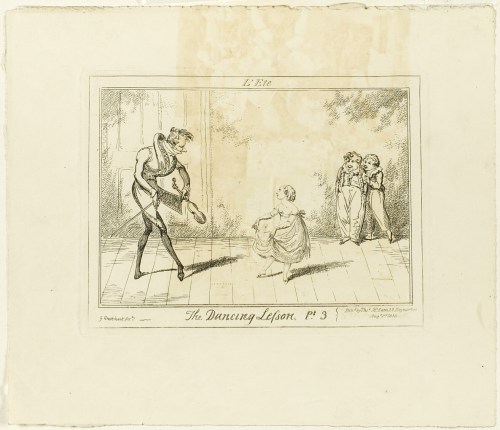
The Dancing Lesson, Pt 3, George Cruikshank, 1825. The Art Institute of Chicago, image in the public domain.

The dancing master in the above image, was employed to teach children the steps and dance moves of the latest dances.

Talented and professional individuals – music teachers, dance instructors, tutors and the like –  often had their services enlisted beforehand, and likely travelled by stage coach or on horseback to their destinations. They would stay in a nearby village or with the family that employed them for the duration of their contract before moving on.

Other people with various skills travelled between cities and towns either looking for work, or to sell their wares. They sold items as varied as kitchen equipment in town squares or brightly colored ribbons at county fairs. Some individuals crossed the English Channel, carrying fashion books and paper dolls* to inform the populace about the latest changes in fashions. I imagine farriers and blacksmiths were in hight demand, since horses were vital. Others offered seasonal labor in exchange for a meal or a place to sleep. Some were beggars or vagabonds who scrounged for any scraps.

The sad fact was that in a land of plenty, land enclosures took away the common fields from villagers by fencing off the shared, common lands, which were vital to rural folks by providing grazing land for livestock, and offering legal ways to gather firewood or hunt game. The impact of enclosures on commoners was enormous, as their independence was taken away. Many left their villages and homes, looking for work in cities and elsewhere, making their situation worse than before. 

Beggar in early 19th C. London, John Thomas Smith, Spitalfields Life.His broom indicates that he might have been a street sweeper.

Itinerants also cadged free rides from friendly farmers and workers, or hitched a ride to the next town. They might take a seat in the back of a humble cart for a few miles, and then continue their walk. Again, a workman/woman might offer their menial services in return for a favor. 

Below are images of a variety of itinerant travellers. The first was created by the incomparable Thomas Rowlandson, of whom I am an enormous admirer.


Aerostation out at Elbows ~

or the Itinerant Aeronaut

Behold an Hero comely tall and fair!

His only Food. Phlogisticated Air!

Now on the Wings of Mighty Winds he rides!

Now torn thro’ Hedges!–Dashed in Oceans tides!


Now drooping roams about from Town to Town

Collecting Pence t’inflate his poor balloon,

Pity the Wight and something to him give,

To purchase Gas to keep his Frame alive. ~

The above copyright free image by Thomas Rowlandson is called Aerostation out at Elbows, or The Itinerant Aeronaut, 1785, Met Museum. The poem below the image is about Vincent Lunardi, an Italian balloonist, whose successful balloon ride was of short duration. Sadly he died in poverty.

Wandering musicians during the Georgian era were also known as gleemen. 

Detail of street musicians in London surrounded by a crowd, Thomas Rowlandson.

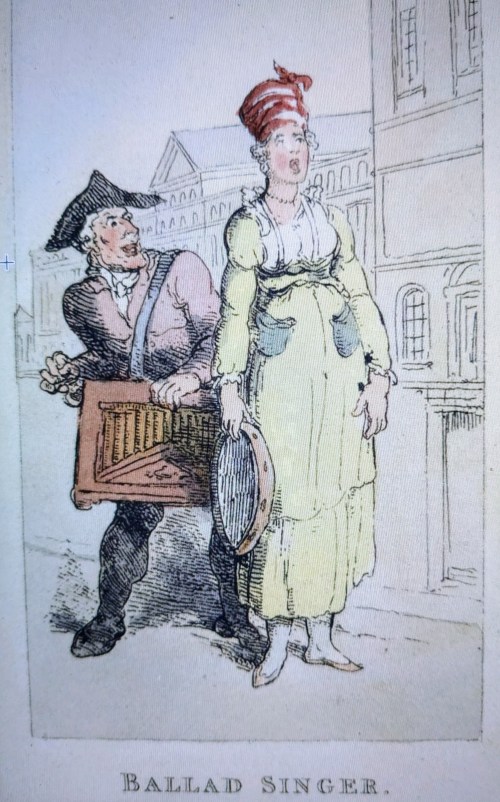
A ballad singer

A Ballad Singer, Thomas Rowlandson, 1820, from Characteristic Sketches of the Lower Orders, British Library

Wagons and carts for the common folk 

Unlike the fancy carriages and equipages of the well heeled, conveyances for the lower classes were ordinary wagons, rough hewn carts, drays, wheelbarrows, wagonettes, pushcarts, donkey or pony carts, and the like. 

This link to a Thomas Rowlandson image of country carts (1810) shows ordinary country folk setting out on a journey. These are a few details of that image:

Setting out behind the covered wagon

Loading the wagon

Larger covered wagons were also used for longer distances. This wagon, to my way of thinking, is the poor man’s stage coach.

Rowlandson, Flying Wagon, 1816, MET Museum, public domain

In Mr. Rowlandson’s England, Robert Southey described the laboriously slow progress of a flying wagon:

The English mode of travelling is excellently adapted for every thing, except for seeing the country…We met a stage-waggon, the vehicle in which baggage is transported, I could not imagine what this could be; a huge carriage upon four wheels of prodigious breadth, very wide and very long, and arched over with a cloth like a bower, at a considerable height: this monstrous machine was drawn by six large horses, whose neck-bells were heard far off as they approached; the carrier walked beside them, with a long whip upon his shoulder…these waggons are day and night upon their way, and are oddly enough called flying waggons, though of all machines they travel the slowest, slower than even a travelling funeral.” – P 23    

Thomas Rowlandson, Country Folk Leaving for the Town, 1818

Take a peek inside this link to Meisterdrucke.us of Thomas Rowlandson’s cartoon ‘Depicting Country Folk Leaving for the Town’. It’s a joyous event, with all the people setting off to…where? A country fair perhaps? The procession is obviously as slow as the Flying Wagon, for many people are walking in pairs and carrying baskets (Food for personal consumption? Produce or goods for sale or barter?).

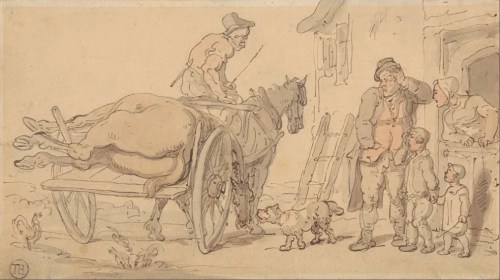
Lastly, this image by Rowlandson of a cart carrying a dead horse to the knacker is sad in several respects. Not only has the family lost a valuable animal, but, looking at the faces of the parents, much of their livelihood as well. One can’t imagine that they can afford to purchase another horse any time soon.

A Dead Horse on a Knacker’s Cart, Thomas Rowlandson, Undated, Yale Center for British Art, Public Domain

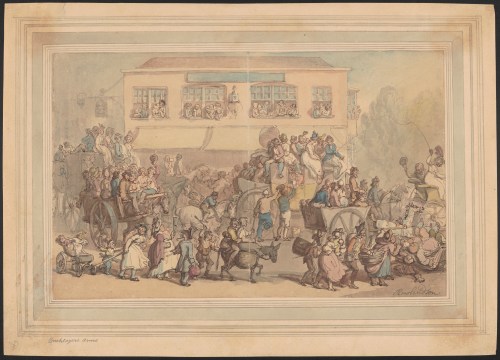
Bricklayers Arms, an image by Thomas Rowlandson, sums up the variety of wagons and methods of transportation.

Stage Coaches

These coaches were unattainable for the very poor, but the working classes could afford an uncomfortable spot on an exposed space ‘up top’. 

A Laden Stage Coach Outside a Posting Inn

Thomas Rowlandson, Stage Coach, 1787, Met Museum, Public Domain

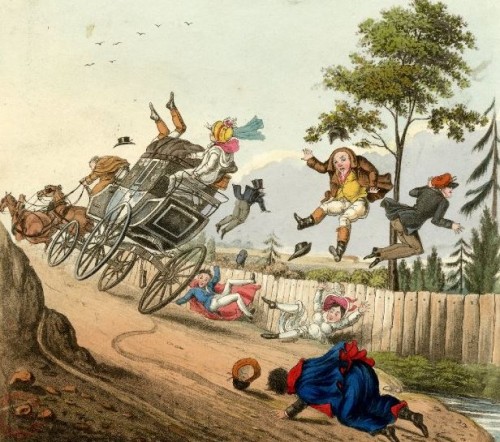
Given the road conditions, ‘up top’ could be a dangerous choice, as one of the images below shows. Newspaper clippings of the time mentioned the deaths of passengers thrown violently to the ground when a stage coach was involved in an accident.

Stage Coach Perils, Donna Hatch, Coach Travel in Regency England: Stage and Mail Coaches

Should everything go right on the journey, and the coach stops at a coaching inn, the unfortunate individuals ‘up top’ are then …”directed to the kitchen with the pedestrians, gypsies, itinerant labourers and soldiers. Do not expect help getting off the eight foot high coach; if you were a lady, you would not be on top in the first place, would you?” A Guide to the Georgian Coaching Inn

Transportation across water

Travellers faced many impediments as they progressed along rural roads, a major one being water. While larger cities and towns provided bridges, most villages surrounded by country lanes did not have this luxury. Passage over small streams was possible – large rocks were frequently placed at comfortable intervals to make walking easier. 

Methods of transportation across a wide and deeper stream or river included a ferry, or a pulley and rope system to tow a wood platform from one bank to the other. (3) 

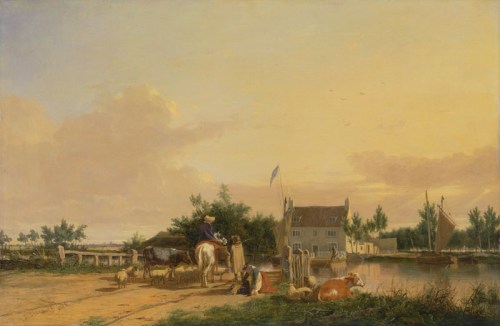
This painting by Joseph Stannard dates from 1826 and shows The Ferry House Inn from the opposite riverbank. Crossing the Yare – Buckenham Ferry

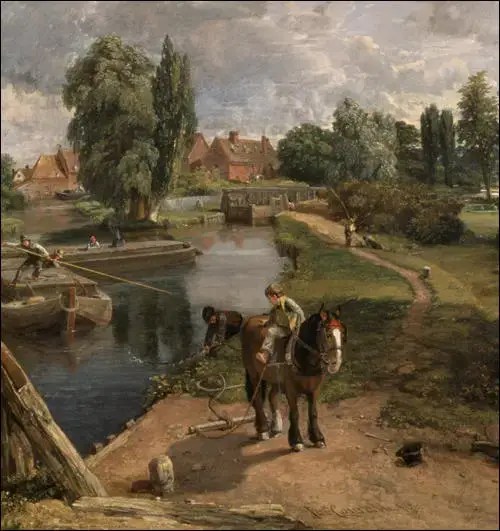
John Constable, Ferry Crossing, River at East Bergholt in Essex, 1817

Barges pulled by horses and mules along towpaths provided inner- and inter-city travel along a system of interconnected canals, which sped the movement of people and goods. 

“A horse, towing a boat with a rope from the towpath, could pull fifty times as much cargo as it could pull in a cart or wagon on roads. In the early days of the Canal Age, from about 1740, all boats and barges were towed by horse, mule, hinny, pony or sometimes a pair of donkeys.” Wikipedia, Horse-drawn boat

As mentioned, ferries, canal boats, and barges carried heavier loads. These boats also provided accessibility and affordability to a variety of people from different classes.

Sources:

(1) Distance and Time In Regency England, By Wade H. Mann, author of A Most Excellent Understanding, Q&Q Publishing, Jun 8, 2022

(2) Mrs Hurst Dancing, To find more images by Diana Sperling, click on this page to the Jane Austen Centre. 

(3) Ferrymen and water men: Water Transportation and Moving in Regency England

Not quite related to this topic, but equally as fascinating are:

Read Full Post »
By Brenda S. Cox

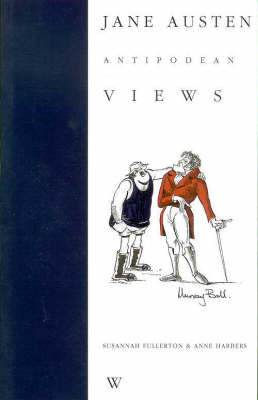
“In 1775, Cassandra Austen gave birth to her second daughter whom she named Jane. The same year Captain James Cook was made a Fellow of the Royal Society, in recognition of his achievements in reaching Botany Bay, claiming New South Wales for the British Government and landing on the islands of New Zealand. Cassandra and George Austen, gazing fondly at their new baby, could never have dreamed that one day their little girl’s name would be familiar and admired in those new British territories on the other side of the world.”—Jane Austen: Antipodean Views, by Susannah Fullerton and Anne Harbers Amazon UK link

Antipodean Views goes on to tell us that Jane Austen certainly knew about Australia. Her brother mentioned Botany Bay in one of his published articles, and her aunt almost got transported there when she was accused of theft. The Exeter Exchange in London had a kangaroo, which Jane’s sister Cassandra probably saw. Austen never mentions Australia in her novels, but many “down under” love Jane today.

Jane Austen: Antipodean Views, by Susannah Fullerton and Anne Harbers, quotes many Australians and New Zealanders telling why they love Jane Austen (or don’t).

When Susannah Fullerton, president of the Jane Austen Society of Australia, invited me to come speak to the JASA in Sydney, I thought, “It’s just too far!” From where I live in the eastern United States, it is quite a distance. Traveling from Atlanta to Sydney takes at least 20 hours, and can be more than 40 hours, depending on stops and layovers. The time change is 14 hours. (So noon on Monday in Atlanta is 2 AM on Tuesday in Sydney.) You cross the international dateline both going and coming back, so you lose a day going, and get it back when you return. So it’s a big commitment to go that far.

I met Susannah at the 2022 AGM in Victoria, Canada, where she gave a wonderful talk on “The Many Duels of Sense and Sensibility,” even after she had traveled halfway around the world. (My favorite part was her discussion of Elinor and Lucy’s verbal duels.) Susannah also leads literary tours, taking groups from Australia (and elsewhere) to England, Europe, and North America. So I thought if she could do all that travel and still talk coherently, I could attempt it as well. I decided to take this wonderful opportunity to see a new part of the world.

Jane Austen enthusiasts down under are part of a network of Janeites stretching around the world. The JASNA (US and Canada) website lists Jane Austen Societies in the U.K., Australia (including groups in Adelaide and Melbourne as well as the main JASA), Argentina, Austria, Brazil, Chile, the Czech Republic, Denmark, India, Italy, Japan, Mexico, the Netherlands, New Zealand, Pakistan, and Spain. That list touches on five of the seven continents. (Any Jane Austen societies in Africa or Antarctica? Or other countries not listed here? Tell us!)

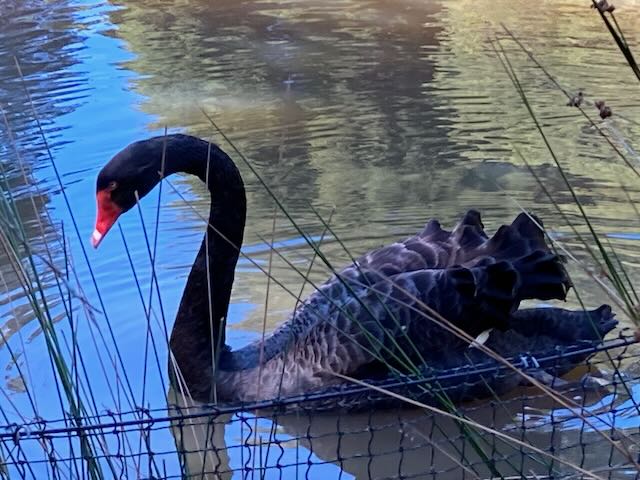
Black swan at the Melbourne Zoo.
Does a trip to the other side of the world sound impossible to you? The black swan, in ancient times, was a symbol of the impossible–until European explorers discovered them in Australia! The term black swan “subsequently metamorphosed to connote the idea that a perceived impossibility might later be disproved.” (Wikipedia) Photo © Brenda S. Cox, 2024

Travels in Australia: Melbourne

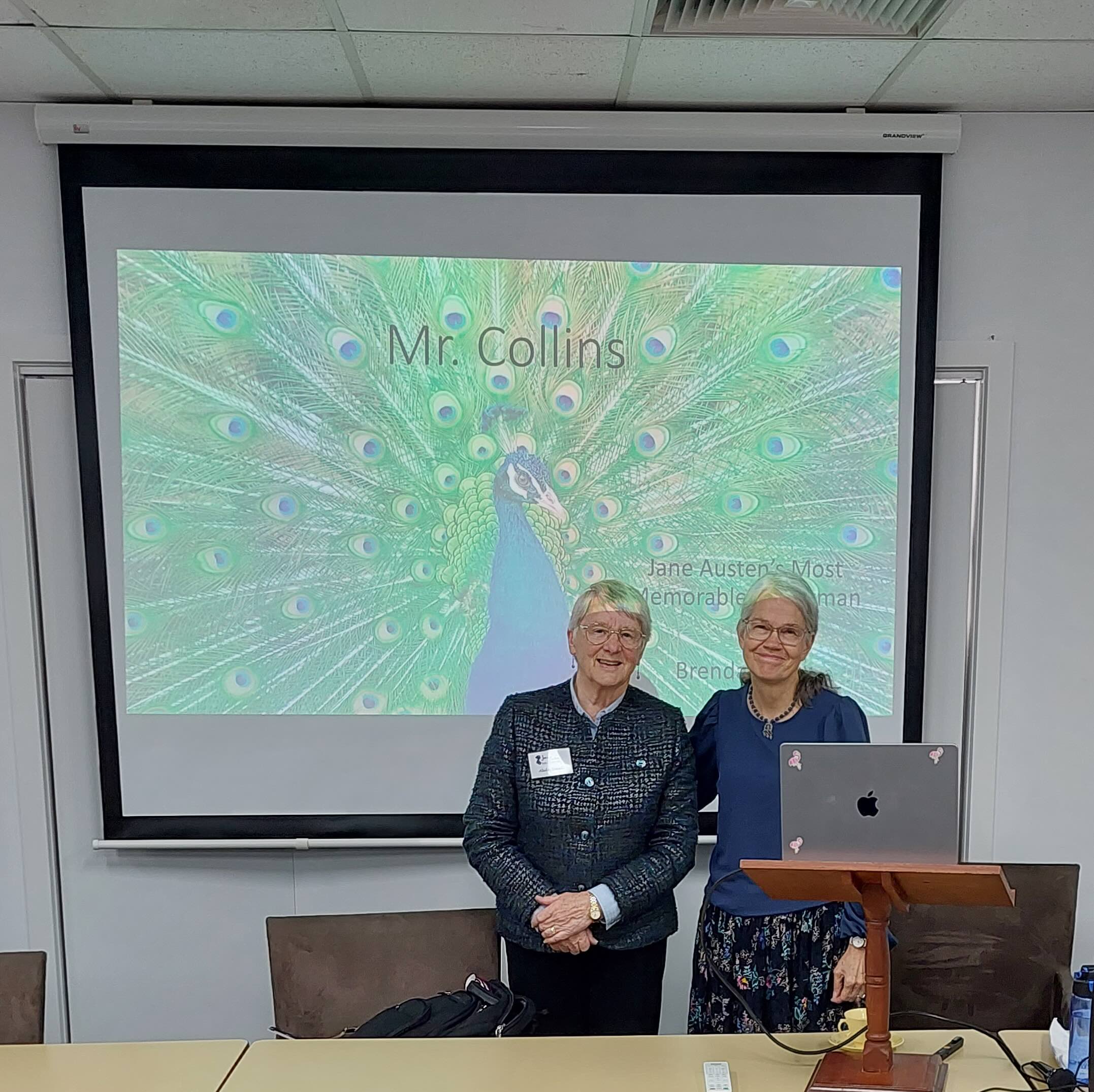
On my recent trip, I got to meet with delightful Jane Austen lovers in both Australia and New Zealand. It was complicated coordinating with all their schedules. But in the end I had opportunities to share my talk, “Why Mr Collins?: The Church and Clergy in Jane Austen’s Novels,” with enthusiastic groups in five cities.

My husband and I started in Melbourne, where Dr. Alida Sewell and her husband kindly hosted us in their home for a week, giving us a chance to start getting over jetlag. Alida edits the bimonthly Newsletter of the Jane Austen Society of Melbourne, which includes book reviews and Austen-related news from around the world. Alida and I got in contact when she reviewed my book, Fashionable Goodness: Christianity in Jane Austen’s England, back in February of 2023, and she also encouraged me to visit.

The Jane Austen Society of Melbourne was founded more than thirty years ago, in 1993. On the day I spoke to the Melbourne group, we had a lovely lunch with the committee members before I got to share with 25 or so participants about Mr. Collins. After a lively discussion, some members took home signed copies of my book. 

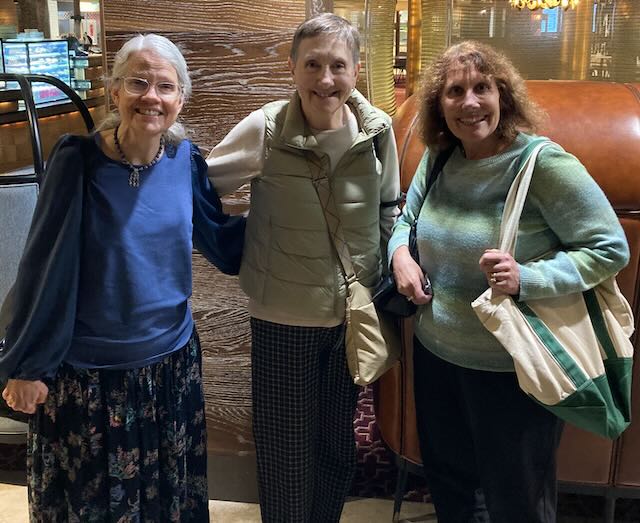
Dr. Alida Sewell, editor of the Jane Austen Society of Melbourne Newsletter, with Brenda S. Cox, who spoke on “Why Mr. Collins”
Photo © Brenda S. Cox, 2024

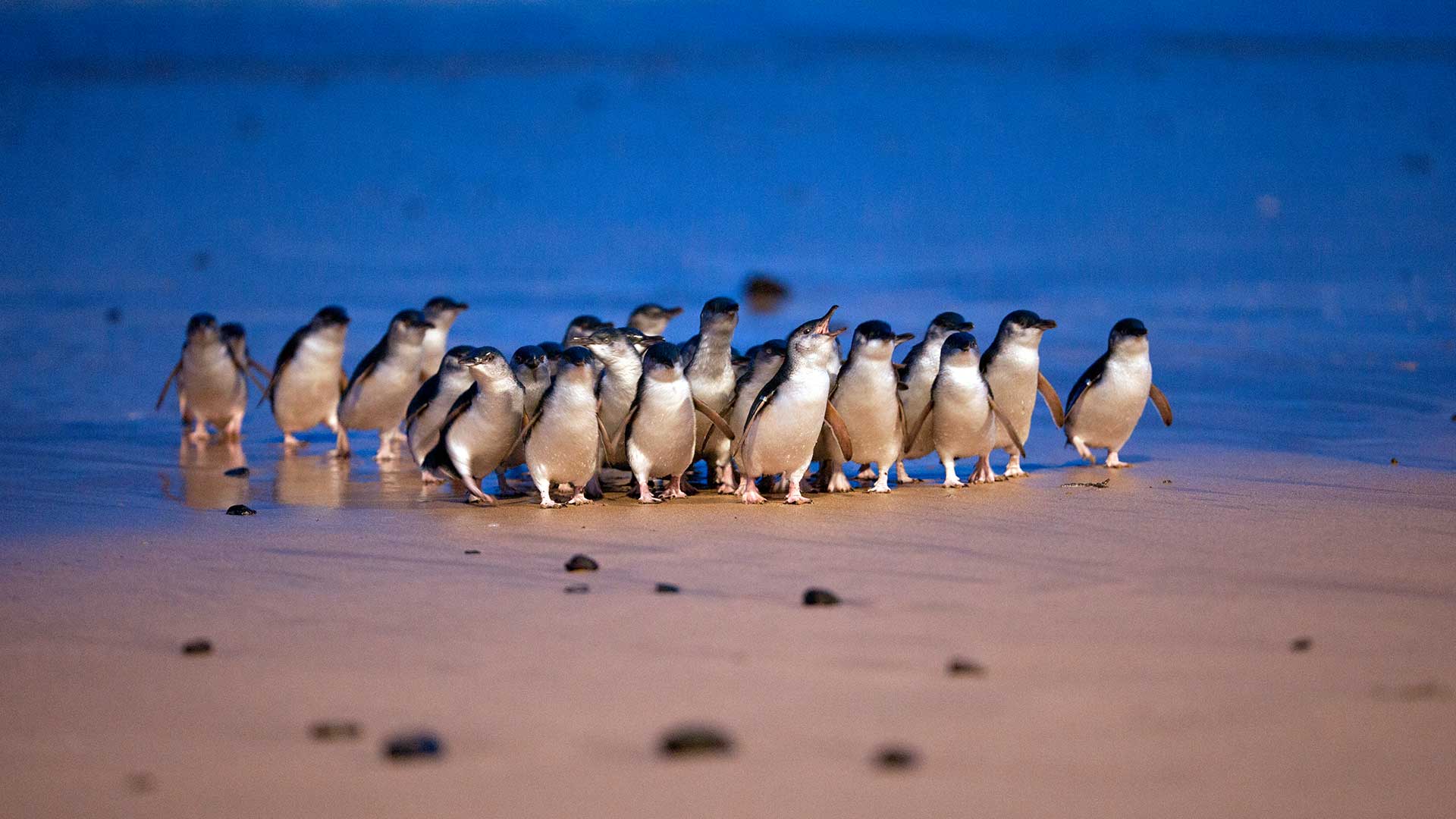
In every place we visited, my husband I went to see some of the unique wildlife of the country. Near Melbourne, we had the delightful experience of seeing hundreds of little penguins, blue and white penguins only 16 inches tall, waddling in from the sea in the evening. Alida also took us to the Moonlit Animal Sanctuary, where we could pet wallabies and kangaroos. We also met gorgeous Australian birds like the pink cockatoo, with its sunset colored crest , and the well-camouflaged tawny frogmouth.

Adorable “little penguins” at Philip Island. Photo courtesy of the Philip Island Penguin Parade website.

Travels in Australia: Brisbane

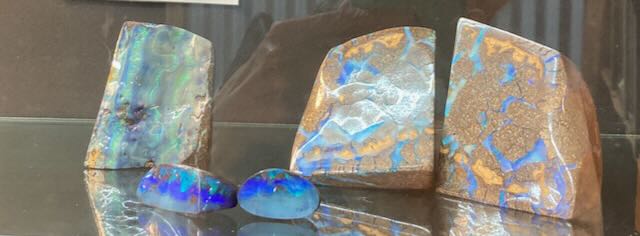
From Melbourne we headed to Brisbane, where Barbara O’Rourke, a member of the local Jane Austen Society committee, generously ferried us around. I got to pet a koala bear at the Lone Pine Koala Sanctuary. We also saw lovely opals, the national gemstone of Australia, at the Brisbane Opal Museum. Australia still produces 95% of the world’s precious opals.

Stunning Queensland Boulder Opals at the Opal Museum in Brisbane,
Photo © Brenda S. Cox, 2024

I spoke to around 70 keen Janeites in Brisbane, and got to order extra books for them beyond the ones I had brought to sell (as I also did in Sydney and Wellington later on! I loved their enthusiasm). This is the twenty-second year of the Brisbane group, which has around a hundred members total. A committee of seven people lead them, each of those seven “doing what they do best,” so that all roles are covered.

At meetings the Brisbane branch of the Jane Austen Society of Australia offers a Regency Fair table. I saw a wide range of interesting-looking materials there. Members bring in Austen-related books and magazines they are finished reading. These are offered for sale at a low, nominal price, which goes to benefit the Society. Books may be donated back later, making it similar to a rotating library, but without anyone needing to keep track of loans and returns. Conversations often start up around the table, giving members opportunities to interact. I love this idea: recycling, networking, and giving everyone a chance to learn and enjoy more of Jane Austen!

The next week we visited friends on the “Sunshine Coast” north of Brisbane, enjoying more birds and wildlife, as well as a ginger factory where we learned about the production of ginger and honey. 

Travels in Australia: Sydney and Southern Highlands

Finally we made it to Sydney, where the Taronga Zoo gave us a fantastic final look at Australia’s very special animals and birds, ranging from platypus and potoroo to giant emus and bright honeyeaters.

An amazing platypus, a mammal that lays eggs and has a duck’s bill, zipping through the water at an Australian zoo. Photo © Brenda S. Cox, 2024

From Sydney, Susannah Fullerton took us out to the Southern Highlands, where we saw a bit of Australia’s frontier culture, then met with another keen group of about twenty Janeites for lunch and my talk.

At the Southern Highlands Jane Austen meeting, Brenda Cox, Jan Merriman (coordinator for Southern Highlands), and JASA President Susannah Fullerton. Photo © Brenda S. Cox, 2024
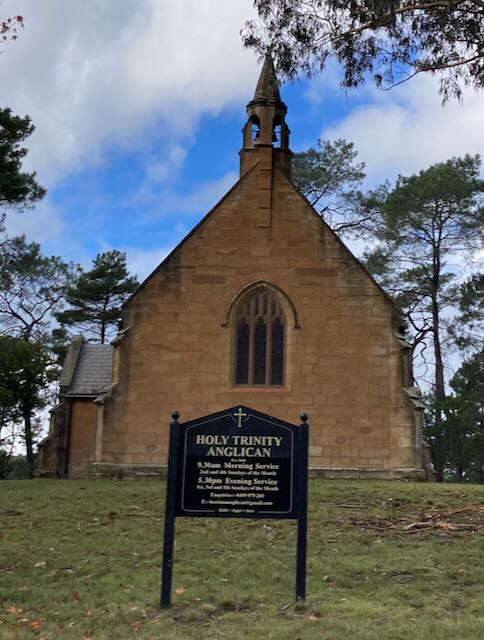
Holy Trinity Anglican Church, Berrima, established in 1849.
Photo © Brenda S. Cox, 2024

Jane Austen Society of Australia Day Conference on Jane Austen and the Church

That Saturday the JASA hosted an all-day conference on “Mr. Collins’ Profession: Jane Austen and the Church.” We began with my talk on Mr. Collins, which explores why Austen, a devout Anglican Christian, chose to portray Mr. Collins as she did, and what his life and challenges were as a clergyman at this time. Then we got to hear about other aspects of the church in Austen’s time, from excellent speakers.

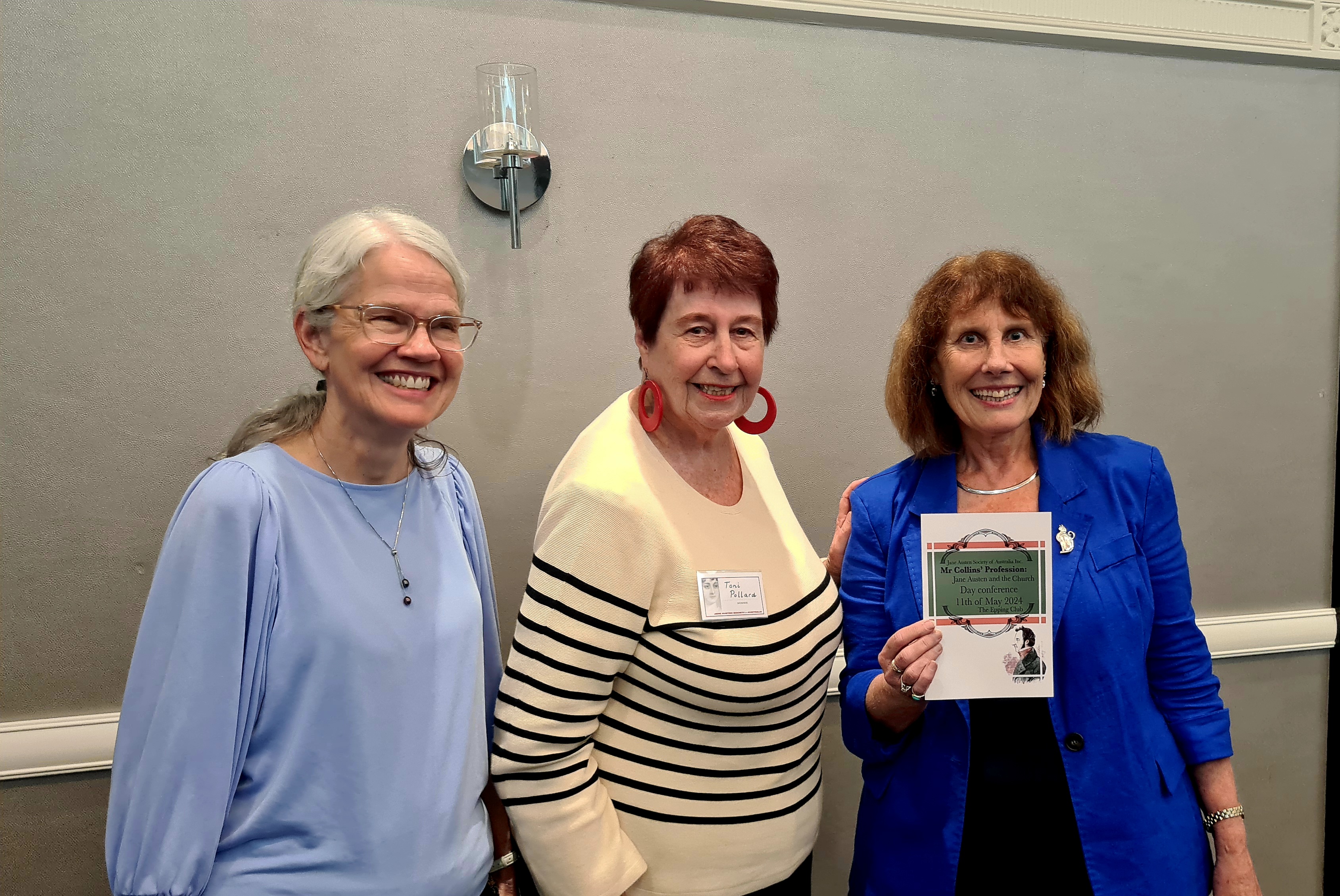
Brenda S. Cox (speaker), Toni Pollard, and Susannah Fullerton (president), holding the conference brochure, at the JASA conference on Jane Austen and the Church, Photo courtesy of JASA

Anne Harbers, writer and art historian, showed us images of clergy from the time, and explained what those images show us. One that fascinated me was Rev. Humphry Gainsborough, the artist Gainsborough’s brother. He was the pastor of an Independent Chapel as well as an engineer and inventor. You may have one of his inventions on your front door—a lock with a chain, that allows the door to be partially opened. Rev. Gainsborough invented that type of lock for the gate of his parsonage in Henley, England.

Roslyn Russell then told us about sermons and devotional literature in Austen’s novels, contrasting her perspective with later authors Anthony Trollope and Barbara Pym. I especially enjoyed meeting Roslyn since I enjoyed her novel, Maria Returns: Barbados to Mansfield Park, which gives Maria Bertram her own happy ending. 

We got even deeper with Scott Stephens’ fascinating talk, “‘How could you be so unfeeling?’: Moral Encounter and its Counterfeits in Jane Austen’s Later Fiction.” He talked about moral encounters, and where deep ones occur in Austen’s novels (for example, on the tops of hills, or in letters), and where shallow counterfeits occur (such as in Bath).

I had the privilege of finishing off a great day by giving a brief talk on “‘Her Parish and Her Poultry’: The Lives of Clergymen’s Wives in Austen’s World.” We explored the similarities and differences between the lives of clergymen’s wives and of gentry wives in the English countryside of Austen’s time.

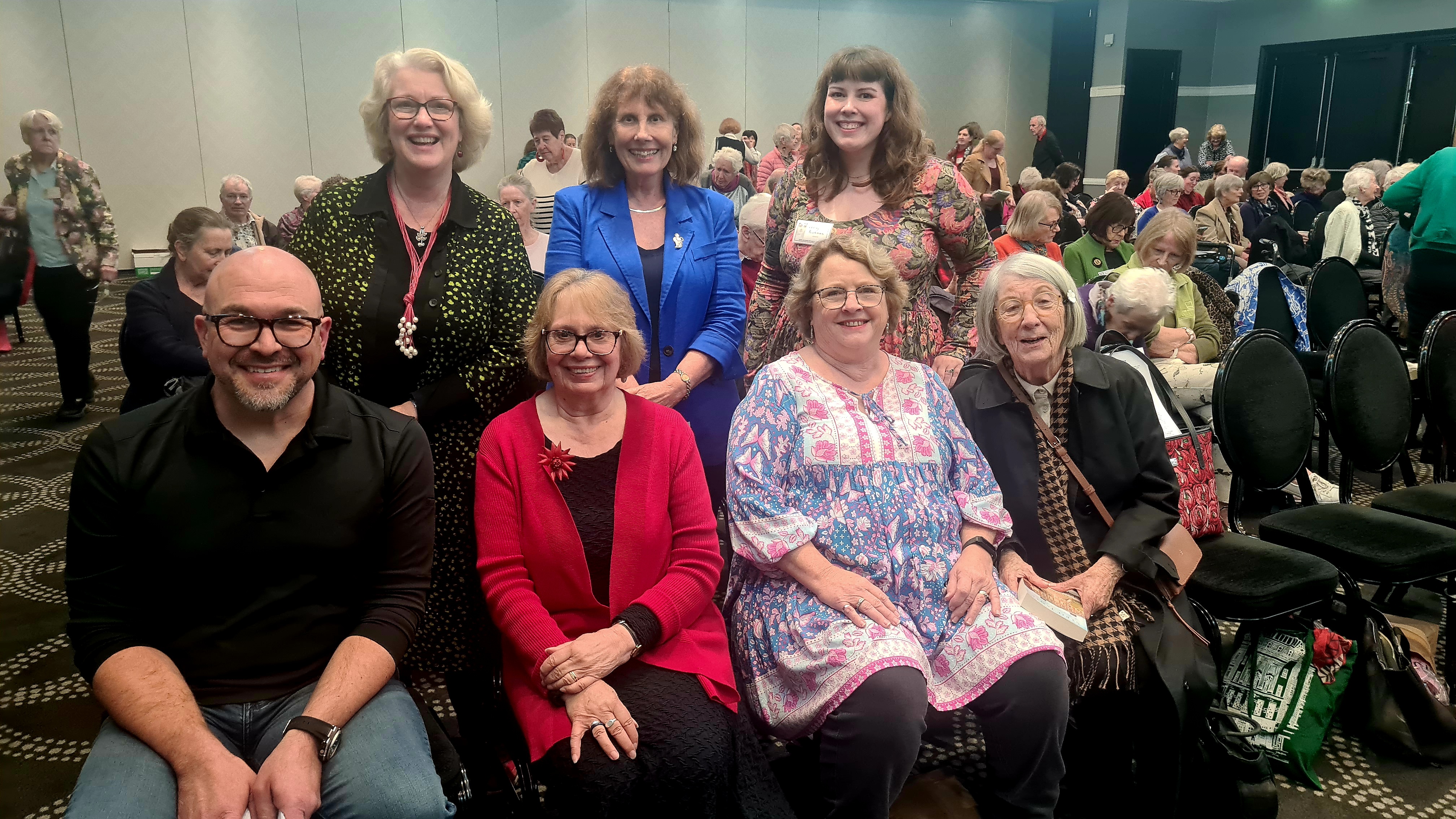
At the JASA Day Conference on Jane Austen and the Church: L-R Back Row: Anne Harbers (speaker), Susannah Fullerton (JASA President), Lesley Rickman (graphic artist who designed the program and other JASA material)
Front Row: Scott Stephens (ABC Australia Journalist and speaker), Dr Roslyn Russell (speaker), Cheryl Hill (JASA Membership Secretary & AV operator), Dr Ruth Wilson (JASA Patron and author of The Jane Austen Remedy).
Photo courtesy of JASA.

The Jane Austen Society of Australia, founded in 1989, has over 500 members. Its regular meetings (not AGMs) are the largest of any Jane Austen Society in the world, averaging around 130 people per meeting. Participants at the Day Conference came from Sydney (where the meeting was held), Melbourne, Canberra, Queensland, and all over New South Wales.

JASA publishes a yearly Chronicle of news and reports, twice-yearly newsheets called Practicalities, and a yearly journal of scholarly papers called Sensibilities. This year’s Sensibilities will include articles based on the talks at the Day Conference, among others. I look forward to reading them, since there’s so much more I could glean! 

On Sunday we got to see a bit of Sydney, worshiping at lovely St. Andrew’s Anglican Cathedral, founded in 1819, soon after Austen’s death. Building on its long history, the church seems to be vibrant and lively today. Placards around the church gave summaries of the Christian message in many languages, for this multicultural city.

After lunch and birdwatching in the park, we visited the Hyde Park Barracks,  which originally held transported convicts, then women immigrants. The museum gave us impressions of some of Australia’s tumultuous history, including the tragic impact on Aboriginal communities.

Travels in New Zealand: Wellington and Beyond

The next day we flew to New Zealand, which is not as close as one might imagine! We saw yellow-eyed penguins, a blue whale, and royal albatrosses in Dunedin, a city with a Scottish flavor on New Zealand’s South Island. On the North Island we visited hobbit homes in Hobbiton (definitely a highlight of the trip); saw amazing geothermal formations and baby kiwis in Rotorua, and toured a Maori village; and marveled at a cave full of glowworms in Waitomo.

Brenda Cox visiting a hobbit house in Hobbiton, New Zealand. Photo © Brenda S. Cox, 2024

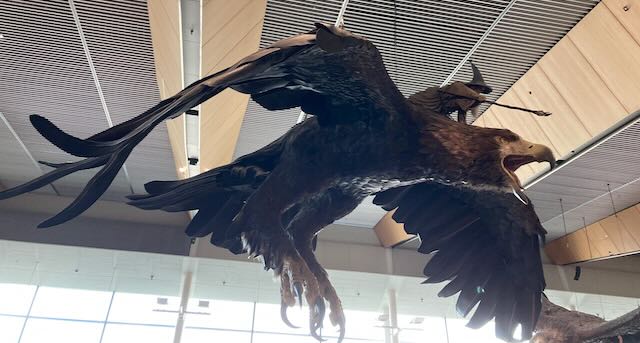
Our Jane Austen encounter was in Wellington, New Zealand. We could see Wellington’s literary and cultural associations immediately. The airport has statues of Gandalf on an eagle, a dragon, and a Doctor Who police box! Frances Duncan, who founded and runs the Jane Austen Society of New Zealand, met us at the airport with Sian Farr, who kindly hosted us in her home and showed us some sights.

Gandalf rides an eagle in the Wellington, New Zealand airport. The Hobbit and The Lord of the Rings movies were filmed in beautiful New Zealand. Photo © Brenda S. Cox, 2024

In Wellington, an eager group of Janeites met with me to discuss Mr. Collins, Jane Austen, and the church. We had a delicious tea, and afterwards they asked great questions. Frances Duncan started the Jane Austen Society of Aotearoa New Zealand just ten years ago, and it has been growing. About 25 people attended the meeting. I hope it spreads to many corners of the beautiful country of New Zealand, across the mountains and along the sea. Contact Frances through their website if you want to start up a Jane Austen group elsewhere in the country.

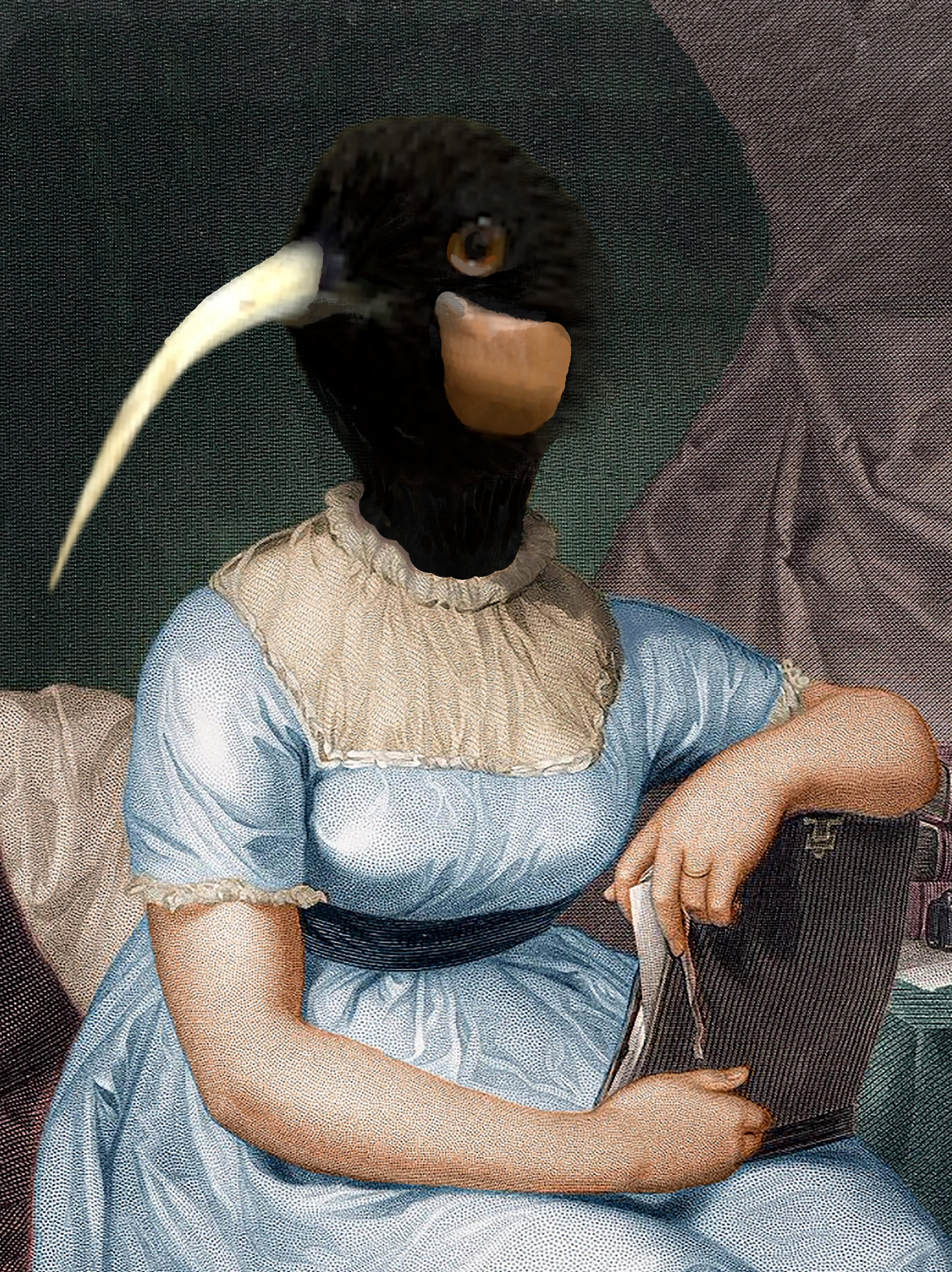
The Jane Austen Society of Aotearoa New Zealand sells humorous merchandise, including this picture of Jane Austen as a huia, a now-extinct New Zealand songbird, described as the bird with the most beautiful song. It was hunted for its feathers, a symbol of leadership and power. They chose it since it is an easily recognizable symbol of New Zealand, and it is extinct—as is Austen. A bit of kiwi humor, says Frances Duncan.
Photo courtesy of Frances Duncan

We enjoyed many of the fascinating birds of New Zealand. My favorite place in Wellington was Zealandia. This nature preserve in the city has specially designed fences to keep out the many non-native predators which have decimated the country’s unique native birds. Now kiwi and other birds are thriving in the preserve and surrounding areas.

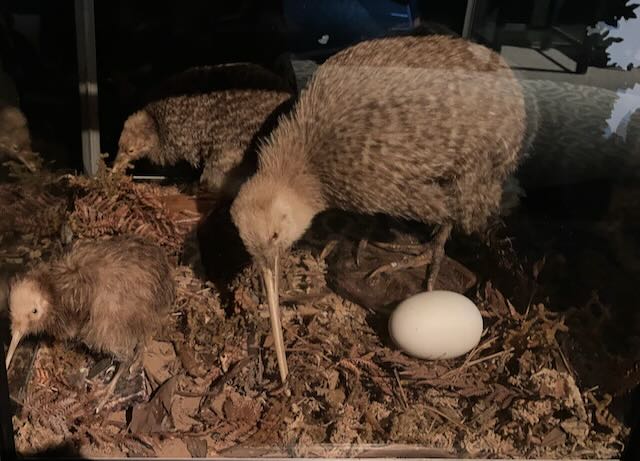
Kiwi exhibit in New Zealand. (The live ones we saw were in nocturnal houses, with red lighting.) Kiwi are adorable endangered birds of New Zealand. (Technically, four species are currently “vulnerable” and one is “near threatened.”) The kiwi fruit, which is small, fuzzy, and round, like the bird, and New Zealanders (“kiwis”), are both called after this bird.
Photo © Brenda S. Cox, 2024

I was impressed by the extensive environmental efforts in both Australia and New Zealand, and the strides they are making toward preserving their incomparable native creatures.

What would Jane Austen have thought about bird and animal conservation, if she lived today? We don’t know, of course. But she does mention animals in her novels, and, as a country clergyman’s daughter, she essentially lived on a farm. Her brother James wrote a poem praising clergyman Gilbert White, who lived near Chawton. White is considered the father of modern ecology because of his book, The Natural History of Selborne.

So I’d like to think Jane Austen would have enjoyed a journey like ours, enjoying the natural world. And I hope our great discussions of her novels and the church in her world would have met her approval as well! I certainly loved meeting so many wonderful people who love Jane Austen as I do.

One highlight of our trip was visiting Hobbiton in New Zealand. For an account of that visit, and lots of great photos, see JRR Tolkien’s Hobbiton, in New Zealand.

Are you a Janeite living “down under”? Tell us where you live, and how you celebrate Jane Austen! And if you are looking for kindred spirits, contact the JASA to find other regional groups.

Brenda S. Cox is the author of Fashionable Goodness: Christianity in Jane Austen’s England. She also blogs at Faith, Science, Joy, and Jane Austen.

Read Full Post »
By Brenda S. Cox

“What are young men to rocks and mountains?”—Pride and Prejudice

Rocks and mountains recur in the story of Lady Hester Stanhope, though the mountains she climbed were much farther away than Derbyshire. We all know that women of Jane Austen’s England faced many restrictions. Austen herself published her books as “a lady” rather than under her own name, to avoid any stigma for stepping outside of the box that society prescribed for her.

Yet some women did step out of that box, some of them very far outside the box! Those in the upper classes with enough money could afford to be “eccentric” and go their own ways. (Some in the middle and lower classes did the same, especially if they were widows, but that’s another story.)

Lady Hester Stanhope

One of the most famous, or infamous, of these trailblazing women was Lady Hester Stanhope, Middle Eastern traveler and pioneer archaeologist. Chawton House hosted a talk entitled “Lady Hester Stanhope: Trowelblazer or Iconoclast?” on Feb. 16. 

Lady Hester was born only a few months after Jane Austen, in March of 1776. She was the oldest child of an earl. In 1803 she moved into the home of her uncle, William Pitt the Younger, prime minister of England. She acted as his hostess and private secretary. When he died in 1806, the British government granted Hester a pension of £1200 a year, at Pitt’s request. After several romantic disappointments, she became disillusioned with England. She went overseas in 1810 and never returned to England. She was almost 34.

Shipwrecked on Rhodes

Starting out on a Grand Tour of Europe, she was shipwrecked on the island of Rhodes, losing all her possessions and money. She wrote,


Unable to make the land, I got ashore, not on an island, but a bare rock which stuck up in the sea, and remained thirty hours without food or water. It becoming calmer the second night, I once more put to sea, and fortunately landed upon the island of Rhodes, but above three days’ journey from the town, travelling at the rate of eight hours a day over mountains and dreadful rocks. Could the fashionables I once associated with believe that I could have sufficient composure of mind to have given my orders as distinctly and as positively as if I had been sitting in the midst of them, and that I slept for many hours very sound on the bare rock, covered with a pelisse, and was in a sweet sleep the second night, when I was awoke by the men, who seemed to dread that, as it was becoming calmer, and the wind changing (which would bring the sea in another direction), that we might be washed off the rock before morning. So away I went, putting my faith in that God who has never quite forsaken me in all my various misfortunes. The next place I slept in was a mill, upon sacks of corn; after that, in a hut, where I turned out a poor ass to make more room, and congratulated myself on having a bed of straw. When I arrived (after a day of tremendous fatigue) at a tolerable village, I found myself too ill to proceed the next day, and was fortunate enough to make the acquaintance of a kind-hearted, hospitable Greek gentleman, whom misfortune had sent into obscurity, and he insisted upon keeping me in his house till I was recovered. 

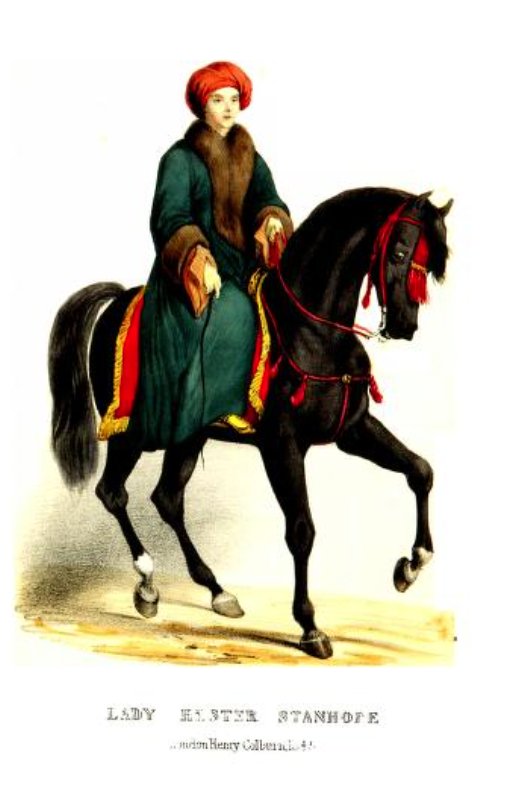
At this point she adopted the Turkish dress of the Ottoman Empire. She explains why she chose men’s clothing:

. . . Everything I possessed I have lost; had I attempted to have saved anything, others would have done the same, and the boat would have been sunk. To collect clothes in this part of the world to dress as an Englishwoman would be next to impossible; at least, it would cost me two years’ income. To dress as a Turkish woman would not do, because I must not be seen to speak to a man; therefore I have nothing left for it but to dress as a Turk — not like the Turks you are in the habit of seeing in England, but as an Asiatic Turk in a travelling dress — just a sort of silk and cotton shirt; next a striped silk and cotton waistcoat; over that another with sleeves, and over that a cloth short jacket without sleeves or half-sleeves, beautifully worked in coloured twist, a large pair of breeches, and Turkish boots, a sash into which goes a brace of pistols, a knife, and a sort of short sword, a belt for powder and shot made of variegated leather, which goes over the shoulder, the pouches the same, and a turban of several colours, put on in a particular way with a large bunch of natural flowers on one side. This is the dress of the common Asiatic; the great men are covered with gold and embroidery, and nothing can be more splendid and becoming than their dress. (Life and Letters of Lady Hester Stanhope, 116-117)

The clothes sound quite sumptuous, and she seems to have enjoyed them! As a foreign woman, and a woman in men’s clothing, Lady Hester occupied an unusual place in Ottoman society. She could be treated as more or less an “honorary man,” relating to local men in ways that local women could not.

Lady Hester Stanhope wearing Turkish men’s clothing. Frontispiece, Memoirs of the Lady Hester Stanhope, Vol. 1 (London: Henry Colburn, 1846).

Egypt to Palmyra

Lady Hester traveled deeper into the Middle East. She wasn’t much impressed with the wonders of Egypt. She refused to enter the Great Pyramid and complained of “an inconceivable number of fleas.” Many English tourists visited Egypt, and she wanted to do something more impressive.

Because of her background with Pitt in politics, and her connections, she was able to get permission from the Ottoman Pasha to go to Palmyra, an ancient city in the Syrian desert. When she reached it with her Beduin caravan after six days of travel, they “crowned” her “Queen of the Desert,” after the ancient Queen Zenobia.

During her travels, Lady Hester constantly racked up debts, and wrote back to the English government asking for money. They sometimes ended up paying because of her high connections.

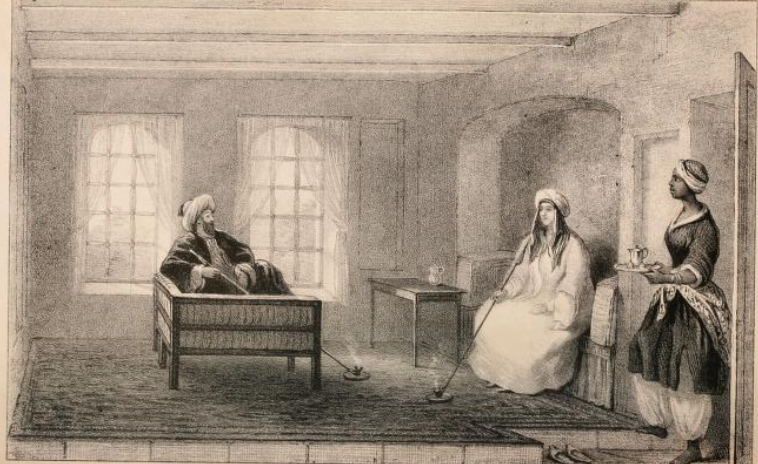
Lady Hester Stanhope smoking a Turkish pipe. Frontispiece, Memoirs of the Lady Hester Stanhope, Vol. 2 (London: Henry Colburn, 1845).

Archaeologist; Searching for Treasure

Emma Yandle, curator of the Chawton House exhibition on “Trailblazers: Women Travel Writers,” went on to discuss Lady Hester Stanhope’s somewhat questionable contributions to archaeology. Lady Hester was arguably the first Westerner given official permission to excavate an ancient site; certainly she was the first woman to do so.

Lady Hester somehow obtained a manuscript, purportedly written by a monk, describing the location of immense hoards of buried treasure (three million gold coins!) in the ancient cities of Ashkelon, Awgy (near Jaffa), and Sidon. She got permission and safe conduct letters from the Ottoman government to excavate at Ashkelon. She promised the Ottoman government all the treasure she would find. She asked the British government to pay for the excavations, simply for the honor it would bring to England and to herself.

Excavations began in April of 1815. Lady Hester was the visionary, nominally in charge. Actually, though, her personal physician, Dr. Charles Meryon, directed the excavations and kept the records. They found no gold coins.

They did, however, find one archaeological treasure. It appeared to be a Roman statue, somewhat mutilated. According to a later biography, this made Lady Hester Stanhope “the first person who ever intentionally excavated an ancient artifact in the ‘Holy Land.’”

However, Lady Hester feared that if the Ottoman ruler heard about this, he would believe that she was excavating treasures to send back to her native England. She had promised she would not do that. (Many others of the time were plundering the various countries they colonized.) So—she destroyed the statue! She had it smashed and thrown into the sea. A very strange decision.

We still have drawings and a description of the statue, but that’s all. A much later archaeological expedition, in 1921, found what were apparently the missing pieces of that statue.

The records of the expedition, however, gave a lot of historical information. The layers of history that were uncovered were recorded: a Roman temple at the lowest layer, above it a church, and over that a mosque. (This was confirmed by the later expedition.) They also recorded the locations of any artifacts found. This was a new procedure. Other diggings at the time simply took whatever they could find and shipped it off to museums or private collections, with no details of location or depth. So Lady Hester’s excavation did blaze new trails for archaeology.

End of Life

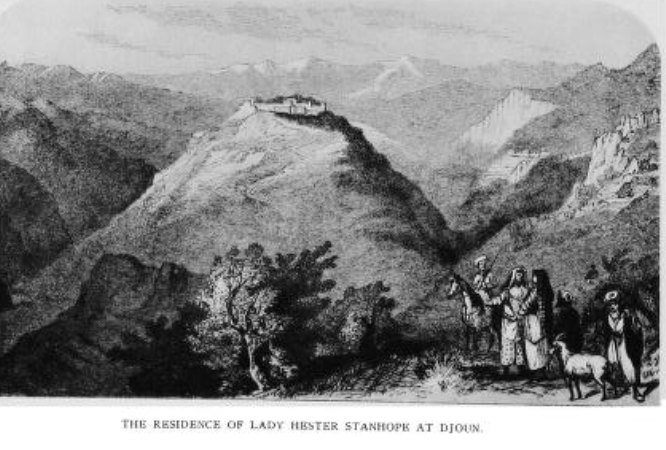
Lady Hester Stanhope later settled on a mountaintop among the Druze people of Lebanon, near Sidon. She became disastrously involved in Middle Eastern conflicts, and went deeper and deeper into debt. She died, penniless and alone, in 1839.

The Residence of Lady Hester Stanhope at Djoun. Frontispiece, The Life and Letters of Lady Hester Stanhope, by her niece the Duchess of Cleveland (London: John Murray, 1914).

Dr. Meryon, who had accompanied her on many of her travels, wrote her memoirs in 1845-6, romanticizing her story.

Paul Pattison, at English Heritage, summarizes Lady Hester Stanhope’s life: 

She was always a wilful aristocrat, who wanted to govern her life and the lives of others – indeed believed it was her position in life to do so – and on occasions she was overbearing and unkind. But she was also vivacious, daring, sharp-witted, charismatic, benevolent, and brave to the point of recklessness. 

Above all, she rejected society conventions and the restrictions of life for a woman in Europe, embracing the unexpected opportunity to be her own mistress within an Eastern culture that excluded women from public life. That alone sets her apart as a pioneer and an extraordinary human being.

As far as I’ve been able to discover, Jane Austen never mentioned Hester Stanhope in her letters. She may have known of some of her exploits, however. Both were trailblazers: Jane, quietly, from her home; and Hester, flamboyantly, in exotic places.


Resources about Lady Hester Stanhope

Memoirs of the Lady Hester Stanhope; the sequel, Travels of Lady Hester Stanhope; and Life and Letters of Lady Hester Stanhope, are available on archive.org

Lady Hester, Queen of the East, by Lorna Gibb

Star of the Morning: The Extraordinary Life of Lady Hester Stanhope, by Kirsten Ellis


Brenda S. Cox is the author of Fashionable Goodness: Christianity in Jane Austen’s England. She also writes for Faith, Science, Joy, and Jane Austen.


Read Full Post »
Back in Jane Austen’s day travel was so difficult and laborious over poorly constructed roads that the majority of the people who lived in that century traveled no farther than 14 miles from where they lived. Most walked, and even so they had to contend with muddy roads that were almost impassible after heavy rains or breathe in choking dust during times of drought. (In cities, dusty streets would be watered down by merchants early in the morning.)

Diana Sperling, a party walking to dinner along muddy roads.

Travel at night was dangerous. Without a widespread means of lighting roads or an organized police force, night travelers were at the mercy of highwaymen. In cities, link boys were paid a half pence to carry a light in front of pedestrians, or for those on horseback and in carriages.

Georgian cast iron light fixtures, Landsdowne Crescent in Bath. Note the cones, which extinguished the light.

Lanterns hung in front of city doors or were carried. In the country, torches hung from trees lining a lane that led up to a house. Balls and parties were planned during the full moon, although a rainy or cloudy night would spoil these well-laid plans.

A link boy lights the way in the city, 1827.

The situation would not change until the Industrial Revolution brought about such life altering inventions as gas lights, macadam roads (whose hard surface facilitated smoother travel), the steamboat, and rail travel.

The perils of overcrowding, 1812

The following descriptions of poor road conditions from Old Country Life, a book published in 1892, describes a time just after Jane Austen’s death, but one that her longer lived siblings would have known. While people’s memories of distant events are often faulty, the emotions they felt tend to stay with them. Here then are some eye witness accounts retold many decades later:

What a time people took formerly in travelling over old roads! There is a house just two miles distant from mine, by the new unmapped road. Before 1837, when that road was made, it was reached in so circuitous a manner, and by such bad lanes, and across an unbridged river, that my grandfather and his family when they dined with our neighbours, two miles off, always spent the night at their house.

Negotiating a muddy road. Image @Roads in the 18th Century

In 1762, a rich gentleman, who had lived in a house of business in Lisbon, and had made his fortune, returned to England, and resolved to revisit his paternal home in Norfolk. His wish was further stimulated by the circumstance that his sister and sole surviving relative dwelt beside one of the great broads, where he thought he might combine some shooting with the pleasure of renewing his friendships of childhood. From London to Norwich his way was tolerably smooth and prosperous, and by the aid of a mail coach he performed the journey in three days. But now commenced his difficulties. Between the capital and his sister’s dwelling lay twenty miles of country roads. He ordered a coach and six, and set forth on his fraternal quest. The six hired horses, although of strong Flanders breed, were soon engulfed in a black miry pool, his coach followed, and the merchant was dragged out of the window by two cowherds, and mounted on one of the wheelers; he was brought back to Norwich, and nothing could ever induce him to resume the search for his sister, and to revisit his ancestral home.

Pack horses. Image @The Rolle Canal Company

Roads were in such a poor condition that transportation over rivers and canals was preferred. If waterways were not nearby, pack horses and carrier wagons carried heavy and fragile items into areas were roads were near to impassible. Carrier wagons were sturdy wagons pulled by oxen and covered with canvas cloth.

Items had to be safely packed before they could be transported. Paper was expensive and cardboard boxes had yet to be invented. Goods were carried in cloth sacks, metal canisters, leather baskets, wood barrels, sturdy trunks, or wooden crates. Additional containers were made of cloth, woven straw, crockery, glass, and tin.

18th century coopers making barrels. Image@Instructional Resources Corporation.

The safe preservation of foods in metal containers was finally realized in France in the early 1800s. In 1809, General Napoleon Bonaparte offered 12,000 francs to anyone who could preserve food for his army. Nicholas Appert, a Parisian chef and confectioner, found that food sealed in tin containers and sterilized by boiling could be preserved for long periods. A year later (1810), Peter Durand of Britain  received a patent for tinplate after devising the sealed cylindrical can. – A brief history of packaging

Fragile items like glass and china received extra protection and were wrapped in cloth or straw. Considering the poor road conditions,  it is a wonder that any of these items survived their long journeys intact. View an image and explanation of a stage wagon in this link.

Reliable forms of old-fashioned transportation still exist in this world. Image@Washington Post

Below is a description of a carrier and his wagon.  (click here to see examples):

It is a marvel to us how the old china and glass travelled in those days; but the packer was a man of infinite care and skill in the management of fragile wares.

Does the reader remember the time when all such goods were brought by carriers? How often they got broken if intrusted to the stage-coaches, how rarely if they came by the carrier.  The carrier’s waggon was securely packed, and time was of no object to the driver, he went very slowly and very carefully over bad ground. – Old Country Life, Sabine Baring-Gould, 1892

Breakdown of the Christmas stage, a Victorian illustration. Note that oxen are strapped to an empty cart, ready to take on passengers, who are still 10 miles from their destination.

As noted before, people often spent the night when they arrived as guests for dinner. Once a person made the journey to visit relatives, they tended to stay for weeks, even months. Elizabeth Bennet’s visit with Charlotte was of several weeks duration; Cassandra Austen frequently visited her brother Edward for weeks at a time, which is when Jane would write to her.

City streets were crowded and narrow. Thomas Rowlandson. The Miseries of London. 1807. Image @Lewis Walpole Library

“It is of some importance,” said Sydney Smith, “at what period a man is born. A young man alive at this period hardly knows to what improvements of human life he has been introduced; and I would bring before his notice the changes that have taken place in England since I began to breathe the breath of life—a period of seventy years. I have been nine hours sailing from Dover to Calais before the invention of steam. It took me nine hours to go from Taunton to Bath before the invention of railroads. In going from Taunton to Bath I suffered between ten thousand and twelve thousand severe contusions before stone-breaking MacAdam was born. I paid fifteen pounds in a single year for repair of carriage springs on the pavement of London, and I now glide without noise or fracture on wooden pavement. I can walk without molestation from one end of London to another; or, if tired, get into a cheap and active cab, instead of those cottages on wheels which the hackney coaches were at the beginning of my life. I forgot to add, that as the basket of the stagecoaches in which luggage was then carried had no springs, your clothes were rubbed all to pieces; and that even in the best society, one-third of the gentlemen were always drunk. I am now ashamed that I was not formerly more discontented, and am utterly surprised that all these changes and inventions did not occur two centuries ago.” – Old Country Life, Sabine Baring-Gould, 1892, p. 216

Paving a macadam road in the U.S., 1823

Read Full Post »

Older Posts »