Feeds:
Posts
Comments

Archive for the ‘Victorian Era’ Category

Gentle Readers, Frequent contributor Patty from Brandy Parfums recently attended a cooking class that featured classic recipes. She says of her experience: “When we think about our wonderful holiday dinners coming up, it is good to remember the origins of mid-winter celebrations, so ingrained in our DNA.” I can’t think of two more interesting recipes to try than the two Patty describes in this post.

Cooking Class Taught by Culinary Historian Cathy Kaufman at I.C.E, the Institute of Culinary Education, New York, NY on December 5, 2011 by Patricia Saffran

Before there was Christmastime, the cherished holiday and lovely dinner that many have come to look forward to each winter, in ancient times there was the winter solstice celebration of rebirth focusing on the sun, in Stonehenge and other Neolithic sites. Later, light-starved Romans celebrated the Saturnalia, in 217 BC starting with December 17th and extending to a week long festival with gorging and other very pagan activities.

Stonehenge

Then there was the Roman and Mithra Dies Natalis Solis Invicti, the birthday of the invincible sun, December 25th. Old customs die hard but we still pay tribute to tree worship in the form of the Christmas tree, that came to Great Britain from Germany. It was first introduced by Queen Charlotte, with the connection made stronger later by Prince Albert. When we come to Victorian times is when the present traditions take hold.

As culinary historian, Cathy Kaufman described the holiday’s traditions and her special class:
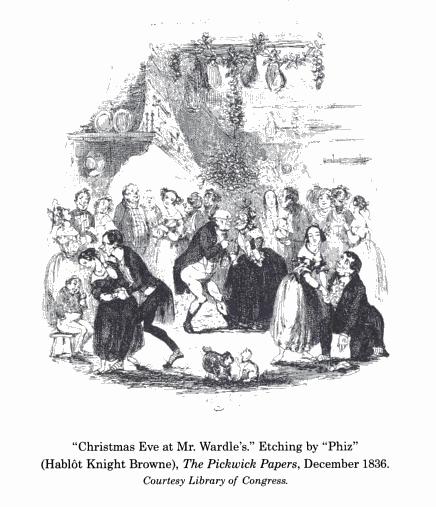
A Charles Dickens Christmas

“Nothing pushes the nostalgia button at Christmastime more than Charles Dickens’s A Christmas Carol, with its warming images of a candlelit tree and Victorian plenitude. Yet prior to the 19th century, Christmas was a very different holiday, and it was only in the Victorian era that our concept of Christmas as a child-centered family holiday arose. After reviewing the evolution of Christmas holidays, we will use 19th-century English cookbooks, such as Charles Francatelli’s The Modern Cook and Eliza Acton’s Modern Cookery for Private Families, to create a groaning board of Victorian delights, including Jerusalem Artichoke Soup; Lobster Fricassée; Baked Goose with Chestnuts; Roasted Filet of Beef à l’Anglaise; Endives with Cream; Christmas Pudding; Gingerbread; and Twelfth Night Cake.”

Cathy continued, “This is upper class food that we’re making tonight, that took a large staff in the kitchen to prepare, with no expenses spared, using the most luxurious ingredients. It’s also infusion cuisine made with expensive stocks, showing the French influence in this period. There’s also a fair amount of cream in many dishes with a touch of cayenne pepper, an influence of the British colonials in India. The French at this time would have just used nutmeg. There were many women cooks in the kitchens of the wealthy in England, and in France there were more men in the kitchens.”
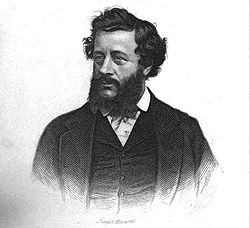
Charles Elme Francatelli

We separated into three groups to make the various dishes. I chose the group that was making the Charles Francatelli recipe for Beef à l’Anglaise. Francatelli was born in London in 1805 and went on to study with the great chef Marie-Antoine Carême in France, inventor of haute-cuisine. (At the downfall of Napoleon, Carême later went to work in London for the Prince Regent and George IV.) Francatelli was the chef for Queen Victoria and went on to be the chef at the Reform Club. His influential book was called The Modern Cook, published in 1846. This recipe is very time consuming and labor intensive with a vegetable and olive oil marinade and Financière and Espagnole (including truffle juice and veal stock) sauces for basting and serving. Our group also made vegetable garnishes and one of the three desserts, the Plum Pudding.

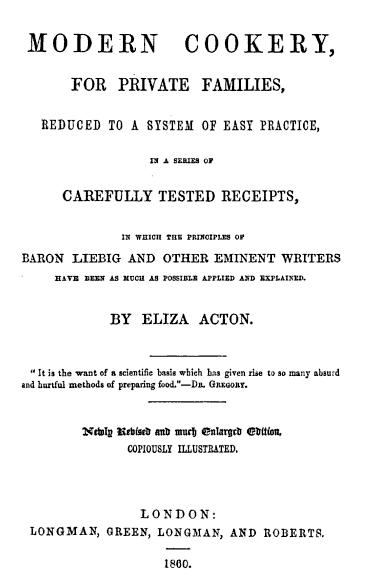
Another group made the Lobster Fricassée from an Eliza Acton recipe. Eliza Acton was born in Sussex in 1799. Like Francatelli, she spent time in France. She is credited with writing the first practical cookbook with a list of ingredients and instructions. Mrs. Beeton was supposed to have modeled her cookbook on Acton’s. The lobster recipe is somewhat complicated in that uses both a Béchamel and Consommé made from veal, mushrooms, ham, vegetables and stock. Final baking in the oven with the sauce and bread crumbs finished off this delectable dish.

The goose recipe from Charles Francatelli featured a Madeira wine mirepoix and a luting paste, a flour and water cover for the goose’s first hour of cooking to keep it moist.

Here are two recipes that are absolutely delicious and will be easy to make for a home version of a Victorian Christmas feast. Both recipes are presented in the original text and then in Cathy Kaufman’s modernized version for today’s kitchens.

Jerusalem artichoke

Jerusalem Artichoke, or Palestine Soup (Eliza Acton)

Wash and pare quickly some freshly dug artichokes, and to preserve their colour, throw them into spring water as they are done, but do not let them remain in it after all are ready. Boil three pounds of them in water for ten minutes; lift them out, and slice them into three pints of boiling stock; when they have stewed gently in this from fifteen to twenty minutes, press them with the soup, through a fine sieve, and put the whole into a clean saucepan with a pint and a half more of stock; add sufficient salt and cayenne to season it, skim it well, and after it has simmered two or three minutes, stir it to a pint of rich boiling cream. Serve it immediately.

2 lb. Jerusalem artichokes
4 cups chicken stock
Salt and freshly ground white pepper to taste
1/8 teaspoon cayenne pepper, or more to taste
5/8 cup heavy cream mixed with 1/4 cup Crème fraîche

Pare the Jerusalem artichokes.  Drop the pared Jerusalem artichokes into a pan of boiling salted water.  Cook for ten minutes to set the color.  Drain and refresh.

Slice the Jerusalem artichokes into pieces of about 1/2 inch thick and place in a saucepan with the chicken stock.  Simmer for 20 minutes and pass mixture through a food mill three times [or puree in a blender].

Return the puree to a clean saucepan and add the spices and heavy cream mixture.  Cook for two minutes, skim any impurities off the surface, adjust the seasoning and serve.
 

.

Fronticepiece, Modern Cookery by Eliza Acton

Gingerbread (Eliza Acton)

Whisk four strained or well-cleared eggs to the lightest possible froth (French eggs, if really sweet, will answer for the purpose), and pour to them, by degrees, a pound and a quarter of treacle, still beating them lightly. Add, in the same manner, six ounces pale brown sugar, free from lumps, one pound of sifted flour, and six ounces of good butter, just sufficiently warmed to be liquid, and no more, for if hot, it would render the cake; it should be poured in small portions to the mixture, which should be well beaten up with the back of a wooden spoon as each portion is thrown in: the success of this cake depends almost entirely on this part of the process. When properly mingled with the mass, the butter will not be perceptible on the surface; and if the cake be kept light by constant whisking, large bubbles will appear in it to the last. When it is so far ready, add to it one ounce of Jamaica ginger and a large teaspoonful of cloves in fine powder, with the lightly grated rinds of two fresh, full-sized lemons. Butter thickly, in every part, a shallow square tin pan, and bake the gingerbread slowly for nearly or quite an hour in a gentle oven. Let it cool a little before it is turned out, and set it on its edge until cold, supporting it, if needful, against a large jar or bowl. We have usually had it baked in an American oven, in a tin less than 2 inches deep; and it has been excellent. We retain the name given to it originally in our circle.

Please note: The treacle, sugar and flour are measured by weight, not by volume.

2 tablespoons softened butter for preparing the baking pans
3 eggs
20 oz treacle
6 oz light brown sugar
6 oz butter, melted and cooled
16 oz cake flour, sifted
4 tablespoons ground ginger
1 teaspoon ground cloves
grated zest of two lemons

Preheat the oven to 350ー F.  Generously rub the inside of a 9 x 9 x 2 baking pan with the softened butter and set aside.

Stir the eggs together and pass them through a strainer to remove the white threads holding the yolks. Transfer to the bowl of a standing mixer fitted with the whisk attachment and beat for two minutes. Very slowly pour in the treacle, beating constantly. Add the brown sugar in a slow trickle and continue beating. Add the butter and a steady stream, beating thoroughly to incorporate. Add flour in several additions, continuing to whisk. Finally, whisk in the spices and the lemon zest.

Pour the batter into the prepared pan and bake for 50 minutes to an hour, or until baked through. Cool on a rack before unmolding. Dust with confectioners’ sugar before serving.

Links:


Read Full Post »

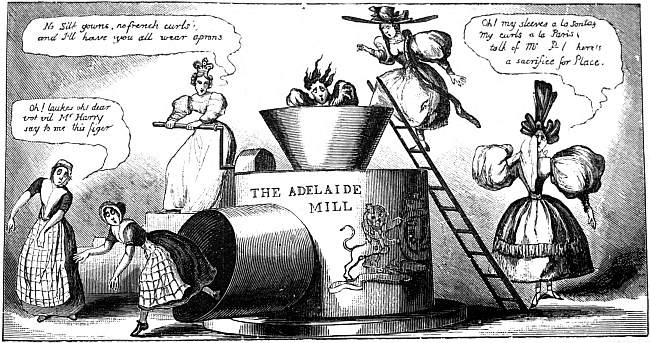
Caricature by Robert Seymour, 1830

After the death of Princess Charlotte in childbirth in 1817, the British Royal family was left without a legitimate heir to the throne. Since their marriage, King George IV had felt an overpowering physical and mental aversion to Queen Caroline, his consort, and the possibility of his begetting another child on her was less than zero.

None of the King’s brothers were married. The Dukes of York, Clarence, Kent, Cumberland, Sussex, and Cambridge all began to court potential brides in earnest.

In 1818 William Henry, Duke of Clarence, who would reign as King William IV, abandoned his 20-year relationship with Mrs. Jordan, with whom he had ten children, to marry Adelaide of Saxe-Meiningen, a rather plain lady half his age. In short time the strong-willed duchess managed to take her husband’s finances in hand and pay off his debts through economical living. Parliament voted to increase his allowance, which the Duke, who was angling for more, finally accepted.

William was crowned King in 1830. By all accounts he was faithful to his queen. They lived a sober, almost boring life,  but, sadly, their two infant children did not survive. Queen Adelaide’s strong influence throughout her marriage can be seen in this illustration.This cartoon of the Adelaide Mill, drawn by English caricaturist, Robert Seymour, shows Adelaide decreeing that the court domestics must dress more humbly:

From other contemporary pictorial skits by Seymour we learn that various changes were made in the royal establishment, and the new queen seems to have addressed herself specially to a reform in the dresses of the court domestics. On the 1st of October, 1830, Seymour represents her grinding an enormous machine, called the “Adelaide Mill,” into which the women servants, dressed in the outrageous head-gear and leg-of-mutton sleeves of the period, are perforce ascending, and issuing from the other side attired in plain and more suitable apparel. “No silk gowns,” says Her Majesty as she turns the handle. “No French curls; and I’ll have you all wear aprons.” The new queen seems also to have shown a disposition to encourage native manufactures and produce at the expense of French and continental importations. These changes were not particularly pleasing to the Conservative lady patronesses of Almack’s, who were celebrated at this time for their capricious exclusiveness. One of Robert Seymour’s satires, bearing date the 1st of November, 1830, shows us a conference of these haughty dames, who seriously discuss the propriety of admitting some lady (probably the queen) who proposed appearing at one of the balls “in some vulgar stuff made by the canaille at a place called Kittlefields” [Spitalfields].” – English Caricaturists and Graphic Humourists of the Nineteenth Century. How they Illustrated and Interpreted their Times, by Graham Everitt

The death of King William IV in 1837 led to the long and successful reign of Queen Victoria, daughter of Prince Edward, Duke of Kent.

Learn more about Mrs Jordan in this link: The Delectable Dora Jordan

Read Full Post »

Inquiring readers: Not often does news of great import come our way, such as this item unearthed from the depths of Andrew Capes’s crashed computer. His having retrieved it is nothing short of miraculous, for now he can share the rest of Charlotte Collins’ story with the world. If you found this news item as intriguing as I did, please let him know what you think of it in the comment section below! Article copyright (c) Andrew Capes.


Extract from the Hertfordshire Gazette, June 1876
Obituary Notice

Mrs Charlotte Collins of Longbourn Hall


We have been saddened recently to receive

notification of the death at the end of May, at

the advanced age of 92 years, of Mrs Charlotte

Collins, née Lucas, widow of the late Reverend

William Collins, of Longbourn Hall, near

Meryton. Mrs Collins is survived by her only

son, Thomas Collins, his wife Mary (née

Bennet), and her grandson, the Rt Hon. Sir

Timothy Collins PC, all of whom continue to

reside at Longbourn Hall.


Mrs Collins’s funeral at Meryton was attended

by a distinguished gathering of friends and

relations, many of whom had travelled great

distances to be present. Several members of the

extended Lucas family were there, although
Mrs Collins had outlived all her immediate

relations, and there were also representatives

and descendants of the former Bennet family,

with whom the Collinses had maintained

intimate connections for a great many years.

Among the latter were Mrs Elizabeth Darcy,

widow of the late Mr Fitzwilliam Darcy of

Pemberley in Derbyshire, and her niece, Mrs

Jane Lucas, daughter of the late Mr & Mrs

Charles Bingley of Freshfield Park in Yorkshire,

who is also the late Mrs Collins’s sister-in-law.

The occasion was graced with the presence of

Lydia, Lady Wickham, widow of Lieutenant

Colonel Sir George Wickham, Bart., late hero

of the French, American, and Affghan

campaigns. The Dowager Lady Wickham has

recently returned from India to pass her

remaining years with her son, Sir Arthur

Wickham de Bourgh, at his family home,

Rosings Park in Kent.


Charlotte Collins was born in March 1784, the

eldest of five children of Sir William and Lady

Lucas, latterly of Lucas Lodge near Meryton in

Hertfordshire. There she met and married the

Reverend William Collins, a cousin of the

Bennet sisters, in January 1812. The couple lived

at Hunsford in Kent where their son, Thomas

Collins, was born in 1813. In 1823, upon the

death of Mr Frederick Bennet, the Reverend

Mr Collins inherited Longbourn-house, an

estate of which Mrs Collins was destined to

remain mistress for over half a century.

Upon their removal to Longbourn, Mr and Mrs

Collins were pleased to allow Mr Bennet’s

widow and daughter Mary to continue to live in

the house, and to treat it as their home. Mary

had been entrusted under the terms of Mr

Bennet’s will with the care of his extensive library,

and she immediately set about this task

with the greatest diligence, continuing to

pursue improvements to the collection, chiefly

through a series of judicious acquisitions,

almost without interruption from that time

until the present day. Upon that occasion also,

Mr Collins desired that the name of the house

be changed from Longbourn-house to

Longbourn Hall, to reflect the elevated status

with which he expressed the hope that it

would, in the course of time, become

associated.


Regrettably, however, within less than a year of

the Collins family’s installation at Longbourn,

the Reverend Mr Collins sustained a minor

injury whilst engaged in clearing undergrowth

from a small wilderness beside a lawn in his

garden, the resulting wound from which most

unfortunately became infected. The rapid

progress of this infection caused him to

succumb soon afterwards, his resulting death

thus sadly depriving him of anything more than

the briefest period of enjoyment of his newly

acquired estate.


Mrs Bennet also died later that same year, and

Mrs Collins thereafter began to observe in

young Thomas the development of a strongly

studious character, carefully fostered by Miss

Mary Bennet’s solicitude towards him in her

combined role of cousin, mentor and librarian.

There gradually grew between these two

younger members of the household a firm

attachment, which eventually developed

beyond their previous cousinly affection, this

being confirmed by their marriage in 1833 and

the subsequent birth of a son, Timothy, in the

following year.


For above forty years since then, membership

of the Longbourn household underwent no

material alteration, until the recent death of

the elder Mrs Collins. This period has

nonetheless been punctuated by several notable

events associated with the family, perhaps the

most remarkable of which was the famous

Catherine (“Kitty”) Carter trial of 1862. Kitty

Carter was Mrs Mary Collins’s sister, and, in

defiance of social conventions, the elder Mrs

Collins allowed her to stay as a guest at

Longbourn Hall throughout the whole of that

protracted and scandalous affair.


The details of the case are so well known, even

today, that it would be superfluous to recount

them here; suffice it to say that the verdict

eventually obtained vindicated the faith that

both Mrs Collinses had placed in their relation,

who duly acknowledged her debt to them in an

autobiographical memoir, published later that

year, through which her name became known –

some might say, notorious – around the world.


Some nine years previously, a considerable

change had taken place at Longbourn, with the

purchase by the Great Northern Railway of

part of the estate’s farming land, for the

construction of the line through Meryton to

Ware. The substantial sum thereby realised

enabled the elder Mrs Collins to throw out a

new self-contained wing from the earlier house,

with the intention of entertaining friends and

family without interfering with the orderly

conduct of the rest of the household. The

generous nature of her year round hospitality

benefited in its turn from the improvements in

the means of travel provided by the new

railway, such that her visitors were now able to

reach Meryton from places as far afield as

Derbyshire and Yorkshire in a matter of hours,

rather than the days that had previously been

occupied in the completion of such journeys.

Mrs Collins retained few links with the Church

of England after the death of her husband,

although she did maintain friendships with

several of his former parishioners in and around

Hunsford for some time after her removal from

that part of the country. She was amused in her

later years to learn that the Rosings Estate, of

which the Hunsford rectory – where she spent

the first ten years of her married life – formed a

small part, had passed into the hands of the

nephew of her daughter-in-law, when it was

inherited by Sir Arthur Wickham de Bourgh,

Bart, upon the death of his first wife, Anne.

The concern that the elder Mrs Collins felt for

the education and welfare of her grandson, Mr

Timothy Collins, showed her to be

exceptionally solicitous on his behalf, and it

could be said with some certainty that his

successful parliamentary career, up to and

including his position in Mr Gladstone’s recent

administration, in the course of which he was

honoured with a knighthood, was the direct

result of the attention which she paid to his

upbringing. She also instilled in him the

passionate advocacy of many international

causes, foremost among which was that of

Italian unity, finding especial friendship and

fellow-feeling with the great Italian leader

Giuseppe Garibaldi, who was invited to

Longbourn Hall briefly on the occasion of his

visit to London in 1864.


Mrs Collins had always taken a great interest

not only in her own family, but also in those

both of her lifelong friend Mrs Elizabeth

Darcy, and of Mrs Darcy’s sister, the late Mrs

Jane Bingley. It was with great pleasure that she

saw her own younger brother, John Lucas,

marry Mr and Mrs Bingley’s daughter, also Jane,

in 1832, thereby sharing her own extended

family of nephews, nieces and cousins with

those of the former Bennet sisters.


Mrs Collins was widely renowned and loved for

the care she took to include all her extensive

family and friends in her regular invitations to

Longbourn, and for her careful remembrances

of birthdays and anniversaries of even the

youngest members of the family, extending to

the third and fourth generations, always with

thoughtful and appropriate gifts.


Mrs Collins travelled extensively, both in the

United Kingdom and abroad, often, especially

in her latter years, accompanied by her lifelong

friend Mrs Elizabeth Darcy. They completed

their last foreign journey together, to Italy, only

five years ago, at the height of the war in

France, which contributed not a little to the

excitements and discomforts of that journey.

Mrs Collins retained her health and her

faculties, save for gradually failing eyesight, to

the end of her long life, and many will recall the

occasion of her 90th birthday celebrations

which brought people from all over Britain, and

some from further afield, at which she herself

expressed a wish for it to be considered as, in

some measure, a way of bidding farewell to all

her many friends and relations.


The request expressed by Mrs Collins, that her

remains be removed from Meryton and

interred alongside those of her husband in the

churchyard at Hunsford, was complied with

shortly after her funeral, and a small family

gathering attended the interment ceremony as

a final farewell gesture to a well-loved and

notable figure who will be much missed, not

only here in Hertfordshire, but also much

further afield.


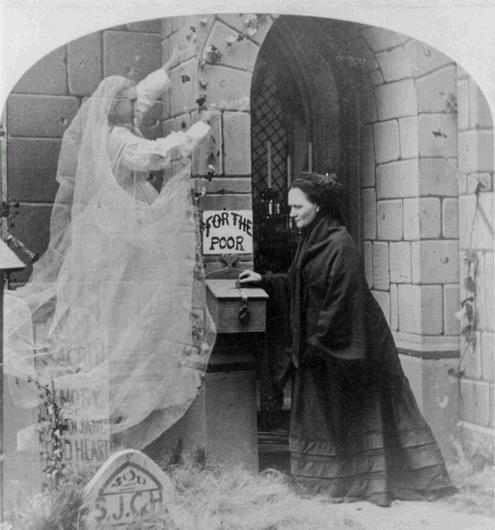
The Widow's Mite, 1876. Image @Morbid Anatomy

—————————————————————————————————
NOTES ON THE OBITUARY OF MRS CHARLOTTE COLLINS
AS SHOWN IN THE HERTFORDSHIRE GAZETTE, JUNE 1876
—————————————————————————————————

This Obituary Notice was discovered in the archives of the (fictional, of course) Hertfordshire Gazette, a long defunct weekly newspaper which circulated (as its title implies) mainly in Herfordshire, during the latter half of the nineteenth century and the first half of the twentieth.

The piece was deliberately written without reference to any of the many continuations of P&P, even those attributed to Jane herself. I felt that a retrospective view from 63 years on would imply a much greater leap of the imagination than a mere ‘continuation’ of the novel would require.

Most of it needs no explanation for those familiar with the novel, though there are some things which might raise a question or two. Some of these are:

What was the ‘Kitty’ Carter trial?
The details are not recorded – but there WAS a notorious murder trial in 1862 – a nurse called Catherine Wilson was tried and found guilty of multiple murders for money; she was the last woman to be publicly hanged in London – some 25,000 people attended her execution. The ‘Kitty’ Carter trial was clearly much more ‘classy’ than that, involving scandal in very high places, and a very different outcome; it probably would not have involved murder. Carter, of course, was one of Wickham’s fellow officers.

Two of the marriages are with much older women. Is this not improbable?
Uncommon, but by no means improbable. It was certainly possible for an older woman to marry a younger man. I think the Mary/Thomas marriage entirely natural; and although the Arthur Wickham/Anne de Bourgh one might be a little more unlikely, Arthur would have inherited his father’s title (which was granted only a short time before his death in action in the First Affghan Campaign of 1837-39) when he was in his mid-20s and Anne was newly independent on the death of Lady Catherine.

What was Sir Timothy Collins’s post in the Gladstone cabinet of 1871-74?
He was Chairman of the Local Government Board, a new post created by Gladstone in 1871. He must have been promoted when he was quite young. In historical fact, the post of President of the Board went to Sir James Stansfeld, but I think Sir Timothy probably edged ahead of him at the time of the vote of no confidence in Stansfeld as Civil Lord of the Admiralty in 1864. Stansfeld, incidentally, was also a great supporter of Garibaldi.

Great Northern Railway – Meryton to Ware
No such line was actually built – the railway at Ware was built in 1843 by the Great Eastern Railway. However, the Great Northern did build a line from Welwyn to Hertford in 1858 which connected with the Ware line. The Great Northern main line would have made access from Yorkshire and Derbyshire to Meryton via Hitchin or Hatfield very much easier than it had previously been from about 1851 onwards.

Respectfully submitted by Andrew Capes. Your comments are most welcome.

Read Full Post »

The servants in Downton Abbey. Image courtesy @ITV and PBS Masterpiece.

Downton Abbey. Gosford Hall.  Manor House. Regency House. Each film follows the servants and takes the viewer up and down back stairways, into kitchens and butler’s pantries, and stables and courtyards. But how were the servants’ quarters laid out, and where were they placed in relation to the public and private rooms that the family used? Each house had a different arrangement, to be sure, but patterns did exist.

A narrow corridor leads from the kitchen. Image courtesy @PBS Masterpiece.

The interior and exterior shots of Downton Abbey were filmed in Highclere Castle,but because the servant kitchens and bedrooms below-stairs no longer existed as they once were, the servant quarters for the mini-series were reconstructed in Ealing Studios in London. The cost of reconstructing these “plain” rooms was relatively affordable. Imagine if one of the elaborate public rooms had to be reconstructed. As script writer Julian Fellowes observed: “The thing about filming in these great houses is that if you were to start from scratch, you simply couldn’t build this and if you did you would have used up all your budget in one room.”

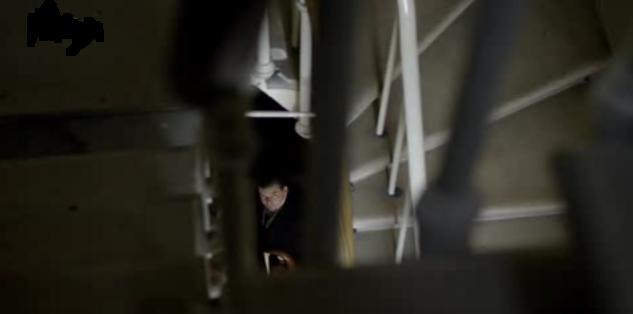
Servant stairs in Downton Abbey. Image courtesy @PBS Masterpiece

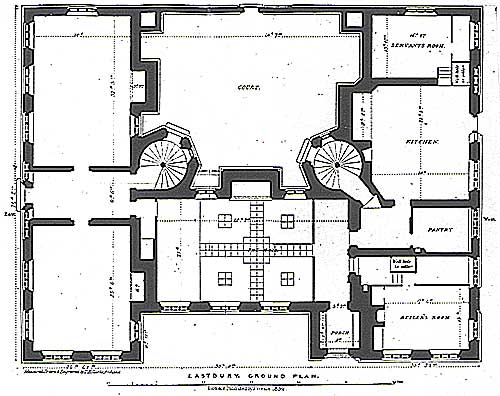
The ground plan from Eastbury Manor House is representative of a great house. It shows the servant quarters at the right near tight round servant stairs, or back stairs, that the servants used instead of the grand staircase reserved for the family and their guests. Maids were expected to work invisibly and sweep and dust when the family was asleep, or work in a room when the family was not scheduled to use it. In fact, many of the lower servants never encountered the family during their years of service.

Unless they were polishing or cleaning the grand staircase, the servants would use the backstairs for all other occasions. A small housemaid’s closet would be located near the back stair on the bedroom floor to accommodate brushes, dusters, pails, and cans. In “modern” Victorian and Edwardian houses, such a closet might  contain a sink that provided water for mopping.  Some great houses boasted a linen-room on the bedroom floor, where clean bed linen and table linen were stored. In this instance, a dry environment was essential.

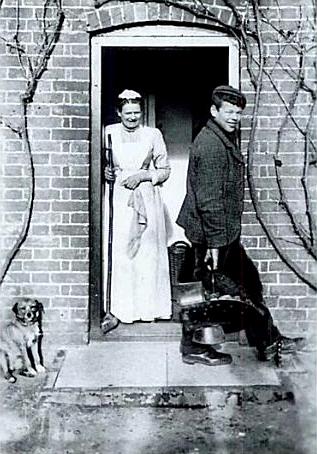
Late 19th c. maid and lad at the back entrance

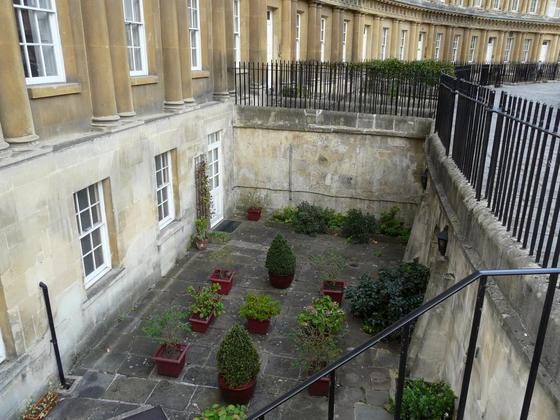
Servants were expected to enter the house in their own entrance, even in smaller houses, such as townhouses.  The Regency Townhouse Annex shows a typical entrance below street level. If you click on the links on the various rooms, you can see the other servant areas in this site.

Stairs to servant’s entrance. Bath. Image @Tony Grant

In a country house, the entrance would be in the back of the building or from a courtyard, where supplies could be delivered. The philosophy of a smooth running household was that servants were out of sight and out of mind.

Belowstairs entrance, Bath. Image @Tony Grant

Upon entering, servants would walk along a long hallway to reach the servants’ rooms and other work areas such as the kitchen, scullery, servant’s hall, housekeeper’s room, butler’s room, storage room, etc.  Country were at least two or three stories tall. Servants climbed the stairs and came down them again all day long, cleaning, hauling water, carrying meals or coal for fires, and a myriad other duties. They rose before the family, often from top floor garrets with small windows, and worked long after their employers had gone to bed.

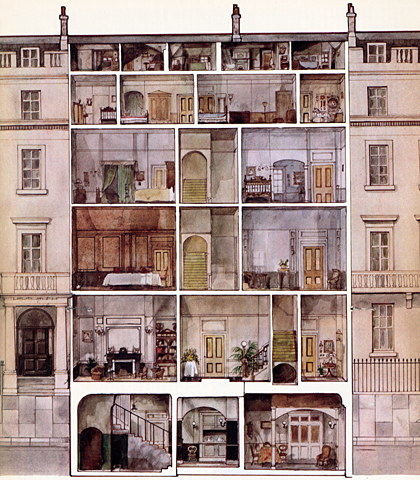
Interior, Upstairs Downstairs web page. Notice the tiny garret bedrooms.

In this image, you can see the small garret rooms reserved for servants in the attic of a townhouse. Men’s and women’s quarters were separated, as in Downton Abbey, with the women’s quarters called the virgin’s wing. The most common servant quarters are described below.

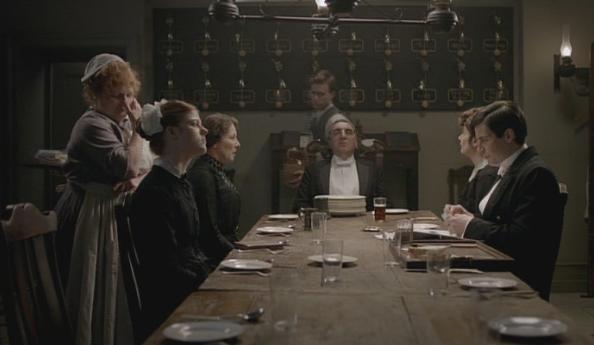
A meal belowstairs. Downton Abbey. Notice the servant bells on the back wall. Image courtesy @PBS Masterpiece

Servant’s Hall:

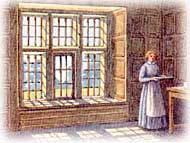
The servant’s hall was a common room where the work staff congregated, ate their meals, performed small but essential tasks, like mending, darning, polishing, ect. A long table was its main feature, as well as a window that would let in enough light for the tasks that needed to be accomplished. This window is a feature in images of several servants halls, which makes me think it was essential, for many of their tasks (darning, polishing shoes, ironing, and the like) required good light.

1907 Watercolor of the windows in a servant’s hall

The servants would regard the hall as their living room, for they ate their meals there and congregated in the hall for the evening. Often the cook did not regard making the servants’ meals as part of her duty, and this task would be left to the kitchen maids. Servants would also receive the visitors’ servants here (as in Gosford Park), persons of similar rank, or their own visitors on a very rare occasion.

Image of Victorian servants eating dinner in the servants hall.

The servant bells were located in this area, as well as hooks for coats and uniforms.

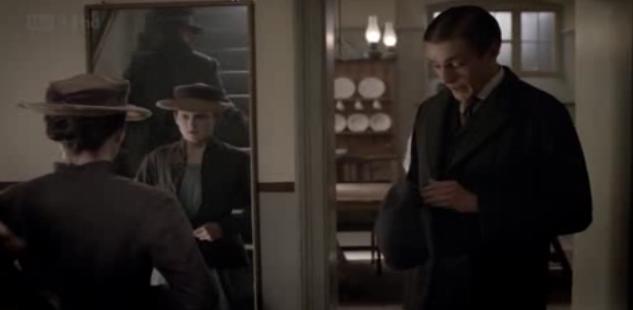
Daisy puts on her coat as William speaks to her just outside the servants hall. Downton Abbey. Image courtesy @PBS masterpiece

The servants followed a hierarchy downstairs as strict as upstairs, and the upper servants, the butler, housekeeper, cook, valet and ladies maid would be served meals and tea by the lower servants.  The highest ranking servant was the stewart, then came the butler and housekeeper.

Anna completes a task in the servants hall. Downton Abbey. Image courtesy @PBS Masterpiece

The ladies maid would defer to the housekeeper and the valet to the butler. Standing low down was the scullery maid or tweeny, who often was just a young girl of twelve or thirteen. Her hours were the longest, for she would make sure that the water was boiling for the cook before she began her day.

Kitchen:

The long work table is the focal point of the kitchen. Downton Abbey. Image courtesy @PBS Masterpiece

The kitchen even in great houses were utilitarian, and positioned away from the family quarters to keep cooking smells away yet near enough for the delivery of food. Kitchens were also located near an entrance were supplies could be delivered, and near the kitchen gardens (but not always. See below.)

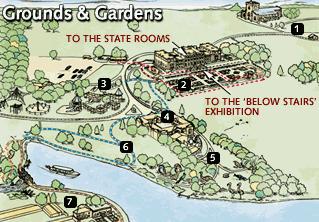
Harewood house and grounds. The kitchen was a 20-minute walk to the walled garden.

Kitchens tended to be oblong and dominated by a large kitchen table, where the majority of food preparation was done. The window would be ideally positioned to the left side of the range, and the kitchen dresser, where essential equipment was held, would stand close to the work table.

Kitchen suite, 1900 house.

The cook worked under the housekeeper, but the kitchen was her domain. She saw to its cleanliness and neatness, and made sure the larders were well-stocked. Not only were the floors, shelves, and work spaces scrubbed, but they had to be thoroughly dried to prevent mold and mildew from contaminating food stuffs and work tops. The arrangement of the scullery and kitchen was convenient, so that one did not need to cross the kitchen to reach the scullery. Natural light in both rooms needed to be ample. 

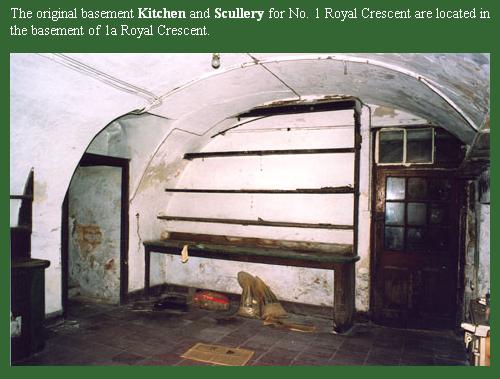
This kitchen in the Royal Crescent in Bath needs renovation and preservation.

She (for by the end of the 19th century, most of the cooks in British households were female) oversaw the meals and kitchen staff, consisting of kitchen maids and the scullery maid.

Scullery and kitchen in the Fota House, Ireland

Scullery:

Cleaning in the scullery

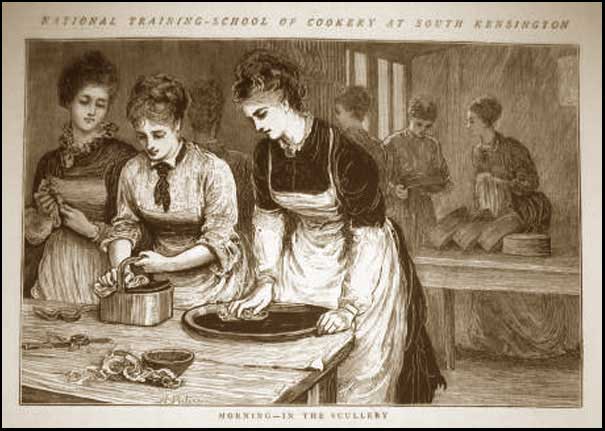
The scullery was always located in a separate room from the kitchen so that food would not be contaminated by soiled water. Double stone sinks were the main feature of this room, where pots and pans and the servants’ crockery were rinsed and cleaned. The family’s fine china would be washed in a copper sink, whose softer surface prevented chipping. A cistern above the sinks was used to flush the drains, which led out of house. This was one reason that sculleries were located next to the outer walls and nearest the courtyards or an outer garden. Often, the scullery had no door into the kitchen (only a pass through), and one could enter the room only from the outside. An outside door in the scullery was also known as the “tradesmen’s entrance”.

Scullery, Image @Harewood House.

Food preparation also occurred in this area, such as chopping vegetables. Hygiene was essential in order not to contaminate existing food supplies, or the people within the house with soiled cutlery or water. This meant constant hauling of fresh water, scrubbing, washing, and cleaning. The scullery floor, made of stone, was lower than the kitchen’s, which prevented water from flowing into the cooking areas. Dry goods were stashed well away from the scullery, which also had to be kept dry in order to prevent mold. To prevent standing in water all day long, raised latticed wood mats were placed by the sink for the scullery maid to stand upon.

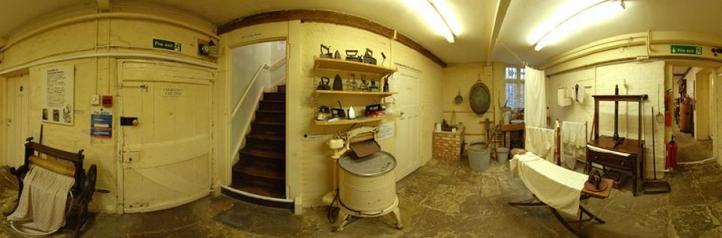
Panorama of a Victorian scullery with boiler and laundry features

Sculleries also contained a copper for boiling clothes on laundry day, washtubs, washboards, irons, and cabinets for cleaning supplies. In 1908, an eight-room house required 27 hours per week of labor, which did not include laundering clothes. One can only imagine how long a house the size of Downton Abbey took to manage.

Scullery sinks, Chawton

She stood at a sink behind a wooden dresser backed with choppers and stained with blood and grease, upon which were piles of coppers and saucepans that she had to scour, piles of dirty dishes she had to wash. Her frock, her cap, her face and arms were more or less wet, soiled, perspiring and her apron was a filthy piece of sacking, wet and tied round her with a cord. The den where she wrought was low, damp, ill-smelling, windowless, lighted by a flaring gas-jet……with many ugly dirty implements around her. – The History of Country House Staff

In this 17th c. image, the scullery maid stands upon a platform to keep her feet dry.

In Downton Abbey, the scullery maid is nowhere to be seen. (Daisy is the kitchen maid,  with vastly different duties.) Two modern women who played the scullery maid in Manor House quit the series, unable to pursue that role for the duration of the series. Only the third person, Ellen Beard, who had a better understanding of the scullery maid’s duties of endless washing, managed to remain at her station until the very end. Click on this link to hear a short podcast of a Scottish scullery maid, who described her job as slave labor.

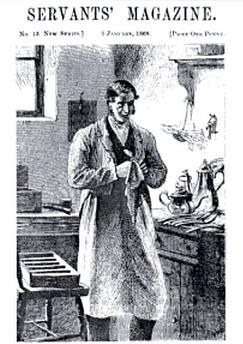
The butler polishes the silver, 1868.

Butler’s room and Butler’s Pantry

The duties of the butler confine him to the drawing-room and dining-room. The dining-room, however, is his particular domain; he sees that everything is in order, that the table is laid correctly, the lighting effect satisfactory, the flowers arranged, and in short that the room and appointments are in perfect readiness for a punctual meal. In this work a parlor maid assists him by sweeping and dusting, and a pantry-maid helps him by keeping everything immaculate and in readiness in the pantry. The butler serves at breakfast, luncheon and dinner.” – Vintage Maids and Butlers

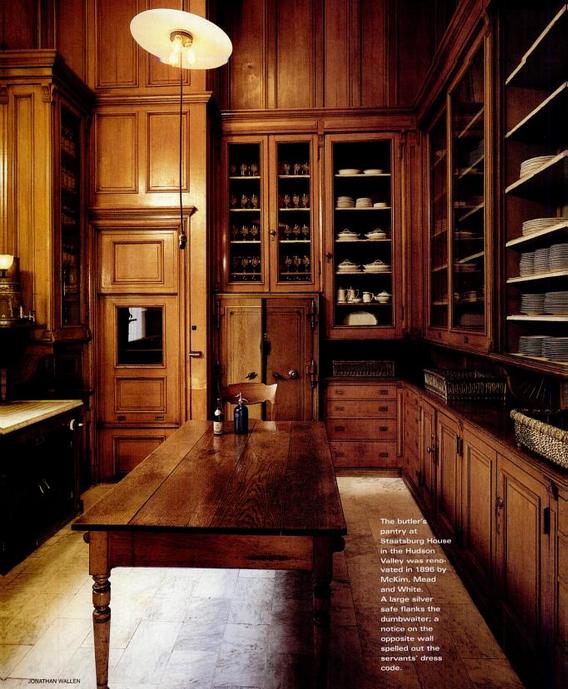
Butlert’s pantry, 1896. Staatsburg House, McKim, Mead, & White

The butler’s rooms, which included the Butler’s Pantry, were located in the basement nearest the dining room upstairs and back entry, and had no connection with the kitchen, except for service. When he was summoned, even in his rooms, the butler could appear quickly. In smaller establishments, such as Matthew Crawley’s house, the butler also acted as valet. In all instances, except for the steward, he was the highest-ranking servant, answering directly to the master.

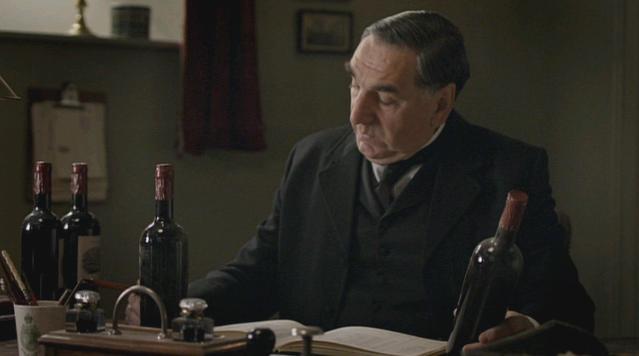
One of the duties of the butler (Mr. Carson in Downton Abbey) is to account for the wine. In this instance, he notices a discrepancy in the tally and the books. Image courtesy @PBS Masterpiece

The butler’s pantry was kept under lock and key, so that thievery was impossible at best, and at the very least deterred. A plate-closet or safe were placed there, as well as a private scullery for cleaning. The butler’s bedroom was a necessary (and lockable) adjunct in large houses for the protection of the plate.

Mrs. Hughes and Mr. Carson chat in her sitting room. Downton Abbey. Image courtesy @PBS Masterpiece

The Housekeeper’s Room

The housekeepers room in large establishments served as both a sitting- and business-room where she would take the directions of the day from the lady of the house. She would also entertain visitors of similar rank in her quarters. The housekeeper oversaw the female servants, and when she walked, a thick assortment of keys, symbols of her status and which dangled from her waist, would jiggle and certainly make a sound.

The housekeeper’s room in Uppark. At times the upper servants would congregate there for tea, and in some houses, for dinner.

Before dinner in the servants hall, the upper servants would assemble in the housekeeper’s room, also known as the Pug’s Parlour, and walk in for dinner, with the butler leading the way. This was known as the Pug’s Parade. After dinner, the upper servants would withdraw to the housekeeper’s parlor again for conversation.

Servant Bedrooms

Anna and Gwen confronted by O’Brien in their unlocked room. Downton Abbey. Image courtesy @PBS Masterpiece

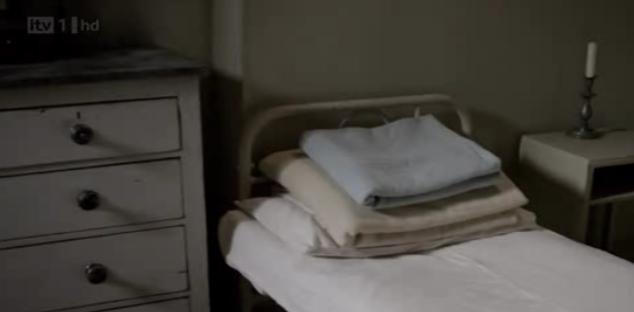
In the latter half of the 19th century, servants slept in attic bedrooms. These were often cold and damp in the winter and hot in the summer, with little light coming in from small windows. Some male servants slept downstairs to guard the family silver. The furnishings in servant quarters were basic and essential. A servant might have a locked box in which personal materials were kept, but the rooms were open and subject to inspection by their employers.

The valet’s simple bedroom. Downton Abbey. Image courtesy @PBS Masterpiece

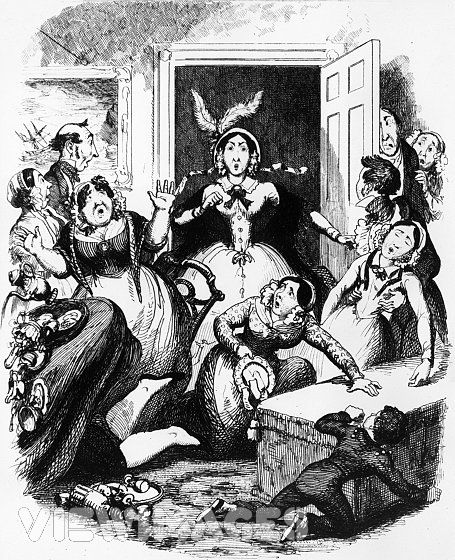
One source for servant quarters and duties of the servants cautioned that books about servant etiquette discussed ideal behavior. In reality, servant turnover was high, theft did occur, and servants did not always know their place. In this humorous Punch cartoon, the mistress arrived home unexpectedly, catching the servants eating upstairs and generally misbehaving. The truth, I suspect, is somewhere in between.

“Oh, hey, the missus! Servants eating a meal upstairs.” Cruikshank. Punch

Sources: (A long list that fleshes out the topic.)

Read Full Post »

Copyright @Jane Austen’s World. From the desk of Shelley DeWees, The Uprising

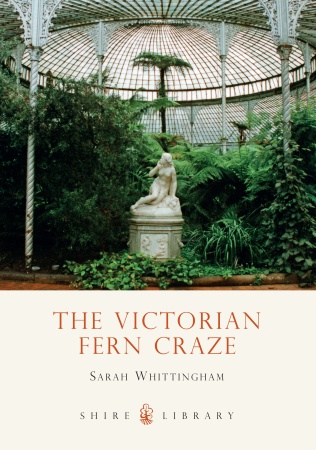
Jane Austen's WorldEvery once in a while, it seems, I stumble upon something I had absolutely no idea existed. I remember discovering something called a “thumb drive” stashed in my friend’s pen, on which she’d stored everything she’d ever written, and I distinctly recall the first time I tried a roasted beet (why didn’t anybody tell me about the most delicious vegetable in the world?). Reading The Victorian Fern Craze by the highly-qualified writer and lecturer Sarah Whittingham was one of these moments, one of these special blips that caused a true case of head scratching and verbal claims of “WOW! I had no idea about this!”

This slender little book is aptly named. People really were crazy for ferns during the Victorian years, its gradual growth a perfect example of cultural snowball effect. Passion for gardening was filtering down from the rich into the middle classes of people, who wished to beautify their houses and back yards with small, precious plots. “They were assisted by technical and chemical advances,” explains Whittingham, “together with endless advice and instruction in a proliferation of new gardening literature.”


Jane Austen's World

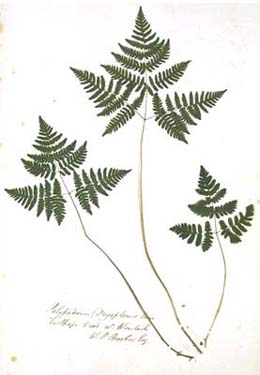
Pressed fern, 1840

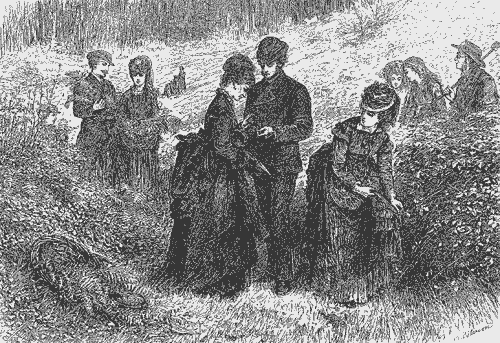
Passions combined with literature, then support from the church emerged, touting fern collecting as a moral, healthy, educational activity that might “lead through nature to nature’s God.” Young people loved to have a reason to go somewhere, anywhere, especially with the mind of digging under rocks and climbing into caves to reach a fern, and women found themselves with a special opportunity to mix with the opposite sex. This, on top of major strides in transport and housing of these special plants, brought ferns into the hearts and homes of Victorian England with abandon.


Jane Austen's World

Gathering Ferns, Illustrated London News, 1871

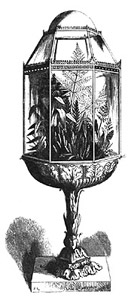
Whittingham spends a great deal of time speaking about the nature of the fern and its particular needs, and focuses particularly on the creation of a controlled environment meant to support their delicate constitutions. Invented by Nathaniel Bagshaw Ward (1791-1868), the Wardian Case was the result of years of experimentation and trial-and-error research into how one might keep a fern alive in a world of pollution, variable temperatures, and low lighting. The sealed, glazed glass boxes became very popular and grew in size and splendor, eventually turning into hothouses, plant conservatories, shadehouses, glasshouses that could be built into the side of existing homes. Some of the fancier tabletop Wardian cases might even include aquarium space, aviaries, or terrariums, and it became fashionable to keep animals alongside ferns in general (Henry Boyle kept alligators in his Lake District hothouse). These Wardian cases were a huge part of the fern craze, and Whittingham gives them the ample page space they deserve without boring the reading to death. In fact, the images and illustrations of the cases are quite extraordinary, and I found myself in another moment of, “Wow! Look how cool that is!” A Wardian case…who knew?

Jane Austen's World

Victorian wardian case

The book is, in general, expertly researched and chock full of inspiring photographs. While the writing can be a bit dry at times, the material is engaging and interesting, positively brimming with opportunities to absorb some out-of-the-ordinary knowledge. If you’ve ever wondered why every fashionable house in England has space for plants, or why ferns keep popping up in décor from all across the 19th century, this book is for you. One warning though: you’ll start to see ferns everywhere and you’ll want to talk about them when you do. Your friends may think you’re crazy, but you can just say, “Nope. I’m just crazy for ferns!”

Read Full Post »

« Newer Posts - Older Posts »