Feeds:
Posts
Comments

Inquiring readers: This article from frequent contributor, Patricia Saffran from Brandy Parfums, describes the exhibit at the British Museum, which opened in London on May 24. These exquisite works of art, along with others, will be on view through September 30th. With this exhibit, the upcoming Olympic Games, and the Diamond Jubilee Celebration, what a sterling year it has been thus far for Great Britain.

Queen Elizabeth’s love of horses is well-known. As part of the Queen’s Diamond Jubilee Celebration, an exhibition has been created in her honor on the history of the horse in civilization. Opening May 24, 2012 at the British Museum in London, the emphasis in this exhibition is on the domestication of horses and the revolutionary impact of horses on ancient civilizations. Artifacts and art from the Museum’s extensive collection, as well as various loans on display depict the horse in its early use in farming, hunting and warfare. In the exhibition, the role of horses in the history of the Middle East is examined with an emphasis on the breeding of the Arab as a foundation of the Thoroughbred. Britain’s long equestrian tradition figures prominently in the show.
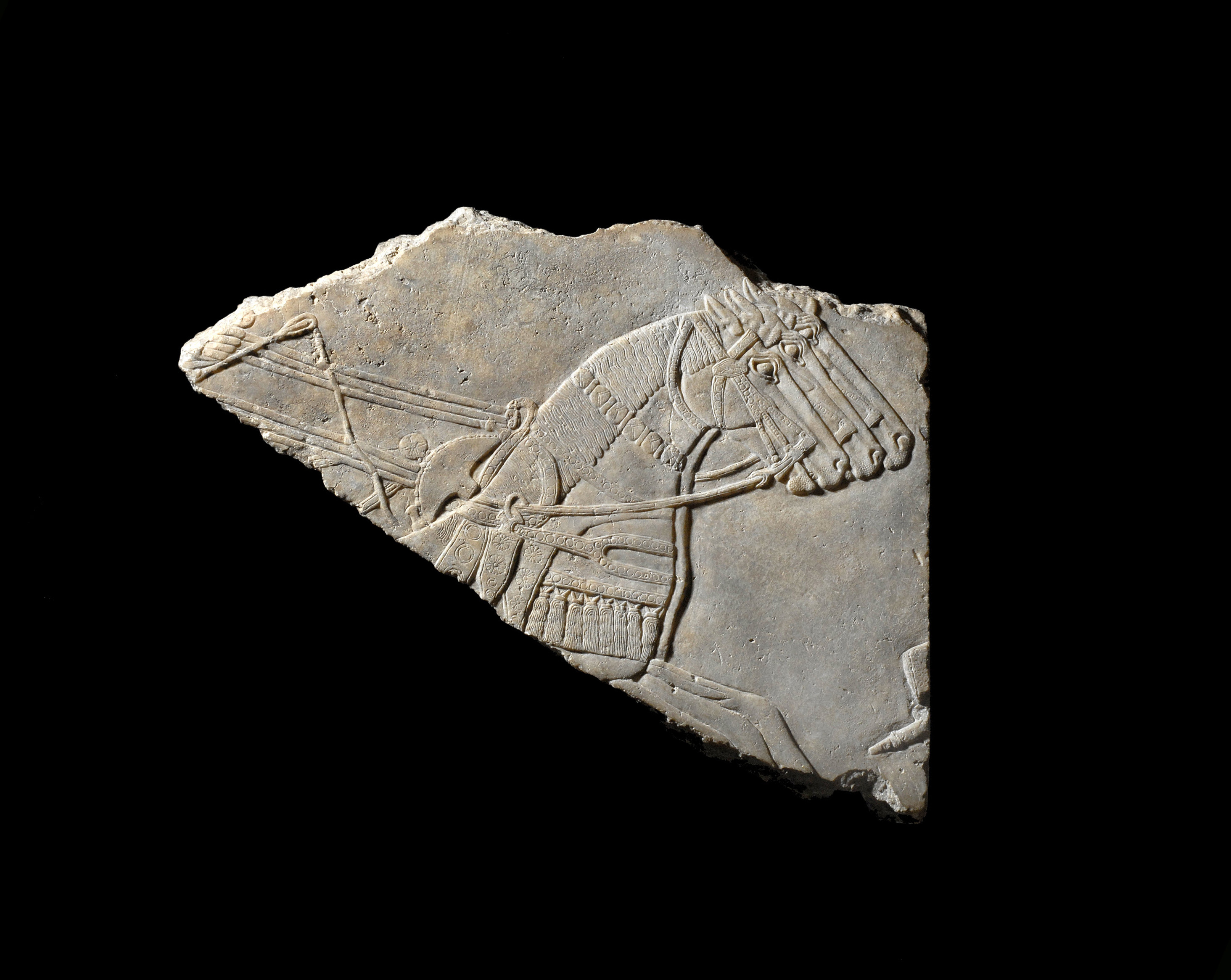
253093: Fragment of carved limestone relief featuring the heads and foreparts of three horses drawing a chariot with reins, hands of
charioteer and whip, 9thC BC, Neo-Assyrian. Copyright the Trustees of the British Museum.

The genus Equus, including all current species such as horses, asses and zebras, is native to North America. During the first major glaciations of the Pliocene, around 2.6 million years ago, certain species crossed the Bering Land Bridge. From there they spread out, some to Africa diversifying into zebras. Other species spread to Asia, the Mideast and North Africa as desert asses. The modern horse, equus caballus, migrated to Asia, Europe and the Mideast. Other Equus species drifted toward South America.

Due to the possible change in grasses, forage, or the threat of hunting, it is believed that horses, asses and zebras remaining in North and South America died out at the end of the last glaciations of the Pleistocene around 10,000 years ago, but there is no definitive proof. Some horses may have stayed and survived in the Great Plains or elsewhere in the Western Hemisphere. Horses were reintroduced into the Americas by the Spanish about five hundred years ago, and possibly before that by the Vikings and Asians.
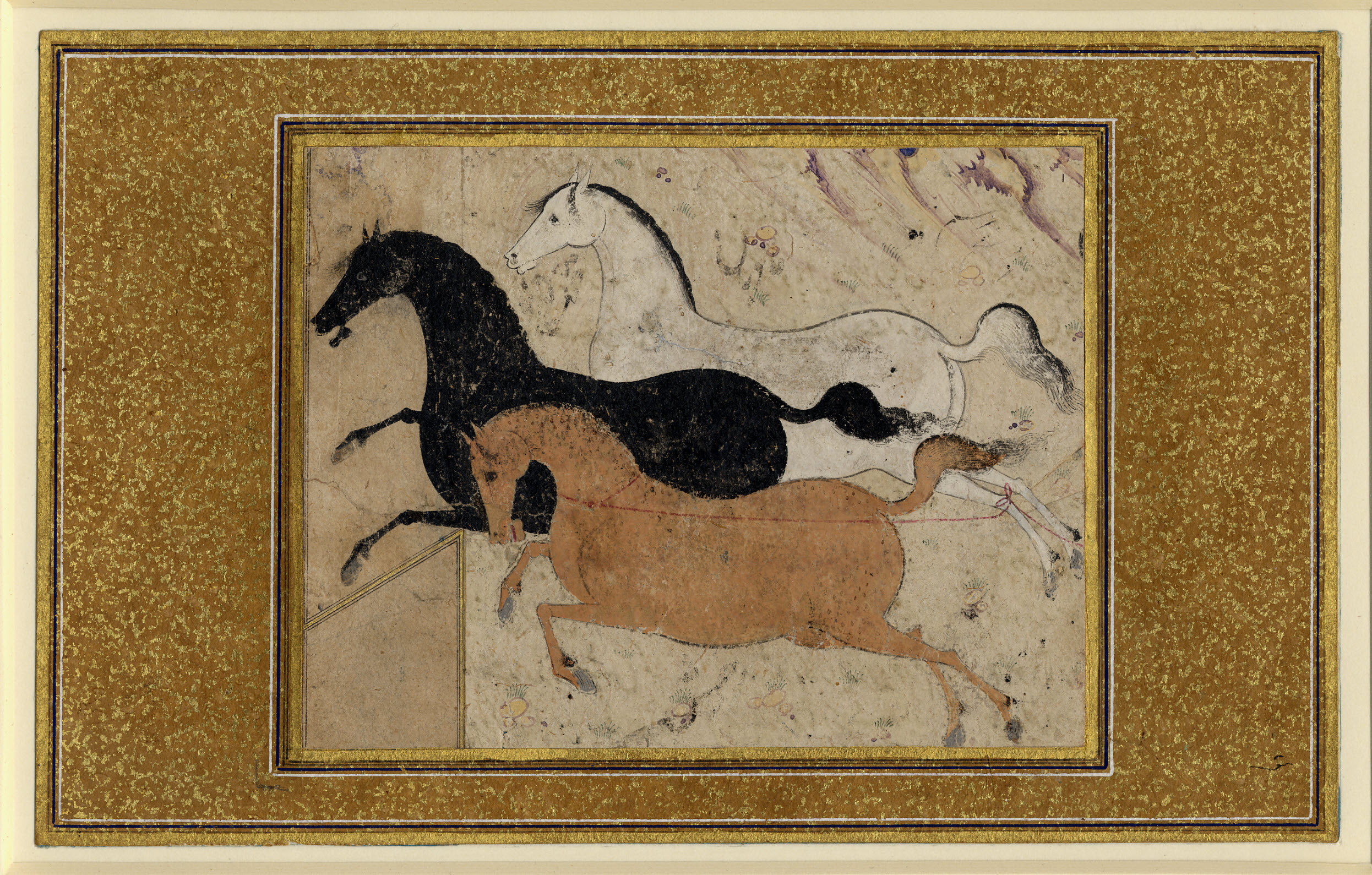
90313: Three horses (white, black and chestnut) galloping across a bare landscape, chestnut horse has a lasso round its neck and white horse round its hind legs. mid-16thC, Persian. Copyright the Trustees of the British Museum.

As horses moved toward the rich grasslands in the steppes of southern Russia around 5,000 years ago, their domestication occurred – the wild Przewalski’s horse in Central Asia is an exception.

Horses were introduced to the Ancient Near East in about 2,300 BC. Before this time donkeys, asses and oxen pulled crude carts in this area. Technological advances later on saw swifter carts and chariots pulled by horses, and the development of horseback riding. The history of conquest utilizing horses along with advancements in writing, art, architecture and agriculture were all part of the culture of these ancient lands.

The following are highlights of the exhibition with some of the history attached to the objects and art on display.

The famous standard of Ur, a Sumerian mosaic from 2,400- 2,600 BC with chariots drawn by equines is on display.

One of the earliest known representations of a horse and rider will be shown – a terracotta mould from Old Babylonia (Iraq) from about 2000-1800 BC. The rider sits well to the back of the horse where there is very little control. Later in the ninth century BC, Assyrian cavalrymen brought horses that may have been bred to be finer and faster. They sat forward on the horse for better maneuverability, and the calvary charge was born.
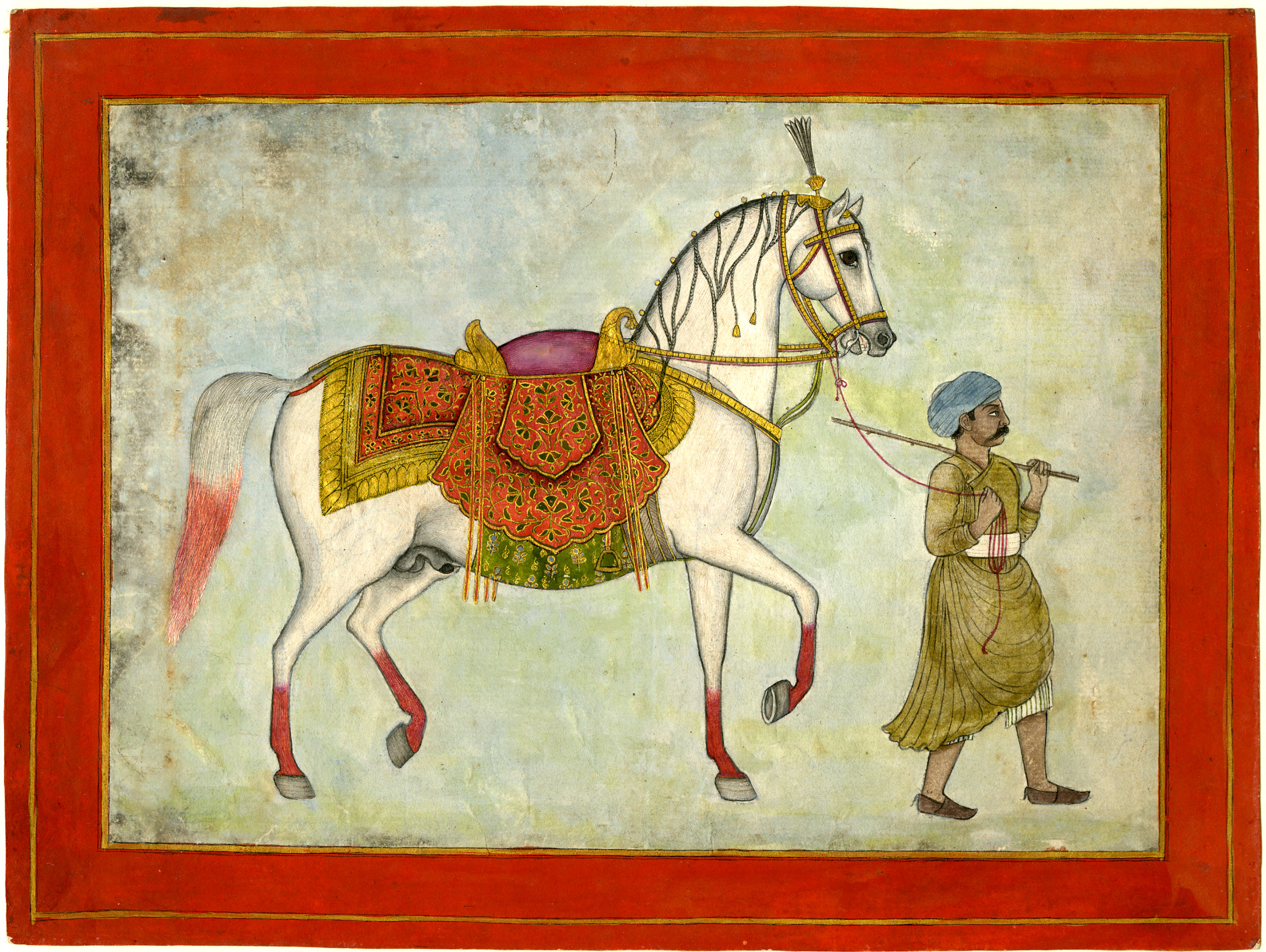
265010: Album leaf. A horse with elaborate saddle and harness being led by a groom. On paper. Copyright the Trustees of the British Museum.

Horses were highly prized and given as gifts in the Ancient Near East around 2000 BC according to ancient texts. Also, around this time what appears to be an Arab type can be seen in Egyptian tomb paintings – horses with a short back, high tail and large eyes. In about 1,600 BC the use of the faster, superior chariot ushered in the Chariot age – which was to have a profound effect on warfare, even reaching later on to China and elsewhere. Particularly among the ancient Hurrians, between the Tigris and Euphrates, a system of royal patronage developed with an aristocratic military.

The Assyrians reveled in the horse as a source of prestige and created meticulously crafted horse trappings. A Neo-Assyrian carved relief from Nimrud(Iraq) from the 9th century BC shows the intricate detail in these chariot horse trappings.

The Achaemenid King Darius was known to hunt fast game like lions from a fast-moving chariot and a seal of this image is on display. Darius was better known for developing a system similar to the Pony Express where horses were changed at intervals to deliver mail along the improved Royal road, stretching 1000 miles long. It was Herodotus who wrote, “nothing stops these couriers from covering their allotted range in the quickest possible time. Neither snow, rain, heat nor darkness.” (Sound familiar?) – Herodotus, the Histories, Book VIII, 5th century BC.
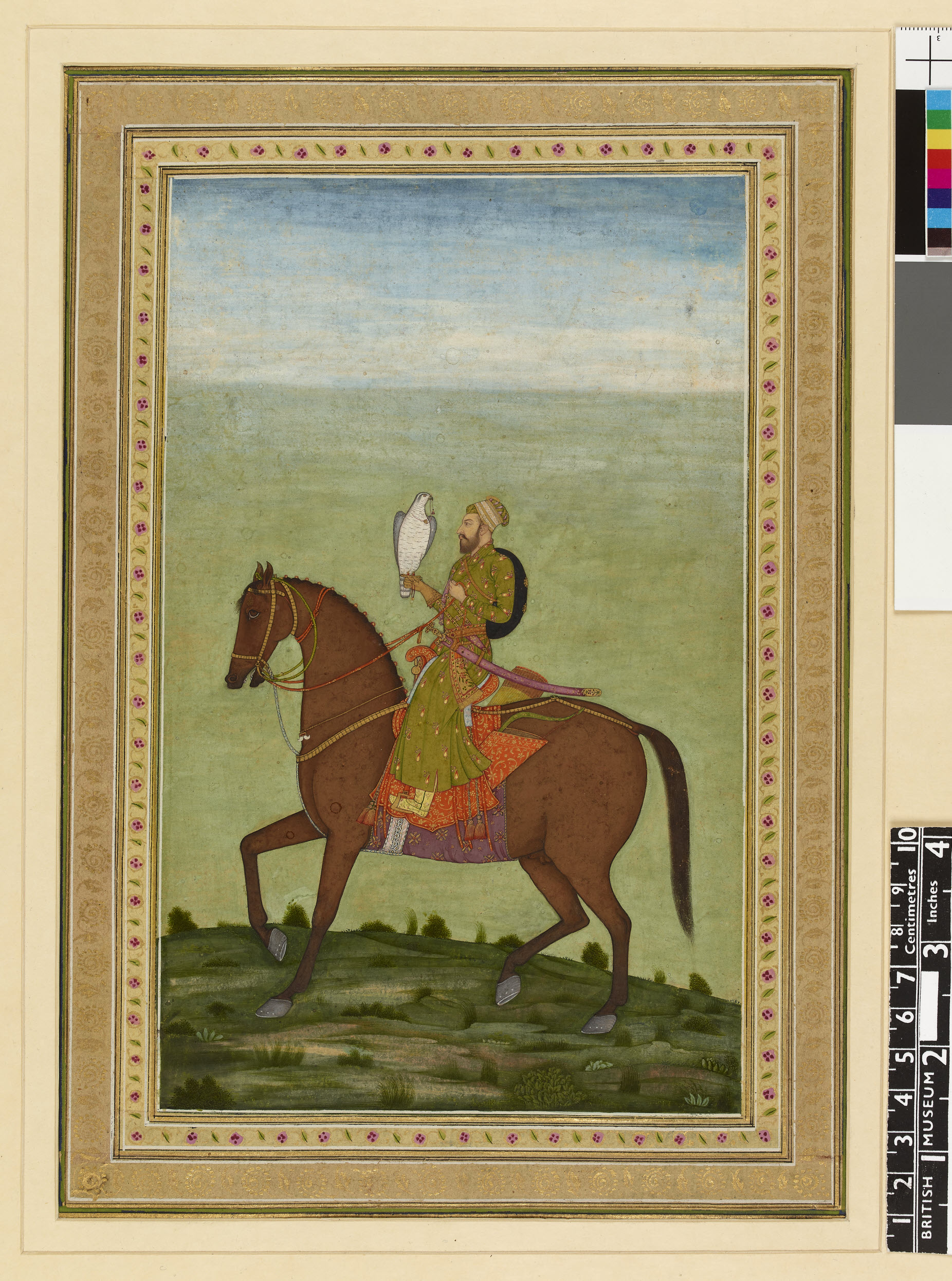
948688: Man on horseback, with a falcon, early 18th century, India. Copyright the Trustees of the British Museum.

The Parthian Empire 3rd century BC to 3rd century AD, saw more developments in horse combat. They were famous for the “Parthian shot” – pretending to flee while on horseback, then turning around shooting an arrow backwards. We now use the expression, “Parting shot” that comes from this manoeuvre.

Under the Parthians and later Sassanian Dynasty in 224 AD horses and riders started to wear armor for battle. While we think of jousting as quintessentially European with its armored horses and riders, the sport was actually practiced early on by the Parthians and Sassanians.

The horse grew in importance in the world across what is now Arabia, India and Turkey with numerous depictions in paintings and ceramics. Lovely Mughal miniatures from the 7th century AD reveal the high status of horses. Many show an owner and his beloved horse with delicate detail. The famous
Furusiyya manuscript from the 14th century AD is on display with its text on horsemanship.

Fine horses in the Middle East are explored in the Abbas Pasha manuscript from the 19th century. This document is the main text to describe the lineage of the purebred Arabian horses acquired by Abbas Pasha (the viceroy of Egypt). The Arab is the result of deliberate selective breeding.
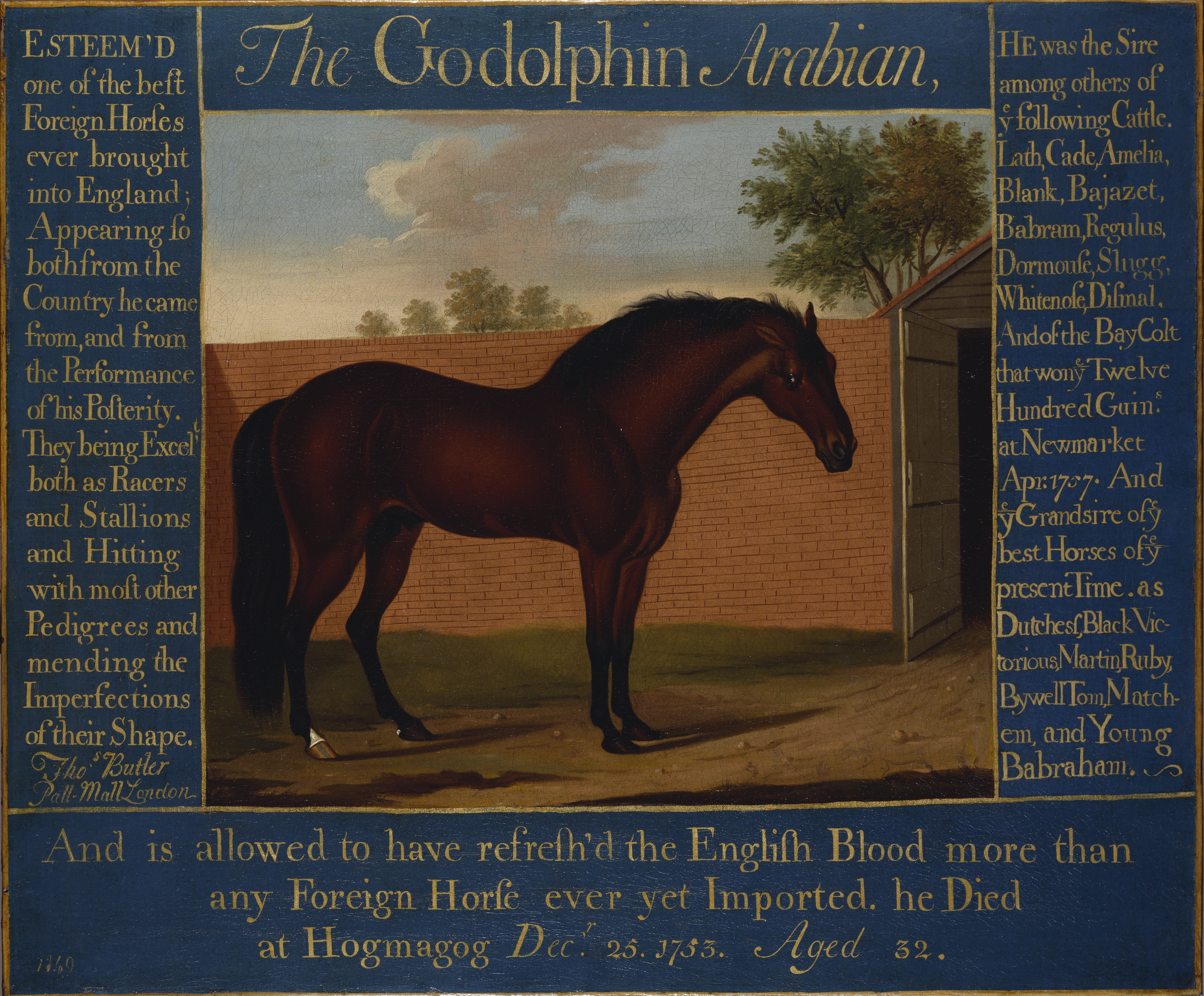
406001: The Godolphin Arabian, Butler, T, 1750-55: Copyright of the Royal Collection

This exhibition includes the famous painting of the Godolphin Arabian by Thomas Butler, painted around 1750- 1755. The Godolphin Arabian was one of three foundation stallions (the other two being the Byerly Turk and the Darley Arabian) brought to England in the 18th century and bred to native
English horses to eventually become the Thoroughbred. The majority of modern Thoroughbreds (95%) are descended from these stallions. Those readers who saw the fantastic exhibition, All the Queen’s Horses, at the Kentucky Horse Park in 2003, will be familiar with this painting, which is on loan from
the Royal Collection.
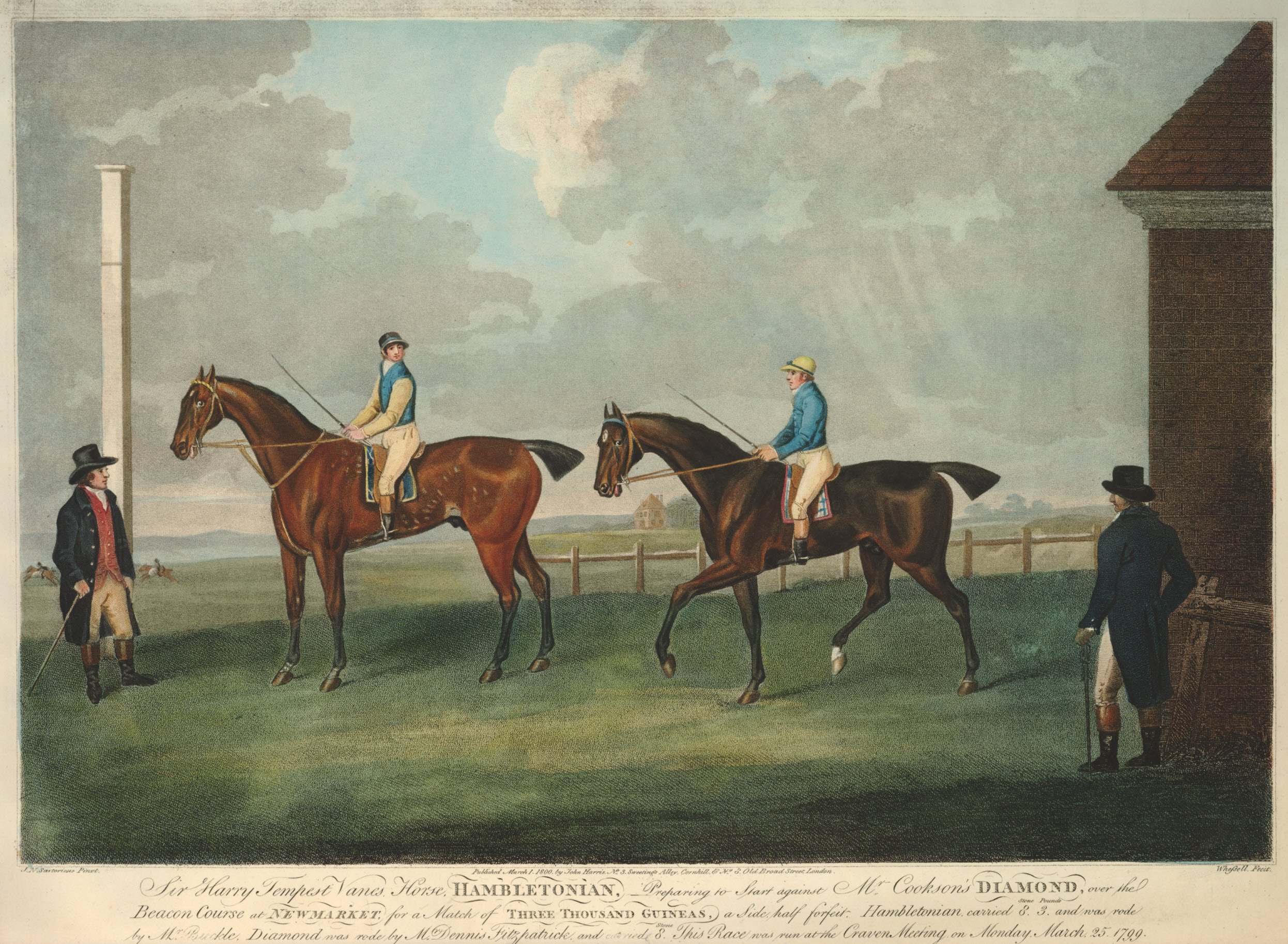
185544: Hambletonian and Diamond at Newmarket.1800, by John Whessell, Copyright the Trustees of the British Museum

Also from the Royal Collection is a silver Faberge sculpture of the race horse Persimmon who had been owned by the Queen’s great-grandfather, Edward VII. The horse created a sensation by winning the 1896 Doncaster, St. Leger and Epsom Derby, the Epsom Derby being shown around the world in an
early newsreel.
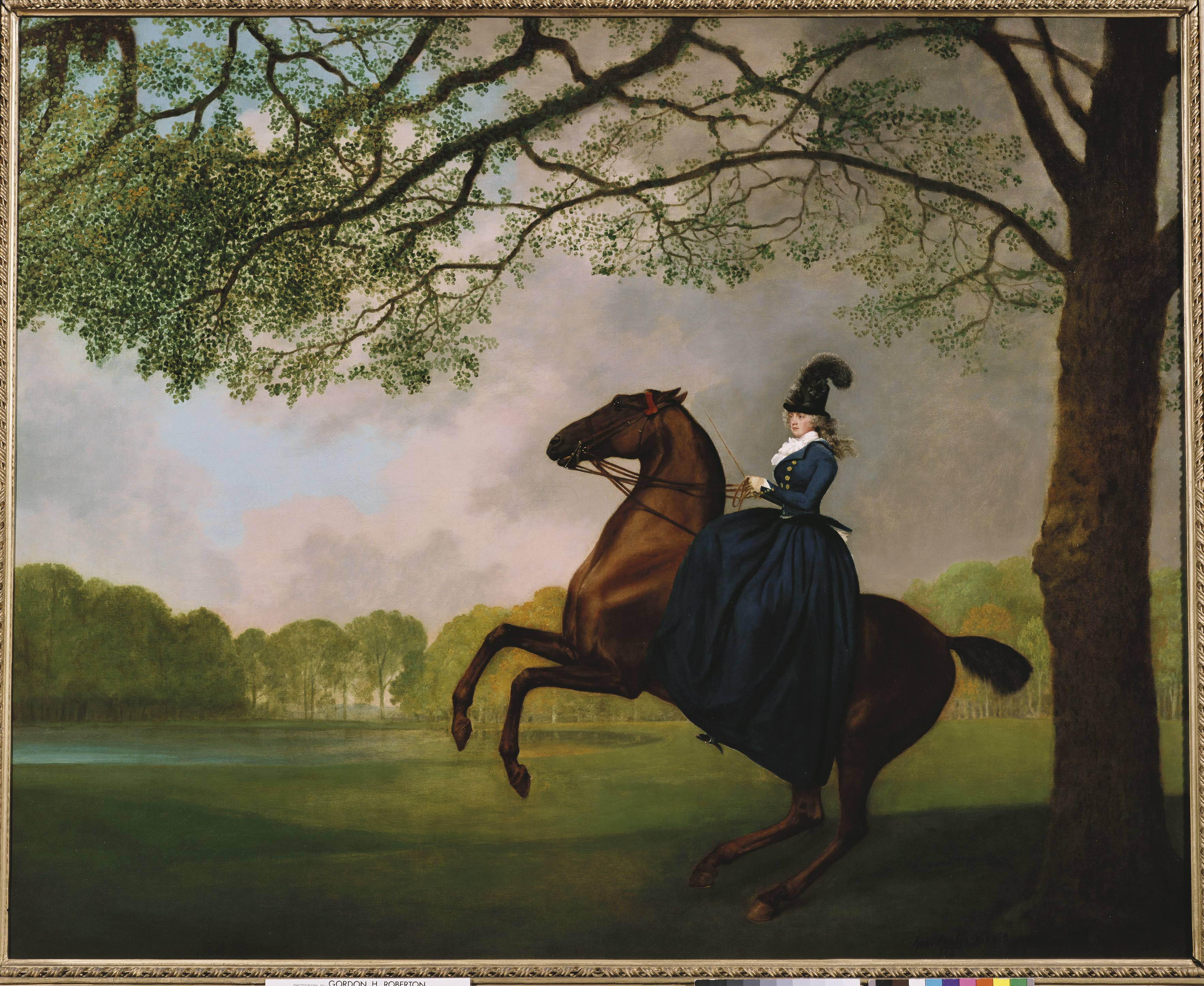
400997: Lady Laetitia, Stubbs, G, 1793: Copyright of the Royal Collection

Normally hanging in the private quarters of Windsor, a George Stubbs portrait of Laetitia, Lady Lade on horseback will be on display. Lady Lade was a somewhat controversial figure, who swore among other things, but who was a gifted horsewoman. This painting from 1793, was commissioned by George IV who was smitten with Laetitia, the wife of his racing manager. The pleasure-loving George IV was himself an expert horseman, whip and breeder of racehorses.

Discussing the exhibition, curator John Curtis told The Guardian, “There are probably horses somewhere in every gallery in the museum, from Assyrian sculptures to coins. They’re so familiar and ubiquitous they mostly go unnoticed. We want to bring them together and show their importance in
history. The horse was an engine of human development…..”

For more information: britishmuseum.org Admission is free. The exhibition runs from May 24 – September 30.
While in the Museum, be sure to see the Elgin Marbles, a must for horse enthusiasts.
A Request from a Graduate Student: Hello Fellow Jane Austen Readers! Have you ever read a published sequel to a Jane Austen novel? Are you a fan of Jane Austen sequels?

My name is Cliff Bryant, and I am a graduate student at Virginia Tech, conducting a research project on readers of published sequels of Jane Austen?s novels. I want to find out how readers came to read the sequels, and whether or not you like them.

If you are interested in participating in my study, just click on the link, and take the survey. It will take less than 10 minutes, and I will release the results in a few weeks, so you can check back and see how you compare to other Jane Austen sequel fans. (Feel free to contact me with questions at cliffbryant@vt.edu.)

(Just to be clear, I am talking about actual published sequels to the novels, not web fan fiction, or mash-ups like Pride and Prejudice and Zombies – though maybe that will be my next project!).

If you choose to participate, thanks so much! Just click the link, review the consent information, then take the survey!

Thanks!

(LINK – https://survey.vt.edu/survey/entry.jsp?id=1339705453120)

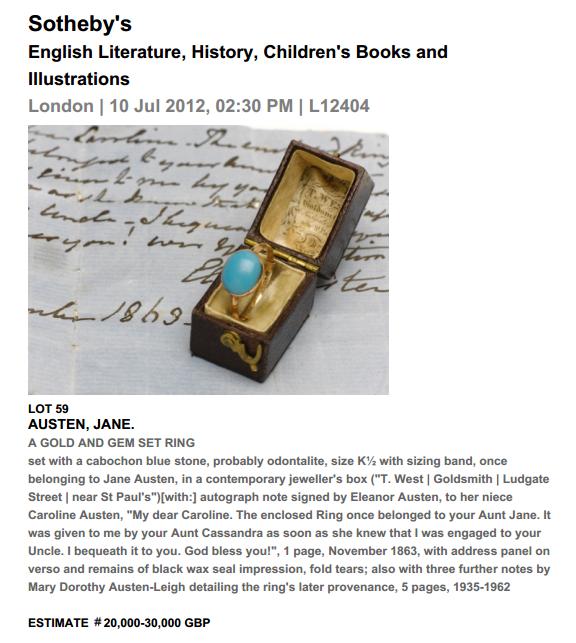
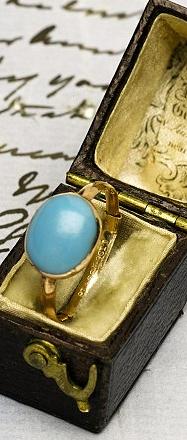
I am jumping a bit late on the Jane Austen bandwagon with news of this ring. Coverage by Austen Authors and Austenonly is quite detailed and interesting, and I have very little to add to their information other than to offer the text of the PDF document put out by Sotheby’s. The ring, as well as original editions of Jane’s books, will be auctioned on July 10th.

I will say that this cabochon ring is lovely and made of a semi-precious stone, which makes sense, considering Jane’s economic situation. Amazingly, no one knew of this possession until quite recently, when it came time to be sold. The £30,000 price tag will be realized quickly, no doubt, and the number of people who will bid on this rare item will push the price well past its original estimate. Does anyone want to bet for how much this ring will eventually go? Let’s hope it will find a home in a British museum.

PROVENANCE
Jane Austen (1775-1817); her sister Cassandra (1773-1845); given in 1820 to her sister-in-law Eleanor Austen (née Jackson), second wife of Rev. Henry Thomas Austen (d. 1864); given in 1863 to her niece Caroline Mary Craven Austen (1805-1880, the daughter of Rev. James Austen); her niece Mary A. Austen-Leigh (perhaps first to her mother Emma Austen-Leigh, née Smith); her niece Mary Dorothy Austen-Leigh; given to her sister Winifred Jenkyns on 27 March 1962; thence by descent

LITERATURE
W. Midgley, ‘The Revd. Henry and Mrs Eleanor Austen’, Collected Reports of the Jane Austen Society: 1976-85 (1989), 86-91

CATALOGUE NOTE
An intimate personal possession of Jane Austen’s, hitherto unknown to scholars, that has remained with the author’s descendants until the present day. The stone is probably Odontalite, a form of fossilised dentine that has been heated to give it a distinctive blue colour, which came into fashion in the early 19th Century as a substitute for turquoise. It is an attractive but simply designed piece, befitting not only its owner’s modest income but also what is known of her taste in jewellery. Fanny Price, the heroine of Mansfield Park, is given a gold chain by her cousin Edmund “in all the niceness of jewellers packing”, with the comment that when making his choice “I consulted the simplicity of your taste” – in contrast to the more elaborately decorated chain that she had been given by Mary Crawford. Similar sentiments are found in one of Austen’s letters when she informed her sister Cassandra that “I have bought your locket … it is neat and plain, set in gold” (24 May 1813).

On Jane’s death her jewellery, along with other personal possessions, passed to Cassandra, and she appears to have given a number of pieces as mementos. After Jane’s death Cassandra wrote to Fanny Knight that Jane had left “one of her gold chains” to Fanny’s god-daughter Louisa (29 July 1817), and she appears to have given the best-known piece of jewellery known to have belonged to her sister, the topaz cross given to her by her brother Charles in 1801 (see her letter to Cassandra, 26 May 1801), to their mutual friend Martha Lloyd.

Three years after Jane’s death, Cassandra gave the ring to Eleanor Jackson, on hearing the news that she was about to marry her brother Rev. Henry Thomas Austen. Henry had been Jane’s favourite brother and was closely involved in getting her novels into print. He lived locally to Cassandra and was by this time a clergyman (curate of Chawton from 1816, appointed perpetual curate of nearby Bentley in 1824), having previously gone bankrupt as a banker. Eleanor, his second wife, was the niece of the rector of Chawton, Rev. Papillon, and seems to have been known to the Austen family for many years.

Eleanor kept the ring for many years, bequeathing it to her niece Caroline shortly before her death. Caroline’s brother, James-Edward Austen-Leigh, wrote A Memoir of Jane Austen, and Caroline herself assisted this project by committing her own childhood memories of her aunt to paper, for her brother’s use. Caroline never married and the ring passed in turn to James-Edward’s daughter Mary, at which point it passed beyond the generation who had personal memories of Jane.

Click here for the PDF document

Also for sale:

Pride and Prejudice, Edgerton, 1813

Some books are so useful they are hard to pass up. Several months ago, I received the Kindle edition of Behind Jane Austen’s Door by Jennifer Forest, author of the delightful Jane Austen’s Sewing Box. Behind Jane Austen’s Door takes you on a tour of a Regency house, room by room – the entrance hall, drawing room, dining room, breakfast room, dressing room, bedroom, and kitchen – to
explore the challenges and lives of Jane Austen’s women. Included is an appendix that provides a quick overview of the Regency era.

More accessible in tone and organization than the excellent Behind Closed Doors by Amanda Vickery and If Walls Could Talk by Lucy Worsley, which cover similar but more comprehensive territory, this book can be used as a quick reference by people who want immediate access to the purposes and functions of the rooms in a Georgian household. What distinguishes this book is its close association to Jane Austen and her novels (much like Jennifer Kloestler’s book, Georgette Heyer’s Regency World, is associated with that author).

In these large houses [such as Pemberley], the women didn’t need to use the drawing room during the day. There were other rooms for use; they had their own office and other smaller parlors. The drawing rooms, and yes there could be more than one drawing room, in these big houses were just for receiving the morning visitors and for evening entertainment.

One gains close glimpses of a rich family as well as one of more modest means, such as the household that Jane Austen’s mother oversaw.

She works with the cook in preparing menus, sourcing food and caring for the vegetables, dairy and chickens. On washing day, she and her daughters work alongside the servants to get all the laundry completed: it was just so time consuming in the days before washing machines! A gentlewoman had to monitor the budget, find supplies and pay the bills for all those expenses, including the tea and wine. 

While much of the territory that Jennifer covered seemed familiar, it is arranged in such a pleasant and easy to use format that new authors to the Jane Austen genre or Regency romance will find it very useful, especially Jane Austen fans.

Jane Austen’s own mother used her dressing room at Steventon as a second sitting space, more casual and private than the drawing room. After five weeks of illness, Mrs Austen’s return to health allows a resumption of tea in the dressing room. “My mother made her entree into the dressing-room through crowds of admiring spectators yesterday afternoon, and we all drank tea together for the first time in five weeks … We live entirely in the dressing-room now, which I like very much; I always feel so much more elegant in it than in the parlour.” Letter from Jane Austen to Cassandra Austen, Sunday 2 December 1798.

Oh, there will be people who say that they already know this information and that the book provides nothing really new, but readers who are just discovering Jane Austen and the Regency world will think otherwise. I, for one, am happy to have another source to turn to when checking my facts about meal times and the precise function of certain rooms and furniture. The book, which is a quick read, is available in e-book format. I found this quite convenient, for I can access it on all my mobile devices and computers. Also, at $2.99 for the Kindle version, it is quite a bargain. I give it four out of five Regency teacups!

About the Author
Jennifer Forest has a Bachelor of Arts and a Graduate Diploma in Cultural Heritage Management. Jennifer is a museum curator with a love of beautiful old historic buildings. She lives in Australia, a country built by Regency England.

Blog: Behind Jane Austen’s Door

Print Length: 51 pages
Sold by: Amazon Digital Services
Language: English
ASIN: B006YITPAS
Text-to-Speech: Enabled
X-Ray: Not Enabled
Lending: Enabled

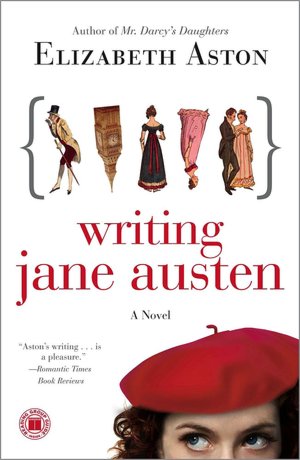
Have you ever read a book that made you squirm, yell out loud, and want to smash fine china to release your frustration? I usually put such books down and don’t bother to finish them. In this instance I was listening to Writing Jane Austen by Elizabeth Aston in my car and kept punching the on and off button. While I HATED Georgina, the main protagonist, the plot retained my interest just barely enough to keep me going.

Let me say up front that Elizabeth Aston knows her Jane Austen history and has a way with dialogue that is modern, smart, and funny. She also creates vivid characters with names like Henry LeFroy and Mr. Palmer, and has them shopping in stores like Mr. Darcy’s in Bath.

So what is my beef with Writing Jane Austen, which was published in 2010? Simply put, its heroine, Georgina. (I cannot recall her last name and am unwilling to relisten to the first CD to find out.) If an author asks me to spend hours of my life with her heroine, she should provide me with a character that commands my respect and/or interest. I could muster none for Georgina – no respect, no empathy, and absolutely no concern for her well being. In fact, if it hadn’t been for the wonderful young Maude, Henry LeFroy’s sister, I would have stopped listening to the audiobook after the first CD.

It is my firm belief that no well-educated author is as stupid as Georgina, the young woman who has been picked (for no good reason that I can see) to complete Jane Austen’s long lost and unfinished 3,000 word manuscript entitled “Love and Freindship.” Writing Jane Austen makes fun of the publishing industry’s mania for JA sequels, prequels, and mash-ups, and there are moments when Elizabeth Aston gets it completely right. But then I realized that this novel is as cynical as the  industry it is lampooning, and with a defective heroine to boot. Either Elizabeth Aston has created dumb Georgina on purpose to ramp up her contempt for money-grubbing publishing houses who have jumped on the Jane Austen bandwagon in pursuit of the almighty dollar, or she actually thinks that her dumb-as-a-post heroine has a few redeeming qualities. Not.

So why do I dislike Georgina so acutely? She lacks intellectual curiosity, has a less than open mind, and repeatedly demonstrates an inability to be practical in the face of a situation over which, if she possessed a smidgen of self-awareness, she has full control.  She is immature and uninteresting, a lethal combination. Much of the plot hinges on the fact that Georgina must write a 120,000 word book in the style of Jane Austen within a few months. The problem? She has never read a Jane Austen novel and has no interest in doing so, for she assumes that Jane’s books are a classic version of light chic lit, a genre she despises.

At the novel’s opening, Georgina is between a rock and a hard place. Her first book, a gritty, grim and dark Victorian novel, was forgettable, and her second book has stalled at Chapter One. Her agent threatens to drop her unless she writes Love and Freindship, and she is broke. The publisher’s advance will stave off her creditors and buy her more time to live in England. So, what does Georgina do after she gives in and agrees to write the book?  Anything but read a Jane Austen novel. At this point I began to develop an extreme dislike for Georgina that bordered on hatred. How stupid can you get? Elizabeth Aston keeps the reader dangling with this weak plot point: is Georgina EVER going to read a Jane Austen novel and write the damned book?

This wait was stretched out for so long that I nearly spat at my CD player. At one point I yelled, “Enough already, you stupid woman! READ Jane’s books!” Even a brainless monkey would have known that this is the first step one should take when one agrees to mimic a famous author’s writing style. Georgina’s reasons for resisting did not resonate with me. In fact, when she finally picked up Pride and Prejudice and reacted with  predictable gooey Jane Austen adoration, the only reason I kept listening to the audiobook was because I was driving along a boring stretch of highway.

What happened next in the book was so totally predictable that I began to laugh: After reading all of Jane Austen’s novels back to back in record time, Georgina now feels inadequate to the task of completing the manuscript of Love and Freindship. And so she is paralyzed with inaction.

Like I cared.

The heroine wasn’t all bad, I grudgingly admit. There were poignant moments, as when Georgina is brought to tears as she recognizes Jane Austen’s genius, or when she sees her writing table in Chawton Cottage and is actually able to muster an insight with her pea brain – that Jane could do so much with so very little.

I could have done without the interminable expositions about writer’s block, and some of the more improbable situations, such as ghostly apparitions of costumed people and carriages that were not integral to anything, except that the author seemed to think it a good idea to plop them in here and there. It is to Ms. Aston’s credit that she kept me listening until, well, almost the very end, for I did not quite finish the book, leaving the last CD in its sleeve. That’s how little I cared about Georgina and her angst about finishing Love and Freindship.

Reading or hearing this novel is akin to watching a TV movie of the week: Here today, gone tomorrow. In 20 years or so, as the Jane mania recedes into memory, you will likely find it for sale for 25 cents on the shelves of a Salvation Army store, while Jane’s excellent novels will still be  selling and selling and selling. Thankfully, I borrowed my audio book of Writing Jane Austen from my local library and did not have to part with a cent. If you are still tempted to read the novel, I suggest you do the same.

I am giving this book One Regency Teacup (out of five). In the words of the all-knowing Lady Catherine de Bourgh, “I am most seriously displeased.”