Feeds:
Posts
Comments

Gentle readers, I have been staying inside during this week’s heatwave, which shows no signs of letting up. As I showered, I wondered how people in days of yore dealt with their sweat and overheated bodies. Karl Philipp Moritz’s excellent and delightful travel journal from 1782, ‘Travels in England’, gave me a clue. Here are some excerpts from his account of wandering through the British countryside.
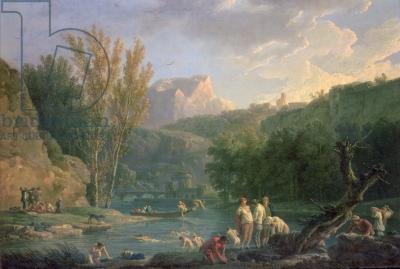
River Scene with Bathers, 18th century (oil on canvas), Vernet, Claude Joseph (1714-89) Image @Bridgeman

Now it is a pleasing exchange to find that in two hours I can walk eight miles.  And now I fancy I was about seventeen miles from London, when I came to an inn, where, for a little wine and water, I was obliged to pay sixpence.  An Englishman who happened to be sitting by the side of the innkeeper found out that I was a German, and, of course, from the country of his queen, in praise of whom he was quite lavish, observing more than once that England never had such a queen, and would not easily get such another.

It now began to grow hot.  On the left hand, almost close to the high road, I met with a singularly clear rivulet.  In this I bathed, and was much refreshed, and afterwards, with fresh alacrity, continued my journey.
A river landscape with bathers, Dutch 18th c. painting. Such scenes were common throughout Europe.

Karl, a romanticist, read Milton as he rested in between long walks. His account bears witness to his love of the British countryside, despite the poor manners of inn keepers, who were wary of a man on foot. (Those who traveled on horseback or in a carriage received preferential treatment. )The following description shows how people during the Georgian era were not as deprived of baths as we thought, or as adverse to bathing!

I went down into the coffee-room, which is immediately at the entrance of the house, and told the landlord that I thought I wished to have yet one more walk.  On this he obligingly directed me to stroll down a pleasant field behind his house, at the foot of which, he said, I should find the Thames, and a good bathing place.

I followed his advice; and this evening was, if possible, finer than the preceding.  Here again, as I had been told I should, I found the Thames with all its gentle windings.  Windsor shone nearly as bright over the green vale as those charming houses on Richmond Hill, and the verdure was not less soft and delicate.  The field I was in seemed to slope a little towards the Thames.  I seated myself near a bush, and there waited the going down of the sun.  At a distance I saw a number of people bathing in the Thames.  When, after sunset, they were a little dispersed, I drew near the spot I had been directed to; and here, for the first time, I sported in the cool tide of the Thames.  The bank was steep, but my landlord had dug some steps that went down into the water, which is extremely convenient for those who cannot swim.  Whilst I was there, a couple of smart lively apprentice boys came also from the town, who, with the greatest expedition, threw off their clothes and leathern aprons, and plunged themselves, head foremost, into the water, where they opposed the tide with their sinewy arms till they were tired.  They advised me, with much natural civility, to untie my hair, and that then, like them, I might plunge into the stream head foremost. Refreshed and strengthened by this cool bath, I took a long walk by moonlight on the banks of the Thames.  To my left were the towers of Windsor, before me a little village with a steeple, the top of which peeped out among the green trees, at a distance two inviting hills which I was to climb in the morning, and around me the green cornfields.  Oh! how indescribably beautiful was this evening and this walk!
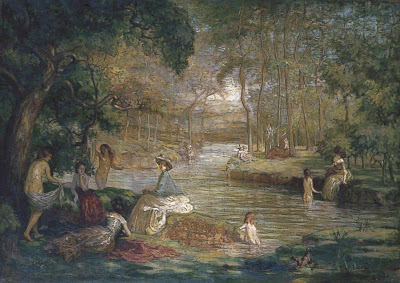
Women Bathers by a River, Tharp, 1900. This painting was made over 100 years after Karl’s journey. Notice the segregation of the women from the men, which held true over a century before this painting was made.

About Karl Philipp Moritz (from Wikipedia): Karl was a German author, editor and essayist of the Sturm und Drang, late enlightenment, and classicist periods, influencing early German Romanticism as well. He led a life as a hatter’s apprentice, teacher, journalist, literary critic, professor of art and linguistics, and member of both of Berlin’s academies. Karl traveled through England in his 20s; he died young, when he was 37.

This scene in Pride and Prejudice 1995 might not have been in Jane’s book, but Darcy’s desire to cool off in his stream-fed pond made sense and was historically accurate.

You can download Karl Philipp Moritz’s book for free into your Kindle or Kindle app. [Moritz, Karl Philipp, 1757-1793. Travels in England in 1782 by Karl Philipp Moritz (Kindle Locations 987-992). Mobipocket (an Amazon.com company).]
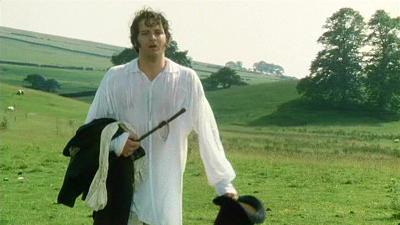
Colin Firth in a wet shirt.

This beautiful marquetry table transforms into a desk with a turn of a key. This short animated film shows you how it operates and how an elegant French lady in the 18th century would have used it. Enjoy.

Exquisite marquetry of this French mechanical table.

Read about metamorphic furniture (which is different from mechanical furniture) at this link.

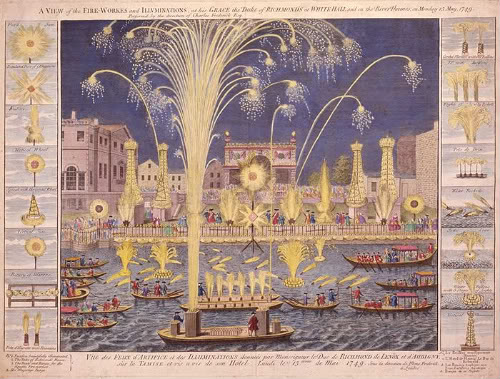
Today U.S. citizens are celebrating July 4th and the independence of our nation from Great Britain. Grand firework displays will play a pivotal role in our national revelry tonight, culminating a day long celebration. Fireworks were not unknown during the Georgian Era, and were used for grand effect in public celebrations. I will point out only a few instances in London.

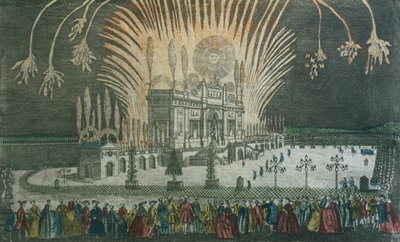
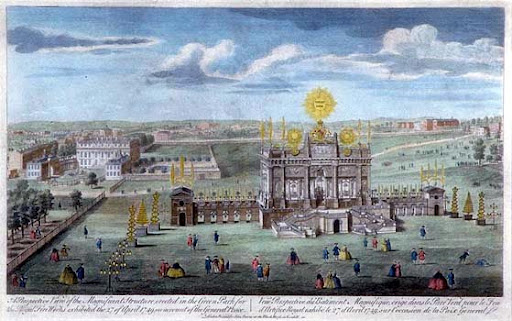
The picture above is of the firework display held by the Duke of Richmond at Richmond House near the Thames in Whitehall, London [May 1749] and shows both the whole effect of all the fireworks and also, very interestingly, gives individual details [on the side] of the individual fireworks which made up the whole display. – Austenonly

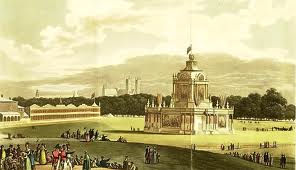
Temple of Peace in Green Park.

Early view of Green Park and the Temple of Peace.

Green Park was readied for a grand fireworks display in 1763 to celebrate the Treaty of Paris, which ended the French and Indian War in North America. The park had attracted firework displays before:

The Green Park was used for a national party in 1746 to celebrate the end of the War of Hanoverian Succession. The royal family arranged a great firework display and commissioned the composer, Handel, to write his Music for the Royal Fireworks. A vast Temple of Peace was built in the park to store the fireworks. But early on a stray rocket hit the temple. Three people died and 10,000 fireworks were destroyed in the fire that followed. – The Green Park

Temple of Peace in Green Park lit up by fire works.

The Treaty of Paris  granted Great Britain control of all land to the east of the Mississippi River, a cause for a grand celebration and a good reason for building a ceremonial temple. (View a print of the scene here.)

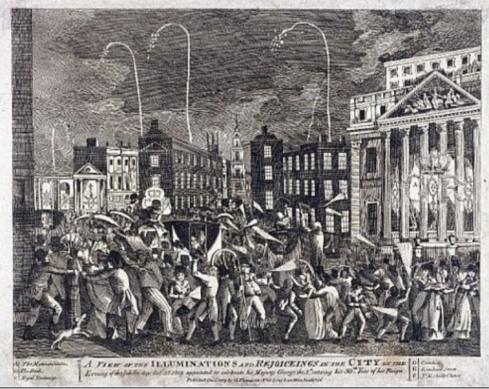
Another cause for creating massive firework displays was the long reign of George III. The details of  the Golden Jubilee celebrations are beautifully described at Austenonly.

Fireworks in London in celebration of King George III Golden Jubilee in 1809

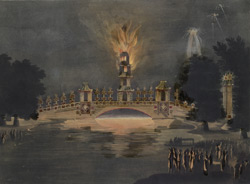
Fireworks were quite dangerous, and so were  gas lit fires. In 1814, another grand celebration was planned in St. James Park (which lies close to Green Park) to commemorate 100 years of the Hanoverian royal family. A seven-story pagoda was erected on a Chinese-style bridge spanning the canal in St. James’s Park.

A view of the Chinese pagoda burning. Image @British Library

The splendid gala was organized for the joint August first celebration of the Hanoverian Centenary and the anniversary of the Battle of the Nile. The brilliant and daring tactics of Lord Nelson at the Battle of the Nile were represented by rowboats upon the canal. A disaster occurred when the gas lit pagoda caught fire and burned. Two men were killed and a number injured trying to put out the fire. A number of the Royal swans succumbed to smoke and fire. The crowd unaware that this was an accident took the occurrence to be part of the spectacle and applauded wildly. – The Georgian Index

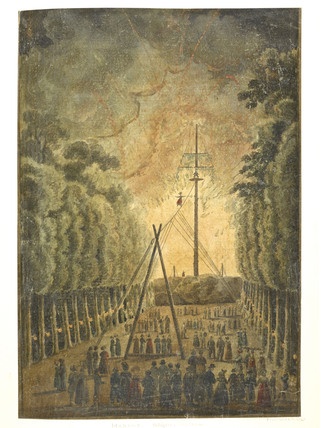
When the Napoleonic Wars came to an end, famed rope walker, Madame Squi, could finally cross the English Channel in  1816 to perform at Vauxhall Gardens for the first time.

Madame Saqui illuminated by the bursts of fireworks, Vauxhall, 1816. Copyright Museum of London*

‘In the midst of a great burst of fireworks, Bengal lights glimmering faintly in the clouds of smoke, she (Saqui) stands on a rope, sixty feet up, and follows a narrow and difficult path to the end of her journey. Sometimes she is completely hidden from our eyes by the billowing waves, but from the way she walks, so self-assured, one would think an Immortal was walking peacefully towards her celestial home.’ [Lerouge on Madam Saqui at Vauxhall] – Rope Walkers and Equillibrists

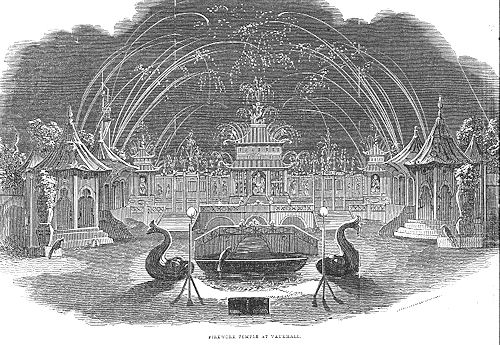
Firework displays were no novelty at Vauxhall Gardens, or any of the major gardens where people congregated to walk along grand promenades, dance publicly to music, eat, drink, and enjoy an evening out in the open.

Fireworks display at Vauxhall, 1800s.

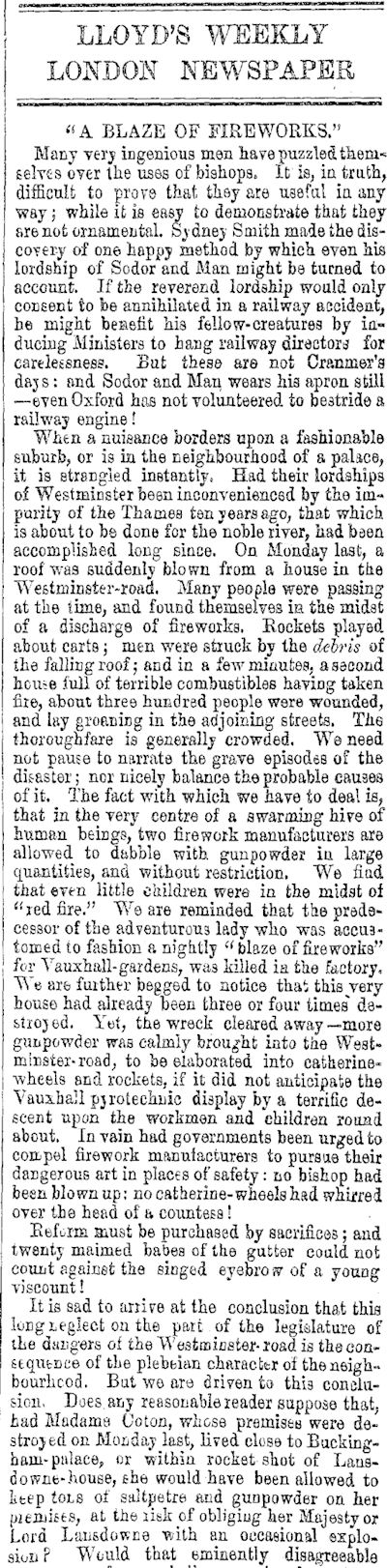
There were terrible accidents then as now with fireworks. Here is an account from  an 1858 newspaper** about an accident in central London:

All over the U.S. we will be enjoying various kinds of firework displays. Those in Washington D.C. and the major cities will be the grandest, I am sure. I recall an intimate firework display along a small lake in Vermont one year, in which only a few fireworks were set off. Interestingly, of all the firework displays I have seen, that is the one I tend to recall. Happy Birthday, America! Stay safe.

*Museum of London Prints

**Newspaper Account of Vauxhall accident.

More about Green Park at this link.

Among the principle gifts in 1908 may be mentioned: – suit of clothes, &c., formerly belonging to Mr Thomas Coutts, the founder of Coutts Bank, died 1822, given by Francis Coutts, Esq., Announcement for The Victoria & Albert Museum

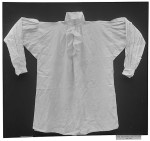
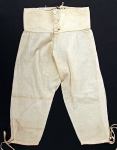
Shirt. Image @Metropolitan Museum of Art
This cryptic announcement does not tell the whole story of how a number of important museums around the world came into the possession of several portions of Mr. Coutt’s wardrobe. In her excellent book, Four Hundred Years of Fashion, Natalie Rothstein (curator of silks at the Victoria & Albert Museum) recounted how the clothes that had once been worn by Thomas Coutts, successful banker, came to be passed down for several generations in the family and divided among a number of major museums in 1908 and 1912.  The collection was unusual, for it consisted of the entire wardrobe of a gentleman who lived in the early 19th century, that included:

the considerable number of cloth costumes, articles of hosiery and underclothing left by Mr Thomas Coutts at the time of his death, 24th February 1822 . . . The cloth suits are all of a plain black and of precisely the same cut, so that only one is necessary for exhibition.”

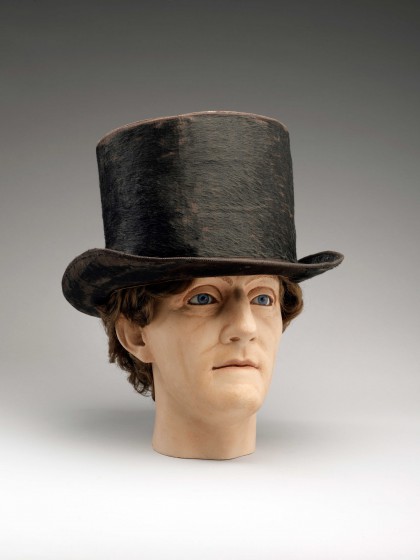
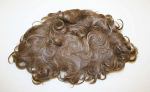
One of the ten wigs in the “brutus” style. One wonders if Mr. Coutts is wearing one in the illustration below! Image @The Metropolitan Museum of Art

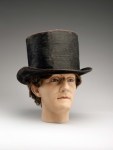
Top hat

Additional clothes in the collection include: 57 items of underwear made of linen or wool,  46 shirts made of a fine cambric and with and without frills, four spotted nightgowns, several plain nightgowns, 13 pair of leather and wool gloves, ten wigs and three beaver hats. Such a large, intact group of clothes from one source was rare and unique. Ironically for the museums, according to Strandlines, “Thomas Coutts seems to have been an eccentric man, who preferred to dress scruffily and to hide his wealth, rather than display it.”

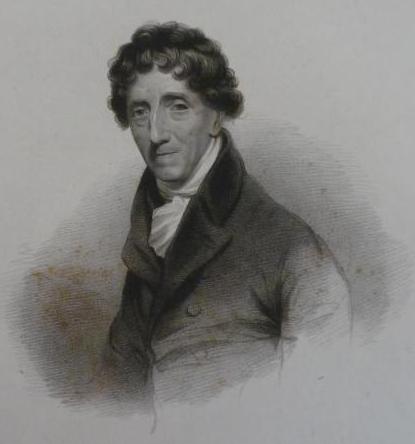
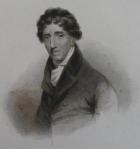
Thomas Coutts. {From an engraving by R. W. Sievier of an oil painting by Sir W. Beechey, R.A.)

Coutts was not a wit himself or the cause of wit in others. There are, indeed, two or three anecdotes, ” duplications,” in the argot of the Higher Criticism of the same legend, which turn upon the piquant incongruity of his garb with his gear. He is dressed in a threadbare coat, “the costume of a decayed gentleman,” and a benevolent stranger of limited means presses a guinea into his hand, and then to his dismay learns that he has ” pouched ” the wealthiest man in England. It may have been so. A dean once complained to the present writer that he was often mistaken for the verger, and offered a shilling for his services as guide to the Cathedral. It is possible that before the days of Harriot Mellon, Coutts was sometimes ” attired in very faded, worn-out clothes,” but his wardrobe, which his widow preserved in camphor, was, like Alice Fell’s new cloak, as stout and ” warm as man can sell.” A select portion is preserved at the Victoria and Albert Museum, and may be inspected by the curious. He had, too, some five or six ” Brutus ” wigs, which were of the finest make and the costliest description. Even if these legends are founded on fact, they are hardly worth the re-telling.” – The life of Thomas Coutts, bankerErnest Hartley Coleridge (1920).

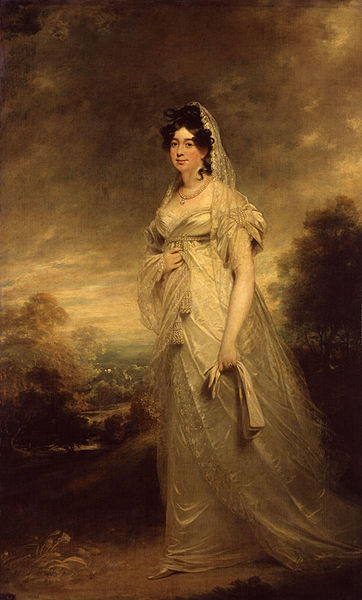
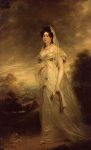
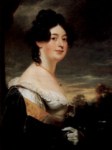
Harriot Mellon Coutts and the future Duchess of St. Albans, painted by Sir William Beechey in 1817-1818. She preserved her husband’s wardrobe.
It was fortuitous that Coutt’s second wife, Harriot Coutts, nee Mellon, was the daughter of a wardrobe-keeper in a company of strolling players. One can only imagine that when she was made a widow the preservation of her husband’s wardrobe would come naturally to her. The Victoria & Albert Museum eventually acquired three suits, several sets of the underwear, two of the spotted nightgown, and some accessories. The rest of Coutts’s wardrobe was (sadly) divided among a number of museums, including The Metropolitan Museum of Art in New York, The Royal Ontario Museum, The Royal Scottish Museum, Bristol Museum and Art Gallery, and more. All but one of the museums would receive a black suit. With vast understatement, Ms. Rothstein (who laments the break up of such an intact collection) writes:

The clothes worn by Mr Coutts were probably not the height of fashion but rather conservative. There is no mention of any trousers for instance, in the full list of his clothes. All his suits had breeches. The cut of his coats is consistent with the current fashions: his tailor was probably as conservative as his customer. None of his coats had a waist seam. – Four Hundred Years of Fashion, Natalie Rothstein, p. 62

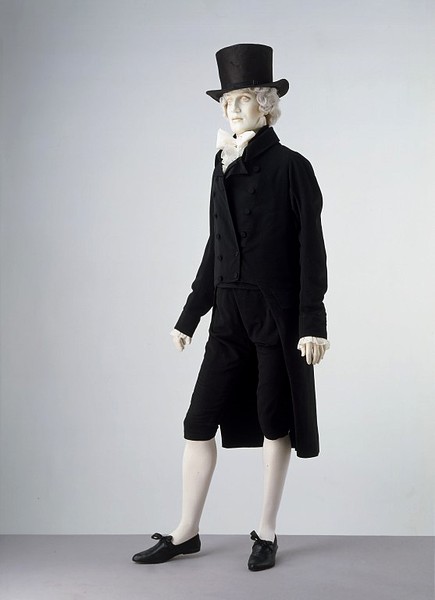
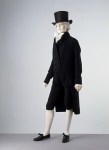
Black wool day suit. Image @ Victoria & Albert Museum

Since the late 16th century, middle-class professionals like doctors, lawyers, clergymen, academics, merchants, and businessmen have worn these stark black suits. This tradition continued through the 19th century and well into the 20th. “The sombre colour of this suit befits the sober profession of its wearer, Thomas Coutts (1735-1822), the founder of Coutts Bank., including the old-fashioned breeches, which suited his age. Top hat made in Great Britain, ca. 1800-1817. Cotton shirt, (1800-1820) made in England. (Text from the V&A.)

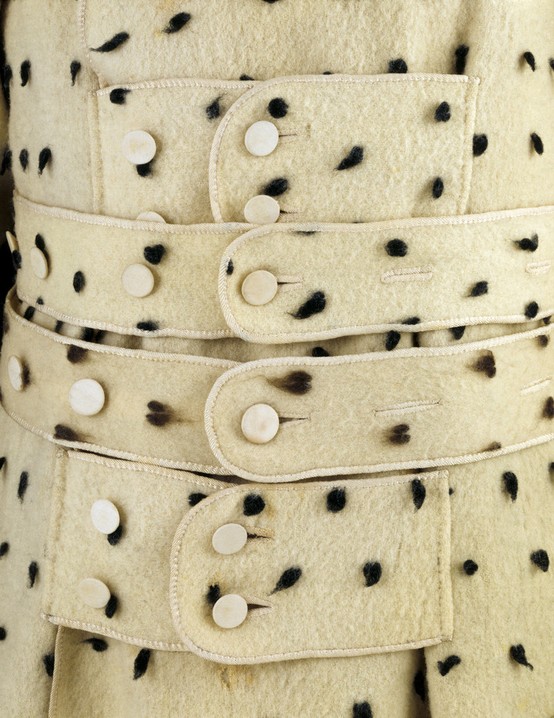
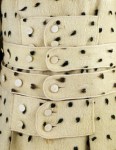
Detail of one of Coutts’s nightgowns. Image @Victoria & Albert Museum

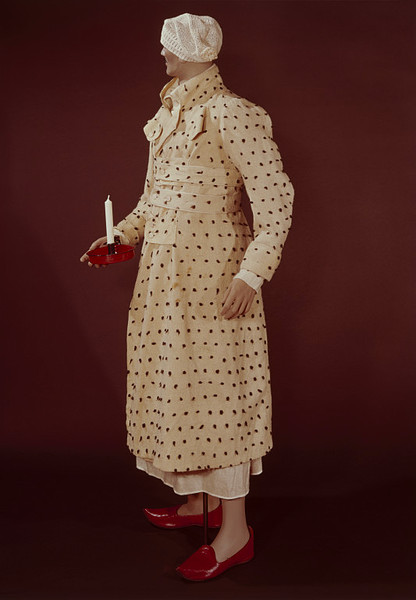
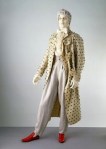
Nightgown. Image @V&A

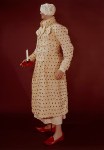
Nightgown. Image @V&A

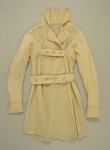
Nightgowns were worn over shirt and breeches, in the privacy of home before noon or late at night.  The tufts of black wool on the cream wool fabric are meant to imitate ermine. These nightgowns come from the wardrobe of Thomas Coutts (1735-1822), the founder of Coutts Bank. (Text from the V&A.)

More on the topic:

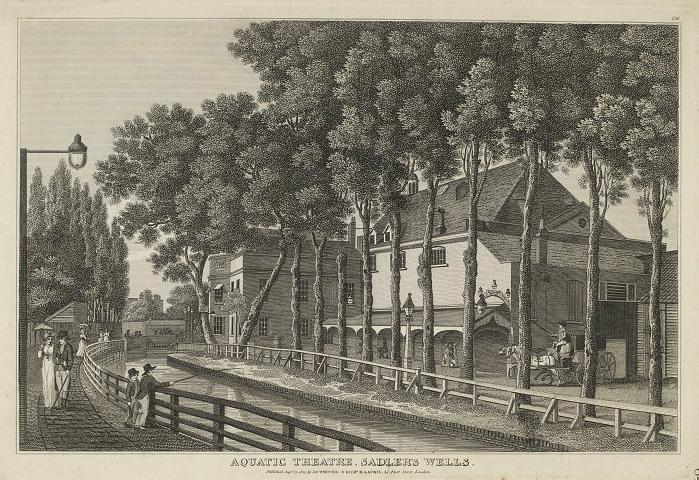
Sadler’s Wells Aquatic Theatre, 1813. copyright The V&A Museum. Click on image to view details.

Sadler’s Wells was a performing arts area located in Clerkenwell in the outskirts of London. Named after Richard Sadler, who opened a musick house there in the late 17th century, the region boasted well water thought to have medicinal qualities.

Sadler was prompted to claim that drinking the water from the wells would be effective against “dropsy, jaundice, scurvy, green sickness and other distempers to which females are liable – ulcers, fits of the mother, virgin’s fever and hypochondriacal distemper.” -Wikipedia

Six theatres have stood at this site since Sadler built his first theatre. A second theatre,  Sadler’s Wells, was constructed in 1765, which attracted summer theatre goers (the Theatre Royal offered performances only in the fall and winter.)

Interior of the theatre in 1810. One can see the water-filled tank on the stage.

In the early 19th century, Sadler’s Wells began to offer aquatic spectacles. The construction of a large tank (90x24x3 ft)  in 1804 by Charles Dibdin covered the entire area of the stage. It was flooded with water that was pumped from the nearby New River at the cost of 30 pounds per annum. This renovation allowed for the theatre to be used for naval melodramas, a popular theme, one imagines, in the days of the Napoleonic Wars and tales of Admiral Nelson’s heroism. The Siege of Gilbraltar, an ambitious spectacle, deployed 117 model ships created by the Woolwich Dockyard shipwrights and riggers, who used a scale of one inch to a foot in exact imitation of the slightest details, including the rigging. Children were cast as drowning Spanish sailors, and could be seen struggling in the waves.

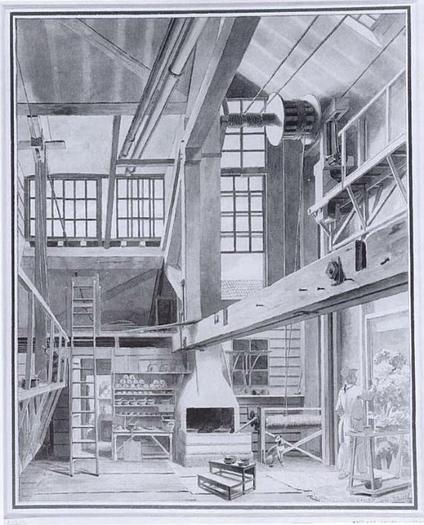
Scenic artist at work, 1790. Image @British Museum

A beautiful drop scene that filled up all the area of the proscenium showed the English fleet drawn up in battle against France and Spain. The enormous painting was used to entertain the audience during a delay while preparations were made behind stage. In order to alleviate 20 minutes of boredom between scenes, the stage slowly rose to nearly the roof of the theatre in full view. A second water tank was built on the theatre’s roof to simulate waterfalls. (With the lack of temperature control in the 19th century and windows in the main area, one can imagine that the theatre’s interior developed a powerful moldy smell in the heat of summer!)

Audience watching a play at Drury Lane, Rowlandson, 1785

The behavior of the theatre goers at Sadler’s Wells left much to be desired. As early as 1711 it was observed that members of the audience were publicly drunk, and their behavior boorish and loutish. Karl Philipp Moritz, a German traveler in England in 1782, described in his travel diary the audience in a typical British play house. Not only was the crowd rowdy between scenes and before the performance (making a “noise and uproar”), but there was a constant pelting of orange peels, for oranges were “tolerably cheap”.

Besides this perpetual pelting from the gallery, which renders and English play-house so uncomfortable, there is no end to their calling out and knocking with their sticks till the curtain is drawn up…I sometimes heard, too, the people in the lower or middle gallery quarrelling with those of the upper one. Behind me, in the pit, sat a young fop, who, in order to display his costly stone buckles with the utmost brilliancy, continually put his foot on my bench, and even sometimes upon my coat. – Karl Philipp Moritz

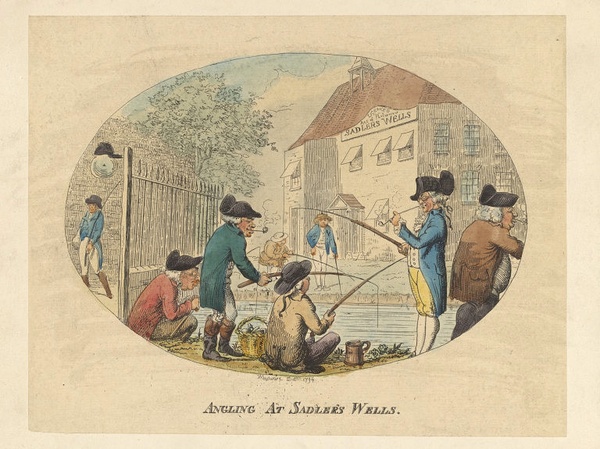
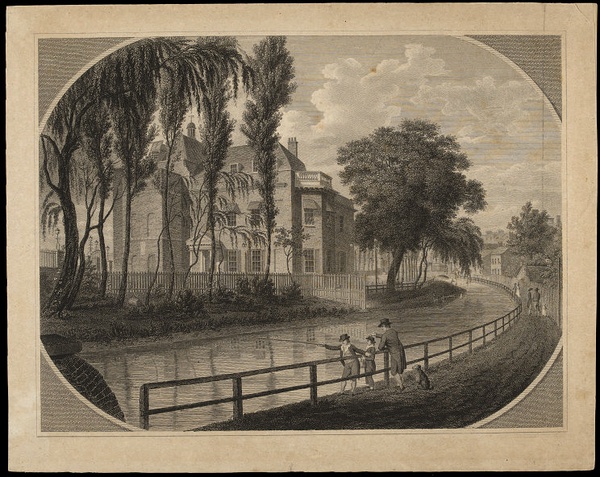
Another view of the theatre. Fishing seems to have been a popular pasttime as well.

If the Sadler’s Wells theatre audience had a particularly rowdy reputation compared to theatres in central London, one can only imagine how truly awful the experience was. The theatre slowly lost its lustre during the first half of the 19th century, for it was located in the rural outskirts of London. Without street lights and an organized police force, travel at night was dangerous, and patrons of the theatre were provided escorts as they traveled back to central London.

 Pinero’s play Trelawny of the ‘Wells’ (1898), portrays Sadler’s Wells as outmoded by the new fashion for realism. The theatre declined until, by 1875, plans to turn it into a bath house were proposed and, for a while, the new craze of roller skating was catered to, as the theatre was converted into a roller-skating rink and later a prize fight arena. The theatre was condemned as a dangerous structure in 1878. – Wikipedia

Anglers at Sadler’s Wells.