Feeds:
Posts
Comments

Dear Readers, Christine Steward from Embarking on a Course of Study has frequently contributed articles from her blog. She developed this post from her notes during a lecture by Jane Austen scholar, Gillian Dow. 

GOUCHER JANE AUSTEN SCHOLAR LECTURE: “Translating Austen; Or, when Jane Goes Abroad”

Following are my notes from a fascinating lecture that takes place every other year at Goucher College, home of the Alberta H. and Henry G. Burke Papers and Jane Austen Research Collection. This year the scholar was Dr. Gillian Dow, Professor at Southampton University and of Chawton House Library.

Gillian has written a piece for Masterpiece on PBS that addresses my reading project:

What was “extensive reading” to consist of for Austen’s female contemporaries and her fictional heroines? Certainly, a diet of pure fiction would not suffice. Indeed, many late eighteenth and early nineteenth-century novels employ the device of a warning from the narrator, directed at their female reader: beware of the dangers of fiction, the young woman is told, it enflames the mind and leads to romantic flights of fancy.

More of that article here if you’d like to read it. Let’s continue on with my notes. It was a fascinating lecture!

(Note: if any of what appears below is incorrect, it is entirely my fault as I may have misheard as I tried to keep up.)

The talk took place in February, in the Alumni House at Goucher on an, if not warm, definitely almost-spring-like, evening. The room was packed. More than 100 people, with at least 20 students (a coup!). Her talk focused on the various translations of Jane in other countries. She began with a quote by T.E. Kebbel in The Fortnightly Review (1885): “Miss A could hardly be appreciated by anyone not thorough English.”

That said, Gillian told us that there’s a room in the Jane Austen House Museum where translations of Austen’s novels are kept on the shelves (wish I’d known this when I visited there last year – if you go, check these out). About 70 of them, from Japan, Serbia, Iran, and other European countries – Sweden, Denmark, Germany, France for example.

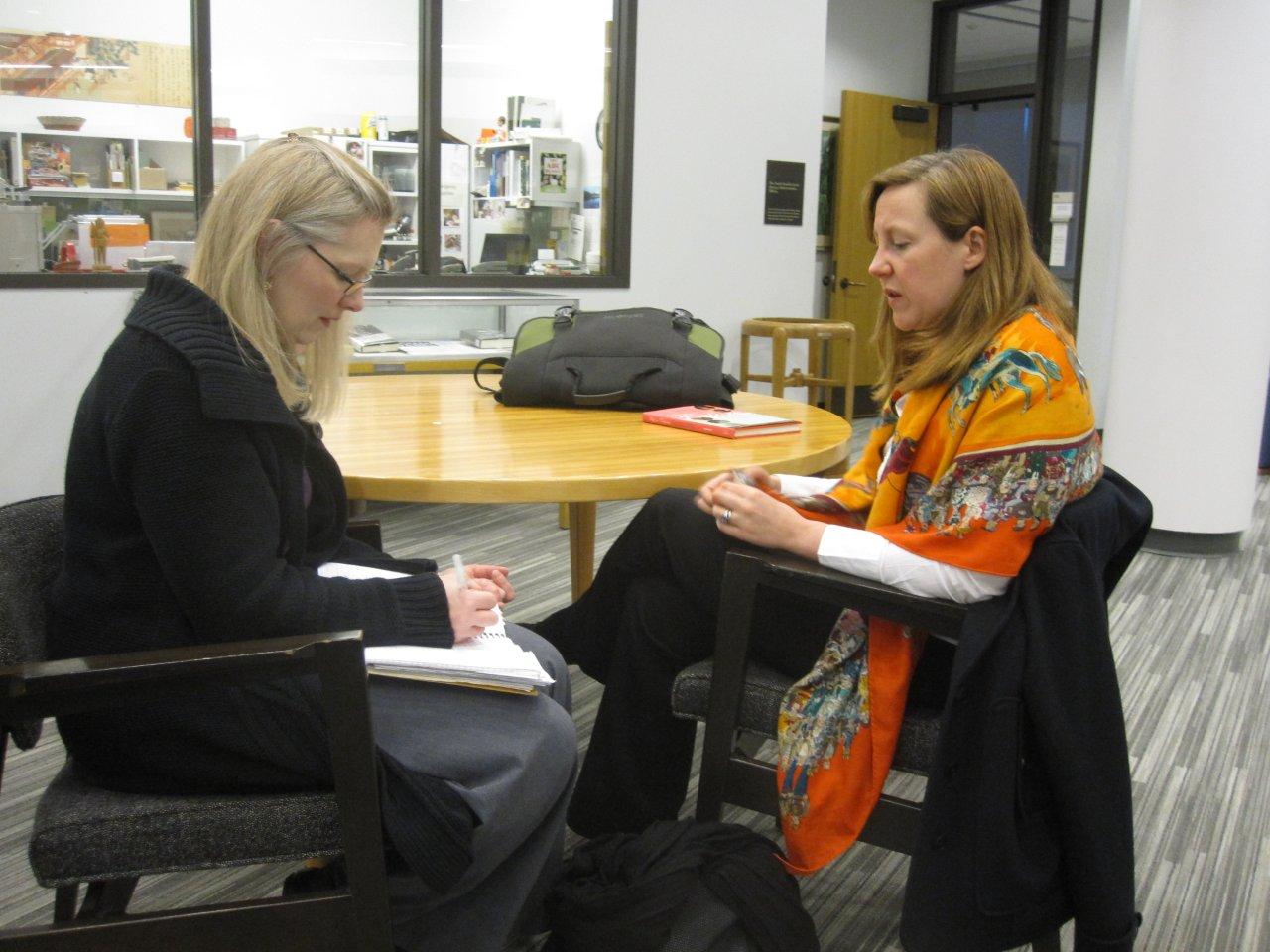
Christine meets with Gillian

The first translation was in a Swiss periodical in 1813 – Pride and Prejudice.

To read further click on this link: http://www.embarkingonacourseofstudy.com

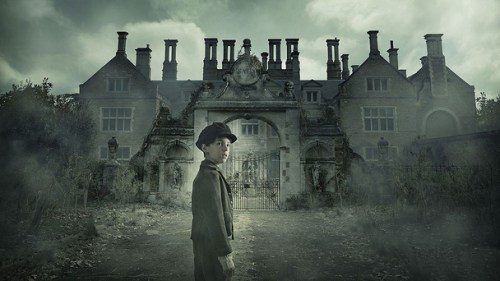
Young Pip (Oscar Kennedy) visits Satis House (Holdenby House's courtyard transformed digitally by Triad Digital).

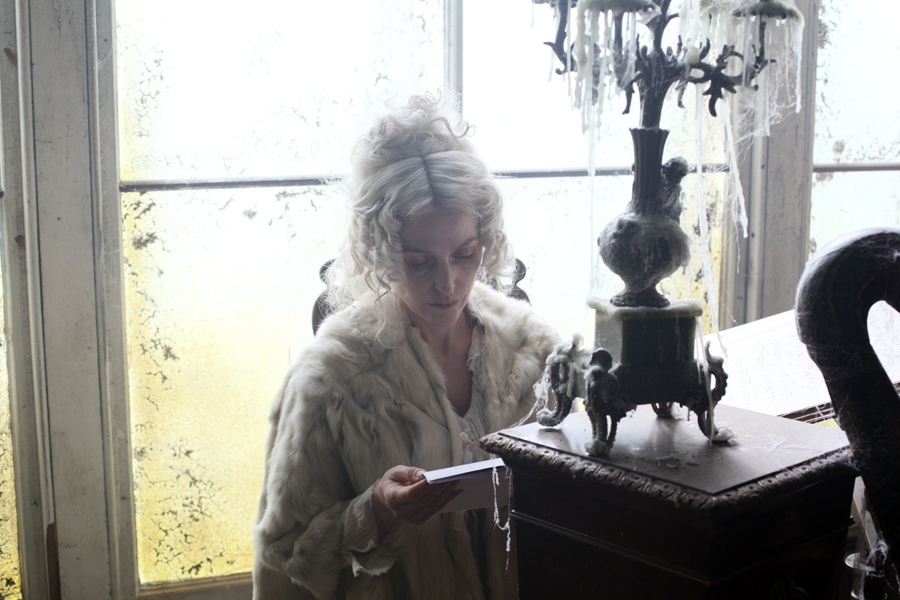
One of the most polarizing aspects of Great Expectations 2011 is Gillian Anderson’s portrayal of Miss Havisham. Many people loved it; as many hated it.

At 43 years of age, some critics regard the actress as being too young for the part. Yet Martita Hunt played Miss Havisham in David Lean’s classic when she was 47, only fours years older than Gillian. Helena Bonham Carter is set to play Miss Havisham in a new theatrical film version coming out later this year. She will soon be 44 years old.

Others find Gillian Anderson’s take on Miss Havisham to be all wrong. I agree with the critic who wrote that regardless of how one feels about the actress as Miss Havisham, she dominates her scenes as the jilted bride. Paired with the CG changes made to Holdenby House to transform it into Satis House, the viewer is treated to one of the creepier interpretations of Miss Havisham in her rotting manse.
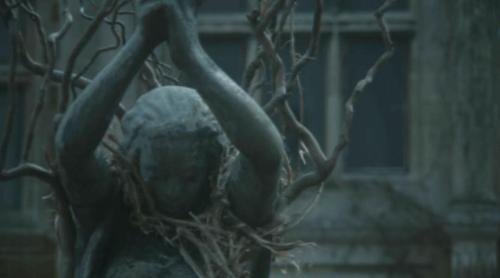
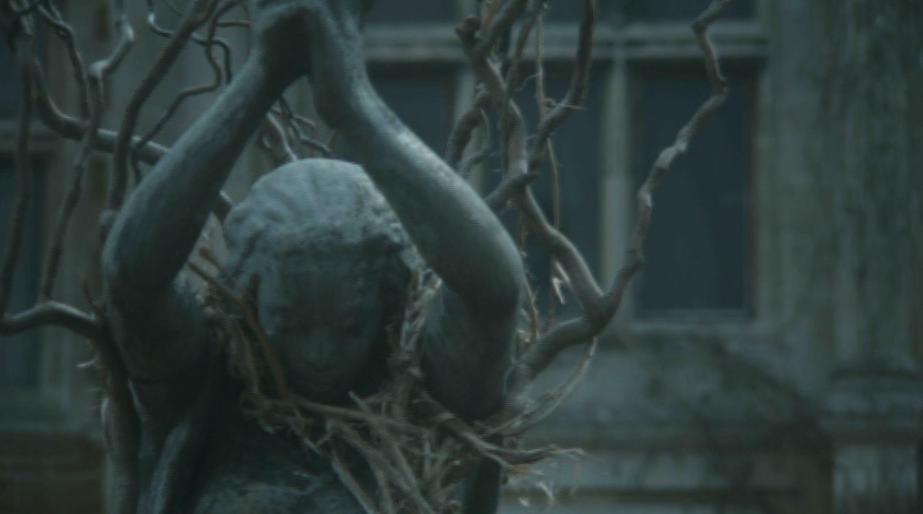
Stone angel in courtyard strangled by vines.

The film sets up Pip’s first meeting with Miss Havisham and Estella by transforming the courtyard into a dark, vine-strangled environment. This alone should tell Pip that all is not right with his new patron.
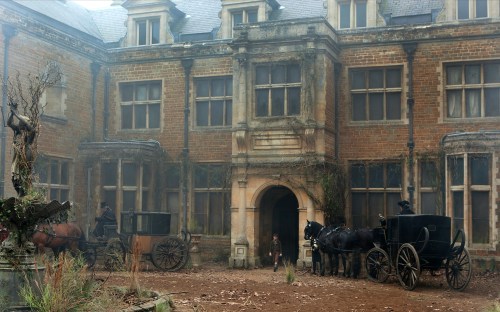
Transformed courtyard.
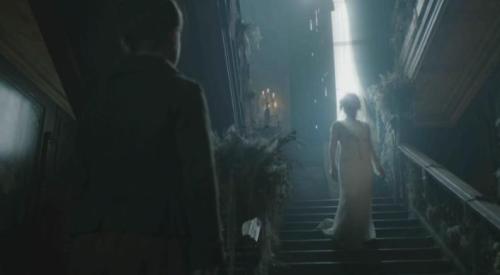
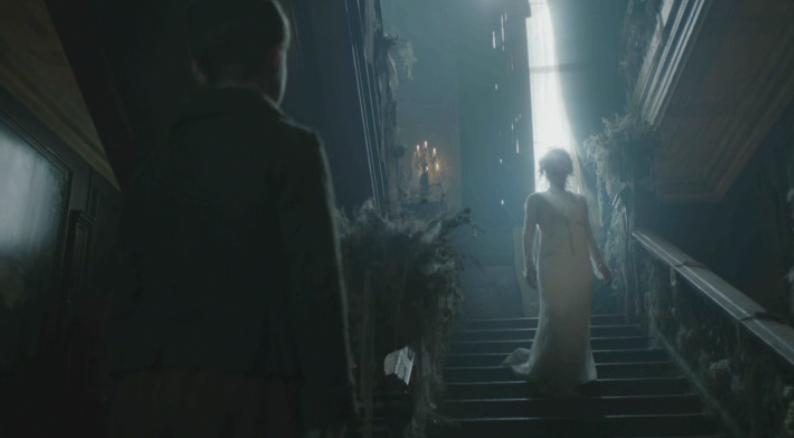
Miss Havisham glides down the stairs like a ghostly apparition.

In this adaptation, Pip’s first glimpse of Miss Havisham is of her gliding down the stairs in a candle-lit, dark oak stairwell. A break in the curtain backlights her figure and features. Not a word is said. In the novel, Pip has heard that Miss Havisham is an immensely rich and grim lady who led a life of seclusion.
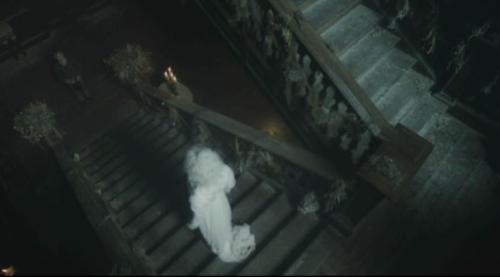
The stairs are covered with dust and candles are fully ablaze despite the day light.

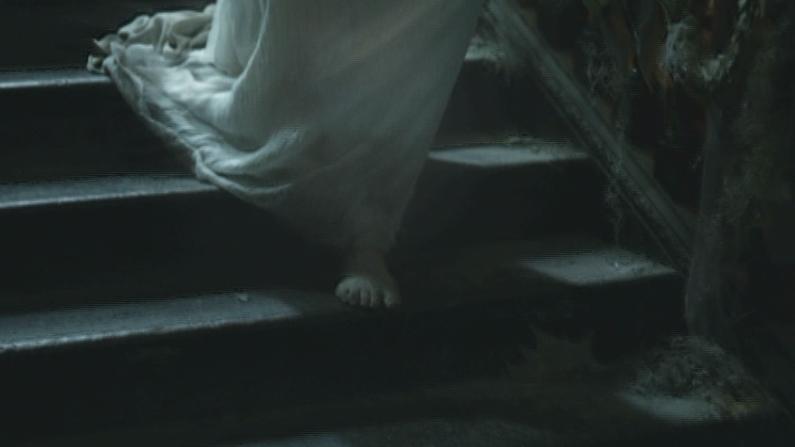
Miss Havisham as an eerie apparition is enhanced in this scene in which her white figure is indistinct and as fuzzy as the dust on the stairs.
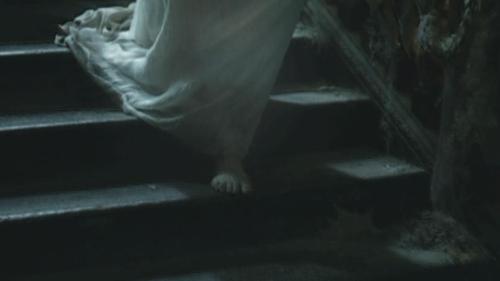
When she discovered that her bridegroom-to-be had absconded with her money and her heart, Miss Havisham was at her dressing table putting on her bridal clothes. She had put on one shoe, her other foot was stockinged. Gillian Anderson is seen walking barefoot, a change in Dickens’ story that I found perplexing. In fact, many of the changes in both plot, scenes, and costumes seemed odd.
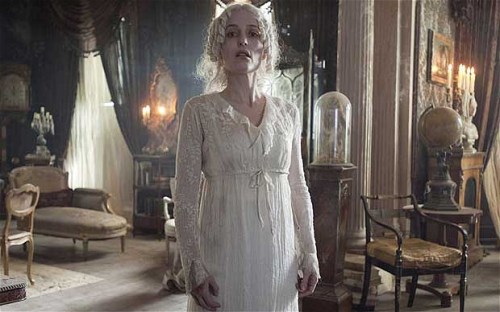
Surely the dress would have been yellower and more ragged and tattered after having been worn for so long?

While I enjoyed Gillian Anderson’s reworking of Miss Havisham into a neurotic recluse with a tendency towards self-mutilation, I wondered at the decision to make her appear like a mini-me version of Bette Davis’s Baby Jane. Her wedding gown, I suppose, was meant to look like a Regency version of a bridal dress, but to my way of thinking it resembled a nightie. Her curls, which were not supposed to have been touched in years, hung tight around her face. By the time Pip met her, her white hair would have looked like a rat’s nest.  The delicate fabric of her gown remained remarkably intact – it should have been frayed, especially at the edges and where she sat. She was not wearing a veil, which should have been attached askew on her head. And her train would  have been tattered and filthy, and had an ombre look about it, going from black at the floor to dark gray, to lighter grey until it met the yellowing white color of the gown higher up.

One way to assess if the changes were beneficial is to turn to Dickens’ own words:
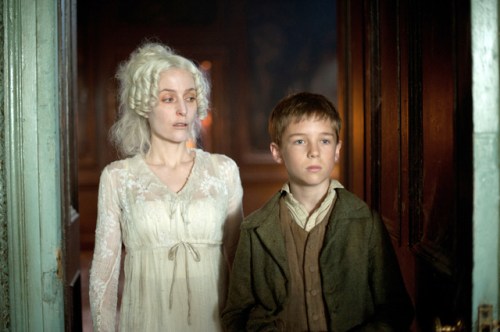
In Dickens' great tale, Pip met Miss Havisham as she sat near her dressing table.

However the only thing to be done being to knock at the door. I knocked and was told from within to enter. I entered therefore and found myself in a pretty large room well lighted with wax candle.s No glimpse of daylight was to be seen in it. It was a dressing room as I supposed from the furniture though much of it was of forms and uses then quite unknown to me. But prominent in it was a draped table with a gilded looking glass, and that I made out at first sight to be a fine lady’s dressing table.”

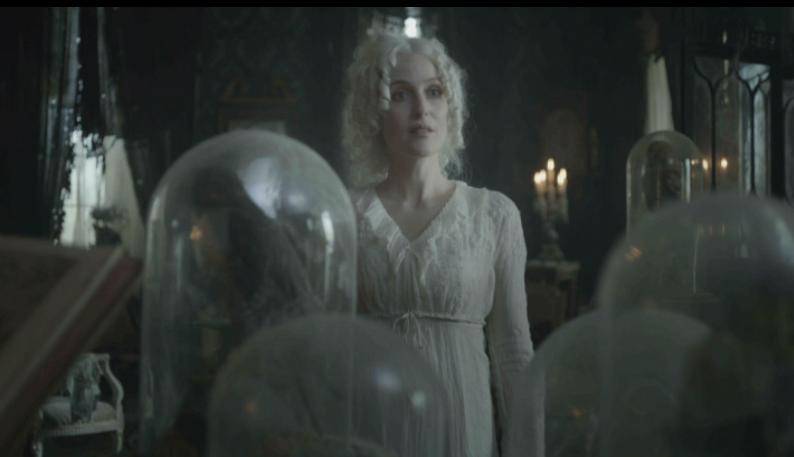
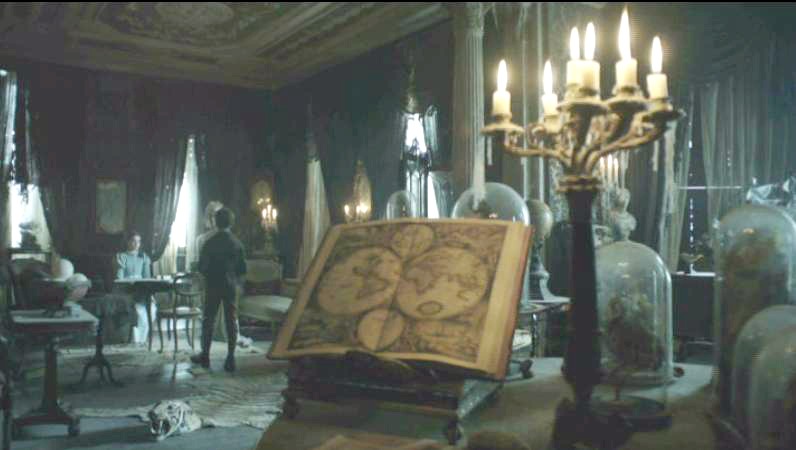
In this film, Miss Havisham walks Pip through a room filled with dusty glass dome-covered scientific specimens that her dead brother had collected from exotic places, much as a docent would accompany a visitor through a musty science museum.
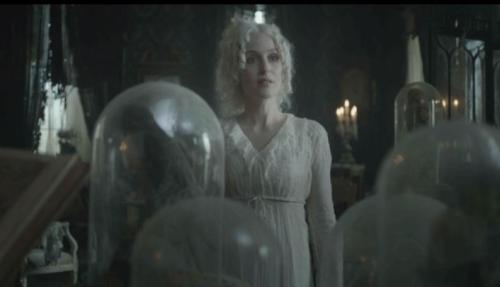
Dead specimens under dusty glass.

Pip’s actual first impression of Miss Havisham after walking through a dark house was much more powerful and immediate:

In an armchair with an elbow resting on the table and her head leaning on that hand sat the strangest lady I have ever seen or shall ever see.”
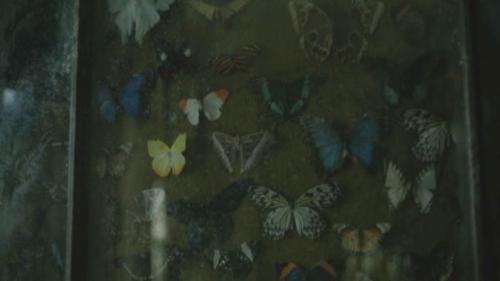
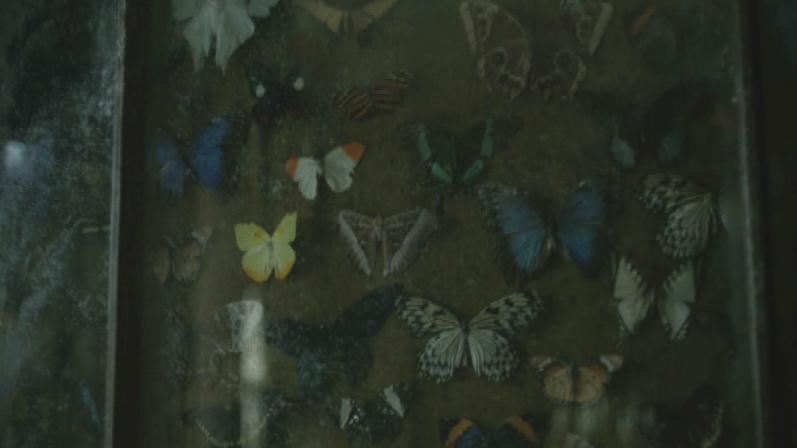
Once beautiful butterflies pinned into a frozen position, a rather obvious visual simile.

Dickens gave the costume and set designers a plethora of descriptions to work with:

She was dressed in rich materials, satins and lace and silks, all of white. Her shoes were white. And she had a long white veil dependent from her hair; and she had bridal flowers in her hair, but her hair was white. Some bright jewels sparkled on her neck, and on her hands, and some other jewels lay sparkling on the table. Dresses less splendid than the dress she wore, and half packed trunks, were scattered about. She had not quite finished dressing, for she had but one shoe on, the other was on the table near her hand; her veil was but half arranged, her watch and chain were not put on, and some lace for her bosom lay with those trinkets, and with her handkerchief; and gloves and some flowers and a prayer book all confusedly heaped about the looking glass.”
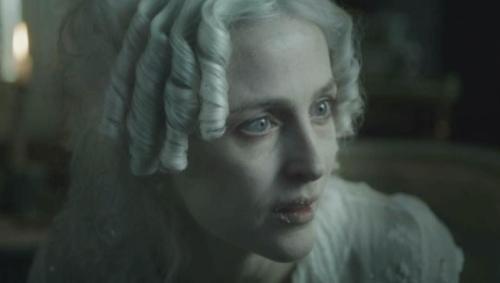
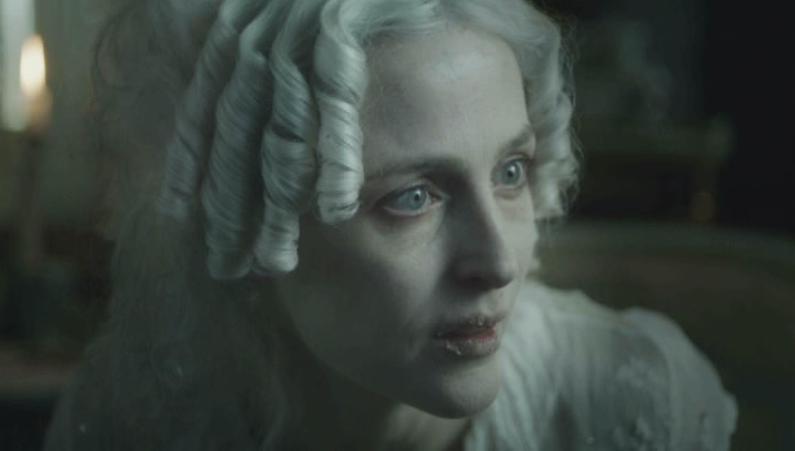
Gillian Anderson's lips are as parched as dry paper, but the curls are too neat for someone who has not tended to her hair in decades.

I have no quarrel with Gillian Anderson’s age. The book is written through Pip’s eyes, and a young boy would have found anyone in their 40’s to be ancient. Gillian did an excellent job of resembling someone who had not seen sunlight in decades, and whose physical condition was deteriorating as a result of physical and emotional neglect. Her curls make her look much too young and are incongruent. Why would she take care to wear such beautiful curls when she has neglected everything else about her appearance?
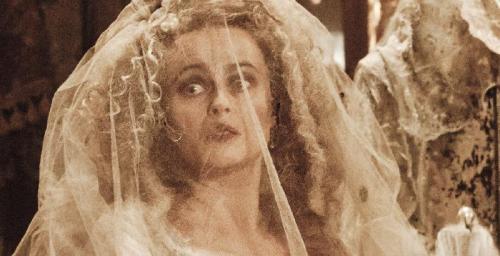
Helena Bonham Carter plays Miss Havisham in the yet to be released Great Expectations

If viewers were turned off by Gillian’s creepy Miss Havisham, with her high-pitched little girl voice and nervous bird-like mannerisms, then the above photo indicates that Helena Bonham Carter’s take on the spinster is set to go over the top as well. Let’s go back to Dickens’ description of Pip’s first meeting with his new patron to see if these interpretations fit in with his vision of the jilted bride:

It was not in the first minute that I saw all these things, though I saw more of them in the first minute than might be supposed. But I saw that every thing within my view, which ought to be white, had been white long ago, and had lost its lustre, and was faded and yellow. I saw that the bride within the bridal dress had withered like the dress, and, like the flowers, and had no brightness left, but the brightness of her sunken eyes.  I saw that the dress had been put upon the rounded figure of a young woman, and that the figure upon which it now hung loose had shrunk to skin and bone. “

Miss Havisham was a skeletal, withered shadow of a woman who shone as dimly as a pale moon hidden behind clouds. Gillian’s Miss Havisham shines just a little too brightly.
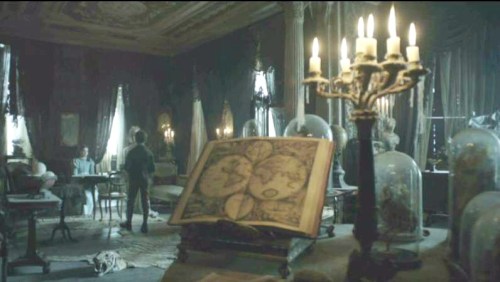
Pip approaches Estella for the first time.

It was when I stood before her avoiding her eyes that I took note of the surrounding objects in detail, and saw that her watch had stopped at twenty minutes to nine, and that a clock in the room had stopped at twenty minutes to nine.”

For some strange reason, the clocks in the film had stopped at 11:00. It’s these minor inattentions to detail that grate.
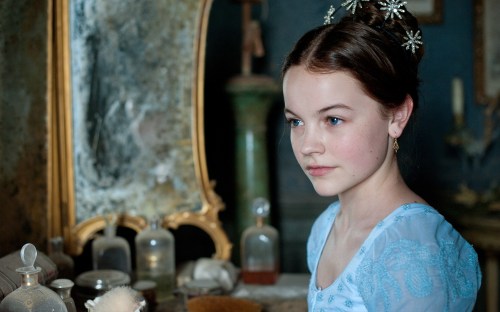
Izzy Meikle-Small plays the haughty young Estella.

“Look at me”, said Miss Havisham. “You are not afraid of a woman who has never seen the sun since you were born.”

These words would have been much more powerful in the introductory scene than Gillian’s museum tour guide of her rooms.
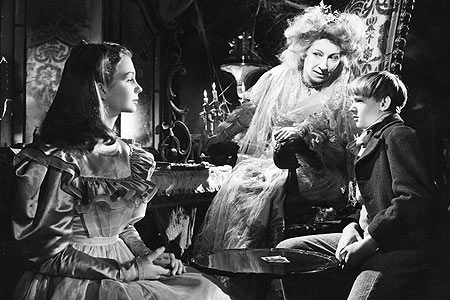
David Lean's Great Expectations featured a rather mature Jean Simmons. Martita Hunt as Miss Havisham and Tony Wager as Pip.

David Lean’s set was dark, as described by Dickens. Too much sunlight was allowed inside the house Gillian Anderson’s Miss Havisham inhabited. This served to make Satis House look much dirtier but less creepy.
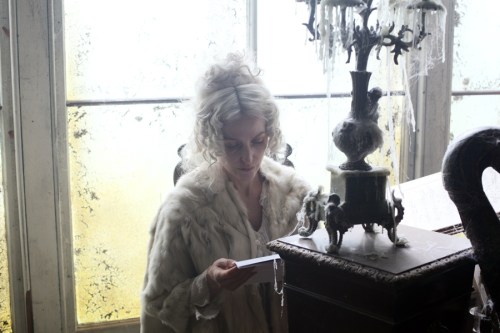
I find it remarkable that many critics found this adaptation visually too gloomy. I think there is too much light. Dickens described the curtains as emitting no light whatsoever.

I glanced down at the foot from which the shoe was absent, and saw that the silk stocking on it once, while now yellow, had been trodden ragged. Without this arrest of every thing, this standing still of all the pale decayed objects, not even the withered bridal dress on the collapsed form could have looked so like grave clothes, or the long veil so like a shroud.

So she sat corpse like as we played at cards; the frillings and trimmings on her bridal dress looking like earthy paper, as if they would crumble under a touch. I knew nothing then of the discoveries that are occasionally made of bodies buried in ancient times which fall to powder in the moment of being distinctly seen, but I have often thought since that she must have looked as if the admission of the natural light of day would have struck her to dust”

The above description tells us why it would have been more important for the set designer to have kept Miss Havisham in total darkness. While some of the effects of the light on the dust and dirt was striking, the only evidence of “earthy paper” was on Gillian Anderson’s parched lips.
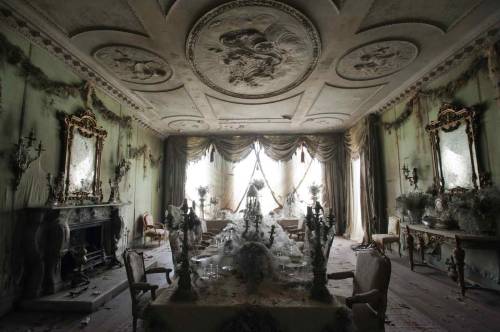

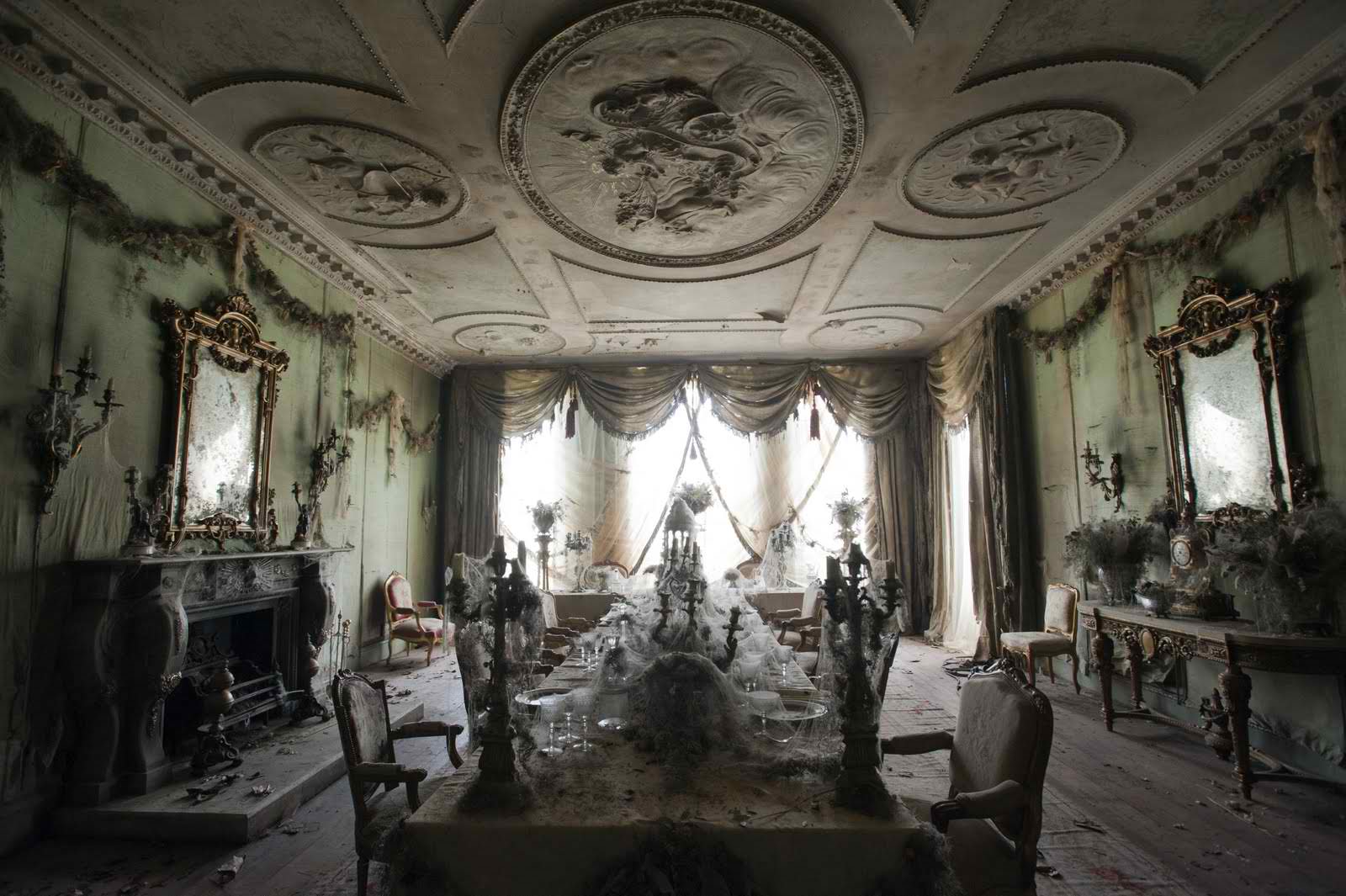
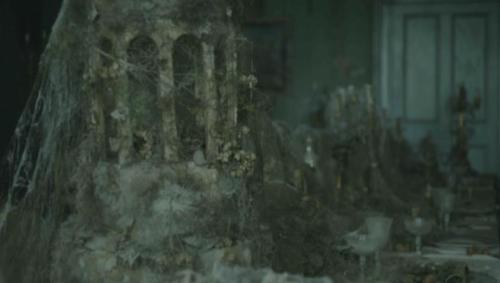
This set of the decaying bridal banquet is gorgeous. The house itself is allowed to rot (and Pip begins to notice the water damage and crumbling walls as he matures), much as Miss Havisham is allowing herself to rot inside and out. There were moments when the production shone. The film’s colors follow the current trend for digital color correction to create atmosphere. Whether you like it or not, I’m afraid the trend is here to stay.
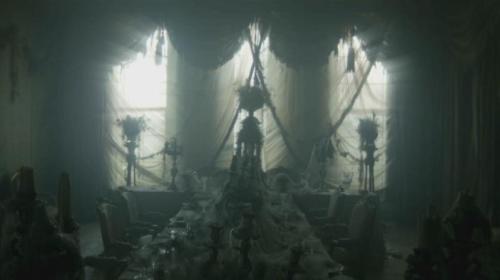
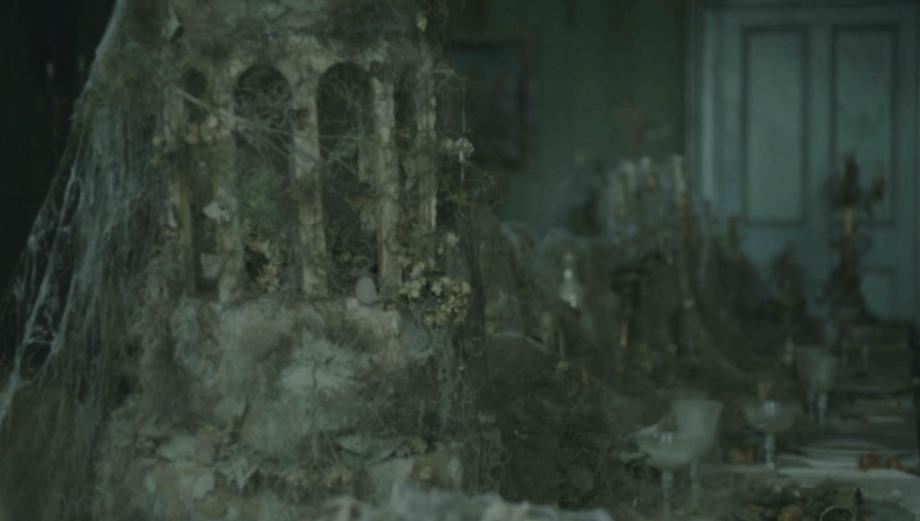
The wedding cake looked skeletal and creepy, as if bugs were ready to crawl out of it. Still, would so much of the food and flowers have remained recognizable?
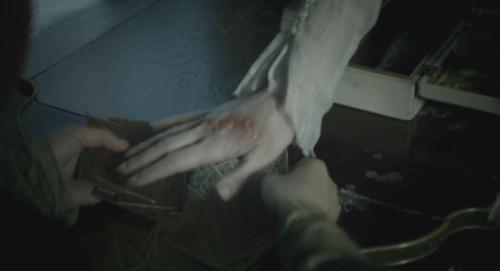
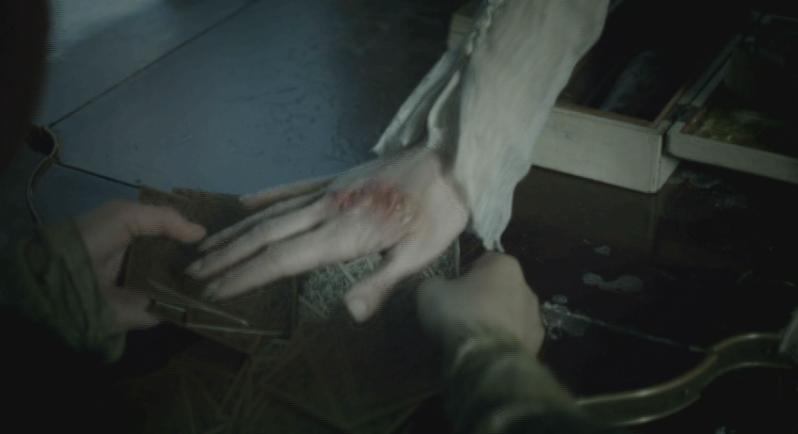
Miss Havisham's self-mutilation is evident early on in the film.

The self-mutilation, in this instance, Miss Havisham is constantly scratching her hand, was an interesting touch that added another layer to her manic obsessions. At times she seemed completely insane and incapable of self-possession. In this adaptation, Gillian portrays Miss Havisham as a weak victim who somehow finds the strength of will to plot her revenge on all male-kind.
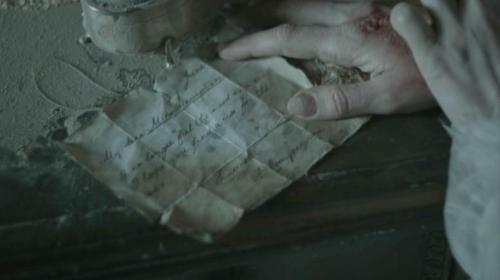
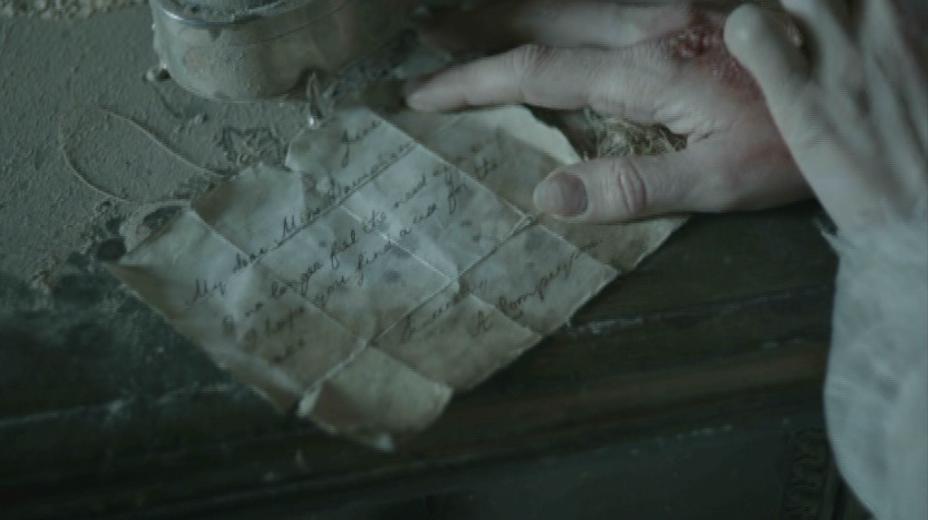
The letter of betrayal from Compeyson, the fiance who jilted Miss Havisham.
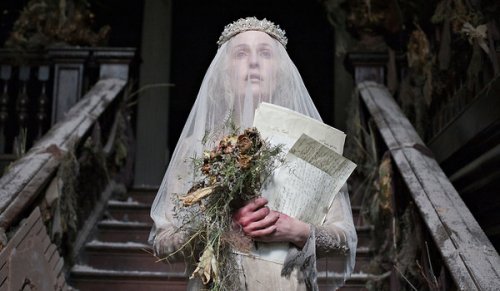
The incongruity of a perfect white veil over the decaying flowers and (finally) the tattered sleeves struck me as being wrong in Gillian’s final scenes. While I loved the cinematography of the exterior sets, these visual mistakes detracted from my enjoyment of the story. One other thought: while I enjoyed watching the young Pip and Estella, I was bothered by their older counterparts. It was very hard for me to swallow that Pip was more beautiful than the girl he loved.
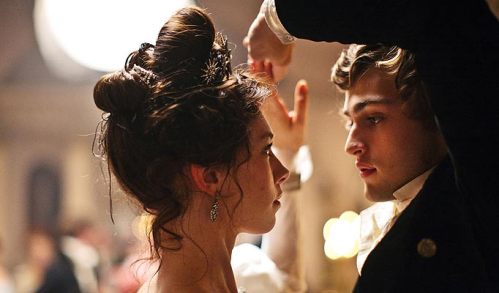
Vanessa Kirby as Estella and Douglas Booth as Pip

Your thoughts?

You can watch Great Expectations online through May 8th on PBSs website.

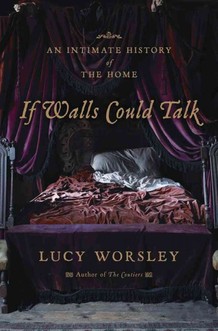
I love to listen to Fresh Air when I am walking my dog. On March 13, I had a most delightful listen when Terry Gross interviewed Lucy Worsley, the author of If Walls Could Talk: An intimate History of the Home. This interview came almost a year after the book was introduced in the UK. The video series was also shown on BBC last fall. As is often the case, I am among the last to know.

I listened to Terry’s interview with Lucy and was mesmerized. First, a bit about Ms. Worsley and her work:

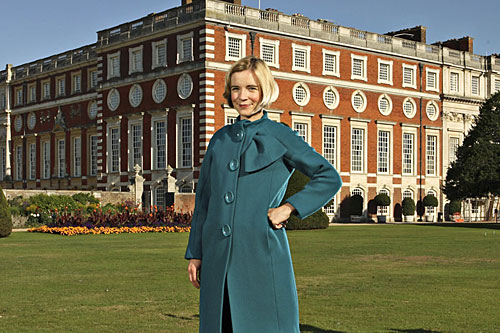
Lucy Worsley works as the chief curator in several palatial buildings in London, including Kensington Palace, Hampton Court Palace and the Tower of London. In contrast, she lives in what she calls a “normal, boring modern flat.”

The differences between her home and her workplace inspired Worsley to research the history of the home, which she details in her new book If Walls Could Talk. The book answers questions like: Why did the flushing toilet take two centuries to catch on? Why were kitchens cut off from the rest of a home? And did strangers really share beds as recently as a century ago? (Yes, they did.) – If Walls Could Talk

This video provides a perfect introduction to the book:

In Austenonly, Julie Wakefield discusses the evolution of the kitchen.  Click here to read her excellent post, The Georgian Kitchen.

I was struck by the evolution of the bedroom. Until quite recently in historic terms, there were not enough rooms in a house to provide a separate room for sleeping. The bedroom was a crowded and semi-public space. A bed was for sleeping; people had sex elsewhere.  In medieval times, the family often shared their bedroom with people they did not know. It wasn’t until Georgian times that a couple began to expect privacy as they slept. Even then, children were expected to share a bed.

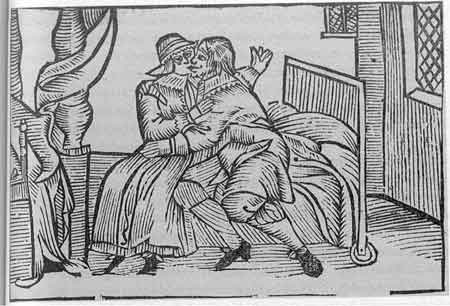
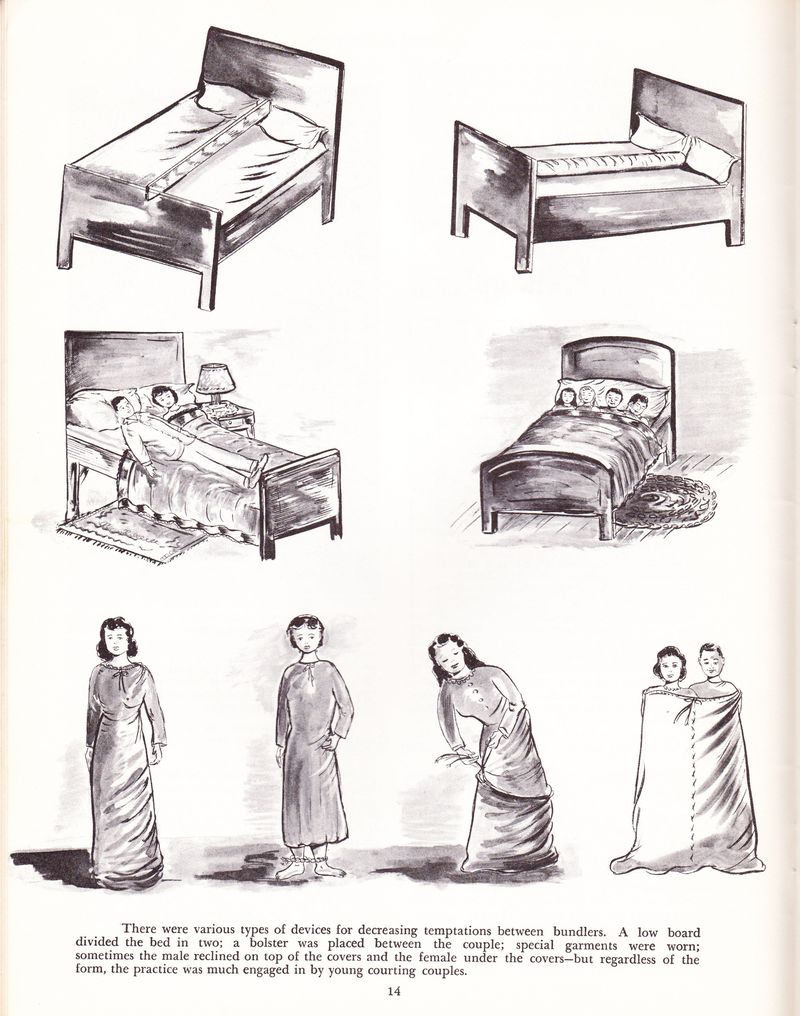
18th century woodcut of a bundling couple.

Parents were realistic about the hot blood coursing through a courting couple’s veins and their need to be together.  Considering that a couple could not marry until they could afford to set up house, the average bride and groom to be had to wait years before they were wedded. Bundling was considered a sensible alternative to an amorous man and woman going off to a shed or field to follow their biological instincts. It was a custom followed by the lower levels (certainly not by the upper classes, where a woman’s chaste reputation was highly prized) and practiced in rural areas of England through the 18th century.

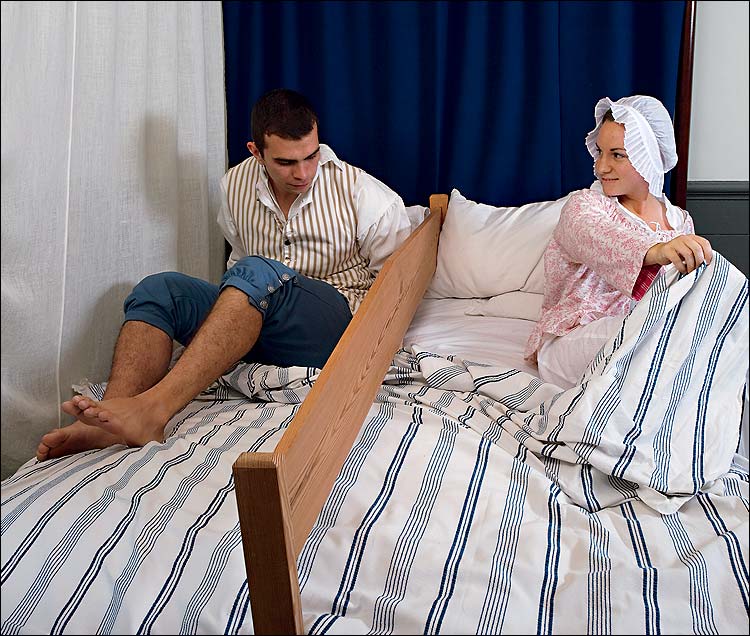
The practice was called “bundling” because the young man and young lady were each fully clothed, each had a separate set of linens, and the couple was usually separated by a board or bolster. Since all was done openly, with family members often helping the young woman by knotting her securely in her clothes, it was assumed that such courtships would remain chaste; and, quite often, they did.

But, youngsters then were no different from youngsters today, and temptation was not always fully resisted. As the numbers of premarital pregnancies rose in the 18th century, some people maintained that bundling was at least partially to blame. And, as homes were gradually being equipped with improved lighting, parlor stoves, and comfortable furniture, bundling gradually faded from practice. By the early 1800’s only couples in the most remote rural areas were still courting beneath a quilt. – The Curious Courtship Practice Known as Bundling

A bundling couple. He lies on top of the bed, she is under the covers. Image @History.org

After a night spent in bed together, the young couple did not have to marry (unless the woman somehow became pregnant). Bundling was a way of getting to know each other better and to see if they were compatible. Ms. Worsley identified the practice as a level of supervision by the family. This practice was not fool-proof, however.
Although sex was theoretically not involved, the practice coincided with a huge increase in premarital pregnancy. By the end of the century, 1/3 of all brides were pregnant by the time they reached the altar: The History of Courtship

Image @Fresh Vintage. Bundling was practiced in the U.S. a long time after the custom died in the U.K. Click on image to enlarge.

As a means of saving money, travelers would opt to share a bed. In some inns, a bundling board was used to separate the strangers. This poem describes bundling in quite some detail. In the U.S., the Amish and Mennonites practiced bundling well into the 20th century and, it is said, even today.

THE BUNDLING BAG
Where might young lovers better be,
Than right at home in bed?
Some giddy youth might care disdain,
And occasionally break the enchanted chain;
But most kept faith, ’tis said.
Some folks think it quite a risk,
But others make calm reflection:
We have men as husbands for our girls to get,
That they then might have naught to fret.
So few youngsters raised objection.
The bundling bag was just the thing
For young folks “on the go;”
It made matters safe, for man and maid;
Old folks retired, quite unafraid.
All these things are truly so. – Little Known Facts about Bundling in the New World, by A. Monroe Aurand, Jr.

Lucy Worsley

More on the topic: If you are as fascinated with this topic as I am, click on the links below to learn more about this custom in both Great Britain and the U.S.

From the moment the new adaptation of Great Expectations opened, viewers knew that this was not going to be their grand daddy’s sentimental interpretation of Charles Dickens’ classic. I struggled with how to review this PBS special, which aired last night, and realized that I could only do it through visuals. In the first 15 minutes, with very little dialogue, cinematographer Florian Hoffmeister captures the essence of Pip’s bleak life and visually sets up the rest of the plot. (Problems with the coloration of the screen captures must be blamed on my poor photo editing skills, not the cinematographer’s!) If you missed the first episode, you can watch it online until May 1.

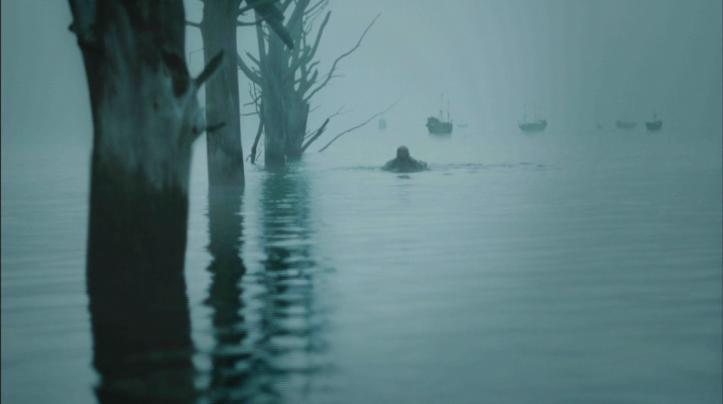
Like some preternatural creature, Magwitch rises from the marsh waters. One of the ships in the background is the prison ship from which he escaped.

It is said that Ray Winstone has always wanted to play Magwitch

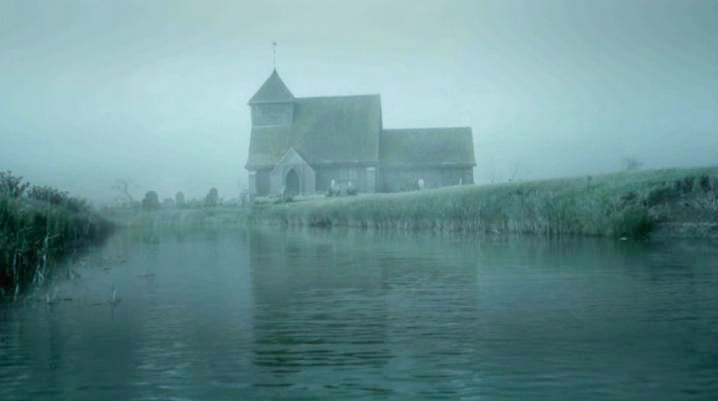
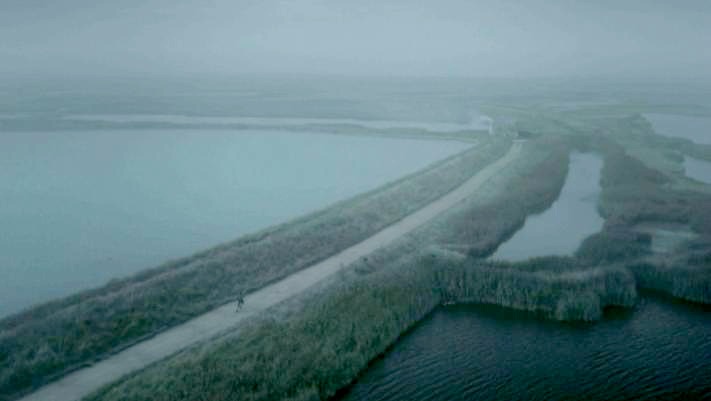
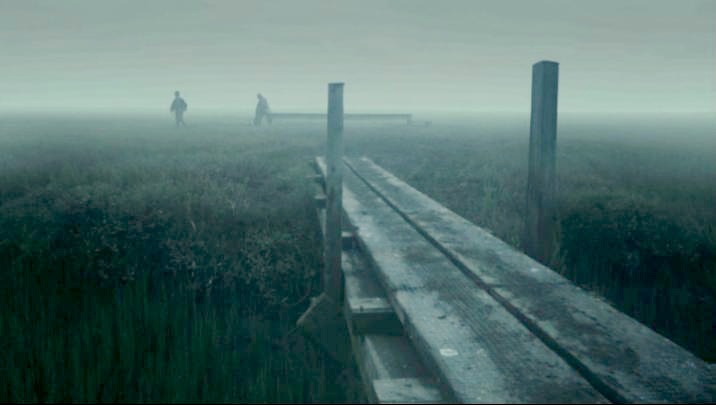
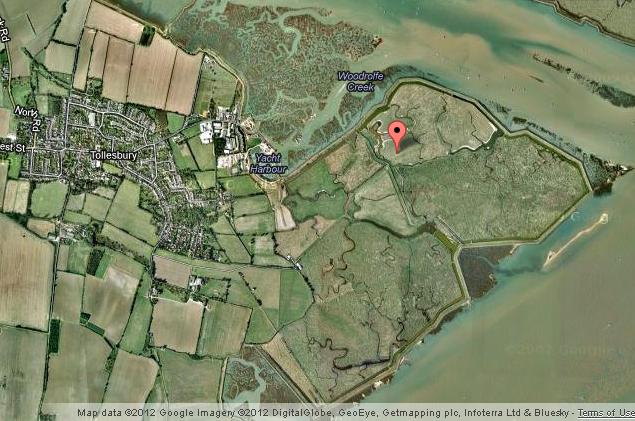
These scenes were shot in Tollesbury Wick Marshes in Essex, known for its wildlife. The fog adds to the sense of isolation.

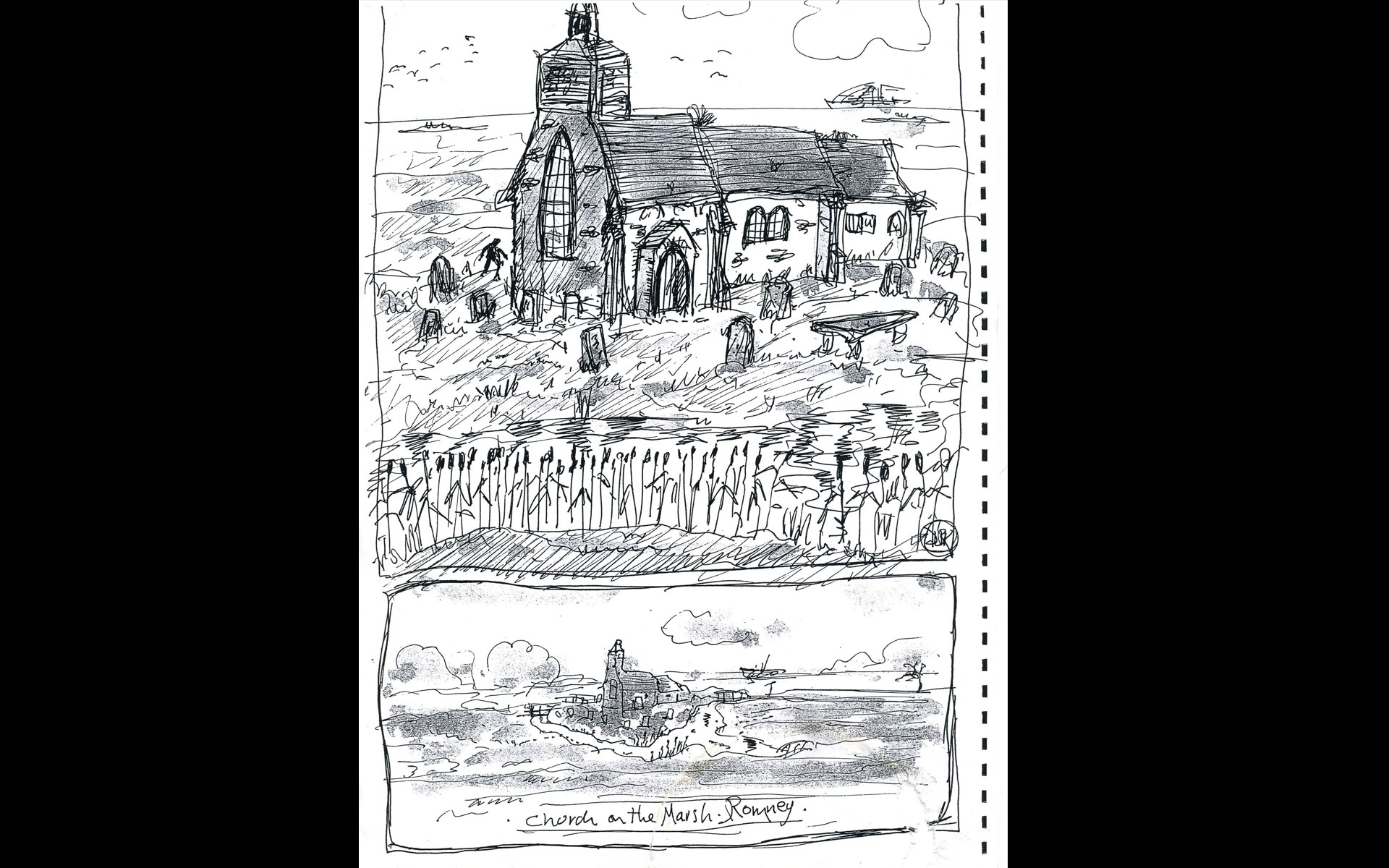
Sketch of the church on the marsh. David Roger, production designer. Image @PBS Masterpiece Great Expectations. How much of these scenes were due to CG design?

Our first view of Pip (Oscar Kennedy) is at his parent's graveside. The smaller stones represent his dead siblings. "There were five of us," he told Miss Havisham sadly. So far, other than the booming of the ship's cannon, not a word has been said.

Pip should have been mortally scared of Magwitch and never come near him again. There is nothing pretty about their first encounter.

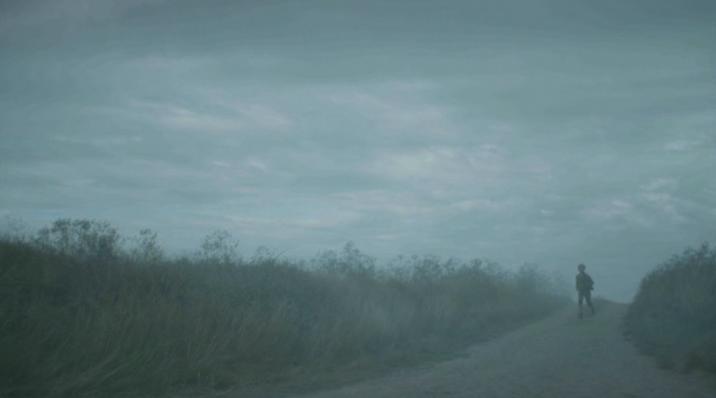
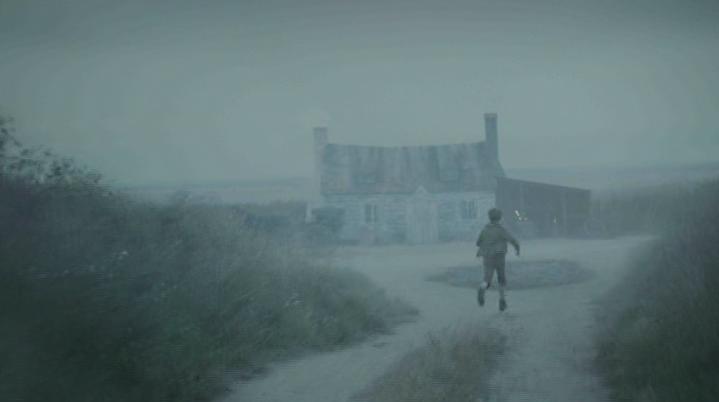
Pip's run to the Forge, where he lives with his sister and her husband, Joe Gargery, shows how isolated this section of the country is - flat, with few landmarks on the horizon. It would be nearly impossible for Magwitch to find a hiding place.

Orlick (Jack Roth)is Joe Gargery's assistant and no friend of Pip's. In this scene he almost looked like a zombie appearing through the mists. His encounter with the boy as he runs home to find a file for Magwitch is filled with hate and jealousy on Orlick's side, and dread on Pip's. It sets a malevolent tone to an already edgy opening.

The Forge is little more than a hovel.

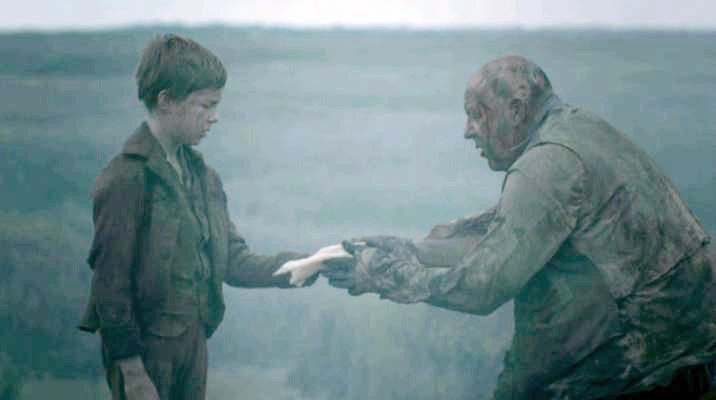
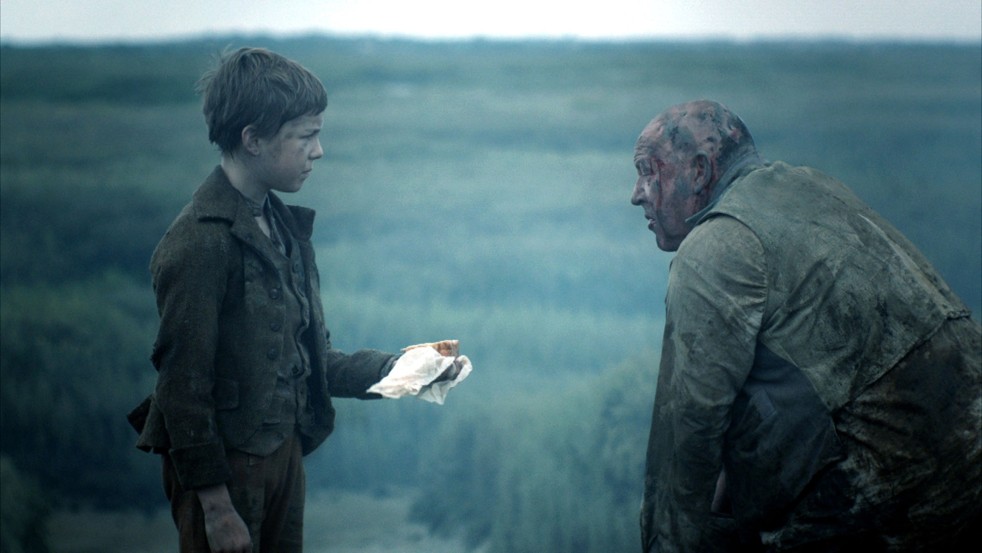
This scene is quiet and pivotal. For many precious moments, Magwitch does not speak or move when he understands what Pip is offering him. Knowing how harsh Pip's life is, I too was moved by the boy's generosity.

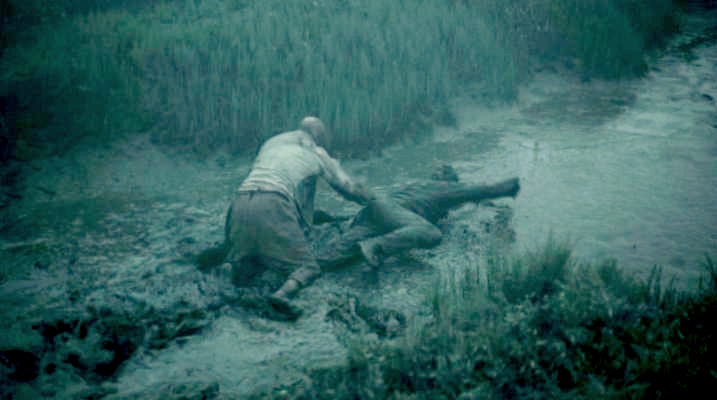
The marsh lands through Florian Hoffmeister's lens are harsh and unforgiving. Magwitch can only cling under the platforms in the muck, but he will have no place to go when the tide rises.

This fight in the muck was elemental. I flinched as I watched this. At this point we are only 10 or 12 minutes into the film and I could not pull my eyes away.

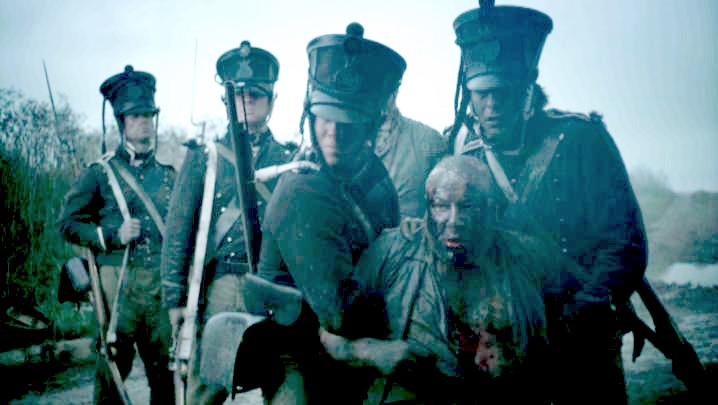
Magwitch is caught, covered with mud and blood, yet still defiant. It is obvious that he has the grit, determination, and ingenuity to escape again.

In all these early scenes, only Joe Gargery (Shaun Dooley) shows Pip genuine love, concern, and kindness. His steady support of Pip provides the only real stability in the young boy's life.

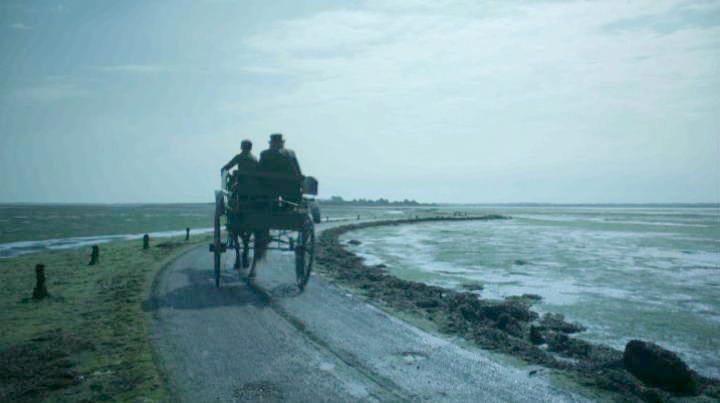
The travelers journey through what seems to be a flat, bleak land. As observers of wildlife know, marshes teem with life, offering food for scores of creatures, both transient and permanent.

The two travelers are mere specks in this vast landscape. It would seem to be a perfect dystopian setting for The Hunger Games.

My next visual review will take us into Miss Havisham’s house. Great Expectations, 2011 was directed by Brian Kirk and adapted for the screen by writer Sarah Phelps. The cinematographer was Florian Hoffmeister and the production designer was David Roger. I commend them all for setting the stage so well for Pip’s story. Young Oscar Kennedy plays a compelling young Pip who stirred my heart strings.

Read the fabulous interview with production designer David Roger at this link.

The following links describe the Tollesbury Wick Marshes in Essex.

Google map of Tollesbury marshes

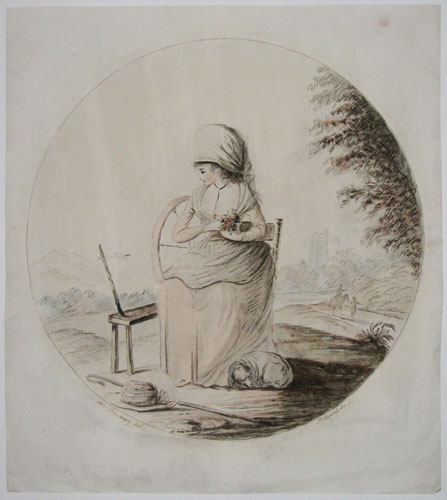
Can you imagine Jane Austen at her spinning wheel? We will soon have the possibility of seeing the Austen family’s spinning wheel at Chawton Cottage after its restoration. My sense is that it was highly unlikely that Jane Austen herself spent much time using it for spinning.

A lady spinning at her wheel, after Wm Bunbury, 1781. Image @Grosvenor Prints*

She wrote in a letter from Chawton dated Friday, May 31, 1811 to Cassandra, who was staying at Godmersham Park:

I have taken your hint, slight as it was, and have written to Mrs. Knight, and most sincerely do I hope it will not be in vain. I cannot endure the idea of her giving away her own wheel, and have told her no more than the truth, in saying that I could never use it with comfort. I had a great mind to add that, if she persisted in giving it, I would spin nothing with it but a rope to hang myself, but I was afraid of making it appear a less serious matter of feeling that it really is.

Jane’s wit and humor came to the fore, and she used it to good effect to show how little such a gift would mean to her. Mrs. Knight eventually died and biographer, David Nokes, writes:

There came news from Kent of the sad death of Mrs. Knight. The old lady left a donation of £20 to be distributed among the poor of Chawton parish, but Jane was relieved to find there was no mention of the spinning-wheel.  – David Nokes, Jane Austen: A Life, p. 392

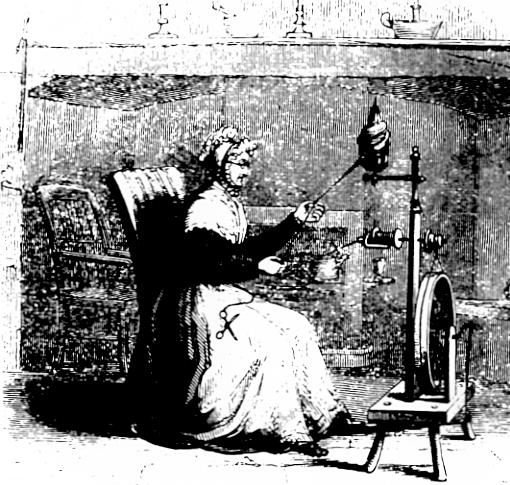
Cottage woman at work on her spinning wheel. Burnett

And so Jane was saved from the burden of spinning. Many of  her female friends and relations enjoyed the pasttime. Her nephew, Edward Austen-Leigh, wrote in his memoir:

With regard to the mistresses, it is, I believe, generally understood, that at the time to which I refer, a hundred years ago, they took a personal part in the higher branches of cookery, as well as in the concoction of home-made wines, and distilling of herbs for domestic medicines, which are nearly allied to the same art. Ladies did not disdain to spin the thread of which the household linen was woven. Some ladies liked to wash with their own hands their choice china after breakfast or tea. In one of my earliest child’s books, a little girl, the daughter of a gentleman, is taught by her mother to make her own bed before leaving her chamber. It was not so much that they had not servants to do all these things for them, as that they took an interest in such occupations. – Edward Austen Leigh, A Memoir of Jane Austen, p 37

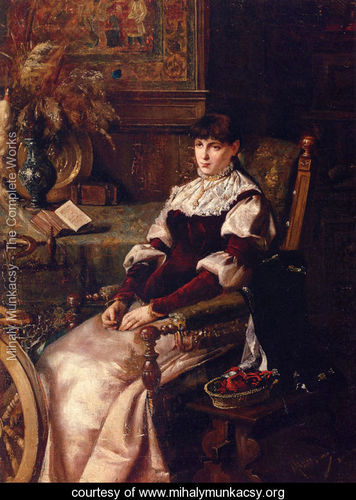
Spinning was popular with ladies all over Europe. Late 19th c. painting by German artist Mihaly Munkacsy

It is quite likely that the thread used for the lace on Mrs. Hurst’s gown in Pride and Prejudice (over which Mrs. Bennet exclaims) was spun by the lady who made it. In those days, ladies of the highest order spun yarn used for embroidery or lace making. They gathered in small groups to spin wool and wile away the time as they gossiped or engaged in pleasant conversation. Jane Austen notes on January 14, 1796 that “Anna is now here; she came up in her chaise to spend the day with her young cousins, but she does not much take to them or to anything about them, except Caroline’s spinning-wheel.”

The unlikely accomplishment of spinning had been a social skill practiced at the highest levels of society, probably because the parlor spinning wheels which the socially prominent operated were beautifully wrought and highly decorative. (In Jane Austen’s letters, we find Austen commenting to her sister regarding a proposed gift of a spinning-wheel, which she refuses because of the sense of identification of the fine tools of women’s work with their owners [Selwyn 68].)  Further, a woman’s ability to create a smooth sewing thread was considered a remarkable accomplishment; – Susan E. Jones, Thread-cases, Pin-cushions, and Card-racks: Women’s Work in the City in Jane Austen’s Persuasion

Fashionable ladies most likely did not bother to do the hard work of cleaning, sorting, dyeing, carding, and greasing yarn in preparing the wool for the spinning wheel. Instead, they performed the lighter tasks of spinning the wool yarn into a finer thread.

In a recent BBC Radio 4 interview, Val and David Bryant discussed the very special “Planta” wheel owned by the Austen family. Val is an expert on the history of spinning wheels and her husband is a spinning wheel restorer. The couple spoke about their remarkable acquisition, which is being restored in Chesire.

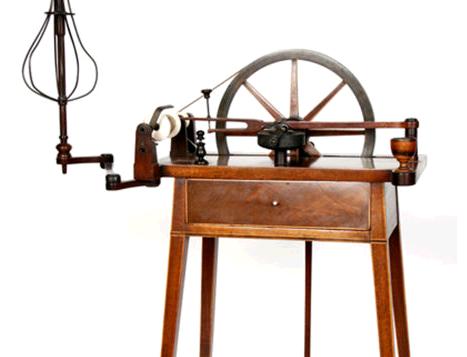
Austen family "Planta" spinning wheel in the shape of a table, with Sheraton style legs and a drawer. Image @BBC Radio 4

The spinning wheel once owned by the Austens is a beautiful and rare specimen made like a piece of furniture. It looks like a little table with Sheraton-style legs and had a little drawer. Its maker, John Planta (c. 1798-1824), was a craftsman from Fulneck, Yorkshire near Leeds. His specialty was to produce high quality spinning wheels in a unique Sheraton style.

This spinning wheel resembles the fine drawing room models that were designed for ladies who spun for pleasure: It is a world away from ordinary spinning wheels destined for the cottage industry.  The Bryants speculated that this elegant spinning wheel was a “must-have” gadget for its day. They were becoming so fashionable and desirable, that some were embellished with inlays and finials. The Austen’s spinning wheel is remarkable in that it still has the original instructions on how to use it.

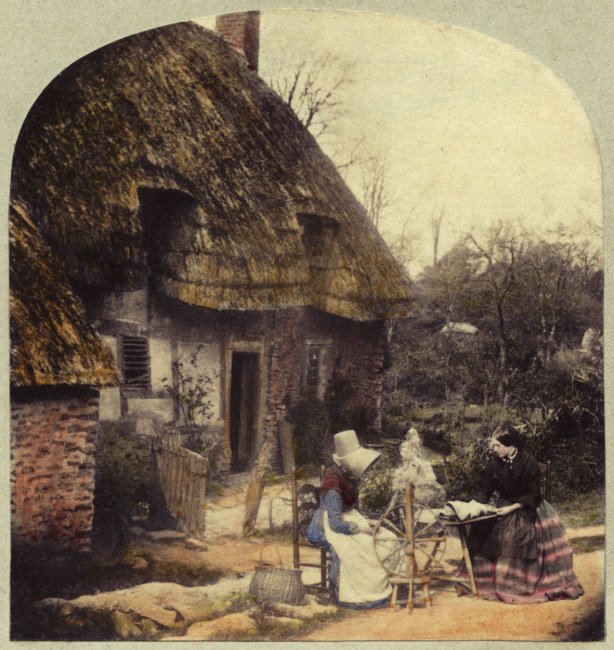
Victorian photograph of a cottage woman at her spinning wheel, 1850. Image @Daily Mail

The Austen family spinning-wheel is currently missing a treadle and footman that drives the crank, and it needs a new pulley. It also squeaks. Once it is restored, it will go on display in Chawton Cottage for all the visitors to see! I’ll keep you posted.

More on the topic: