Feeds:
Posts
Comments

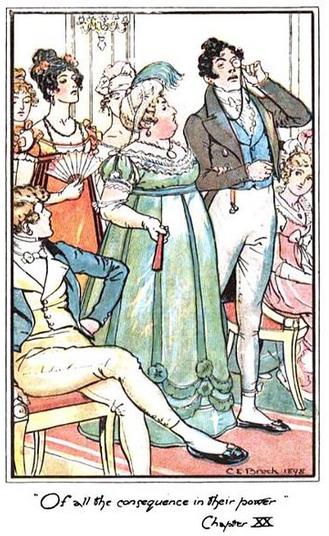
Dowager Viscountess Dalrymple makes an appearance with Sir Walter Elliot. Brock illustration.

“The Bath paper one morning announced the arrival of the Dowager Viscountess Dalrymple, and her daughter, the Honourable Miss Carteret. . . ” – Jane Austen, Persuasion

I have often wondered about dowagers and their status in Regency society in relation to widows. When did a widow become a dowager? Did all 19th century widows acquire the title? Why or why not?

Mirriam Webster Dictionary provides an answer : “Dowager – The widow of a peer, eg the Dowager Countess of Somewhere. The term was not added to a woman’s title unless and until the new holder of the title married.” The definition contains the clue. Until the new heir married, an aristocratic widow retained the title she acquired on the day of her own wedding.

Widows were legally entitled to a dower share or a third of the value of her husband’s estate after his death, for under the law of primogeniture he was the only real property owner. Dower rights meant that she would benefit for the rest of her life from a third of the income produced by a farm or from rental property on his estate:

“Under English common law and in colonial America, dower was the share of a deceased husband’s real estate to which his widow was entitled after his death. After the widow’s death, the real estate was then inherited as designated in her deceased husband’s will; she had no rights to sell or bequeath the property independently. She did have rights to income from the dower during her lifetime, including rents and including income from crops grown on the land.

One-third was the share of her late husband’s real property to which dower rights entitled her; the husband could increase the share beyond one-third in his will.

Where a mortgage or other debts offset the value of real estate and other property at the husband’s death, dower rights meant that the estate could not be settled and the property could not be sold until the widow’s death.” Women’s History 
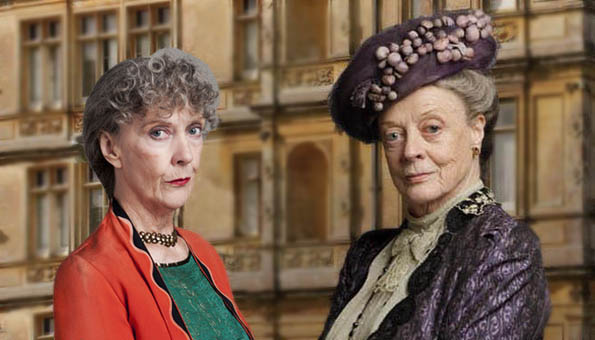
Dowager Maud, Lady Holland (Dame Eileen Atkins) and Violet, Dowager Countess of Grantham (Dame Maggie Smith) were able to live comfortably on 1/3 of the income of their husbands' estates.

Violet, the Dowager Countess of Grantham in Downton Abbey, would actively assume the title of dowager upon her son’s marriage so that there would be no confusion of having two Countesses of Grantham in the same room. But she did not always go by that title. Generally speaking the dowager would be known by the simplest title when encountered alone. Therefore, Violet would be referred to as the Countess of Grantham unless she attended the same event as her daughter -in-law. In that case, she would be referred to as the dowager countess.

Cora, Countess of Grantham

Upon the heir’s marriage, it was expected that the dowager would move from the estate into a house of her own to guarantee a smooth transition of power. This was not always the case. As Amanda Vickery made clear in her fascinating book, Behind Closed Doors: At Home in Georgian England, some brides needed to summon a great deal of patience and cunning when their mamas-in-law dragged their heels in moving to the dower house. In real life, the Dowager Duchess of Leinster chose to live at Number 14 Harley Street in London. She would leave town occasionally to stay in her cottage in Wimbledon. Eleanor Percy, the Dowager Duchess of Northumberland, was the childless widow of the 4th Duke. The dowager moved into Stanwick Park following her husband’s death in 1865, and after the 5th Duke had moved into Alnwick Castle, the ducal estate. Eleanor lived a productive life at Stanwick Park, creating elaborate gardens and cultivating fruits and flowers. Sadly, Stanwick Hall no longer stands today due to lack of fortune. – Stanwick Hall: England’s Lost Country Houses
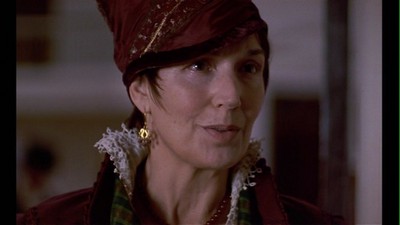
Susan Fleetwood as Lady Russell in Persuasion

Widowhood could emancipate a woman or lead her to poverty, depending on the income she derived from her dower rights and her dowry, which was the money and goods that a bride’s father had negotiated for her upon her marriage. Take Lady Russell from Persuasion. She did not remarry again from choice. Her independent life, free from money worries, was so improved without the presence of a husband who could dictate her every move and who would have control over her possessions that she would be a fool to remarry unless she fell head over heels in love. In that event she would lose her first husband’s income as stipulated by dower rights, although she would retain her dowry and any property she received through her mother.

Mrs. Dashwood and her daughters await the arrival of her replacement as mistress of Norland.

In contrast to Lady Russell’s situation, Mrs. Dashwood’s circumstances in Sense and Sensibility were instantly reduced due to the stipulations of the estate her husband was overseeing, which decreed the inheritance would go directly to the son, regardless of how much Mr. Dashwood desired to make provisions for his second wife and daughters. This is why on his deathbed he tried to extract a promise from John Dashwood, for Mr. Dashwood had not lived long enough to save money from the income of the estate for his second family. Due to Fanny’s stinginess, Mrs. Dashwood and her daughters are left to live on the modest income from her dowry (which was barely enough to keep them comfortable) and the beautiful items that she had brought into her marriage (which she retained as her own, much to Fanny Dashwood’s chagrin).
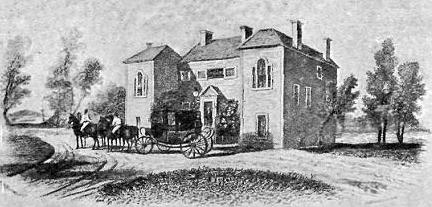
An elopement to Gretna Green was a most foolhardy and risky step for a young heiress

The dowry was one of the reasons that it was more than foolhardy for a young woman of fortune to elope to Gretna Green. Upon marriage all her worldly goods were legally handed over to her husband. An unscrupulous man could spend every single one of her pennies – except the amount that her father had settled upon her. A young woman who eloped had no such protection, for her family, caught unawares, would not have had the time to provide for her personal welfare. Her husband could go through her fortune (and his) with impunity, leaving her penniless and without recourse after his death.
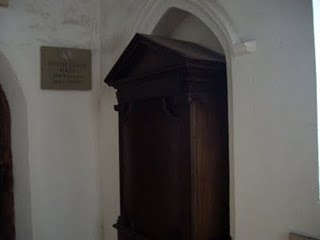
Sarah Hare's cabinet. Image @Just pleasantly floundering around

Poor Sarah Hare died in 1744 at the age of 55 of a commonplace accident. It was said that she “used to sew on a Sunday and as a punishment died from pricking her finger. “ Sarah did indeed die after injuring herself while sewing – from septicemia, or blood poisoning.

Sarah made no extraordinary contributions to this world except one – a wax effigy of herself, the only such mortuary statue of its kind in England outside of Westminster Abbey. (Most mortuary statues at the time were made of marble.) She was the youngest daughter of Sir Thomas Hare of Stow Hall in Stow Bardolph, Norfolk, where the family lived in a Jacobean style red-brick mansion. The Hare family had lived in a house on that site since 1589 and played a significant role in the village of Stow Bardolph. In 1622, Sir Ralph Hare built six almshouses and provided them with 86 acres of land for division among the inmates.

Today we know very little about Sarah Hare’s life except that she never married and was not very pretty. Sarah must also have had a premonition of her death, for she requested the following in a will dated August 1743:

“I desire Six of the poor men in the parish of Stow or Wimbotsham may put me in to the ground they having five shillings a piece for the same. I desire all the poor in the Alms Row may have two shillings and sixpence each person at the Grave before I am put in. This I hope my Executor will see firstly performed before Sunset…..I desire to have my face and hands made in wax with a piece of crimson satin thrown like a garment in a picture hair upon my head and put in a case of Mahogany with a glass before and fix’d up so near the place were my corps lyes as it can be with my name and time of Death put upon the case in any manner most desirable if I do not execute this in my life I desire it may be done after my Death.”

Her wishes were met. During her lifetime or after her death molded impressions were made of her face and hands, which were poured in wax. She was buried in the Hare mausoleum in Holy Trinity church. One can only imagine the solemn procession which carried this spinster to her grave. Surrounding her closed mahogany cabinet , which is situated in a corner of the vault, are memorials to the Hare family, dating from the 17th-20th centuries.

Sarah Hare in her cabinet. Image @Find a grave

Her cabinet is plain. A bronze plate engraved with the words – “Here lyeth the body of Sarah Hare…” – its only adornment. Her lifesize effigy has waited for over 250 years behind a pair of mahogany doors for the occasional visitor to find it.

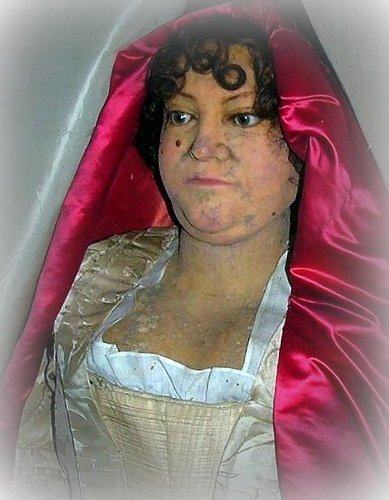
Eye witnesses to the site have described the shock of seeing an uncanny life-like impression of a woman long dead. Only her torso, head and hands are visible. The effigy is dressed in one of Sarah’s gowns and a dark curly wig covers her head. But it is her plain features , warts and realistically painted skin blemishes that the visitor finds the most striking:

“The door to the cabinet is not without reason – she is terrifying, her face dumpy, warted, defiant. I had seen photographs of her in the years since I found her at school, but nothing could prepare me for the frisson of the cabinet door swinging open. I thought of the fairground peepshows that I can just about remember, and I realised that I would have paid for this, too.” – The Cabinet of Sarah Hare 

Another eye witness described her reaction:

“I opened the door, and there, staring at me with loppy eyes, was the waxwork of a seriously unattractive woman – literally warts and all. How big does your ego have to be?” Norfolk, Part 1, Things Go Well

One wonders about Sarah’s motive for having this wax effigy made of her, for she must have known that she was no beauty. Each of us seeks immortality in our own way, some through our children, others through good deeds, inventions, or extraordinary talents. Sarah had the monetary means to make sure that her days on this earth would not soon be forgotten.

Sarah Hare

Time takes its toll on wax effigies, however. Judith Dore and Monica Dance restored Sarah’s effigy in 1987, a procedure they described in an article “The Saving of Sarah Hare.” Their abstract states:

“The wax surface was cleaned with a mild soap to remove dirt; cracking was stopped by lining of the head with an open weave material dipped in molten wax. A thin layer of water colour was then applied to give a more life-like appearance. For the costume, a highly skilled conservationist was required as it was in such bad condition. The cabinet housing the effigy was damaged and rodents had gained access and eaten part of the costume. General condition, cleaning and restoration of the costume is described in a report enclosed with this article. The cabinet was also repaired.”

Sarah Hare’s spirit can rest easy for another couple of centuries, content in the knowledge that her image has been preserved for generations to come.

We’ve all come to associate Regency women’s fashion with delicate white muslin fabrics – sprigged muslin, spotted muslin,  checked and striped muslin, and embroidered muslin. Henry Tilney, the hero in Northanger Abbey, was well-acquainted with muslins through his sister, who wore only white.

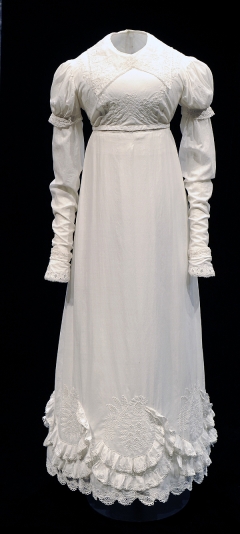
Sheer white muslin gown with whitework embroidery. Image @Vintage Textile

In the 17th century and until the late 18th century, England imported muslin, a thin cotton material, from India.  The British East India Company traded in Indian cotton, silk fabrics, and Dacca (Dhaka or modern-day Bangladesh) muslins. Muslins from Bengal, Bihar and Orissa were also imported. The delicate cloth, which first originated in the Middle East in the 9th century, was perfect for clothing and curtains in hot, arid countries. – Muslin: Encyclopedia Britannica

Muslin gown, 1816

Muslin was a finely woven light cotton fabric in plain weave without a pattern, and had identical warp and weft threads. The fabric selection is quite flexible, coming in a wide variety of weights and widths. It accepts dyes and paints so successfully that today it is often used for theatrical backdrops and photographic portraits. One observation must be made: muslins of the past were made of much finer, more delicate weave than today’s muslins. –  How Is Muslin Fabric Made?

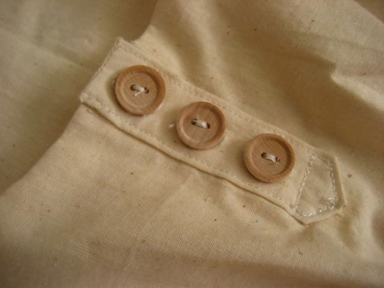
Buttons on a modern muslin fabric

Muslin gown circa 1815, Bath museum

An important feature of muslin fabrics is its ability to drape. Regency fashions were based on robes and garments from antiquity. The ability to drape and maneuver the fabric on the figure was an important feature of this cloth. Today, designers use muslin as a test garment for cutting and draping a design before creating the final dress from more expensive fabrics.

Another excellent feature of muslin is its ability to take dye, paints, and embroidery. The cloth accepted many patterns, motifs and designs that made it versatile and unique. Textile as Art

Plus the white fabric was a mark of gentility. White was difficult to keep clean or required constant cleaning. It was one thing for an aristocratic lady like Eleanor Tilney to wear white, but another for a maid to presume to wear such a high maintenance garment. Mrs Norris, that awful woman from Mansfield Park, approved of Mrs. Rushworth’s housekeeper’s action of turning away two housemaids for wearing white gowns.

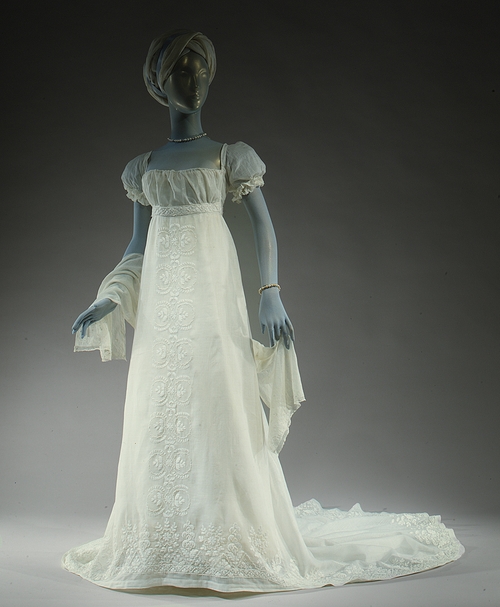
Muslin evening dress. Image @Metropolitan Museum of Art

Embroidery transformed the simple white muslin gown into works of art. Whitework embroidery was particularly striking, but colored threads could be equally beautiful. The draping quality of the cloth lent itself well to columnar-shaped empire waist gowns.

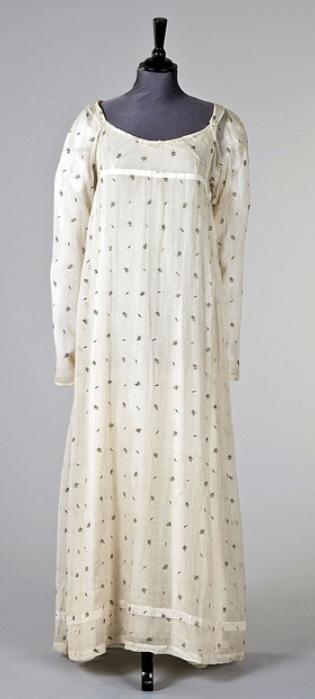
Indian sprigged muslin gown, 1800. Image@Kelly Taylor Auctions Trouvais

Muslin was imported from the Far East for centuries. Then the weavers in west Scotland, who were proficient in spinning fine cottons such as linen, cambric, and lawn, began to pay attention to weaving a finer, more delicate cloth.

Sheer muslin gown, 1800. Image @Victoria & Albert Museum

Muslins, therefore (plain for the most part in Glasgow, and fancy ornamented in Paisley),were among the earliest and principal cotton fabrics produced on the looms of the west of Scotland. About the year 1780 James Monteith, the father of Henry Monteith, the founder of the great printworks at Barrowfield, and of the spinning and weaving mills at Blantyre, warped a muslin web, the first attempted in Scotland; and he set himself resolutely to try to imitate or excel the famous products of Dacca and other Indian muslin-producing centres. As the yarn which could then be produced was not fine enough for his purposes, he procured a quantity of “bird-nest” Indian yarn, “and employed James Dalziel to weave a 6-4th 12” book with a handshuttle, for which he paid him 2Id. per ell for weaving;. It is worthy of remark that the same kind of web is now wrought at 2|d. per ell The second web was wove with a-fly shuttle, which was the second used in Scotland. The Indian yarn was so difficult to wind that Christian Gray, wife of Robert Dougall, bellman, got 6s. 0 J. for winding each pound of it. When the web was finished Mr Monteith ordered a dress of it to be embroidered with gold, which had presented to Her Majesty Queen Charlotte.”1

1817 Muslin day dress. Image @Bowes Museum

Once fairly established, the muslin trade and various other cotton manufactures developed with extraordinary rapidity, and diverged into a great variety of products which were disposed of through equally numerous channels. Among the earliest staples, along with plain book muslins, came mulls, jacconets or nainsooks, and checked and striped muslins. Ginghams and pullicats formed an early and very important trade with the West Indian market, as well as for home consumption. These articles for a long period afforded the chief employment to the hand-loom weavers in the numerous villages around Glasgow and throughout the west of Scotland. The weaving of sprigged or spotted muslins and lappets was subsequently introduced, the latter not having been commenced till 1814. Although the weaving of ordinary grey calico for bleaching or printing purposes has always held .and still retains an important place among Glasgow cotton manufactures, it has never been a peculiar feature of the cotton industry; and the very extensive bleaching and print-works of the locality have always been supplied with a proportion of their material from the great cotton manufacturing districts of Lancashire. – p 501, The Encyclopaedia Britannica: a dictionary of arts, sciences, and general literature, Volume 6, Thomas Spencer Bayne, 1888.

Embroidered muslin round gown, 1795. Image @Cathy Decker

More on the topic:

Murder Most Persuasive is Tracy Kiely’s 3rd mystery based loosely on Jane Austen’s novels. One can readily guess the influence from the title. Elizabeth Parker makes her third appearance as a sleuth. Much like Miss Marple she finds herself at the right place at the right time. Like Miss Marple, Elizabeth understands that she has a talent for solving mysteries.

In this instance, Elizabeth has gathered with family members at the funeral of great-uncle Martin Reynolds. When Uncle Martie’s house in St. Michael’s is sold for the benefit of his three daughters, the body of Michael Barrow is discovered buried underneath the swimming pool. Michael, who was to have married Reggie, Martie’s eldest daughter, had disappeared the night before the wedding and only days before the pool’s concrete shell was poured.

Along with Michael went a great deal of Uncle Martie’s money, embezzled by the runaway groom it was presumed. With the discovery of Michael’s body the questions uppermost in everyone’s minds are: how did Michael wind up under that slab of cement and what happened to the money?

As with Tracy’s other novels, the writing style is light and breezy and the mystery’s fun to follow. In this instance, the parallel to Austen’s Persuasion is hard to ignore. Ann, Uncle Marty’s middle daughter, broke up with young Joe Muldoon under the influence of her father and her dead mother’s dearest friend, an action she still regrets 8 years later. A mousy professor who has lost her looks, she encounters Joe, now a successful man and the detective on the case. Will this star crossed couple come to find love again? My curious mind not only wanted to know, but was wholly satisfied.

I could describe the plot in more detail, but I don’t want to spoil the fun for you. Of Tracy’s three mysteries, this is my favorite so far (as is Austen’s Persuasion). I enjoyed meeting the characters so much that I quite forgot to follow the clues. Still, even when I tried to solve the mystery, I was pleasantly surprised to find out who had done the dastardly deed.

Tracy writes mysteries in the old style. No gritty reality and base language sully her pretty towns and well-drawn characters. Blood, while mentioned, is not described down to its forensic core. Thus I recommend that you read Tracy’s book on a lazy afternoon in a sunny alcove, with a pot of steaming hot tea and some scones and clotted cream, and a cat on your lap and a dog at your feet. I give this delightful tale four out of five Regency tea cups.

Murder Most Persuasive by Tracy Kiely
Hardcover: 304 pages
Publisher: Minotaur Books (August 30, 2011)
Language: English
ISBN-10: 0312699417
ISBN-13: 978-0312699413

Giveaway Contest:

The name of the winner will be drawn by random number generator at midnight on September 10th, EST. To enter, please tell me which Jane Austen character you would like to see murdered in a mystery and why. Contest over. Congratulations, Martha!

My other Kiely reviews:

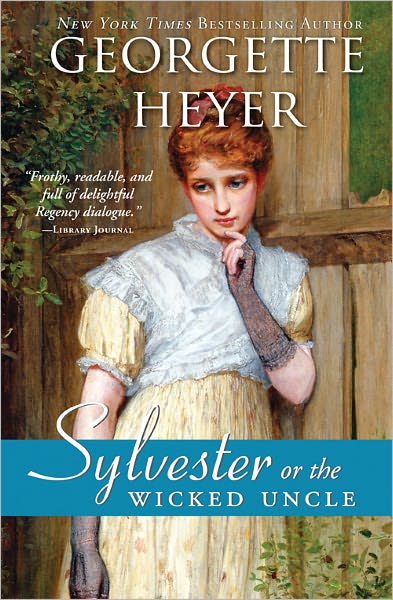
Gentle readers: Please leave a comment if you wish your name to be be eligible for a drawing of Sylvester, or the Wicked Uncle, a wonderful Regency romp by Georgette Heyer. The drawing will be held the moment electricity is restored in my house. My best estimate is that this will take another week. Only U.S. and Canadian residents are eligible. (So sorry, but the book is being sent by the publisher, who has requested this geographic restriction.) Update: Contest closed. Congratulations Rebeka! You have won a copy of Sylvester.

Sylvester, Duke of Salford thinks quite highly of himself and is pleased by his impeccable manners and easy smile, which easily influences servants to do his bidding. But Phoebe Marlow, whose mousy manner hides her bright mind and talents as an equestrienne and a writer, was not so impressed when she first met him during her coming out season. She is even less enthralled with the Duke when he arrives for a visit at her father’s estate to look her over as a possible bride.

Sylvester’s fond Mama also harbors concerns for her son, especially when Sylvester announces his intentions to marry and begins to discuss his preference for a bride with her:

‘But I’m inclined to think now that is is more important that she should be intelligent. I don’t think I could tolerate a hen-witted wife. ‘Besides I don’t mean to foist another fool on to you.’

‘I am very much obliged to you!’ she said, a good deal entertained. ‘Clever, but not beautiful: very well! Continue!’

‘No, somedegree of beauty I do demand. She must have countenance, at least, and the sort of elegance which you have, Mama.’

‘Don’t try to turn my head, you flatterer! Have you discovered among the debutantes one who is endowed with all these qualities?’

‘At first glance, I suppose a dozen, but in the end only five.’

‘Five!’

At this point Sylvester’s mama becomes concerned, for she realizes that he is choosing his life’s mate with his head, not his heart. The woman who immediately springs to her mind for her son is Phoebe Marlow, and so our cluelessly haughty (yet kind) Duke collides with the novel’s heroine, who is not in the least willing to spend any time with him, at least not until circumstances throw them together and she gets to know him better.

The plot revolves around Phoebe’s big SECRET: she has authored a book in which Sylvester, with his saturnine brows, is featured prominently as the villain. The more Phoebe gets to know Sylvester, the more she realizes how wrong she was about him and the more she worries about the book’s effect on their budding friendship (for Phoebe was uncannily accurate in her representation about certain aspects of Sylvester’s life).

Georgette Heyer takes us from the cozy settings of country mansions, to London in High Season, to Dover and over to France. A colorful array of her usual characters add liveliness to a somewhat improbable plot, including Phoebe’s good friend Tom, Sylvester’s dodo bird of a sister-in-law, Ianthe, and a supremely idiotic and over-indulged fop named Sir Nugent.

In my opinion, if you are a Georgette Heyer fan and haven’t read this book yet, you will be well advised to do so now. I give it four out of five Regency tea cups!

For a chance to win this book, leave a comment about your favorite Georgette Heyer book! Contest closed. The winner is: Rebeka!