Feeds:
Posts
Comments

Fans of Jane Austen’s fiction are familiar with the rising middle class, successful and enterprising tradesmen, upward mobility through marriage, the fragility of life (especially for fishermen, sailors and child-bearing women), and the difficulties of road travel. All these topics are touched upon in a short biography of Mr. Edward Innes, a successful baker and property man.

In this image, Mr. Innes is dressed as a gentleman, and is followed by a companion, Mr. James Cooper. As his position rose in life, his sensibilities must have become quite delicate, for as he passes a woman carrying a basket, Mr. Innes shields his face and nose from the offending stench that must have emanated from her basket.
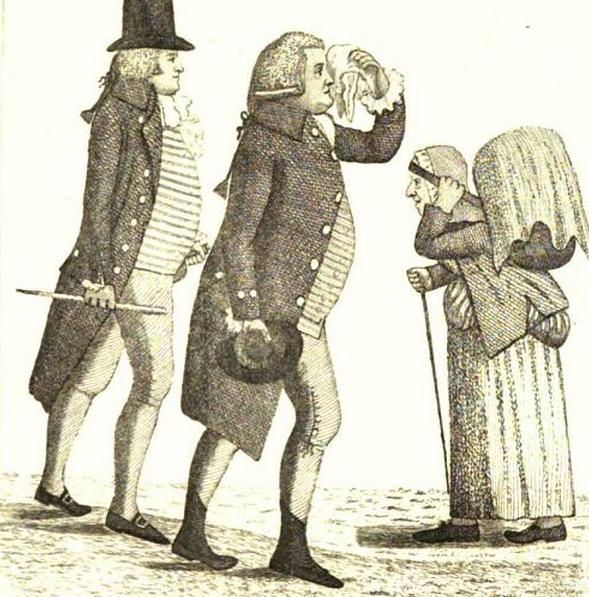
Mr. Edward Innes and his second, James Cooper

Mr. Innes, if this account is to be believed, was a nonpareil, covering the distance to London in his carriage at the unheard of speed of 50 miles per day.

The progenitors of Mr Innes were farmers in the neighbourhood of Glencorse, but his father was a baker, and had his shop at one time at the head of the Fleshmarket Close. Latterly, the shop having been let without his knowledge to a higher bidder, he removed to his son’s property situated betwixt Marling and Niddfy’s Wynds. In his younger years, the old man was usually styled the handsome baker from his exquisite symmetry, and he was not less fortunate in his choice of a pretty woman for his wife. Isabella, or Bell Gordon, had been married to the captain of a vessel, who was drowned at sea only a few weeks after. The young widow then only in her eighteenth year, happening to be on a visit at the house of her brother in law, Mr Syme ,ship builder, Leith; the handsome baker was introduced to her acquaintance, and the result was a speedy union. Besides a daughter by her first husband, Mrs Innes had eight children, of whom the subject of our notice was the second eldest.

Mr Edward Innes, after serving his apprenticeship with his father, commenced as a baker on his own account in the High Street. In addition to his good fortune in business, he acquired considerable property by his wife, a Miss Wright of Edinburgh, by whom he had several children. Mr Innes kept a horse and gig, an equipage rather unusual for a tradesman in his day; and what was considered remarkable at that time, he drove to London on one occasion, accompanied by his wife, in eight days, a distance averaging fifty miles a day. The circumstance was much talked o,f and taking into account the then state of the roads, the performance was really one of no ordinary magnitude. – A series of original portraits and caricature etchings, Volume 2, Part 2 (Google eBook), John Kay, 1838, p 284.

Note: Considering the poor road conditions of the day, carriage horses averaged from 2-4 miles per hour; at breakneck speed, they could achieve a remarkable 6 miles per hour, but horses that pulled a carriage could keep up this pace for only a short distance. Thus Mr. Innes and his wife spent long hours on the road (10-12 per day) and had their horses frequently changed at stops along the way.

Other posts on this topic:

For those who were so unfortunate as to miss Upstairs Downstairs, PBS has made the series available online one day after the initial airing. Click here to watch Episode One.

Ten points to ponder as you contemplate the first episode of Upstairs Downstairs:

1. Rose is back. She is the bridge between the old series and the new. (Jean Marsh was one of the original creators of the show.) Time has not been kind to Rose. Although only six years have passed since the Bellamys left 165 Eaton Place, the poor maid turned housekeeper seems to have aged three decades.

Rose now runs her own business

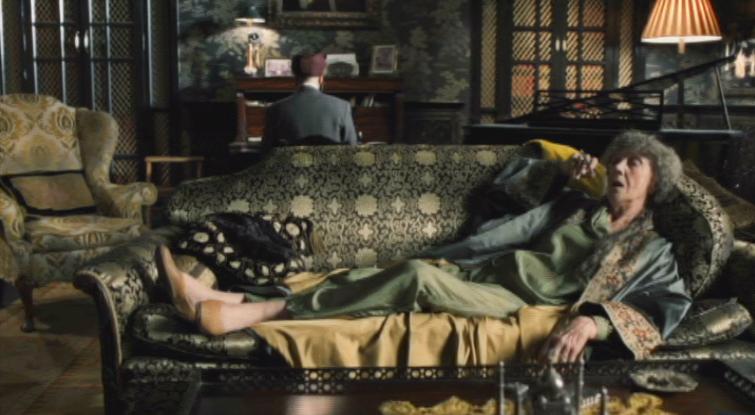
2. Co-creator Eileen Atkins was committed to another project when filming of the original series began, but she was available for this series. Her turn as Lady Maude Holland, the dowager mama does not quite rival Maggie Smith’s Violet in Downton Abbey, but unlike Maggie, Eileen was given a most interesting, very capable, quite mysterious and handsome secretary – Mr. Amanjit Singh.

Maude dictates her memoirs to her secretary

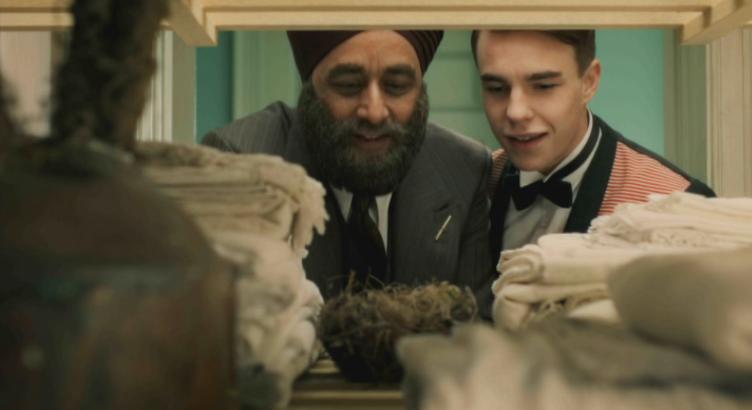
3.  Few series feature a monkey or a fledgling in a nest. This one has both.

Mr. Amanjit Sing (Art Malik) and Johnny (Nico Mirallegro) place the egg in a linen closet

4. Agnes and Hallam are passionately in love. I wonder if her bitchiness when talking to the servants turns him on, or is it her thriftiness?

Passion in Eaton Place (Keeley Hawes and Ed Stoppard)

5. Like Downton Abbey, there seems to be a foreshadowing of a relationship between the chauffeur and his young mistress, in this instance, Agnes’s sister, Lady Persie, a rebellious though uneducated minx.

Harry (Neil Jackson) and Lady Persie (Claire Foy)

6. What self-respecting viewer can resist a series that features both the family jewels and a home renovation?

The Holland Jewels

7.  We are given one more reason to despise Wallis Simpson.

Instead of the King, Wallis brings Her Ribbentrop (Edward Baker-Duly) to the party

8. A mystery is afoot. Will Johnny the footman, whose passion for the nubile (but very underage Ivy) has put him in the clinker, be able to highfoot it back to Eaton Place?

Ivy (Ellie Kendrick) turns out to be a tease.

9. Will we ever warm up to Pritchard and Mrs. Thackeray? Or will our fond memories of Mr. Hudson and Mrs. Bridges stand in the way? And where was Georgina (Lesley Ann Downe)?


10. Shall Episodes 2 & 3 firmly answer the question: Which series is better, Downton or UpDown? Inquiring minds want to know. Vote here.

Ivy meets Lady Holland

18th century robe a la Francaise. Image @Rijksmuseum

During the 18th century and much of the Regency era, trains were popular on evening and court dresses, and at times on walking gowns. The length of the train shortened as the 18th century progressed, but even shorter trains swept over lawns and grounds and sidewalks. This fashion turned out to be quite expensive, for after several short walks, the fabric would be quite soiled or would need replacement. Oliver Goldsmith wrote in Citizen of the world (1760):

Nothing can be better calculated to increase the price of silk than the present manner of dressing. A lady’s train is not bought but at some expense, and after it has swept  the public walks for a very few evenings, is fit to be worn no longer, more silk must be bought in order to repair the breach, and some ladies of peculiar economy are thus found to patch up their tails eight or ten times in a season.”

One imagines that the delicate muslin trains of the Regency era were as easily wrecked by wear and tear, and that only the rich could afford such an extravagant consumption. There were ways to save one’s train. In 1996’s Emma, Gwynneth Paltrow is seen holding up her train during the dance.

Emma's train is attached to her wrist.

In Northanger Abbey, Jane Austen described how Isabella Thorpe and Catherine Morland pinned up each others trains.

They called each other by their Christian name, were always arm in arm when they walked, pinned up each other’s train for the dance, and were not to be divided in the set; and if a rainy morning deprived them of other enjoyments, they were still resolute in meeting in defiance of wet and dirt, and shut themselves up, to read novels together.”

1800 sprigged muslin gown. Image @Christies

One can only conclude that trains (or tails, as Goldsmith called them) were an extravagance that the ordinary working woman did not indulge in wearing, for until mass production made cloth more affordable, the added lengths of cloth, plus the constant need for laundering and patching, would make this fashionable feature prohibitively high for most women.

Note: That Isabella and Catherine met  “in defiance of wet and dirt” meant something, for shoes and fabrics were so delicate at the time, that ladies tended to stay indoors on rainy days.


Image @The Culture Concept Circle

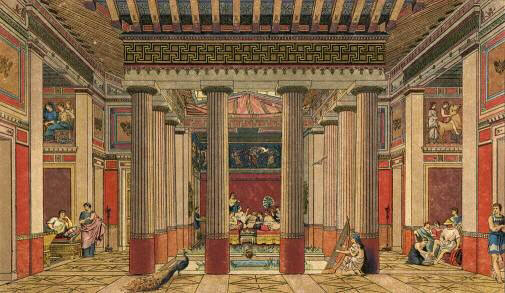
The era in which Jane Austen lived was a complex time in which scientific advances, the Industrial Revolution, warfare in Europe, and visits to ancient lands influenced the culture of Great Britain. These articles from The Culture Concept Circle will answer your questions about a few of the influences on the neoclassical style so prevalent during this time. Videos are included in some links.

Image @The Culture Concept Circle

Posts on this blog:

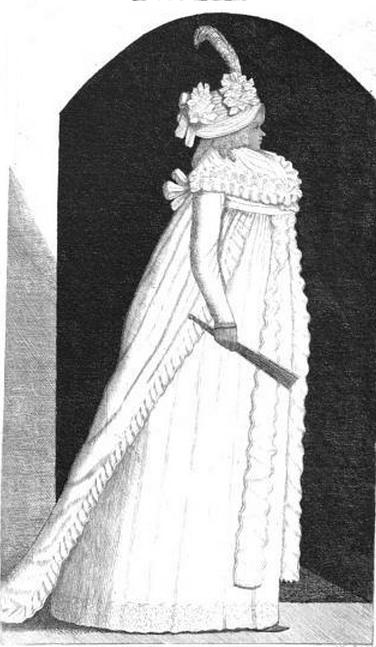
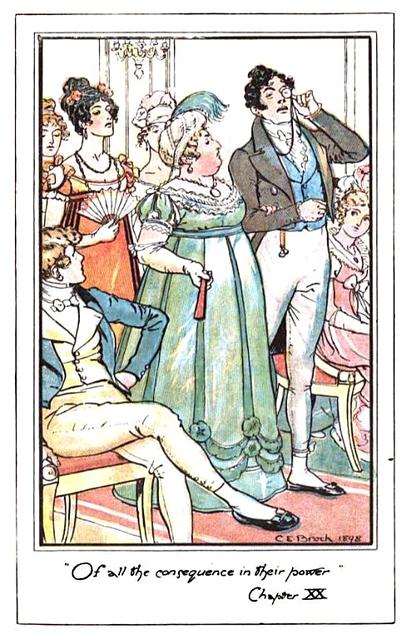
Jane Austen’s novels did not ignore the rising middle class and successful merchants and tradesmen, the nouveau riche of her era. Mr. Bingley and his sisters were the fortunate offspring of a tradesman. Mrs. Bennet’s,  Mrs. Jennings’, and Mrs. Elton’s vulgarities cannot be denied and add spice to her tales.  A real life representative of the rich bourgeois class was Mrs. Smith, once married to a trader named Kinnear. I would imagine that if a stranger met her, there would be no mistake from her demeanor and accent where her origins lay. She dressed well, according to an eye witness, and managed to live out her years in comfort.

Mrs. Smith, 1795

MRS SMITH IN THE COSTUME OF 1795. That this Portraiture was sketched without a sitting may be conjectured from a memorandum by the artist, which states that when the lady heard of his intention to publish her likeness, she sent for him to come and get a proper look at her, but he did not choose to accept the invitation. Those who remember Mrs Smith will have little difficulty in recognising a strong likeness to her in the Etching. Mrs, or rather Luckie Smith, for so in her later years she was uniformly styled, is dressed in the somewhat ridiculous fashion prevailing towards the close of [the] last century. The Print bears the date 1795, and at that period she resided in South Bridge Street. Some years afterwards, she removed to a house purchased for her in Blackfriar’s Wynd. Mrs Smith was a native of Aberdeen, and had in early life been married to a trader of the name of Kinnear, by whom she had a son and two daughters. After the death of her husband, she resumed her maiden name of Smith. Her favourite walk was the Meadows. She was a stout, comely looking woman, and usually dressed well. She lived to old age in the enjoyment of two annuities, one of which she derived from a gentleman of fortune, the husband of one of her daughters. The other daughter was also well married, and we believe is now in America. Mrs Smith died in January, 1836. – A series of original portraits and caricature etchings, Volume 2, Part 2 (Google eBook), John Kay, 1838, p425.

The description might remind Georgette Heyer fans of Mrs. Floore from Bath Tangle. That “redoubtable old lady had inherited, besides two fortunes, considerable interest in her father’s soap factory, and her husband’s shipyard.” Hah!

Here is another telling description of Mrs. Floore, and how an aristocrat, comfortable in her own skin, would find such a creature fascinating:

Upon several occasions, both [Serena} and Fanny had been diverted by the startling appearance presented by an elderly female of little height but astonishing girth, who, while she adhered, perhaps wisely, to the fashions of her youth, was not wise enough to resist the lure of bright colours. She had a jolly, masterful countenance, with three chins beneath it, and a profusion of improbable black ringlets above it, imperfectly confined by caps of various designs, worn under hats of amazing opulence. Serena drew giggling protests from Fanny by asserting that she had counted five ostrich plumes, one bunch of grapes, two of cherries, three large roses, and two rosettes on one of these creations. An inquiry elicited from Mr King the information that the lady was the widow of a rich merchant of Bristol—or he might have been a shipowner: Mr King could not take it upon himself to say. No doubt a very good sort of a woman in her way, but (her la’ship would agree) sadly out of place in such a select place as Bath.” – Chapter 6

Can you imagine the Miss Bingleys hobnobbing with Mrs. Floore, or Sir Walter Elliot entertaining her in his house in Bath?

Can you imagine Sir Walter Elliot or Lady Dalrymple conversing with Mrs. Smith or Mrs. Poole? (Hugh Thompson, Persuasion)

In Bath Tangle, an adventurous Serena is quite taken by Mrs. Floore, whereas her timid stepmother, Fanny, is aghast:

‘Serena!’ breathed Fanny. ‘What an extraordinary creature!

‘Yes, but quite delightful, I promise you!’

‘But, Serena, she is dreadfully vulgar! You cannot really mean to visit her!’

Serena did visit Mrs. Floore, which few ladies of refinement would do, but she was secure in her position in Society and bored out of her gourd, and Mrs. Poole, besides being a nice and sensible person, provided her with entertainment. A reluctant Fanny accompanies her:

The call was paid, though without the suggested prelude; and the welcome accorded to the ladies was so good-natured and unaffected that Fanny was brought to acknowledge that however vulgar Mrs Floore might be she had a great deal of drollery, and was certainly no toad-eater. She declined a civil invitation to return the visit, saying, with paralysing candour, that it was one thing for their ladyships to visit in Beaufort Square whenever they felt so inclined, and quite another for them to be entertaining her in Laura Place, and very likely making all their acquaintance wonder what kind of company they had got into. – Chapter 7

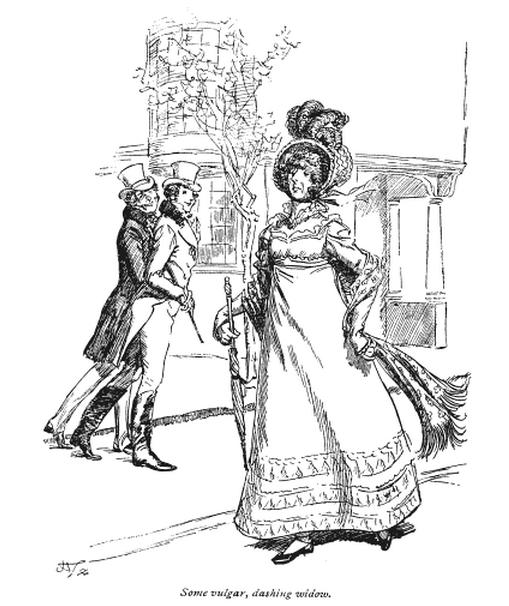
Hugh Thompsons illustration of a vulgar, dashing widow. (Emma)

Times were a-changing. The rising middle classes were able and willing to lay out ready cash to move up in the world. What they lacked (aside from refinement) were land and a nice title. The aristocrats had these aplenty. Since many a landed family had squandered their fortunes, it was inevitable that the lines of distinction would begin to blur as the nouveau riche began to snap up estates in foreclosure or shove their very rich daughters in front of impoverished heirs.